Thursday, May 08, 2025


Antonio Gramsci: Theirs and Ours

It has been forty-eight years since Eric Hobsbawm delivered a paper, “Gramsci and Political Theory,” before the Gramsci Conference held on March 5-6, 1977 (Reprinted as an article in Marxism Today, July, 1977).

Hobsbawm, contemplatively, reviews the forty years that had transpired since Antonio Gramsci’s death in 1937 after over a decade in a fascist prison. For the first ten years (1937-1947) Gramsci was virtually unknown outside of Italy, where Communist Party leader Palmiro Togliatti sought to integrate Gramsci-thought into the PCI’s work.

The next decade (1947-1957) found Gramsci’s influence in Italy expanding even beyond Communist circles, establishing him as an important national cultural figure.

It is with the third decade (1957-1967) that Gramsci became familiar to many people outside of Italy, with interest especially strong in the English-speaking world as noted by Hobsbawm. The recent strong critique of Stalin in the world Communist movement and the post-war strength and independence of the Gramsci-influenced PCI played a role in expanding the influence of Gramsci. Though not mentioned by Hobsbawm, the first (1957) limited US publication of Gramsci’s works was a brief (64 page) translation/commentary by Carl Marzani, Man and Society, published by the indomitable, Cold War-defiant publisher Cameron Associates. Marzani’s admiration and view of Gramsci as a model and contrast to Soviet practices is readily apparent.

With the fourth decade (1967-1977), Hobsbawm maintains that “Gramsci has become part of our intellectual universe. His stature as an original Marxist thinker — in my view the most original such thinker produced in the west since 1917 — is pretty generally admitted… Such typically Gramscian terms as ‘hegemony’ occur in Marxist and even in non-Marxist, discussions of politics and history as casually, and sometimes as loosely, as Freudian terms did between the wars”.

By 1977, Hobsbawm’s thinking was converging with the emergent school of Eurocommunism, perhaps helping to explain his estimation of Gramsci’s importance.

Would Hobsbawm — if he were alive today — be surprised that, nearly a half century after he made his address in London, Antonio Gramsci’s most influential admirers were thinkers on the Trump right? Would he be shocked to see an article in the Wall Street Journal entitled “Meet MAGA’s Favorite Communist”?

The WSJ reports:

Christopher Rufo is perhaps the most potent conservative activist in the U.S… For the past year, Rufo has been working on a book called “How the Regime Rules,” which he describes as a “manifesto for the New Right.” At its core is a surprising inspiration: the Italian Communist thinker Antonio Gramsci, a longtime boogeyman of American conservatives. “Gramsci, in a sense, provides the diagram of how politics works and the relationship between all of the various component parts: intellectuals, institutions, laws, culture, folklore,” said Rufo, a senior fellow at the Manhattan Institute.

Author Kevin T. Dugan notes that many international right-populist leaders pay homage to Gramsci, including Georgia Meloni, Marine Le Pen, and Jair Bolsonaro, while Argentina’s president, Javier Milei, told Tucker Carlson that “he had to wage a culture war every single day” against opponents who “have no problem with getting inside the state and employing Gramsci’s techniques; seducing the artists, seducing the culture, seducing the media or meddling in educational content.”

Other right-wing intellectuals have adopted Gramsci, according to the WSJ:

Gramsci’s name appears in the writing of paleoconservative thinkers Paul Gottfried, Thomas Fleming and Sam Francis, who influenced Pat Buchanan’s Republican presidential bids in the 1990s. One of Gramsci’s biggest proponents in the pre-Trump era was Andrew Breitbart, the founder of Breitbart News, who quoted his axiom that “politics is downstream of culture.”

More recently, far-right writers like Curtis Yarvin, who’s influenced Vice President JD Vance, have talked about how to capture power through a culture war.

Regardless of how selectively MAGA appropriates Gramsci-thought, however differently right-populists interpret Gramsci from his original intent, the mere fact that Gramsci is taken far more seriously by the right than by all but the Marxist left is cause for deep reflection.

The right sees politics as a contest — even a war — over how people interpret the world. They borrow this notion from how Gramsci writes about ideology. They intend to conduct that war with fervor.

Conversely, the center-left and even some “Marxists” embrace a market-model that imagines a forum of idea-sellers, who fairly exchange and value ideas. In this fantasy, everyone has an equal voice. They imagine that institutions like universities and media forms are neutral social and political instruments that objectively pursue, project, and protect the unvarnished truth.

Like Gramsci, the populist-right recognizes that the ideological superstructure — what the right broadly and cynically calls “culture” — is always captured by social forces. For Gramsci, following Marx, “It is not the consciousness of men that determines their existence, but their social existence that determines their consciousness” (Gramsci roughly quotes this from memory often, throughout The Prison Notebooks). Unlike the populist-right, Gramsci sees the forces shaping ideas as those constructed and maintained by the ruling capitalists.

When “Reaganism” arrived on the scene decades ago, astute left observers noted that “class war had broken out, with only one side fighting,” a commentary on the ineffectual labor movement.

Today, with the Trump-right attacking the universities, public media, school books, publishers, law firms, and other aspects of the superstructure, it can be said that “cultural” war has broken out, with only one side fighting, a commentary on the ineffectual center-left.

Quite obvious, the populist-right has — crudely appropriating Gramsci — launched a cultural war on hollow, complacent institutions blind to their own vulnerability.

Lessons for the Left

As Hobsbawm points out, by 1977 Gramsci-thought was becoming as popular and used “as loosely, as Freudian terms did between the wars.” Subsequently, Gramsci quote-mongering became fashionable and academic hipness was often assured by grounding discourse in the more enigmatic writings of Gramsci. “Hegemony” became one of the most used and misused words in the academic lexicon. Since most of Gramsci’s prison writings were necessarily cast in coded language, his thought lent itself to broad interpretation and misinterpretation.

Too often “hegemony” was understood as a writer’s personal interpretation of ruling-class dominance: something richer and more extensive than the simple statement in the Manifesto that “The executive of the modern state is but a committee for managing the common affairs of the whole bourgeoisie.” Gramsci is explicit in exposing “the hegemony of a social group [‘beyond the dictatorship of coercive apparatus’] over the entire national society exercised through the so-called private organizations such as the church, the trade unions, the schools, etc.” — not exactly an earth-shaking conclusion for Leninists in his time, but well worth endorsing.

As Hobsbawm points out: “What is new in Gramsci is the observation that even bourgeois hegemony is not automatic but achieved through conscious political action and organization.” That is the lesson that the MAGA right draws, even if Gramsci’s left acolytes miss it.

In addition, hegemony is not merely an analytic tool for understanding capitalist-class rule, but, in Hobsbawm’s words, it is a “struggle to turn the working class into a potential ruling class” that “must be waged before the transition to power, as well as during and after it.” Liberals and social democrats who pay homage to Gramsci’s grasp of the mechanisms of class power, show no interest in Gramsci’s primary interest in establishing competitive, alternative mechanisms: media, entertainment, schools, activities, recreation, governance, and social life. He saw a need for preserving and protecting what was good and useful in existing working-class ethos and culture, while constructing what was even better for the future. Togliatti and the PCI sought to establish that hegemony in Italy’s Red Belt with different degrees of success. Italian Communist-influenced cinema, from Giuseppe De Santis’ 1949 Bitter Rice to Bernardo Bertolucci’s 1976 Novecento, represent that attempt made available to international audiences.

Nothing like this conscious collective attempt to nourish and promote working-class cultural life has been attempted on any scale in the US since the demise of the pre-neutered Congress of Industrial Organizations. Even the days of an independent radio station (WCFL, in Chicago) are past.

As Hobsbawm explains, “The basic problem of hegemony, considered strategically, is not how revolutionaries come to power, though that question is very important. It is how they come to be accepted, not only as the politically existing or unavoidable rulers, but as guide and rulers.” Two examples from Hobsbawm are telling: “The Polish communists in 1945 were probably not accepted as a hegemonic force, though they were ready to be one… The German social-democrats in 1918 would probably have been accepted as a hegemonic force, but they did not act as one.”

Marxist-Leninists in many, but not all, capitalist countries are cut off today from working-class life — they are led by intellectuals, but not organic intellectuals, paraphrasing Gramsci — with no vital connection to working-class life.

Apart from the Communist Parties, leftists have willfully or from ignorance failed to acknowledge that Gramsci wrote as a Leninist, accepting the critical importance of a vanguard party (The Prince), though he had ideas about party organization that reflected conditions peculiar to Italy in his time (e.g., the Turin movement). Without a party, no sense can be made of an “organic” connection to the working class.

John Womack reminds us that Gramsci’s “original” thoughts are often elaborations on ongoing debates in the Marxist movement. For example, the military-sounding contrast between wars of position and wars of maneuver predate Gramsci’s argument, with the Kautsky-Luxemburg dispute over the strategy of attrition versus the strategy of overthrow. These debates were carried forward into the early Comintern and played an important role in shaping Communist strategy.

It is commonplace on the left to view Gramsci’s idea of a “war of position” as a passive interregnum between the “wars of maneuver” where the working class and its allies can directly challenge the capitalist class from a position of relative strength. Too often this idea of positional warfare has been interpreted to be a period of defensive treading water. In the US, Gramsci’s war of position has often been used as a justification for supporting the Democratic Party in its turf war with the other bourgeois party or as grounds for taking a back seat to other organizations in an unnegotiated united front.

Hobsbawm addresses this misreading of Gramsci:

[T]he failure of revolution in the West might produce a much more dangerous long-term weakening of the forces of progress by means of what he called “passive revolution.” On the one hand, the ruling class might grant certain demands to forestall and ward off revolution, on the other, the revolutionary movement might find itself in practice (though not necessarily in theory) accepting its impotence and might be eroded and politically integrated into the system… In short, the “war of position” had to be systematically thought out as a fighting strategy rather than something to do for revolutionaries when there is no prospect of building barricades. (my emphasis)

Today’s left often neglects the essential questions of place and time in evaluating Gramsci’s thinking. Hobsbawm is careful to point out that Gramsci was writing about specifically Italian conditions and lessons for the Italian left: “Italy in Gramsci’s day had a number of historical peculiarities which encouraged original departures in Marxist thinking.” Hobsbawm discusses six “peculiarities” in great detail.

In addition, it is necessary to note when Gramsci was writing, as well as when Hobsbawm was commenting on Gramsci.

Writing from prison with Italian fascism securing its hold over Italy, Gramsci was understandably motivated to take a critical eye toward the tactics and strategy of the PCI, as much forward looking as retrospectively. Hence, his revisiting the Southern question. It would be ill-advised to generalize his conclusions to every revolutionary project under different conditions.

Further, Hobsbawm writes at a time (1977) when the PCI’s electoral share was growing (34%, up 7%, 1976), when the PCI committed to a Gramsci-inspired historical compromise, and Eurocommunism was on the rise. At the same time, the Portuguese revolution– met with great expectations by the socialist left– appeared to be dashing those expectations and heading toward conciliation with the mainstream European community. Hobsbawm, like others favoring the Eurocommunist road, turned to Gramsci for an explanation: “…we see in countries in which there has been a revolutionary overthrow of the old rulers, such as Portugal, in the absence of hegemonic force even revolutions can run into sand.” History was not kind to Eurocommunism and the PCI project.

Perhaps the most cited Gramsci quote is: “The crisis consists precisely in the fact that the old is dying and the new cannot be born; in this interregnum a great variety of morbid symptoms appear.”

The great blacklisted, expatriate director, Joseph Losey, used the Gramsci quote, to good effect, as the preamble to his film version of Mozart’s Don Giovanni. Others have used it to introduce the many crises that have afflicted the capitalist system.

One could argue that we are in just such an interregnum today, with the capitalist system struggling to continue ruling in the “old way.”

Therefore, there may be much that we can learn from Gramsci. But we must remember that he remained a Leninist. If he were alive today, he would be searching for the party capable of giving birth to the new.


Greg Godels writes on current events, political economy, and the Communist movement from a Marxist-Leninist perspective. Read other articles by Greg, or visit Greg's website.


Sci-fi Antidote for the Age of Genocide

Review of Mickey7

Are you overwhelmed by Israel, Trump, starvation, drones, hypersonic monstrosities, doubling our ‘defense’ budget, reducing people to things, bloodlust? Did I mention ISRAEL?

I turn to sci fi when the world looks/ feels super bleak. Mickey7 is a 2022 science fiction novel by Edward Ashton with a sequel, Antimatter Blues, and a film adaptation, Mickey 17, directed by Bong Joon-ho. As with any really good novel-film, you should start with a nice hardback in a comfortable chair and launch yourself into the cosmos, let your imagination do the travelling. The many metaphors behind it are too savory to waste on a rushed, cut-to-the-bone glossy visual spectacle. The special effects are best conjured in your mind in this page-turner with multiple meanings.

The eponymous Mickey7 is a cyborg, the expendable member of a beachhead colony on an alien world. He fell down a deep hole in the snowy, rocky planet Neflheim and was left for dead by his supposed best human friend Berto, though his human true-love Nasha wanted to volunteer to save him. But he failed to die. A huge creeper – a native (nephilim?) – shepherds him out of the tunnel, though by the time he returned to the colony, there was already a Mickey8 being ‘born’ out of primordial soup, a reconstruction of him, a kind of super 3D-bioprint. This latest technology requires supercomputers and huge amounts of energy, but with the harnessing of antimatter, energy is limitless and such a creation is possible.

Sounds great, but this process was used by a psychopath, Manikova, in the past, on the terraformed Eden II, to make multiple clones of himself and, well, the whole process was shutdown and then refashioned to be used only to assist colonization of other planets. One ‘expendable’ would accompany each colony to be used to test the atmosphere, land, water for toxins and other suicidal missions and if he dies horribly, he would be reconstituted.

Who would want to do that? Criminals, but also volunteers who would imagine themselves as living a kind of eternal life. As long as they were nice, heroic and obedient. If not, they would, well, you get the picture. Not so eternal.

It’s a delightful tale of essentially identical twins, thinking alike, rivals, playing the usual twin games of fooling your lover with your twin taking your place, leading to jealousy and then a threesome (with yourself!). You laugh, and ponder lots of philosophical and war&peace issues:

*The ship of Theseus paradox: if you repair the ship over time, or just rebuild it from scratch, is it still the ship? Are Mickey7&8 sharing one consciousness, one soul? When an expendable takes a trip to the tank, he’s just doing in one go what his body would naturally do over the course of time anyway. As long as memory is preserved, he hasn’t really died. Kant’s phenomenology means we can never really know the nous of the phenomenon, i.e., there’s no answer. The Natalist religion that arose after the initial psychopath scare proclaims ‘one human one soul’, with capital punishment for any violation. I.e., the question doesn’t/shouldn’t arise.

*A corollary paradox: Does a threesome with your double and his/your lover make you a ‘perv’?

*When he’s facing death for the 8th time, he tells Nasha not to watch. No, I’ll be there. Dying … even if it’s temporary, you shouldn’t have to do it with nobody around for company.

*The hero is portrayed as a venal selfish coward, a traitor. Sound like hasbara about Hamas guerrilla fights? Living in tunnels that the colonizers can’t seem to penetrate, and fear? The protagonist(s) wearing suicide antimatter vests in the tunnels to kill the enemy/themselves. Israeli commandos destroying Hamas in their tunnels? Later, when faced with execution, Nasha says, This colony wasn’t chartered as a theocracy. You can’t just burn us at the stake.

*A man has conspired with the enemy in a time of war. There is no greater crime./ What about genocide? It wasn’t conspiring with the enemy that led us to abandon old Earth.

*The creepers are communal intelligence. The Marshall thinks that they are at war because the creepers killed a few humans. The idea that dissecting a few ancillaries would be considered an act of aggression is beyond them. They are just parts of the whole, not intelligent things themselves. I realized reading this that Nature is communal. There are no individuals except as fractal bits of the whole. This is a principle throughout Nature. If a few humans die, so what? The human race goes on. We have lost this vital understanding of Nature. We only exist communally.

*Don’t kill the messenger. When Mickey7 refuses to commit genocide against the natives, Netanyahu (sorry, the Marshall) wants first to just kill him, but Mickey7 is now the only emissary, mediator with the native creepers, the only one they trust. Netanyahu (sorry!) assumes they are just Amalek, not really Jewish (sorry, human) so it is fine to kill them all and terraform Niflheim. Mickey7 realized they were sentient, as they magnanimously saved him. They read his mind and realized he was not their enemy, that he trusted them, so while Mickey8 was getting ready to kill them all in their tunnel with an antimatter bomb, they killed him and let Mickey7 return to mediate with Netanyahu (I’m not going to keep apologizing, though to be fair to Netanyahu, Trump fits the bill equally.).

*The tunnels are immune to carpet bombing – low tech defensive technology – keeping the natives safe from the colonists/Zionists.

*Antimatter WMDs hover over the novel, a silver bullet but extremely dangerous. We may not have the high ground anymore, but we still have an insane amount of power available. Sound familiar? When Netanyahu/the Marshall doesn’t kill Mickey7&8 immediately, Mickey 7 cracks, Don’t get too excited, Eight. I’m pretty sure this is a temporary reprieve. Poor Gazans at this very moment!

*It’s a truism that every new technological advancement has been applied first to advance the interests of the horny. The printing press? Some Bibles, mostly porn. Antibiotics? Perfect for treating STIs. The second area of course is war.

*The best colonizing effort was on a planet with sentient, shy tree-dwelling cephalopods (octopuses) who were not even noticed by colonizers for two decades, so the colonizers were not primed to face a lethal enemy by then and a common language and modus vivendi was achieved. These natives were so attuned to their environment that they didn’t need fire, killing, agriculture, war – all the things that made humans so toxic. (Read: Palestinians as the shy natives, but Muslims in general, who lived peacefully in the Ottoman caliphate and never developed lethal industrial technology, vs European countries, obsessed with war and world conquest.) Sadly, no analogy with resolving the Palestine-Israel standoff today.

Ashton mulled over these provocative themes for years, rewriting his 2022 novel from an earlier short story, but it’s as if he’s writing it today. Genocide of natives by venal colonizers, tunnels as refuge, runaway greenhouse effect, Earth abandoned. It is cathartic to read a vision of how it is possible to escape the nightmare world that US-Israel is creating and live in peace and harmony with natives. It’s very difficult, and can only come after heart-wrenching suffering.

Eric Walberg is a journalist who worked in Uzbekistan and is now writing for Al-Ahram Weekly in Cairo. He is the author of From Postmodernism to Postsecularism and Postmodern Imperialism. His most recent book is Islamic Resistance to ImperialismRead other articles by Eric, or visit Eric's website.
Climate sanctions against fossil-addicted capitalists

Wednesday 7 May 2025, by Patrick Bond

South Africa


The implications of climate-unjust politics are ever more important to interpret and resist. United States President Donald Trump, an unabashed ‘climate denialist’, withdrew his country, the main historic emitter of greenhouse gases, from United Nations negotiations, and should now be sanctioned. But annual UN COPs (Conferences of the Parties) won’t, because the ‘climate action’ approach is dominated by the West and BRICS. They continue to deny the world long-overdue ‘climate justice’ and they won’t punish Trump’s climate crimes.


Even worse, the G20 is a geoeconomic network fusing the interests of G7 imperialist and BRICS sub-imperialist carbon-addicted economies. Its leaders will meet in Johannesburg in late November, preceded by environmental ministerials in mid-July (at Kruger Park) and from 2-8 October in Cape Town.

Not only has climate justice been ignored in the UN and G20, the degeneracy of climate-action advocacy in both annual summits can be traced to the West and the BRICS. The latter bloc originally comprised Brazil, Russia, India, China and South Africa. New members include the high-emissions economies of Iran, the United Arab Emirates, Egypt, Indonesia and Saudi Arabia (though Riyadh is apparently dropping out of BRICS in the wake of Trump’s victory).

BRICS economies produce 53% of global emissions, but only 30% of the world’s Gross Domestic Product. In 2025, other high-carbon economies have joined as formal ‘partners,’ including Nigeria and Kazakhstan. Both are major oil exporters to Israel, and Russia and South Africa are two of the three main coal suppliers to the genocidaires.

What interests do sub-imperial BRICS corporates and states have in common with Western climate imperialists? In a process initiated in Copenhagen in 2009, the West+BRICS have used—and will continue to use—such UN summits 1) to avoid cutting emissions to the extent necessary to avoid climate catastrophe, 2) to deny their climate debt, and 3) to ‘privatise the air’ via carbon markets. These remain the three most durable areas of common interest.

What differences do the BRICS have with Europe and the UK? Mainly the ‘carbon pricing’ mechanism and tariffs that will be imposed on their export products, as explained—and firmly opposed—by former SA trade minister Rob Davies in Amandla! 95/96: “Africa can use Global North’s Unilateral Departures from Trade Agreements to Support Low Carbon Industrialisation.”
The West’s decarbonisation ‘carrots and sticks’

Decarbonisation rhetoric will continue in UN and G20 summits, especially without the attendance of climate-denialist Washington hacks. And for BRICS members South Africa and India, and BRICS partners Nigeria and Vietnam, decarbonisation will be advanced through a European-British financial ‘carrot’ known as the Just Energy Transition Partnership (JETP). Other carrots can be found in a now-cancelled US Inflation Reduction Act, which represented Joe Biden’s return to state industrial policy, but of a green variety.

However, President Cyril Ramaphosa last year backtracked on the JETP deal to shut down Eskom coal-fired power plants early, and is now also asking Trump’s favourite US oil companies to explore SA for offshore methane gas.

So there is also a need for ‘sticks,’ especially climate sanctions.

So far, the most decisive sanctions have been imposed, first, by Western bankers intimidated by ‘Divest-Invest’ climate activists from financing fossil-fuel projects; and second, by Xi Jinping, who in 2021 prohibited new coal-fired power plants along his Belt and Road Initiative.
Rejecting the CBAM stick—on whose behalf?

In addition, an inclement European and British climate-mitigation stick carries a clumsy name: the Carbon Border Adjustment Mechanism (CBAM). Since 2023, more than any other African, Davies has lobbied against climate sanctions (including in Amandla!): “CBAM needs to be rejected, opposed, and challenged in any way or forum possible.”

Davies invariably promoted high-carbon deals, such as the 2017 Musina-Makhado Special Economic Zone (MMSEZ), to be run by Chinese entrepreneur Ning Yat Hoi, head of Shenzhen Hoi Mor Resources Holding Company (at that time on an Interpol list for fraud at Zimbabwe’s largest gold mine).

Davies’ successors, Ebrahim Patel and Parks Tau, testified to parliament in 2023 and 2024, respectively, that they “developed and submitted SA’s submission into the UK consultation process on CBAM following consultations with affected industries and government departments”. They then embarked upon “lobbying actions, activation of public and stakeholder support for the [anti-CBAM] position, advisory opinions from international trade bodies, building alliances with like-minded developing countries…”

But who do Davies, Patel, Tau and their officials actually speak for?

The obvious “affected industries” CBAM will hit hardest are members of the Energy Intensive Users Group (EIUG): 27 pollution-intensive, mostly-foreign companies which guzzle 42% of SA’s electricity while hiring just 4% of workers.

Hence Davies’ argument primarily serves the interests of the highest-carbon fraction of multinational capital, especially firms he himself worked on behalf of, as a senior Pretoria politician during the 2010s. At the time, South Africa’s resource cursing dramatically worsened thanks to the 2002-14 commodity super-cycle, which depleted far more natural wealth from underground than was reinvested by the EIUG extractive capitalists.

Davies amplified South Africa’s vulnerability to climate sanctions when, from 2009–2019, he exercised substantial power over economic policy and mega-projects. He invariably promoted high-carbon deals, such as the 2017 Musina-Makhado Special Economic Zone (MMSEZ), to be run by Chinese entrepreneur Ning Yat Hoi, head of Shenzhen Hoi Mor Resources Holding Company (at that time on an Interpol list for fraud at Zimbabwe’s largest gold mine).

Ning’s version of the MMSEZ would have added 13% to national greenhouse gas emissions. But Xi’s sanctions against coal-fired power plants lowered that figure to 8%, still a carbon-budget buster.

While in power, Davies not only promoted another coal-fired power plant, but also shale fracking of methane gas, massive subsidisation of cars and trucks powered by diesel and petrol engines (not electric vehicles), and other high-carbon EIUG firms.

He has a filthy track record, not green credentials.

Asked at a November 2024 Alternative Information and Development Centre seminar whether opposition to CBAM served the interests mainly of multinational corporate mega-polluters, Davies did not answer.
The mainstream case for CBAM

What irks Davies and many trade officials is that the European Union (EU) and the United Kingdom (UK) are imposing the CBAM as a tariff protecting their local industries. Without it, given their far more ambitious climate policies than South Africa, the EU would experience deindustrialisation as a result of artificially cheaper imports of high-CO2-embedded goods.

EU officials claim—correctly – that such tariffs will also prevent what is known as emissions outsourcing: letting the Third World do the dirty industrial work and take responsibility for the resulting greenhouse gases, even if the final products are consumed in the West.

The reason CBAM has emerged as a wedge between imperialist and sub-imperialist (especially BRICS) economies is that, starting in 2018, the EU Emissions Trading Scheme carbon price rose rapidly, reaching a peak of $115/tonne of pollution in early 2023 (though it crashed 50% in the following year). Companies with excess EU emissions had to pay a far higher price for their pollution than they do in South Africa, the only country on the continent with a carbon tax. SA’s price for emitting CO2 is a tokenistic $0.38/tonne.

The actual climate damage done by emitting that tonne is $1,056, according to the US National Bureau of Economic Research last May. Pretoria, therefore, vastly undercharges EIUG corporations for CO2 emissions. To properly ‘make polluters pay,’ as SA’s National Environmental Management Act insists—but as is not implemented for greenhouse gases—would raise the local carbon tax by nearly 2,800 times.
State support for the Minerals Energy Complex

Obviously, any carbon tax increase should be imposed at the same time as an increase in free basic electricity (e.g. to 2kWh/person/day) and massive public-transport subsidies, in order that poor and working-class families are completely insulated from such increases.

For more than a decade, SA’s ultra-low (polluter-doesn’t-pay) carbon price was due to EIUG lobbying. As a result, the five most recent finance ministers exhibited a pro-corporate, climate-unconscious orientation when setting the carbon tax, especially Enoch Godongwana who is delaying raising it as scheduled.

The past and current Environment Ministers—Barbara Creecy and Dion George—not only failed to promote a higher carbon tax, but repeatedly endorsed corporate pollution by extending the deadlines for pollution reduction to Eskom and Sasol, killing hundreds of Mpumalanga residents in the process.

George admitted in late 2024 that he’d never even heard of the COP before getting the ministerial position. When African and small island nations staged a walk-out from the Baku UN climate summit in November 2024, George stayed inside with the imperial/sub-imperial bloc.
Damage done by CBAM?

The difference between carbon prices requires EU and UK importers of SA goods to purchase ‘CBAM certificates’ to continue their trade. Initially, this will mainly affect aluminium, iron and steel exports. CBAM is designed to penalise both direct emissions during production (‘process emissions’) and indirect emissions from embedded fossil energy, so as to end irrational subsidies like South Africa’s absurdly low carbon tax.

How harmful for exports would CBAM be? Vast exaggerations are offered by politicians representing the high-carbon sectors. At a 2023 meeting of BRICS environment ministers, Creecy announced, “Africa stands to lose approximately $26 billion each year in direct taxes to the EU in the initial phase of the CBAM alone. Very soon, others, including the USA, UK and Canada, will follow the EU’s example, and the list of taxed commodities will grow.”

This is an extreme distortion. The “$26 billion”—0.84% of Africa’s 2023 GDP of approximately $3.1 trillion—reflected only one biased estimate of the adverse impact. It comes from a paper by two London School of Economics consultants commissioned by Saliem Fakir, head of the conservative African Climate Foundation. The $26 billion is plausible only if additional agricultural and manufactured goods are included in the EU CBAM (which they are not in the short term or in any published schedule).

Yet this scare figure was uncritically reported not only by Creecy; South African international trade official Mahnendra Shunmoogam complained to the EU that Africa would suffer “at least $26 billion/annum,” without any assessment of the research methodology.

In reality, only a few African economies are exposed to declining exports to the EU due to CBAM. For aluminum and iron and steel, the losers are South Africa, Mozambique, Egypt, Tunisia; for fertiliser, South Africa and Egypt; and for cement, Tunisia.

Trade and Industrial Policy Strategies economist Seutame Maimele estimated Africa’s CBAM cost at just $7.3 billion per annum, or 0.024% of GDP. So Davies, Creecy and Shunmoogam are overestimating CBAM’s damage by an inexcusable 356%.
A full accounting of costs and benefits

Davies also opposes CBAM’s “huge disproportionality: the gains in emissions reduction are small, compared to the loss of export earnings and incomes, in any of the scenarios.”

He ignores that export of CBAM-listed goods—especially smelted metals—also entails unequal ecological exchange. Raw materials within these products include non-renewable resources extracted and processed by multinational corporations, with inadequate reinvestment.

Most such firms remove profits, dividends, and debt repayments, as well as illicit financial flows. The depleted wealth and stolen financial capital should instead be conserved for future generations, to cite a rudimentary definition of ‘sustainability.’ Davies’ pro-export stance for these sectors leads to extreme economic unsustainability.

Even conservative World Bank ‘natural capital accounts’—especially measures of raw materials depletion, greenhouse gas damage and pollution—show South African wealth shrinkage far faster than GDP growth. This is due to export of minerals from what is one of the world’s worst ‘resource curse’ sites, a factor Davies and his successors have never taken seriously.

The CBAM-proscribed products are not only subject to process emissions during production. There is also an ultra-inefficient electricity input to deep-mining extraction, smelting and processing. Only three other economies have higher emissions per person per unit of GDP than South Africa: the UAE, Kazakhstan and the Czech Republic.

Moreover, South Africa suffers from chronic ‘load-shedding’ electricity shortages, with Stage 6 returning in recent weeks. If CBAM results in lower EU demand for such goods (and if those goods are not consumed in other export or domestic markets), that would allow redistribution of scarce electricity to labour-intensive industries, small businesses and households.

In turn, electricity redistribution would boost economic output and eco-social public goods, compared to present EIUG abuse. There would be less reliance upon non-renewable-resource depletion due to CBAM, along with far lower levels of pollution and emissions..

South Africa is one of the most extreme cases of subsidising climate chaos, with $56 billion in annual implicit and explicit subsidies, according to the IMF, based on a carbon price of only $63/tonne. For a more realistic figure, multiply that price by 17: South Africa gifts CO2 emitters $9400 billion in implicit annual subsidies, contrasted with the 2024 GDP of $403 billion.

Our climate justice movement has been unable to halt such insanity. That is why the South African branch of fossil-addicted capitalism—and branches across the BRICS, too—will require sanctions in the form of a CBAM. Yes, the EU/UK version needs reforms, such as using revenues to make their overdue climate debt payments.

It goes without saying that the workers and communities hosting these industries should be urgently compensated through a genuinely just transition process (not like the JETP circus suffered during Eskom’s Komati coal-fired power plant closure).

Like the anti-apartheid movement in the early 1960s, which at its low point desperately needed international solidarity in the form of a Boycott Divestment Sanctions campaign, and just like we must now ramp up BDS against genocidal Israel, there is an historical lesson: the most vigorous anti-imperialists should make demands upon imperialist states to disrupt global value chains that reward profiteers.

Otherwise, those chains will prevent future generations’ ability to survive a climate catastrophe.

Amandla 29 April 2025

Attached documentsclimate-sanctions-against-fossil-addicted-capitalists_a8978-2.pdf (PDF - 923.9 KiB)
Extraction PDF [->article8978]

Ecology and the Environment


Patrick Bond
Patrick Bond is a professor at the University of Johannesburg Department of Sociology.


International Viewpoint is published under the responsibility of the Bureau of the Fourth International. Signed articles do not necessarily reflect editorial policy. Articles can be reprinted with acknowledgement, and a live link if possible.


Absurd (Scary) CO2 Emissions


In a major blow to the Paris ’15 climate agreement, last year witnessed one more nail in the coffin of the celebrated agreement to slow down CO2 emissions by 2030, as CO2, for the first time in modern history, enters the scientifically established danger zone. This agreement was/is meant to curtail global warming and hopefully save major ecosystems from collapse. But now, with too much noncompliance by countries and rapidly ascending CO2 emissions, Paris ’15 is at rest in a coffin awaiting an un-ceremonial burial.  Nobody wants to attend.

CO2 emissions went bonkers in 2024, up 3.75 ppm, a new all-time-record, smashing all prior years and looking very ominous with trouble likely ahead as global warming kicks into higher gear, raising the question of whether property/casualty insurance companies will survive the onslaught: (1) raging wildfires (2) atmospheric river cloudbursts (3) widespread flooding (4) skies blackened by tornados (5) scorching droughts (6) category 5+ hurricanes, all of which follow in the footsteps of excessive greenhouse gases in the atmosphere.

It should be noted that the property/casualty insurance industry was already on the ropes with CO2 emissions lower. They’ve publicly admitted it! The following is a must-read article written by a key player in the worldwide insurance industry; frankly, a must-read for anybody concerned about the future: “Climate, Risk, Insurance: The Future of Capitalism,” March 25, 2025.

Within only a couple weeks of that standalone earth-shattering article that lays out the climate change-global warming disaster scenario from a senior member of the property/casualty insurance industry, Arctic News published a startling notice on April 14, 2025, “Record High Increase in Carbon Dioxide,” CO2, the primary target of the now-infamous Paris 2015 climate agreement. Oops! All Paris ’15 bets are off, as CO2 increased by a thundering record-shattering 3.75 ppm, a rocket ship blastoff by historic standards, and the future likely higher yet:

1960 +0.96 ppm

1970 +1.13 ppm

2000 +1.24 ppm

2024 +3.75 ppm

And that’s before the Trump administration turned the oil and gas spigot wide open along with a big push for coal as well as an ultra-ultra-massive rollback of environmental regulations, meaning the fossil fuel and chemical industries are deeply indebted to the administration for removing costly regulations that forced them to adhere to a clean environment!

Additionally, according to a recent article in Science: “Trump Administration Fires Staff for Flagship U.S. Climate Assessment” (subtitle: Move Could Open Door to Using High-Profile Report to Attack Science), April 9, 2025. This is obviously devious to an extreme, possibly altering climate reports. But unfortunately the truth remains, as the insurance industry continues to raise rates and/or drop coverage because the reality of harmful climate change takes precedence over doctored reports.

The 430 ppm CO2 Danger Zone

Reality is inescapable: Of all the greenhouse gases, CO2 alone is responsible for 2/3rds of the warming effect by greenhouse gases. This is 100% a proven fact that was discovered by Exxon’s scientists years ago (“Exxon Scientists Predicted Global Warming with ‘Shocking Skill’,” Harvard Gazette, Jan. 12, 2023).

Effective January 2025, CO2 registered 426.03 ppm versus 422.25 ppm in 2024. By way of comparison, in 1960 CO2 in the atmosphere was 316.00 ppm. And until advent of the industrial revolution mid 18th century, CO2 levels were below 300 ppm for ages.

According to an IPCC (Intergovernmental Panel on Climate Change) report: “In 2016, a worldwide body of climate scientists said that a CO2 level of 430 ppm would push the world past its target for avoiding dangerous climate change.” (MIT Climate Portal)

Acceleration of CO2 is getting to be downright spooky +200%-t0-300% since the start of the new century. It’s never increased at such a rapid pace throughout recorded history. According to current readings by Mauna Loa Observatory, Hawaii, CO2 exceeded 430 ppm for six days in a row in April 2025 and hit 430.51 on April 21. And the new year is still young. Clearly, CO2 emissions are out of control running roughshod over any pretense of climate change mitigation efforts by parties to the Paris ‘15 climate agreement (RIP?).

Moreover, the U.S., one of the world’s major influencers of economic behavior and climate change, is pushing in the wrong direction, encouraging more CO2 emissions via increased production of oil and gas and coal while falsely claiming “climate change is a hoax.” This is an extreme position, bold-faced lie, not supported by facts, making Emperor Nero look like a lightweight. It’s the whole planet, stupid, not just Rome!

Meanwhile, a casual Google search of four words: “climate change and insurance” reveals the startling truth, bringing up page after page after page filled with titles such as: “Climate Change is Driving an Insurance Crisis.”  Business gets it: “Property Values to Crater up to 60% Due to Climate Change,” Business Insider, August 9, 2024. Yes, the word “crisis” fills the pages. It’s a crisis! Crises end badly, but we’ve only just begun.

According to the Arctic News’ article, it’s about to get much, much worse. But what’s worse than a crisis? A worsening crisis seems to be on the docket. As clearly stated, “Not only are concentrations of CO2 very high, but additionally, there has been an increase in total solar irradiance.” This is therefore the ole one-two punch to the gut as increased solar irradiance means more solar energy reaches the surface absorbed, ipso facto, increasing global temperatures as excessive levels of CO2 blanket and trap heat. This is a fatal formula for life on Earth, just ask sister planet Venus, 95% CO2 atmosphere, surface temperature 870°F, which melts lead.

It should be noted that Arctic News has a reputation for taking the more extreme view of where climate change is headed, but it should also be noted that it” footnotes a lot of peer-reviewed climate science,” albeit taken to an extreme conclusion, which happens to be the prospect of an oncoming “extinction event” with climate change a wild stallion that can’t be tamed.

It’s difficult to ignore heightened concern of the property/casualty insurance industry alongside Arctic News both publicly exposing a rapidly descending climate system that’s literally changing the landscape of property ownership, starting with coastal properties and working inland, as homeowners find insurance premiums, if available where they reside, squeezing throats, stated as such in the following quote from the insurance industry article included herein: “The insurance industry has historically managed these risks. But we are fast approaching temperature levels 1.5°C, 2°C, 3°C where insurers will no longer be able to offer coverage for many of these risks. The math breaks down: the premiums required exceed what people or companies can pay. This is already happening. Entire regions are becoming uninsurable. (See: “State Farm and Allstate exiting California’s home insurance market due to wildfire risk,” 2023).

Already, the climate crisis that started on the West Coast is spreading fast: “The Home Insurance Crisis Hits the US Heartland,” Business Insider, April 6, 2025.

It was only a couple of months ago when James Hansen (Columbia – Earth Institute) said 2C is dead: “Climate Change Target of 2C is ‘Dead’ says Renowned Climate Scientist,” Guardian, Feb. 4, 2025. If medals are ever awarded for correct calls, James Hansen, Ph.D. gets the gold medal for the following: “Global Warming Has Begun, Expert Tells Senate,” New York Times, June 24, 1988. He nailed it!

The insurance article insinuation of “entire regions becoming uninsurable,” standing alone, should be enough motivation to turn the screws of climate change mitigation efforts to whatever level necessary at whatever costs! Who cares how much a Worldwide Marshall Plan to ‘hopefully’ control radical climate change costs? The alternative is unspeakable, and there’s little time to waste.

Now that the insurance industry is feeling the wrath of numerous climate change warnings issued by Arctic News over many years, it may be a good idea to at least consider what the extreme publication has to say.

Here’s the Arctic News’ summation of climate change:

Climate Emergency Declaration

The situation is dire and the precautionary principle calls for rapid, comprehensive and effective action to reduce the damage and to improve the situation, as described in this 2022 post, where needed in combination with a Climate Emergency Declaration, as discussed at this group.

Climate Emergency in bold red letters is how Arctic News sees the current situation.

As for the property/casualty insurance industry: “There is only one path forward: Prevent any further increase in atmospheric energy levels. That means keeping emissions out of the atmosphere.” So far, this solution is not even close to working as CO2 emissions are currently cranking up faster than ever before, knocking on the door of the 430 ppm danger zone, which is starting to look like a cake walk.

You’re underinsured!

Robert Hunziker (MA, economic history, DePaul University) is a freelance writer and environmental journalist whose articles have been translated into foreign languages and appeared in over 50 journals, magazines, and sites worldwide. He can be contacted at: rlhunziker@gmail.comRead other articles by Robert.


Syria: Fishing in Troubled Waters

Don’t blame the Kurds, the Alawites, or the Druze for Israel's fishing in Syria's troubled waters. The blame lies primarily with the new HTS rulers and their jihadist allies.
May 7, 2025
Source: Gilbert Achcar


An Israeli Merkava tank parked between Medinat al-Salam and Khan Arnabeh in Quneitra province, Syria, Jan. 5, 2025. (Tareq al-Salameh)


Israel has accustomed us to fishing in troubled waters. The Zionist state has long been interested in sowing discord and fanning its flames in striving to redraw the map of the Middle East in its image, so that the logic of sectarian and ethnic fragmentation prevails over the logic of citizenship and shared loyalty to a state that merges sectarian and ethnic groups into a single melting pot while preserving their rights. Inspired by the Roman Empire’s famous principle of “divide and conquer”, Israel has sought, since its inception, to exploit the differences it found in its immediate and distant surroundings, playing sectarian minorities against the regional Sunni majority and ethnic minorities against the Arab majority: Druze, Christians, Kurds, and others – even Shiites during the time of the Shah of Iran, before that country became a hotbed of anti-Israel hostility and contributed in turn to fuelling Shiite sectarianism in neighbouring Arab countries in an effort to expand its regional influence.

From this perspective, the Zionist state’s behaviour in Syria since the collapse of the Assad regime is neither surprising nor unusual; it is rather entirely natural. Israel exploited that collapse to destroy the bulk of the military means possessed by the ousted regime, radically weakening Hay’at Tahrir al-Sham (HTS) in its quest to replace the former regime by extending its control over the greater part of Syrian territory. Israel took advantage of the power vacuum to extend its control beyond the borders of its occupation of the Golan Heights, as established after the 1973 war. This was done for two transparent purposes: one being to strengthen its strategic position over southern Lebanon, and the other to facilitate its penetration into Syrian territory towards Druze-majority areas.

The recent confrontations opposed the HTS regime and jihadist groups under its umbrella, on the one hand, and armed Druzes protecting their community and safeguarding it from the tutelage of a government that fails to respect their rights, on the other. They had previously managed to impose the same on the former regime itself, despite its claim to protect minorities, and they are now even keener to uphold this self-protection in the face of a new regime whose armed forces include extremist Sunni groups hostile to the country’s various minorities. Indeed, the HTS regime has so far failed to convince the rest of Syria’s population, including a large segment of Sunni Arab Syrians, of its sincere intention to establish a civil, democratic, non-sectarian regime that is inclusive of all components of the Syrian people and respects their specificities.

Here lies the crux of the matter: Zionist fishing in troubled waters requires, first and foremost, muddying the waters. Don’t blame the Kurds, who suffered terribly from Arab chauvinistic Baathist persecution for decades before seizing the opportunity of the civil war to impose their autonomy in their areas of concentration in the northeast. Don’t blame either the Alawites, who were subjected to a hideous sectarian massacre last March, in which men wearing HTS uniforms participated and in which approximately 1,700 civilians were killed. Likewise, don’t blame the Druze, who were subjected to a sectarian attack under the pretext of a fabricated video attributed to a sheikh from their sect, which could only fool those blinded by preconceived sectarian hatred.

The blame lies primarily with those who attributed the collapse of the Assad regime exclusively to themselves, whereas Israel played a greater role in creating the conditions for its downfall through the decisive blow it dealt to Iran’s ability to shore it up, whether through Lebanon’s Hezbollah or by sending forces from Iran and Iraq. HTS should have modestly acknowledged the limitations of its own forces, which are quite weaker than those of the Kurdish forces in the northeast, and far too weak to allow it to extend its control over all the Arab regions that were controlled by the ousted regime with the assistance of Russia and Iran.

Instead, Ahmad al-Sharaa got euphoric about replacing Bashar al-Assad in his presidential palace (he even began to increasingly look like a bearded version of the deposed president). He acted as if he could dominate all of Syria, first appointing the HTS government that ruled Idlib as the government of all Syria, then forming a new government under HTS hegemony, in which the “representation” of the Syrian people is limited to a symbolic minimum that convinced no one (the worst of which was having a single and only woman to represent the female majority of the Syrian population and its Christian minority). He promised a constitutional process marred by the same flaws, and implied that Syria would not hold elections for four years.

Instead of all this, which is completely contrary to what Syria needs, the only path that could lead to the country’s reunification should have been pursued. As indicated from the outset (see “How to Rebuild the Syrian State?”, 17 December 2024 – in Arabic, not translated), it is the path of calling for a comprehensive conference in which all political, sectarian, and ethnic components of the Syrian people are represented, and in which women are represented in conformity with their proportion of the population. This conference would then establish an interim government in which these components participate, paving the way for the election of a constitutional council within a period not exceeding one year. The council would then draft a new constitution for submission to a popular referendum, with a two-thirds majority required for it to enter into force. These are the only conditions that can cleanse Syria’s waters and reassure the various components of its population. What the HTS regime has done so far, however, is dangerously muddying the waters, opening the way for various regional adepts of fishing in troubled waters, foremost among them the Zionist state.


Gilbert Achcar
Gilbert Achcar grew up in Lebanon. He is a Professor of Development Studies and International Relations at the School of Oriental and African Studies (SOAS) in London. His books include The New Cold War: Chronicle of a Confrontation Foretold. Morbid Symptoms: Relapse in the Arab Uprising; The People Want: A Radical Exploration of the Arab Uprising; The Clash of Barbarisms; Perilous Power: The Middle East and U.S. Foreign Policy; and The Arabs and the Holocaust: The Arab-Israeli War of Narratives. He is a member of Anti-Capitalist Resistance.


‘HTS rejects Syria’s social mosaic, thus obstructing any path toward a democratic, pluralistic future’

By  Women's Protection Units (YPJ) KURDISH
Published 

YPJ logo

In light of the recent developments in Syria particularly following Hay’at Tahrir al-Sham’s (HTS) seizure of power and the overthrow of the Ba’athist Syrian regime we observe that the conflict in Syria has deepened, descending further into widespread chaos. This jihadist regime and its extremist ideology have perpetrated massacres and acts of genocide against our people in the Syrian coastal regions. Today, we witness this same oppressive force launching brutal assaults against our Druze community with equal ferocity.

Yet, our Druze people represent an ancient and honorable community, just like all the other components of Syrian society, and they have long struggled for their freedom and independence. HTS, with its authoritarian and oppressive mentality, seeks to subjugate the deeply rooted peoples of this land, such as the Alawites and Druze, deliberately sowing sectarian conflict and fueling tensions among the diverse communities of the region. By doing so, they aim to exploit these divisions in pursuit of their notorious strategy of “divide and rule.”

Recent events have further exposed the grave danger posed by this jihadist ideology not only to the peoples of Syria but to women in particular. A regime that rejects the rich diversity of peoples and faiths can never be a model for governance in Syria. Historically, Syria has been a homeland where diverse communities have coexisted on the same land. This diversity must never be a pretext for genocide or persecution; rather, it should be a wellspring for freedom of thought, expression, and coexistence.

In truth, Syria has endured the unspeakable horrors of a prolonged and bloody war. The peoples of this region are exhausted by this destruction and yearn to live freely and with dignity on their own land. However, the jihadist mentality categorically rejects Syria’s social mosaic, thus obstructing any path toward rebuilding a democratic, pluralistic Syria. Moreover, democracy cannot take root in a system dominated by patriarchal and authoritarian rule.

The model capable of leading Syria into a just and peaceful future is the Democratic Nation model whose achievements can already be witnessed in the reality of North and East Syria (Rojava), where all communities have been able to express their identities and live freely in harmony and mutual respect.

As the Women’s Protection Units (YPJ), we categorically condemn these terrorist crimes committed against our Druze and Alawite peoples, who are an integral part of Syria’s social fabric. We stand firmly against all forms of systematic terrorist aggression that target human values and threaten the unity of Syrian society. We believe that self-defense is the primary and indispensable guarantee for building a free and democratic society.

We affirm that only women possess the vision and strength to lead Syria through this critical juncture, steering the region toward stability and security. At the same time, we can construct a future Syria that is democratic and secure, guided by the ethical and aesthetic consciousness of womena consciousness that stands in direct opposition to the dominant, violent, patriarchal mentality.

On this basis, we call upon all peoples especially women to embrace the principle of self-defense as a means to protect their rights and the rights of all communities, for self-defense is a natural and legitimate right for every people. Women across the region and around the world must shoulder their historic responsibility to their peoples, and together, we must escalate our struggle to strengthen unity and organization.

Once again, we reaffirm our commitment to building a free and dignified life through collective struggle and shared consciousness. We declare that the only viable solution for Syria lies in establishing a participatory society shaped by the organized will and leadership of women. In response to the massacres committed against our Syrian people, our greatest act of resistance will be to embrace the mission of legitimate self-defense with conscious, organized resolve and to realize a democratic Syria that welcomes all peoples and women in peace, dignity, and freedom.


Syria: Building an anticapitalist economy in Rojava

Published 

Rojava anticapitalist economy

First published at Academy of Democratic Modernity.

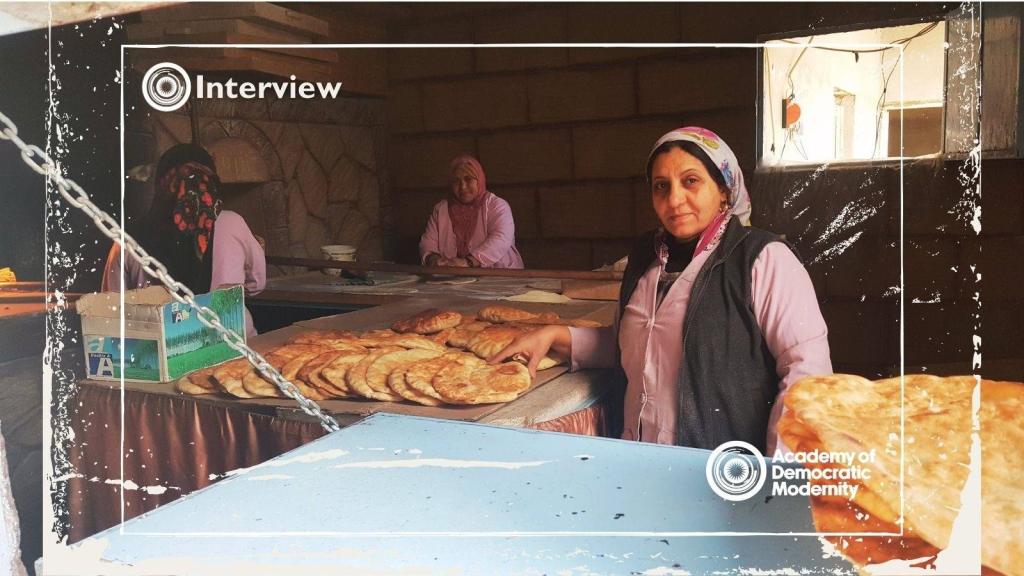
Since 2012, there has been a democratic self-government in northeastern Syria organized according to the principles of democratic confederalism. The social system of the Democratic Autonomous Administration of North and East Syria (DAANES) constitutes a real alternative to the capitalist system, especially for people and movements fighting for a more just world. The economy is vital in this context. What kind of economic order is there in Rojava/North and East Syria? What economic spheres exist, and who controls them? How are the market, production, and consumption organized? How is the issue of property dealt with? What are the class relations in Rojava, and what role does the class struggle play in the revolution?

The Academy of Democratic Modernity (ADM) has posed these and other questions to Dr. Azize Aslan, an expert on the region and its economic aspects. Her published book Anticapitalist Economy in Rojava elaborates on these questions and is published in English and Spanish. The German version will be published in 2025.

Azize Aslan is from Kurdistan and lives in Mexico. She studied economics and did her master’s degree in development economics in Istanbul, where she supported the organisation of women’s cooperatives. Since then she has been working on issues related to women’s economy and co-operatives in Kurdistan. She holds a PhD in Sociology from the Institute of Social Sciences and Humanities of the Benemérita Universidad Autónoma de Puebla, Mexico. She received the Jorge Alonso Chair Award for her work in 2021. This interview with ADM was conducted in November 2024.

Download PDF version of the interview.