Saturday, May 10, 2025


Press freedom in Greece going 'from bad to worse,' Human Rights Watch report says

Copyright AP Photo

By Maria Psara
Published on 09/05/2025 - 19:56 GMT+2

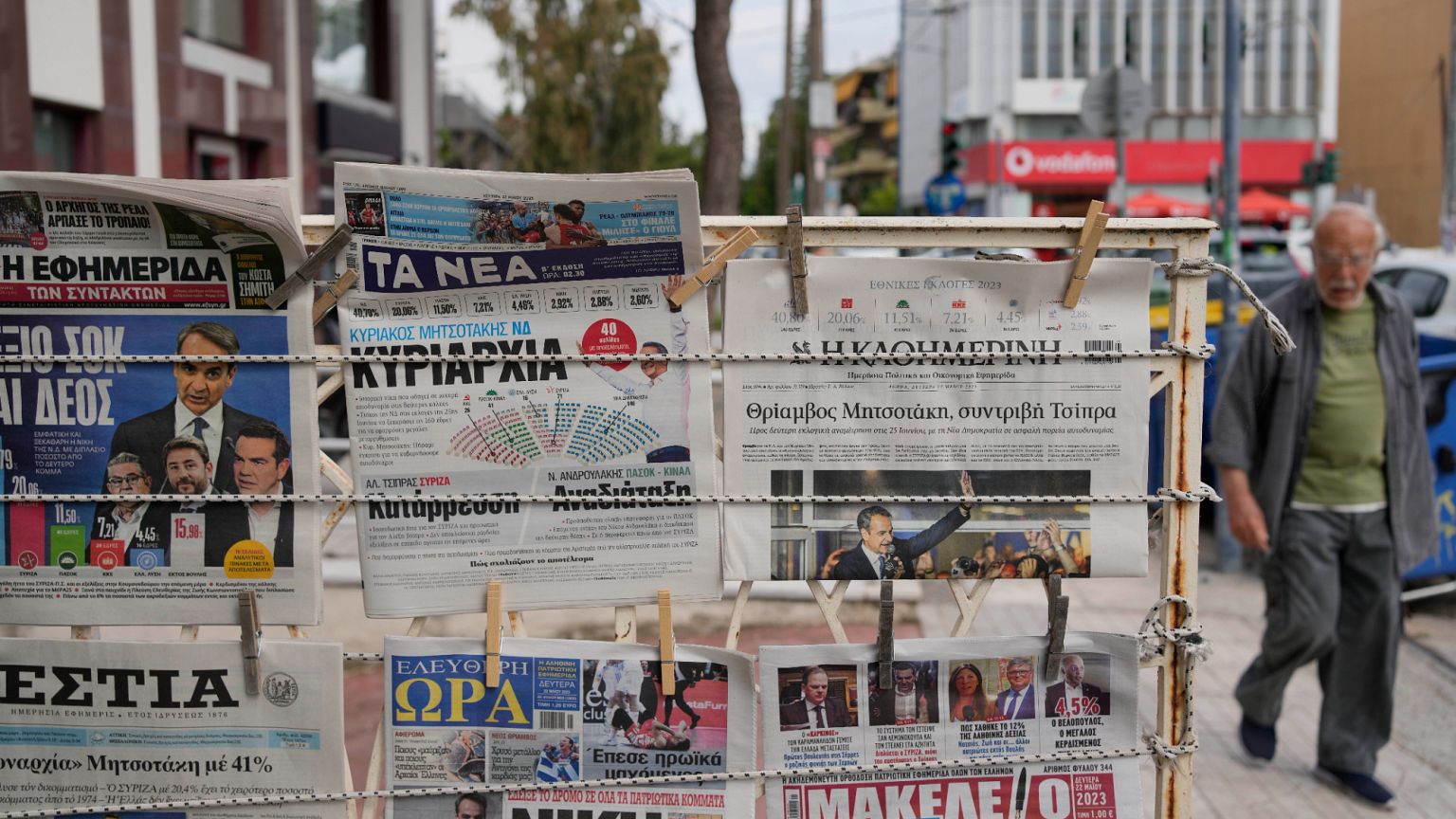
HRW says the 'image internationally of a forward-thinking and modern administration' that Athens wishes to present to the world is at odds with the reality on the ground.

A new report published by Human Rights Watch (HRW) has delivered a scathing assessment about the state of press freedom and the difficulties facing journalists in Greece.

The report. "From Bad to Worse: The Deterioration of Media Freedom in Greece", is based on personal testimonies and documents "pervasive and deliberate restrictions on journalism in Greece" that create an environment in which "critical reporting is stifled and self-censorship becomes the norm".

It also notes that "journalists face state surveillance, harassment and intimidation by pro-government actors and abusive lawsuits by politicians, which threaten democracy and the rule of law."

The international NGO recommends that the European Union monitor the situation in Greece to ensure progress is made towards freedom of the press and that democratic values are upheld.

This is the second negative report in as many days about Greece and the rule of law.

A Reporters Without Borders (RSF) report published on 2 May has provoked a heated political debate in the country with the government fighting back.

"The only truth about press freedom in all EU countries is reflected annually in the European Commission's Annual Rule of Law Report, which includes a special section on media and press freedom," government spokesperson Pavlos Marinakis said.
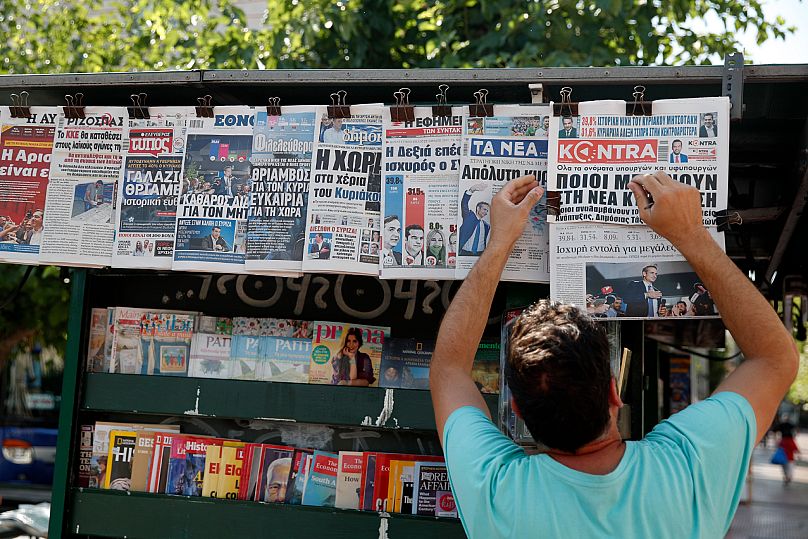
A vendor adjusts the front pages of the Greek newspapers as all of them refer to the election result in Athens, 8 July, 2019AP Photo

Based on personal testimonies

Greece is facing a media freedom crisis "as a result of actions and omissions by the Greek government that threaten democracy and the rule of law," HRW said.

Their research is based on interviews with 26 journalists working for various media outlets, along with academics, lawyers and media experts.

HRW interviewed journalists working in print, electronic media, television and radio, for public, private and independent media, foreign correspondents and freelancers.

Reports and other documents were also analysed and contacts were made with relevant bodies.

Twenty-two journalists described an increasingly hostile work environment, while six reported specific cases of harassment by high-level government officials related to their reporting.

"Few journalists were willing to report, fearing reprisals," the survey authors noted.

One independent foreign correspondent said: "Now I am thinking of leaving the country. I really am. I just don't see the point in subjecting myself to this level of stress. Stories matter, but the level of violence seems to have gotten worse."

A journalist with over 25 years of experience at a major Greek private television channel said: "What you say on TV is so controlled that you have no freedom. The control is done by those in high places...Everything is controlled. What you say, how you say it."
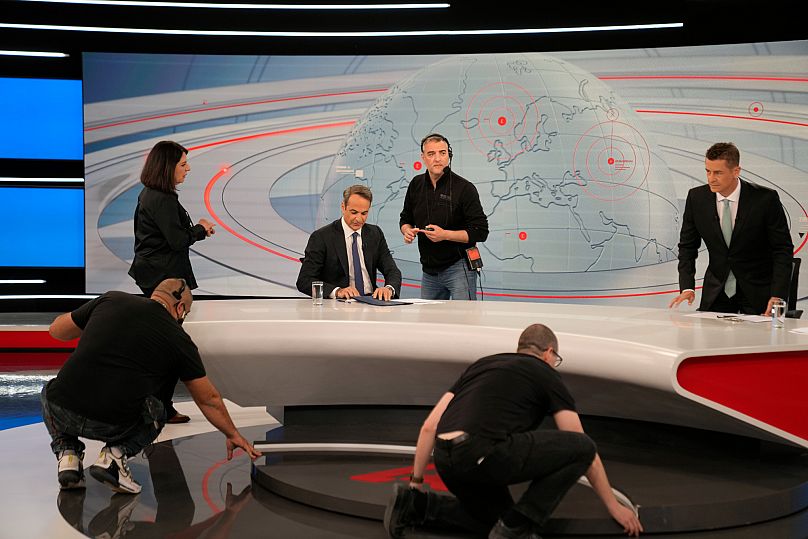
Technicians prepare a studio before an interview with Greece's Prime Minister Kyriakos Mitsotakis at Alpha television station in Athens, 25 April, 2023AP Photo


A lack of colour

The colours used to describe the situation in Greece are dark: the media landscape in Greece is characterised by a high concentration of ownership, with a few powerful individuals controlling many agencies. Many of them have ties to the ruling party.

The report documents the hostile environment for independent media and journalists since the New Democracy government took office in July 2019, including allegations of harassment, intimidation, surveillance and abusive lawsuits, which contribute to self-censorship and freeze media freedom.

Human Rights Watch also found the use of state funds "to influence coverage and editorial influence in the public media, further exacerbating this climate," stressing that these conditions undermine freedom of expression and the public's right to information.

There is specific reference to PredatorGate. "In 2022, the government faced strong suspicions that it used Predator spying software to target, among others, journalists, resulting in a major surveillance scandal," the report said.

In the investigation, seven of the journalists said they had evidence or strong suspicions of government surveillance, either through more traditional means, such as wiretapping, or by targeting with commercial spy software.

"This raises serious privacy and freedom of expression concerns and risks stalling reporting, as both sources and journalists fear for their safety," it noted.
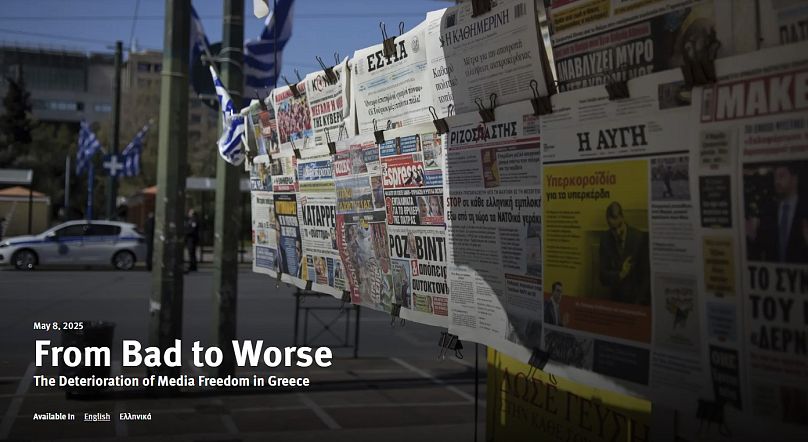
A screenshot of the Human Rights Report on media freedom in Greece
Cleared

Among the anonymous testimonies is that of Stavros Malichoudis, a freelance journalist who discovered in 2021 that Greece's intelligence service was spying on him.

"For many months I was in fear. In fear of meeting people, my sources, and exposing them. It took me a long time to disengage from what happened and start reporting again," he said.

Human Rights Watch also found that the government exerted undue influence on state media, such as ERT and the Athens-Macedonian News Agency (AMNA), undermining their independence. The government also used state advertising funds to favour pro-government media.

Another major concern is using the legal system against journalists, notably through abusive lawsuits, often known as SLAPPs (Strategic Lawsuits Against Public Participation).

"The vindictive defamation lawsuits filed by Grigoris Demetriades, nephew of the Greek prime minister and a former high-ranking government official, against journalists who reported on the wiretapping scandal are an example of this trend," the report said.

Moreover, "while recent amendments decriminalised 'simple defamation' (spreading a fact, even if true, that may be offensive), the laws still create criminal liability for 'insult' and 'slander'," it adds.

Human Rights Watch also found a pattern of attempts by the government and other authorities to undermine accountability. This includes invoking national security to prevent the disclosure of information related to the surveillance scandal, investigating whistleblowers, and an unwillingness to disclose details about the distribution of public advertising funds to the media.

Related


Communication with the government

Human Rights Watch shared the findings of its investigation with the government and relevant authorities and media, and their responses are summarised in the report.

"While the government has identified some initiatives aimed at improving media freedom, it is not clear whether these actions will lead to meaningful change. The government's overall response largely defends the status quo and downplays the seriousness of the problems Human Rights Watch documented," the watchdog said.

The report also cites Prime Minister Kyriakos Mitsotakis' rejection of the European Parliament's resolution, saying the country's rule of law is "stronger than ever" and that "Greece in recent years has often been the focus of slander" in response to criticism of his government's human rights record.

"The Greek government's dismissive response to the European Parliament's legitimate criticism suggests that stronger action is needed from the European Commission," said Hugh Williamson, director for Europe and Central Asia at Human Rights Watch.

"In particular, the Commission and the EU as a whole must monitor the situation closely and ensure that real progress is made on media freedom in Greece and that basic democratic values are respected," he concluded.


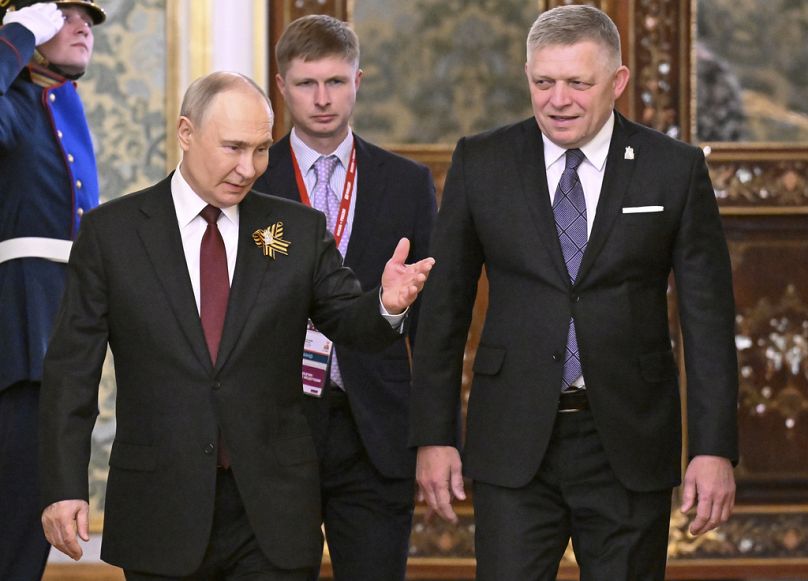
Slovak protesters condemn PM Robert Fico's Moscow visit to meet Russian President Vladimir Putin


By Malek Fouda
Published on 10/05/2025 -

Thousands of protesters gathered in Freedom Square in the capital, Bratislava, to voice their objection to PM Fico and oppose his anti-Europe, pro-Russian policies.

Demonstrators convened in the Slovak capital, Bratislava, on Friday to express their opposition to the recent visit of Prime Minister Robert Fico to Russia.

Fico was the sole leader from a European Union nation to attend the celebrations in Moscow commemorating the 80th anniversary of the victory over Nazi Germany in World War II.

“We’ve had enough of Fico,” “Slovakia is Europe,” and “Stay there,” the people who gathered at the Freedom Square chanted.

The organisers stated that Fico does not represent the entirety of Slovakia

The Kremlin has leveraged the yearly 'Victory Day' festivities to showcase its military capabilities.

On Friday, Russian President Vladimir Putin commended the Russian forces fighting in Ukraine, stating that “we are proud of their courage and determination, their spiritual force that always has brought us victory.”
Russian President Vladimir Putin, left, and Slovakia's Prime Minister Robert Fico enter the hall during their meeting in Kremlin, Moscow, Russia, Friday, May 9, 2025Alexander Nemenov/AP

Fico stated in a video message that his objective was to create a relationship of “normal, friendly cooperation” with Russia.

The rallies in Bratislava and some other towns and cities across Slovakia were the latest in a wave of protests that were fuelled by Fico’s recent trip to Moscow for talks with Putin over gas deliveries in December.

Fico, a controversial figure both domestically and internationally, regained power in 2023 when his leftist Smer party triumphed in a parliamentary election that promoted pro-Russian and anti-American sentiments.

Renowned for his pro-Russian perspective, he has publicly opposed the European Union's policies regarding the ongoing war in Ukraine.

His administration has encountered significant protests against its pro-Kremlin stance and increasingly Eurosceptic approach. Fico has routinely echoed anti-EU rhetoric and threatened on numerous occasions to withdraw Slovakia from NATO.


Iraq losing $1mn daily due to dust storms

Iraq losing $1mn daily due to dust storms
Iraq's economy is losing $1mn daily due to dust storms with each year getting worse. / CC: Social media
By bnm Gulf bureau May 6, 2025

Iraq is losing approximately $1mn per day due to dust and sandstorms that strike the country, according to a report by the Iraq Green Observatory, an environmental affairs monitoring body on May 6.

Annual sand and dust storms are wreaking havoc on regional countries as climate change continues to cause some of the highest temperatures worldwide in Iraq, Kuwait and Iran. Regional countries have held several events to try and slowdown the emergence of suffocating storms but have so far failed to turn the tide. 

"The storms hitting Iraq cause financial losses estimated at $1mn daily, due to damages inflicted on various sectors," the observatory stated in its report.

The health sector is the most affected, according to the report, due to expenses incurred by the ministry for treating respiratory patients, in addition to patients who prefer staying at home and purchasing breathing apparatus rather than going to health centres and hospitals.

Other damages caused by these storms include increased car accidents on external roads due to a lack of visibility, as well as significant damage to crops.

The report also highlighted additional harm to animals and other living organisms, along with the consumption of large amounts of water for cleaning homes, government offices, and vehicles, which may result in partial blockages of sewage networks due to accumulated waste and mud.

The observatory called on authorities to "expedite the solution to this problem through focusing on afforestation and establishing the planned green belt in several provinces, especially border provinces."

This year is expected to top record temperatures in the Persian Gulf region, according to several regional weather experts, as the effects of climate change continue to put strain on the regional weather patterns.

The Iraqi report comes out as neighbouring Iran has announced that schools, government offices and universities will be shut in several nearby regions, local Sharq newspaper reported on May 6.

The province of Kermanshah has seen the most extensive shutdown, with its governor-general announcing the closure of all offices, banks, schools, and universities for the day due to the critical air conditions in the provincial capital and its border cities.

Khuzestan and Bushehr provinces have also opted for remote operation of schools and universities due to unfavourable atmospheric conditions reported in the morning and afternoon in Khuzestan. Offices and banks in both provinces are continuing their activities as usual.

Earlier in August 2024, regional weather stations reported record temperatures, with Dayrestan in Iran reporting a heat index record of 82.2°C (180°F) and a dew point of 36.1°C (97°F), indicating an international record.

The heat has caused a series of electricity failures across the region as people prepare to make the most significant movement for the annual Arba'een pilgrimage in Iraq.

Iraq’s Arba’een festival, which brings about one of the largest religious gatherings in the world – and is sometimes dubbed the biggest movement of men, women and children on the planet – is stated to begin after Hajj this year and in the extreme heat zone.


Young generations face unprecedented climate extremes

Young generations face unprecedented climate extremes
Young generations face unprecedented climate extremes / bne IntelliNews CC: illustrate Digital Ug
By bnm Gulf bureau May 8, 2025

More than half of children born in 2020 will experience unprecedented lifetime exposure to extreme heatwaves even if global warming is limited to 1.5°C above pre-industrial levels, according to new research published in Nature.

The international study, led by researchers including Luke Grant and Wim Thiery, examined how six different climate extremes will accumulate over the lifetimes of different generations under various warming scenarios. Their findings portray a stark future for today's youth.

"Our results call for deep and sustained greenhouse gas emissions reductions to lower the burden of climate change on current young generations," the authors wrote in their comprehensive analysis released on 8 May.

The research projects that under current mitigation policies, which align with a pathway reaching 2.7°C warming by 2100, the proportion of people experiencing unprecedented lifetime exposure to climate extremes will at least double from 1960 to 2020 birth cohorts.

Even more concerning, if global temperatures rise by 3.5°C by 2100, an overwhelming 92% of children born in 2020 will face unprecedented lifetime exposure to heatwaves, compared with 52% under a 1.5°C pathway. This represents a difference of 111mn children versus 62mn experiencing these extreme conditions.

"Children would reap the direct benefits of this increased ambition," the study states, noting that 613mn children born between 2003 and 2020 could avoid unprecedented lifetime exposure to heatwaves if warming is limited to 1.5°C rather than continuing on the current trajectory.

The research defines "unprecedented lifetime exposure" as experiencing a cumulative number of extreme events that exceeds the 99.99th percentile of what would be expected in a pre-industrial climate – effectively meaning a one in 10,000 chance of occurring without human-induced climate change.

While heatwaves showed the most dramatic increases, other climate extremes also presented significant concerns. For crop failures, the proportion of the 2020 birth cohort facing unprecedented exposure rises from approximately 13% under a 1.5°C scenario to 29% with 3.5°C warming. Similarly, river flood exposure increases from 5% to 14% when comparing the same warming scenarios.

"For the 2020 birth cohort, this estimate changes from 6% to 11% in a 1.5°C pathway and from 10% to 19% in a 3.5°C pathway," the researchers noted regarding tropical cyclones when limiting analysis to regions where such events can occur.

The study also revealed troubling disparities in climate impact distribution. The most socioeconomically vulnerable populations face significantly higher risks of unprecedented climate exposure, with 95% of the most deprived children born in 2020 projected to experience unprecedented heatwave exposure under current policies, compared with 78% of the least deprived.

"Socioeconomically vulnerable groups have lower adaptive capacity and face more constraints when it comes to implementing effective adaptation measures," the researchers emphasised. "Our results highlight that precisely these groups with the highest socioeconomic vulnerability and lowest adaptation potential face the highest chance for unprecedented heatwave exposure."

At the country level, the research found that under a 1.5°C pathway, equatorial regions demonstrate relatively high proportions of unprecedented heatwave exposure, with 104 out of 177 countries analysed having most of their 2020 birth cohort (≥50%) living with unprecedented exposure to heatwaves.

This pattern becomes more widespread under higher warming scenarios. In a 2.5°C pathway, 157 countries have majority populations facing unprecedented heatwave exposure. Most alarming, in a 3.5°C pathway, 167 countries have majority populations affected, with 155 countries having ≥90% of their 2020 birth cohort experiencing unprecedented heatwave exposure, and in 113 countries the entire birth cohort faces this extreme scenario.

The researchers acknowledged certain limitations in their analysis, noting that they do not account for how people might adapt to extremes and potentially reduce their exposure or vulnerability. They also do not capture non-local impacts of climate extremes, such as supply chain disruptions or market instabilities, making their estimates "conservative."

"Although we refer to heatwaves throughout the paper, our definition technically refers to a 3-day extreme heat event that is expected on average once per century under pre-industrial climate conditions," the researchers clarified, highlighting the nuanced definition of extremes used in their methodology.

Beyond the human toll, the study points to cascading effects of climate extremes through economic impacts, including "rising cost of living due to supply chain disruptions" and "taxation to recover public infrastructure."

The authors conclude with a clear message about the urgency of climate action: "This underlines the urgent need for deep and sustained greenhouse gas emission reductions to safeguard the future of current young generations."

Additional benefits of limiting warming to 1.5°C include 98mn children avoiding unprecedented exposure to crop failures, 64mn avoiding river floods, 76mn avoiding tropical cyclones, 26mn avoiding droughts, and 17mn avoiding wildfires, compared to the projected 3.5°C pathway.

As the researchers concluded: "Young generations will reap the consequences of the present-day mitigation of greenhouse gas [GHG] emissions."

LATAM BLOG: Gold, murder and the collapse of the Peruvian State

LATAM BLOG: Gold, murder and the collapse of the Peruvian State
The state had prior intelligence on the kidnapping, including the execution video days in advance. Yet no intervention was made. / Panorama
By Alek Buttermann May 6, 2025

The slaughter of thirteen miners in Pataz, a remote province in Peru’s La Libertad region, is not merely a tragic, unfortunate event. It is the brutal manifestation of a state rendered impotent by its own laws, hijacked by criminal economies, and complicit politicians. In a country where policy has long favoured appeasement over enforcement, the line between miner and mafioso has all but disappeared.

This most recent atrocity was not unforeseen. In fact, it was foretold by years of systemic neglect, corruption and short-sighted legislation. On May 4, thirteen workers employed by contractor R&R, which operates with the mining company Poderosa, were found dead after having been abducted a week earlier to be tortured and summarily executed. A harrowing video later circulated showing the victims forced to kneel before being shot point-blank in the neck. The killings were allegedly orchestrated by a known criminal, ‘Cuchillo’, whose organisation, like many others in the area, operates with relative impunity.

The state reportedly had prior intelligence on the kidnapping, including the execution video, days in advance. Yet no intervention was made. According to multiple sources, including family members of the victims, police were well aware of the captives’ location but failed to act. Whether this failure stems from negligence or outright complicity remains unclear, but the consequences are unmistakably deadly.

An emergency in name only

Pataz has been under a declared state of emergency since February 2024, with both military and police forces supposedly deployed. But this has done little to halt the criminal grip on the region. Since 2020, mining firm Poderosa has reported 39 murders of its employees, repeated sabotage of its operations, and large-scale theft of gold.

The government’s response has ranged from performative to downright counterproductive. Instead of intelligence-driven surgical crackdowns, authorities have imposed blanket curfews and banned motorcycles: measures that mainly punish the local population while leaving organised crime untouched. One particularly baffling policy was the 30-day suspension of formal mining operations in the area, which effectively handed over control to illegal groups.

Prime Minister Gustavo Adrianzén admitted to poor communication regarding the massacre but failed to explain why no preemptive action was taken. The Ministry of Justice now provides legal support to victims’ families, though it is cold comfort in the face of what the Coordinadora Nacional de Derechos Humanos has described as “a collapse of state presence”.

The REINFO loophole: law as a shield for criminality

At the heart of Peru’s failure is a legal framework that shelters, rather than penalises, illicit miners. The Registro Integral de Formalización Minera (REINFO), initially intended as a transitional mechanism for formalising small-scale miners, has devolved into a legal sanctuary for criminal operations. Since its inception in 2017, REINFO has been extended six times—the latest in November 2024—despite the fact that fewer than 3% of its 84,000 registered entities have been properly signed up.

According to the Ministry of Environment, REINFO now perpetuates “a framework of impunity”. It permits registrants to operate without environmental assessments, allows the sale of inputs and machinery, and effectively shields operators from prosecution. Criminal gangs exploit these known legal loopholes to launder gold, evade taxes and launder money via shell companies, real estate, and even political campaigns.

Astonishingly, it is Congress itself, dominated by parties such as Alianza Para el Progreso (APP), Fuerza Popular and Acción Popular, that has championed these extensions. Eduardo Salhuana, President of Congress in 2024, has spearheaded pro-REINFO legislation while simultaneously meeting with informal mining lobbyists. The Observatorio de Minería Ilegal notes that such lawmakers have prioritised “private interests over constitutional rights”, actively facilitating the destruction of ecosystems and communities.

A state in the shadow of gold

The reach of the mining mafias extends far beyond Pataz. In Madre de Dios, another hotspot of illegal activity, over 6,000 hectares of rainforest are deforested annually, with REINFO permits used as cover. In regions like Loreto and Ucayali, indigenous territories have been invaded under the same legal pretences.

And the consequences are not just environmental. According to investigative reports, the illegal gold economy sustains a sophisticated money-laundering network. Gold is sold to acopiadores (intermediaries) with dubious credentials, then “legalised” through fake invoices and shell companies. From there, it is exported via commercial entities that claim to have sourced it from REINFO-registered miners. In Pataz, opulent mansions—some uninhabited, many without any visible income source—stand as grotesque monuments to this illicit wealth.

The political silence is deafening. César Acuña, Governor of La Libertad and leader of APP, has faced growing criticism for failing to address the crisis in his region. Allegations, though unproven, circulate about APP operators receiving support from informal mining interests. 

Cynicism in Congress, cowardice in power

The absence of genuine political will was epitomised by an image from a recent congressional session, where lawmaker Jorge Montoya was photographed sound asleep as the Minister of the Interior explained the details of the Pataz massacre. It was yet another embarrassing snapshot of the elite’s indifference to a crisis consuming the country’s rural heartlands.

Meanwhile, as the government feigns concern, grieving families bury their dead and local leaders beg for help. Aldo Carlos Mariños, mayor of Pataz, broke down in tears as he condemned the central government’s abandonment of his province. Threatened with death, he declared that he would rather be killed than become complicit in the Peruvian state’s corruption and inertia.

The National Society of Mining, Petroleum and Energy has called for an urgent government strategy involving intelligence operations and institutional strengthening. Still, until now, all that has materialised are platitudes and superficial actions.

The carnage in Pataz is not an isolated tragedy; it is the visible rupture in a corrupt state captured by gold. When criminal syndicates operate with legal cover, when legislators legislate for mafias, and when law enforcement turns a blind eye, the result is not just lawlessness—it is a failed republic.


Ukrainian refugees living in Poland boost taxes by $400mn and GDP growth – survey

Ukrainian refugees living in Poland boost taxes by $400mn and GDP growth – survey
Exiled Ukrainians working Poland have boosted the economy by at least 0.5% and paid $414mn in taxes in 2024, according to a new survey. / bne IntelliNews
By bne IntelliNews May 8, 2025

Ukrainian citizens living in Poland contributed PLN1.65bn ($414mn) in personal and corporate income taxes in 2024, marking a 27.7% increase compared to the previous year and double the amount recorded in 2022, according to figures released by Gremi Personal analysts, PAP reported on May 8.

Ukrainians accounted for a third (33.7%) of total tax revenues collected from foreigners in Poland this year, reflecting their growing economic importance to the domestic economy. The rise in tax payments has been driven by a combination of structural factors, including tax reforms, higher wages, and a surge in Ukrainian entrepreneurship.

“The contribution of Ukrainians to the Polish economy continues to grow steadily, not only through employment but also through business creation and tax payments,” analysts from Gremi Personal said.

As of 2024, 1.55mn Ukrainian citizens reside in Poland, with a over a fifth (22%) based in Warsaw. Many are active in key sectors of the economy, with 29% employed in production, 22% in transport and logistics, 16% in administrative services, and 11% in construction, according to the survey.

Open for business

Ukrainian migrant labour was important before the war with Russia broke out three years ago, providing essential manpower to the flourisihing economy, but with the influx of more permanently based worker in the country, many have opened their own small- and medium-sized enterprises (SMEs).

The number of registered Ukrainian sole proprietorships—known in Poland as JDGs —rose to 33,165 in 2024, an increase of 16% from the previous year and more than double the 2022 figure. Between 2022 and 2024, Ukrainians registered a total of 77,700 JDGs, representing 9% of all new businesses in the country.

Gremi Personal expects that tax contributions from Ukrainians will continue to rise, citing stable employment patterns and further business registrations. “We are witnessing a structural integration of Ukrainians into the Polish economy, and this is reflected in the tax data,” the analysts said, as cited by PAP.

Retail and housing sectors have also benefited. Cities such as Warsaw, Kraków and Wrocław have reported a surge in demand for goods, services and rental properties, with retail sales outperforming earlier forecasts.

The government has acknowledged the economic value of Ukrainian refugees, though longer-term challenges remain around integration, education and healthcare provision. “Their contribution is clear,” said Polish Deputy Minister of Development and Technology Krzysztof Michalski in April. “The key now is ensuring their talents are fully utilised in our economy.”

Macroeconomic impact

The army of industrious workers trying to build a new life in exile has had a knock on effect that has boosted the economy in general.

Government data and independent economic analyses indicate that the influx of Ukrainians—most of whom are working-age women with children—has helped raise Poland’s GDP, by around 0.5 percentage points in 2023, primarily through increased consumer demand and labour force participation. Analysts expect the long-term impact to be even greater, particularly if integration policies succeed in retaining workers.

“The inflow of Ukrainian refugees has supported both the supply and demand sides of the economy,” the NBP stated in its latest macroeconomic outlook. “Consumption has risen due to population growth, while labour market tightness has eased in several sectors.”

Before the war, Poland faced acute worker shortages, particularly in logistics, construction, manufacturing, and services. The Ukrainian workforce has filled many of these gaps, with official statistics showing over 700,000 Ukrainian citizens now employed or actively participating in the Polish labour market.

Their willingness to accept lower wages compared to Polish counterparts has also helped limit unit labour cost growth, one of the key factors behind a slower-than-expected rise in core inflation. Economists at ING Bank ÅšlÄ…ski noted that this dynamic contributed to moderating inflation in the post-pandemic period, as businesses were able to stabilise prices while expanding output.

Poland’s consumer price index (CPI) rose 4.9% year on year in March (chart), maintaining the same pace as in January and February, according to GUS, but down substantially from the record peak levels of over 18% in early 2023.  Although inflation remains above the National Bank of Poland’s (NBP) target range of 1.5%-3.5%, the continued stability in price growth so far in 2025 has shifted the central bank’s monetary policy outlook and it is widely expected to start cutting rates later this year.

“The inflation plateau at the beginning of the year turned out to be lower than the worst-case scenarios, and CPI inflation is unlikely to exceed 5% year-on-year at any point in 2025,” PKO BP said in a comment in April.


Albania’s ruling Socialists head for historic fourth term

Albania’s ruling Socialists head for historic fourth term
Prime Minister Edi Rama greets supporters ahead of Albania's May 11 general election. / Edi Rama via Facebook
By Clare Nuttall in Glasgow May 8, 2025

"The question is not whether we will win, but by how much?” said Albanian Prime Minister Edi Rama in video posted on his social networks ahead of the country’s May 11 general election. 

The election will pit Rama’s Socialist Party against its main rival, the opposition Democratic Party led by former president and prime minister Sali Berisha, who promises to ‘make Albania great again’. 

But even with the help of US President Donald Trump’s former campaign manager, Chris LaCivita, Berisha’s efforts to unseat the Socialists are likely to prove unsuccessful. Pre-election polls indicate the Socialists, which have been in power since 2013, are heading for yet another term in office. 

A Piepoli poll conducted for Report TV indicates that the party is on course to secure 50.5% of the vote, boosting its parliament seats by one to 75, enough to form a government independently. The Democratic Party-led Alliance for a Great Albania is projected to receive 37% of the vote, cutting its seats from 63 in the current parliament to 54.

Similarly, a McLaughlin survey, carried out for Top Channel, shows backing for the Socialist Party at 49.9%, while the Democratic Party-led alliance trails with 34.9%.

Both polls, as well as a survey by Euronews, show strong support for the Socialists in the Albanian capital Tirana. 

Rama appears confident ahead of the vote, musing on how decisively the Socialists will defeat their opponents. “Whether we will win is not a question. Unquestionably we will win. But how much? What power will May 11 give us, the Albanian people. Will we simply be a government, a representation, or will we be a representation with greater popular support than what we have today,” he said, according to a transcript of the video published by CNA

The socialists swept to power in 2013, going on to win the next two elections in 2017 and 2021. The party initially ruled in coalition with former president Ilir Meta’s Democratic League of Socialists (now the Freedom Party), but from 2017 was able to dispense with the smaller party’s support and rule alone.

Throughout this time, the Democrats have not been able to make a substantial dent in the ruling party’s popularity either via the ballot box or on the streets. 

The party’s reputation was damaged by a lengthy power struggle between Berisha and its former leader ex-Tirana mayor Lulzim Basha that culminated in Berisha’s supporters storming the party headquarters in January 2022.

Highlighting ongoing tensions within the party, a mass brawl broke out among Democratic Party supporters at a rally in Elbasan on May 7.  

Moreover, Berisha has been personally sanctioned by the US since 2022, accused by former secretary of state Antony Blinken of “significant corruption”. Efforts to have the designation lifted, including by appointing lobbyists close to Trump, did not succeed in time for the election. 

The Freedom Party, once a third force in Albanian politics, has dwindled in influence. Meanwhile two new parties, Shqipëria Bëhet and Mundësia, are expected to clear the threshold to enter the new parliament. 

Ahead of the May 11 election, campaign environment has been fairly subdued, marked more by personal attacks and allegations of corruption than by substantive policy debate, according to a preliminary assessment by the OSCE’s Office for Democratic Institutions and Human Rights (ODIHR). Observers noted a “high degree of polarisation and mistrust between the two main parties”. 

Economic policy has emerged as one of the dominant campaign issues, as Rama and Berisha trade barbs over growth, taxes and the cost of living.

Rama has touted his government’s record on GDP growth, EU integration progress and falling unemployment. “When we took office, GDP was under €10bn. Today it is €25bn,” Rama told supporters in Burrel, northern Albania, on May 2. “By 2030, we will reach €35bn.”

Rama pointed to data from international institutions showing Albania’s GDP has grown by 109.6% since 2013, outpacing its regional peers. He also highlighted improvements in unemployment and per capita income, claiming a drop in joblessness from 18% to 8.8% and a tripling of exports since his party took power. The prime minister has made similar points during other recent campaign speeches. 

Large infrastructure projects have also featured heavily during the Socialists’ three terms in power, and are much promoted on Rama’s various social media outlets. 

On May 8, just three days before the election, the prime minister ceremonially welcomed the first flight to the new airport at Vlora, in the heart of the Albanian riviera, describing it in a Facebook post as “another example of pride of Renewed Albania”. 

Another theme pushed in the Socialists’ campaign is Albania’s progress towards EU accession. The party was given candidate status in 2014, a year after the Socialists came to power, and is now at the negotiation stage, with a potential accession date put forward of 2030. In a recent boost, Albania has been decoupled in the accession process from its neighbour North Macedonia, whose progress had become bogged down in bilateral disputes with Greece and Bulgaria. 

More broadly, as pointed out in a bne IntelliNews oped, Albania has gone from an isolated a poverty stricken country at the end of the communist era to a fast-growing economy, staunch Nato member and reliable member of the Western international community.  

Meanwhile, Berisha has focused on the struggles of specific groups such as small businesses, farmers and exporters, promising sweeping tax cuts and subsidies. “We will reduce taxes and do everything so that business and tourism in Tropoja and all of Albania can breathe,” Berisha declared at a rally in Tropoja, northeastern Albania, on May 4.

Berisha outlined a programme pledging a minimum wage of €500 and an average wage of €1,250, as well as fivefold increases in agricultural subsidies. He also promised a consumer card that would reduce the cost of basic goods by 20% for vulnerable families.

“We will create the most business-friendly climate in Europe,” Berisha said in Peqin on May 3, vowing to cut VAT to 15% and introduce a flat 10% tax for medium and large enterprises. He also proposed a scheme to compensate exporters for losses due to the euro’s depreciation.

But while Albania’s leading politicians compete on subjects such as wages and pensions, the campaign has also been characterised by personal insults. 

Albania’s two leading politicians have taunted each other with owl-themed jibes, with Rama calling Berisha a “swamp owl”, while the opposition leader argued the bird is a symbol of wisdom. Rama often appears in social media videos holding a model owl, to mock his opponent. 

Berisha recently accused the Rama government of living in luxury while citizens struggle on €140 pensions. “Ministers dress like princesses,” he said, pledging that “the difficult situation will end on May 11”. 

Rama has responded by highlighting his opponent’s age; at 80, Berisha is two decades older than the prime minister. “An ancient politician like an archaeological find,” he described him on May 8, adding that the opposition leader is “hopeless” and “desperate”. 

Accusations of corruption have flown from both sides during the campaign. 

Berisha frequently accuses Rama of turning Albania into a narco-state, and blaming his government for crime in the country. 

The ruling Socialists’ reputation has taken a hit from the arrest of Erion Veliaj, the mayor of Tirana and a high-profile figure within the party. 

The OSCE/ODIHR’s April 28 report noted that campaign discourse has been marred by accusations of corruption and misuse of state resources. 

However, the Democratic Party has also been hit by corruption scandals. Berisha was charged by the Special Structure against Corruption and Organised Crime (SPAK) in 2024 in a corruption case concerning the privatisation of Partizani sports club land

Contracts with US lobbying firms have failed to secure a lifting of the sanctions ahead of the election; instead SPAK has opened a probe into how the Democrats managed to pay a reported $6mn fee for one firm’s services.

Overall, Albania’s May 11 general election represents a test for the country’s democratic progress, taking place after changes to the electoral framework and in a politically charged atmosphere, international observers said at the end of April. 

The OSCE/ODIHR said the 2025 vote is “an important milestone for the country” and a critical moment in Albania’s efforts to strengthen democratic institutions during ongoing accession negotiations with the European Union.

The elections will be the first in Albania to allow out-of-country voting, with approximately 246,000 of the total 3.7mn registered voters casting ballots from abroad via postal voting. The Central Election Commission (CEC) has led a broad outreach campaign to inform citizens of the new procedures, including targeted voter education for minorities and people with disabilities.


War is a growing concern across Europe – Statista

War is a growing concern across Europe – Statista
On VE day in Europe the fear of a new war is increasingly worrying Europeans. US President Donald Trump is no longer guaranteeing Europe’s security and Russia is looking more threatening than ever. Frontline countries in Central Europe are most concerned. / bne IntelliNews
By Felix Richter of Statistia May 9, 2025

VE Day, or Victory in Europe Day, is celebrated on May 8 each year to mark the formal end of World War II in Europe, reports Statista.

On this day in 1945, Allied forces accepted the unconditional surrender of Nazi Germany, bringing nearly six years of brutal conflict in Europe to a close. The day is commemorated to honor the courage and sacrifice of those who fought and died during the war, and to celebrate the return of peace to the continent. Today, on the 80th anniversary of VE Day, that peace suddenly seems fragile, as Russia’s invasion of Ukraine and the crumbling transatlantic alliance have rattled Europe’s long-lasting sense of security.

With the United States under Donald Trump no longer seen as a reliable partner and Putin’s Russia posing an unpredictable threat, concerns about possible military conflicts have risen across Europe. According to Ipsos’ monthly What Worries the World report, more and more Europeans fear the prospect of war, naming it among the top three concerns their country is currently facing. As our chart shows, those concerns are particularly widespread in Poland, which is not a surprise given its border with Ukraine and proximity to the war that has been raging on for more than three years now.

But growing concern about military conflicts isn’t limited to Eastern Europe, with the Netherlands, Germany and France also seeing significant increases in the share of respondents who picked war as a top 3 concern. Looking beyond Europe, fears of war are less widespread in other parts of the world, with an average of 12 percent of respondents naming it a top concern across 29 countries. Interestingly, armed conflict is not a major concern for people in South America, with less than five percent of respondents in Brazil, Chile, Colombia, Argentina and Peru naming war as a top concern.


You will find more infographics at Statista


COMMENT: Trump’s tariff drive hits emerging markets as growth and inflation forecasts slide – Oxford Economics

COMMENT: Trump’s tariff drive hits emerging markets as growth and inflation forecasts slide – Oxford Economics
President Trump's tariffs are hurting emerging markets more than developed ones, as the former are more dependent on exports to rich countries for income. / bne IntelliNews
By bne IntelliNews May 6, 2025

President Donald Trump’s aggressive trade policies are already casting a long shadow over emerging market (EM) economies, with analysts cutting growth forecasts and warning of prolonged investment uncertainty and policy disruption.

“Because there are no winners in a trade war, we slashed our EM GDP growth forecasts by 0.4ppts to 3.7% in 2025 and by 0.2ppts to 3.7% in 2026. These are the single-largest downgrades we've made to our EM growth projection since the onset of the coronavirus pandemic,” said Callee Davis, senior economist at Oxford Economics in a note on April 30.

“We are already seeing the consequences of the Trump-era tariff framework returning at scale,” said Davis. “The new blanket tariffs and retaliatory measures have not only dimmed near-term growth prospects but also reduced the attractiveness of investment across key EMs.”

The main conclusion of the Oxford Economics note included:

  • The punitive tariffs caused us to downgrade China's 2025 growth forecast by 0.5ppts to 4.1%. China is nevertheless more resilient than most think, partly because exports to the US were only 3% of China’s GDP. Still, the tariff hit means its growth target is no longer attainable.
  • Mostly driven by China and a few other EMs (India, Thailand and Poland), we lowered our 2025 aggregate EM inflation forecast since our November 2024 baseline, which incorporated our initial take on President Donald Trump's presidency. This corresponded with reduced key policy rate expectations from our forecasters.
  • However, several LatAm and Central and Eastern European countries had upward revisions to their inflation forecasts over the past few months, corresponding with a more hawkish outlook for end-2025 interest rates than a few months ago.
  • Most central banks kept key policy rates on hold in March and early April, but stronger EM currencies, particularly in EM Asia, may support rate cuts in the near term.
  • The Central and Eastern European economies may buck the policy-easing trend, as the disinflationary impact of lower commodity prices will be offset by the demand spillovers from the large German fiscal stimulus. We expect cuts this year to be gradual.

China in the front line

China, although less dependent on exports to the US, faces a substantial economic blow from the trade war. Oxford Economics lowered China’s 2025 growth forecast by 0.5 percentage points to 4.1%, citing deteriorating trade flows and policy inertia.

“The idea that China can weather a 150% effective tariff rate without consequence is overly optimistic,” said Davis. “Even with fiscal buffers, the damage to confidence and demand is already evident. We believe the 5% growth target is out of reach.”

US is its own victim

As commentators repeatedly point out, tariffs are a tax on the US consumer, not the exporting country, and that is going to negatively affect US growth this year.

Analysts are anticipating a supply shock in the coming months as the imposition of tariffs take several months to work their way through to cancelled cargo orders. However, sometime in May or June US shop shelves will start to empty as supplies from overseas, and China in particular, start to dry up.

Oxford Economics lowered its 2025 GDP growth forecast for the US by 0.8ppts to 1.2% since March. It also lowered the growth forecast for 2026 by 1ppt to 1.6%.

“This reflects substantial, albeit scaled back, US tariff hikes. Although a recession in the US is not our baseline, we think that any additional increases in the effective tariff rate would push the US into recession. Aside from the demand-driven shock of tariffs, the surge in policy uncertainty is weighing heavily on business investment,” said Davis. “However, we still expect the economy to improve next year, supported by a positive fiscal impulse and the fading effects of tariffs on inflation and real disposable income. We expect uncertainty about fiscal policy to rise in H2.”

Inflation in focus

While several Asian and Central and Eastern European countries saw lower inflation forecasts on the back of reduced demand and stronger currencies, Latin American and some CEE economies registered upward revisions. This trend, according to Davis, points to “diverging monetary policy paths and growing tension between inflation control and growth support.”

“Core price inflation has trended downward on a three-month average basis. Meanwhile, food price inflation increased for the Asia 7 – ­China, India, Indonesia, Thailand, Malaysia, the Philippines and Vietnam – and the LatAm 4 – Brazil, Mexico, Colombia and Chile – but eased for the CEE 3 – Poland, Romania and Hungary,” says Davis.

Some central banks, including those in India and the Philippines, have begun rate-cutting cycles, enabled by softer inflation and exchange rate recovery. However, Davis noted that “countries like Brazil and Hungary remain constrained by currency volatility and localised inflationary pressures linked to supply-chain costs and imported goods.”

Trade and retaliation

The new tariffs, which Oxford Economics assumes will remain in place until the end of 2026, are already reshaping trade assumptions. While China has responded with proportional retaliation, most EMs are expected to avoid escalation and pursue negotiation channels instead.

“Retaliation is unlikely to be broad-based,” said Davis. “Emerging markets are opting for damage control, seeking exemptions or revised trade terms rather than entering a full-blown tariff war.”

Oil price fall brings some relief

Oil-importing countries stand to benefit from declining global commodity prices, with Brent crude forecast to average $67.50 per barrel this year. However, exporters such as Nigeria and Saudi Arabia may face growing fiscal and balance-of-payment pressure.

FX rebound short-lived

Despite currency rebounds across many EMs, Oxford Economics warned that the rebound in EM currencies thanks to a weaker dollar could reverse in the second half of 2025 as markets react to tighter US fiscal policy and a potentially stronger dollar. However, most major EM currencies are still weaker than they were before Trump's election victory.

“Much will depend on the Federal Reserve’s stance and US domestic demand,” Davis said. “A shift toward a firmer dollar could erode recent EM currency gains and reignite inflation risks.”

Oxford Economics says a steady decline in the EM hawkishness index suggests easing room is narrowing as inflation expectations moderate. Still, policy flexibility remains uneven, especially in countries with lingering fiscal vulnerabilities and volatile capital flows.

“Ultimately, EMs are being forced into reactive mode,” Davis said. “Whether through tighter trade policy, delayed investment or defensive monetary stances, the global fallout of Trump’s tariff strategy is already well under way.”


Food, Water, Energy: Romanian extremists' utopian model or a road to authoritarianism

Food, Water, Energy: Romanian extremists' utopian model or a road to authoritarianism
Calin Georgescu’s “Food, Water, Energy” programme promises to heal Romania, but risks setting the country on a road to authoritarianism.
By Iulian Ernst in Bucharest May 9, 2025

Aspiring president George Simion has announced that if elected, he will appoint Calin Georgescu as Romania's prime minister — a move that effectively brings Georgescu’s “Food, Water, Energy” programme to the forefront of national debate. 

More than a policy platform, this document functions as an ideological roadmap: one that promises to heal Romania through moral revival, economic distributism and sovereign independence. But beneath the soaring rhetoric lies a deeper concern — that Georgescu’s is a vision that, if implemented without constraint, could morph into an authoritarian project cloaked in rhetoric about patriotism and virtue.

Georgescu’s “Food, Water, Energy” programme is rich in symbolism and national longing. It speaks to real frustrations with corruption, inequality and foreign dependence. But its proposed cure may be worse than the disease. In promising order, virtue and self-reliance, it risks smuggling in authoritarian control under the banner of moral renewal.

If Simion wins the presidential election runoff on May 18 and if he brings this roadmap to life by giving Georgescu executive power, Romania may find itself not rejuvenated, but restrained — its future bound by a vision too rigid, too moralistic and too centralised to accommodate the real, flawed, diverse world we live in. Hopefully, this will not happen overnight as the legislative power's cooperation is needed for such a complex construction. 

Utopia by design, ambiguity by execution

Georgescu’s programme presents a moral, almost messianic vision for Romania, rooted in sovereignism-distributism, participatory democracy and Christian ethics. It positions the state as a benevolent force, leading a moral and economic rebirth by empowering local communities, restoring national dignity and protecting natural resources. This rhetorical high ground, however, often masks a lack of actionable clarity, particularly on institutional mechanisms and governance.

Phrases like “meetings between citizens, specialists and the state will take place at the table of Truth, Freedom and Reconstruction” reflect a kind of idealist social engineering that overlooks the complexity of human motivations, dissent and conflicting interests.

The programme does not address the fundamental political problem of pluralism: what happens when citizens radically disagree? Nor does it explain how those who do not meet the moral standards are included in this future society. Without tolerance for error or conflict mediation mechanisms, utopia risks turning into exclusion (or even elimination).

Backward-looking romanticism meets modern impracticality

At its core, the programme proposes a return to a pre-industrial socio-economic model: worker-owned small-scale production units, localised trade, traditional farming, cooperative banks and the elimination of “speculative” (i.e., financialised) ownership. Georgescu calls for the end of the extractive economy, placing spiritual and ecological values over capital flows, scale economies and efficiency.

While noble in intent, this model is profoundly mismatched with current technological and economic realities. Modern economies depend on scale, complexity and global integration, not self-sufficiency and localised barter-like relations.

The proposed distributist ownership model resembles early 20th-century Catholic social thought or even medieval guild systems, not viable frameworks for the AI, biotech or digital sectors of today. The role of technology, data, global logistics and knowledge economies is absent from the vision. These are not luxuries, but foundations of national competitiveness.

Indeed, Georgescu’s model may have been relevant before the communications and capital revolutions, but it underestimates the entangled nature of today’s global value chains, financial systems and labour specialisation. It is unclear how Romania could remain economically competitive while isolating itself from these networks.

A slogan not a governance model

Georgescu’s embrace of “participatory economic democracy” aims to empower citizens directly in legislation and local development. While laudable in principle, the proposal lacks mechanisms, safeguards and feasibility. 

It raises the questions of how will citizens participate in legislative processes without creating legislative gridlock or populist capture? How is misinformation, radicalisation, or elite manipulation prevented in such a system?

Digital tools may enable broader consultation, but meaningful participation on complex technical matters requires expertise, time, and institutional design — none of which is addressed.

In the absence of these answers, “participatory democracy” becomes more of a slogan than a governance model.

Sovereignty vs global reality

Georgescu advocates for a “sovereign state” that reclaims control over its resources, limits foreign exploitation, and reduces dependence on international institutions. While national self-determination is legitimate, his framing appears selectively isolationist:

Rejecting global green policy frameworks as “oligarchic” while still promoting “eco-efficiency” shows an inconsistent understanding of environmental policy.

The mandatory 51% state participation in all resource exploitation risks scaring off investors and contradicts Romania’s EU commitments.

Despite claiming to oppose xenophobia, the rhetoric of “Romania as a civilisation” and distrust of global structures hints at soft nationalism, particularly dangerous in a region prone to historical resentments.

Moreover, there is no clear economic strategy to replace the investments, partnerships, and supply chains that may be lost under such a “sovereignist” turn.

Visionary but unbalanced environmental and agricultural policy

One of the most detailed sections of the programme concerns agriculture and the environment, where Georgescu promotes organic farming, bee protection, soil regeneration and the sacredness of rivers. These are visionary and well-intentioned, but unrealistic in many ways. 

The scale is unfeasible. Organic smallholdings and peasant farms cannot feed an urbanised population or compete with industrial agriculture in efficiency.

The romanticisation of rural life ignores demographic realities — Romania’s youth are leaving rural areas for cities or abroad, not returning to peasant households.

Moreover, the outright rejection of synthetic fertilisers, pesticides, and GMOs is scientifically dubious and potentially harmful to productivity.

Sustainability is essential, but agriculture also requires innovation, not just tradition.

Moral revivalism and a risk of exclusion

Georgescu proposes a Christian moral foundation for the entire society, including education, health and the economy. This introduces two problems. 

First, it may blur the line between church and state, potentially alienating secular or religiously diverse citizens.

The focus on “moral elites”, “vocation” and “worthy citizens” creates an elitist undercurrent: what happens to the unworthy, the sceptical, the lazy or the deviant? Society includes the flawed, not just the virtuous.

A well-designed state does not rely on universal goodness but manages imperfections. This programme seems to do the opposite.

Strategic gaps and contradictions

Despite its impressive breadth, the programme exhibits serious contradictions and blind spots. 

It calls for decentralisation and subsidiarity while demanding a strong guiding state.

It wants a reduced bureaucracy but proposes vast new roles for the state in agriculture, education and energy.

It seeks fiscal stability and low taxes while proposing expansive social engineering, public investment and new institutions.

It opposes privatisation but demands re-industrialisation – a historically state-heavy and cost-intensive process.

These tensions are not addressed — they are simply layered over with optimism.

In conclusion, this is a visionary moral narrative, disconnected from real-world complexity

Georgescu’s programme is best understood not as a pragmatic policy platform, but as a moral and cultural manifesto — a call for spiritual and national renewal. It appeals to disillusionment with current elites, ecological anxiety and nostalgia for a “purer” Romania. But as a roadmap for governance, it lacks economic realism, technological relevance, political pragmatism and operational detail.

In a complex, interconnected world, noble intentions must be matched by functional systems. The programme offers the former, but not the latter.