It’s possible that I shall make an ass of myself. But in that case one can always get out of it with a little dialectic. I have, of course, so worded my proposition as to be right either way (K.Marx, Letter to F.Engels on the Indian Mutiny)
Saturday, May 10, 2025
James Bond franchise has 'nothing to worry about' when it comes to tariffs, Trump says
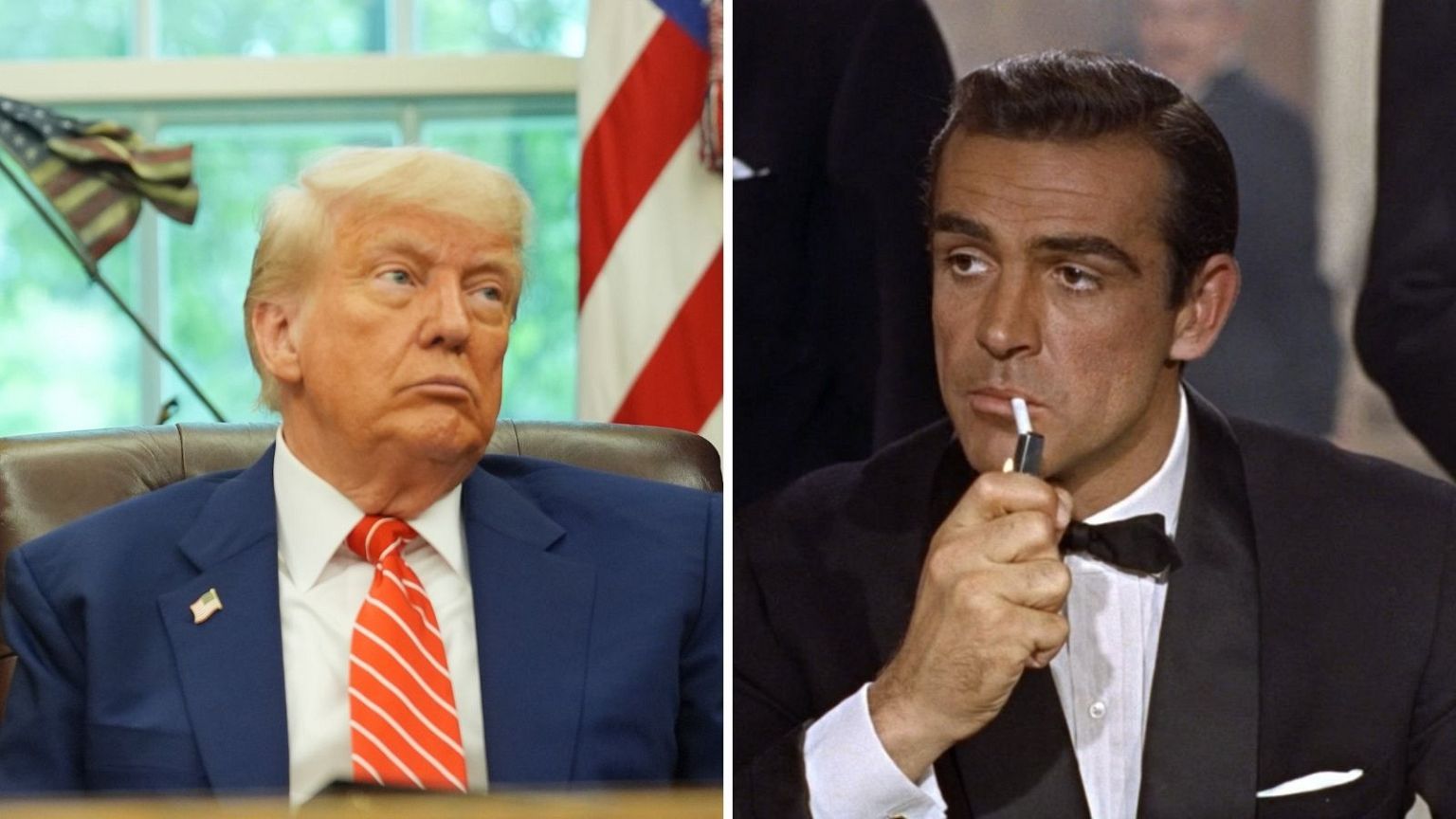
Donald Trump even attempted an impression of late actor Sean Connery while discussing the impact of US tariffs on the UK film industry following the announcement of a UK-US trade deal.
He wrote on social media at the time: “The Movie Industry in America is DYING a very fast death. Other Countries are offering all sorts of incentives to draw our filmmakers and studios away from the United States. Hollywood, and many other areas within the U.S.A., are being devastated. This is a concerted effort by other Nations and, therefore, a National Security threat. It is, in addition to everything else, messaging and propaganda!”
However, it would appear that the tariffs won't apply to 007 and the James Bond franchise.
During a press conference on Thursday (8 May) to discuss a trade deal with the UK that will slash tariffs on British goods, Trump doubled-down on his plans.
“As you know, we’re putting tariffs on… film, the moviemakers,” Trump said. “And we’re going to be doing some tariffs to get them, because a lot of them have left this country. They all live here, the money comes from here, everything comes from here, but they make them in other countries. So, we’re gonna do something to bring them back, maybe to a large extent.”
However, he seemed to assure that the James Bond franchise will be safe – in large part due to Trump’s connection to Sean Connery.
“But James Bond has nothing to worry about, that I can tell you,” Trump added. “And you know, Sean Connery was a friend of mine. Sean Connery was responsible for my getting zoning in Aberdeen. He said, ‘Let the bloody bloke build his golf courses.’ I was like four years into the process, and it was impossible in Aberdeen… He was a great guy, Sean Connery.
Quite how Trump’s tariffs will work is unclear, as is whether these measures will apply to US productions that are partially filmed overseas. However, Trump’s statements continue to wreak havoc and stir confusion.
Trump’s James Bond comments come as the 007 franchise is being rebooted.
Amy Pascal and David Heyman will produce the next Bond film and Amazon MGM’s Courtenay Valenti and Sue Kroll said at CinemaCon in April that the pair of “filmmaking legends” is working on the film.
“We are committed to honoring the legacy of this iconic character, while bringing a fresh, exhilarating new chapter to audiences around the world alongside Amy and David,” said Valenti. “They are both in London getting started and couldn’t be here tonight, but we wanted to thank them for what we know will be an incredible partnership.”
Euroviews. Are we witnessing the end of US exceptionalism — and the beginning of European renaissance?
Copyright AP Photo/Euronews
By Philippe Gijsels, Chief Strategy Officer, BNP Paribas Fortis
Published on
The opinions expressed in this article are those of the author and do not represent in any way the editorial position of Euronews.
Say hello to the multipolar world in which China is rapidly becoming a pole of economic and military power. Meanwhile, the old continent is struggling to speak with one voice and remain relevant, Philippe Gijsels writes.
There are decades where nothing happens, and then there are weeks where decades happen. The past few weeks have certainly fallen into the latter category, with remarkable intensity.
Since Donald Trump’s Liberation day announcements, stock markets have made a round trip. After an initial collapse we saw one of the strongest and fastest rebounds in recent history.
For the moment, things seem to have calmed down. Still, we are clearly not out of the woods yet. Or to put it in market terms: expect volatility to persist.
This volatility originates from both the geopolitical and economic domains. As Neil Howe so eloquently argues in his book "The Fourth Turning Is Here," a fourth turning is unfortunately a period marked by wars and geopolitical tensions — an era in which extremist parties, both from the left and the right, gain strength, while the centre becomes smaller, weaker and increasingly powerless to make the decisions that, in the end, everyone knows must be made.
s also a point in history during which sitting presidents, parties, and governments of any colour, shape or ideology are typically voted out.
The second big source of uncertainty and volatility originates from the economic sphere and is closely related to the first one. In a fourth turning, globalisation is under pressure. In our book "The New World Economy in 5 Trends," Koen De Leus and I discuss not deglobalisation but multi-globalisation.
China, a pole of economic and military power
We are no longer looking at a unipolar world solely centred around the US. Say hello to the multipolar world in which China is rapidly becoming a pole of economic and military power. Meanwhile, the old continent is struggling to speak with one voice and remain relevant.
Just to say that the economic volatility that we are witnessing is closely related to the geopolitical fragmentation. Not so long ago, when the world was still truly globalised, we had one global business cycle. All the major blocks tended to move together on the waves of global expansion and global contraction.
In this world, central banks’ action would sometimes differ a bit in an amplitude, but generally the direction would be the same. Today, it is not so hard to envision the US and the European economies to grow at a different pace and central banks as a consequence conduct and all together different policy.
Also, China will, depending on the policies conducted, grow at a different speed. Japan is finally exiting more than four decades of deflation and its interest rates are on the rise, while in most other parts of the world they are coming down.
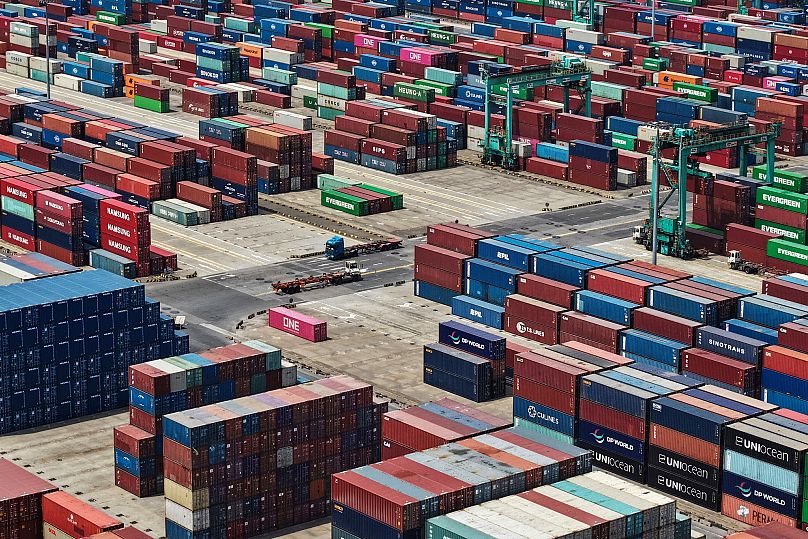
Trucks move past containers piled up at a container terminal in Shanghai, 9 May 2025Chinatopix via AP
We should look at this new economic reality in terms of tectonic plates. The blocks are no longer moving at the same speed in the same direction. Instead, the plates are shifting unpredictably at different speeds.
It’s no wonder that we'll see collisions, leading to massive volatility in currency and interest rate markets as a logical consequence.
In this world, volatility will be more the rule than the exception. The main conclusion of our book “The new world economy in 5 trends” is that after the COVID-19 pandemic, we have moved into a new economic paradigm in which both interest rates and inflation will be structurally higher than from 1982 until the pandemic.
It all comes and goes in waves, it always does. And a huge wave is coming. The drivers of this totally new environment are the massive debts, aging of the population, multi-globalisation (including a new arms race) and climate change.
Innovation may play a mitigating role and may in an extreme scenario be even powerful enough to counter the four other forces.
Investors should focus on real assets
All of this has deep and profound consequences for investors. Even though volatility will be huge, holding too much cash is not an option as inflation will eat up its purchasing power.
Above all, investors should focus on real assets like equities, real estate, wine and gold and silver, for which the bull market has only just has begun. The same goes for the commodity space. We are only in the very first inning of the largest commodity bull market in time due to massive supply shortages that we foresee.
For companies, it means that they should put in place hedging techniques for navigating a world of higher interest rates, higher inflation and higher and more volatile commodity prices.
Countries have a unique opportunity to outperform in a fourth turning, at least for those who understand the rules of the new game. Those who don’t will have a hard time keeping the bond vigilantes off their backs.
Maybe in 30 years’ time we will look back on today as both the start of the European Renaissance and the end of US Exceptionalism. This would bode well for both the euro and European equities.
However, it will not be a walk in the park. The road that the old continent will have to travel to be once again a voice on the world stage will be long, hard and winding.
Philippe Gijsels is Chief Strategy Officer at BNP Paribas Fortis.
‘Major loss’: Trump administration to axe database tracking cost of climate-fuelled extreme weather
Copyright AP Photo/Richard Vogel, File
By Alexa St John with AP
Published on
For decades, the database has tracked hundreds of major events across the country, including destructive hurricanes, hail storms, droughts and freezes.
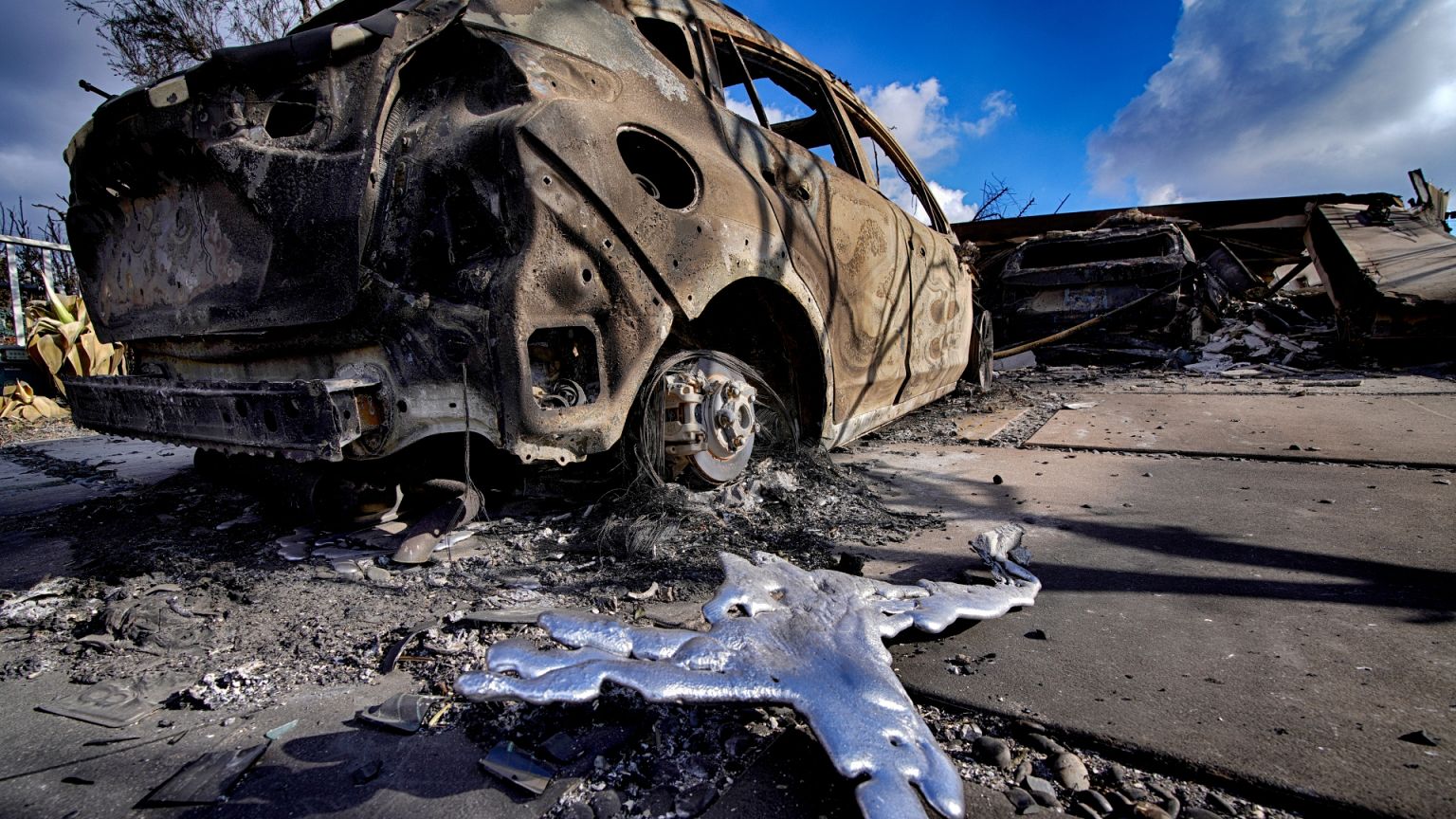
The US National Oceanic and Atmospheric Administration will no longer track the cost of climate change-fueled weather disasters, including floods, heat waves, wildfires and more.
It is the latest example of changes to the agency and the Trump administration limiting federal government resources on climate change.
NOAA falls under the US Department of Commerce and is tasked with daily weather forecasts, severe storm warnings and climate monitoring. It is also parent to the National Weather Service.
The agency said its National Centers for Environmental Information would no longer update its Billion-Dollar Weather and Climate Disasters database beyond 2024, and that its information, going as far back as 1980, would be archived.
For decades, it has tracked hundreds of major events across the country, including destructive hurricanes, hail storms, droughts and freezes that have totalled trillions of dollars in damage.
The database uniquely pulls information from the Federal Emergency Management Agency’s assistance data, insurance organisations, state agencies and more to estimate overall losses from individual disasters.
NOAA Communications Director Kim Doster said in a statement that the change was “in alignment with evolving priorities, statutory mandates, and staffing changes.”
'These changes will make Americans less safe in the face of climate change'
Scientists say these weather events are becoming increasingly more frequent, costly and severe with climate change. Experts have attributed the growing intensity of recent debilitating heat, Hurricane Milton, the Southern California wildfires and blasts of cold to climate change.
Assessing the impact of weather events fueled by the planet's warming is key as insurance premiums hike, particularly in communities more prone to flooding, storms and fires. Climate change has wrought havoc on the insurance industry, and homeowners are at risk of skyrocketing rates.
One limitation is that the dataset estimated only the nation's most costly weather events.
The information is generally seen as standardised and unduplicable, given the agency's access to nonpublic data, and other private databases would be more limited in scope and likely not shared as widely for proprietary reasons. Other datasets, however, also track death estimates from these disasters.
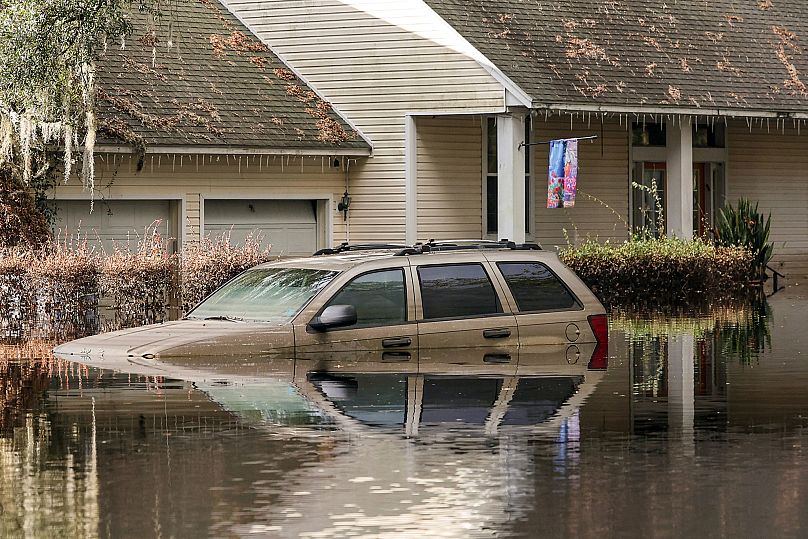
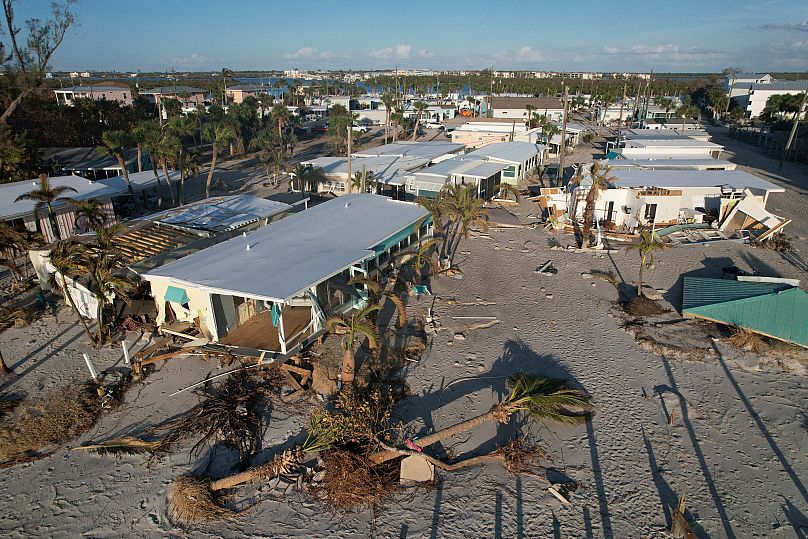
A neighborhood still flooded from Hurricane Milton in November 2024. AP Photo/Mike Carlson, File
Jeff Masters, a meteorologist for Yale Climate Connections, pointed to substitutes from insurance brokers and the international disaster database as alternative sources of information.
Still, “The NOAA database is the gold standard we use to evaluate the costs of extreme weather,” Masters said, “and it’s a major loss, since it comes at a time when we need to better understand how much climate change is increasing disaster losses.”
These moves also don’t “change the fact that these disasters are escalating year over year,” Kristina Dahl, vice president of science at nonprofit climate organisation Climate Central.
Damage from Hurricane Milton is seen at a mobile home community on Manasota Key.AP Photo/Rebecca Blackwell, File
“Extreme weather events that cause a lot of damage are one of the primary ways that the public sees that climate change is happening and is affecting people."
“It’s critical that we highlight those events when they’re happening,” she added. “All of these changes will make Americans less safe in the face of climate change.”
How has Trump downsized weather services in the US?
The move, reported Thursday by CNN, is yet another of President Donald Trump’s efforts to remove references to climate change and the impact of greenhouse gas emissions on the weather from the federal government’s lexicon and documents.
Trump has instead prioritised allies in the polluting coal, oil and gas industries, which studies say are linked or traced to climate damage.
The change also marks the administration's latest hit overall to the weather, ocean and fisheries agency.
The Trump administration fired hundreds of weather forecasters and other federal NOAA employees on probationary status in February, part of Elon Musk's Department of Government Efficiency efforts to downsize the federal government workforce. It began a second round of more than 1,000 cuts at the agency in March, more than 10 per cent of its workforce at the time.
At the time, insiders said massive firings and changes to the agency would risk lives and negatively impact the US economy. Experts also noted that fewer vital weather balloon launches under NOAA would worsen US weather forecasts.
More changes to the agency are expected, which could include some of those proposed in the president's preliminary budget.
The agency's weather service also paused providing language translations of its products last month — though it resumed those translations just weeks later.
Coca-Cola and Unilever among dozens of plastic brands tied to Texas fracking, investigation reveals
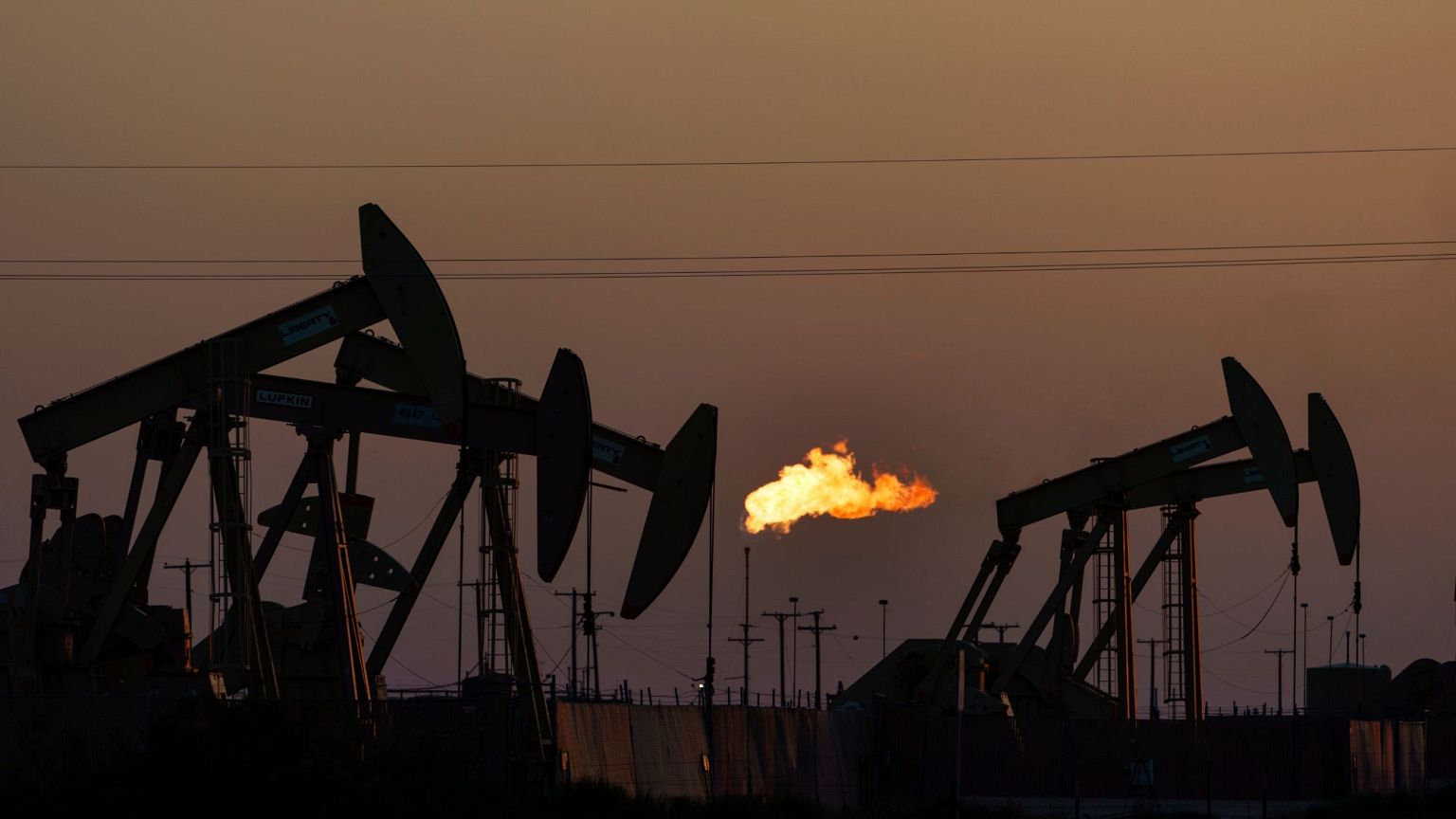
More than 25 major consumer brands and petrochemicals have been traced to fracking in the Permian Basin, one of the world’s ‘carbon bombs’.
A Magnum ice cream wrapper caught in the wind, a Coca Cola bottle lost at sea. When we picture plastic pollution, it’s the littering of items like these that springs to mind. But new research points to problems upstream too, tracking plastic production to the oil fields where it originates.
For the first time, fracking operations in the US have been linked to ethane exports to Europe through major petrochemical companies and on to globally recognised brands.
More specifically, these petrochemicals come from fracking in the Permian Basin in Texas. It has been described as a ‘carbon bomb’ for the catastrophic impact its full extraction would have on global emissions. Water pollution here is so bad that some residents have filmed themselves setting tap water on fire.
“It’s really about walking the talk,” says Delphine Levi Alvares, global petrochemicals campaign manager at the Center for International Environment Law (CIEL), which has released the new research in collaboration with Stand.earth.
“If we’ve rejected fracking in Europe, for the impact on our communities, why should we accept consumer products coming from fracking that has impacts on other communities?”
The data “connects the dots” that campaigners long suspected were there, Levi Alvares tells Euronews Green. Most surprising, she says, is just how concentrated the supply chain is at the start, with petrochemical giant INEOS playing a particularly pivotal role in Europe.
How do fracking-derived petrochemicals end up in European plastic packaging?
The researchers started at the source, explains Dr. Devyani Singh, an investigative researcher at Stand.earth. They identified companies with the highest yield of natural gas liquids (NGL), which include ethane, and honed in on five firms: EOG Resources, Chevron, Devon Energy, Occidental Petroleum and Diamondback Energy.
Another US company, Enterprise Products, is the biggest transporter of NGL through its pipelines - running from oil wells to its port in Texas. From here, Stand.earth used an array of ship tracking data and company records to see where the vessels were unloading and who bought their cargo.
The two primary buyers were Indian multinational Reliance Industries and UK-headquartered INEOS - the world’s fourth largest chemical company and Europe’s biggest plastic producer. In the case of INEOS, some of the ship tracking was made easy by the fanfare around its ‘Dragon’ vessels, proudly emblazoned with ‘Shale Gas for Progress’ and ‘Shale Gas For Europe’.
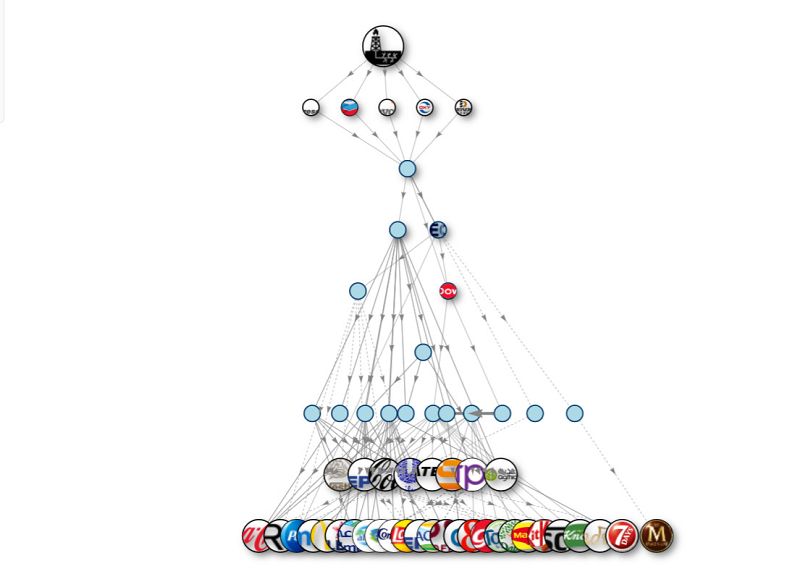
A screengrab of Stand.earth's new visualiser, which sheds new light on the critical players driving the plastics and climate crises.Stand Research Group/CIEL
It has subsidiaries at various stages of the supply chain. In Europe, INEOS turns ethane into ethylene, the world’s largest petrochemical feedstock, used to form polyethylene and PET - which end up in everything from plastic bags to bottles and clothes. It also acts as an intermediary in some polymer production - supplying chemicals to Dow Chemicals, for example, another major player in the network.
Stand.earth’s supply chain visualiser links INEOS directly to Procter and Gamble - a parent company with many brands under its name, like Always (menstrual products), Gillette and Olay. It also indirectly supplies Unilever, Coca-Cola, Nestle, and many other household brands.
The more links, the more likely a particular plastic item is made of petrochemicals derived from the Permian Basin, explains Dr Singh.
Ethane isn’t the only feedstock for plastic production. But there has been a shift away from using the primary alternative, an oil refining derivative called naphtha, in recent years. And with Europe producing only a small amount of ethane itself, the vast majority is shipped from the US - and the majority of that from Texas.
How could US and EU politics affect this supply chain?
Plastic is a supply-driven issue, the campaigners emphasise. “We know that there’s a correlation between the explosion of single-use plastic production from the beginning of 2000 and the boom in fracking in the US,” says Levi Alvares.
Despite consumers being guilt tripped over their plastic use, it’s this influx of cheap ethane that spurs on the industry to produce more, she says, and to create new markets when some close.
It remains to be seen how Trump’s second term will impact fracking, following an expansion under his first presidency. The US President’s command to “drill baby drill” isn’t necessarily music to the ears of fossil fuel producers since more extraction means more competition and lower prices.
“It potentially means that there will be more feedstock for petrochemicals production, and primarily for plastic,” explains Levi Alvares. “At the same time, there is a war on tariffs, so we don’t know how that’s going to play out in the fossil fuel trade.”
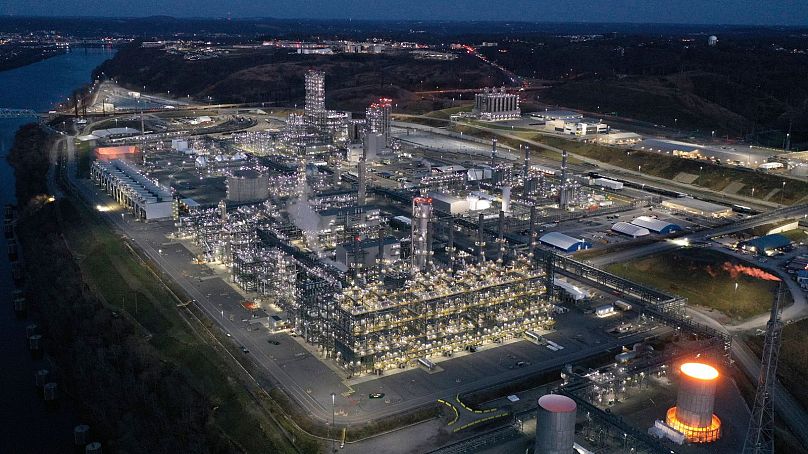
An ethane cracker plant owned by Shell on the Monongahela River in Monaca, Pennsylvania.AP Photo/Gene J. Puskar
Meanwhile, Brussels is pushing to re-industrialise and decarbonise Europe to make it more competitive through the new Clean Industrial Deal. It’s an amenable environment for petrochemical companies to advance their plans, such as INEOS’s Project One in Antwerp.
If built, this would be the biggest ethane cracker in Europe - a plant that uses extreme heat to break the gas into ethylene and propylene. Project One has faced continuous legal challenges from ClientEarth and other green NGOs, which argue that authorities have failed to consider its full environmental impact.
With Europe cracking down on plastic consumption, CIEL argues there’s no clear demand for the facility.
“The price of EU competitiveness and supposedly decarbonisation is actually much different than what [decision makers] are willing to see, because you cannot decarbonise the EU petrochemical industry if the feedstock is coming from fracking in the US or oil extraction in the Niger Delta and so on,” argues Levi Alvares.
“Externalising environmental degradation and human rights violations is one part of the ongoing petro-colonisation that Gulf South communities are forced to shoulder,” says Yvette Arellano, founder and executive director of Fenceline Watch in Houston, Texas, a grassroots organisation.
“From toxic extraction in the Permian Basin to poisonous production along the Houston Ship Channel, the cost is irreversible damage to our children’s health - low birth weights and reproductive and developmental harm - spanning generations.”
First and foremost, the campaigners are calling for a reduction in the production of plastic.
“The single-use plastics that we are being inundated with in our life everywhere, when we have other options, are basically Big Oil’s way of continuing to push for the expansion of the fossil fuel industry,” says Dr Singh.
Brands, adds Levi Alvares, “are usually forgetting that their primary business is not packaging, it’s really bringing products to people, and so [using plastics] is a choice that they make. Therefore, they have a responsibility in terms of where this is coming from.”
CIEL and Stand.earth say their research is a step forward in transparency and should make brands look upstream when assessing plastic-related pollution. They say commitments about virgin plastic use have been getting weaker in recent years, making companies look “hypocritical” when supposedly demanding solutions.
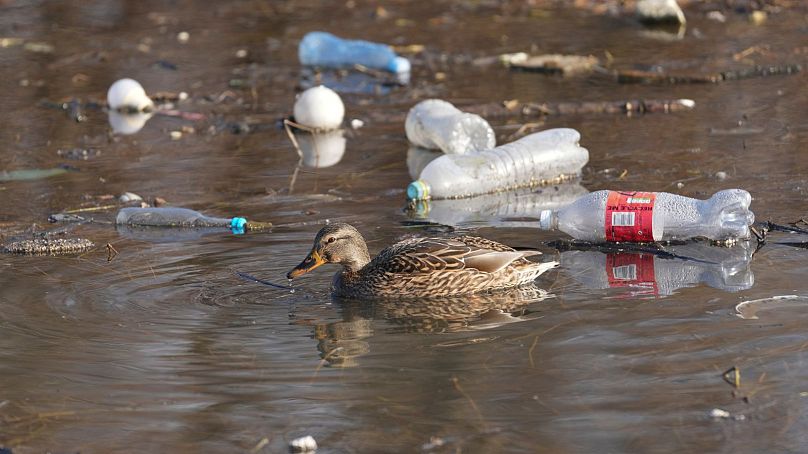
A wild duck floats on the water between dumped plastic bottles and waste at the Sava river in Belgrade, Serbia, December 2024. AP Photo/Darko Vojinovic
Coca-Cola, for example, a leading member of the Business Coalition for a Global Plastics Treaty, announced it was dropping its voluntary virgin plastic use reduction goals just after talks about the treaty collapsed in December. The company’s plastic use is set to exceed 4.1 million metric tonnes a year by 2030, according to a new study from Oceana.
Although feedstocks often fly under the radar, petrochemicals are on track to become the largest driver of global oil and gas consumption, according to an IEA report on energy ‘blind spots’.
“Without transparency, restrictions on chemicals of concern, and clear caps on production, corporate polluters will continue to profit while communities bear the cost,” says Steven Feit, senior attorney and legal and research manager at CIEL. “We need a strong Global Plastics Treaty to cut plastic production and hold corporate polluters accountable across the entire supply chain."
A Unilever spokesperson says the company “purchases virgin plastic from a range of converters, which derive from petrochemical sources. Reducing our virgin plastic use is a priority, and last year we used more recycled plastic than ever before (21 per cent in 2024).”
Euronews Green contacted INEOS, P&G and Coca-Cola but they did not immediately respond to a request for comment.
ECOCIDE
How poaching caused over 100 vultures to die in mass poisoning in South African national park
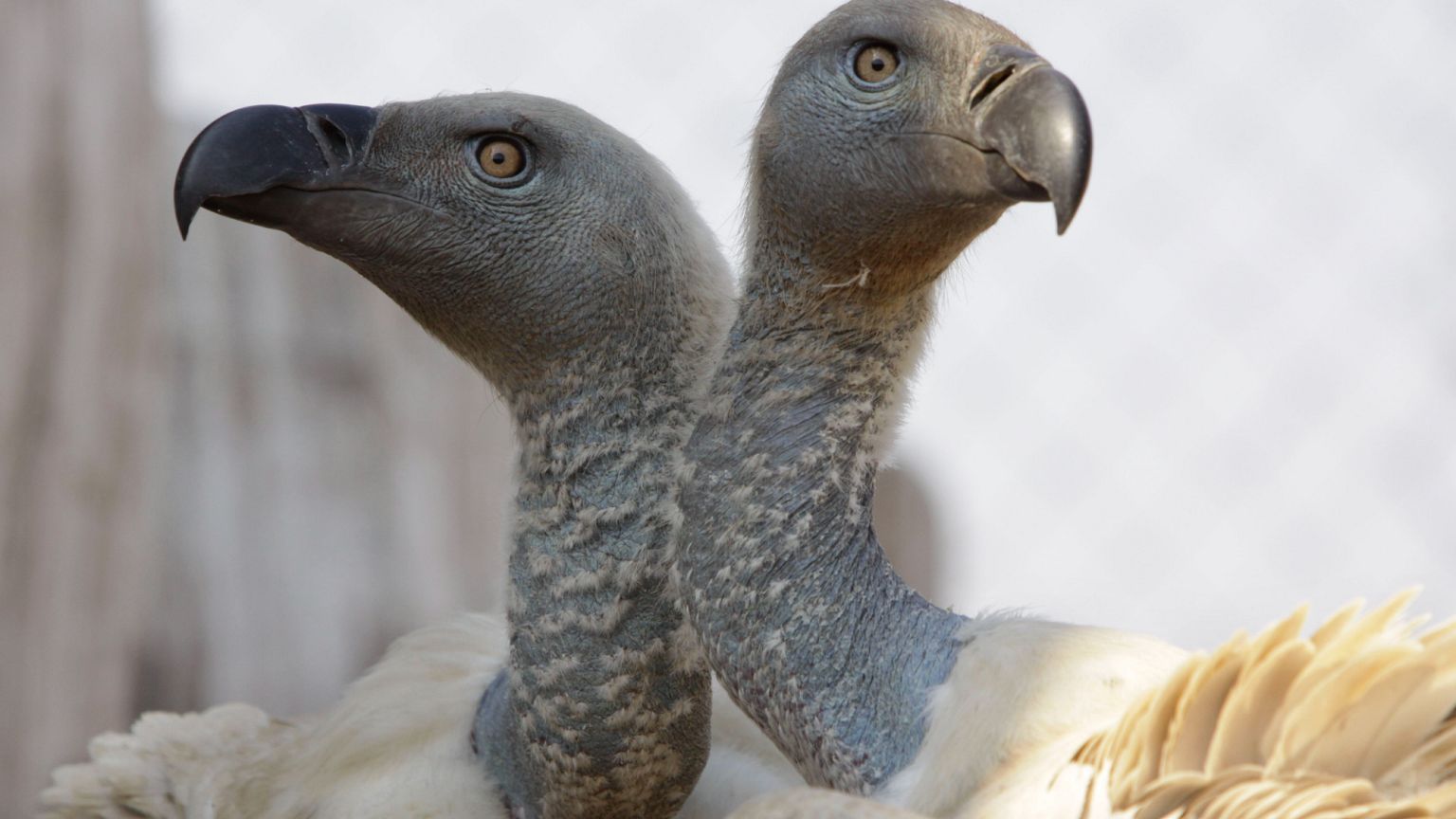
Vultures are key to wildlife ecosystems because of the clean-up work they do, feeding on the carcasses of dead animals. At least 123 vultures died in South Africa's flagship national park after eating the carcass of a poisoned elephant, park authorities and an animal conservation group said on Thursday.
The elephant was reportedly laced with agricultural pesticides by poachers.
Another 83 vultures that were rescued from the site and transported for treatment by helicopter or a special vulture ambulance are still recovering.
The mass poisoning was one of the worst seen in the famous Kruger National Park in northern South Africa, said SANParks, the national parks agency.
Vultures are especially vulnerable to poisoning
Vultures are key to wildlife ecosystems because of the clean-up work they do, feeding on the carcasses of dead animals.
But that also makes them especially vulnerable to poisoning by poachers, either intentionally or as a result of the killing of other animals.
Hundreds of vultures typically feed on a single carcass.
The elephant had been poisoned by poachers in a remote part of the huge park to harvest its body parts for the illegal wildlife trade, SANParks and the Endangered Wildlife Trust said.
Many vulture species are endangered in Africa because of poisoning and other threats. The affected birds in Kruger included Cape vultures, endangered lappet-faced vultures and critically-endangered white-backed and hooded vultures.
Rangers face a daily battle against poachers
"This horrific incident is part of a broader crisis unfolding across southern Africa: the escalating use of poisons in wildlife poaching," SANParks and the Endangered Wildlife Trust said in their joint statement. "Poachers increasingly use agricultural toxins to target high-value species."
The Kruger National Park covers approximately 20,000 square kilometres and is nearly twice the size of small countries like Jamaica and Qatar.