Sunday, May 11, 2025

Remembering Sétif, the VE Day colonial massacres that ‘lost Algeria’ for France

Eighty years ago this week, as jubilant crowds in Europe celebrated the defeat of Nazi Germany, French forces launched a ferocious colonial crackdown in eastern Algeria where demonstrators had dared to raise the Algerian flag. The Sétif massacres would lead Algerian nationalists to embrace armed struggle, paving the way for the country’s gruesome war of independence. Long forgotten in France, the tragedy still poisons relations between the two countries.


Issued on: 09/05/2025 
By: David GORMEZANO
FRANCE24

Demonstrators wave Algerian flags in Sétif, in French-ruled Algeria, May 8, 1945.
 © Rights reserved

On the morning of May 8, 1945, even as revellers thronged the streets of French cities to celebrate the end of World War II, a crowd of around 10,000 people gathered in Sétif, a commercial hub in Algeria’s Constantine region, east of Algiers.

The local authorities, in what was then a French département, had authorised a rally to celebrate the victory over Nazi Germany, while forbidding any flag other than that of liberated France.

Still, some demonstrators showed up waving Algerian flags and singing the patriotic chant “Min Djibalina” (From our Mountains), which would later become an anthem of the independence struggle. Some cried “Free Messali Hadj”, calling for the release of a jailed champion of Algerian independence. Others shouted, “We want to be your equals” and “Down with colonialism”.

Suddenly, “a policeman shot an Algerian flag-bearer, sparking shock and anger among the crowd, who then turned on the Europeans who were present,” Benjamin Stora, an Algeria-born French historian, said in a 2022 interview with FRANCE 24.

Stora, who spent half a century investigating the fraught history between Algeria and its former colonial power, said “tens of thousands of people” were killed in the ensuing repression, which he described as a weeks-long “massacre”.

“It was a war of reprisal that lasted practically two months,” he explained. “We talk about the events of May 8 but in truth the repression lasted through May and June 1945.”
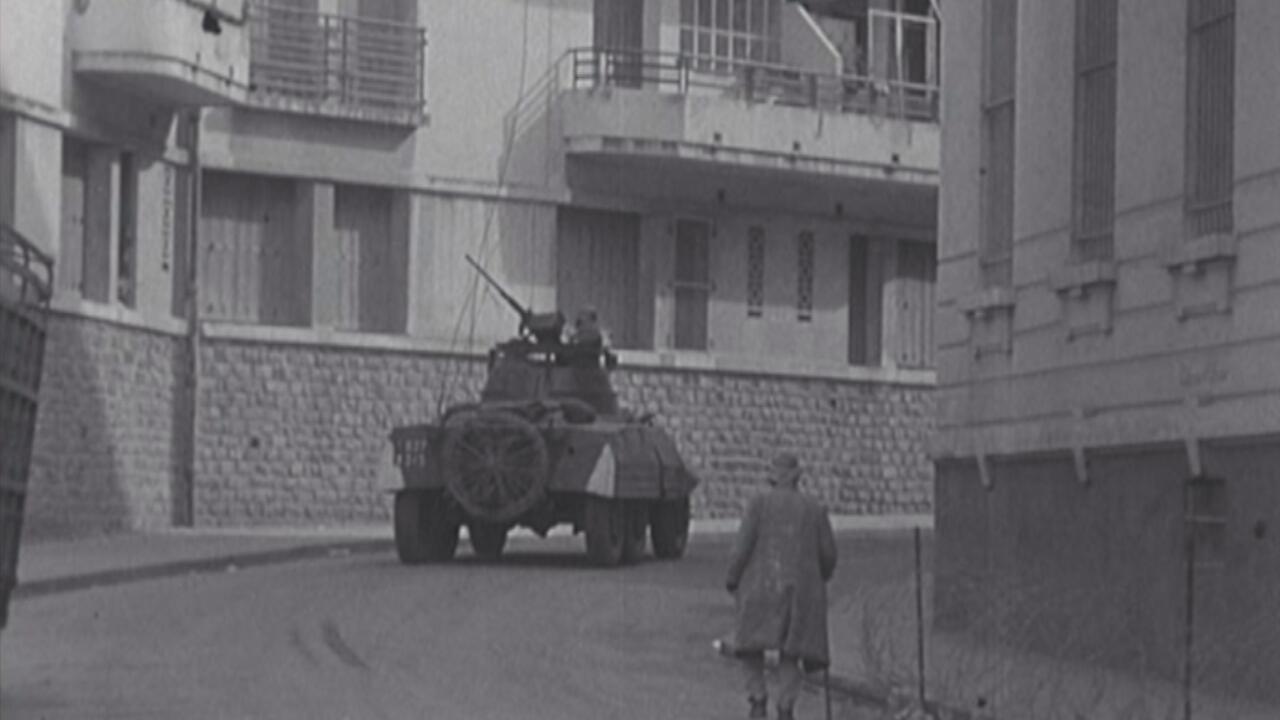
12:16 FRANCE IN FOCUS © FRANCE 24


Algerian nationalists at the time said some 45,000 people were killed in the massacres at Sétif and in the towns and surrounding areas of Guelma and Kherrata, an estimate later adopted by independent Algeria in 1962.

French authorities in 1945 put the death toll at 1,500 Algerians and 103 “Europeans”, the term used to refer to Algeria’s white, settler population.

“Various figures have been put forward,” said Stora. “US intelligence spoke of 30,000 dead, while historians’ estimates range between 8,000 and 20,000 dead. There were summary executions, arbitrary arrests and murders committed by the regular army, but also by European militias (...) The repression was absolutely appalling.”

Point of no return

A turning point in Algerian history, the Sétif massacres are intimately tied to the end of the World War II, during which General Charles de Gaulle’s Free French forces – opposed to Nazi-allied Vichy France – had relied heavily on colonial troops.

In the months following the bloody repression, hundreds of thousands of Algerian Muslim soldiers, who had fought with the Allies against Nazi Germany at the battle of Monte Cassino in Italy and during the Provence landings, were gradually demobilised and sent home.

“Upon returning home, Algerians who had fought with the Allies for two or three years were shocked to discover the scale of repression. Many families had been affected, since all the northern part of Constantine province had been bombed, particularly by the air force,” said Stora.

Veterans who “took part in the war effort had thought they would be rewarded. Or at least that their rights would be recognised,” he added.


An aerial view of Sétif in 1935. © AFP file photo

The scale and horror of the massacres perpetrated by police, the army and parts of the settler population persuaded many advocates of Algerian independence that peaceful dialogue was simply not on the agenda in the wake of World War II.

Algerian nationalists who had opposed colonial rule since the 1930s soon turned to armed struggle, launching a bloody war of independence in November 1954 that would end nearly eight years later with the departure of over a million French and other nationals who were living in Algeria.

Indifference, then ignorance


The massacres of May-June 1945 marked a turning point for a generation of Algerians who believed that fighting to liberate France would in turn pave the way for their liberation from colonial rule.

Read moreSixty years on, Algerian and French nationals share stories of the Algerian War

In mainland France, however, indifference prevailed. Absorbed by his efforts to rebuild France and restore its standing among the world’s powers, Charles de Gaulle devoted just two lines to the subject of Sétif in his memoirs.

Two voices attempted to break this deafening silence.

One was José Aboulker, an Algerian member of the French Resistance who denounced the massacres in a speech at the National Assembly in Paris in June 1945. The other was Albert Camus, “who protested vigorously against these massacres, saying that Algerians were considered inferior, as though they were subhumans”, said Stora.

“Camus spoke vehemently against the colonial system,” he added. “He was one of the few French intellectuals, perhaps the only one in 1945, to realise the significance of these terrible events, which would lead to a hardening of Algerian nationalism.”

Eighty years on, recognition of this tragic episode is still in its infancy.

In 2005, at the request of then president Jacques Chirac, the French ambassador in Algiers, Hubert Colin de Verdière, referred to the “massacres” of May 8, 1945, as an “inexcusable tragedy”, marking the first such acknowledgement by a French official.

On a visit to Guelma University three years later, another ambassador to Algeria, Bernard Bajolet, acknowledged “the very heavy responsibility of the French authorities of the time in this outburst of murderous madness [which claimed] thousands of innocent victims, almost all of them Algerian.” Referring to the hundreds of Algerians thrown into the town’s mountain gorges, Bajolet said the massacres “insulted the founding principles of the French Republic and left an indelible mark on its history”.
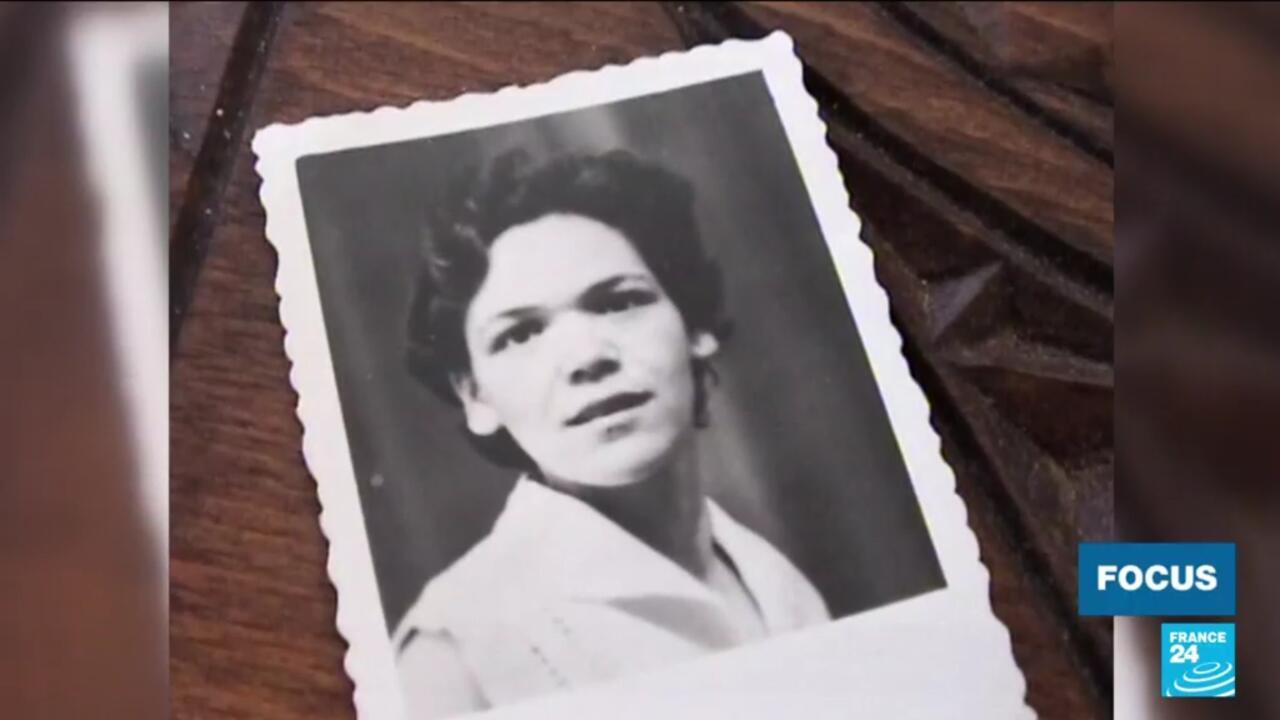
04:45 FOCUS © FRANCE 24


In April 2015, a French minister laid a wreath in front of a stele commemorating the first Algerian victim of the crackdown on the Sétif protest of May 8, 1945. Three years earlier, former president François Hollande had acknowledged in a speech to the Algerian Parliament “the suffering that colonisation inflicted” on Algerians.

No French president has apologised for the colonial crimes perpetrated during more than a century of French rule over Algeria.

Since 2020, May 8 has been known in Algeria as “National Remembrance Day”.


Divided memories


French officials’ tentative gestures to acknowledge colonial-era crimes in Algeria have so far failed to bridge a deep divide in the way the two countries perceive their shared past.

“The fact that it has taken so long to face up to the reality of colonial rule has only widened this divide,” Stora observed. “These opposing memories need to be bridged, so that we can move forward together and so that historical memory is not an obstacle to a Franco-Algerian relationship.”

Since 2022, Stora has co-chaired a committee of French and Algerian historians tasked with reviewing the countries’ shared past and achieving a “reconciliation of memories”. Its work has been derailed by a resurgence of diplomatic tensions between Paris and Algiers, inflamed by France’s recognition last year of Moroccan sovereignty over the disputed Western Sahara, where Algeria backs the pro-independence Polisario Front.

In a recent interview, Stora said the historians’ work was effectively at a standstill.

“The commission has not met for a year now,” he said. “Political issues have interfered with its work.”

Read moreOn Algeria visit, Macron says 'painful' shared past 'prevents us from looking to the future'

Meanwhile, a group of French lawmakers led by leftwinger Danièle Simonnet has launched a separate initiative to recognise the “Other May 8” – a phrase used to refer to the Sétif massacres – as a “state crime”.

“France has recognised these terrible massacres, but it hasn't acknowledged that this was a state crime,” said Simonnet. “Sétif was bombarded, it was a massacre on a huge scale, and it’s important that we face up to that fact.”

A former member of the hard-left France Unbowed (LFI) party, Simonnet has set up a cross-partisan group at the National Assembly that auditioned historians and organised a conference on the events of May-June 1945. She is now urging President Emmanuel Macron to directly address the Sétif massacres.

“Many families are still scarred by this history,” she said. “To move forward together, it would help if the president could put words on what happened, even if it’s just a speech.”

Simonnet was part of a delegation of French lawmakers who travelled to Algiers on Thursday to attend events marking 80 years since the massacres at Sétif, Guelma and Kherrata.

In a message this week, Algerian President Abdelmadjid Tebboune framed the commemorations as a matter of national pride and described the events of May-June 1945 as a prelude to Algeria’s fight for independence.

“The commemoration of May 8 reflects the Algerians’ commitment to freedom and dignity, for which they took to the streets with bare hands to confront an enemy,” Tebboune said, calling French colonialism “genocidal” and a crime against humanity.

This article was adapted from the French original by Benjamin Dodman.
German burials of Nazi remains stir controversy over national memory

Long read


World War II ended in Europe 80 years ago this Thursday, but the remains of German soldiers are still being found. As Germany's far-right AfD party rallies behind a broader effort to reframe national memory, the discoveries – and the German commission in charge of providing “dignified” burials for them – are reigniting questions around remembrance.


Issued on: 08/05/2025
By: Lara BULLENS
FRANCE24

A worker takes part during a demonstration of the equipment that will be used during the search campaign to find the remains of 47 German soldiers and a French woman accused of collaboration, executed in June 1944 by the local resistance, in Meymac, France, June 27, 2023. © Pascal Lachenaud, AFP

A meeting for veterans in the small town of Meymac in central France was coming to an end. All items on the agenda had been discussed when 95-year-old Edmond Reveil announced to the group he had a confession to make – a secret he could no longer hold on to.

The former Resistance member explained to attendees how in June 1944, the small group of fighters he was with had captured 47 German soldiers and a French woman suspected of collaborating with the occupying forces. Lacking the means to keep them prisoner and afraid the soldiers would destroy Meymac as they had nearby Tulle just a few days earlier, the group decided to kill their captives.

Their remains, Reveil said, may still be buried on a wooded hill nearby.

Meymac’s mayor, who was at the meeting, knew nothing about the drama that had unfolded in his commune until Reveil made his confession back in 2019. Shortly after, he informed both the French National Office for Veterans and Victims of War (ONaCVG) and its German counterpart, the War Graves Commission (Volksbund).

After years spent verifying the veteran’s claims, waiting for the Covid-19 pandemic to pass and getting the green light from authorities, the search for the remains began in August, 2023.

A ‘dignified’ burial


World War II ended 80 years ago but the remains of Germans are still being discovered today.

A Dutch couple unearthed a Nazi helmet while digging for a water pipe on their property in Poland. After an extensive excavation effort led by the Volksbund, the remains of 120 German civilians and eight soldiers were uncovered from the depths of their garden in March 2023.

Ukrainian servicemen found the remains of two Wehrmacht soldiers in the northern outskirts of Kyiv while digging a trench in April 2022. And in early 2023, the Volksbund unearthed the bones of 41 German soldiers in a small town in western Ukraine after a local pastor gave a tip saying a medical plane had crashed near the village during the war.

Whether Nazi soldier or child caught in artillery fire, it is the goal of the Volksbund to look for and recover the bodies of Germans abroad who died in both the first and second World Wars and offer them a “dignified” burial. On its website, the commission says it is “committed to the culture of remembrance”.

Read moreFrom Ravensbrück to freedom: The story of Sweden’s daring ‘White Bus’ rescue

The Volksbund, founded in 1919, was a citizens' initiative before it was handed it over to the Nazi government and the Wehrmacht graves service. When WWII ended, the Volksbund slowly restructured itself and in 1954, the German government officially commissioned the organisation to take on the role it occupies today.

The commission says it receives more than 20,000 inquiries a year about the whereabouts of Germans who died or went missing during both World Wars.

It claims to be mostly self-funded through donations and “income from legacies and bequests”, with the rest of its costs covered by public funds from the German government.

Countries generally have an organisation similar to the Volksbund, like the ONaCVG in France or the Commonwealth War Graves Commission. But when it comes to Germany, memory is in constant battle with the past, and the Volksbund's activities can be a contentious issue.

Thorny questions

Critics of the Volksbund have argued that in providing proper burials to Wehrmacht soldiers, the commission indirectly puts their lives on equal footing with the victims of WWII. And even the former president of the organisation, Markus Meckel, acknowledged the complex nature of burying the remains of German soldiers in an interview with the New York Times.

“How do we mourn and remember these soldiers without honouring them?” he said.

The Volksbund's activities have also become increasingly muddied with the rise of extremist parties across Europe. For the first time since WWII ended eight decades ago, a far-right party – the AfD – came in second during the German parliamentary elections on February 23, doubling its votes from 2021. The party is a fervent supporter of the Volksbund. Its leader, Alice Weidel, called on the German government in October 2024 to provide more financial support to the organisation.

The left in Germany has criticised the use of public funds for the Volksbund, calling it “intolerable”. In response, the Volksbund insisted “war dead have a right to permanent rest”.

“There is a danger that the Volksbund becomes instrumentalised,” says Darren O’Byrne, a historian of modern Germany at Cambridge University. “Although it existed before the AfD, its interests align with those of the party, who are in favour of a more honourable treatment of Germany’s war dead.”

But O’Byrne, who lived in Germany for 12 years, says that the controversies around the organisation are “not much discussed” in the country and that the work they do is “quite respected”.

“[The Volksbund] carries out what would be perceived by many as a rather mundane task,” he explains. “There seems to be a broad political consensus among German parties, broadly speaking, of an appreciation of its work. The AfD is not the only party who wants to provide it with public funding.”

Read more'We'll make it home together': A friendship between two deported women in Ravensbrück camp

However, the way German history is framed and remembered is also a broader, ongoing discussion in the country, especially in far-right circles. Senior figures of the AfD have called for an end of the country’s post-war repentance and dubbed the Holocaust memorial in Berlin a “memorial of shame”.

“Whether the [Volksbund] exists or not, it will have a very little role in the change in German memory culture,” says O’Byrne. “That is not to say that it doesn’t have a certain responsibility, though.”

“There is [also] a dissonance between the perceptions of the Volksbund from the outside and how it is treated inside Germany,” the historian explains. “In the Western historical consciousness, places like the US or UK, Nazism is the evil. It is literally north on the moral compass. So it does not come as a surprise that other countries are saying, ‘How can you be burying people who not only took part in, but largely drove the greatest human catastrophe in modern history?’”

“Does it come down to who deserves a burial?” O'Byrne asks. “It is a really complex question.”

The grey zones of remembrance


Lucien Tisserand was hired by the Volksbund to be the custodian of Normandy's La Cambe German cemetery from 1991 to 2014. Beyond maintaining the grounds, he was also tasked with exhuming the remains of German soldiers killed during WWII. Tisserand recovered the remains of 200 bodies throughout his career.

“A lot of tips came to us a few decades after the war,” he told daily newspaper Ouest France in May of last year. “Many people knew [where German soldiers were buried], but said nothing. It was taboo. I remember a farmer who knew bodies were on his plot of land but would make a detour to avoid driving past them.”

Read moreWorld War II veterans leave their children a legacy of trauma

Like Reveil, the former Resistance fighter, who waited over seven decades to go public. Once the others in the group who had witnessed the killings with him had all died, he decided it was time – he did not want to take the secret with him to his grave.

“We felt ashamed, but did we have a choice?” Reveil told local newspaper La Vie Correzienne, who first published his testimonial in May 2023.

Once it was in the press, the story spread like wildfire. And in the lead-up to the search for remains that began in August 2023, Reveil's critics said he had smeared the image of the French Resistance by talking about mass killings. He had tarnished the heroic image they had upheld since the end of the war.

“[Reveil] offered history. It seems his critics were interested in memory. They were interested in a version of history that was probably bound up in their identity,” says O’Byrne. “History and memory clash all the time.”

A search was carried out in Meymac in the 1960s, and 11 of the 47 bodies were excavated. The mission was abruptly stopped after five days, and no one knows why. But the most agreed-upon hypothesis is that the Volksbund was facing intense anger from local memorial associations.

No remains were found following Reveil’s confession and the consequent search that took place in August that year. In October 2024, search efforts were given one “last chance”. The excavation lasted three days before being officially shut down for good.

As time passes, those like Reveil who were alive during World War II and witnessed events first-hand are becoming fewer and farther between. "Once the last victim, perpetrator or bystander dies, the Third Reich will cease to be a living memory. All that will be left is history," says O'Byrne. "Then we, the living, get to negotiate what lessons we take from it."

The historian ends with a cautious eye to the future. “In this climate, everything is being questioned again … We are finding ourselves at an inflection point in history where everything is being renegotiated.”
Cuba celebrates annual Pride with march in Havana

Issued on: 11/05/2025 

Rainbow flags were waved through Havana on May 10 as hundreds of people participated in the Gay Pride parade. Brandishing banners saying "Socialism yes, homophobia no” and “Cuba is love," members of the LGBTQ+ community

Stockholm is latest city to refuse 'bizarre' US request to abandon diversity


The Stockholm City Council has rejected the US embassy's demand that it adopt the Trump administration's anti-diversity policies, with Stockholm’s vice-mayor for planning calling the request "bizarre". Several European nations and cities have slammed US efforts to force its anti-DEI policies on the continent.


Issued on: 09/05/2025 
By:FRANCE 24

 A heart in rainbow colors frames Stockholm City Hall during Pride Week 
on July 31, 2024. © Christine Olsson, TT News Agency, Sweden Out, AFP

The Stockholm City Council has rejected the US embassy's demands that it roll back diversity, equity and inclusion (DEI) policies at the behest of the Trump administration.

In his inauguration speech, US President Donald Trump vowed to end what he sweepingly but vaguely called efforts to “socially engineer race and gender into every aspect of public and private life”.

This has translated into attempts to eliminate programmes in the United States that seek to encourage diversity and equality in education, the work force and beyond.

In an email to the city's planning office dated April 29, the US embassy asked that Stockholm officials sign a document promising that contractors would not operate any programmes promoting DEI that would violate current US law.

“It’s so bizarre,” Jan Valeskog, Stockholm’s vice-mayor for city planning, told the Swedish newspaper Dagens Nyheter on Tuesday.

The city council said Friday that it would not comply with the embassy's demands or offer an official response.

“We were really surprised, of course,” Valeskog told The Associated Press.

“We will not sign this document at all, of course not.”

Valeskog said that while the city wants to maintain a good relationship with the US embassy, it will follow Swedish law and current city policies even if they include DEI practices.

Countries and cities across Europe have received similar demands from US embassies – including France, Belgium and the city of Barcelona – all of which have lashed out at the attempt to expand anti-diversity policies to the continent.

Read moreTrump administration asks French companies to comply with DEI ban


Questionnaire sent to French firms

The US embassy in Paris sent letters in March to several French companies warning against pursuing diversity programmes.

The letters, sent to firms currently doing or looking to do business with the United States, included a questionnaire asking them to certify that they "do not practice programmes to promote diversity, equity and inclusion".

The questionnaire added that such programmes "infringe on applicable federal anti-discrimination laws" in the United States, where Trump signed an order banning federal DEI programmes the day he returned to office.

"We would be grateful if you could complete and sign the document in English within five days and return it to us by email," the letter read.

"If you do not agree to sign this document, we would appreciate if you could provide detailed reasons, which we will forward to our legal services," it added.

The letter told companies that Trump's January 20 executive order rescinding DEI programmes "also applies to all contractors and suppliers of the US government, regardless of nationality or country of operations".

France lacks US-style DEI policies

France hit back through its ministry of foreign trade.

"US interference in French companies' inclusion policies is unacceptable, just like its unjustified tariff threats," the ministry said.

"France and Europe will defend their companies, their consumers, but also their values."

France does not have US-style affirmative action policies, and French law bans treating individuals differently based on origin, ethnic group or religion. Even conducting polls asking about ethnicity or religion is illegal.

However, many large companies have sought to diversify their recruitment pools. A 2023 study found that close to 97 percent of French CEOs were White.

France does require companies with more than 1,000 employees to try to promote gender equality, with benchmarks such as having at least 30 percent of executives be women.

Economy Minister Eric Lombard's office said the letter "reflects the values of the new US government" – but not French values.

"They are not ours," it said. "The minister will remind his US counterparts of that."

(FRANCE 24 with AP, AFP and Reuters)

By 

On Saturday, the town of Starbase, Texas, was born. The town includes Elon Musk’s SpaceX launch facility and company-owned land covering 1.6 square miles.


If Musk and Trump have their way, America as a whole could eventually be Starbase, Texas. 

Consider: 

Starbase is a company town. That company is Musk’s SpaceX. Its new mayor, Bobby Peden, is a SpaceX vice president. He was the only name on the ballot. Its two commissioners are also SpaceX employees. The local measure creating Starbase passed 212 to 6. Almost everyone who voted works for SpaceX or has a relative who does.

America is starting to look like one big national company town. The largest 1 percent of U.S. corporations now own a record 97 percent of all U.S. corporate assets. Fewer big corporations dominate every American industry, and they’re exerting more political influence than ever. Musk and Trump are twisting tax laws and regulations in favor of even fewer big corporations. 

Starbase is hardly a democracy. It’s the brainchild of Elon Musk, the richest man in the world, who founded the town because he didn’t want to deal with local regulations in getting approvals for his space launches. Musk’s DOGE has hamstrung federal agencies under whose authority SpaceX falls, such as the EPA and FAA — which just decided to allow him to go from five Starship launches a year to 25.


America, too, is looking less and less like a democracy. One man posts executive orders on social media, often without explanation or reason — and entire industries are created or destroyed, hundreds of thousands of jobs are terminated, universities and law firms are threatened, and legal residents of the United States are abducted without court hearings. Several of his advisers have disdained democracy and openly admired authoritarian Viktor Orbán’s Hungary and the late Lee Kuan Yew’s Singapore. 

It’s hard to know what’s happening in Starbase. There’s no independent press, and Starbase has explained little about its plans for the new city. Reporters can’t simply wander in and interview whomever they wish. 

It’s getting to be that way in America too. We don’t know what Trump is going to do next or why. The White House selects the reporters and outlets it wants in its press pool. Some big outlets, such as The Washington Post and CBS, are owned by the super-rich who want to curry favor with Trump and don’t want to anger him, so they limit what their outlets can say. 

Starbase is harming the environment. The first integrated Starship vehicle launched from the site in April 2023 exploded in midflight, igniting a 3.5-acre fire south of the pad site in Boca Chica State Park and sending debris thousands of feet into the air. State and federal regulators fined SpaceX for violations of the Clean Water Act and said the company had repeatedly polluted waters in the Boca Chica area. 

America’s environment is also endangered — due in part to Musk and Trump, who are eviscerating environmental protections in favor of large private profit-making ventures like, well, Musk’s Starship. 

Starbase is the brainchild of a single multibillionaire. He plans to live there part of the time with some of his 14 children and their four mothers, and he ultimately decides all important matters for the town. 

America is the part-time home of many of the world’s billionaires, who also have outsized influence over important matters the nation deals with. 

Finally, Starbase is insular. It will not share its tax revenue with anyone else. Because it’s incorporated separately, the town will keep for itself all the revenue generated by its property-owning taxpayers. 

Trump’s America is becoming as insular as Starbase. Trump has all but eliminated USAID along with medical and humanitarian aid to war-ravaged people around the world. He’s cutting trade and deporting residents with student visas and green cards who don’t toe the company line. 

So is Musk’s Starbase the future of America? Only if we let it become so.


Robert Reich
Robert B. Reich is Chancellor's Professor of Public Policy at the University of California at Berkeley and Senior Fellow at the Blum Center for Developing Economies, and writes at robertreich.substack.com. Reich served as Secretary of Labor in the Clinton administration, for which Time Magazine named him one of the ten most effective cabinet secretaries of the twentieth century. He has written fifteen books, including the best sellers "Aftershock", "The Work of Nations," and"Beyond Outrage," and, his most recent, "The Common Good," which is available in bookstores now. He is also a founding editor of the American Prospect magazine, chairman of Common Cause, a member of the American Academy of Arts and Sciences, and co-creator of the award-winning documentary, "Inequality For All." He's co-creator of the Netflix original documentary "Saving Capitalism," which is streaming now.

Mexico sues Google for using ‘Gulf of America’ to appease Trump


Mexico on Friday said it had filed a lawsuit against US tech giant Google for renaming the Gulf of Mexico to the Gulf of America for Google Maps users in the United States, even though parts of it are on the Mexican continental shelf.


Issued on: 10/05/2025 
By: FRANCE 24

01:41The Gulf of Mexico now shows up as ‘Gulf of Mexico’ for US Google Maps users. © Drew Angerer, AFP file photo


Mexico has sued tech giant Google over its re-labelling of the Gulf of Mexico as the Gulf of America, a name change made by US President Donald Trump via executive order.

“The lawsuit has already been filed,” Mexico's President Claudia Sheinbaum said Friday at a news conference, without saying where and when it was submitted.

The gulf shares borders with both the United States and Mexico, and Trump’s order only carries authority within the US. Mexico, as well as other countries and international bodies, do not have to recognise the name change.

Mexico argues that "Gulf of America" should only apply to the part of the gulf over the United States continental shelf.

Mexico’s foreign ministry had previously sent letters to Google asking it to not re-label Mexican territorial waters as the Gulf of America.

In February, Sheinbaum shared a letter from Cris Turner, Google’s vice president of government affairs and public policy, stating that Google will not change the policy it outlined after Trump declared the body of water the Gulf of America.

Turner in his letter said the company was using Gulf of America to follow “longstanding maps policies impartially and consistently across all regions”.

As it stands, the gulf appears in Google Maps as Gulf of America within the United States, as Gulf of Mexico within Mexico and Gulf of Mexico (Gulf of America) elsewhere.

Read moreGoogle changes Gulf of Mexico to 'Gulf of America' for US Maps users after Trump order

Name goes centuries back

The Gulf of Mexico has carried that name for more than 400 years. The Associated Press refers to it by its original name while acknowledging the new name Trump has chosen.

The White House moved in February to block the AP from being among the small group of journalists to cover Trump in the Oval Office or aboard Air Force One, with sporadic ability to cover him at events in the East Room.

The AP sued three Trump administration officials over access to presidential events, citing freedom of speech in asking a federal judge to stop the blocking of its journalists.

Read moreTrump says AP will be restricted from White House until it adopts 'Gulf of America'

A federal judge ordered the White House last month to restore the AP’s full access to cover presidential events, affirming on First Amendment grounds that the government cannot punish the news organisation for the content of its speech.

The judge’s decision granted emergency relief while the lawsuit proceeds.

(FRANCE 24 with AP)
Taliban suspends chess in Afghanistan, cites religious concerns over gambling

The Taliban government has suspended the game of chess across Afghanistan, citing its potential association with gambling, prohibited under the country’s morality laws. The decision, announced by a sports official on Sunday, reflects the administration's ongoing enforcement of its austere interpretation of Islamic law since seizing power in 2021.


Issued on: 11/05/2025 
By:FRANCE 24

In this picture taken on June 30, 2022, people play chess games during a chess tournament in Kandahar, Afghanistan. © Javed Tanveer, AFP

Taliban authorities have barred chess across Afghanistan until further notice over concerns it is a source of gambling, which is illegal under the government's morality law, a sports official said on Sunday.

The Taliban government has steadily imposed laws and regulations that reflect its austere vision of Islamic law since seizing power in 2021.

"Chess in sharia (Islamic law) is considered a means of gambling", which is prohibited according to the Propagation of Virtue and Prevention of Vice law announced last year, sports directorate spokesperson Atal Mashwani told AFP.

"There are religious considerations regarding the sport of chess," he said.

"Until these considerations are addressed, the sport of chess is suspended in Afghanistan," he added.

Mashwani said the national chess federation had not held any official events for around two years and "had some issues on the leadership level".

Azizullah Gulzada owns a cafe in Kabul that has hosted informal chess competitions in recent years, but denied any gambling took place and noted chess was played in other Muslim-majority countries.

"Many other Islamic countries have players on an international level," he told AFP.

He said he would respect the suspension but that it would hurt his business and those who enjoyed the game.

"Young people don't have a lot of activities these days, so many came here everyday," he told AFP.

"They would have a cup of tea and challenge their friends to a game of chess."

Afghanistan's authorities have restricted other sports in recent years and women have been essentially barred from participating in sport altogether in the country.

Last year, the authorities banned free fighting such as mixed martial arts (MMA) in professional competition, saying it was too "violent" and "problematic with respect to sharia".

(FRANCE 24 with AFP)

Celebrate Mothers Day For Peace

Before Hallmark Cards and Fin de siecle 19th century capitalism commercialized Mothers Day it was originally a celebration of Peace and a call to End War.

History of Mother's Day: Julia Ward Howe

The idea of official celebration of Mothers day in US was first suggested by Julia Ward Howe in 1872. An activist, writer and poet Julia shot to fame with her famous Civil War song, "Battle Hymn of the Republic". Julia Ward Howe suggested that June 2 be annually celebrated as Mothers Day and should be dedicated to peace. She wrote a passionate appeal to women and urged them to rise against war in her famous Mothers Day Proclamation, written in Boston in 1870. She also initiated a Mothers' Peace Day observance on the second Sunday in June in Boston and held the meeting for a number of years. Julia tirelessly championed the cause of official celebration of Mothers Day and declaration of official holiday on the day. Her idea spread but was later replaced by the Mothers' Day holiday now celebrated in May.

History of Mother's Day: Anna Jarvis
Mothers Day OriginAnna Jarvis is recognised as the Founder of Mothers Day in US. Though Anna Jarvis never married and never had kids, she is also known as the Mother of Mothers Day, an apt title for the lady who worked hard to bestow honor on all mothers.

Anna Jarvis got the inspiration of celebrating Mothers Day from her own mother Mrs Anna Marie Reeves Jarvis in her childhood. An activist and social worker, Mrs Jarvis used to express her desire that someday someone must honor all mothers, living and dead, and pay tribute to the contributions made by them.

A loving daughter, Anna never forgot her mothers word and when her mother died in 1905, she resolved to fulfill her mothers desire of having a mothers day. Growing negligent attitude of adult Americans towards their mothers and a desire to honor her mothers soared her ambitions.

To begin with Anna, send Carnations in the church service in Grafton, West Virginia to honor her mother. Carnations were her mothers favorite flower and Anna felt that they symbolised a mothers pure love. Later Anna along with her supporters wrote letters to people in positions of power lobbying for the official declaration of Mothers Day holiday. The hard work paid off. By 1911, Mother's Day was celebrated in almost every state in the Union and on May 8, 1914 President Woodrow Wilson signed a Joint Resolution designating the second Sunday in May as Mother's Day.

“...each war carried within itself, the war which will answer it. Each war is answered by another war, until everything is destroyed...That is why I’m so wholeheartedly for a radical end to the madness...Pacifism simply is not a matter of calm looking on; it is work, hard work...those lovely small apples out there...everything could be so beautiful if it were not for the insanity of war...one day, a new idea will arise and there will be an end of all wars...People will have to work hard for that new state of things, but they will achieve it.”


A Mother’s Grief: Kathe Kollwitz Descends into the Marginalized

Kathe Kollwitz (1867-1945) was a progressive artist who used art as a cathartic means to live through the death of her son in WWI and grandson in WWII.

Trapped in the sexist generation of early 20th century Germany, K¨athe defied
the society in which she lived to create art that served as an empathetic
mouthpiece for society’s marginalized. She created thousands of lithographs and
hundreds of sculptures depicting war, death, and poverty. K¨athe found beauty
in the struggle of the working class and constantly used her physician husband’s
patients as subjects of her work. As she continued into the socialist realm, she
made enemies with German leaders, including Adolph Hitler. Her work fiercely
rejected Germany’s involvement in World War I and condemned Hitler’s Third
Reich near the onset of World War II. K"athe’s use of bleak colors and disturbing
subject matter penetrates the viewer’s comfort zone. The viewer is unable to
turn away from her work without feeling guilt, and is forever haunted by her
prudent recognition of truth.

Compassionate Witnessing and the Transformation of Societal
Violence: How Individuals Can Make a Difference


As I understand it, my mother named me “Kaethe” after the German graphic artist
Kaethe Kollwitz, whose work greatly moved her.(Kollwitz & Kollwitz, 1988) Kollwitz primarily depicted workers, and mothers and children. She combined her professional work with devotion to family, a life choice that was especially meaningful to my mother. Apparently, when my father came to the hospital and she told him that she had chosen “Kaethe” for my name, he asked her to re-consider this choice, telling her that he feared it would be unwise for a post-Holocaust Jewish child to have a German first name.

Persuaded, my mother and he decided to call me “Kathy.” So, I had informed my South
African audience, even a name can bear the imprint of macro-societal traumas. I looked down, searching my notes for the example I had intended to provide.

From the back of the room, a woman shouted at me: “But you are Kaethe.” I remember freezing. This woman’s father had been a leader in the South African Defense
Forces during the Apartheid years. She had chosen a different path, working with
dedication to improve the lives of all South Africans, and working to dismantle her own racism. Her comment stunned me, pointing out something that was obvious to her but hidden to me. I had tried to construct a life that was consistent with the values expressed in the life and work of this fine human being my mother so admired.


Sunday, May 13, 2007
How Much Longer Must Mothers in Gaza Fear Losing Their Children?

As the US celebrates “Mother’s Day,” thousands of mothers in Gaza are mourning.
May 11, 2025

Koki — pictured here at age 4 shortly before her death in March 2025 — was killed by an Israeli bomb as she celebrated Eid at her grandparents’ house
.Lolo Mando Al-Qishawi / Majdi Fathi / NurPhoto via Getty Images


This spring, with hands overflowing with tenderness, Lolo Mando Al-Qishawi — a Palestinian mother living on Yaffa Street in the Al-Tuffah neighborhood in the eastern part of Gaza City — lovingly adorned her daughter in her Eid dress, her eyes reflecting the girl’s pure, uncontainable joy. But soon, those same hands, trembling with heartbreak, had to strip away the colors of celebration, wrapping her child instead in the cold, final cloth of farewell.


Eid Al-Fitr was meant to be a day of blessings, but instead it turned into a haunting sorrow as a mother’s heart was shattered. How had happiness vanished so swiftly? What cruel twist of fate had stolen away her sweet, innocent girl, who had wished for nothing more than a simple, joyful Eid?

This is how the mothers of Gaza endure every shade of pain.

Mothers in Gaza start fearing for their children during the nine long months of pregnancy, pouring their souls into preserving the fragile life within their wombs.

As a child grows before a mother’s eyes, her love and protection only deepen; she beams with pride at her baby’s first steps and first words. But now, again and again, mothers in Gaza have been forced to gather the shattered pieces of their children’s broken bodies from beneath the rubble.

Related Story

On Mother’s Day, Remember the Mothers of Trayvon, Sandra and Tamir
A lamentation for the mothers of Trayvon Martin, Sandra Bland, Tamir Rice and others harmed by police violence. By Eisa Nefertari Ulen , Truthout  May 12, 2019


Lolo, my mother’s cousin, was one of those mothers whose journey through infertility was a tale of endless struggle and heartache. Her greatest dream was simple: to become a mother, to hold her child in her arms, and shower her with boundless love and care.

But this dream was not easy to realize. Lolo endured years of grueling attempts through in vitro fertilization treatments, each procedure a painful step toward hope. The road was never smooth; she underwent numerous fertility treatments, one after another, with every failure intensifying the anguish in her heart. Yet she never gave up. Her determination to become a mother burned brighter than any setback.

Her father, living abroad, supported her unwaveringly, sending large sums of money to fund her costly treatments, never once questioning the sacrifices she had to make.

After more than 750 injections that drained both her body and spirit, her long-awaited miracle finally came — she was pregnant.

Lolo gave birth to the daughter she had dreamed of for so long, naming her Koki, the living symbol of her patience and struggle. Koki, who grew up in her mother’s arms, became the light of Lolo’s life, filling her world with joy for four beautiful years. But happiness, it seemed, was never meant to last.

On the second day of Eid, Koki was filled with excitement to go with her father to her grandparents’ house to wish them a happy Eid and say “Eid Mubarak” to everyone.

Most children in Gaza cherish every moment of Eid — dressing up, going out to visit family, clinging to moments of fleeting joy. Lolo lovingly prepared Koki, dressing her in the beautiful dress she adored, and sent her off with her father, full of joy and innocence.

But just minutes later, a devastating message reached Lolo: The house of her husband’s family had been bombed.

In that heart-stopping moment, the news came — the entire family was killed, including her husband and their beloved daughter Koki. In an instant, everything shattered. The joy of Eid was replaced by a tragedy so deep that no words could ever capture its horror.

Lolo’s mind refused to accept the reality. Moments earlier, she had been laughing with her daughter and husband, holding onto happiness — and suddenly, in a heartbeat, everything was gone. How could a life built on love vanish so cruelly? How could an entire family be wiped out without even a chance to say goodbye?

Lolo’s story is a deep wound, but the story of her daughter, Koki, cuts even deeper.

How could the military kill a child so innocent, so full of life, with such merciless cruelty?

My family couldn’t reach Lolo on the phone because her grief was too raw, too overwhelming. But we watched a video clip of her on the news, broken and inconsolable, clutching her daughter’s small body and crying out: “After all these years of struggle, I finally held you… How could you leave me, my beloved?”

To this day, Lolo wakes each morning with the same heartbreaking question on her lips: What crime did my innocent child ever commit?

Imagine how many other mothers in Gaza are experiencing the same grief as Lolo. We were all born from the womb of a mother who endured and sacrificed for us. We know their feelings — how they fear for us as much as we fear for them, how we live in constant anxiety, always fearing the worst.

I vividly remember at the beginning of the war when a house next to ours was bombed, and my brother Mohammad was struck in the skull. His injury was severe, and the feeling that swept through all of us was as if someone was trying to tear our family apart, to rob us of our happiness. I remember my mother clearly — how she cried bitterly and stayed awake all night, not resting until Mohammad was discharged from the hospital, and we knew he was stable and safe.

How many mothers will continue to live with this fear? How many will carry this unbearable burden, day after day?

It’s not only the fear of death that haunts the mothers of Gaza, but also the unbearable agony of watching their children starve, unable to feed them, powerless to save them.

It’s not only the fear of death that haunts the mothers of Gaza, but also the unbearable agony of watching their children starve, unable to feed them, powerless to save them. A thought so unimaginable — especially in the year 2025. Who could have ever predicted that children would die from famine in such a time as this?

I vividly remember when the war began, my mother said something that haunts me to this day: “I wish you were still in my womb, so I could protect you more.”

She said this out of a profound fear of losing us, as if she longed for a way to shield us from the horrors we now face.


This article is licensed under Creative Commons (CC BY-NC-ND 4.0), and you are free to share and republish under the terms of the license.


Dalia Abu Ramadan 
is a Palestinian storyteller and aspiring graduate of the Islamic University of Gaza, sharing powerful narratives that reflect the strength, resilience, and challenges of life in Gaza.

Amid Israel’s Starvation Campaign, Palestinian Chef Fights to Preserve Heritage

“Tabkha: Recipes From Under the Rubble” reimagines traditional Palestinian cuisine amid genocide.
May 9, 2025

Tabkha, Mona Zahed’s cookbook, was published by Slingshot Books on behalf of Coffees for Gaza in February 2025.Aphrodite Delaguiado

In the heart of Gaza, during the darkest days of Israel’s 18-month genocide, Chef Mona Zahed continued to cook. At the age of 38, with four children depending on her, Zahed became a beacon of hope for her family as she navigated despair and a lack of food while continuing her culinary practice. Her passion for cooking not only fueled her survival but also culminated in the release of her cookbook, Tabkha: Recipes From Under the Rubble. The book, which showcases 20 traditional Palestinian recipes and includes innovative alternatives born from extreme hardship, is a crucial documentation of Palestinian cultural tradition amid Israel’s genocidal campaign of erasure. Published by Slingshot Books, Tabkha also features illustrations made by 21 artists.

“I’m a science graduate and a proud mother of four: Mohammad, 16, Hayat, 15, Sarah, 14, and Zahed, 10,” Zahed told Truthout. “We live in a home that’s partially fallen apart, in an area of Gaza that’s seen a lot of destruction. Many buildings are just piles of rubble, and we struggle to find basic needs like water for washing and drinking. The streets are cluttered with trash and debris, but despite it all, we’re grateful to be back in our homes and are determined to make a life here.”

The biting cold and absence of basic utilities highlight the challenges she endures. “It’s freezing here because we have no windows to block the chilly air. We cover the gaps with nylon, which doesn’t really keep us warm for our children, but at least it’s a step up from the tent we lived in while we were displaced.

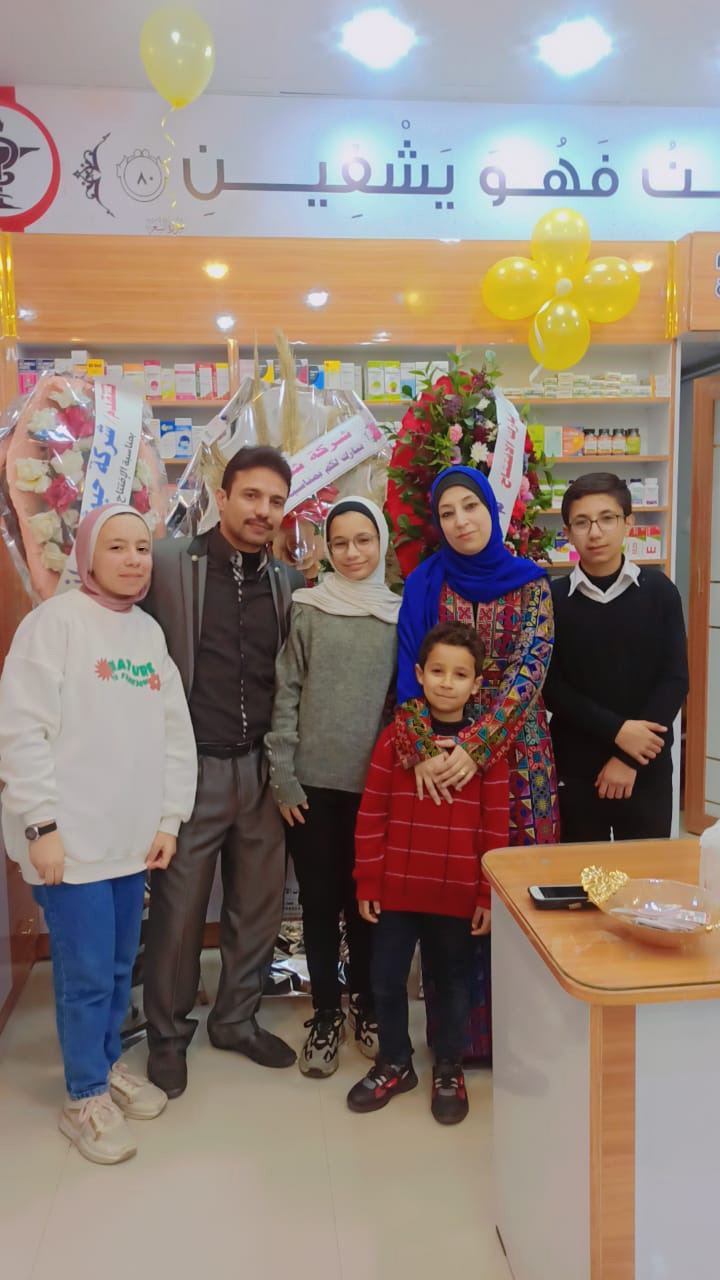
Before the genocide began, Zahed ran a teaching center and her husband managed his own pharmacy while their kids attended school. Their home shared a neighborhood with several international organizations
.
Mona Zahed stands with her husband Osama and children Muhammad, Sarah, Hayat and Zahid in her husband’s pharmacy in Gaza on the pharmacy’s opening day in September 2023. His pharmacy has now been destroyed by the Israeli military.Courtesy of the family of Mona Zahed

“Our life before the war was beautiful, Alhamdulillah. We enjoyed everything around us and were on the verge of financial stability. I taught at the center from 8 am to 5 pm,” Zahed shared. Her commitment to her children’s education was clear: “I would take a break from 10-11 am to cook and care for them before heading back to teach.” She even brought her young child, Zahed, along with her, proudly noting, “My children are the top in their classes, Alhamdulillah. I always tried to ensure that their education remained unaffected by my work or their father’s, but when the war hit, everything changed.”

Zahed says she’ll never forget the Israeli assault’s first day. “I was getting my children ready for school for their exams, and at first, we didn’t understand what was happening; we thought it was just rain or thunder. Confusion and worry set in as I kept them indoors while we followed the news, struggling to process the shock of the unfolding chaos. Three days later, our neighborhood, known for its towers and buildings, became one of the first bombed, prompting us to evacuate as the danger drew alarmingly near to our home.”

Amid the attacks, Zahed found creative ways to deal with the scarcity in her cooking. “During the genocide, I crafted recipes from the limited resources we had due to starvation and food shortages.” Despite the dire circumstances, she worked hard to uplift her children’s spirits. “They were satisfied with what I made, even eating meals they had previously disliked because they simply had no other choice.”

“Moreover, there was no gas, which made meal preparation incredibly time-consuming; we had to cook things in advance,” Zahed explains

.
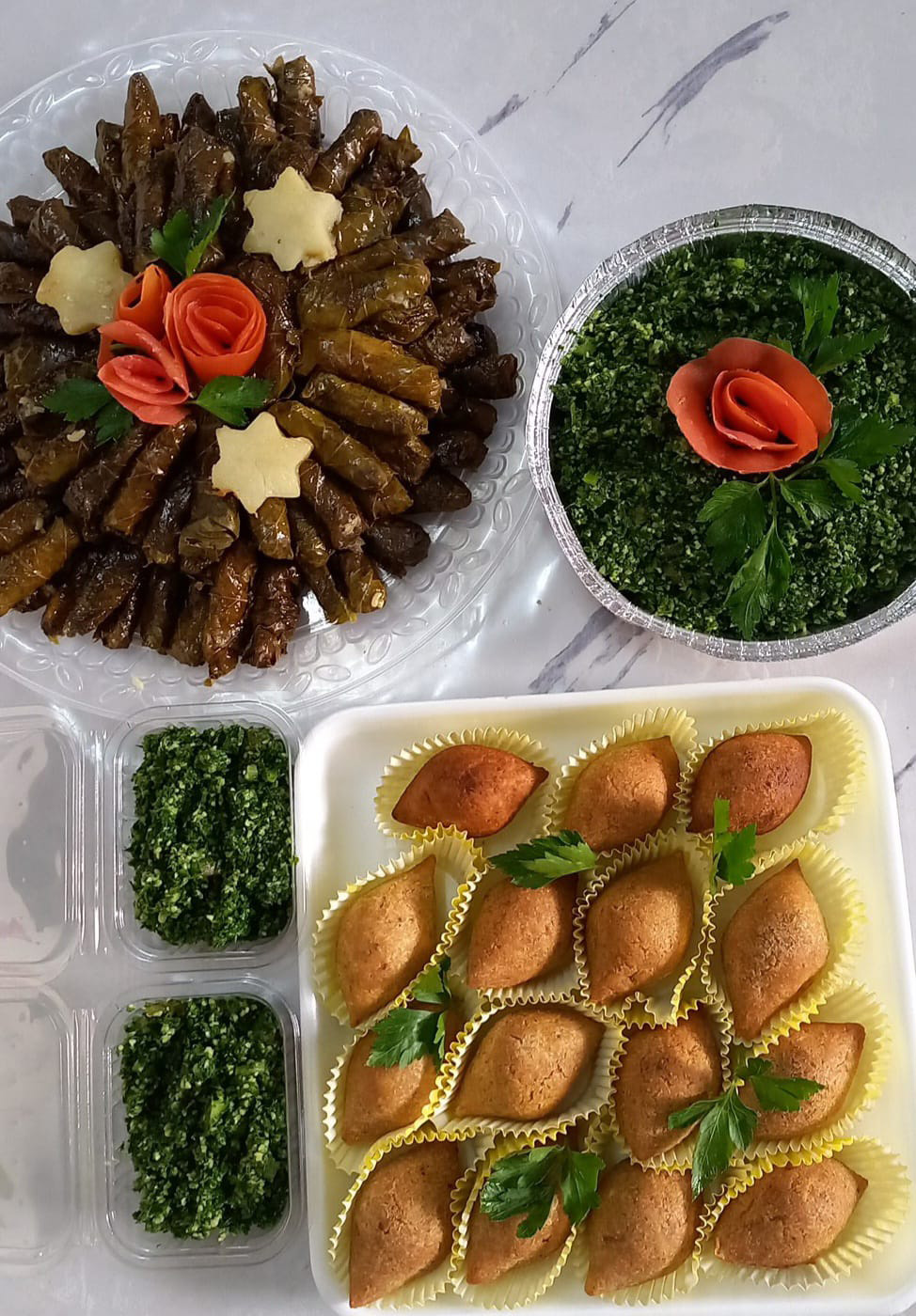
Mona Zahed prepares grape leaves, tabbouleh salad and kibbeh for delivery in August 2023 in Gaza.Mona Zahed

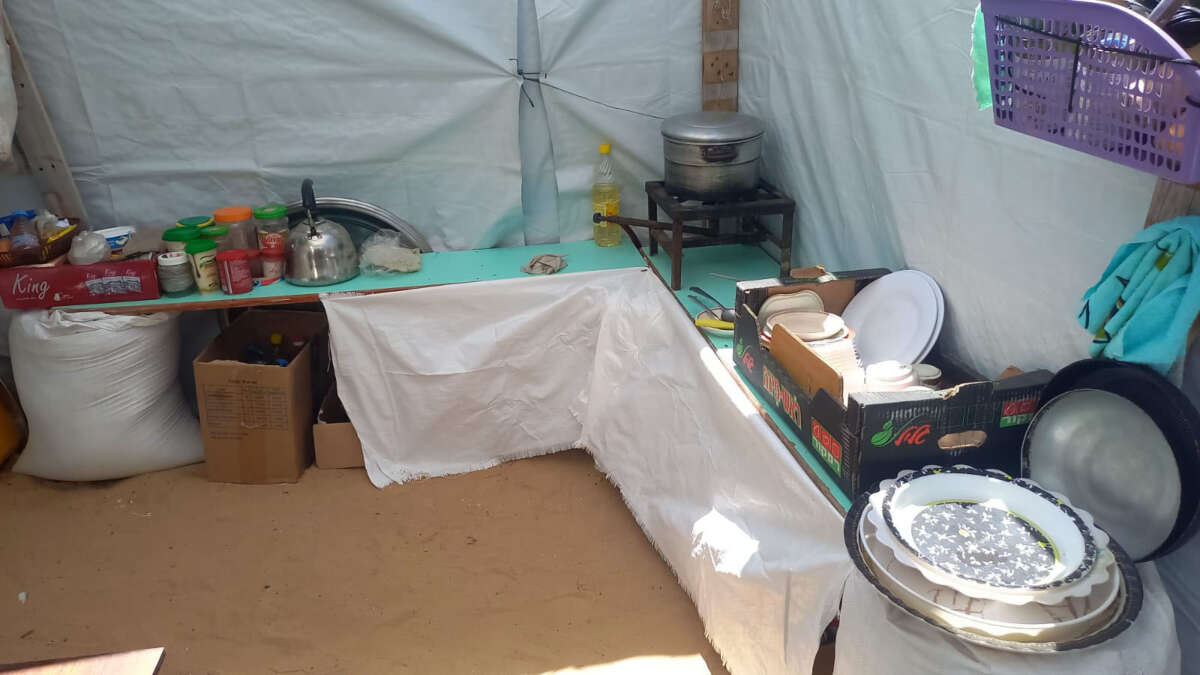
Having been displacement by the genocide, Gaza chef Mona Zahed now cooks in this small kitchen in a tent made of nylon. This photo is from January 2024.Mona Zahed

“Sometimes, when we found a single apple, we felt a wave of happiness, slicing it thinly to share among four of us once a week,” Zahed said. Necessity demanded innovation in her recipes: “When yeast was unavailable, I experimented with fermenting dough. With no fresh fish around, I used canned tuna to create fesikh, sometimes frying it and other times baking it with vegetables. I transformed luncheon meat into various dishes, frying it or crafting it into shawarma, while canned beef became a savory grilled delight with parsley and onion. I even added vermicelli to our lentil soup, constantly adapting to make the most of what little we had.”

Now two months into a total blockade on all aid into Gaza, tens of thousands of Palestinian children are in urgent need of medical care due to malnutrition.

Even these meals, with their alterations borne out of need, could be logistically difficult to put together. “Most of our food consisted of canned items, which were hard to find and often too expensive,” said Zahed. “As a woman and a mother, I bore a heavy responsibility during those [first] 15 months, looking after many people. Those were tough days, especially when we ran out of flour; it broke my heart to see my children without bread. We often spent our days eating just pieces of biscuits from aid packages, only two at a time per packet.”

These extreme food shortages were not unintended by Israel, but were deliberate — “a tactic of genocide,” according to a UN report from July 2024:

Israel made its intentions to starve everyone in Gaza explicit, implemented its plans and predictably created a famine throughout Gaza. Tracking the geography of Israel’s starvation tactics alongside Israeli officials’ statements confirms its intent. Israel opened with a total siege that weakened all Palestinians in Gaza. Then, Israel used starvation to induce forcible transfer, harm and death against people in the north, pushing people into the south, only to starve, bombard and kill people in newly created refugee camps in the south.

The consequences have been devastating. “Never in post-war history had a population been made to go hungry so quickly and so completely as was the case for the 2.3 million Palestinians living in Gaza,” the report stated.

Israel has also repeatedly targeted Palestinian cooks and food aid providers, killing those who are striving to feed a starving population.

Now two months into a total blockade on all aid into Gaza, tens of thousands of Palestinian children are in urgent need of medical care due to malnutrition. Dozens of Palestinians have died have died due to Israel’s starvation policy. Amid the longest and most encompassing blockade ever imposed on the besieged territory, international food organizations in Gaza have said their supplies are gone. Nearly 290,000 children may perish soon if food is not allowed in, Al Jazeera reported.

Before conditions further plummeted, Zahed found ways to prioritize her children’s nutrition. “Sometimes, I would take the leftover white rice from lunch, add spices and seasonings so that my children would accept it for dinner.” She made use of every available ingredient: “We used dry bread in lentil soup or in salads called ‘fattoush,’” showcasing her resourcefulness in ensuring her family’s sustenance amid scarcity.

Zahed explained to Truthout how the genocide has changed her. “The war affected me a lot, but it proved to me that I’m strong. It has made me older and taught me many lessons, placing many responsibilities on my shoulders, yet we remained steadfast.” Those responsibilities came under the most harrowing of conditions. “One of the most horrifying days was the night we were forced to flee our home when they planned to bomb the tower nearby. Even when I ask my children about their most terrifying memories of the war, they also mention this night.”

“Another terrifying moment was when we fled from Deir al-Balah to Khan Younis, traversing streets filled with tanks and snipers. We truly believed that it could be our last moment. With no other choice, we pushed through, surviving by a miracle while witnessing people being injured and killed right before our eyes.”

Zahed mourned the profound loss of Gaza’s beauty due since October 7, 2023. “Just a day before the war erupted, I strolled along the beach, expressing to my brother how lovely Gaza was while yearning for job opportunities and development. Now, Gaza feels like a graveyard; returning home, I barely recognized the streets, filled with sorrow as if we had regressed a century. We hope for a day when it can be rebuilt.”

“While the world sympathizes with us, many see us merely as numbers. Our suffering, perceived as normal to some, overshadows our identities; we are not just statistics but individuals with families and friends. The ongoing violence reduces us to mere figures, yet we are people deserving of a dignified life.”

Zahed’s book highlights Palestinian cultural tradition during a time when Israeli forces are trying to erase everything about Palestinian life. It is an attempt to save this heritage and traditional food even with the absence of some basic ingredients.
This page from Tabkha features an illustration by Carmen Garcia of Palestinian families cooking together.
Aphrodite Delaguiado

Despite the horrors surrounding her, Zahed found she could engage with her children through food: “My children were confident in my cooking. When we stumbled upon ingredients for a meal we hadn’t had in a long time, their joy was palpable as they exclaimed, ‘Mom, this is the Gazan food!’ — a phrase they often repeated.” She believes that her passion for cooking reflects her people’s resilience: “All recipes reflect the strength of the Palestinian woman. The war has shown us that we can find alternatives and create something from nothing. Throughout the hardship and starvation, it became clear that Palestinians possess an incredible ability to adapt and innovate in dire circumstances.”

Amid the struggles of displacement in Nuseirat camp, Zahed recounts the daily challenges her family faced while living in temporary shelter. “Living in a sixth-floor apartment, my son Mohammed would carry 20-liter gallons of water up the stairs as we needed about 4-5 gallons daily. We cooked over an open fire, relying on basic staples like rice, spaghetti and soup, often only having bread once a day due to the high cost of vegetables.” During these hardships, her passion for cooking brought her joy: “Whenever I cook, I feel a sense of happiness. Even during the war, people would reach out for my recipes, and it fills me with pride to help others in this way. I love crafting delicious meals, often picturing the ingredients before I start cooking.”


The cookbook wasn’t just about recipes — it’s about preserving culture in the face of devastation.

Tabkha was inspired by a Japanese friend, who encouraged her to compile a diary of recipes for sale. In the book, she included 15 traditional Palestinian recipes, covering both desserts and savory dishes. In the midst of war, she took the initiative to document her culinary legacy, creating videos that showcased her improvisation with the ingredients around her. Her cookbook features a variety of dishes, including both desserts and savory meals, along with what she refers to as the “war alternatives” — all based on innovative recipes inspired by traditions passed down from her ancestors. It also showcases the work of 21 artists who illustrated the recipes, each in their unique styles.

“I loved to put that in a book because we want to reach our voice to the world. Every culture has its guide, and when food recipes spread widely, people start getting attracted to it and start to ask who created it,” Zahed said. Everything about putting the book together — from the improvisation to the ancestral knowledge to the spread of Palestinian culinary tradition — serves as an act of resistance during genocide, as the Israeli state attempts to erase Palestinian existence.

The cookbook wasn’t just about recipes — it’s about preserving culture in the face of devastation. “Our recipes tell the world stories of our history, cause and that we exist. Maqlouba, Maftool, and Sumaqiyaa are all dishes that represent our people. Each time Palestinian food becomes a trend online and I see people from all over the world making it, I feel proud that the world knows Gaza and that we are not forgotten,” Zahed said.

Through creative improvisation, inherited knowledge, and the richness of Palestinian food, the book documents life, love and identity as Israel attempts to destroy and starve Gaza

.
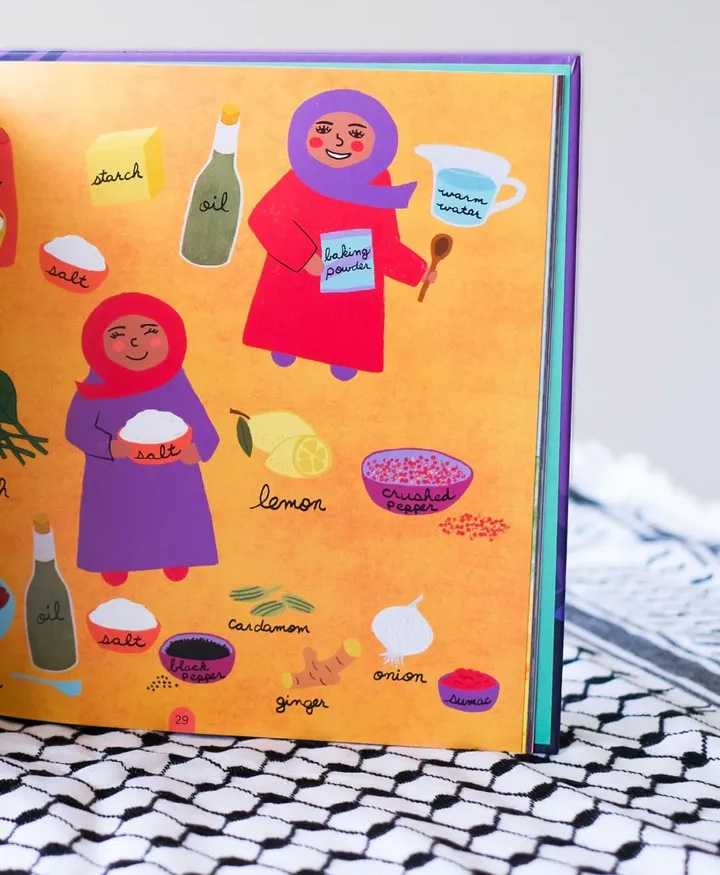
This illustration by Grace Ann Ekstrom, which is featured in Mona Zahed’s cookbook, depicts the ingredients used to make mahwi. The drawings of the two girls are inspired by Mona’s daughters, Sara and Hayat.Aphrodite Delaguiado

Zahed expressed a strong desire to restart her culinary explorations. “I want to work again on my cooking project, but gas is expensive, and other materials are hard to find.” Still, Zahed envisions a future where she has her own business — a shop to share her food, and a kitchen specifically for women.

“My message to the world is that Palestinians in Gaza are humans who feel and have dreams,” Zahed said. “We deserve to live peacefully. We will start again. We are strong people who don’t lose faith. We have hope.”

Mona Zahed bakes spinach mahwi in a clay oven, continuing to cook in a tent in Gaza in March 2024 after having been displaced by Israeli attacks.Mona Zahed
Displaced from her home, Mona Zahed prepares a hummus fatteh meal using canned chickpeas, tahini and canned luncheon meat due to the lack of access to fresh meat in Gaza in July 2024.Mona Zahed
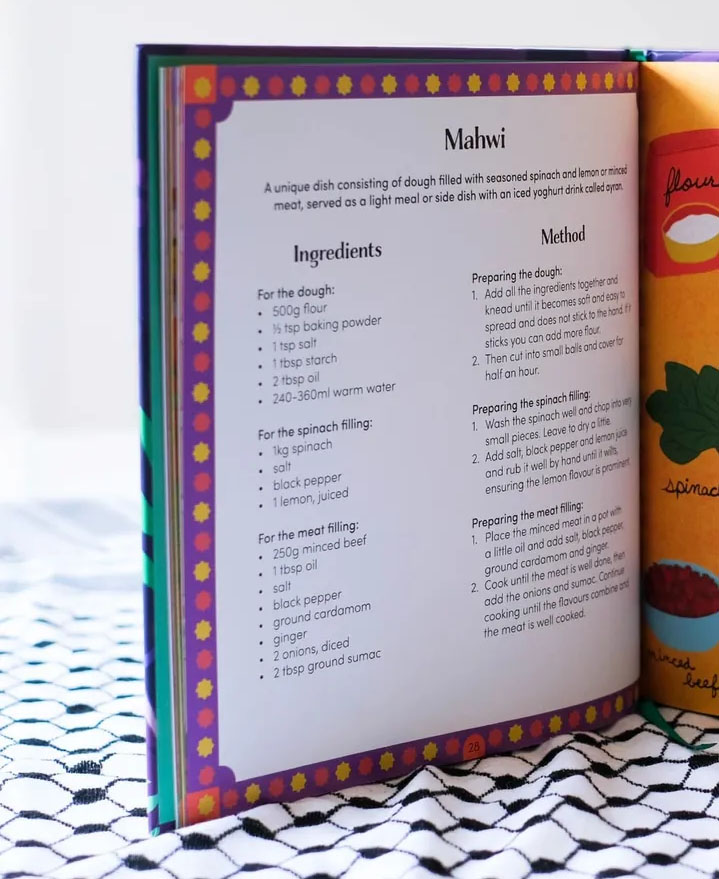
This is a sneak peek of Mona Zahed’s recipe of the Palestinian dish mahwi on February 2025.Aphrodite Delaguiado

Mona Zahed’s cookbook includes this page featuring a photo of Mona and Osama with their children before the war and thanking readers for their support.
Aphrodite Delaguiado


This article is licensed under Creative Commons (CC BY-NC-ND 4.0), and you are free to share and republish under the terms of the license.


Eman Alhaj Ali is a Palestinian freelance journalist, writer, translator, and storyteller from Gaza. Her writings appeared on a variety of international and local websites, such as The New Arab, Electronic Intifada, Al Jazeera English, The Nation, Mondoweiss, Middle East Eye and many others. She is a member of We Are Not Numbers, and contributed to a variety of books and anthologies, such as We Were Seeds and We Are Not Numbers: Voices of Gaza’s Youth. Writing and reading are her passions.