Sunday, May 11, 2025

Anti-war left?
Published May 9, 2025
DAWN


The writer teaches at Quaid-i-Azam University, Islamabad.

AS in the past, the evolving war-like situation in the subcontinent has triggered cries in both India and Pakistan for all internal political differences to be forsaken in the name of ‘national unity’. Amongst the most notable examples of what this means in practice are the public statements issued by India’s two major left-wing parties, the Communist Party of India (CPI), and the Communist Party of India-Marxist (CPI-M), following India’s strikes inside Pakistan on May 7.

Both parties have aped the Modi regime’s narrative about Pakistan harbouring ‘terrorists’ and the righteousness of targeting the ‘infrastructure’ (read: civilians) responsible for the Pahalgam attacks of April 22. The statements are uncritical of Indian state policy and only cursorily mention the need for diplomatic solutions to avert war.

Other Indian opposition parties, including the Congress, have expressed similar positions. But the parliamentary communist parties, with a long history of challenging state nationalism whilst also being principally anti-war, appear to be entering unchartered territory.

Bear in mind that the CPI and CPI-M have both remained largely critical of the Indian government’s support for Zionist war crimes against Palestinians since October 2023. They have repeatedly demanded that India re-adopt its historical policy of support for Palestinian self-determination, refusing to be drawn into the dominant discourse of dehistoricising Palestinian militancy and engaging in blanket condemnation of Hamas as a ‘terrorist’ organisation.

The CPI and CPI-M are threatening their very own political creed.

Even if India’s otherwise robust left has been less willing to challenge the Indian state with regards to the question of Kashmiri self-determination, it has at various points acknowledged the organic roots of militancy in held Kashmir rather than just pawn off all responsibility to the proverbial ‘foreign hand’. But by taking the positions they have vis-à-vis burgeoning conflict with Pakistan, the CPI and CPI-M are threatening their very own political creed.

This is no small matter, especially when looked at from the perspective of the much smaller and embattled Pakistani left. To oppose state militarism in this country can be a perilous endeavour, as evidenced by the repression faced by progressive forces. But despite the propaganda in official and online media, left-progressives have not retreated from their principled positions.

It is not just in India that it is becoming more difficult for what can broadly be called the anti-war left to survive, let alone thrive. Hindutva is not the only extreme ideology to have taken hold through ‘democratic’ institutions. We all live in political environments dominated by an increasingly xenophobic right wing, undergirded by entrenched military-industrial-media establishments. But this is exactly why surrendering to majoritarian sentiment is anathema for anyone committed to a long-term horizon of justice, egalitarianism and lasting peace.

The CPI-M ought to have learned from its own historic defeat in what was once its bastion of West Bengal in 2011. Having ruled one of India’s largest states for over three decades, its downfall was triggered by a symbolic decision in 2007 to dispossess thousands of peasants in Nandigram so as to set up a special export zone. The peasantry was the bedrock of CPI-M’s politics, but by acquiescing to the then dominant logics of neoliberal globalisation, the party turned its back on its social base, and signed its own death warrant.

In the intervening two decades, the CPI-M has been unable to recover lost ground in West Bengal, though re­­-taining governmental po­­wer in Kerala. The soc­i­a­list left in Pak­is­tan is not curr­e­ntly equip-ped to take state power, so parliamentary communism in India still represents an inspiration of sorts. But by unequivocally supporting the Modi regime in its warmongering, both the CPI-M and CPI have greatly reduced their lustre.

At the time of writing, India has further escalated tensions by flying drones into major Pakistani cities, triggering panic and creating further space for hawkish elements in the Pakistani political and intellectual mainstream. The drones are reportedly imported from Israel, a symbol of the growing synergy between Zionism and Hindutva. Surely it is this nexus that Indian progressives should be seeking to challenge.

At the very least, those on the left in the subcontinent and beyond must stop uncritically deploying the language of ‘terrorism’ at the behest of the state, thereby trampling upon the real histories of structural oppression which explain so many conflicts in our region and world. In the fog of war hysteria and disinformation, this much clarity is a must.

The writer teaches at Quaid-i-Azam University, Islamabad.

Published in Dawn, May 9th, 2025
Modi, Kashmir and Pakistan

Khurram Husain 
Published May 8, 2025
DAWN
The writer is a business and economy journalist.


INDIA and Pakistan are being driven, inexorably, towards a confrontation that neither side wants but neither side can avert. The drivers of conflict have multiplied, the limits tested by these episodic stand-offs have been stretched, and the points of contact between their militaries during the kinetic manoeuvres in each of these stand-offs has multiplied.

From the first such stand-off, perhaps in 1990, till today, there is an unmistakable trajectory of escalation. What is driving this?

One of the big drivers is India’s attempt to end its difficulties in occupied Kashmir using a violent development model that has lain behind the rise of Narendra Modi. The model was born in the early 2000s that saw two pivotal developments in both India and Pakistan. Up until 9/11, Pakistan was being pushed increasingly towards global isolation and its economy was depleted to near breaking point. The country had undergone three rounds of debt rescheduling and just finished a gruelling, short-term Stand-by Arrangement with the IMF that left the populace battered with unemployment and sharply rising energy costs. There was no further growth path for Pakistan in those years other than deeper structural reform, which was proving too heavy a burden even for a dictator with near absolute power.

However, 9/11 changed all that overnight. Instantly, Pakistan went from being an international pariah to a front-line state in a superpower’s war, and was eventually crowned with the status of ‘major non Nato ally’. The volume of money that poured into the country, coupled with the generous terms of debt rescheduling extended by the Paris Club in December 2001, impacting a total debt stock of $12.5 billion, allowed the regime of Gen Musharraf to pump growth to unprecedented levels, creating a bubble economy that made more fortunes for more people than any similar period in the country’s history.

Modi’s model of development rested on the ability to efficiently dispossess people and take land required for large-scale projects.

This sudden reversal of fortunes in Pakistan came as a rude shock to our neighbours in India. Over the course of the 1990s, India and Pakistan were locked in a stand-off over Kashmir, which left India increasingly embattled by the uprising in the occupied territory and Pakistan in the grip of sanctions and isolation. India accused Pakistan of sponsoring the uprising in occupied Kashmir, and of providing training and cover to militants in the troubled valley. At one point, Pakistan came close to being placed on the State Department’s list of sponsors of terrorism, a designation that would have had far-reaching implications for the country had it come to pass.

By 2001, India’s policy of imposing a crushing isolation on Pakistan was finally bearing fruit when 9/11 came along and reversed it all. This was a big shock to the Indian foreign policy establishment, which had shouldered a tremendous cost in men and materiel for repression of the uprising in occupied Kashmir, under the hopes that pressure on Pakistan would eventually cause the uprising to die down. All those hopes were dashed once Pakistan became a superpower favourite again.

The Congress party had seen its fortunes sag throughout the 1990s, losing power to the BJP by the end of the decade. But in 2004, it scored a surprising victory at the polls and renewed its electoral strength again in 2009 by increasing its seats in the Lok Sabha from 153 to 206.

Yet trouble brewed behind this double movement in the early 2000s, which had seen the return to power of the Congress party in India and a reversal of Pakistan’s fortunes. This was when Modi made his appearance on the big stage of Indian politics with the Gujarat riots in 2002, cynically using communal hate and violence as a tool to grab power. Once in power, Modi unrolled a model of violent development, which fused rent-seeking alliances with billionaires at the federal level, with high levels of public expenditure on infrastructure projects to promote ports, power plants, luxury urban housing developments and more. This model of development rested on the ability to efficiently dispossess people and take land required for large-scale projects, high levels of government spending and a close, symbiotic relationship between wealthy elites, the party apparatus and the government machinery of India.

Fortunes changed following the Great Financial Crisis in 2008. The Congress party was at a loss for ideas on how to restart growth in India, and Musharraf’s growth bubble burst comprehensively while Pakistan’s troubles with the US mounted. As Pakistan sank once more into its pre-9/11 state of isolation coupled with a depleted economy, the Congress party hurtled towards its most stunning electoral defeat ever in 2014. That was Modi’s year, when he also brought this model of violent development as his party’s vision for achieving a final resolution of New Delhi’s long-running Kashmir problem.

Two ideas were central to this vision, and both have a pedigree in India’s policy conversation going back at least to the early 2000s. One was to revoke Kashmir’s special status granted under Article 370 of the Indian constitution. The second was to cast off the constraints of the Indus Waters Treaty. With both these done, the government would be in a better position to use public funds to initiate large-scale infrastructure projects through which to select winners and losers within Kashmir. The idea was to reward those who would play ball with the government, and crush those who wouldn’t.

These are the broad developments that imparted such inexorable momentum to the episodic return of stand-offs between India and Pakistan. Modi’s India wants to make Kashmir its own, regardless of the wishes of Kashmir’s inhabitants. Pakistan is determined to thwart this ambition, regardless of the cost it has to pay along the way. Neither side can win in this situation. Yet none can afford to lose either.

The writer is a business and economy journalist.

Published in Dawn, May 8th, 2025
War and lies
DAWN
Published May 10, 2025

THE suspension of disbelief required to follow the Indian media these days must qualify as an extreme sport. One imagines viewers needing a cup of tea and a lie-down afterwards, if only to reorient with reality.

Consider, for example, the breathless ‘coverage’ that has been aired by several Indian news channels regarding their military’s campaign against Pakistan. During Thursday night’s transmissions, one claimed that Islamabad had fallen, another that Peshawar had been bombed; one that Lahore was in the crosshairs of Indian tanks, and another that the Karachi port was in flames. One promised that an F-16 had been shot down, while another that Prime Minister Shehbaz Sharif had surrendered. But it was the gaggle of ‘experts’ on a live Times Now broadcast, excitedly proclaiming that a ground invasion of Pakistan was underway, that truly captured the absurdity of it all.

Truth is the first casualty of war, but it is nonetheless jarring to witness its assassination on such an industrial scale. That the fog of war obscures the truth is understandable, but for newsrooms to actively add to the fog rather than try to pierce it, less so. That said, the media on this side of the border is also not above blame. A few television channels and the so-called experts featured on them have been acting irresponsibly. They must avoid unconfirmed or unverified reports and concentrate more on sensible reporting.

But at least Pakistani media is publicly censured when it is unable to do justice to its duty. Many will openly state that they do not trust it to report truthfully and reliably and will be more open to what independent sources and foreign media have to say. One wonders if there is a similar level of self-awareness next door, where major news networks seem engaged in a race to outdo each other in patriotic theatre, unmoored from any discernible restraint.

Reports that social media platforms like X and Meta have been ‘legally’ coerced into blocking thousands of accounts to protect New Delhi’s narratives should invite global concern over the health of the world’s so-called ‘largest democracy’. More so because the ‘information’ being fed to the Indian people is patently false, dangerously misleading, and designed to whip up base sentiments. Media irresponsibility can lead to the creation of unrealistic expectations in the minds of ordinary people, and these expectations, when unmet, often turn into pressure on leaders to ‘do more’ against the perceived enemy. This is how skirmishes escalate into battles, and battles into full-blown wars. It bears repeating that in times of crisis, it is the journalists’ job to inform, not inflame. The dereliction of this duty has dangerous real-world consequences. Media on both sides of the border would do well to heed this warning.

Published in Dawn, May 10th, 2025
India must rethink

Ishrat Husain 
Published May 10, 2025


The writer is the author of Development Pathways: India, Pakistan and Bangladesh 1947-2022.

THE April 22 Pahalgam incident has evoked a hysterical reaction from India, which has attacked Pakistani and Azad Kashmir cities killing innocent civilians, including children, and damaging the Neelum-Jhelum hydel works. Within five minutes of the Pahalgam attack, Indian media started pointing fingers at Pakistan alleging it had enabled the terrorist attack. Two weeks later, India attacked without providing a shred of evidence of Pakistan’s alleged involvement. The purpose of this article is to urge Indian policymakers to avoid prolonging their actions as the political, social and economic costs for their own country are substantial, and instead, examine their policy stance dispassionately.

India ranks fifth among global economies and has an impressive record of rapid economic growth, which has lifted several hundred million out of poverty. It is one of the world’s leading exporters of IT and IT-enabled services, and aspires to become a developed economy by 2047, with the size of its economy projected to range between $23-35 trillion. This requires an uninterrupted and continuously upward moving growth curve. India is also working hard to become a permanent member of the UN Security Council and is among a group of developing countries leading the movement towards a multipolar world with the expanding role of BRICS.

Given this wide range of ambitions, any attempt to disrupt regional peace through kinetic or non-kinetic actions will derail it from its chosen path. Peaceful and cordial relations with neighbouring countries, on the other hand, would enhance the prospects of attaining these ambitions.

There have been past instances, such as in the 2001-02 stand-off, when Indian policymakers made sensible decisions and withdrew from the path of prolonged confrontation. The Indian troops were mobilised in large numbers in 2001-02 along the Pakistan border and as Zahid Hussain recently noted “there was an imminent threat of a full-fledged war between the two countries, but sanity prevailed. Not only was war prevented, but a more substantive peace process between India and Pakistan was also witnessed”.

The economic costs of military adventures, along with at least six other channels, can adversely affect the trajectory of India’s path towards prosperity and influence as a regional power. Elevated risk perception, trade routes and supply chain disruptions and uncertainty about the future would activate the channels highlighted below.

Any attempt by India to disrupt regional peace will derail it from its chosen path.

Cost of military adventures: Foreign affairs forums on the economic impacts of a full-scale India-Pakistan war estimate the daily cost of mobilising operations could reach $670 million with broader economic losses potentially reaching $17.8 billion, which is equivalent to a 20 per cent GDP contraction over four weeks of conflict. According to Antonis Bhardwaj, a short-term conventional India-Pakistan war could cost between INR14.6bn and INR50bn a day in direct military expenses. A prolonged conflict, accounting for broader macroeconomic impacts could lead to economic losses exceeding $17.8bn daily.

Global capability centres:
1,800 offshore corporate offices owned by hundreds of foreign-based MNCs operate in India; they generated earnings of $65bn in 2024. During the last few years, over 150 GCCs have provided back-office, legal, accounting, engineering, design, product development, consulting and architect services, and they act as R&D centres. Many other corporations are thinking of following suit. The principals of existing and planned centres may have second thoughts if political tensions or cross-border incursions continue from time to time.

Tourism:
India receives 10m tourists every year recording a growth rate of 20pc, contributing $30bn in foreign exchange earnings. The tourist industry has a high multiplier effect on local economies and is a source of significant employment in hospitality, transport, entertainment, handicraft and many other ancillary services. Empirical evidence shows that there is a drop in tourist visits even if there is a semblance of disturbance or violence or threat in the host country. Thus this 20pc annual growth in tourism may be lost.

Financial markets
: External capital flows, FDI, foreign portfolio investment, external commercial borrowings, nonresident Indian deposits and workers’ remittances have contributed to the build-up of large foreign exchange reserves and financed the large excess of capital flows over and above those required to finance the current account deficit. Foreign investors own about $800bn worth of Indian stocks — roughly 16pc of India’s market cap. Foreign funds are not insensitive to the larger political and economic ecosystem. Financial markets would experience capital flight. Moody’s analytics estimates that potential foreign investment outflows of $10-15bn would take place within the first month of conflict.

Defence spending:
India has allocated $78.7bn in the FY25 budget for defence. Many voices are pleading to further increase the allocations to modernise and upgrade equipment. An increased threat perception of incursions, war or skirmishes across the LOC or international borders may, in fact, result in larger budgetary allocations for defence. In a country where 800m people still receive subsidised food ration it would be unfortunate if the resources are diverted from welfare to military goods.

Foreign direct investment: India is one of the major recipients of FDI with a cumulative amount of $1.05tr. These flows have increased 20 times from FY01 to FY24 from $237m in 1990 to $71bn 2024. The RBI Bulletin has observed that India is poised to benefit from supply chain realignments, diversified FDI sources and engagement with global investors seeking resilience and scale, given its already established trade linkages. These linkages and realignments would be at risk of rupture if confidence in the economy falters as a result of worsening cross-border skirmishes.

Indus Waters Treaty: The IWT’s unilateral abeyance is hardly justifiable on moral and legal grounds. Given the growing hazards of climate change the two countries along with China and Bangladesh should negotiate an arrangement where food security, water availability and the energy needs of the lower riparian countries are ensured. A potential humanitarian crisis — for which India would be blamed — should be avoided.

Many neutral observers have opined that given Pakistan’s struggle to put the economy on track, its fight against TTP and BLA terrorism and its banning of the Lashkar-i-Taiba and other extremist groups and prosecution of their leaders, it is highly implausible that it would indulge in proxy wars.

Published in Dawn, May 10th, 2025


Why Modi keeps pushing India to the brink of war with Pakistan


The lesson of Modi’s entire public life has been that playing with fire benefits his politics — from the inferno of Gujarat in 2002 to Muslim massacres in Delhi in 2020.
Published May 10, 2025 

Around two months before his latest derangement, India’s Narendra Modi paid tribute to his RSS inspiration, Veer Savarkar. As the founding father of Hindutva, Savarkar’s ideas have long informed Modi’s actions.

And those ideas are pretty basic. “India should follow the German example to solve the Muslim problem,” Savarkar said in 1938, “…Germany has every right to resort to Nazism and Italy to fascism — and events have justified those -isms.”

Given such events reduced Europe to the bloodlands of World War II, Modi now wishes the same for South Asia: Pakistan and India have been closest to war in half a century; fighter jets tango overhead; and a new generation wakes up to the sirens their grandparents once had to.
At the brink of war, again

But we’re here now, and it mostly has to do with Delhi’s own neuroses: the rabid base, the status anxiety, and an occupation that refuses to resolve itself. Modi’s annexation drive in Kashmir was demographic change 101; the “Muslim problem”, to quote Savarkar, would be resolved, even if India had to shred its own supreme law to do it.

But no one asked Kashmir’s sons and daughters. The Pahalgam attack wasn’t a cause; it was a reply — one that came on the heels of mass murder and repression.

Even here, however, Pakistan’s response was to condemn it, call for a neutral probe, and talk up peace. India’s response was to try and choke the water supply to an entire civilian population, fire missiles at a three-year-old girl, and name its operation after the hair choices of married Hindu women.

Because Modi takes the same policy decision each time there’s a Kashmir crisis: to externalise it to Pakistan, and then scream revenge. For Uri in 2016, for Pulwama in 2019, for Pahalgam today. The evidence provided — for an accusation that could lead to nuclear war and the end of the world: none yet.

Instead, the prime minister has again rushed to the border on fumes: at the close of India’s saffron decade, Modi has fed off his manic base, and his base has fed off him — peace is political suicide. Every election demands a war, and every corpse is campaign fodder.


More the pity for his Western allies, long banking on India as the region’s net security provider. But while the ’20s may vary from century to century, a Nazi is still a Nazi.

And no Nazi ever stopped his ingress without a punch to the face: courtesy the excellent Pakistan Air Force doing its job, and only its job (other services take a hint), five planes were shot out of the sky in the middle of their bombing run. CNN, Reuters, and French intelligence would also confirm the first-ever demise of a prize Rafale, India’s shiny new toy.
Memes against drones

Hence, also, the second problem: in the same way that Modi’s revenge in 2019 climaxed with wing commander Abhinandan getting checked for microchips on his return from Wagah, the 2025 remix saw Pakistani pilots use Chinese tech to down million-dollar death machines. As Western defence contractors looked on aghast, the global war economy changed overnight.

Of course, much of this is the world the West has made for us: amid the rivers of blood in Gaza, amid the collapse of the post-1945 world order, amid free reign to genocidairres in Tel Aviv and to brutes in Moscow. Asked about the Pak-India conflict, vice president JD Vance shrugged, “None of our business”.

So be it: Pakistan would have to stand up to bullies on its own. Now it has — Modi’s war kicked off with the IAF losing five warplanes, all to self-defence. Before Pakistan could even mention retaliating, Operation Sindoor had become Operation Duckshoot.

None of this was meant to happen: the lotus boys have been trying for escalation for some time now — a goofy theory they’ve borrowed from fellow dimestore Nazis in Israel. Borders, balance, proportion, none of it means anything. All international law is to be discarded, while targets are to be inflicted with shock-and-awe violence.

Just that it hasn’t worked there, and it especially isn’t working here. As one US defence czar put it, “Anyone who thinks they can control escalation through the use of nuclear weapons is literally playing with fire.”

But the lesson of Modi’s entire public life has been that playing with fire benefits his politics — from the inferno of Gujarat in 2002 to Muslim massacres in Delhi in 2020. Where this throughline stops is Pakistan: at the Muslims that got away, and learned to shoot back.

Repelled at the outset, Delhi has tried sating its far-right hordes in other ways. It switched to suicide drones swarming Pakistan’s cities. It tried to change the subject online, by unleashing its IT zombies. (The usual Hindutva triple feature followed: fake news, rape threats, and pornography.)

Yet headlines across the world carried on: this jet, that jet, Dassault stocks versus Chengdu’s. Even The Economist, an otherwise reliable Pakistan-basher, pointed to the conflict’s core cause: “India needs to end its self-defeating repression of the part of Kashmir it controls.”

India’s legacy media didn’t fare much better. After destroying Karachi port — if entirely on the Internet — war hawk Barkha Dutt took cover in a blacked out hotel, where she told us the “moonless night did not even allow for a sliver of light” — nor, perhaps, a sliver of integrity. By the time morning broke, the only thing India had managed to end was Fawad Khan’s Instagram.

If there was a story in all this, it was, as always, Pakistanis themselves. Facing neo-fascists next door and indifference abroad, they responded with memes and jokes. When force was called for, they mostly urged it in defensive terms. They called out their own state for its censorship, for its unrepresentativeness, for its tone-deaf ministers, yet rallied behind the white and green. They mourned seven-year-old Irtiza Abbas Turi, while refusing to mirror Hindutva’s poisonous demonisation of children. And they refused to part with their humanity, wishing for peace from start to end.


The author is an advocate at the Lahore High Court. He is a partner at Ashtar Ali LLP, where he focuses on constitutional law and commercial litigation. He is also a columnist at Dawn.


SMOKERS’ CORNER: BETWEEN DOGMA AND SURVIVAL

DAWN
May 11, 2025 

Illustration by Abro


In a 1956 essay, the British writer Aldous Huxley wrote, “At least two thirds of our miseries spring from human stupidity, human malice, and by the great motivators and justifiers of malice and stupidity: idealism, dogmatism and the proselytising zeal on behalf of religious or political idols.”

Huxley wrote these words just 11 years after the end of World War II. The memory of the horrors of that war would have still been fresh in his mind — such as the memory of an idealistic programme in Nazi Germany to create a ‘1,000-year Reich’ founded on the supposed intellectual, spiritual and physical ‘superiority’ of the white ‘Aryan race’, which was ‘destined’ to rule supreme after vanquishing ‘inferior’ races.

Such beliefs were concocted by the Nazis to motivate a polity that was struggling to come to terms with the ‘humiliation’ that their country had suffered in the First World War. Then, in the late 1920s, Germans became victims of a rapidly crumbling economy. So, a lot of them quite liked the idea of being told that they were a superior race, led by a ‘strongman’ (Hitler), who shaped himself not only as a ‘fearless leader’, but also as a messianic figure whose impulse, will and wisdom would put in place the building blocks of the coming 1,000-year Reich.

Therefore, the core theme in most of Huxley’s post-war writings was the manipulation of whole societies through ideologies that harden to become dogmas. These dogmas are then given a sacred status. Huxley was most concerned by the fact that this process diminishes the ability of critical thinking in societies because the education that is imparted in schools is more about indoctrinating ideologies and dogmas rather than about sharpening and expanding the intellect.

In an age of rising populism and fragile states, Pakistan’s ‘hybrid system’ may be less about democratic ideals and more about national survival and political pragmatism

But doesn’t it take the indoctrination of one ideology to dislodge another?

Soon after World War II, democracy was pitched and romanticised (by the West) as an ideology against those ideologies that stifle thinking and ‘natural rights’. But what the world has been witnessing from the 2010s is an adverse reaction to democracy. This reaction is manifesting a renewed interest in many people in stiffer ideologies, even to the extent of them desiring to be ruled by messianic figures and ‘strongmen’.

This is mostly emerging in the shape of populism. Populism is often described by political scientists as a ‘thin-centred ideology’, or an albeit clumsy, theatrical style of politics that borrows from other ideologies. Nevertheless, today it is gleefully devouring democracy.

Interestingly, there is a school of thought that suggests that by borrowing heavily from the right, clumsy modern-day populism has even begun to erode mainstream conservatism and conventional right-wing politics. However, the other (more alarming) view is that, clumsy or not, populism will lead to the return of systematic fascism and totalitarianism.

Keeping in mind the way populism is causing some serious social, economic and political disruptions in established democracies (in Europe, the US and India) — imagine what it may end up doing in developing democracies such as Pakistan. Actually, one has already seen what it did before it was uprooted — not by another ideology — but by an ‘-ism’ that is often not considered to be an ideology as such: (political) pragmatism.


Ideologies are systems of beliefs and values that shape understanding of the world and guide actions. Political pragmatism is an approach focused on the practical consequences and usefulness of ideas and actions. Idealists and romantics detest it. They call it ‘centrism’. They do so because they can’t help but view things through an ideological lens alone. Centrism is an ideology, but it is different from political pragmatism, which isn’t one.

I will try to demonstrate this by making a case for political pragmatism as an effective deterrent against populism in Pakistan. This political pragmatism is manifested by what we now call the ‘hybrid system’ that produces ‘hybrid regimes.’ Hybrid regimes — at least in the context of Pakistan — are governments that are ‘democratic’ but in which state institutions such as the armed forces are ‘allowed’ to become important stakeholders in the decision-making process.

Ever since the 1990s, Pakistan has had hybrid regimes. But the hybrid system that the military establishment (ME) began weaving from the early 2010s was almost officially declared as a recognised system in 2018. It had serious teething problems, though, mainly because the ME chose to pick populism as a ‘useful idea.’ Ideologies, including thin-centred ones such as populism, do not gel well with pragmatism.

Therefore, by 2019, the populism-centred hybrid system began to trigger deep structural conflicts, until the ME decided to pull out the system’s populist drive and replace it with the experience of established mainstream parties that are inherently pragmatic.

The hybrid system was not discarded. It remained in place but, this time, instead of pretending to be based on an ‘ideology’, it is justifying itself as a necessity to maintain economic and political stability, something It has somewhat succeeded in achieving. It does not have any idealistic pretensions, other than that of the textbook nationalism kind. It is largely pragmatic and antithetical to any kind of populist politics.

Of course, as expected, those who were ousted by it, and the usual cast of idealists and romantics, are constantly castigating it. A lot of their criticism does carry weight. But, I also believe, there is nothing so terribly flawed in the argument that the hybrid system as it is today is indeed a necessity — at least until threats posed by populist politics, economic fragility, insurgencies in Balochistan and Khyber-Pakhtunkhwa, and by India, are largely warded off.

This needs to be done (and is being done) in a realistic and pragmatic manner. We can all return to play with ideology later, when actual threats are actually mitigated.

Published in Dawn, EOS, May 11th, 2025


UK Increases Funding and Areas to Spur Offshore Wind Energy Development

offshore wind farm
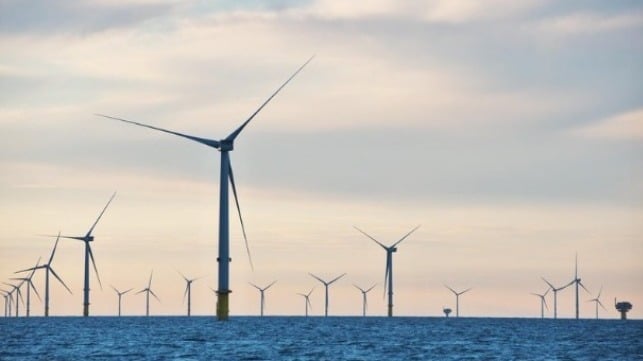
UK is taking more government steps to spur offshore wind development (Vestas)

Published May 9, 2025 5:20 PM by The Maritime Executive


Offshore wind energy continues to be a key portion of the UK’s plan for renewable energy with the government announcing on May 9 that it will expand funding and the available areas in response to strong demand from the industry. The UK continues to be the leader in Europe and the second largest globally with nearly 15 GW currently installed, while the government has set a target to reach 50 GW by 2030.

This week, the plan appeared to be in jeopardy when Danish developer Ørsted said it had decided to shelve plans for the fourth phase of the Hornsea project. Located 75 miles off the east coast of England, the first phase of the project started generation in 2020 with 1.2 GW of capacity, followed by phase 2 in 1.4 GW in 2022. Construction is underway on Hornsea 3, which will add 2.9 GW, while the now-shelved fourth phase was to provide an additional 2.4 GW. Ørsted cited the continued increase of supply chain costs, higher interest rates, and an increase in the risk to construction and operation on the planned timeline.

Secretary Ed Miliband, heading the Department for Energy Security and Net Zero, countered today asserting that the government continues to receive strong interest for the development of offshore wind energy projects. He said hundreds of bids have been received in the latest government scheme, a “strong signal that industry supports the government’s clean power by 2030 mission.” 

Following higher than expected demand, the Energy Secretary said the government was going to increase funding in its Clean Industry Bonus program from the planned £200 million ($266 million) to £544 million ($724 million). The award winners will be announced shortly.

The Clean Industry Bonus program will provide financial rewards for offshore wind developers that prioritize investments in regions that most need clean energy. The government points to the opportunities to aid traditional oil and gas communities, ex-industrial areas, ports, and coastal towns. According to the government, the program will support cleaner manufacturers, new upgraded factories, port infrastructure, and more business for UK supply chains. This and other government support efforts are projected to spur up to £9.3 billion ($12 billion) in private sector investment over the next four years.

“Now is the time to go further and faster to capture this unrivalled opportunity for green industrial growth,” said Claire Mack, Chief Executive at Scottish Renewables.

Last month, Prime Minister Keir Starmer announced they were accelerating £300 million ($400 million) in investment through another scheme, Great Britain Energy, to support the growth of the offshore energy sector. Since taking office in 2024, Starmer’s government has also increased the pricing subsidy and taken other steps to support the development of wind and other renewable energy sources.

At the same time, on Friday, The Crown Estate, which is responsible for the management of Britain’s seabed rights, announced it was also taking steps to expand offshore wind energy. It approved the Capacity Increase Program, which will maximize existing offshore wind lease areas for seven current wind farms. By amending the seabed rights, The Crown Estate estimates an additional 4.7 GW of energy could be generated. 

The Crown Estate highlights that the projects were awarded rights in the Round 3 leasing that took place in 2010 or the 2017 Wind Extension program. All seven of the projects have existing grid connections and infrastructure, which The Crown Estate says will enable swift development, noting they are within pre-established offshore wind energy sites.
 

Canada Marks 80th Anniversary of Battle of the Atlantic

Royal Canadian Navy
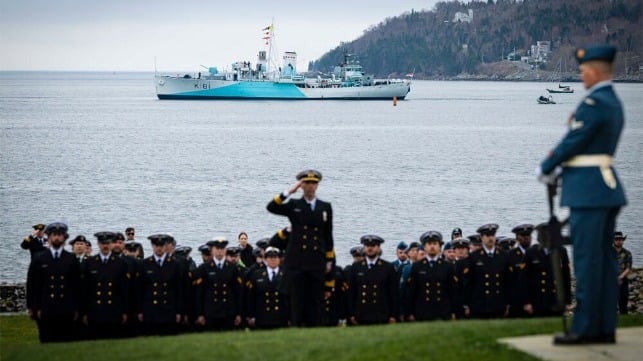
Canada conducted ceremonies to mark the 80th anniversary of the end of the Battle of the Atlantic (RCN)

Published May 9, 2025 7:51 PM by The Maritime Executive


Canada is maintaining its tradition of honoring the heroism of sailors who took part in the Battle of the Atlantic and ended up paying the ultimate price. On May 4, the country commemorated the 80th anniversary of the battle that was the longest continuous military campaign during World War II and which claimed the lives of 4,600 Canadians.

Canada has designated the first Sunday in May as the day navy families gather to commemorate the battle, not only to honor the struggle, sacrifice, and loss but also to celebrate the courage of its sailors in the face of daunting obstacles. This year, events were held across the country in order to keep the memories alive.

The Battle of the Atlantic, which lasted from the outbreak of hostilities in September 1939 until victory in May 1945, is credited with transforming the Royal Canadian Navy (RCN) from a tiny, ill-equipped, and under-trained force into one of the largest navies. At the outbreak of the war, the RCN comprised only six destroyers, a handful of smaller vessels, and 3,500 sailors. By the time the conflict was ending, RCN had grown to over 373 fighting ships and almost 100,000 sailors.


The battle remains an important aspect of WWII. With continental Europe under Nazi Germany’s control, the United Kingdom stood alone against the Nazi threat. To sustain Britain’s war effort, supplies of food and war materials from the rest of the world had to be shipped there. The Nazi used all-out submarine warfare to try to cut Britain off and starve the island nation into submission, making no distinction between military warships and civilian merchant vessels.

In response, convoys were formed, with warships (escorts) protecting the merchant ships carrying the supplies. Canada was at the forefront in providing its warships to offer escort services. Over the course of the war, Canada alongside other allied naval and air forces fought more than 100 convoy battles and performed as many as 1,000 single ship actions against submarines and warships of the German and Italian navies. The RCN destroyed or shared in the destruction of 33 U-boats and 42 enemy surface craft.

RCN suffered significant casualties. The country lost over 60 ships while over 2,100 sailors, 1,700 merchant mariners, and more than 900 aviators lost their lives. The battle also reached Canadian waters with 23 ships sunk in the Gulf of St. Lawrence and the St. Lawrence River.

“As we commemorate the 80th anniversary of the Battle of the Atlantic, we honor the bravery of the Canadians who served with unwavering resolve and remember those who made the ultimate sacrifice. The Battle of the Atlantic left a lasting imprint on Canada’s national story and the identity of the RCN,” said Vice-Admiral Angus Topshee, RCN Commander.

On the 80th anniversary, Topshee recalled the bravery and inspiring action of the sailors of HMCS Esquimalt, the last Canadian ship sunk in the war on April 16, 1945. The sinking, coming just three weeks before the end of the war, remains a painful memory as 44 sailors, more than half of the crew, died within sight of their home port of Halifax. 

This year’s ceremonies were more poignant as the number of living World War II veterans continues to decline. 
 

Canada's Veterans organization compiled a detailed history of the Battle of the Atlantic presented online.

'I was there when the German U-boats surrendered'

David Wilson
BBC News NI

BBC
Bert Whoriskey was 14-years-old when a fleet of U-boats berthed outside his home

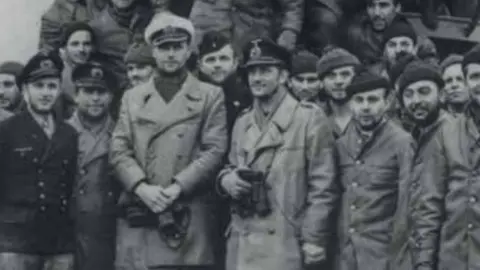
On 14 May 1945, almost a week after Britain and its allies celebrated victory in Europe, Hitler's defeated Atlantic U-boats berthed for the final time.

The German submarines – the "U-boat peril" as Churchill had called them - had been the Allies' principal threat at sea during the Battle of the Atlantic, a campaign that raged throughout the war.

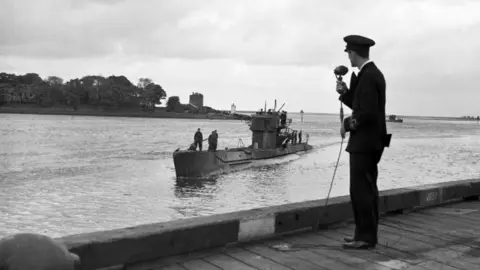
On that day, the first of the U-boats made their way up the River Foyle to Lisahally in County Londonderry to formally surrender.

Eighty years on, Bert Whoriskey, then just 14, and who watched the surrender, told BBC News NI it is a day he can "never ever forget".

'The war had ended, excitement was second to none'

"The war had ended, excitement was second to none, " he said.

"There were ships of of all kinds, and at their head a big Navy destroyer, and there they were coming up the Foyle.

"The U-boats were following, around eight, or 10 of them, and they berthed about 200 yards from our house."

BBC commentator Lt. Commander Harry McMullan, reported on the surrender of German U-boats at Lisahally

Pre-war, Lisahally had been a quiet hamlet on the shores of the River Foyle.

It was home to about 20 families, mainly workers at a manure factory, whose homes had been built by the factory owners.

"All we had was a nice cricket pitch, and a pavilion – that was Lisahally until 1939 when Hitler decided it was time to have a war," Bert said.

Within months, Lisahally, as well as the city of Derry, and the wider north west of Northern Ireland, would be transformed. Lisahally would become one of the Allies' most strategically important ports.

Vast amounts of timber arrived, stretched out across Bert's childhood cricket pitch, along with US Naval Construction Battalions (Seabees).

Work began, and continued day and night for months.

A huge jetty was built at the "back of our house," he said.

Then the Royal Air Force arrived.

Huge oil storage facilities were built nearby, an airfield too.

Barrage balloons arrived, surrounding the area to protect it from air strike.

'Lisahally was ready'


Never had then nine-year-old Bert "seen anything as big".

"When that was all built you just looked at it, Lisahally was ready," said Bert.

Soon, he said, the ships started to arrive.

"Destroyers, battleships submarines, they all came to refuel and rearm. There was British, Canadian, American, Australian, Dutch. This went on every day for the rest of the war," Bert said.

Derry City and Strabane District Council Archive Collection
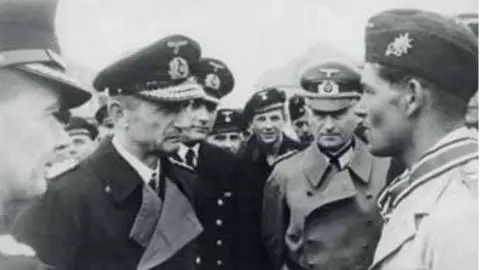
U-boat commanders were formally ordered to surrender by Admiral Sir Max Horton, commander-in-chief, Western Approaches

The naval base - shared by the Royal Navy, the Royal Canadian Navy and the United States Navy - was vital to the protection of convoys in the Atlantic.

At one time, 140 Allied escort ships were based on the River Foyle, and Londonderry was home to Base One Europe, the US Navy's operating base in Northern Ireland.

The Battle of Atlantic was the longest continuous military campaign of World War Two.

More than 66,000 Allied merchant seamen, sailors and airmen died, with 175 Allied warships and 5,000 merchant ships destroyed by German U-boats.

'They paid the ultimate price'

As months gave way to years, Bert said, "you could see the the price that was being paid for where we are today".

"The ships were coming in damaged. They would have let us on every once in a while. The young men who were crewing the ship, you could see in their faces they were terrified," he said.

"Nearly every day there would be bodies on the jetty, waiting to be taken away. That always comes back into my dreams, the bodies on the jetty getting put into the back of a lorry - people who paid the ultimate price."

When victory in Europe finally came, Bert remembers sailors jumping into the Foyle "because they were so excited".

A "big announcement" came in the days that followed, he said.

"They announced the U-boats fighting at our end of the Atlantic were surrendering at Lisahally," he said.

On 14 May the first of the U-boats berthed at Lisahally and formally ordered to surrender by Admiral Sir Max Horton, commander-in-chief, Western Approaches.

"Of all the things that happened, all the things we had seen, this was the biggest of them all," Bert said.

"We were only young. All we thought was we had spent six years fighting the Germans, and now we were going to see actual real Germans," Bert said.
Advertisement

Derry City and Strabane District Council Archive Collection
Bert remembers the German crews singing marching tunes, and playing football after their surrender


Bert and his pals had to wait until "all the pomp died down".

"The first thing we heard was the singing of marching tunes.

"When we looked at them and I will never forget, they were all very young. Not many of them were even as old as 30.

"You could tell they were glad the war was over, they knew they had survived."

The German submariners were held at the naval base for about a year and Bert and his friends used to go down and look through the fence.

"One day they were all on their knees in a big line, we thought they were going to be shot," Bert said.

"What they were doing was pulling the grass out of the ground to make a football pitch – the next day a goalpost was put up.

"We spent time marching up and down with them. They made us toys at Christmas, they made a toy double decker bus – I had never seen a double decker bus."


Admiral Lord West of Spithead said the port in Northern Ireland was hugely important

Derry's strategic importance can not be underestimated, Admiral Lord West of Spithead, the First Sea Lord and Chief of the Naval Staff from 2002 to 2006, said.

"It was absolutely crucial and we needed to get our ships and facilities as far to the west as we could," he told BBC Radio Ulster's Good Morning Ulster programme.

"It was wonderful that we could use the base up in Londonderry which put our ships a bit closer."

The U-boats were deliberately sunk - or scuttled - off the coast of Derry and Donegal after the war.

A special event to commemorate the city's wartime role is set to take place in Derry's Ebrington Square on 17 May.


Robberies Continue in Singapore Strait with Six Ships Hit in May

Robberies Singapore Strait
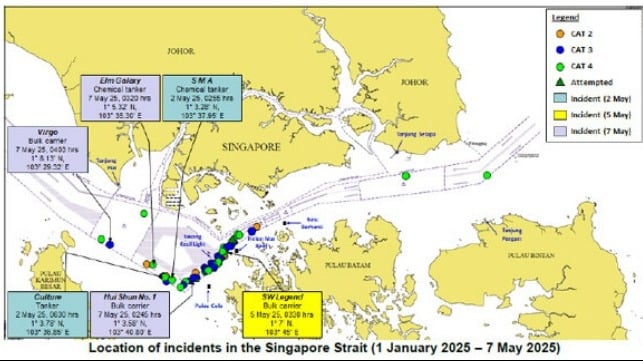
Map shows the clustering of the 50 incidents in 2025 (ReCAAP)

Published May 9, 2025 6:46 PM by The Maritime Executive


ReCAAP (Regional Cooperation Agreement on Combating Piracy and Armed Robbery against Ships in Asia) is sounding the alarm as the robbery spree in the area around the Singapore Strait continues. The organization, which marked 20 years, is expressing concern and warning of the possibility of further incidents.

While there has been a total of 50 incidents reported to ReCAAP since the start of 2025, they are highlighting that there were three incidents in close proximity in one hour and 15 minutes on May 7 and two other incidents in just three and a half hours on May 2. All the incidents were aboard vessels underway in the eastbound lane of the Singapore Strait near the western area near the Phillip Channel. Most of the incidents reported in 2025 have been in this same area.

Most of the incidents are robberies where the perpetrators attempt not to interact with the crew or flee when they are spotted. ReCAAP, however, has warned that more of them are being seen with guns or knives, including two people who appeared to have guns when they were spotted among a group of five boarders on a Greek-owned bulker, Virgo, on May 7. The two boarders seen on the Wisdom Ocean bulk carrier Hui Shun No. 1 on May 7 had knives.

The incidents vary between a single person aboard the MOL Singapore chemical tanker Elm Galaxy to five people on the UAE-managed product tanker S M A on May 2. Both the S M A and the Galaxy reported engine spare parts were stolen, while the other vessels did not report anything missing. None of the crew were injured in any of the latest incidents.

ReCAAP notes its concern stems from the dramatic increase. This year it has received 50 reports compared with 14 incidents between January 1 and May 7, 2024.

As it is only a monitoring and coordination initiative designed to educate everyone, ReCAAP can only issue alerts. It is, however, again urging the littoral states to increase patrols and surveillance in the region. They said it is critical to respond promptly to reports from the vessels and to strengthen coordination and promote information sharing.

For ships transiting the area, ReCAAP advised intensifying vigilance and maintaining lookouts while in these waters. The greatest concern is in the hours of darkness.

The area between the Singapore and Malacca straits has become a hotbed for piracy and robberies. Across the whole of the Southeast Asia region monitored by ReCAAP, it lists only 58 incidents so far in 2025, with 50 in the area around Singapore.


Mooring Lines in Poor Condition Caused Cargo RoRo Endurance to Break Free

breakaway cargo ship
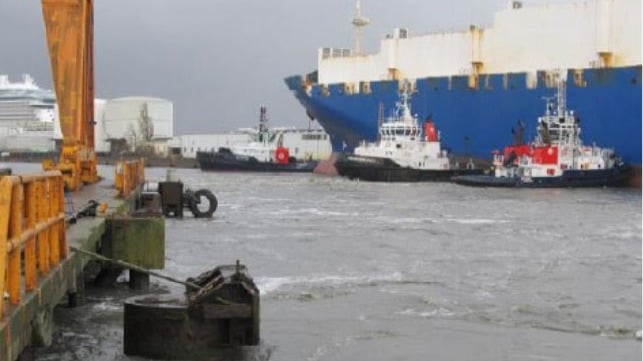
Tugs struggled to regain control of the breakaway ship after the lines parted (Bremen Police)

Published May 9, 2025 7:28 PM by The Maritime Executive


Worn-out mooring lines that were not replaced on time are being called the reason a US-flagged cargo RoRo broke free from its dock and out-of-control hit a pier and dry dock at the Port of Bremerhaven in Germany. Germany's Federal Bureau of Maritime Casualty Investigation (BSU) issued a report concluding that if the lines had been properly maintained, the incident might never have happened.

BSU analyzes the incident involving the RoRo cargo ship Endurance (49,000 dwt) built in 1996 and operated by ARC (American Roll-on Roll-Off Carriers). The incident occurred on March 13, 2021, when the vessel’s mooring lines broke, causing her to drift through the harbor and collide with a dry dock, among other things.

Investigators have now determined that the main cause of the line breakage was the worn mooring lines that were not replaced in good time due to an inadequate safety management system. Owing to the conditions of the mooring lines, coupled with offshore winds with gusts reaching speeds of up to 50 knots, the accident was most likely to happen despite preventive efforts by the ship’s master.

The Endurance was moored starboard side in Bremerhaven when the lines parted at about 0945. Investigators were able to establish that the master was aware of the weather forecast and conscious of the potential danger of mooring line failure. For this reason, he had taken appropriate precautionary measures against line failure by requesting tugs.

Nineteen minutes before the incident at 0924, the master had gone to the bridge because of the prevailing wind conditions at the berth. At 0930, he requested tug assistance and instructed two of his deck officers to inspect the lines. When the lines failed, he issued instructions to drop the starboard anchor, start the main engine, and raise the lowered vehicle ramp.

Before the arrival of the tugs, the 868-foot (264.6-meter) Endurance had drifted toward the Lloyd Werft dockyard. The first two tugs arrived about eight minutes after the line failures and before the main engine was running, but could not prevent the allision. It was determined that the vessel was only about 120 meters (less than 400 feet), meaning the tugs did not have enough time and space to prevent the contact.

The line failure contributed to the material damage to the ship, the berth, and the dockyard. However, nobody was injured, and no pollution was reported. The damage on the ship included a crack above the waterline in the shell plating on the port side, a hole in the bulbous bow, and a dent and paint abrasions at the stern on the starboard side.

BSU concluded in its investigation that the mooring lines were in poor condition. The vessel’s operator, ARC, had also arrived at the same conclusion in its internal investigation, determining that the condition of the lines may not have been consistent with requirements. The lines were damaged to such an extent that only two of the 14 lines met the requirements for mooring lines.

Following the BSU investigation, actions have been taken to prevent similar occurrences. They include the procurement of berth analysis software by the Port of Bremerhaven. Expected to be deployed this year, the software is designed to trigger alerts that would help the port inspect a vessel's mooring arrangement.

The report also highlights that as of January 1, 2024, new internationally binding guidelines for the inspection and maintenance of mooring equipment, including lines, came into force. In particular, the vessel operator is now required to introduce a procedure for mooring operations, as well as the inspection and maintenance of mooring equipment, including mooring lines. A maintenance procedure must be implemented on ships so that worn lines are identified in good time before they fail. Maintenance must be carried out and documented on board.