Monday, May 12, 2025

US and China cut tariffs dramatically

U.S. cuts China tariffs to 30 percent, China slashes levies on imports from U.S. to 10 percent.

May 12, 2025 
By Ali Walker and Elena Giordano
POLTICO EU

Top U.S. officials said Monday that America and China will both substantially cut reciprocal tariffs targeting each other.

The announcement goes some way toward deescalating U.S. President Donald Trump’s huge tariff war that has upended global trade and caused economic aftershocks around the world.

The U.S. will cut tariffs on Chinese imports from 145 percent to 30 percent, while the Chinese side will drop measures from 125 percent to 10 percent.

“We have a mechanism for continued talks,” U.S. Treasury Secretary Scott Bessent said at a press conference after U.S.-China talks in Geneva over the weekend.


Full text: Joint Statement on China-U.S. Economic and Trade Meeting in Geneva

(Xinhua15:11, May 12, 2025

GENEVA, May 12 (Xinhua) -- China and the United States on Monday released a joint statement on China-U.S. Economic and Trade Meeting in Geneva.

The following is the English translation of the full text of the joint statement:

Joint Statement on China-U.S. Economic and Trade Meeting in Geneva

The Government of the People's Republic of China ("China") and the Government of the United States of America (the "United States"),

Recognizing the importance of their bilateral economic and trade relationship to both countries and the global economy;

Recognizing the importance of a sustainable, long-term, and mutually beneficial economic and trade relationship;

Reflecting on their recent discussions and believing that continued discussions have the potential to address the concerns of each side in their economic and trade relationship; and

Moving forward in the spirit of mutual opening, continued communication, cooperation, and mutual respect;

The Parties commit to take the following actions by May 14, 2025:

The United States will (i) modify the application of the additional ad valorem rate of duty on articles of China (including articles of the Hong Kong Special Administrative Region and the Macau Special Administrative Region) set forth in Executive Order 14257 of April 2, 2025, by suspending 24 percentage points of that rate for an initial period of 90 days, while retaining the remaining ad valorem rate of 10 percent on those articles pursuant to the terms of said Order; and (ii) removing the modified additional ad valorem rates of duty on those articles imposed by Executive Order 14259 of April 8, 2025 and Executive Order 14266 of April 9, 2025.

China will (i) modify accordingly the application of the additional ad valorem rate of duty on articles of the United States set forth in Announcement of the Customs Tariff Commission of the State Council No. 4 of 2025, by suspending 24 percentage points of that rate for an initial period of 90 days, while retaining the remaining additional ad valorem rate of 10 percent on those articles, and removing the modified additional ad valorem rates of duty on those articles imposed by Announcement of the Customs Tariff Commission of the State Council No. 5 of 2025 and Announcement of the Customs Tariff Commission of the State Council No. 6 of 2025; and (ii) adopt all necessary administrative measures to suspend or remove the non-tariff countermeasures taken against the United States since April 2, 2025.

After taking the aforementioned actions, the Parties will establish a mechanism to continue discussions about economic and trade relations. The representative from the Chinese side for these discussions will be He Lifeng, Vice Premier of the State Council, and the representatives from the U.S. side will be Scott Bessent, Secretary of the Treasury, and Jamieson Greer, United States Trade Representative. These discussions may be conducted alternately in China and the United States, or a third country upon agreement of the Parties. As required, the two sides may conduct working-level consultations on relevant economic and trade issues.
(Web editor: Zhang Kaiwei, Zhong Wenxing)

Key takeaways from China-U.S. high-level economic and trade meeting

CGTN

The two-day China-U.S. high-level meeting on economic and trade affairs concluded in Geneva, Switzerland.

Chinese Vice Premier He Lifeng, who also serves as the Chinese lead on China-U.S. economic and trade affairs, met with U.S. lead person Treasury Secretary Scott Bessent and U.S. Trade Representative Jamieson Greer, over the weekend.

Focusing on the implementation of the important consensus reached by the two heads of state during their phone call on January 17, the two sides held candid, in-depth and constructive discussions. They reached a series of major consensus and made substantial progress during the talks.

They also agreed to establish an economic and trade consultation mechanism to maintain communication on their respective concerns in the economic and trade fields.

This marks the first round of talks since the U.S. imposed heavy tariffs on Chinese goods.


A press briefing held by the Chinese side following the China-U.S. high-level meeting on economic and trade affairs in Geneva, Switzerland, May 11, 2025. /Xinhua

In-depth, candid and constructive

The Chinese delegation held a press conference following the high-level meeting with the U.S. side.

The meeting was candid, in-depth and constructive, said He, adding that China and the United States have also agreed to establish an economic and trade consultation mechanism.

The two countries, He said, will finalize the relevant details as soon as possible and release a joint statement on Monday summarizing the outcomes of the talks.

Through the joint efforts of both sides, the talks were fruitful, he said, adding that this marks an important step towards resolving differences through equal dialogue and consultation. It has laid the foundation and created conditions for further narrowing differences and deepening cooperation.

Economic and trade relations between China and the United States are not only of great significance to both countries but also have a major impact on the stability and development of the global economy, said He.

Speaking at the press conference, Li Chenggang, the international trade representative with the Chinese Ministry of Commerce and vice commerce minister, said the two countries conducted the talks based on mutual respect, equality and mutual benefit, in a professional and efficient manner.

Both sides, he said, have accommodated each other's concerns and development interests, creating favorable conditions for the stable, sound and sustainable development of China-U.S. economic and trade relations.

A view of a terminal at Shanghai Port in east China's Shanghai, May 11, 2025. /VCG

A view of a terminal at Shanghai Port in east China's Shanghai, May 11, 2025. /VCG

Finding solutions, extending list of cooperation

As two major countries at different stages of development and with different economic systems, it is natural for China and the United States to have differences and frictions in economic and trade cooperation, He said during the meeting, stressing that the key is to find proper solutions to these issues based on the principles of mutual respect, peaceful coexistence and win-win cooperation.

There are no winners in a trade war, He said, adding that China does not want a trade war but is not afraid of one. If the U.S. side insists on infringing upon China's rights and interests, China will resolutely retaliate and respond accordingly.

He urged both sides to explore more potential areas for cooperation, extend the list of cooperative initiatives, expand the scope of mutual benefits, promote the continuous and new development of China-U.S. economic and trade relations, and inject greater stability and certainty into the development of the world economy.

During a meeting with World Trade Organization (WTO) Director-General Ngozi Okonjo-Iweala on Sunday, He called on all parties to resolve differences and disputes through equal dialogue within the WTO framework, to jointly uphold multilateralism and free trade, and to push for the stable and smooth functioning of global industrial and supply chains.

Okonjo-Iweala said WTO members should work together to defend an open and rules-based multilateral trading system, strengthen dialogue and cooperation on international trade issues, and enhance the WTO's role in promoting trade liberalization, improving trade efficiency, and achieving global sustainable development.


WTO chief welcomes positive outcomes from China-U.S. talks

CGTN


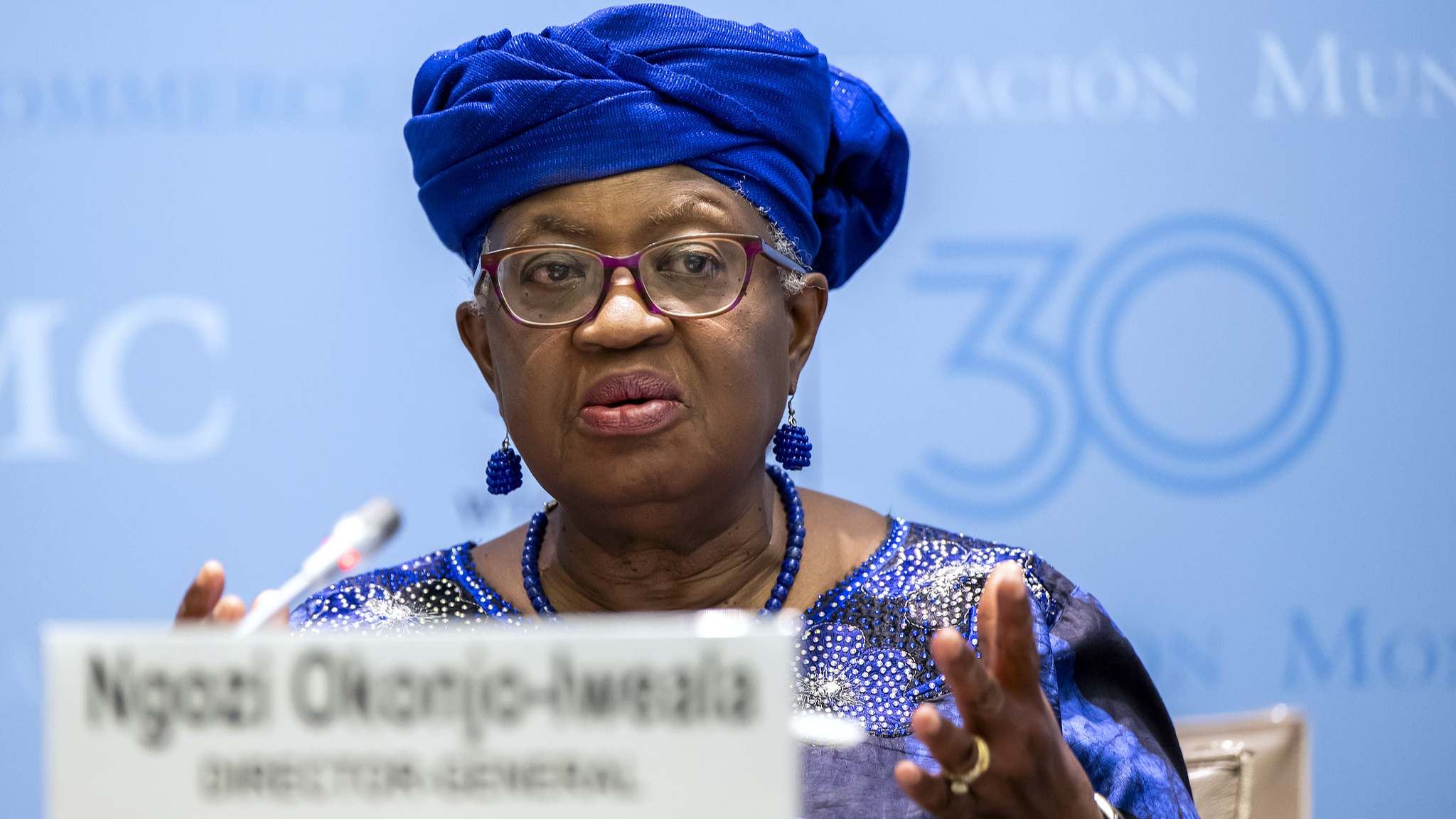
A file photo of WTO Director-General Ngozi Okonjo-Iweala. /VCG

World Trade Organization (WTO) Director-General Ngozi Okonjo-Iweala on Sunday said she was pleased to see positive outcomes achieved during the high-level meeting on economic and trade affairs between China and the United States.

In a statement, Okonjo-Iweala said the talks marked an important step forward, adding that amid the current global situation, such progress is critical not only for both countries, but also for the rest of the world, including the most vulnerable economies.

Instant View: US-China agree to cut tariffs,

 90-day pause
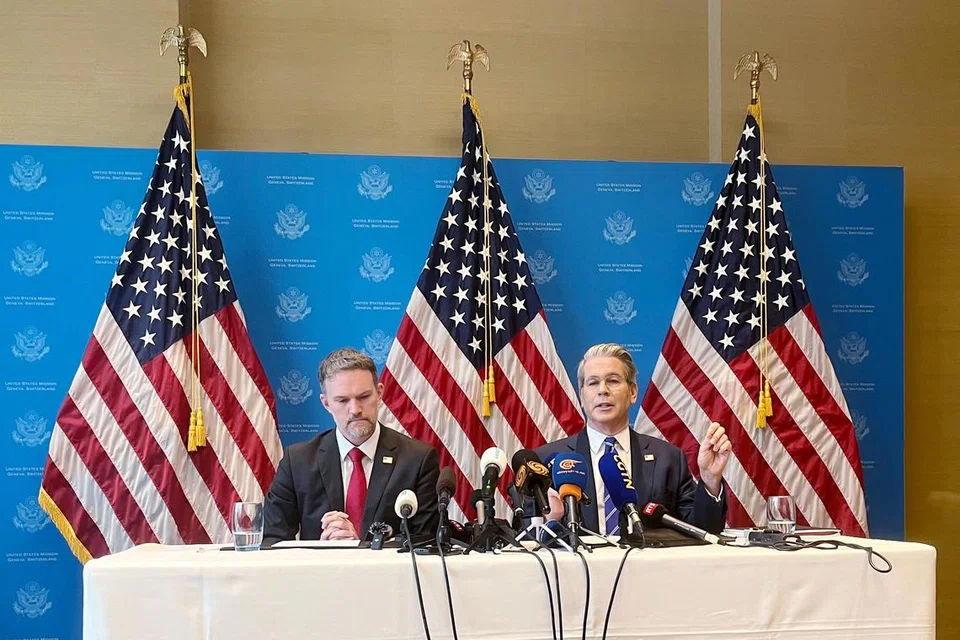


U.S. Secretary of the Treasury Scott Bessent and U.S. Trade Representative Jamieson Greer attend a news conference after trade talks with China, in Geneva, Switzerland, May 12, 2025. REUTERS/Emma Farge

UPDATED May 12, 2025

LONDON/SHANGHAI - Stocks and the dollar surged on Monday after the United States and China said they had agreed on a 90-day pause on tariffs and reciprocal duties would drop sharply, giving investors some confidence that a full-scale trade war may have been averted.

U.S. Treasury Secretary Scott Bessent, speaking after talks with Chinese officials in Geneva, told reporters the two sides had reached the deal that was outlined in a joint statement and that reciprocal rates would drop by 115 percentage points.

This weekend's meetings were the first face-to-face interactions between U.S. and Chinese officials since U.S. President Donald Trump returned to power and launched a global tariff blitz, imposing particularly hefty duties on China.


MARKET REACTION:

STOCKS: Futures on the S&P 500 and Nasdaq jumped to trade up 2.8% and 3.5%, respectively, from gains of 1.5-2% previously, while in Europe, the STOXX 600 rose 0.7% in early trading.

FOREX: The dollar extended gains, with the euro down 1.2% at $1.1164, having traded down 0.2% on the day earlier, while the yen weakened, leaving the U.S. currency up 1.6% at 147.715, from a 0.5% gain earlier.


BONDS: Benchmark 10-year U.S. Treasury yields rose 7 basis points on the day to 4.44%, having traded up 5 bps before the joint statement.


COMMENTS:

JAN VON GERICH, CHIEF MARKET ANALYST, NORDEA, HELSINKI:


"Markets have taken it at face value, I personally am a bit sceptical, if you want to end up with low tariffs then why do it like this? It’s still bouncy, and uncertainty is elevated.

"I’m still worried that there will be a last word, that now they’ve come to an initial conclusion the details won’t satisfy both sides, and there will be something else but, of course, time will tell. I would not take everything we hear at the moment at face value, that’s what we saw on ‘Liberation Day’ (April 2 tariff announcement), and now, and it still bounces both ways."

JANE FOLEY, HEAD OF FX STRATEGY, RABOBANK, LONDON:

"The market reacted already overnight in anticipation of this, and we’ve got a bit more details now, and it's continuing the tone it set overnight, where it’s buying back the dollar. We have this scenario where the dollar is now being treated as a risky asset and is making gains.

"We’ve had reassurance from the U.S. that negotiations will continue and that the tone of the negotiations have been positive and US and China don’t want to decouple, so there is a lot more optimism that the tariffs won’t have the devastating impact that perhaps they could have done, and there is a collective sigh of relief in markets.

"That doesn’t mean that we’re back to where we were before the Trump inauguration, the 10% baseline tariff still exists everywhere, the 90 pause is there and the clock is starting to tick. The overall scenario is not as bad as it could have been, but we still have a fair amount of uncertainty about where these tariffs will settle, their impact on world growth and central bank policy."

KENNETH BROUX, SENIOR STRATEGIST FX AND RATES, SOCIETE GENERALE, LONDON

"There is a de-escalation between China and U.S. resulting in a reduction of tariff on Chinese goods to 30% and Chinese tariffs on US goods to 10%. It's a clear vote by the market in favour of riskier assets. It's a step in the right direction and a positive of U.S. assets and U.S. economy."

"The dollar was lagging other markets in the recovery from the April lows. We had equities up back to April 2nd levels, we had bond yields up to those levels and the dollar was actually lagging that move. Now the conditions are falling into place for a deeper adjustment and a bigger recovery of the dollar to catch up with equities and bond yields."

ZHIWEI ZHANG, CHIEF ECONOMIST, PINPOINT ASSET MANAGEMENT, HONG KONG:

"This is better than I expected. I thought tariffs would be cut to somewhere around 50% and this is much lower. Obviously, this is very positive news for economies in both countries and for the global economy, and makes investors much less concerned about the damage to global supply chains in the short term.

"But we also need to keep in mind this is only a three-month temporary reduction of tariffs. So this is the beginning of a long process. The two sides will spend months probably, to come up with a resolution, or reach a final trade deal, but this is a very good starting point."

ARNE PETIMEZAS, DIRECTOR RESEARCH, AFS GROUP, AMSTERDAM:

"Such a sharp U-turn by the US on tariffs on a Monday morning is quite the surprise. It seems that tariffs on China will fall to manageable levels, albeit temporary. Markets should rally on this. How can Trump credibly raise tariffs when the 90-day pause ends? He has toned down his tariffs faster than anyone thought he could, and April 2 will soon be forgotten. Granted, he told you to buy the dip."

WILLIAM XIN,CHAIRMAN OF HEDGE FUND SPRING MOUNTAIN PU JIANG INVESTMENT MANAGEMENT, SHANGHAI:

"The result far exceeds market expectations. Previously, the hope was just that the two sides can sit down to talk, and the market had been very fragile. Now, there's more certainty. Both China stocks and the yuan will be in an upswing for a while." REUTERS

China firmly supports multilateralism, free trade and WTO's greater role: vice premier


(Xinhua13:38, May 12, 2025

GENEVA, May 12 (Xinhua) -- China will continue its support for the World Trade Organization (WTO) to work as a stabilizer of global trade and to make greater contributions in addressing global challenges, Chinese Vice Premier He Lifeng said here on Sunday.

During his meeting with WTO Director-General Ngozi Okonjo-Iweala, He said that the multilateral trading system, with the WTO at its core, is the cornerstone of international trade and plays an important role in global economic governance.

He urged all parties to resolve differences and disputes through dialogues on an equal footing within the WTO's framework, to jointly uphold multilateralism and free trade, and push for the stable and smooth functioning of global industrial and supply chains.

China will continue to participate comprehensively and deeply in the reform of the global trade body, safeguarding the legitimate rights and interests of developing members, said the Chinese vice premier.

He, the Chinese lead person for China-U.S. economic and trade affairs, also briefed the WTO chief on the high-level China-U.S. economic and trade meeting held over the weekend in Geneva.

Okonjo-Iweala said that the current global economic and trade growth faces severe challenges, noting that WTO members should work together to defend an open and rule-based multilateral trading system, strengthen dialogue and cooperation on international trade issues, and push for a greater WTO role in facilitating trade liberalization, improving trade efficiency, and achieving global sustainable development.


(Web editor: Zhang Kaiwei, Zhong Wenxing)

Carbon ostrich of climate change economics: Trump administration denying reality, experts say

'It is no longer federal government policy to maintain a uniform estimate of the monetised impacts of greenhouse gas emissions', Jeffrey B. Clark, the acting administrator of the White House office of information and regulatory affairs, wrote in a May 5 memo


Lisa Friedman
 Published 12.05.25


The White House has ordered federal agencies to stop considering the economic damage caused by climate change when writing regulations, except in cases where it is “plainly required” by law.

The directive effectively shelves a powerful tool that has been used for more than two decades by the federal government to weigh the costs and benefits of a particular policy or regulation.

The Biden administration had used the tool to strengthen limits on greenhouse gas emissions from cars, power plants, factories and oil refineries.

Known as the “social cost of carbon”, the metric reflects the estimated damage from global warming, including wildfires, floods and droughts. It affixes a cost to the economy from one ton of carbon dioxide pollution, the main greenhouse gas that is heating the planet.

When considering a regulation or policy to limit carbon pollution, policymakers have weighed the cost to an industry of meeting that requirement against the economic impact of that pollution on society.

During the Obama administration, White House economists calculated the social cost of carbon at $42 a ton. The first Trump administration lowered it to less than $5 a ton. Under the Biden administration, the cost was adjusted for inflation and jumped to $190 per ton.

But “it is no longer federal government policy to maintain a uniform estimate of the monetised impacts of greenhouse gas emissions”, Jeffrey B. Clark, the acting administrator of the White House office of information and regulatory affairs, wrote in a May 5 memo.

In his memo, Clark doubted the scientific consensus that pollution from things like transportation and industry is heating the planet.

He argued that there were too many “uncertainties” in calculating the figure, including “whether and to what degree any supposed changes in the climate are actually occurring as a consequence of anthropogenic greenhouse gas emissions”.

Scientists and environmental groups say that the Trump administration is denying reality.

“It’s very clear that climate change is causing harms to people in the US and around the world, and that these harms are growing worse with increasing warming,” said Robert E. Kopp, a climate scientist at Rutgers University. “By effectively saying the social cost of carbon should be treated as zero, this policy arbitrarily and capriciously ignores the science and economics of climate change.”

Michael Greenstone, an economist at the University of Chicago who first came up with the idea of the social cost of carbon as a justification for climate policy, said the new guidance means “feelings, not facts” would guide federal policy.

“The decision is like Alice in Wonderland’s Humpty Dumpty, who said ‘Words can mean whatever I choose them to mean’,” Greenstone said. “So, yes, it is possible to have policies that assume climate change will have no impacts, but that does not make it so.”


It remains unclear whether environmental groups will sue the administration fornot considering the social cost of carbon.


New York Times News Service
Radio Free Asia’s Uyghur service in danger following Trump’s decisions: “Without RFA, China will truly become a black hole for information”


Anne Bocandé
Editorial Director RSF
Organisation:  RSF_en

Reporters Without Borders (RSF) is alarmed by the announcement that the Uyghur service of Radio Free Asia (RFA), the world’s only independent Uyghur-language news service, will close at the end of May due to US President Donald Trump’s executive order to dismantle the United States Agency for Global Media (USAGM), which distributed funding to the international broadcaster. Gulchehra Hoja, Senior Journalist for RFA’s Uyghur service,⁩ explained to RSF what this means for the public’s access to reliable information in one of China’s most restricted regions. RSF urges US Congress to take action to restore RFA and honour its commitments to press freedom worldwide.


“Despite constant threats, RFA’s Uyghur journalists have tirelessly and courageously broken stories that revealed the true extent of the atrocities committed by the Chinese regime. Without RFA Uyghur, the international community will lose its only window into one of China's most restricted regions, while Uyghur people will suffer the loss of their only independent outlet. RSF calls on the US Congress and the international community to take action in response to this alarming situation and support the outlet's journalists so they can continue their vital work.
Anne Bocandé
Editorial Director RSF


In early May 2025, US international broadcaster Radio Free Asia (RFA) announced that by the end of the month, half of RFA’s language services, including the world's only independent Uyghur language news service, will no longer produce or publish new content. As RFA can no longer rely on the US Agency for Global Media (USAGM) to disburse the funds approved by Congress, the outlet began mass layoffs affecting half of its services. The cuts follow an executive order signed on 14 March by US President Donald Trump, which terminated federal funding for the USAGM, effectively paralysing the agency that supports vital media outlets such as RFA.

In China — a country that sits at the bottom of the RSF World Press Freedom Index 2025 and is the world’s biggest prison for journalists — RFA is one of the few outlets documenting the violent campaign of repression against the Turkic ethnic groups in Xinjiang Uyghur Autonomous Region, and the world’s only independent news service producing content in Uyghur language. In an interview with RSF, the service’s senior journalist Gulchehra Hoja how the closure of RFA’s Uyghur service will impact access to information in one of the world’s most closed-off regions.

RSF: Could you tell us about the work of RFA Uyghur journalists?

Hoja: For 26 years, RFA journalists have been exposing the human rights abuses suffered by Uyghurs and other Turkic peoples at the hands of the Chinese regime, providing the world with reliable facts, first-hand evidence and news. We have been reporting on the oppression, suppression, and unjust policies of the Chinese authorities in Xinjiang. Our news has been used as reference material by the US government for setting policies towards China, as well as by international human rights organisations and research centres.


RSF: What impact will the closure of RFA have on Uyghur people if their only access to factual and independent media is gone?

Hoja: 20 million Uyghurs had only one reliable international news source and radio station that could convey their voice to the world: Radio Free Asia. It is a very regrettable decision by the Trump administration to erase the voice of the Uyghurs, especially when the regime’s genocide continues and China has intensified its false propaganda to normalise it. The effect this will have on the Uyghurs is nothing less than “giving up.” It brings deep despair.


RSF: What RFA journalists endured for their reporting on China?

Hoja: RFA journalists have always been victims of China’s transnational repression tactics. I have become a target of China since the day I first spoke on the radio under my own name. In November 2001, China issued a ‘Red File’ on me, destroying my videos, photographs, and audio files from before I came to the United States. They held my family hostage. They pressured my parents. Since then, I have not been able to return home. In February 2018, I learnt that 25 of my direct relatives had been taken to the so-called re-education camps. Additionally, 50 family members of six journalists from our radio station had been kidnapped. We did not bow to these threats, and continued reporting.


RSF: Can the potential closure of RFA’s Uyghur service be weaponised by the Chinese regime to further their propaganda?

Hoja: China has previously invested heavily in blocking Radio Free Asia’s broadcasts and set up special jamming stations. It has also used [propaganda] media outlets to falsify our news. Now, by shutting down our radio station on its own, the US government is giving the Chinese government a reward. Without RFA, China will truly become a black hole for information. I still can’t understand the motive behind it. Losing our radio station has become a sign that the United States has failed to keep its promise of democracy and human rights. I think it is also harmful to the US. Nothing can replace Radio Free Asia.


RSF: What is your reaction to the fact that, after the outlet’s closure, Uyghur voices might lose their platform in the democratic world?

Hoja: The closure of such an important media outlet is not only a matter of unemployment for us journalists, but also a blow to our spirit. I spent 24 years devoting not only my mind but also my heart and life to this broadcaster. As a result, I became a target of the Chinese regime, labelled as a “terrorist.” I used to not be afraid of these open threats, but rather proud, as I had the utmost confidence that the American government valued our work and would support us. At a time when China is torturing and killing my people, as Uyghur journalists in the United States, we need protection [from China’s transnational repression] more than ever. I cannot imagine our future. But what worries us most is the hopelessness of our voiceless people.


RSF: What will the future bring for RFA journalists?

Hoja: For 24 years, our people have been hearing that Radio Free Asia is the voice of the drowned, the voice of the free press… This was also our promise to our people. It was our mission to broadcast their voice to the world. We will not abandon our mission to be their voices, as we can also make our reporting heard through social media. I express my deep respect to my fearless journalist friends who are fighting for justice against oppressors. Being a voice for the voiceless requires a price, and standing up for justice against oppressors requires courage. We are proud to be journalists.


China’s repression of Uyghur journalists

Since 2016, Beijing has been conducting a violent campaign of repression in Xinjiang province in the name of the “fight against terrorism,” which international observers characterise as a “genocide.” According to the latest count by RSF, 79 journalists and press freedom activists are being held in Xinjiang, including Sakharov Prize winner Ilham Tohti. At the same time, China exerts transnational repression against Uyghur journalists who continue to report on the regime’s atrocities.

Ranked 178th out of 180 countries and territories in the 2025 RSF World Press Freedom Index, China is the world's largest jailer of journalists and press freedom defenders.
Trump tariffs and US Imperialism
MAY 12, 2025
AFRICA IS A COUNTRY


Trump’s April 2025 tariff blitz ignited market chaos and deepened rifts within his own coalition. Beneath the turmoil lies a battle between technocrats, ultranationalists, and anti-imperial populists, all vying to reshape—or destroy—American global power.


Newsapaper stand in Nottinghamshire, UK April 2025. 
Image © Steve Travelguide via Shutterstock.


On April 2, 2025, Donald Trump declared a “Day of Liberation” and slapped massive tariffs on most countries—excluding Russia but including a 50% tariff on Lesotho. The standard Left argument is that Trump’s tariffs represent capital’s warfare against the working class in response to the crisis of global capitalism. Of course, there’s some validity to that view, but it tends to operate at an excessively high level of abstraction.

More immediately, it doesn’t explain the ferocious backlash to tariffs from multiple fractions of capital, both within and beyond the Trump coalition. After the tariff tsunami, Elon Musk called Trump’s economic advisor Peter Navarro “a moron and dumber than a sack of bricks.” Meanwhile, liberal mainstream media outlets screamed bloody murder, portraying Trump not only as dumb but deranged. The frenzy only intensified when the stock market meltdown carried over into the bond market, which, as financial orthodoxy tells us, isn’t supposed to happen.

Trump responded by postponing most of the tariffs for 90 days, even as he ramped up the trade war with China. In just over a week, Wall Street went ballistic, the dollar rapidly devalued, Trump’s approval ratings tanked, and much of the Republican Party—and key fractions of capital—went into panic mode, even as they remained terrified of crossing him. These dynamics remain ongoing.

Trump’s tariffs are not merely erratic protectionist gestures. Rather, they form part of a blunt and confused arsenal aimed at dismantling post-Second World War US imperialism and replacing it with a brutal new form of nationalist global domination—one stripped of the trappings of “soft power” such as USAID. This multi-sided project emerges from factions within the New MAGA Coalition, and takes different—and often contradictory—forms.

Understanding these contradictions in their specificity is essential, not just for critique but for posing questions about new possibilities for organizing and alliance-building—not only in South Africa, but working towards a concrete internationalism, a topic to which we’ll return later.
The new MAGA coalition

So, what is this New MAGA Coalition behind Trump 2.0? First, it includes fractions of capital that extend well beyond those who underwrote Trump 1.0—most notably Elon Musk and the South African “PayPal mafia,” along with the tech broligarchy so grotesquely on display at the inauguration: Zuckerberg, Bezos, and other billionaires.

It also encompasses elements of the petty bourgeoisie and working class that go beyond Trump’s earlier mostly white cross-class base, as the late Mike Davis described in Catalyst in 2017. Most notably, sizable Latino communities in some US regions have come to identify with MAGA—vividly documented by Paola Ramos in her recent book on the Latino far right. Another notable addition in 2024: disaffected, mainly young Black men who joined the MAGA coalition.

What knits this awkward coalition together is a powerful anti-woke sentiment and a ferocious opposition to liberal DEI (Diversity, Equity, Inclusion) initiatives that proliferated after the nationwide Black Lives Matter uprisings of 2020. David Walsh describes “woke” as a “catch-all specter that could variously connote the ravages of state planning, the anarchism of street protests, or the godlessness of modern secular society—not an empty vessel, exactly, but a foil and common enemy against which a political coalition of often diametrically opposed interests could congeal,” as he writes in Boston Review.

Also traveling under the anti-woke banner is unfiltered racism, patriarchy, and vicious heteronormativity—especially targeting trans people—all of which underscore the limits of elitist liberalism, as discussed on The Dig. These brutalities are now wrapped in a (mostly white) Christian Nationalist package that stretches back to Trump 1.0, but is being significantly re-elaborated in Trump 2.0.

What also distinguishes Trump 2.0 is its rooting in a far more coordinated and organized project of dismantling and privatizing the state, one that’s been in formation for several years. Its blueprint is a 920-page document titled “Mandate for Leadership: The Conservative Promise,” published in 2023 by the Heritage Foundation. It has come to be known as Project 2025: Presidential Transition Project.

During the campaign, Trump denied having read it (probably true), but the steaming pile of executive orders he gleefully signed post-inauguration came straight out of it and continues to do so. Unlike Trump 1.0, Trump 2.0 has determined and coherent operatives behind it. They’re driving the juggernaut of destruction—most notably Russell Vought, head of the powerful Office of Management and Budget—despite the clown-car nature of most of Trump’s cabinet. Even if Musk were to depart for Mars brandishing his chainsaw, the scaffolding of Project 2025 appears firmly in place, at least on the surface.

But look a little closer and you’ll find that this scaffolding had a fatal weakness from the start. Scroll down to Chapter 26 on Trade, and two sharply opposed visions emerge.

In the section on “Fair Trade,” Navarro—Trump’s key pro-tariff advisor in both administrations—concludes that “America gets fleeced every day in the global marketplace, both by a predatory Communist China and by an institutionally unfair and nonreciprocal WTO.” Focusing on the large trade deficit by which the US imports significantly more than it exports, he asks: “Might America even lose a broader hot war because it sent its defense industrial base abroad on the wings of a persistent trade deficit?” The answer, for Navarro, is clear: tariffs are imperative to “restore American greatness, both economically and militarily,” by bringing manufacturing back home.

In the opposing section, “The Case for Free Trade,” Kent Lassman presents the classic conservative argument against protectionism. Declaring that “American manufacturing is currently at an all-time high,” he slams tariffs as a lose-lose-lose scenario: the tariff raiser loses access to affordable goods, the target country loses export markets, and retaliatory tariffs punish the instigator yet again. He also warns of the hidden costs of tariff dodging. For Lassman, recent departures from free trade have damaged the US economy and “weakened alliances that are necessary to contain threats from Russia and China.” He calls for reaffirming “openness, dynamism, and free trade” as the pillars of continued US dominance into the next century.

These splits and contradictions have carried over into the tariff wars erupting within the MAGA coalition itself. There are now two distinct pro-tariff projects, both aimed at reconfiguring US imperialism. One is the so-called Mar-a-Lago Accord, led by Treasury Secretary Scott Bessent. The other is a far more radical vision pursued by Steve Bannon and the wide array of popular forces he continues to mobilize.

Before unpacking these competing projects and their wider implications, it’s important to sketch briefly the key contours of US imperialism. The main pillars of American global power are a specific configuration of finance capital—with the US dollar as global reserve currency—backed by overwhelming military force.

Because key commodities such as oil and gold are priced in US dollars, all countries must hold dollars. Small open economies like South Africa operate at a distinct disadvantage. Meanwhile, the US can accumulate massive debt by issuing Treasury Bonds—a privilege no other country enjoys. Since the end of the Cold War, the US has spent over $30 trillion more than it has taken in.

China has played a key role in underwriting this system, using export earnings to purchase US debt, thereby lowering the cost of borrowing. At the same time, shrinking employment, stagnant wages, and rising inequality since the 1980s pushed much of the US population into a frenzy of consumption and spiraling personal debt. This dynamic relies on large trade deficits—precisely what significant factions of the MAGA coalition see as the greatest threat to American power.

Back in 2019, historian Adam Tooze asked, “Is this the end of the American Century?” His answer: not quite. Financial and military power remained intact. But what had collapsed was any claim that American democracy could serve as a political model. What we were facing, he wrote, was “a radical disjunction between the continuity of basic structures of power and their political legitimation.” When Joe Biden took office in 2021, he sought to resuscitate the liberal international order—an order whose cruel hypocrisies are now starkly exposed in US support for Israel’s war on Gaza, as Adam Hanieh has brilliantly analyzed. Trump 2.0, through its tariffs and trade wars, is in effect attacking the financial pillar of US global power with a sledgehammer—even if this is not quite what some of his pro-tariff advisors intended.
Tariffing the end of empire?

Unlike Navarro and others who see the trade deficit as the central existential threat to the US, the authors of the so-called Mar-a-Lago Accord are primarily concerned with what they regard as the gross overvaluation of the dollar. Their aim, per a New York Times report, is to use:

tariffs and other strong-arm tactics to force the world to take a radical step: weakening the dollar via currency agreements. This devaluation, the theory goes, would make U.S. exports more competitive, put pressure on China, and increase manufacturing in the United States.

In addition to Treasury Secretary Bessent, a key figure is Stephen Miran, who Trump appointed as Chair of the Council of Economic Advisors in March 2025. Just after the 2024 election, Miran published “A User’s Guide to Restructuring the Global Trading System.” In dense, economistic language that Trump has almost certainly never read, the 41-page document lays out the justifications and strategies for devaluing the dollar using threats of tariffs and defense pact withdrawals—country by country.

In short, Bessent and Miran envisage tariffs as part of a coercive negotiation strategy: to pressure countries into raising their currency values relative to the dollar, and to relocate key industries to the US. These include sectors deemed vital to national security, such as semiconductors, pharmaceuticals, and military equipment. While the “User’s Guide” insists the dollar must remain the dominant currency, it also acknowledges growing efforts to find alternatives, such as the Chinese renminbi or a potential BRICS currency. Though such efforts are deemed doomed to fail, Miran asserts, “alternative reserve assets like gold or cryptocurrencies will likely benefit.”

The Mar-a-Lago Accord, when read alongside the “User’s Guide,” affirms the substantial advantages of the US’s reserve currency status—cheap borrowing and global power projection among them. But it argues that the costs are now outweighing the benefits. “As the economic burdens on America grow with global GDP outpacing American GDP,” Miran writes, “America finds it more difficult to underwrite global security, because the current account deficit grows and our ability to produce equipment becomes hollowed out.” Hence, the push for policies that “recapture some of the benefit our reserve provision conveys to trading partners and connect this economic burden sharing with defense burden sharing.”

Even so, the “User’s Guide” issues a sharp warning against disruption and volatility: “There is a path by which the Trump Administration can reconfigure the global trading and financial systems to America’s benefit, but it is narrow, and will require careful planning, precise execution, and attention to steps to minimize adverse consequences.”

Naturally, the preposterous tariffs that Trump unveiled on April 2 (reputedly dreamed up by Navarro) run directly counter to these cautious recommendations—leaving Bessent and Miran to bluster about the President’s “extraordinary negotiating skills.” As the markets melted down and Trump threatened to sack the chair of the Federal Reserve while ramping up attacks on China, Bessent increasingly found himself in the awkward position of having to leash the rampaging orange bulldog.

In the ensuing economic, political, and military chaos, the technocratic pipe dream of an orderly reconfiguration of US imperial power has imploded, leaving the remains of the Mar-a-Lago Accord scattered across the manicured grounds of the White House. What persists, however, is a hard core of MAGA support for a far more radical popular project: one aimed at dismantling US imperialism as we’ve known it.
Nationalist-populist opposition to US Empire

In a striking profile from October 2024, James Pogue shows how Stephen Bannon “has turned his immensely influential War Room show … into a cross between a daily troop muster and a policy training school, which he uses to tutor millions of “peasants,” as he likes to phrase his target demographic, on how this global power structure actually functions.”

He quotes Bannon insisting, “To be serious, you’ve got to be anti-imperial.” People are waking up, he claims: “Once you talk about how the system is financed, they are fucking furious. A working-class audience can understand that something’s not right with the system, but they can’t put their finger on it.” Calling his listeners “the army of the awakened,” Bannon has made it his mission to lay it all bare, Pogue reports.

Before unpacking the substance of this anti-imperialism, some context matters. Bannon is not best understood as a singular “great man” but as a figurehead within a global network of right-wing Christian nationalist forces, rooted in the US and deeply embedded in the MAGA bloc. He’s also closely allied with Peter Navarro—both were jailed in 2024 for contempt after refusing to testify in the January 6 congressional inquiry. While Navarro maintains Trump’s ear despite mockery from parts of MAGA, Bannon is far more articulate and intellectually potent, and actively shapes the movement’s populist base.

In an article from 2020, I outlined how Bannon was instrumental in constructing the popular forces that helped propel Trump’s 2016 victory. First, he hijacked the anti-Obama Tea Party from the Koch brothers and delivered it to Trump. Second, he played a major role in stoking backlash to bipartisan immigration reform efforts in 2013—linking xenophobia to anti-trade sentiment and mobilizing it before these issues had fully entered the political mainstream. In a 2017 interview, Bannon recalled saying:

I said, look, trade is number 100 on the list of issues, nobody ever talks about it, and immigration is like two or three, but if we ran a campaign that really focused on the economic issues in this country and really got people to understand how trade is so important, and immigration are inextricably linked… we could really set this thing on fire.

Trump, he claims, became the mouthpiece for these ideas by “[deploying] a very plain-spoken vernacular.”

Third, Bannon seized control of key media outlets—including Breitbart News, massively funded by the Mercer family—which he used to destroy enemies both inside and outside the GOP, while pushing his conservative, anti-globalist, traditionalist nationalism. By the 2016 election, Breitbart had far outstripped Fox News, dominating the right-wing media ecosystem. Today, Bannon reportedly believes he wields more power through War Room than he ever did as Trump’s campaign architect or White House strategist.

The “anti-imperial common sense” Bannon communicates to his “peasant” audience includes—but far exceeds—Navarro’s tariffs, which he supports. It also goes well beyond the Mar-a-Lago Accord. Rather than merely twisting global systems of finance and military power in America’s favor, Bannon and his fellow hyper-nationalists seek to obliterate altogether the post-1980s form of US imperialism.

What exactly does this anti-imperialism consist of? It has a solid—and glittering—material base. Bannon’s worldview is reportedly detailed in a multi-volume report titled The End of the Dollar Empire, available only via the Birch Gold Group, a firm that offers not just a gold-backed ETF but actual physical gold. Downloading the report requires entanglement with Birch Gold, so I passed. But listening to War Room podcasts, one can’t miss the constant exhortations to secure your IRA with Birch Gold in anticipation of a dollar collapse.

Bannon isn’t focused on trade deficits or dollar valuation alone. He’s obsessed with the entire dollar-based global order. As Pogue notes, it creates a perverse military incentive: “It lets us finance huge expenditures on hypercomplex weapons and allows us to toss off hundreds of billions of dollars to support Ukraine’s and Israel’s wars”—even as it hollows out America’s ability to manufacture basic war matériel. Biden’s attempt to weaponize the dollar during the Ukraine war failed to crush the ruble, and raised a new alarm: that others might now see it’s possible to abandon the dollar entirely.

Pogue also interviews Samuel Finlay of the IM-1776 project, whose views align with Bannon’s. Finlay emphasizes “rootedness” and “tradition,” which he connects to a hatred of global capital and resistance to the military-industrial complex—a position that directly contradicts decades of Republican orthodoxy. People like Finlay, Pogue writes, have come to the same “awakening” Bannon is fomenting: that the system has betrayed those who believed in and served it—leaving them with NAFTA, fentanyl, and an elite that views their values as backward and dangerous.

War Room weaves these insights into a broader narrative. Disaffected veterans and others are fed a critique of “the lords of Wall Street” and “the apartheid state of Silicon Valley.” The message: elites own everything and have sold out to the Chinese Communist Party—thus funding the very forces attacking America. According to Bannon, we are now in a “Time of War,” one that dwarfs debates over trade, inflation, or price hikes.

So, how do the wild gyrations of post–Liberation Day fit into the Bannon-Navarro worldview? From their perspective, the unraveling of the “Dollar Empire” since April 2 looks like progress. As Pogue notes, Bannon and fellow populists across the West have come to embrace a multipolar world modeled on Russia’s strategic vision—one that displaces the American-led order Bannon believes has ravaged the US. On an April 25 episode of War Room Battleground, Bannon claimed that we are “moving toward a new geopolitics of blocs.”

Yet the very Americans Bannon sees as crushed by the Dollar Empire are also most exposed to its chaotic dismantling. First, prices for the cheap imports that sustain the US economy—and low-income Americans in particular—are spiking. Second, as the dollar declines as reserve currency, government spending will be slashed. And who bears that burden? Early signs include proposals to gut Medicaid to help fund tax breaks for the rich. Third, rising automation will sharply undermine promises that reindustrialization will yield secure, high-wage jobs and revive devastated regions.

In short, the idea that a protectionist, isolationist, national capitalism—mashing up xenophobia, anti-globalism, Christian nationalism, and anti-elite rage—can deliver liberation is just as much of a pipedream as the Mar-a-Lago Accord.

Which brings me back to the central claim: understanding Trump’s tariffs as blunt weapons aimed at either reconfiguring or shattering US empire matters deeply for the Left, both in the US and globally. What we need is not nostalgia for the collapsing liberal order, nor Kamala-style “politics of joy” in the face of atrocities in Gaza. Instead, we need what Stefan Kipfer calls “concrete internationalism.” He develops the analysis with reference to current conditions in Canada, but with much broader transnational relevance. Distinguishing between nationalism and national-popular democratic projects, he insists that “left national-popular projects can offer alternatives to nationalism only if they are components within larger internationalist strategies” that reject the tendency of all nationalisms “to demote emancipatory social questions of class, gender, and race.” In South Africa, we are, of course, sharply aware of these dangers.

Trump’s tariff debacle and the ensuing meltdown have exposed the fragilities of the liberal international order, the absurdities and devastations of global capitalist dynamics, and the dangers of resurgent nationalisms and forms of fascism. Grappling with the limits and contradictions of a Bannonite “anti-imperial common sense” can help, I hope, to make space not only for protest and resistance, but also for envisaging and building toward a very different project of concrete socialist internationalism.

Revised version of a presentation to the Zabalaza for Socialism Conference on Coming to Terms with Trumpism: What Should the Global South Do? April 13, 2025.
The hidden costs of Trump's 'madman' approach to tariffs

The downsides of his trade policies are symptoms of a larger strategic flaw


quincyinst.org
Joshua Schwartz
May 12, 2025

Is the trade war launched by Donald Trump the act of a madman or a mad genius? To the extent Trump’s tariffs are a “negotiating strategy,” as Treasury Secretary Scott Bessent has claimed, are critics missing that they are simply part of the “art of the deal” that will enable America to gain coercive leverage over other states? According to the madman theory of international politics, it is possible Trump’s gambit has a strategic logic. However, there is a crucial flaw with this strategy that will likely cause it to fail.

The madman theory was developed in the nuclear weapons era by the scholars Daniel Ellsberg(the famous, or infamous, leaker of the Pentagon Papers) and Thomas Schelling (who won the Nobel Prize in economics). Its logic is that some threats, such as launching a nuclear attack against a nuclear-armed opponent, inherently lack credibility because carrying them out would be irrational in that it would cause both the target state and the threatening state great pain. However, if the leader making the threat is perceived as irrational or crazy, then the threat may actually be believable, and the target could decide that backing down to avoid punishment is the prudent option. As Richard Nixon said in a private oval office discussion with his chief of staff in 1968:

“I call it the Madman Theory, Bob. I want the North Vietnamese to believe that I’ve reached the point that I might do anything to stop the war. We’ll just slip the word to them that ‘for God’s sake, you know Nixon is obsessed about Communism. We can’t restrain him when he is angry—and he has his hand on the nuclear button’—and Ho Chi Minh himself will be in Paris in two days begging for peace.”

Trump’s tariff strategy may follow a similar logic. According to the Yale Budget Lab, Trump’s tariffs could increase prices for the average American household by almost $5,000 just this year. Given the mutual costs Trump’s tariffs involve, his threats may lack credibility on their face, just as many nuclear threats do.

However, to the extent Trump is perceived of as at least somewhat crazy, his threats may be more believable than if he was viewed as rational. In fact, like Nixon, Trump is a self-professed fan of the madman strategy. For example, in a discussion with top cabinet officials regarding the U.S.-South Korea trade deal in 2017, Trump reportedly told Robert Lighthizer, the U.S. Trade Representative:

“You’ve got 30 days, and if you don’t get concessions then I’m pulling out.” “Ok, well I’ll tell the Koreans they’ve got 30 days,” Lighthizer replied. “No, no, no,” Trump interjected. “That’s not how you negotiate. You don’t tell them they’ve got 30 days. You tell them, this guy’s so crazy he could pull out any minute…You tell them if they don’t give the concessions now, this crazy guy will pull out of the deal.”

Trump’s plan to end the U.S.-South Korea Free Trade Agreement in his first term was ultimately foiled by Gary Cohn, his chief economic advisor, who reportedly stole from Trump’s desk a letter that would have made the withdrawal official after Trump signed it. However, with a team of more loyal and pliant advisors installed in his second term, Trump has been able to follow through on his trade war strategy based on the madman theory.

Trump also seems to believe that this strategy is having the intended effect: “I am telling you, these countries are calling us up, kissing my ass. They are dying to make a deal…‘Please, sir, make a deal. I’ll do anything. I’ll do anything sir.’” Indeed, the European Union and countries like Vietnam and Israel have offered to lower trade barriers on American goods in return for the removal of Trump’s tariffs. The U.S. and Britain also just struck a trade deal that ostensibly involves some real, even if limited, concessions by the United Kingdom.

Despite some advantages, however, the madman strategy is far from a panacea and entails significant drawbacks that will likely limit what Trump is able to achieve. One major issue (for which I provided evidence in a peer-reviewed study that conducted surveys of the American public) is that a leader who is perceived as mad is likely to face increasing levels of disapproval among their own domestic public. This can then undermine their bargaining leverage with foreign leaders.

The madman strategy is generally unpopular domestically because the public values competence in leaders, and thus is unlikely to look kindly on a leader it perceives of as actually or potentially crazy. Alexander Hamilton made this argument about John Adams, a member of his own Federalist Party, when discussing the “great and intrinsic defects in his character, which unfit him for the office of Chief Magistrate.” Richard Nixon said much the same in a private Oval Office conversation in 1973, when he said, “We are never going to have a madman as president, in this office…Ours [system] throws them out…about every four years, if a guy shows that he’s [unclear phrase], out!” That is one key reason why Nixon kept his own attempt to use the madman strategy to convince the Soviets and Vietnamese he was crazy and might use nuclear weapons to win the Vietnam War secret from the American public.

This reasoning helps explain why Trump’s trade war is unpopular domestically. Moreover, well-known psychological biases make average citizens more averse to losses than they are attracted to gains. In the case of a trade war, this means the public is likely to be wary of paying higher prices than they were previously in return for the theoretical promise of greater domestic production in the future. This is especially the case given that Trump’s promises to tame inflation was one of his campaign’s most effective selling points in winning the presidency last fall.

The domestic unpopularity of the madman strategy can undermine a leader’s leverage in negotiations with other states, as foreigners may doubt the leader will have the political capital to enact or maintain the threatened policies in the short, medium, or long term. This is what appears to be happening in the case of Trump’s tariffs, as the strongly negative reaction among the U.S. public and business community—the fact that that, in Trump’s words, “they were getting a little bit yippy, a little bit afraid”—forced the president to dramatically reverse course and pause the tariffs for 90 days before even a single deal was struck, undermining his bargaining leverage. Some foreign governments may now question whether Trump will be willing to reimpose the tariffs even if his terms are not met. As a New York Times article put it, “[Chinese leader] Xi [Jinping] learned that his adversary has a pain point.” By backing down, Trump may also have revealed that he is less crazy than he would like adversaries to believe, which was also the fatal flaw of Nixon’s attempt to use the madman strategy to win the Vietnam War.

In sum, while critics who claim the madman theory has zero utility are somewhat overstating the case, it does have crucial flaws that will severely undermine what Trump will likely be able to achieve in the realm of international trade. Moreover, the harsh economic costs of this strategy and its blatant inconsistency with long-held American values championed since World War II make it a clearly unwise course to pursue moving forward.


Joshua Schwartz
Joshua A. Schwartz is an assistant professor at the Carnegie Mellon Institute for Strategy & Technology. He holds a PhD from the University of Pennsylvania and was previously a grand strategy, security, and statecraft fellow at the Harvard Kennedy School and Massachusetts Institute of Technology.

The views expressed by authors on Responsible Statecraft do not necessarily reflect those of the Quincy Institute 
Chinese companies bought up European ports — and now Brussels is starting to worry

Chinese firms own stakes in about 30 European ports, and that’s raising security concerns.


Chinese giants COSCO and China Merchants, as well as Hong Kong-based Hutchison now hold stakes in more than 30 terminals across the EU. | Stephanie Lecocq/EPA-EFE


May 9, 2025 
By Martina Sapio
POLITICO EU

Europe is getting twitchy about who owns its ports, with mounting anxiety driven by the outsized footprint of Chinese firms across the bloc’s maritime gateways.

Transport Commissioner Apostolos Tzitzikostas on Thursday told industry leaders that Europe’s ports must “reconsider security … and examine foreign presence more carefully.” It was one of the clearest signals yet from Brussels that what once was seen as a benign investment is now starting to look like a security liability.

The Commission’s recent defense white paper echoed that concern by floating the idea of stricter controls on foreign ownership of “critical transport infrastructure.”

That unease is mirrored in a draft paper from the Socialists and Democrats in the European Parliament, seen by POLITICO, which calls for tougher rules in the upcoming overhaul of the EU’s foreign investment screening regulation.

Neither Tzitzikostas nor the S&D mentioned China by name, but the subtext wasn’t exactly subtle. Simon Van Hoeymissen, a researcher at Belgium's Royal Higher Institute for Defense, said the language likely nods to Beijing’s expanding hold over key European ports — from Antwerp-Bruges and Rotterdam to Piraeus in Greece.

Chinese giants COSCO and China Merchants, as well as Hong Kong-based Hutchison now hold stakes in more than 30 terminals across the EU.

‍“The reality is clear,” said Ana Miguel Pedro, a Portuguese MEP with the center-right European People's Party. A member of the Parliament’s Seas, Rivers, Islands & Coastal Areas Intergroup, she warned that “foreign state-driven actors like Beijing are operating with a level of coordination and intent that far exceeds the fragmented response of individual countries.”

Pedro argued COSCO isn’t behaving like a typical market actor but is taking orders from the Chinese Communist Party. “Its growing presence in ports is not just an economic concern,” she said. “It’s a strategic vulnerability.”

The EU is starting to see it that way, too.

"Russia’s invasion of Ukraine and China’s unofficial support for Russia have only heightened concerns about the security of the EU’s ports," says a recent report from the Warsaw-based Centre for Eastern Studies think tank.

Transport Commissioner Apostolos Tzitzikostas on Thursday told industry leaders that Europe’s ports must “reconsider security … and examine foreign presence more carefully.” | Marcin Obara/EPA

One example of the kind of strategic entanglement the EU is now confronting is playing out in Poland, at the Gdynia Container Terminal, where Hutchison has held a stake for over 20 years.

That situation could change. Under pressure from U.S. President Donald Trump, who wants Chinese-linked companies out of the Panama Canal, Hutchison is negotiating a $23 billion sale of port properties worldwide, including 14 in Europe, to a consortium led by BlackRock and including Mediterranean Shipping Company. However, that deal hit a wall in March after Beijing intervened.

What makes Gdynia especially revealing isn’t just the trade it handles — it’s what sits next door: a naval base, a shipyard, and the headquarters of Poland’s elite naval special forces, meaning that whoever runs the terminal holds a front-row seat to European and NATO military logistics and defense operations.

Recognizing the strategic significance, the Polish government has listed the terminal as critical infrastructure, meaning the operator has to work closely with the government on security.

This high-stakes backdrop sharpens the edge of Pedro’s warning — and underscores why the EU is now reassessing foreign involvement in its ports with renewed urgency.

“If a foreign adversary exploits a vulnerability in one European port, it jeopardizes all of us,” she said. “In today’s world, we cannot afford strategic blindness while others act with full visibility and intent.”