The Hydra of Authoritarian Violence
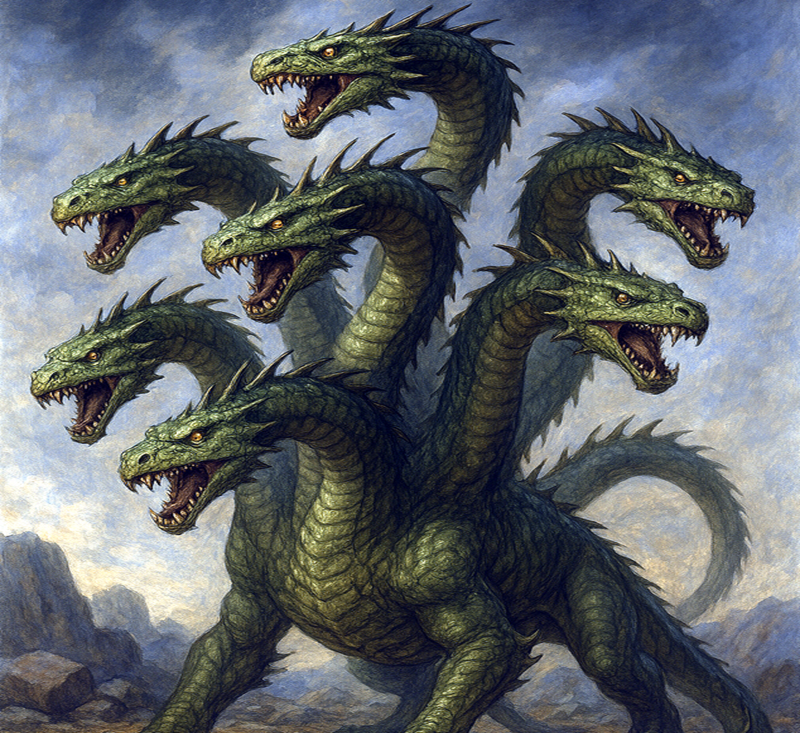
The violence is interconnected.
U.S. military forces attack Caracas to extract its president, killing as many as 80 people in the course of their operation.
An ICE agent shoots and kills a poet, a mother of three, on a street in Minneapolis.
A 43-year-old disabled widow, burdened by medical debt from her husband’s and her own cancer, walks two hours in the early morning darkness to get free treatment at a health fair in Columbus, Ohio, a treatment for conditions not covered by her Medicaid. At the same time, Medicaid, and the SNAP food benefits that have also sustained this widow, are being severely cut by this administration.
Real harms to real people: it isn’t difficult to trace the connections from ledger to ledger in the federal budget. President Trump and his ICE-friendly Congress supercharged ICE’s deportation powers last year with a $75 billion supplement over and above its roughly $10 billion annual expenditure of the last few years. In the same One Big Beautiful Bill Act, the President and Congress cut Medicaid by $1 trillion, a reduction to be spread over 10 years, hurting low income adults, children, seniors in nursing homes, and hundreds of rural hospitals. To these ledger entries must be added the first-ever $1 trillion defense budget, a budget that continues to generate hundreds of billions in windfall profits for defense contractors, and a budget that enables this president to wield immense military power, unconstrained by anything other than, as he said, “my own morality. My own mind.”
Connecting the ledger entries means more than shining a light on distorted national priorities. It points to a fundamental reality that differentiates this election from any that preceded it. For the first time in U.S. history, a national election (the midterm election) is taking place with a consolidating authoritarian administration in power. Authoritarian rulers and regimes wield power, or attempt to wield power, without regard to the rule of law, human rights, or human well-being. By definition, they operate by the threat or use of violence – harm to others – in order to achieve specific objectives and hold on to power for its own sake.
To ignore this reality, to pretend that electioneering must proceed as it’s always been done in the past, is to drive straight ahead on a freeway while looking only in the rearview mirror. It’s a dangerous venture.
Many Democratic leaders feel confident they can carry the campaign banner of affordability to midterm victory this year. It’s true that the prices of groceries, rent, health care, and other necessities pose great hardships for millions of Americans, but affordability as a campaign slogan will go only so far. People need to know, in terms as clear and straightforward as possible, how the immense wealth of the United States is being diverted to harmful ends. They need to understand how many of the forms of violence they’re witnessing today emanate from a single source: the inherent, persistent aggressions of an authoritarian regime.
In ancient Greek mythology, the Hydra was a dangerous nine-headed serpent that attacked humans and animals alike. Any time one of its heads was cut off, another two would grow back. The legendary hero Heracles slew the monster by cutting off its heads and having his nephew Iolaus cauterize each of the wounds.
The myth of the Hydra offers a vivid image of how different forms of violence can be traced to a single, lethal source. But its utility ends there. No Heracles will come to slay this beast. A single “heroic” figure, or figures, isn’t even desirable. A complex history must first be accounted for: how the current authoritarian regime emerged from decades of festering inequalities of wealth and power, from long-standing precedents of scapegoating, racism, and xenophobia.
But a different set of traditions must also be acknowledged. The land that gave rise to the most toxic kinds of violence also nurtured generations of nonviolent activists, teachers, and leaders, who pushed the nation to deliver on its earliest promises of freedom and equality. They were the abolitionists, suffragists, trade unionists, human rights and peace activists who engaged in creative, nonviolent struggles to keep widening the horizons of human possibility.
Their heirs today fully understand that the 2026 midterms are not about politics as usual. They know that the struggle for democracy, for human well-being, must be waged nonviolently in street protests large and small, in myriads of strategic noncooperative actions (e.g. boycotts like that of Avelo Airlines), in straight-up campaigning and electioneering, and in protecting the vote from all kinds of promised subversions. They know that this is – and will continue to be in the coming months – a difficult and multidimensional struggle. But they also know that if it’s conducted wisely, it’s a struggle that will go a long way in putting the brakes on a runaway authoritarianism – and possibly reversing its course. Nonviolence, more expansively and creatively understood than ever before, must be the order of the day.
Andrew Moss, syndicated by PeaceVoice, writes on politics, labor,and nonviolence from Los Angeles. He is an emeritus professor (Nonviolence Studies, English) from the California State University.

No comments:
Post a Comment