Mark Carney, World Hero
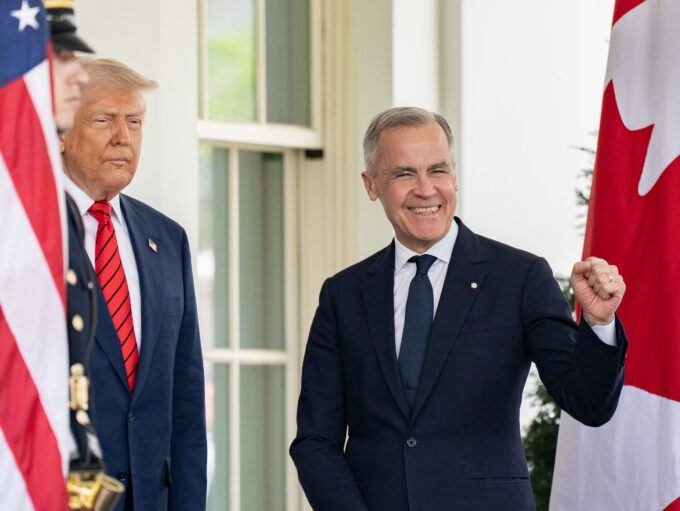
Photograph Source: The White House – Public Domain
I’m not in the habit of touting central bankers as heroes, but Mark Carney definitely hit a home-run in his speech at Davos. He called out Donald Trump’s derangement and outlined the basis for a new structure of international relations that does not rely on the United States to play the leading role.
To his credit, Carney did not glorify the old system, acknowledging that in the “rules-based system” led by the United States, the rules were not always followed when it benefited the United States. He didn’t get into the specifics of the violations, maybe his list wouldn’t be as extensive as some of ours, but at least he acknowledged that all were not equal under the law.
But the key point was the recognition that Trump has destroyed the era of U.S. hegemony, and the rest of the world has to adjust to that fact. Carney called on the “middle powers,” which would include Germany, France, the UK, Italy, Japan, South Korea, and Canada, to band together to craft a new system.
Carney has taken big steps in that direction with Canada. He has moved to make new trade deals with Brazil, the European Union, and even Mexico in the event that Trump decides to nix the current tripartite USMCA that is up for renewal this year.
Perhaps most importantly, Carney has moved to strengthen trade ties with China. This both opens up substantial economic benefits and shows the sort of geo-political pragmatism that Canada and other democracies will need in confronting Trump.
On the economic side, China can be a huge market for Canada’s agricultural output, as well as its oil and natural gas, if Trump decides that he no longer wants it. China also can be a major supplier of solar panels, wind turbines, batteries, and electric vehicles.
On this last issue, Carney struck the perfect compromise. While Canada, like the United States, imposes prohibitive 100% tariffs on most Chinese EVs, it agreed to import 50,000 EVs a year with very low tariffs. This is similar to the voluntary export restraint (VER) agreement the United States had with Japan in the 1980s. At the time, high gas prices were causing a massive shift in demand from big gas guzzling U.S. cars to well-built high mileage Japanese cars.
In order to protect the domestic industry, the Reagan administration agreed to accept a limited number of Japanese cars. This gave the U.S. industry time to adjust and begin building higher quality small cars. The Carney deal with Chinese EVs can have the same effect. It will allow Canadian drivers to recognize the benefits of the low-cost high quality EVs produced by Chinese will at the same time providing breathing space for its domestic auto industry to produce EVs, likely in collaboration with the leading Chinese companies.
This sort of deal can also be a model for Europe, which is also struggling with Chinese competition in its auto industry. Unlike Donald Trump, the rest of the world recognizes the reality of global warming. This means that they have a very real interest in shifting as quickly as possible to EVs, while still preserving jobs in their auto industry. This will also raise living standards, as people can buy cars that cost less to buy and far less to operate.
Carney’s deals seem to already be paying off for the country’s economy. It added254,000 jobs in 2025, growth of 1.4%. This would be equivalent to an increase in jobs of more than 2.2 million in the United States, roughly four times what we generated last year. In spite of the drop in exports with the United States, Canada’s exports were 0.5% higher in 2025 than in 2024.
While it is common for pundits to boast that the United States economy has left other wealthy countries in the dust, measured in purchasing power parity terms, Canada’s economy has actually grown slightly more rapidly than the U.S. economy since the pandemic.
This doesn’t mean everything is great in Canada. At 6.8 percent, its unemployment rate is considerably higher than in the United States. But this was also true before the pandemic. Canada also has a problem of high housing prices, which Carney is attempting to address by promoting new construction. The jury is still out on that one, but it is helpful to have someone in charge who can think about these issues seriously.
The other part of this story is that Europe and other democracies need to approach China with the same sort of pragmatic clarity as Carney. China is not a democracy, and it has a long list of human rights abuses. Nonetheless, it is an essential ally in a world where Donald Trump insists that he can do whatever he wants.
If closer ties with China seems troublesome, people should look back to the alliance with the Soviet Union in World War II. No one thought Joseph Stalin was a nice guy, but Roosevelt, Churchill and the rest of the anti-fascist alliance understood the necessity of his role in defeating Hitler. It is unfortunate that we have come to the point where China would be seen as the stable super-power, but we have.
It would be great if Canada and other middle powers, to take Carney’s phrase, can reconstruct a international system of laws, where ideally they will be applied equally regardless of the power of the states in question. Hopefully, they will promote democracy and human rights in practice, not just in rhetoric.
But those are issues that will ultimately be determined down the road. For now, the issue at hand is putting together an alliance of countries that can tell Donald Trump he cannot do whatever he wants around the world. And if he doesn’t like it, maybe he can get his friend at FIFA to give him another peace prize.
This first ran on Dean Baker’s Beat the Press blog.
Jawed Naqvi
DAWN
CANADIAN Prime Minister Mark Carney finished two significantly ground-breaking visits to Beijing and Davos last week and they hold a message for nations and leaders feeling the heat from President Donald Trump’s insulting and arrogant behaviour with friend and foe alike.
And while Carney maintained his country’s relations with the US were multifaceted and far-reaching, he was pleased that his rare talks with President Xi Jinping had set up guardrails for greater predictability in bilateral relations and to keep each other’s interests in mind. He also clarified — perhaps to avoid needlessly poking Donald Trump in the eye — that there hadn’t been a free trade agreement with Beijing even if thousands of electric cars from China would be plying Canadian roads in the coming days. And if this riles the US, so be it.
Why is it so difficult for Indian Prime Minister Narendra Modi, representing a no less major power, to speak up like Carney? Holding the BRICS presidency for 2026, Modi is required to host a summit of its increasingly powerful and influential leaders in New Delhi around August. However, when Modi does speak, he usually speaks about a municipal election his party would win or has won, if he is not otherwise threatening to replace this or that opposition government in the coming state polls.
The last time one heard him speak on a foreign policy issue from Indian soil was the threat he made (unusually) in English in Bihar about avenging the death of innocent tourists in a terror attack in Kashmir in April last year. It resulted in Operation Sindoor against Pakistan, which apparently served no purpose other than to reveal India’s shocking diplomatic isolation under Modi’s watch.
Going by the claims of Modi’s own preferred media, he is a great speaker, a charismatic one, in fact. So why does the prime minister of India get tongue-tied facing Trump, whose presidency he canvassed for in 2020, which for likelier other reasons Trump lost.
In Davos, Carney spoke even more boldly about souring ties with the US. He told the ruling elites that the 80-year-old world order under US stewardship had ruptured and that there was a need to rearrange equations. The betterment of humanity and protecting its only known hospitable planet was paramount.
“We knew the story of the international rules-based order was partially false, that the strongest would exempt themselves when convenient, that trade rules were enforced asymmetrically, and we knew that international law applied with varied rigour, depending on the identity of the accused or the victim,” Carney’s message was blunt. “Let me be direct. We are in the midst of a rupture, not a transition.”
Why does the prime minister of India get tongue-tied facing Donald Trump?
Carney’s address was backed by the German chancellor and was followed by what seems like a Europe-Canadian pact to shun Donald Trump’s self-promoted Board of Peace for Gaza. Its endorsement by leading Islamic states including Pakistan, Egypt and Turkiye makes it trickier to fathom the true intentions. Imagine the lot working with Benjamin Netanyahu who for his own reasons has enrolled himself aboard. It’s not easy to see how Israel and Pakistan could be in a team that too in the name of alleviating the suffering of Palestinian people! India would have plunged headlong for the plan, but the unstated fear of being seen in the company of Pakistan has perhaps put it in a spot.
Trump’s plan, in any case, is widely seen as a half-baked idea that postures to tend to the humanitarian pleas of the victims of Israeli genocide. It’s also hampered by an even greater worry that Trump may be seeing the body as a substitute for the UN itself.
It’s in this context that Carney’s call for a new game plan for the “middle powers” finds traction, a group to which India presumably belongs as the world’s fourth largest economy. The call was to collectively negotiate the jostling of Big Powers, which impacts everyone, including the Global South. Thus, Carney not only came close to the BRICS ideal of multipolarity, he surpassed it in his zeal to locate a world without nerve-wracking uncertainties or any more inbuilt inequalities with the US.
What did Carney say that melds with the agenda of a multipolar world, which should make India and other BRICS nations take notice? Like them, he spoke of the threat to multilateral institutions, namely the WTO, the UN, COP, the very architecture of collective problem-solving. “When the rules no longer protect you, you must protect yourself. But let’s be clear-eyed about where this leads. A world of fortresses will be poorer, more fragile and less sustainable.” In other words, individual deals with the bully are ill-advised.
“Hegemons cannot continually monetise their relationships. Allies will diversify to hedge against uncertainty. They’ll buy insurance, increase options in order to rebuild sovereignty that was once grounded in rules but will increasingly be anchored in the ability to withstand pressure. This room knows this is classic risk management… . … Collective investments in resilience are cheaper than everyone building their own fortresses. Shared standards reduce fragmentations. Complementarities are positive sum.” Carney could be reading from a Xi Jinping script for the coming BRICS summit.
Calling the middle powers in particular to act together, Carney cautioned: “If we’re not at the table, we’re on the menu.” How could Donald Trump not pace himself in the frame? “China will eat you up,” was his angry response.
There are questions nevertheless that flow from a tartly pinpointed speech. Does Carney’s new order propose to regard Palestine, Venezuela, Congo et al as equally violated by the old order? And what would be the fate of Nato, the Five Eyes and other assorted dubious relics of the US-led West? They can’t logically remain intact, can they, in the event of a genuine rupture with the old order?
Published in Dawn, January 27th, 2026
Mahir Ali
A PAIR of North American leaders delivered remarkably different speeches in Switzerland last week. Donald Trump’s address was a largely predictable, self-aggrandising rant that ranged from justifications for his claim on Greenland (or possibly Iceland) to a racist diatribe against Somalis, interpolated with denunciations of Joe Biden. Mark Carney acknowledged that the rules-based international order was always partially fictitious, and that the rupture cannot be reversed.
The Canadian PM uttered some truths that most of his European counterparts would struggle to enunciate. Carney has, therefore, widely been hailed as a viable anti-Trump by the usual centrists and some progressives. He called upon middle powers to act together in dealing with the foremost hegemon, “because if we’re not at the table, we’re on the menu”. But Denmark has been at the table, yet Greenland is on the menu.
Since last week, Trump has seemingly rescinded his invasion plan and dropped the threat of increased tariffs against European nations that resisted his acquisition of Greenland, citing a ‘framework agreement’ with Nato for establishing military bases (which would anyhow have been possible). Details are still murky, although Guantánamo Bay has been cited as a possible model. The lesson many analysts have drawn is that, like a typical bully, Trump backs down in the face of resolute resistance. If it’s as simple as that, one is forced to wonder why he has not been challenged more frequently.
It is notable, meanwhile, that there wasn’t even a passing mention of Israel or Gaza — under whose rubble the last vestiges of any international order lie buried, alongside the bones of Palestinian children, women and men — in Carney’s oration. Perhaps because Canada has been complicit in the genocide, alongside various other Anglophone or European nations. It is also notable that whereas a bunch of European countries turned down membership of Trump’s ridiculous Board of Peace (BoP) on the basis that an invitation had been extended to Vladimir Putin, none of them cited the inclusion of Benjamin Netanyahu, a genocidal maniac by any measure, as a sufficient cause for steering clear of the imperial entity.
Neither Trump nor Carney offers a solution.
The BoP charter attested at Davos by Trump with the same flamboyance as his birthday greetings to Jeffrey Epstein was signed with a bunch of supplicants hovering in the background, much like the farce at Sharm el-Sheikh last October. The BoP was stupidly endorsed by the UN Security Council last year, when it was considered purely a Gaza-related initiative. The charter doesn’t mention the Israeli-devastated territory at all, but the draft text of its first resolution, revealed on Monday, offers disturbing details.
Even Israel-approved Palestinians are relegated to the fourth tier of the arbitrary structure with Trump at its helm for as long he wishes (or gets bored with peace), with a broad range of reprobates in the higher echelons of this travesty. Trump’s ghostly son-in-law Jared Kushner laid out a bizarre plan at Davos, reinforcing the impression that Palestinians barely matter (except as a potential labour force) in the reconstruction of Gaza as a tourist resort. The UAE will reportedly bankroll a Potemkin village in Rafah to house 25,000 Palestinians vetted by their overlords, and biometrically scanned each time they move in or out of their abodes. A hi-tech refugee camp, in other words.
The enablers, by and large, are autocratic states eager to participate in a global kakistocracy. The fate of Gaza has been handed over to real-estate agents. More than half of the narrow strip is already under Israeli control, and that’s where any construction activity might take place. The ceasefire that Trump crows about has been followed by almost 500 murders by the Israel Defence Forces, including children and journalists, and the demolition of thousands of buildings. The genocide never ended, and the BoP has a recipe for completing it.
At Davos, the US president trumpeted his stature as the self-ordained saviour of Western civilisation. The Canadian PM took a different tack but cast himself in a similar role. Frankly, neither of them fits the bill as a great white hope, with one proclaiming a new world disorder and the other lamenting a status quo ante that benefited the few and dispossessed the many.
Nor does either of them offer a viable vision for the future. The actor Jackie Chan recently revealed that he broke down while watching a video in which a Palestinian child was asked, “What will you be when you grow up?”, and the boy nonchalantly responded: “Children on our side don’t grow up.”
It’s impossible to hold back the tears, but I doubt it would evoke a similar response in either of the great white hopes. If a better world is possible, neither Trump nor Carney will be part of it.
mahir.dawn@gmail.com
Published in Dawn, January 28th, 2026

No comments:
Post a Comment