Sunday, June 01, 2025


Reimagining Irregular Warfare: The Case For A Modernized OSS 2.0 – Analysis
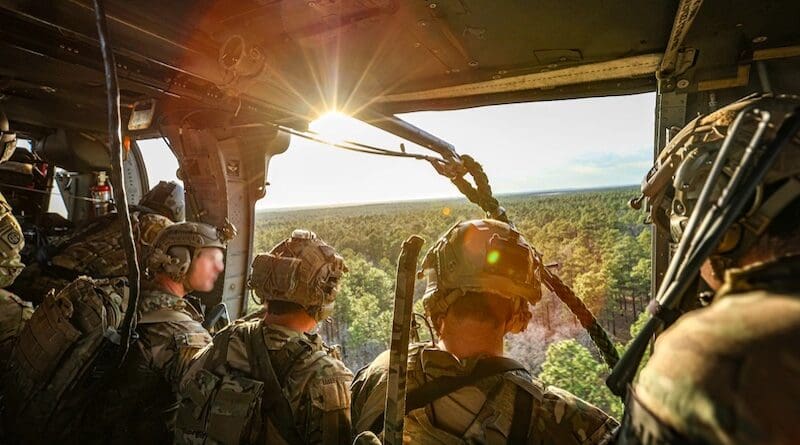
2-82 Assault Helicopter Battalion, 82nd Combat Aviation Battalion UH-60 aircrew teams worked closely with Soldiers assigned to 3rd Special Forces Group to perform fast rope insertion training on Fort Bragg, NC. 25March2025. This training recertified both aircrews and the 3rd SFG team on technical proficiencies. (U.S. Army photo by Sgt. Eli Baker)

By 

A rebuttal to J.R. Seeger’s “A New Office of Strategic Services?” published by FPRI in May 2025.


By Doug Livermore

(FPRI) — A recent piece in the Foreign Policy Research Institute (FPRI) penned by a retired Central Intelligence Agency (CIA) officer argues against proposals to revive the Office of Strategic Services (OSS) model for today’s strategic competition environment. In the piece, the author argues: “Reviving the OSS would add additional bureaucracy without any additional capability and could easily risk intelligence fratricide at a time when the United States needs more focus rather than more capability.” As the co-author of one of the critiqued proposals, I am compelled to note that this argument ignores two fundamental advantages of reviving an OSS 2.0 construct.

First, the assumption is invalid that any updated OSS proposal requires creating more redundant capabilities or excessive additional bureaucracy, rather than simply streamlining existing resources, eliminating redundant capabilities and functions, and breaking down organizational barriers between agencies with identical authorities but different cultures. Secondly, there is no acknowledgement of the very real operational fratricide that is already occurring today because of competing interests between organizations vying for missions and resources in an era of increasing government efficiency. The paralysis this interagency competition causes costs us opportunities that we could better realize through a unitary irregular warfare department under the Department of Defense (DoD).

The Real Opportunity: Streamlining Existing Resources

A modern OSS 2.0 would not require creating entirely new structures from scratch. Instead, it would consolidate and optimize existing resources that are currently fragmented across multiple agencies under the purview of the “Department for Special Operations and Irregular Warfare” (DSOIW), created by redesignating and hyper empowering the DoD’s existing Office of the Assistant Secretary of Defense for Special Operations and Low-Intensity Conflict. This is especially critical as recent reports indicate the CIA is planning to cut 1,200 positions over the next several years, even as the Trump administration requests a historic $1 trillion budget for the DoD.

Given this stark resource disparity and diverging priorities, we face a clear choice: continue with fragmented irregular warfare capabilities split between a shrinking CIA and an expanding DoD or create a more unified approach that eliminates redundancies and maximizes operational effectiveness. Keeping the smaller, shrinking organization as the lead for these efforts threatens limiting and potentially choking off these critical activities just as they are needed most.


Identical Authorities, Broader Capabilities

Both the DoD’s U.S Special Operations Command (USSOCOM) and the CIA’s Special Activities Centerpossess many overlapping and complementary functional capabilities, with both also having the ability to leverage Title 50 authorities to conduct irregular warfare activities. These authorities and capabilities extend beyond kinetic paramilitary activities, such as those made famous in the 2011 raid into Pakistan that killed al-Qaeda leader Osama bin Laden, to include psychological operations, information warfare, and political influence campaigns—areas where DoD has historically relied almost exclusively on its Title 10 (“Armed Forces”) authorities to enable sensitive operations supporting “traditional military activities” that nonetheless far exceed the scope and scale of those conducted by its interagency counterparts.

As I argued in my 2019 Military Times article, “transferring primary responsibility for paramilitary activities from the CIA to Defense Department would simply be a recognition that the majority interest in and capacity for paramilitary activities resides in the Defense Department [with USSOCOM executing].” While such a move would require the assertion of more robust oversight of these USSOCOM activities through existing DoD structures, this would also resolve longstanding congressional concerns that go back decades.

This principle applies equally to the full spectrum of irregular warfare activities. DoD’s Military Information Support Operations (MISO) teams, cyber warfare units, and strategic communications capabilities represent a formidable information-centric arsenal that could be more effectively leveraged in a unified irregular warfare structure under a broader application of the DoD’s Title 50 (“War and National Defense”) authorities. These capabilities, coupled with USSOCOM’s robust operational infrastructure, provide a comprehensive toolkit for influence activities that complement traditional paramilitary operations.

Executive Order 13470 already established the process for assigning covert action responsibility to agencies other than the CIA when “another agency is more likely to achieve a particular objective.” This order already identifies the DoD as the lead for covert action “in time of war declared by the Congress or during any period covered by a report from the President to the Congress consistent with the War Powers Resolution.” And there is precedence for such an arrangement, such as during the Vietnam War when, dissatisfied with the CIA’s performance, President John F. Kennedy transferred primary responsibility for covert actionagainst communist North Vietnam to the DoD. Given USSOCOM’s robust global access and placement, larger personnel reserves, superior technical infrastructure, and significantly greater budgetary resources, it is increasingly clear which organization is better positioned to lead the full range of irregular warfare efforts in today’s strategic environment.

The Global Placement and Capabilities Advantage

USSOCOM has unmatched global access and placement through its network of forward-deployed operators working with partner forces worldwide. These established relationships provide an invaluable foundation for irregular warfare activities without the need to build separate networks or capabilities. A modernized OSS 2.0 structure would leverage this existing infrastructure rather than duplicating efforts.

Human intelligence collection and liaison relationships are critical to the conduct of effective irregular warfare, and the Department of Defense already maintains its own parallel and extensive intelligence networks across the globe. These efforts are spearheaded by the Defense Intelligence Agency (DIA), which specifically focuses on foreign military intelligence and could be more effectively leveraged within a unified irregular warfare framework reporting to DSOIW. However, as a key advisor to the Department of State’s deployed chiefs of mission (or ambassadors), the CIA maintains virtual veto authority over any proposed DoD intelligence and many of its Title 10 irregular warfare activities overseas. The arrangement oftentimes creates tensions driven by divergent organizational interests.

Information Dominance in the Digital Age

Beyond traditional paramilitary operations, today’s irregular warfare landscape demands sophisticated cyber, information, and psychological operations capabilities where DoD has made substantial investments. Of the 18 organizations in the intelligence community, nine fall under the direct purview of the DoD and many focus on those required capabilities. MISO teams, U.S. Cyber Command elements, and strategic communications specialists throughout Defense Intelligence Enterprise (DIE) represent a formidable irregular warfare capability that dwarfs similar resources within the non-DoD intelligence community, including at the CIA.

In an era where influence campaigns, cyber operations, counter-disinformation efforts, and strategic narratives are increasingly decisive in strategic competition, these capabilities must be fully integrated with other irregular warfare tools. Under a unified DSOIW structure, these complementary capabilities could be better synchronized for maximum strategic effect, rather than operating in separate organizational silos with limited coordination.

Efficiency in the Era of Great-Power Competition

Today’s strategic competition with near-peer adversaries requires coherent, efficient application of irregular warfare capabilities. The current bifurcated approach between CIA and DoD creates significant operational inefficiencies that undermine our national security interests. Our intelligence community and special operations forces face duplicative reporting chains that produce redundant intelligence products and congressional oversight, often at considerable taxpayer expense. This unnecessary duplication extends to operational costs as well, with parallel capabilities often maintained across agency boundaries despite serving nearly identical functions.

Perhaps most concerning is how the current structure leads to competing priorities and objectives between agencies engaged in irregular warfare activities. In my own dealings with the congressional intelligence committees, I found that different organizations often briefed the same operations with no mention of other organizations that supported, causing confusion and frustration amongst those elected members charged with overseeing and funding our irregular warfare efforts. This fierce competition for limited resources and attention can compromise operational effectiveness and strategic coherence. Additionally, our limited pool of specialized personnel—individuals with rare skill sets and extensive experience—are inefficiently allocated across multiple organizations rather than being concentrated where they can have maximum impact.

The proposed DSOIW offers a clear solution to these systemic problems. By redesignating and empowering the current Office of the Assistant Secretary of Defense for Special Operations and Low-Intensity Conflict, we would establish proper unitary organizational authority and accountability. This new department would serve as the lead agency for all irregular warfare efforts, eliminating jurisdictional disputes and ensuring unity of effort across the full spectrum of activities and operations.

A Budget Reality Check

The Trump administration’s announcement of a $1 trillion defense budget stands in stark contrast to the CIA’s planned workforce reductions. This dramatic resource disparity makes the case for consolidation even more compelling. Why maintain separate, overlapping irregular warfare capabilities when we could optimize resources under a unified command structure? This move would also unburden the CIA of responsibilities always seen as secondary, allowing the spy organization to refocus on its primary mission: gathering information, generating exceptional analysis, and providing critical strategic insights to national decision-makers.

Secretary of Defense Pete Hegseth recently stated, “President Trump is rebuilding our military—and fast,” while pledging that taxpayer dollars would be spent “wisely, on lethality and readiness.” A modernized OSS 2.0 structure within DSOIW would ensure that irregular warfare capabilities receive appropriate resources while eliminating wasteful redundancies between agencies.

Conclusion: The Path Forward

As we prepare for a new era of strategic competition, we must move beyond institutional turf battles and optimize our irregular warfare capabilities. The proposed OSS 2.0 concept is not about creating something new, but rather about breaking down unnecessary barriers between existing capabilities to create a more efficient and effective approach to irregular warfare. Moreover, the establishment of a single entity fully responsible for and empowered to expand such activities would give Trump a more powerful weapon akin to that wielded by President Franklin Roosevelt in Gen. William “Wild Bill” Donovan’s original OSS during the Second World War.

The timing could not be more appropriate. With CIA resources diminishing while DoD funding reaches historic highs, we face a clear opportunity to streamline our irregular warfare capabilities under a unified structure. Rather than seeing this as a threat to agency prerogatives, we should recognize it as an opportunity to better serve our national security interests in an increasingly complex and dangerous global environment.

The views expressed are the author’s and do not represent official US Government, Department of Defense, or Department of the Army positions.

  • About the author: Doug Livermore is a Special Forces soldier with over two decades of national security experience at tactical, operational, strategic, and policymaking levels.
  • Source: This article was published by FPRI



Published by the Foreign Policy Research Institute

Founded in 1955, FPRI (http://www.fpri.org/) is a 501(c)(3) non-profit organization devoted to bringing the insights of scholarship to bear on the development of policies that advance U.S. national interests and seeks to add perspective to events by fitting them into the larger historical and cultural context of international politics.


ART OF WAR  3 EDITIONS

The Series was origi- nated to aid the distribution of these etexts in multiple formats and to highlight the benefits of PDF Ebooks. They are freely ...

THE ART OF WAR. By Sun Tzu. Translated with introduction and notes by. Lionel Giles, M.A.. 19th May 2004. Page 2. Contents. 1 INTRODUCTION. 4.

The Art of War (Sunzi bingfa/Sun-tzu ping-fa), compiled well over two thousand years ago by a mysterious Chinese warrior-philosopher, is still perhaps the ...


Global Threat Report Reveals Trump’s Strategic Priorities – Analysis


By 

By Luke Coffey


The US Defense Intelligence Agency recently released its annual threat assessment report. While these official government documents are often bland and filled with bureaucratic language, this year’s publication stands out — both for its substance and what it reveals about how the new administration views today’s geopolitical challenges. This is the first threat assessment of President Donald Trump’s second term, and it offers an early insight into the administration’s strategic priorities.

A few things jump out right away. This year’s threat assessment is longer than last year’s, and offers a more detailed and nuanced analysis across multiple sections. But two major changes in this year’s report, when compared with the final assessment produced under the Biden administration, are particularly striking.

The most notable difference is the inclusion of a dedicated section on US homeland defense and border security — placed not as an afterthought but as the first item in the report. This marks a sharp departure from last year’s assessment, which focused almost exclusively on global threats and challenges. The placement and tone of the new homeland security section clearly bear Trump’s personal stamp. One of his most effective political narratives has been that US policymakers focus too much on problems abroad, while neglecting the security of Americans at home. This report reflects that view.

The homeland security section places particular emphasis on the national security implications of illegal immigration, transnational organized crime, and the influx of deadly narcotics by drug cartels into small American communities. These are not just political talking points; they represent real and growing threats to the safety and well-being of Americans. But the political savvy of the framing should not be overlooked.

While the average American may not be deeply familiar with issues such as Taiwan’s security or freedom of navigation in the South China Sea, they are certainly familiar with the devastating impact of fentanyl or cartel violence. Including homeland security at the top of the Defense Intelligence Agency’s global threat assessment makes the report more relevant to the American public and highlights Trump’s emphasis on border security as a matter of national defense.


The second striking difference is the prominent section, entitled “Growing Cooperation Among US Competitors and Adversaries,” which comes immediately after the homeland security section. For the first time, a US threat assessment explicitly links and highlights the emerging coordination among America’s adversaries and competitors. The report states: “Building on activities over the past two years, leaders in Beijing, Moscow, Tehran, and Pyongyang will strengthen their nations’ ties in their drive to undermine the influence of the US and its allies.”

This is an important — and overdue — acknowledgment of a multipolar and interconnected world. For years, much of the US foreign policy establishment has resisted the concept of multipolarity, preferring to see the world in unipolar or bipolar terms. This resistance is rooted in Cold War-era thinking, when power was viewed through a US-versus-Soviet lens. But a new generation of American strategists understands that multiple centers of power exist — and are increasingly coordinating with one another to challenge US interests around the globe.

Recognizing the reality of this multipolar environment does not mean conceding that all powers are equal. It simply acknowledges the complexity of today’s geopolitical landscape. The inclusion of this section in the threat assessment is a necessary step toward grappling with the way these regimes are learning from each other, cooperating diplomatically, militarily, and economically, and exploiting US vulnerabilities.

To illustrate the shift, if you took a diplomat from 1980 and one from 1880 and brought them both to 2025, it might be the latter — accustomed to a world of competing empires and power centers — who would better recognize the dynamics at play today.

Recognizing these trends is one thing, acting on them another. Within the new administration, there are competing schools of thought on how to respond. Some believe China is the primary threat and argue that all instruments of US power should be directed toward countering Beijing. Others, often aligned with more isolationist instincts, believe the US should focus exclusively on homeland security and reduce its global footprint. Then there are more traditional Republican voices who argue that the US must be able to address multiple threats simultaneously and maintain its global leadership role.

Though the administration is still filling out its national security team, the contents of the Defense Intelligence Agency report suggest that the latter group is gaining the upper hand, at least for now. That could signal a more balanced approach in future, one that prioritizes US security at home, while maintaining engagement and vigilance abroad.

In the coming months, the Department of Defense is expected to publish a new National Defense Strategy, which should provide additional clarity on how the US plans to counter the threats identified in the Defense Intelligence Agency assessment. Likewise, the National Security Council is likely to release a similar document outlining a more comprehensive, whole-of-government approach to these challenges.

Importantly, all these strategies must be backed by resources. The White House will need to work with Congress to ensure that the budget aligns with these stated priorities. It is one thing to acknowledge that America’s adversaries are coordinating their efforts, but quite another to craft a strategy — and appropriate the funds — to counter them effectively.

Some in the Biden administration may have understood that this emerging coordination by America’s competitors posed a threat, but were reluctant to spotlight it publicly for fear of being forced to act. The Trump administration, by contrast, has put these challenges front and center. But in doing so, it has also raised the stakes. Having declared that homeland defense is national security — and that America’s adversaries are working together — the administration will now be judged on how it responds.

The coming months will be critical, not only for America’s national security and that of its allies, but also for the future of America’s role in the world.

  • Luke Coffey is a senior fellow at the Hudson Institute. X: @LukeDCoffey

Arab News

Arab News is Saudi Arabia's first English-language newspaper. It was founded in 1975 by Hisham and Mohammed Ali Hafiz. Today, it is one of 29 publications produced by Saudi Research & Publishing Company (SRPC), a subsidiary of Saudi Research & Marketing Group (SRMG).
RBC asks staff to return to office four days a week

By Reuters
Published: May 29, 2025 

Royal Bank of Canada signage is pictured in the financial district in Toronto Sept. 8, 2023. THE CANADIAN PRESS/Andrew Lahodynskyj

TORONTO — Royal Bank of Canada has asked employees to be in office four times a week starting in September, according to a memo seen by Reuters, prompting disapproval among some staff discussing the changes in internal chat groups.

The memos from various business heads were sent to staff on Thursday shortly after the bank reported second-quarter earnings that were lower than analysts’ expectations due to a rise in loan loss provisions to prepare for uncertain times.

The memo said the rule does not apply for roles that are fully remote or are already in full-time office arrangements.

“RBC is a relationship-driven bank and in-person, human connection is core to our winning culture. We set the expectation in 2023 that we’d come together in the office for the majority of the time, with the flexibility to work remotely one to two days a week,” a spokesperson said.

A company-wide internal chat group that discussed the change in policy raised questions such as additional travel time and expenses related to transport, a source told Reuters.


The Canadian lender’s decision comes shortly after U.S. bank JPMorgan Chase, in January asked its employees who are on hybrid work schedules to return to the office five days a week starting in March.

RBC has over 94,000 full-time employees across global offices, as of April 30.

(Reporting by Nivedita Balu in Toronto; Editing by David Gregorio)


Diminishing Returns Threaten World Economic Stability

  • The world economy is facing a predicted contraction due to physical limits related to resource extraction and diminishing returns in various areas, including energy and minerals.

  • Current economic indicators, such as high debt levels, falling oil and coal production, and rising inflation, suggest an impending downturn that will affect global living standards and government stability.

  • As existing economic systems falter, new economic models are expected to emerge, though the transition period will likely be marked by financial instability, job losses, and a decrease in overall prosperity.


I predict that the world economy will shrink in the next 10 years. I think that this is bound to happen because of energy and debt limits the world economy is hitting. There are a variety of other factors involved, as well.

In this post, I will try to describe the physics-based limits that the economy is facing, related to diminishing returns of many kinds. The problem we are facing has sometimes been called “limits to growth,” or “overshoot and collapse.” Such changes tend to lead to a loss of “complexity.” They are part of the way economies evolve. I would also like to share some ideas on the changes that are likely to occur over the coming decade.


[1] The world economy is a tightly integrated physics-based system, which is experiencing diminishing returns in far more areas than just oil supply.

When extraction of a mineral takes place, usually the easiest (and cheapest) portion of the mineral deposit is extracted first. After the most productive portion is removed, the cost of extraction gradually increases. This process is described as “diminishing returns.” Generally, more energy is required to extract lower quality ores.

The economy is now reaching diminishing returns in many ways. All kinds of resources are affected, including fossil fuels, uranium, fresh water, copper, lithium, titanium, and other minerals. Even farmland is affected because with higher population, more food is required from a similar amount of arable land. Additional-cost efforts such as irrigation can increase food supply from available arable land.

The basic problem is two-fold: rising population takes place while the easiest to extract resources are depleting. The result seems to be Limits to Growth, as modeled in the 1972 book, “The Limits to Growth.” Academic research shows that problems such as those modeled (sometimes referred to as “overshoot and collapse”) have been extremely common throughout history.

Precisely how this problem unfolds varies according to the specifics of each situation. Growing debt levels and increasing wage disparity are common symptoms before collapse. Governments become vulnerable to losses in war and to being overthrown from within. Epidemics tend to spread easily because high wage disparity leads to poor nutrition for many low-wage workers. Dr. Joseph Tainter, in his book, “The Collapse of Complex Societies,” describes the situation as the loss of complexity, as a society no longer has the ability to support some of the programs it previously was able to support.

At the same time the existing economy is failing, the beginnings of new economies can be expected to start. In some sense, economies “evolve,” just as plants and animals evolve. New economies will eventually replace existing ones. These changes are a necessary part of evolution, caused by the physics of the biosphere.

In physics terms, economies are dissipative structures, just as plants, animals, and hurricanes are dissipative structures. All dissipative structures require energy supplies of some type(s) to grow and remain away from a dead state. These structures do not “live” endlessly. Instead, they come to an end and are often replaced by new, slightly different, dissipative structures.

[2] Over the next 10 years, the general direction of the economy will be toward contraction, rather than growth.

There are many indications that the world economy is hitting a turning point because of rising population and diminishing returns with respect to resource extraction. For example:

[a] Debt levels are very high in the US and other countries. A rising debt level can temporarily be used to pull an economy forward without adequate energy supplies because it indirectly gives workers and businesses more spendable income. This income can be used to work around the lack of inexpensive energy products of the preferred types in a variety of different ways:

  • It can allow consumers to afford a higher price for existing energy products, if the additional funds get back to customers as higher incomes or lower taxes.
  • It can allow businesses to find more efficient ways of using resources, such as ramping up international trade or building more efficient vehicles.
  • It can allow the development of new energy products, such as nuclear power generation and electricity from wind and solar.

What we are finding now is that these new approaches tend to encounter bottlenecks of their own. For example, oil supply is sufficiently constrained that the current level of international trade no longer seems to be feasible. Also, wind and solar don’t directly replace oil; electricity based on wind turbines and solar panels can lead to blackouts. Furthermore, diminishing returns with respect to oil and other resources tends to get worse over time, leading to a need for ever more workarounds.

If at some point, extraction becomes more constrained and workarounds fail to provide adequate relief, added debt will lead to inflation rather than to hoped-for economic growth. Higher inflation is the issue that many advanced economies have been struggling with recently. This is an indication that the world has hit limits to growth.

[b] Because of low oil prices, companies are deciding to cut back new investments in extracting oil from shale, and likely elsewhere.

Line graph depicting the Brent Oil Price in 2024 US dollars from 1952 to 2024. The graph shows fluctuations in oil prices with significant peaks and troughs over the decades.
Figure 1. Brent equivalent oil prices, in 2024 US dollars, based on a combination of indications through 2023. Sources include historical oil prices in 2023$ from the 2024 Statistical Review of World Energy, published by the Energy Institute; the increase in average Brent spot price from 2023 to 2024, published by the US EIA; and the US Consumer Price Index for Urban consumers.

Figure 1 shows that oil prices rise and fall; they don’t rise endlessly. They rose after US oil production hit its first limits in 1970, but this was worked around by ramping up oil production elsewhere. Prices rose in the 2003 to 2008 period and then fell temporarily due to recession. They returned to a higher level in 2011 to 2013, but they have settled at a lower level since then.

One factor in the price decline since 2013 has been the production of US shale oil, adding to world oil supply. Another factor has been growing wage disparity, as workers from rich countries have indirectly begun to compete with workers from low-wage countries for many types of jobs. Low-wage workers cannot afford cars, motorcycles, or long-distance vacations, and this affordability issue is holding down oil demand.

US oil production from shale is in danger of collapsing during the next few years because prices are low, making new investment unprofitable for many producers. In fact, current prices for oil from shale are lower than shown on Figure 1, partly because US prices are a little lower than Brent, and partly because prices have fallen further in 2025. The recent price available for US WTI oil is only about $62 per barrel.

[c] World per capita coal production has fallen since 2014. A recent problem has been low prices.

Line graph depicting world coal production per capita over the years from 1965 to 2022, highlighting a recent decline labeled 'Coal problem'.
Figure 2. World coal production through 2023 based on data of the 2024 Statistical Review of World Energy, published by the Energy Institute.

Transportation costs are a major factor in the delivered price of coal. The reduced production of coal is at least partly the result of coal mines near population centers getting mined out, and the high cost of transporting coal from more distant mines. Today’s coal prices do not seem to be high enough to accommodate the higher costs relating to diminishing returns.

[d] In theory, added debt could be used to prop up oil and coal prices, but debt levels are already very high.

Besides the problem with inflation, mentioned in point [a], there are problems with debt levels becoming unmanageably high.

Graph depicting the federal debt held by the public as a percentage of GDP from 1945 to projected values in 2055, highlighting key historical events such as World War II, the 2007-2009 financial crisis, and the coronavirus pandemic.
Figure 3. Figure from page 10 of The Long-Term Budget Outlook 2025 to 2055, published in March 2025 by the US Congressional Budget Office.

Figure 3 shows US government debt as a ratio to GDP. If we look at the period since 2008, there was an especially large increase in debt at the time of the 2007-2009 Financial Crisis and the 2020 Pandemic. The debt level has become so high that interest on the debt is likely to require tax revenue to rise endlessly. The underlying problem is needing to pay interest on the huge amount of outstanding debt.

Putting together [a], [b], [c], and [d], the world has a huge problem. As the world economy is currently organized, it is heavily dependent on both oil and coal. Oil is heavily used in agriculture and in transportation of all kinds (cars, trucks, trains, airplanes, and ships). Coal is especially used in steel and concrete making, and in metal refining. We don’t have direct replacements for coal and oil for these uses. Wind and solar are terribly deficient at their current state of development.

The laws of physics tell us that, given the world’s current infrastructure, a reduction in the availability of both crude oil and coal will lead to cutbacks in the production of many kinds of goods and services around the world. Thus, we should expect that GDP will contract, perhaps for a long period, until workarounds for our difficulties can be developed. Today’s wind turbines and solar panels cannot solve the problem for many reasons, one of which is that fact that production and transport of these devices is dependent upon coal and oil supplies.

Thus, without adequate oil and coal to meet the needs of the world’s growing population, the world economy is being forced to gradually contract.

[3] Overall living standards can be expected to fall rather than rise during the next decade.

A recent article in the Economist shows the following chart, based on an analysis by the United Nations:

Graph depicting the Human Development Index (HDI) showing trends from 2000 to 2024, with actual values in red and projected trends in blue.
Figure 4. Chart showing global average “Human Development Index,” as calculated by the United Nations, in the Economist.

Figure 4 shows the trend in the Human Development Index as level in 2023-24. I expect that the trend will gradually shift downward in 2024-2025 and beyond. Modern advances, such as the availability of potable water in homes and the availability of electricity 24 hours per day, will become increasingly less common.

The Economist article displaying Figure 4 notes that, so far, most of the drop in living standards has happened in the poorer countries of the world. These countries were hit harder by Covid restrictions than rich countries. For example, the drop in tourism had a greater impact on less advanced countries than on rich countries. Poor countries were also affected by a decline in export orders for luxury clothing.

Outside of poor countries, young people are already finding it difficult to find jobs that pay well. They are often burdened with debt relating to advanced education, making it difficult for them to have the same standard of living that their parents had. This trend is likely to start hitting older citizens, as well. Jobs will be available, but they won’t pay well. This problem will affect both young and old.

[4] Governments will be especially vulnerable to cutbacks.

History shows that when overshoot and collapse occur, governments are likely to experience severe difficulties, indirectly because many of their citizens are getting poorer. They require more government programs, but if wages tend to be low, the taxes they pay tend to be low, too.

Unfortunately, the kinds of cutbacks being undertaken by the Department of Government Efficiency (DOGE) are very much necessary to get payments by the US government down to a level that can be supported by taxes. Regardless of how successful the current DOGE program is, I expect a huge reduction in the number of individuals on the payroll of the US government, perhaps by 50% to 75%, in the next 10 years. I also expect major cutbacks in the funding for outside organizations, such as universities and the many organizations DOGE has targeted.

At some point, the US government will need to reduce or eliminate many types of benefit payments made now. One approach might be to try to send many kinds of programs, such as job loss protection, Medicaid, and Medicare, back to the states to handle. Of course, the states would also have difficulty paying for these benefits without huge tax increases.

[5] Ten years from now, universities and colleges will enroll far fewer students.

I expect that university enrollments will fall by as much as 75% over the next 10 years, partly because government funding for universities is expected to fall. With less funding, tuition and fees are likely to be even higher than they are today. At the same time, jobs for university graduates that pay well will become less available. These considerations will lead fewer students to enroll in four-year programs. Shorter, more targeted education teaching specific skills are likely to become more popular.

There will still be some high-paying jobs available, requiring university degrees. One such area may be in finding answers to our energy and resource problems. Such research will likely be carried out by a smaller number of researchers than are active today because some current areas of research will be discarded as having too little potential benefit relative to the cost involved. Any approach considered will need to succeed with, at most, a tiny amount of government funding.

High paying jobs may also be available to a few students who plan to be the “wheeler-dealers” of the world. Some of these wheeler-dealer types will want to be the ones founding companies. Others will want to run for public office. They may be able to succeed, as well. They may want to study specialized tracks to advance their career goals. Or they may want to choose institutions where they can make contacts with people who can help them in pursuing their career goals.

For most young people, I expect that four-year university degrees will increasingly be viewed as a waste of time and money.

[6] In a shrinking economy, debt defaults will become an increasing problem.

A growing economy is very helpful in allowing financial institutions to prosper. With growth, future earnings of businesses tend to be higher than past earnings. These higher earnings make it possible repay both the borrowed amount and the required interest. With growth, there is little need to lay off employees. Thus, the employees have a reasonable chance to repay mortgage loans and car loans according to agreed-upon terms.

If an economy is shrinking, overhead becomes an ever-larger share of total revenues. This makes profits harder to achieve and may make it necessary to lay off employees. These laid-off employees are more likely to default on their outstanding loans. As debt defaults rise, interest rates charged by lenders tend to rise to compensate for the greater default risk. The higher interest rates make debt repayment for future borrowers even more difficult.

All these issues are likely to lead to financial crises, as debt defaults become more common.

[7] As debt defaults rise, banks tend to fail. This can lead to hyperinflation or deflation.

In a shrinking economy, the big question when banks fail is, “Will governments bail out the banks?”

If governments bail out the failing banks, there is a tendency toward inflation because the bailouts increase the money supply available to citizens, but not the quantity of goods available for purchase. If enough banks fail, the tendency may be toward hyperinflation–way too much money available to purchase very few goods and services.

If no government bailouts are available, the tendency is toward deflation. Without bailouts, the problem is that fewer banks are available to lend to citizens and businesses. As a result, fewer people can afford to buy homes and vehicles using debt, and fewer businesses can take out loans to purchase needed supplies. These changes lead to less demand for finished goods. This change in demand can indirectly be expected to affect commodity prices, as well, including oil prices. With low prices, some suppliers may go out of business, making any supply problem worse.

Regardless of whether bailouts are attempted or not, on average, citizens can be expected to be getting poorer and poorer as time goes on. This occurs because with a shrinking economy, fewer goods and services will be made. Unless the population shrinks at the same rate, individual citizens will find themselves getting poorer and poorer.

[8] Expect more tariffs and more conflicts among countries.

Without enough oil for transportation, the quantity of imported goods must be cut back. A tariff is a good way of doing this. If one country starts raising tariffs, the temptation is for other countries to raise tariffs in return. Thus, the overall level of tariffs can be expected to rise in future years.

Without enough goods and services for everyone to maintain their current standard of living, there will be a definite tendency for more conflict to occur. However, I doubt that the result will be World War III. For one thing, the West seems to have inadequate ammunition to fight a full-scale conventional war. For another, the nuclear bombs that are available are valuable for providing fuel for our nuclear power plants. It makes no sense to use them in war.

[9] Expect an increasing share of empty shelves, as time goes on.

High tech goods are especially likely to disappear from shelves. Replacement parts for automobiles may also be difficult to find, especially before an aftermarket of locally manufactured parts appears.

[10] Interest rates are likely to stay at their current level or increase to a higher level.

The high level of borrowing by governments and others makes lenders reluctant to lend unless the interest rates are high. It should also be noted that current interest rates are not high relative to historical standards. The world has been spoiled in recent years with artificially low interest rates, made possible by Quantitative Easing and other manipulations.

[11] Clearly, this list is not exhaustive.

The world economy has gone through two major disruptions in recent years, one in 2008, and one in 2020. Very unusual changes such as these are quite possible again.

We don’t know how soon new economies will begin to evolve. Eric Chaisson, a physicist who has researched this issue, says that there is a tendency for ever more complex, energy-dense systems to evolve over time. This would suggest that an even more advanced economy may be possible in the future.

By Gail Tverberg via Our Finite World