Friday, June 13, 2025


Towing Effort Attempts to Move Smoldering Wan Hai 503 Out to Sea
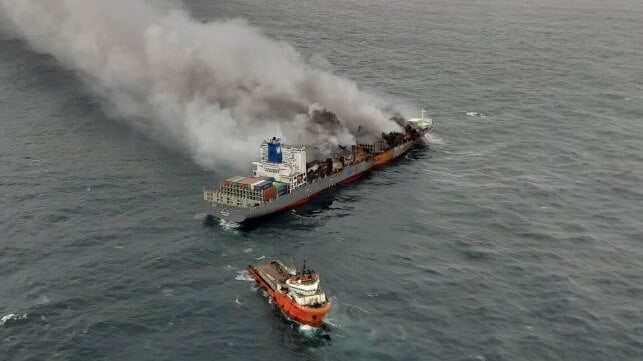
tow of burning containership
The salvage tug has a tow line in an effort to stop the vessel from approach the shore (Indian Coast Guard)

Published Jun 13, 2025 2:49 PM by The Maritime Executive


The Indian Coast Guard is reporting significant progress with the efforts to manage the fire aboard the containership Wan Hai 503. Concern was being raised during the day on Friday as winds began to build ahead of an approaching storm which local officials feared would drive the ship toward the coastline.

Despite continuing hotspots and heavy gray and black smoke coming from the midsection of the vessel, the Indian Coast Guard reports the Indian Navy was able to put a salvage team aboard the vessel late on Friday, June 13. They used a helicopter to winch four salvage personnel on the deck of the vessel. They were able to establish a new towline which has now been passed to the commercial vessel Ocean Warrior hired by the salvage team.
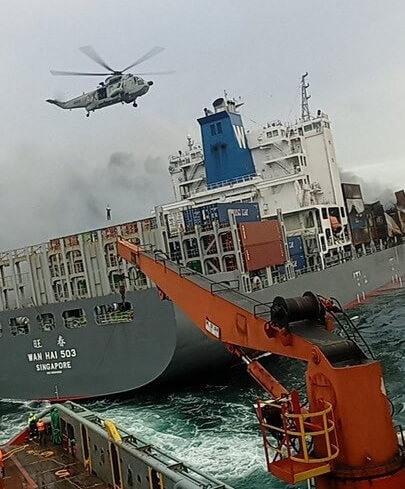
 

Salvage team was placed on the vessel using the winch from an Indian Navy helicopter (ICG)


It was reported to be the third towline attached to the vessel as the prior two had parted. Before the Ocean Warrior was in position for the tow, the Coast Guard had attempted to use the smaller tug Water Lily. According to the situation update, the tug did not have sufficient bollard pull power to pull the Wan Hai 503 away. A third tug, Triton Liberty operating under charter to the Navy was also dispatched from Kochi to aid in the tow.

The Wan Hai 503 was initially about 44 nautical miles away from the coast but at last observation, it is reported to be drifting at speeds up to 1.8 knots. At other times, the report said the vessel was “rotating aimlessly.” It was about 38 nautical miles from the coast with the local authorities beginning to make preparations in case the ship was driven ashore. They sought to assure citizens by saying there would be a seven to eight-hour warning if the vessel was coming ashore.


Part of the concern is a building storm that could drive wind speeds to 50 to 60 mph over the weekend. The Secretary of the Kerala State Disaster Management Authority told the Manorama news outlet that things were starting to look “scary” with the southwest winds gaining strength. Further, they reported with the majority of the cargo incinerated, the vessel is lighter and has increased in speed.

The bulk of the fire is out but below deck and in the midships area there continue to be hotspots that still require boundary cooling. They were also continuing to drop chemicals from above as the fire was proving to be very persistent.


Progress with Wan Hai 503 Fire as India Demands Action from Salvage Efforts
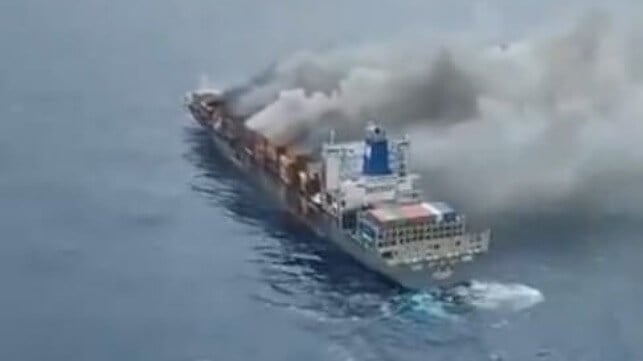
burning containership
India warns for the risk if escalation as hot spots remain on the containership (ICG)

Published Jun 12, 2025 7:56 PM by The Maritime Executive


The firefighting efforts for the Wan Hai 503 containership which are now being undertaken jointly by India’s Coast Guard and Air Force are reporting progress, while India’s shipping authorities are demanding more action by the vessel’s owners and the appointed salvage team. The frustration comes as India has been forced to deal with two containership casualties simultaneously, and today there was another brief scare when a third vessel reported a box fire. 

The Indian Coast Guard has been leading the effort since the fire began on the Wan Hai 503 on June 9, approximately 44 miles off the coast. The fire rapidly engulfed much of the ship with the Coast Guard sending firefighting vessels and today joined by the Air Force which was dropping dry chemical power onto the core of the fire. Today, the fourth day of the effort, the Coast Guard reports it has seven ships engaged in firefighting, boundary cooling, and the continuing search for the four missing crewmembers.

The fire has been substantially reduced with the authorities saying it is approximately 40 percent suppressed. However, there is heavy gray and black smoke and heat zones remain active mostly around the forward cargo hold and below deck. One concern is that heating continues near the fuel tanks and persistent hotspots requiring continuous boundary cooling. 

The Coast Guard was able to get a team aboard the vessel and secured a towline at the stern. They were planning fresh attempts to establish a stable towline that would be connected to the Offshore Warrior, a more powerful platform supply vessel brought in by the appointed salvage company T&T Salvage. 

The goal is to use the stronger tug to pull the vessel away from the coastline. Currently, the vessel is between 38 and 40 nautical miles offshore and drifting to the southeast at 1.5 to 2 knots. The Directorate General of Shipping warns there is a serious risk of escalation if the fire is not stabilized. Further, they are concerned because the weather forecast calls for strong winds likely reaching 50 to 60 knots and heavy rain from June 14 to 16.


The Directorate General sent a letter to Wan Hai and T&T Salvage on June 11 raising serious concerns about their efforts. Reports said the Offshore Warrior had to leave the scene because it did not have adequate fuel and was traveling to Kochi for refueling. Also, the authorities highlighted the vessel has limited firefighting capabilities and lacked foam for firefighting. They are calling the vessel “unsuitable for effectively addressing the rapidly evolving and critical situation.”

The authorities are calling for a stronger response by the companies saying they would not hesitate to initiate criminal proceedings and other punitive measures. They are demanding no further delay or negligence in launching an effective firefighting and salvage operation. 

The Indian Coast Guard is reported to have requisitioned an additional 1,000 kilograms of dry chemical power to be dropped as well as an additional 10,000 liters of firefighting foam. At the last report, it had 3,000 liters available on-site. The Directorate also reported that it has requisitioned the offshore tug Triton Liberty, which is under charter to the Indian Navy, and it was due to reach Wan Hai 503 late on Thursday. It is to be used to support the firefight and for towing assistance.

The Directorate General of Shipping at the same time is demanding more action from the salvage teams working on the MSC Elsa 3 which was lost in the same area. They want the fuel pumping from the wreck to begin although they reported today salvage divers have been able to stop the leaks from the ship.

Further compounding the demands on the Indian Coast Guard another feeder ship, Interasia Tenacity (37,160 dwt) reported a box fire on Thursday said India’s Manoram outlet. The vessel is inbound and due to arrive in India tomorrow but reported a fire in one of the 1,387 containers aboard. The Coast Guard responded but the vessel later advised it had controlled the fire and no longer required assistance.

The Indian Coast Guard has received commendations from many sources including both China and Taiwan for its response which saved 18 seafarers from Wan Hai 503 and the crew from the MSC Elsa 3. The Directorate General however highlights the ultimate salvage responsibility is with the owners and operators of the vessels and they must maximize their efforts to minimize the environmental damage from the casualties.

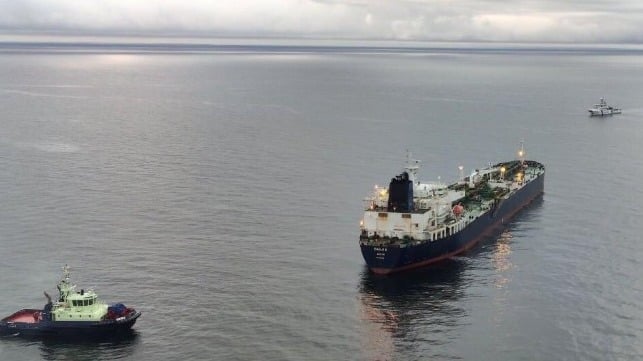
 

Finnish Police Finish Investigation Recommending Charges for Eagle S Tanker

tanker detained in Finland
Eagle S was detained till March while the three individuals have remained in Finland pending completion of the investigation (Finnish Border Guard)

Published Jun 13, 2025 1:33 PM by The Maritime Executive


Investigators working for Finland’s national police announced they have completed their criminal investigation into the damage to the subsea cables. They reported they officially suspect the master and two officers from the tanker Eagle S who have been detained in Finland since January 2025.

The investigation focused on the possible involvement of the Eagle S, a tanker registered in the Cook Islands, which was present in the area at the time the cables were damaged on December 25. Finland quickly identified the vessel as a suspect and took it into custody ordering the master and officers not to leave Finland. Investigators said as a result of the efforts carried out during the criminal investigation, the police have a clear understanding of the sequence of events.

“Among the suspects are the master, the chief mate, and the second mate, who were responsible for the safe passage, navigation, and operation of the vessel,” announced Detective Chief Inspector Sami Liimatainen, Head of Investigation for the National Bureau of Investigation. “The criminal investigation has examined and assessed, among other things, the extent of their responsibility for the condition of the vessel and the degree to which they should have observed the anchor falling into the sea.”

Based on the investigation, the police announced that the senior officers of the tanker Eagle S are “suspected of aggravated criminal mischief and aggravated interference with telecommunications.” The conclusion was based on reviewing material collected from the vessel, examination of the seabed, and interviews with the crew and officers of the tanker.

During the investigation, they retrieved the vessel’s anchor from the sea floor and looked at the broken anchor chain. Reports said they also found marks on the seafloor showing the anchor had been dragged for more than 100 km (more than 60 miles).

The Helsinki Times reported that the crimes would be considered serious criminal offenses under Finnish law. They could carry significant prison sentences. The Finnish media reports the three have consistently denied deliberately damaging the cables, which have now been repaired and returned to service.

The investigators will pass their information to the prosecutor’s office which reviews the information and officially decide if charges will be pursued. However, the news outlet Yle Svenska reported at the end of May that it understood preliminary trial dates have already been set. They said a trial could begin in late August or early September.

A court in Taiwan yesterday, June 12, sentenced the Chinese master of a cargo ship to three years in jail for a similar offense. Taiwan reported the captain of a vessel registered in Togo anchored in an area marked as restricted and permitted the vessel to drift across sensitive cables. They reported finding clear indications of external forces on the damaged cable.

These cases raised awareness of the dangers in the Baltic and Scandinavian countries. They have increased patrols around critical undersea infrastructure and were successful in getting NATO to also commit resources for the protection of the undersea assets.


Trigon Takes FID for Prince Rupert LPG as Canada Grows Gas Exports to Asia

UNLIKE TRUMP'S ALASKA GRIFT

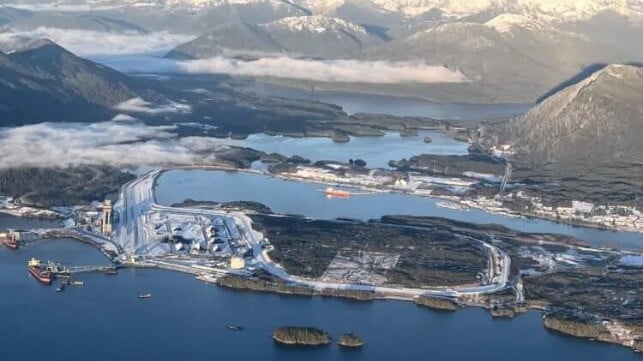
Prince Rupert Canada
Trigon Pacific has decided to proceed with a plan to add LPG exports to Canada's Prince Rupert Port (Trigon)

Published Jun 13, 2025 7:13 PM by The Maritime Executive


Canadian firm Trigon Pacific Terminals intends to increase bulk liquefied petroleum gas (LPG) exports to Asian markets after reaching a final investment decision (FID) on a C$750 million (US$552 million) export facility at the Port of Prince Rupert, British Columbia. It comes as Canada works to expand its energy exports including the Canada LNG plant in Vancouver which is scheduled to start exports in the coming weeks.

Privately-owned Trigon called reaching the FID a critical milestone in the implementation of the open-access export facility that will have a capacity of 2.5 million tonnes per annum. Expected to commence exports in late 2029, the facility will be instrumental in increasing Canadian LPG export sales beyond its traditional U.S. market to the growing Asian markets particularly Japan, South Korea, and India.

The facility, which is now subject to securing all necessary legal and regulatory approvals, will involve the construction of 98,000 cubic meters of new LPG storage capacity and will leverage existing vessel loading infrastructure. The facility will also leverage existing rail yards, with new rail unloading facilities to provide complete unit train unloading.

Trigon operates a multi-commodity bulk export terminal at Prince Rupert that has the capacity to load metallurgical coal, thermal coal, and petroleum coke at a rate of 9,000 tonnes per hour. In 2023, the company decided to redevelop a portion of the existing coal facilities for LPG exports. The move was informed by the Canadian government's decision to ban thermal coal exports starting in 2030.

The company contends that by taking advantage of the available terminal capacity and infrastructure combined with its experience in handling propane, investing in the LPG export facility is a logical next step.

Trigon highlights that demand for Canadian LPG is at its peak with off-take discussions ongoing with Asian markets. Japan, in particular, has been increasing LPG imports from Canada, achieving a stable import volume of 2 million tonnes in 2024. More than 20 percent of Japan's total propane imports flow through the Port of Prince Rupert. Nikkei reported today that Mitsubishi has also agreed to begin LNG imports from Canada, marking the first time Japan has contracted for large-scale Canadian LNG imports.

British Columbia's Environmental Assessment Office also reported this week that work is now underway on the new Prince Rupert Gas Transmission natural gas pipeline project. It will provide a link from Hudson's Hope in northeastern B.C. to Lelu Island near Prince Rupert bringing LNG to a proposed liquefaction plant.

Canada Energy Regulator’s data show that owing to an increase in natural gas production, the country’s propane and butane exports have been on a steady growth path. In 2024, the country’s propane exports averaged 218,300 barrels per day (bpd), a 9.2 percent increase while butane exports surged 15 percent to an average of 56,100 bpd.

“This FID is a pivotal moment for Trigon and for Canada’s energy sector, creating new pathways for Canadian LPG to reach international markets, and driving economic growth, resiliency and opportunity for Canadians,” said Rob Booker, Trigon CEO.

Trigon says that the new facility will address a pressing need for Canadian energy producers who are facing significant challenges accessing export markets due to capacity constraints at existing Prince Rupert facilities.

Trigon’s is the second large-scale export facility being built at Prince Rupert. Last year, U.S. company AltaGas and its Dutch partner Royal Vopak reached an FID for the Ridley Island Energy Export Facility being constructed at a cost of $1.3 billion.


Evolution patterns of water ecology and systematic governance in the Yangtze river basin


KeAi Communications Co., Ltd.

Theoretical framework of SES 

image: 

Theoretical framework of SES

view more 

Credit: Wang Dianchang, et al.


The Yangtze River, often referred to as the mother river of China, is vital to both ecological functions and the economic and social development of the region. In a new study published in Water & Ecology, Dr. Dianchang Wang from the National Engineering Research Center of Eco-environment in the Yangtze River Economic Belt, China Three Gorges Corporation, led a research team to explore the evolutionary characteristics of the water ecological pattern in the Yangtze River Basin over the past century.

The key findings of the study include:

  1. The area of lake wetlands in the middle and lower reaches of the Yangtze River has been on a downward trend, shrinking from 26,020 km2 in the 1930s to 14,400 km2 currently, with a shrinkage rate of 44%.
  2. The sediment flux in the mainstream of the Yangtze River has shown a downward trend since the 2000s. The fluxes of chemical oxygen demand, ammonia nitrogen, and total phosphorus in the mainstream showed a upward trend after the 1980s and went down after the 2010s;.
  3. The number of four prominent domestic fishes (black carp, grass carp, silver carp and bighead carp) in the Yangtze River showed a downward trend after the 1960s and went up after the 2010s.

The team also found that the evolution of the water ecological pattern in the Yangtze River Basin over the past century was divided into four stages.

Stage 1 (before 1940s): The evolution of the water ecological pattern in the Yangtze River was primarily a natural process driven by the natural scouring and siltation of the river-lake system.

Stage 2 (1950s to 1970s): Affected by large-scale agricultural reclamation due to rapid population growth, the evolution of the water ecological pattern in the Yangtze River was mainly characterized by a significant shrinkage of river-lake water and wetland spaces in terms of physical attributes.

Stage 3 (1980s to 2000s): Influenced by increased pollutant emissions and large-scale ecological disturbances brought about by rapid industrialization and urbanization, the evolution of the water ecological pattern in the Yangtze River was mainly manifested by a decline in water environmental quality and a reduction in the number of aquatic species in terms of chemical and biological attributes.

Stage 4 (after 2010s): Driven by the green transformation of economic and social development in the basin and the ecological protection and restoration activities in the Yangtze River resulting from a shift in the understanding of the relationship between humans and nature, the evolution of the water ecological pattern in the Yangtze River is primarily characterized by a gradual and comprehensive recovery and improvement in the health of the water ecosystem.

The researchers proposed water system governance strategies aimed at harmonious coexistence between humans and nature in the new era, as follows:

  1. Establish a“nature - engineering” coupling governance system to promote the coordination of engineering and nature.
  2. Strengthen species conservation and habitat restoration to enhance biodiversity, stability, and sustainability.
  3. Develop green and ecological circular agriculture and shift from “pollution control” to “resource recycling”.
  4. Promote the urban “water operator” mode to improve the quality and efficiency of urban water management.


Excessive use of disinfectants in intensive care patients may increase the risk of antibiotic-resistant infections


Università di Bologna


An international study has, for the first time, revealed a strong and direct link between the rise of antibiotic-resistant bacteria and universal disinfection procedures applied to patients in intensive care units. Published in The Lancet Microbe, the study calls for a reassessment of healthcare guidelines on the widespread use of disinfectants.

“Our research highlights the unintended consequences of universal decolonization in a global context where antibiotic resistance is an increasing threat,” says Marco Oggioni, professor at the Department of Pharmacy and Biotechnology at the University of Bologna and one of the study’s authors. “Coordinated efforts to prevent antibiotic-resistant infections are crucial, but they must not prevent us from critically re-evaluating the tools we use to achieve these goals.”

Universal decolonization is a preventive procedure applied to patients upon admission to intensive care. The entire body is disinfected with chlorhexidine—a commonly used antiseptic also employed to sanitize medical devices and hospital surfaces - and an additional nasal treatment is administered with another disinfectant, mupirocin.

Introduced in the 1990s, the procedure has proven effective in curbing the spread of MRSA (Methicillin-Resistant Staphylococcus aureus), a bacterium resistant to certain antibiotics that can cause severe infections.

For several years, the use of universal decolonization reduced MRSA infection rates from 30–40% to below 5% in many countries, including Scotland, where this study was conducted. The situation is different in Italy, where data from the Istituto Superiore di Sanità still indicate a 26% MRSA prevalence.

“Currently, UK healthcare facilities take different approaches: some hospitals apply universal decolonization to all patients, while others take a more targeted approach, decolonizing only those who test positive for MRSA,” Oggioni explains. “As a result, hospitals adopting universal decolonization use significantly larger volumes of disinfectants such as chlorhexidine and mupirocin.”

Focusing on two Scottish hospitals using these different approaches, the researchers compared bacterial infection levels and antibiotic resistance rates among intensive care patients over a 13-year period.

The results showed higher rates of infection caused by the superbug MRSE (Methicillin-Resistant Staphylococcus epidermidis) in the hospital practicing universal decolonization. MRSE is less well-known than MRSA but is increasingly common and resistant to several types of antibiotics.

“Our findings show that the excessive use of disinfectants in universal decolonization may not improve infection control, and instead leads to a rise in MRSE infections,” confirms Professor Hijazi, who coordinated the study. “In intensive care settings where the risk of MRSA infection is low, indiscriminate use of decolonization procedures may not only be ineffective but also potentially harmful.”

“This applies to regions where MRSA prevalence is low, like Scotland,” Oggioni adds. “In Italy, however, MRSA infection risk remains high despite a downward trend, which means both targeted and universal decolonization are still necessary. We’ll need to reduce MRSA prevalence in Italy before we can reassess the risks and benefits of these intervention procedures.”

The study’s authors therefore call for a reassessment of current practices in light of the evolving epidemiological landscape. New standardized guidelines are needed to identify the most effective decolonization treatments, weighing both the benefits in infection control and the potential impact on antibiotic resistance.


The disappearance of mastodons still threatens the native forests of South America


Universitat Autonoma de Barcelona

The disappearance of mastodons still threatens the native forests of South America 

image: 

Diversity of extinct mammals that inhabited the surroundings of Ancient Lake Tagua Tagua. Author: Mauricio Álvarez

view more 

Credit: Author: Mauricio Álvarez


Ten thousand years ago, mastodons vanished from South America. With them, an ecologically vital function also disappeared: the dispersal of seeds from large-fruited plants. A new study led by the University of O’Higgins, Chile, with key contributions from IPHES-CERCA, demonstrates for the first time—based on direct fossil evidence—that these extinct elephant relatives regularly consumed fruit and were essential allies of many tree species. Their loss was not only zoological; it was also botanical, ecological, and evolutionary. Some plant species that relied on mastodons for seed dispersal are now critically endangered.

Published in Nature Ecology & Evolution, the research presents the first solid evidence of frugivory in Notiomastodon platensis, a South American Pleistocene mastodon. The findings are based on a multiproxy analysis of 96 fossil teeth collected over a span of more than 1,500 kilometers, from Los Vilos to Chiloé Island in southern Chile. Nearly half of the specimens come from the emblematic site of Lake Tagua Tagua, an ancient lake basin rich in Pleistocene fauna, located in the present-day O’Higgins Region.


The study was led by Dr. Erwin González-Guarda, researcher at the University of O’Higgins and associate at IPHES-CERCA, alongside an international team that includes IPHES-CERCA researchers Dr. Florent Rivals, a paleodiet specialist; Dr. Carlos Tornero and Dr. Iván Ramírez-Pedraza, experts in stable isotopes and paleoenvironmental reconstruction; and Alia Petermann-Pichincura. The research was carried out in collaboration with the Universitat Rovira i Virgili (URV) and the Universitat Autònoma de Barcelona (UAB).

An ecological hypothesis finally proven

In 1982, biologist Daniel Janzen and paleontologist Paul Martin proposed a revolutionary idea: many tropical plants developed large, sweet, and colorful fruits to attract large animals—such as mastodons, native horses, or giant ground sloths—that would serve as seed dispersers. Known as the “neotropical anachronisms hypothesis,” this theory remained unconfirmed for over forty years. Now, the study led by González-Guarda provides direct fossil evidence that validates it.
To understand the lifestyle of this mastodon, the team employed various techniques: isotopic analysis, microscopic dental wear studies, and fossil calculus analysis.
“We found starch residues and plant tissues typical of fleshy fruits, such as those of the Chilean palm (Jubaea chilensis),” explains Florent Rivals, ICREA research professor at IPHES-CERCA and an expert in paleodiet. “This directly confirms that these animals frequently consumed fruit and played a role in forest regeneration.”

The forgotten role of large seed dispersers

“Through stable isotope analysis, we were able to reconstruct the animals’ environment and diet with great precision,” notes Iván Ramírez-Pedraza. The data point to a forested ecosystem rich in fruit resources, where mastodons traveled long distances and dispersed seeds along the way. That ecological function remains unreplaced.

“Dental chemistry gives us a direct window into the past,” says Carlos Tornero. “By combining different lines of evidence, we’ve been able to robustly confirm their frugivory and the key role they played in these ecosystems.”

A future threatened by an incomplete past

The extinction of mastodons broke a co-evolutionary alliance that had lasted for millennia. The researchers applied a machine learning model to compare the current conservation status of megafauna-dependent plants across different South American regions. The results are alarming: in central Chile, 40% of these species are now threatened—a rate four times higher than in tropical regions where animals such as tapirs or monkeys still act as alternative seed dispersers.

“Where that ecological relationship between plants and animals has been entirely severed, the consequences remain visible even thousands of years later,” says study co-author Andrea P. Loayza.

Species like the gomortega (Gomortega keule), the Chilean palm, and the monkey puzzle tree (Araucaria araucana) now survive in small, fragmented populations with low genetic diversity. They are living remnants of an extinct interaction.

Paleontology as a key to conservation

Beyond its fossil discoveries, the study sends a clear message: understanding the past is essential to addressing today’s ecological crises. “Paleontology isn’t just about telling old stories,” concludes Florent Rivals. “It helps us recognize what we’ve lost—and what we still have a chance to save.”

The extinct proboscidean species Notiomastodon platensis is observed feeding on Chilean palm fruit in La Campana National Park. Author: Mauricio Álvarez

Reconstruction of the paleoenvironments in which Chilean mastodons lived, from the semi-arid north to the cold rainforests of Patagonia. Author: Mauricio Álvarez

Credit

Author: Mauricio Álvarez

The article's principal investigator (Dr. Erwin González-Guarda) conducting fieldwork in La Campana National Park, a UNESCO Biosphere Reserve, home to Chilean palm forests, whose distribution was shaped by the behavior of megafauna during the Ice Ages.

Credit

University of O’Higgins & IPHES-CERCA