Monday, July 14, 2025

 Why are UK resident doctors striking and what are they paid?


BBC 
 July 14, 2025

Getty Images

Resident doctors in England are planning a walkout for five consecutive days from 25 July, over a pay dispute with the government.

They say they haven't had a "credible pay deal" for 2025-2026, but Health Secretary Wes Streeting argues the strike is "unreasonable" after substantial pay rises in recent years.Resident doctors in England to strike for five days in July


What are resident doctors' pay demands?


The British Medical Association (BMA), a trade union for doctors, says resident doctors' pay will be 20% lower in real terms than it was in 2008, even after an increase in August.

The BMA wants pay for the group - who used to be known as junior doctors - to be brought back in line with the level it was at 17 years ago, when they say their pay started to be eroded.

The claim is based on a measure of inflation called the Retail Price Index (RPI). This includes housing costs and shows higher price increases than some other inflation measures.

The BMA points out that many resident doctors have large student loans and that interest on these is calculated using RPI.

However, the government says RPI is outdated. Instead, it uses the Consumer Prices Index (CPI) to calculate inflation and pay increases. CPI looks at the cost of goods and services based on a basket of household items.

Using the CPI measure, the government says resident doctors' current pay is fair.

Analysis from the Nuffield Trust - a health think tank - suggests pay has fallen 5% since 2008 if CPI is used, compared with nearly 20% for RPI.

What pay rises have resident doctors had and what do they earn?

Since 2023, resident doctors have taken part in 11 separate strikes, arguing for fairer pay and working conditions.

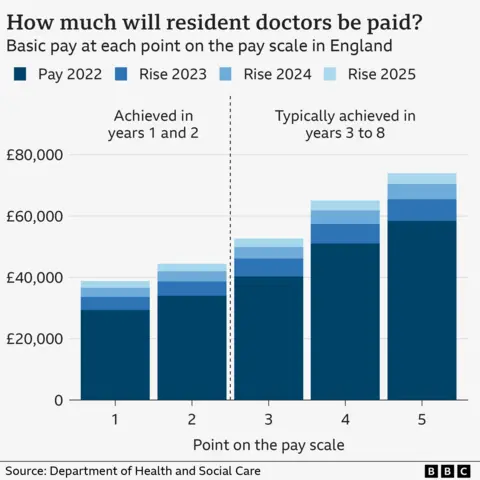
During 2023-24, over two years, they received a 22% pay increase. From August this year, they will get an additional 5.4% pay rise.

Health Secretary Wes Streeting says resident doctors have received the largest pay rises of any public sector employees over the last three years.

The government says it won't be offering any further increases.

During their first foundation year after finishing their medical degree resident doctors in England earn a basic salary of £38,831, for an average of 48 hours worked per week. In the second year, this rises to £44,439.

Medics are often expected to work nightshifts, weekends and longer hours for extra payments.

After eight years as a resident doctor, salaries can progress to around £70,000.


What pay rises have people in other jobs had?


In May, the government announced pay rises for a number of public sector workers, including:4% for other doctors, dentists, and teachers in England, as well as prison officers in England and Wales

a 3.25% rise for civil servants

a 3.6% rise for some NHS staff in England, including nurses and midwives

a 4.5% rise for members of the UK armed forces, with 3.75% for senior military staff

However, the BMA argues that resident doctors may have built up more student debt than people working in other jobs.

A medical degree can take five or six years to complete - longer than most other degree courses.

Resident doctors also say they have little control on where and when they are asked to work. And it can be difficult to put down roots, because of the need to do placements in different parts of the country.

How will patients be affected by the resident doctors' strike?

The medics will stage a walkout in England from 07:00 on 25 July until 07:00 on 30 July.

NHS leaders have warned that patient care will be disrupted if the strike goes ahead.

On strike days, more senior doctors are likely to end up working in emergency and urgent care to replace striking resident doctors. As a result, many planned operations will have to be cancelled.

There were 507,000 appointments and operations cancelled and rescheduled because of strikes by doctors (some including consultants) between July 2023 and February 2024, according to government analysis.

Conservative leader Kemi Badenoch accused the prime minister of having "boasted that he solved the doctors' strike" only for them to take further action, adding that he'd been "weak" in dealing with the medics.

Scotland, Wales and Northern Ireland are not affected by these strikes.

Streeting to give UK doctors priority on NHS jobs, but won't boost pay offer


The Health Secretary is hoping to avoid damaging NHS strikes as he begins talks with the BMA this week


Article thumbnail image
Striking junior doctors protest outside St Thomas’ Hospital before the General Election (Photo by Peter Nicholls/Getty Images)

bookmark

Wes Streeting is preparing to offer UK-trained doctors greater priority for NHS jobs as the Government scrambles to avert a fresh wave of strikes by resident doctors later this month.

The Government announced as part of its 10-year plan for the NHS that it would commit to hiring no more than one in ten NHS recruits from overseas, promising reform to a system where two-thirds of new doctors come from abroad.

However, The i Paper understands that ministers are now prepared to go further in negotiations with the British Medical Association (BMA) as they try to prevent resident doctors – formerly known as junior doctors – from going on strike.

In 2020, Matt Hancock expanded the competition for training posts to include applicants worldwide as the NHS faced a workforce shortage during the pandemic. 

As a result, many more doctors are now competing for available jobs than there are positions, which slows their career progression.

The Government could offer to improve on tackling this bottleneck as part of negotiations on the strikes due to take place this week.

The Health Secretary is also said to be open to discussing other issues related to how annual leave and speciality rotations are managed. 

Insiders have also insisted that Streeting’s proposal of cutting doctors’ pension pots to raise their pay is also still on the table, despite the BMA appearing to rule out this option publicly.

One insider said there was “enough common ground” to strike a deal on working conditions, even if the two sides remain divided on pay, and there were “lots of areas where we agree”.

Resident doctors are set to walk out between 25 and 30 July in a dispute over pay. The BMA is asking the Government to improve on its 5.4 per cent pay offer for this financial year, arguing that doctor pay is still 20 per cent lower in real terms than it was in 2008.

Ministers, however, have insisted they cannot budge on this offer, but are willing to make concessions on working conditions.

“While we cannot go further on pay this year, there is so much more we can do together to improve the lives of resident doctors and the wider NHS,” Streeting said in a letter to the BMA last week.

The conciliatory tone comes as insiders are increasingly concerned about the impact these strikes could have on the NHS, with warnings that NHS trusts are “in the dark” about how many trainee doctors could walk out.

Reports in The Sun on Sunday claim that unions have instructed doctors not to inform their hospitals of their intention to strike, which will make it harder for employers to plan adequate cover for the strikes.

Figures from NHS England show that during 44 days of walkouts in 2023, there was a 31 per cent drop in cancer operations and a 13 per cent drop in emergency heart surgery, with significant delays also reported in neonatal and mental health care.

During these strikes, many hospitals were aware of the number of doctors they needed to cover for, meaning the next round could have an even greater impact on service.

The British Medical Association has said it remains open to talks with the government to avert strike action later this month, but insists ministers have yet to make a “credible” offer.

While the union is willing to discuss “non-pay elements” that could help address doctors’ working conditions, it maintains that the dispute is fundamentally about pay erosion and that “not enough progress” has been made to restore the value of salaries.

In a letter sent to Health Secretary Wes Streeting on Friday, seen by The i Paper, the BMA wrote: “We are, as we have said, committed to meeting with you to settle our dispute and avoid strike action.” 

However, it warned that “not only are you unwilling to talk about pay, but you have not identified any ‘non-pay’ issues for discussion either.” The union said it was “interested to know how you intend to resolve the dispute without any movement to address our pay erosion”.

The BMA also criticised the government for failing to deliver on previous commitments made in a deal last year, including on training rotations and exception reporting. 

“The review into rotational training has barely got off the ground,” it wrote, adding that the small increases in training places announced in the NHS workforce plan “do not sufficiently address the immediate training bottleneck crisis”.


 BIG READ

The NHS trust refusing to pay skilled staff an extra £1 an hour

A group of phlebotomists has been dubbed 'The Magnificent Thirty-Seven' after refusing to back down in the increasingly bitter stand-off with management at Gloucestershire Royal Hospital and Cheltenham General Hospital

Article thumbnail image
They have now spent 107 days on strike, making their industrial dispute one of the longest in NHS history (Photo: Tom Pilston)
bookmark

An NHS trust stands accused of treating some of its lowest paid staff with contempt after denying them an extra £1 per hour in line with neighbouring hospitals.

A group of phlebotomists has been dubbed “The Magnificent Thirty-Seven” after refusing to back down in the increasingly bitter stand-off with management at Gloucestershire Royal Hospital and Cheltenham General Hospital.

The phlebotomists, healthcare professionals who take blood samples from patients to quickly diagnose diseases and conditions, have pent 107 days on strike making the industrial dispute one of the longest in NHS history.

The row centres around whether a national campaign to move healthcare support workers from band 2 to band 3 on the NHS pay scale should include phlebotomists. The Gloucestershire phlebotomists are currently band 2 and paid up to £12.51 an hour – 30p above the national minimum wage.

They argue that their knowledge, skills and training equate to those of a band 3 worker whose top tier is £13.60 – a £1.09 difference. The phlebotomists want to be regraded and given back pay to cover the extra duties they have been doing for years.

‘We want recognition’

Caroline Hayhurst, a former paramedic of 30 years who has been a phlebotomist at the trust for the last 10 years, said: “There are a number of trusts where staff are band 2 and the phlebotomy role does vary from trust to trust, but a lot of people are band 3 already and a lot of trusts have moved staff to band 3 on the back of our dispute. We know our skills align with band 3 and we want recognition of that.

“Ours is a very modest and justifiable claim. The patients are the ones that are inconvenienced the most yet they are telling us to stand our ground.”

The phlebotomists first raised concerns over their pay in February 2024 and submitted a formal complaint last September. Since then, they have accused the trust of ignoring a fair job-evaluation process and of attempting to avoid its obligation to properly assess their skills and responsibilities. The trust refutes the allegations.

The i Paper joined the phlebotomists as they attended the trust’s monthly public board meeting last Friday before returning to the picket line. After laying out the group’s concerns again, and to cheers from her colleagues, phlebotomist Kelly Carter asked the board: “Why are you continuously delaying, moving the goalposts and gaslighting us?”

Kelly Carter among Phlebotomists on Strike at Cheltenham General Hosptial in Gloucestershire in a dispute with Gloucestershire Hospital Foundation Trust. 10/7/25. Photo Tom Pilston
Kelly Carter accused NHS management of ‘gaslighting’ the phlebotomists at the trust’s monthly board meeting on Friday (Photo: Tom Pilston)

The trust promised a job evaluation panel meeting will finally take place on 17 July when a decision will be made. After being told “the process remains ongoing” any further questions from the phlebotomists were shut down by the chair.

Speaking on the picket line following the meeting, Carter said: “It’s really hard to know that the trust has been blocking us. If we’d have had this meeting months ago we could have been back at work by now. It doesn’t feel like they’re thinking about the patients and we really want to get back and see them.

“We’re not asking for extra money – we’re asking them to look at our pay grade as we’re deserving of band 3. I came to this department to join this team. I used to be a receptionist and used to hear them all in their room and just wanted to be with them. We’ve been together so long and are so close that nothing is going to break us now. It’s gone past money, we’re fighting for justice.”

Hayhurst has acknowledged that some trusts continue to pay their phlebotomists on a band 2 rating, but points out that when the issue has been raised elsewhere, such as at the neighbouring Royal University Hospitals in Bath, as well as at trusts in Bristol, Dorset and Salisbury, managers have re-banded the role without the need for phlebotomists to resort to industrial action.

‘They want to save face’

“I don’t know whether it’s a principle now and they’re not willing to back down,” said Kelvin Willsher, 56, the sole man among The Magnificent Thirty-Seven. “Or, in my view, they’ve gone this far that they’re trying now to save face [by holding the evaluation panel]. I don’t know how they can live with themselves.”

Some of the phlebotomists have had to take time off work due to the stress of the situation, Willsher said. “Management say that they care, but the proof’s in the pudding. They don’t care.”

During their strike, the Gloucestershire phlebotomists’ work is being covered by band 4 and 5 nurses, which the phlebotomists argue supports their argument of it being a higher skilled role than band 2.

They are being supported by Unison as part of its pay fair for patient care campaign. Since 2021, more than 40,000 healthcare workers have received around £162m in back pay and more than £64m in salary increases as part of the union’s campaign.

Kelvin Willsher among Phlebotomists on Strike at Cheltenham General Hosptial in Gloucestershire in a dispute with Gloucestershire Hospital Foundation Trust. 10/7/25. Photo Tom Pilston
Kelvin Willsher said some of the phlebotomists have had to take time off work due to the stress of the situation since it began last February (Photo: Tom Pilston)

Asked if they are prepared to strike indefinitely to achieve their aim, Hayhurst said: “Absolutely. This is more than just about money. This is about being valued in the role we perform, and it’s about future generations who want to stay in this job. Never before has there been such pressure on this, and to potentially throw our skills on the scrapheap and go and get a job in a factory because it pays more. Goodwill has run out.”

Kevin McNamara, chief executive of Gloucestershire Hospitals, has said he is “keen to stick within the national framework” so there is “fairness and consistency across the whole of the NHS”. He said the national campaign to move healthcare support workers from band 2 to band 3 did not include phlebotomists.

“I think it starts to undermine a pay terms and conditions framework if we start to take local decisions,” McNamara told the BBC this week.

He said he first asked union colleagues to share an updated job description for evaluation last autumn, but claimed he only received it two weeks ago. “It is something we’re committed to resolving but we have to do it in a proper process,” he said.

Unison general secretary Christina McAnea said: “Other NHS trusts in the region and elsewhere in the country are doing the right thing. They’re paying staff properly for the jobs they do, and compensating them fairly for extra work done previously.

“The bizarre, meanspirited approach adopted by senior executives at Gloucestershire is not only out of step with the rest of the NHS, it clearly isn’t working. There’s no reason why NHS workers in Gloucester and Cheltenham should settle for any less than the thousands of employees who’ve already seen their pay improved, thanks to their efforts and the union’s campaign.”

A trust spokesperson said: “As our phlebotomists have confirmed, our trust pays the same as most other NHS organisations in the country.

“The trust has asked Unison since October for a revised phlebotomy job description for review and they confirmed in March 2025 that there were no changes to the job description. However, they have since provided a revised job description, which was received on 27 June 2025. This week, the trust and Unison agreed that the evaluation panel will meet on 17 July to review the new job description.”

This comes as Health Secretary Wes Streeting will meet representatives from the British Medical Association (BMA) this week for talks in an effort to avoid planned strike action by resident doctors.

The i Paper understands that ministers are now prepared to go further in negotiations with the British Medical Association (BMA) as Streeting tries to prevent resident doctors – formerly known as junior doctors – from going on strike during this talks.

The BMA has said that resident doctors need a pay uplift of 29.2 per cent to reverse “pay erosion” since 2008-09. In September, BMA members voted to accept a government pay deal worth 22.3 per cent on average over two years.

The 2025-26 pay deal saw resident doctors given a 4 per cent uplift plus £750 “on a consolidated basis” – equating to an average pay rise of 5.4 per cent



SCOTLAND

Vaccination plea following death of child after contracting measles


By Rachel Amery
Political Correspondent
THE SCOTSMAN
Published 13th Jul 2025,


Measles vaccination rates have fallen to their lowest level in a decade in Scotland

Scottish ministers have been urged to drive up measles vaccination rates after reports of a child in England dying after contracting the virus.

The child was said to have died at Alder Hey Children’s Hospital in Liverpool amid an outbreak in the region - the hospital said it had seen a surge in “seriously unwell” children being admitted after contracting measles.


The Scottish Government is now being urged to do all it can to encourage parents to vaccinate their children.

Dame Jackie Baillie MSP, Scottish Labour’s health spokeswoman, said: “The vaccine for measles has saved countless lives in Scotland and across the world.

“These immunisations are a modern miracle, but they are only at their most effective when everyone gets vaccinated.

“The Scottish Government needs to ensure families have the information and confidence to access immunisation programmes.

“We must work together to reverse this worrying trend and keep kids and our country safe.”

Lib Dem MP Wendy Chamberlain added: “Measles is highly contagious and for some people it can be very serious.

“As a result, it is concerning to see reports of vaccination rates falling in Scotland.

“The Scottish Government needs to be stressing the importance of getting vaccinated because that is the best protection from becoming ill and helps to prevent major outbreaks.”

Most childhood vaccines were lower in Scotland in 2024 compared to 2023.

The latest data from Public Health Scotland shows the uptake of the first dose of the combined measles, mumps and rubella (MMR) vaccine by the age of five declined to 95.2 per cent. This is the lowest level recorded in 10 years.

Uptake of the second MMR vaccine was 89 per cent.

The difference between those in the most and least deprived areas getting both doses of the MMR vaccine was 10.3 per cent.

The UN’s target is for 95 per cent to be immunised against measles and the NHS says having the MMR vaccine is the “best way” to prevent measles.
Measles starts off with cold-like symptoms followed by a rash, and is spread by breathing, coughing and sneezing.

However, complications can include blindness, swelling of the brain and potential brain damage, severe diarrhoea and dehydration, ear infections, and severe breathing problems such as pneumonia.

Public Health Minister Jenni Minto said: “We continue to urge all parents and carers to vaccinate their child when invited to do so.

“This protects them against serious disease including measles, meningitis and pertussis.

“Childhood immunisation rates in Scotland remain high and we are working with Public Health Scotland and the NHS to increase uptake.”

She added: “The MMR vaccine is safe, and it is vital that all those eligible receive both doses of the vaccination, especially because of the current global threat of measles to international and domestic travellers.”
MORE ILLEGAL ALIENS


UFOs

Military jet's mysterious collision raises questions about advanced UFOs in US airspace: 'Been here all along'

Defense Department documents reveal hundreds of unexplained aerial phenomena near military sites including nuclear facilities
Fox News
Published July 13, 2025 


UFO expert says President Trump is right person to declassify government files

Former U.K. Defense Ministry official Nick Pope tells Fox News Digital that the declassification of federal secrets and other documents is of very high interest to the American people.

Declassified documents revealing a United States military aircraft was previously struck by an unknown flying object is raising eyebrows as experts point to other unexplainable sightings suggesting otherworldly technology flying within the country’s airspace.

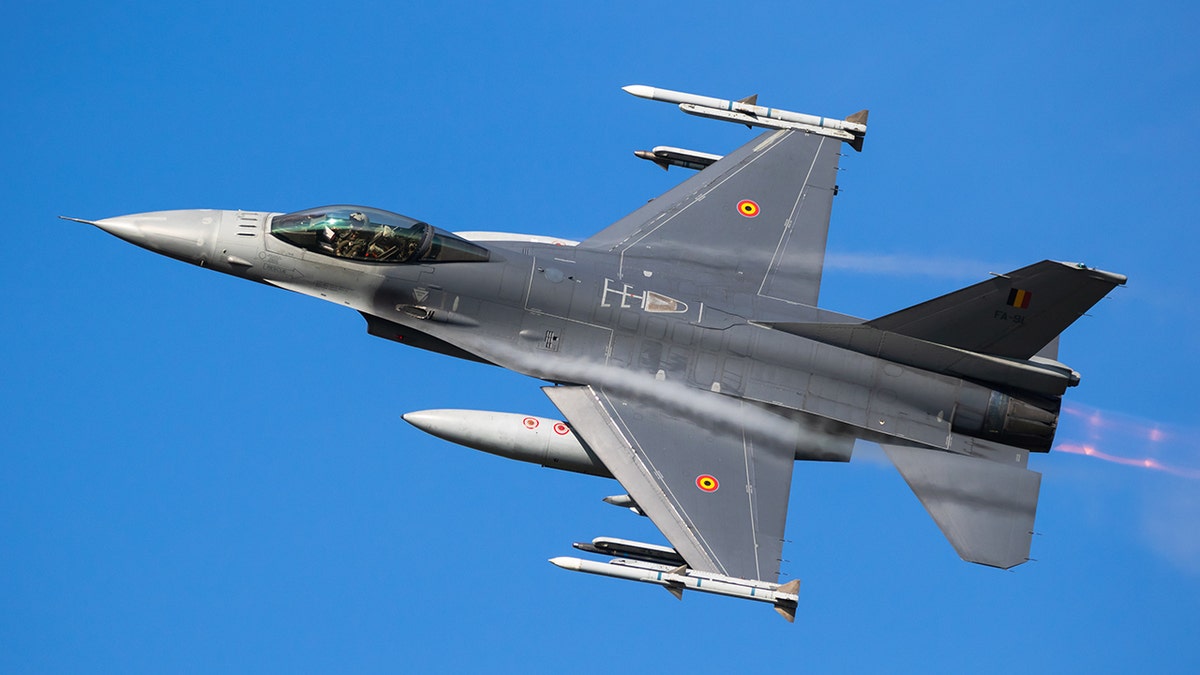
The incident occurred in January 2023, after an unidentified object collided with the left side of an F-16 Viper jet participating in training exercises near Gila Benda, Arizona, an Air Force spokesperson confirmed to Fox News Digital.

The flying object struck the clear "canopy" at the top of the aircraft and was first spotted by an instructor pilot sitting in the rear of the plane, officials said. An initial investigation determined no damage was done to the near $70 million jet, with officials ruling against a possible bird strike.

OVER 60 UFO SIGHTINGS REPORTED WHIZZING ACROSS STATE IN FIRST HALF OF 2025, NATIONAL TRACKING GROUP SAYS


An F-16 fighter jet was struck by an unidentified flying object while engaging in training exercises in Arizona in January 2023. (iStock)

Authorities ultimately determined the aircraft was struck by a drone, but the location and operator of the device have yet to be determined, the spokesperson said.

The incident was the first of four encounters with unidentified anomalous phenomena (UAP) that were reported a day later, according to Federal Aviation Administration (FAA) documents obtained by the War Zone.

"According to military personnel I’ve personally met with, there were objects 200 miles off the East Coast that were extensively loitering and had no visible means of propulsion," James Fox, a director specializing in films about UFO activity, told Fox News Digital. "So a report from 2023 about an actual impact with a UAP doesn’t really surprise me."

SCIENTISTS DISCOVER MYSTERIOUS SPHERE IN COLOMBIA, SPARKING UFO SPECULATION

The concerning collision comes as the Department of Defense reported 757 incidents involving UAPs from May 1, 2023, to June 1, 2024, according to an unclassified document released by the All-Domain Anomaly Resolution Office.

Of those encounters, 708 occurred in the air, with only 49 instances marked as "case closed" by officials. Additionally, the department received 18 reports regarding UAP incidents near nuclear infrastructure, launch sites and weapons, according to the report.

"None of these resolved cases substantiated advanced foreign adversarial capabilities or breakthrough aerospace technologies," the report states.

UFO FOOTAGE CAPTURED BY US NAVY SHOWS MYSTERIOUS AIRCRAFT LAUNCHING FROM SEA, EXPERT SAYS


The Pentagon recorded 757 incidents involving UAPs from 2023 to 2024, according to unclassified documents. (iStock)

The sightings of UAPs near military sites are nothing new, according to Fox.

"There are reports dating back to the 1930s and 1940s," Fox said. "Where you had mysterious, glowing, and orb-like objects that emitted very bright light that could just fly rings around the military planes from World War II."

Fox pointed to the sheer advanced technology showcased within these sightings, such as aircraft that do not emit a heat signature or have the ability to fly stationary in high wind conditions.

"This has been well-documented for decades," Fox said. "So either we’ve managed to track the same thing it’s been, [possibly] non-human intelligence, since the 1940s. Or someone has managed to replicate the technology, reverse engineer it and they’re flying it around."

VIRAL CIA FILE ABOUT ALIENS ATTACKING SOLDIERS TAKES OFF WITH UFO INTRIGUE

Of the 2023 to 2024 reports, 708 occurred in the air, with only 49 instances marked as "case closed" by officials, according to Pentagon documents. (iStock)

In 2020, the Department of Defense established an Unidentified Aerial Phenomena Task Force (UAPTF) to further research and investigate the various UAPs spotted throughout American skies.

"The mission of the task force is to detect, analyze and catalog UAPs that could potentially pose a threat to U.S. national security," the department said in a statement.

Fox also cited officials’ use of updated technology to pinpoint the location and characteristics of UAPs possibly contributing to the influx in reports over recent years.

UFO COVER USED BY GOVERNMENT TO ‘HIDE A LOT OF THINGS,’ FORMER NASA AGENT SAYS

"They’ve adjusted the frequency on particular radars to pick up smaller objects that maybe have been here all along," Fox said, adding, "it’s a global phenomenon exhibiting the technology that’s just lightyears ahead from anything we have. Has there been a successful effort in reverse engineering? [If not], then it falls into the category that many would say is non-human intelligence."

While a vast majority of UAPs spotted by officials are quickly identified, Fox insists there are a select few that have origins unknown to even the highest of government authorities and do not match the technology owned by the country’s adversaries.

"A small percentage of these objects display a technology that's just light-years beyond anything that we or anybody else on the planet has," Fox said. "Which would imply, once you do the process of elimination, if it isn’t Russia or China, and if it’s not us, what's left?"

SCIENTISTS DISCOVER MYSTERIOUS SPHERE IN COLOMBIA, SPARKING UFO SPECULATION

Fox also attributes overall public skepticism regarding UAPs to the U.S. government remaining tight-lipped about its findings over the years. However, officials have continued to work toward transparency with the American public, with a congressional hearing on UFOs occurring for the first time in decades in 2022 and continuing to take place on the floors of Congress.

"The primary reason for secrecy is that it’s difficult for any governing body to admit that there are structured craft of unknown origin whizzing around with impunity," Fox said. "They fly rings around our fastest jets, and [the government] doesn’t know who they are, where they come from or what they want."

Julia Bonavita is a U.S. Writer for Fox News Digital and a Fox Flight Team drone pilot. You can follow her at @juliabonavita13 on all platforms and send story tips to julia.bonavita@fox.com.


Huge wildfire engulfs Grand Canyon destroying historic lodge and 80 buildings

Barney Davis
Published July 13, 2025
METRO UK

Smoke billows over the Grand Canyon, Arizona. (NPS Photo/M. Quinn via REUTERS

Firefighters and hikers fled for their lives as a huge wildfire engulfed dozens of buildings in the Grand Canyon.

The Grand Canyon Lodge, the only lodging where people can sleep inside the natural wonder at the North Rim, was consumed by the flames, park rangers confirmed on Sunday.

Superintendent Ed Keable said the visitor center, the gas station, a waste water treatment plant, an administrative building and some employee housing were among the 50 to 80 structures lost.

‘Numerous’ historic cabins in the area also were destroyed, the park said.

Two wildfires are burning at or near the North Rim, known as the White Sage Fire and the Dragon Bravo Fire.

Wildfires have swept the natural wonder causing firefighters to flee (Pictures: U.S. Forest Service/Kaibab Ranger District)

No injuries have been reported.

Millions of people visit Grand Canyon National Park annually, with most going to the more popular South Rim. The North Rim is open seasonally.

It was evacuated last Thursday because of wildfire, and will remain closed for the rest of the season, the park said in a statement.

Firefighters at the North Rim and hikers in the inner canyon were evacuated over the weekend. The park said along with the fire risk, they could potentially be exposed to chlorine gas after the treatment plant burned. Chlorine gas is heavier than air and can lead to blurred vision, irritation or respiratory problems if high amounts of it are breathed in, according to the Centers for Disease Control and Prevention.
This undated photo provided by the National Park Service shows Grand Canyon Lodge on the North Rim of Grand Canyon, Ariz. (Michael Quinn/National Park Service via AP)

The Grand Canyon Lodge was often the first prominent feature that visitors see, even before viewing the canyon. A highway ends at the lodge, which was known for its sloped roof, huge ponderosa beams and massive limestone facade. By walking across the lobby and descending a stairwell, visitors could get their first view of the Grand Canyon shining through windows across the ‘Sun Room.’

‘It just feels like you’re a pioneer when you walk through there (the lodge),’ said Tim Allen, a longtime resident of Flagstaff, Arizona, and yearly visitor to the Grand Canyon. ‘It really felt like you were in a time gone by.’

Allen said the North Rim felt special and more personal because of its remoteness and reduced number of tourists. He often spent time there camping and doing rim-to-rim hikes, trekking all the way to the bottom of the canyon and back out.

‘It’s heartbreaking,’ he said of the destruction caused by the fire.

The deepening water shortage row between the US and Mexico


Will Grant
BBC
Mexico, Central America and Cuba Correspondent
Reporting from Chihuahua
JULY 13, 2025

BBC
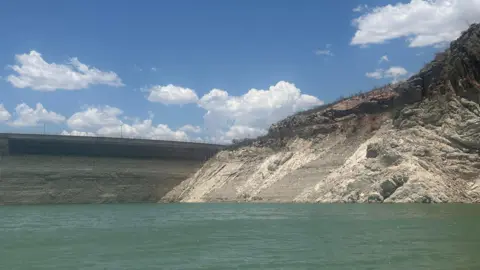
Water levels in Lake Toronto, a reservoir in the north of Mexico, are said to be critically low

After the thirtieth consecutive month without rain, the townsfolk of San Francisco de Conchos in the northern Mexican state of Chihuahua gather to plead for divine intervention.

On the shores of Lake Toronto, the reservoir behind the state's most important dam – called La Boquilla, a priest leads local farmers on horseback and their families in prayer, the stony ground beneath their feet once part of the lakebed before the waters receded to today's critically low levels.

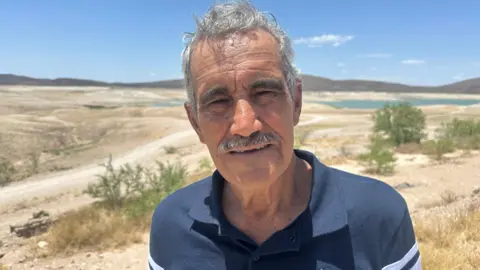
Among those with their heads bowed is Rafael Betance, who has voluntarily monitored La Boquilla for the state water authority for 35 years.

"This should all be underwater," he says, motioning towards the parched expanse of exposed white rocks.

"The last time the dam was full and caused a tiny overflow was 2017," Mr Betance recalls. "Since then, it's decreased year on year.

"We're currently at 26.52 metres below the high-water mark, less than 14% of its capacity."


Rafael Betance says that water levels in the reservoir have fallen for the past eight years


Little wonder the local community is beseeching the heavens for rain. Still, few expect any let up from the crippling drought and sweltering 42C (107.6F) heat.

Now, a long-running dispute with Texas over the scarce resource is threatening to turn ugly.

Under the terms of a 1944 water-sharing agreement, Mexico must send 430 million cubic metres of water per year from the Rio Grande to the US.

The water is sent via a system of tributary channels into shared dams owned and operated by the International Boundary and Water Commission (IBWC), which oversees and regulates water-sharing between the two neighbours.

In return, the US sends its own much larger allocation (nearly 1.85 billion cubic metres a year) from the Colorado River to supply the Mexican border cities of Tijuana and Mexicali.

Mexico is in arrears and has failed to keep up with its water deliveries for much of the 21st Century.


Following pressure from Republican lawmakers in Texas, the Trump administration warned Mexico that water could be withheld from the Colorado River unless it fulfils its obligations under the 81-year-old treaty.

In April, on his Truth Social account, US President Donald Trump accused Mexico of "stealing" the water and threatened to keep escalating to "TARIFFS, and maybe even SANCTIONS" until Mexico sends Texas what it owes. Still, he gave no firm deadline by when such retaliation might happen.

For her part, the Mexican President, Claudia Sheinbaum, acknowledged Mexico's shortfall but struck a more conciliatory tone.

Since then, Mexico has transferred an initial 75 million cubic metres of water to the US via their shared dam, Amistad, located along the border, but that is just a fraction of the roughly 1.5 billion cubic metres of Mexico's outstanding debt.

Feelings on cross-border water sharing can run dangerously high: in September 2020, two Mexican people were killed in clashes with the National Guard at La Boquilla's sluice gates as farmers tried to stop the water from being redirected.

Amid the acute drought, the prevailing view in Chihuahua is that "you can't take from what isn't there", says local expert Rafael Betance.

But that doesn't help Brian Jones to water his crops.

A fourth-generation farmer in the Rio Grande Valley in Texas, for the past three years he has only been able to plant half of his farm because he doesn't have enough irrigation water.

"We've been battling Mexico as they've not been living up to their part of the deal," he says. "All we're asking for is what's rightfully ours under the treaty, nothing extra."

Mr Jones also disputes the extent of the problem in Chihuahua. He believes that in October 2022 the state received more than enough water to share, but released "exactly zero" to the US, accusing his neighbours of "hoarding water and using it to grow crops to compete with us".

Farmers on the Mexican side read the agreement differently. They say it only binds them to send water north when Mexico can satisfy its own needs, and argue that Chihuahua's ongoing drought means there's no excess available.

Beyond the water scarcity, there are also arguments over agricultural efficiency.

Walnut trees and alfalfa are two of the main crops in Chihuahua's Rio Conchos Valley, both of which require a lot of watering – walnut trees need on average 250 litres a day.

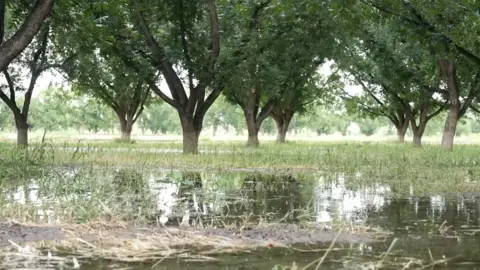
Traditionally, Mexican farmers have simply flooded their fields with water from the irrigation channel. Driving around the valley one quickly sees walnut trees sitting in shallow pools, the water flowing in from an open pipe.

The complaint from Texas is obvious: the practice is wasteful and easily avoided with more responsible and sustainable farming methods.


Many Mexican walnut farmers flood their fields with irrigation water

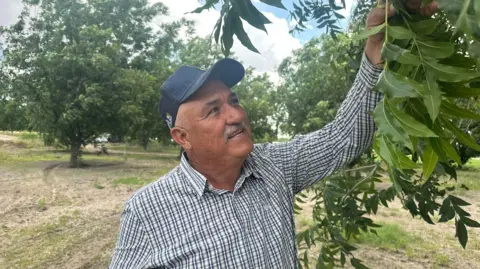
As Jaime Ramirez walks through his walnut groves, the former mayor of San Francisco de Conchos shows me how his modern sprinkler system ensures his walnut trees are properly watered all year round without wasting the precious resource.

"With the sprinklers, we use around 60% less than flooding the fields," he says. The system also means they can water the trees less frequently, which is particularly useful when the Rio Conchos is too low to allow local irrigation.

Mr Ramirez readily admits, though, that some of his neighbours aren't so conscientious. As a former local mayor, he urges understanding.

Some haven't adopted the sprinkler method because of the costs in setting it up, he says. He's tried to show other farmers that it works out cheaper in the long run, saving on energy and water costs.

But farmers in Texas must also understand that their counterparts in Chihuahua are facing an existential threat, Mr Ramirez insists.


Walnut farmer Jaime Ramirez admits that some of his neighbours are wasteful with water

"This is a desert region and the rains haven't come. If the rain doesn't come again this year, then next year there simply won't be any agriculture left. All the available water will have to be conserved as drinking water for human beings," he warns.

Many in northern Mexico believe the 1944 water-sharing treaty is no longer fit for purpose. Mr Ramirez thinks it may have been adequate for conditions eight decades ago, but it has failed to adapt with the times or properly account for population growth or the ravages of climate change.

Back across the border, Texan farmer Brian Jones says the agreement has stood the test of time and should still be honoured.

"This treaty was signed when my grandfather was farming. It's been through my grandfather, my father and now me," he says.

"Now we're seeing Mexico not comply. It's very angering to have a farm where I'm only able to plant half the ground because I don't have irrigation water."

Trump's tougher stance has given the local farmers "a pep in our step", he adds.

Meanwhile, the drought hasn't just harmed farming in Chihuahua.

With Lake Toronto's levels so low, Mr Betance says the remaining water in the reservoir is heating up with uncommon speed and creating a potential disaster for the marine life which sustains a once-thriving tourism industry.

The valley's outlook hasn't been this dire, Mr Betance says, in the entire time he's spent carefully recording the lake's ups and downs. "Praying for rain is all we have left," he reflects.

Additional reporting by Angélica Casas.
Dozens killed in violent clashes in predominantly Druze Syrian city


At least 37 people have been killed in violent clashes between Bedouin tribes and local Druze fighters in the southern Syrian city of Sweida, a war monitor reported Monday, marking the deadliest bout of unrest in the region since May. The unrest has prompted the Syrian government to deploy security forces in a bid to restore order, as fears grow of renewed instability in the Druze-majority province.


Issued on: 14/07/2025 - 
By: FRANCE 24

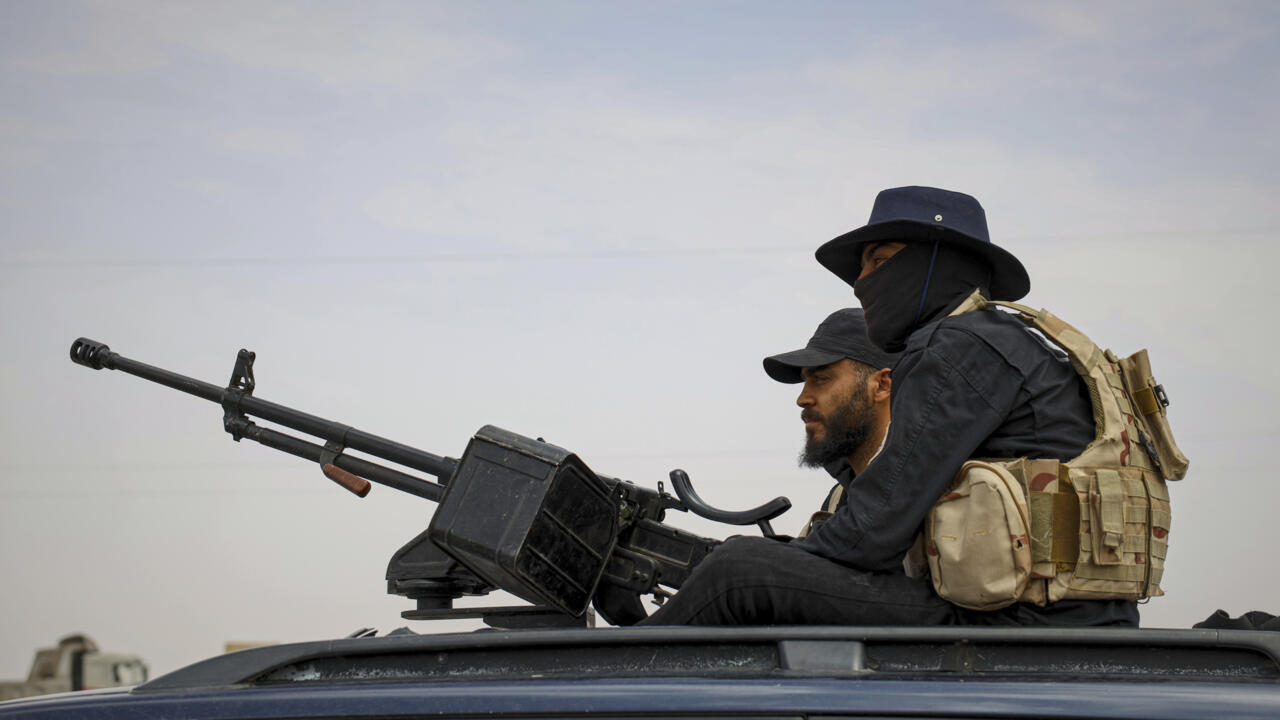
Syrian security forces on highway in Sweida province, southern Syria, Thursday, May 1, 2025. © Omar Albam, AP

Clashes between Bedouin tribes and local fighters in the predominantly Druze city of Sweida in southern Syria have killed 37 people, a war monitor said Monday, as authorities sent forces to de-escalate the situation.

The clashes are the first outbreak of deadly violence in the area since fighting between members of the Druze community and the security forces killed dozens of people in April and May.

The Syrian Observatory for Human Rights said at least 37 people had been killed, 27 of them Druze, including two children, and 10 of them Bedouin.

It also reported the closure of the Damascus-Sweida highway due to the violence.

Syria's interior ministry put the toll at "more than 30 deaths and nearly 100 injuries" and said it would deploy troops in coordination with the defence ministry.

Those troops "will begin direct intervention in the area to resolve the conflict, stop the clashes, impose security, pursue those responsible for the incidents, and refer them to the competent judiciary," an interior ministry statement said.

Syrian state-run media outlet SANA earlier said the security forces had deployed on the administrative borders between Daraa and Sweida provinces in light of the situation.

Sweida Governor Mustapha al-Bakur called on his constituents to "exercise self-restraint and respond to national calls for reform".

Several Syrian Druze spiritual leaders have also called for calm and asked Damascus to intervene.

Due to the violence, the education ministry announced the postponement of Sweida's official secondary school exams due on Monday to a future date.

Syria's pre-civil war Druze population numbered around 700,000, with Sweida province home to the sect's largest community.

Bedouin and Druze factions have a longstanding feud in Sweida, and violence occasionally erupts between the two.

The interior ministry said the violence was "the result of unfortunate armed clashes that broke out between local military groups and clans... against a backdrop of accumulated tensions over previous periods".

Since the overthrow of longtime Syrian ruler Bashar al-Assad, concerns have been raised over the rights and safety of minorities under the new Islamist authorities, who have also struggled to re-establish security more broadly.

Clashes between the new security forces and Druze fighters in April and May killed dozens of people, with local leaders and religious figures signing agreements to contain the escalation and better integrate Druze fighters into the new government.

(FRANCE 24 with AFP)


More than 30 dead in sectarian clashes between Druze, Bedouins in south Syria

Violence erupted after a wave of kidnappings, including the abduction of a Druze merchant on Friday on the highway linking Damascus to Sweida

Reuters| Yesterday |

More than 30 people were killed and 100 injured in armed clashes in Syria's predominantly Druze city of Sweida, the Syrian interior ministry said early on Monday, in the latest bout of sectarian clashes.
The violence erupted after a wave of kidnappings, including the abduction of a Druze merchant on Friday on the highway linking Damascus to Sweida, witnesses said.

This is the first time sectarian fighting has erupted inside the city of Sweida itself, the provincial capital of the mostly Druze province.

Last April saw clashes between Sunni fighters and armed Druze residents of Jaramana, southeast of Damascus, which later spread to another district near the provincial capital.

"This cycle of violence has exploded in a terrifyng way and if it doesn't end we are heading toward to a bloodbath," said Rayan Marouf, a Druze researcher based in Sweida who runs the Suwayda24 website.

The clashes involving Bedouin tribal fighters and Druze militias were centered in Maqwas neighborhood east of Sweida, which is inhabited by Bedouin tribes, and was encircled by armed Druze groups and later seized.

The Syrian ministry of interior said that its forces will begin direct intervention in Sweida to resolve the conflict, calling on local parties in the Druze city to cooperate with the security forces.

Armed Bedouin tribesmen also launched attacks on Druze villages on the western and north outskirts of the city, residents said.


A medical source told Reuters that at least 15 bodies had been taken to the morgue at Sweida's state hospital. Around 50 people were injured, with some transported to Deraa city for medical care.

The violence marked the latest episode of sectarian bloodshed in Syria, where fears among minority groups have surged since Islamist-led rebels toppled President Bashar al-Assad in December, installing their own government and security forces.

Those concerns intensified following the killing of hundreds of Alawites in March, in apparent retaliation for an earlier attack carried out by Assad loyalists.

It was the deadliest sectarian flare-up in years in Syria, where a 14-year civil war ended last December with Assad fleeing to Russia after his government was overthrown by rebel forces.

Israel strikes military tanks in southern Syria, where government forces clash with Druze militias

BUSRA AL-HARIR, Syria (AP) — Israel’s army said Monday it has struck military tanks in southern Syria, where government forces and Bedouin tribes clashed with Druze militias.
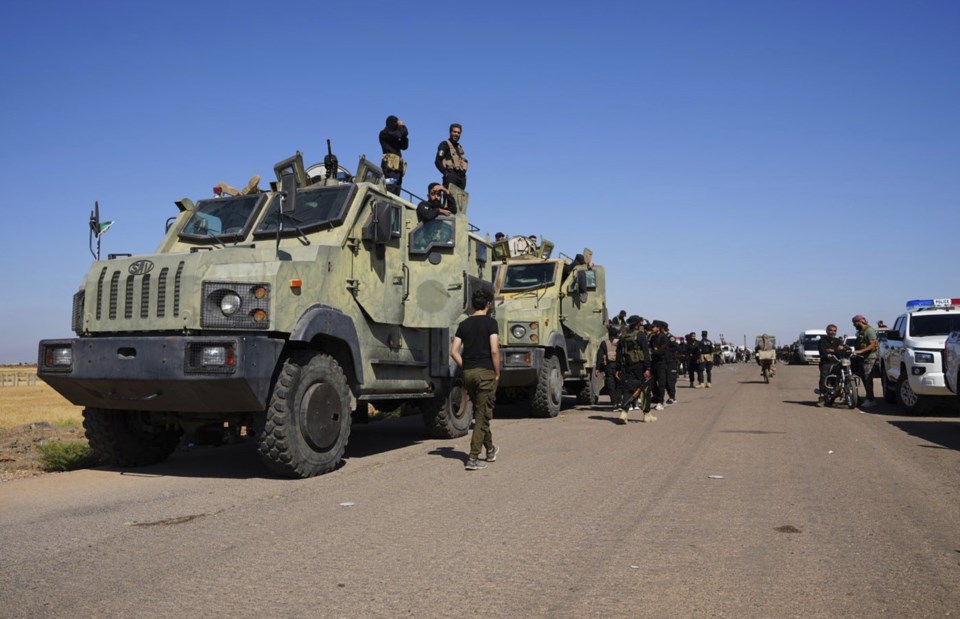
Syrian government security forces gather on the outskirts of Sweida province where clashes erupted between Druze militias and Sunni Bedouin clans, southern Syria, Monday, July 14, 2025. (AP Photo/Malek Khattab)

BUSRA AL-HARIR, Syria (AP) — Israel’s army said Monday it has struck military tanks in southern Syria, where government forces and Bedouin tribes clashed with Druze militias.

Dozens of people have been killed in the fighting between local militias and clans in Syria ’s Sweida province. Government security forces that were sent to restore order Monday also clashed with local armed groups.

Syria's Interior Ministry has said more than 30 people have died and nearly 100 others have been injured. The Syrian Observatory for Human Rights, a U.K.-based war monitor, reported at least 89 dead, including two children, two women and 14 members of the security forces.

The clashes in Syria initially broke out between armed groups from the Druze and Sunni Bedouin clans, the observatory said, with some members of the government security forces “actively participating” in support of the Bedouins.

Interior Ministry spokesperson Noureddine al-Baba said government forces entered Sweida in the early morning to restore order.

“Some clashes occurred with outlawed armed groups, but our forces are doing their best to prevent any civilian casualties,” he told the state-run Al-Ikhbariya TV.

The observatory said the clashes started after a series of kidnappings between both groups, which began when members of a Bedouin tribe in the area set up a checkpoint where they attacked and robbed a young Druze man.

Rami Abdurrahman, who heads the observatory, said the conflict started with the kidnapping and robbery of a Druze vegetable seller, leading to tit-for-tat attacks and kidnappings.

Syria’s defense and interior ministries were deploying personnel to the area to attempt to restore order.

The Interior Ministry described the situation as a dangerous escalation that “comes in the absence of the relevant official institutions, which has led to an exacerbation of the state of chaos, the deterioration of the security situation, and the inability of the local community to contain the situation despite repeated calls for calm.”

U.N. Deputy Special Envoy for Syria Najat Rochdi expressed “deep concern” over the violence and urged the government and local groups to “take immediate steps to protect civilians, restore calm, and prevent incitement.”

She said in a statement the clashes underscored the “urgent need for genuine inclusion, trust-building, and meaningful dialogue to advance a credible and inclusive political transition in Syria.”

In Israel, Druze are seen as a loyal minority and often serve in the armed forces.

Syria’s Foreign Ministry called for “all countries and organizations to respect the authority of the Syrian Arab Republic and refrain from supporting any separatist rebel movements.” In a statement, it called for Syrians to “cease acts of violence, surrender illegal weapons and thwart those seeking to dismantle the Syrian social fabric and sow discord and division.”

Israel sees Druze as a loyal minority

Israel has previously intervened in Syria in defense of the Druze religious minority. In May, Israeli forces struck a site near the presidential palace in Damascus, in what was seen as a warning to Syrian interim President Ahmad al-Sharaa. The strike came after dozens were killed in fighting between pro-government gunmen and Druze fighters earlier this year in the town of Sahnaya and the Druze-majority Damascus suburb of Jaramana.

Israeli Prime Minister Benjamin Netanyahu and Defense Minister Israel Katz said in a statement at the time that Israel “will not allow the deployment of (Syrian government) forces south of Damascus or any threat to the Druze community.”

Over half of the roughly 1 million Druze worldwide live in Syria. Most other Druze live in Lebanon and Israel, including in the Golan Heights, which Israel captured from Syria in the 1967 Mideast War and annexed in 1981.

While many Druze in Syria have said they do not want Israel to intervene on their behalf, factions from the Druze minority have also been suspicious of the new authorities in Damascus after former President Bashar Assad fled the country in December during a rebel offensive led by Sunni Islamist insurgent groups. On several occasions, Druze groups have clashed with security forces from the new government or allied factions.

A group led by Sheikh Hikmat Al-Hijri, a Druze spiritual leader who has been opposed to the new government in Damascus, on Monday issued a statement calling for “international protection” and accused government forces and General Security agency of “supporting takfiri gangs” - using a term for extremist Sunni militants.

‘Like unwrapping an onion’

The Druze religious sect is a minority group that began as a 10th-century offshoot of Ismailism, a branch of Shiite Islam. In Syria, they largely live in the southern Sweida province and some suburbs of Damascus, mainly in Jaramana and Ashrafiyat Sahnaya to the south.

The Druze developed their own militias during the country’s nearly 14-year civil war, during which they sometimes faced attacks by the Islamic State and other Islamist militant groups.

Israel has taken an aggressive stance toward Syria’s new leaders since Assad's fall, saying it does not want Islamist militants near its borders. Israeli forces earlier seized a U.N.-patrolled buffer zone on Syrian territory along the border with the Golan Heights and have launched hundreds of airstrikes on military sites in Syria.

The Trump administration has been pushing for the new Syrian government to move toward normalization with Israel. Syrian officials have acknowledged holding indirect talks with Israel to attempt to defuse tensions, but have not responded to reports that the two sides have also held direct talks.

U.S. envoy to Syria Tom Barrack told The Associated Press last week that he believes normalizing ties will happen “like unwrapping an onion, slowly.”

———

Sewell reported from Beirut. Associated Press writer Kareem Chehayeb in Beirut contributed to this report.

Omar Sanadiki And Abby Sewell, The Associated Press


What role is Israel playing in the clashes between Druze and Bedouins in Syria? - analysis

Israel has demanded southern Syria be demilitarized. This has had the result of creating a vacuum in southern Syria. The government claims that it wants to protect civilians and restore order.

Druze women walk on a street, in Jaramana, Syria May 5, 2025.
(photo credit: REUTERS/YAMAM AL SHAAR)

JULY 14, 2025 

Clashes in Syria between the Druze minority in Sweida and Bedouin tribesmen are the latest in a series of similar confrontations that have taken place since Syria’s new government came to power in December 2024, replacing the Assad regime.

The Druze in Syria have often sought to maintain some of their own autonomy in their region, a trend that increased during the Syrian civil war.

The recent clashes have led Israel to carry out overflights in southern Syria, according to local witnesses in the country.

In addition, reports said that the IDF had targeted armored vehicles in Syria amid the clashes. This is not the first time that has happened. In fact, this is at least the third time in the last six months that this similar cycle has played out.

In essence, the way the cycle works is like this: Druze clash with local Arabs. Usually several people or up to a dozen people are killed, with victims on both sides. The government forces try to intervene. Typically, government forces oppose the armed Druze fighters who have also arrived on the scene. Israel then also threatens to intervene and sometimes carries out airstrikes or threats. Subsequently, the government says it has come to an agreement with the Druze. Commonly, the agreement is supposed to have the Druze accept government control. Generally, nothing changes, and in a month or two, there are new clashes.

Syrian security forces stand together, following deadly clashes between Sunni fighters against armed Druze residents, at the entrance of Jaramana, Syria May 5, 2025. (credit: REUTERS/YAMAM AL SHAAR)


The Druze in southern Syria are armed with light weapons, such as rifles. They also possess other munitions and various types of military vehicles. These are leftovers from the Assad era.

The Druze served in the regime’s military like other Syrians, however, they also sought to arm themselves to protect their own interests. Most Druze live in the area of Sweida, also called Jebel Druze or Druze Mountain.

The Druze have been wary of jihadist groups and persecution. Therefore, they have tended to prefer the Assad regime as long as it didn’t oppress them too much. The regime was dominated by the Alawite minority and often tried to play groups off against each other in Syria. As such, the Druze were used by the regime. Druze in Israel and Lebanon also try to balance their interests with the state, achieving the same types of local autonomy while serving in the armed forces

What this means is that the Druze minority in Syria tends to be well armed and assertive. It also appears to be suspicious of other groups that may chafe against their autonomy, such as Bedouin and other Sunni Arab groups. According to North Press, a Syrian media outlet in eastern Syria, “a Druze militia, early on Monday, held the Syrian transitional government responsible for the recent escalation and violent clashes in Sweida Governorate, southern Syria.”

The report goes on to note that “In a statement, the Men of Dignity movement, a self-defense militia established after the outbreak of the Syrian war to defend Sweida Governorate, called for de-escalation while emphasizing the mobilization of its members to defend the region.” The statement read, “This dangerous tension the governorate is witnessing serves no party but rather threatens civil peace and paves the way for a state of chaos we reject for our people and our country.”

The Druze claim that the government has not secured the road between Sweida and Damascus. The report claims 100 people have been killed and wounded.

“We hold the Syrian government primarily responsible for the current situation,” the statement noted, “due to its failure to maintain security, its silence in the face of repeated violations, and its tolerance of affiliated factions interfering and siding with one group over another.”

It also says “Sweida was and will remain a land of dignity and coexistence. It will not be drawn into any sedition, but at the same time, we will not allow it to become an open arena for settling scores.”

Syria’s government believes a power vacuum has led to this chaos.

Clashes come after Israel demands southern Syria demilitarizedIsrael has demanded southern Syria be demilitarized. This has had the result of creating a vacuum in southern Syria. The government claims that it wants to protect civilians and restore order.

“The [Syrian] Ministry of Interior also issued a statement, attributing the worsening security situation to the absence of active state institutions and the local community’s inability to contain the crisis despite repeated calls for calm,” the report said.

The Syrian Defense Ministry “confirmed Monday the institutional vacuum that accompanied the outbreak of clashes in Sweida Governorate has worsened the state of chaos, in addition to the inability of official security or military institutions to intervene, which hindered the efforts exerted to calming down the situation there,” Syrian state media noted.

“We have followed with deep sadness and concern the bloody developments Sweida province has witnessed over the past two days, which left more than 30 deaths and nearly 100 injuries in a number of neighborhoods and towns,” the ministry said.

“In coordination with the Interior Ministry, we have deployed specialized military units to the affected areas, providing safe passages for civilians,” the report noted.

The difficulty in resolving these issues will mean continued clashes are likely. The Druze will not want to hand over their weapons to the new government.

The role of Israel is complex.

The IDF has said in recent weeks that it has captured two cells near the Golan that were linked to Iran’s Islamic Revolutionary Guard Corps (IRGC).

The IDF has also carried out recent operations on Mount Hermon. These are areas the IDF moved to when the Assad regime fell.

Some argue the IDF should intervene more in Syria. On the other hand, that could lead to more chaos in southern Syria.
Lawmaker says Alligator Alcatraz is an ‘internment camp’ after joint GOP-Dem visit: ‘Packed into cages’


Democrat Debbie Wasserman Schultz, who represents Florida's 25th congressional district, said that pictures of the facility ‘don’t do it justice’


Mike Bedigan
Sunday 13 July 2025


From reproductive rights to climate change to Big Tech, The Independent is on the ground when the story is developing. Whether it's investigating the financials of Elon Musk's pro-Trump PAC or producing our latest documentary, 'The A Word', which shines a light on the American women fighting for reproductive rights, we know how important it is to parse out the facts from the messaging.

At such a critical moment in US history, we need reporters on the ground. Your donation allows us to keep sending journalists to speak to both sides of the story.

The Independent is trusted by Americans across the entire political spectrum. And unlike many other quality news outlets, we choose not to lock Americans out of our reporting and analysis with paywalls. We believe quality journalism should be available to everyone, paid for by those who can afford it.Your support makes all the difference.Read more

A Democratic congresswoman has given a scathing review of the Trump administration’s so-called “Alligator Alcatraz” in Florida, describing it as an “internment camp” that needs to be “shut the hell down.”

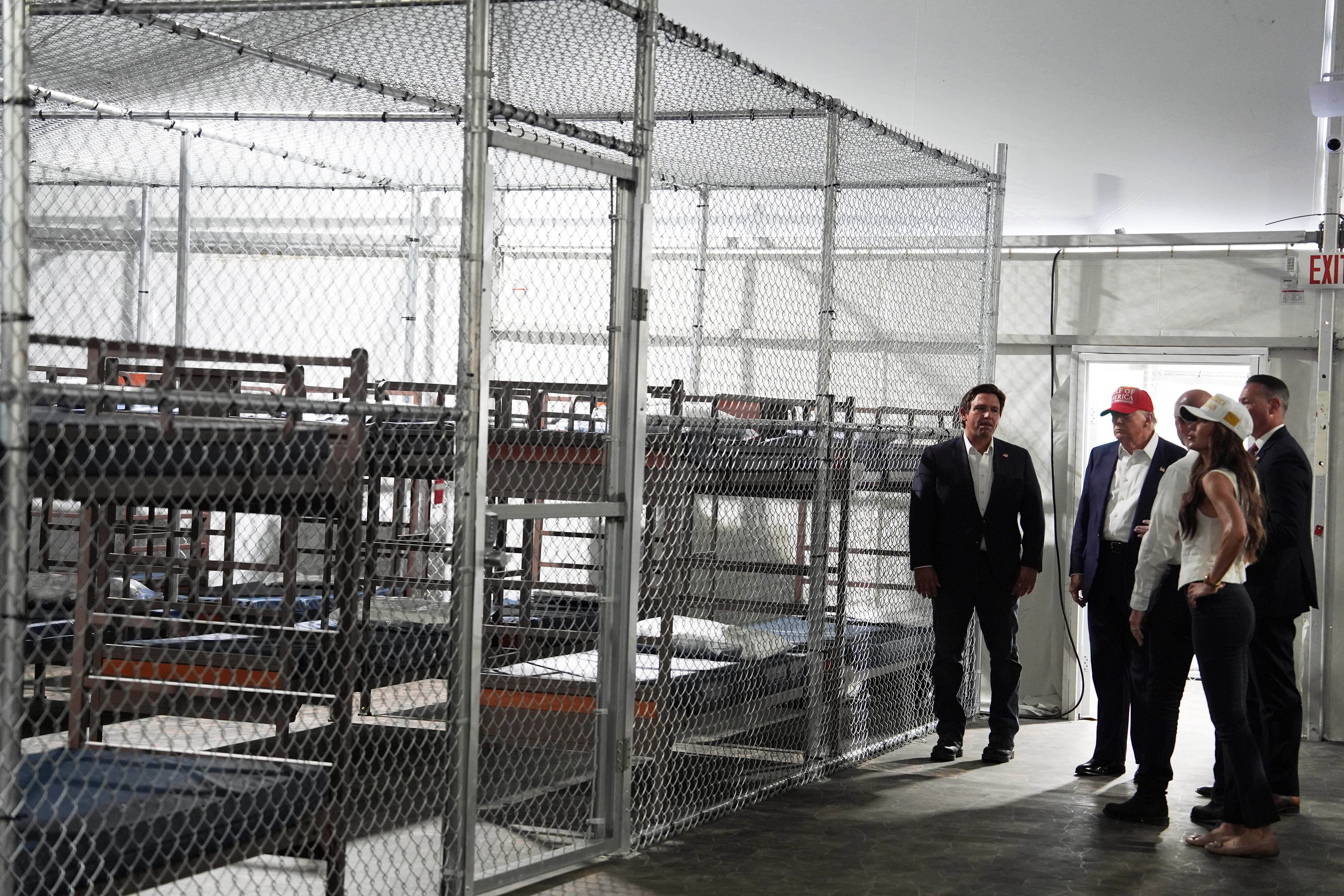
Debbie Wasserman Schultz, who represents Florida's 25th congressional district, said that pictures of the facility “don’t do it justice” and that detainees were being “packed into cages.”

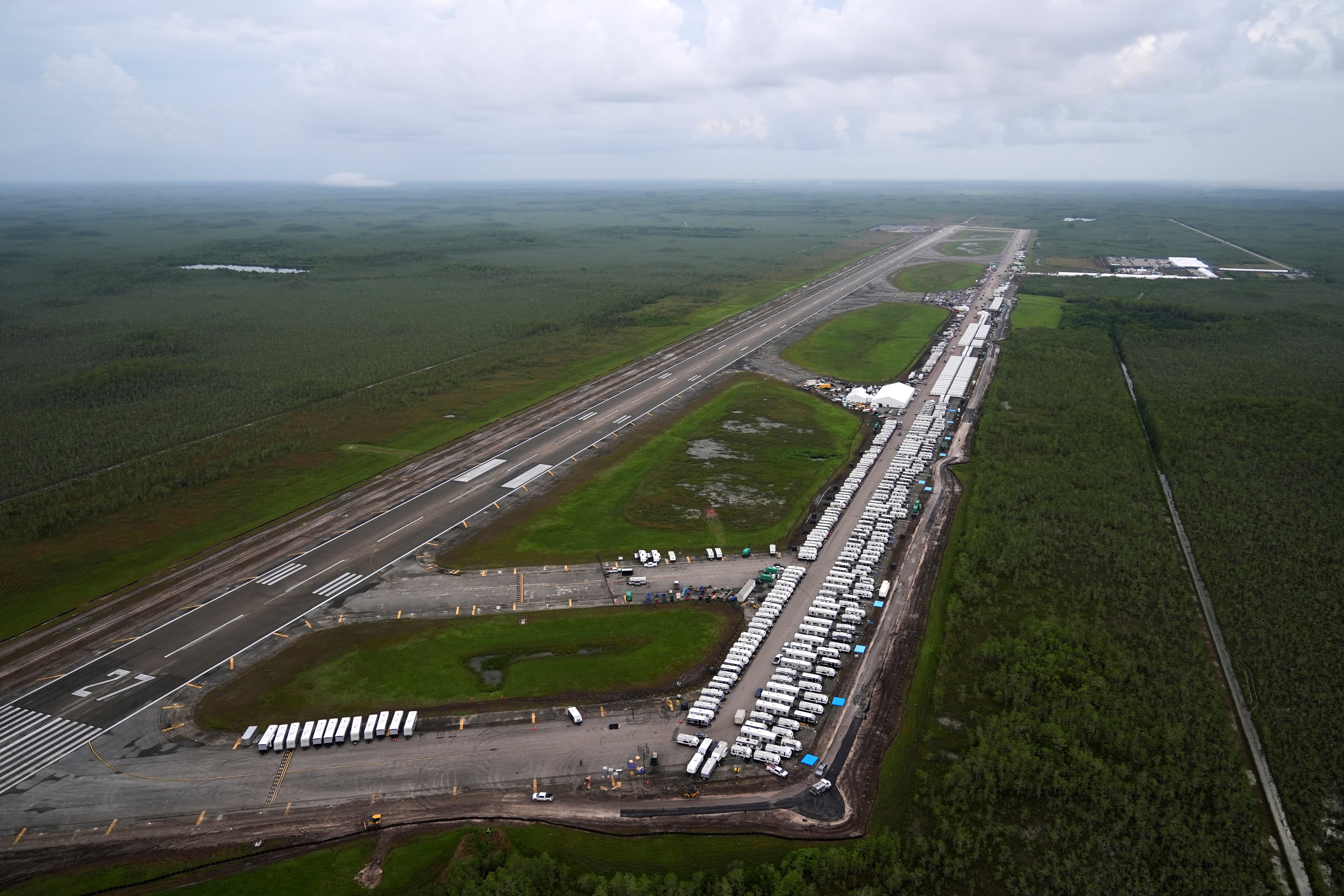
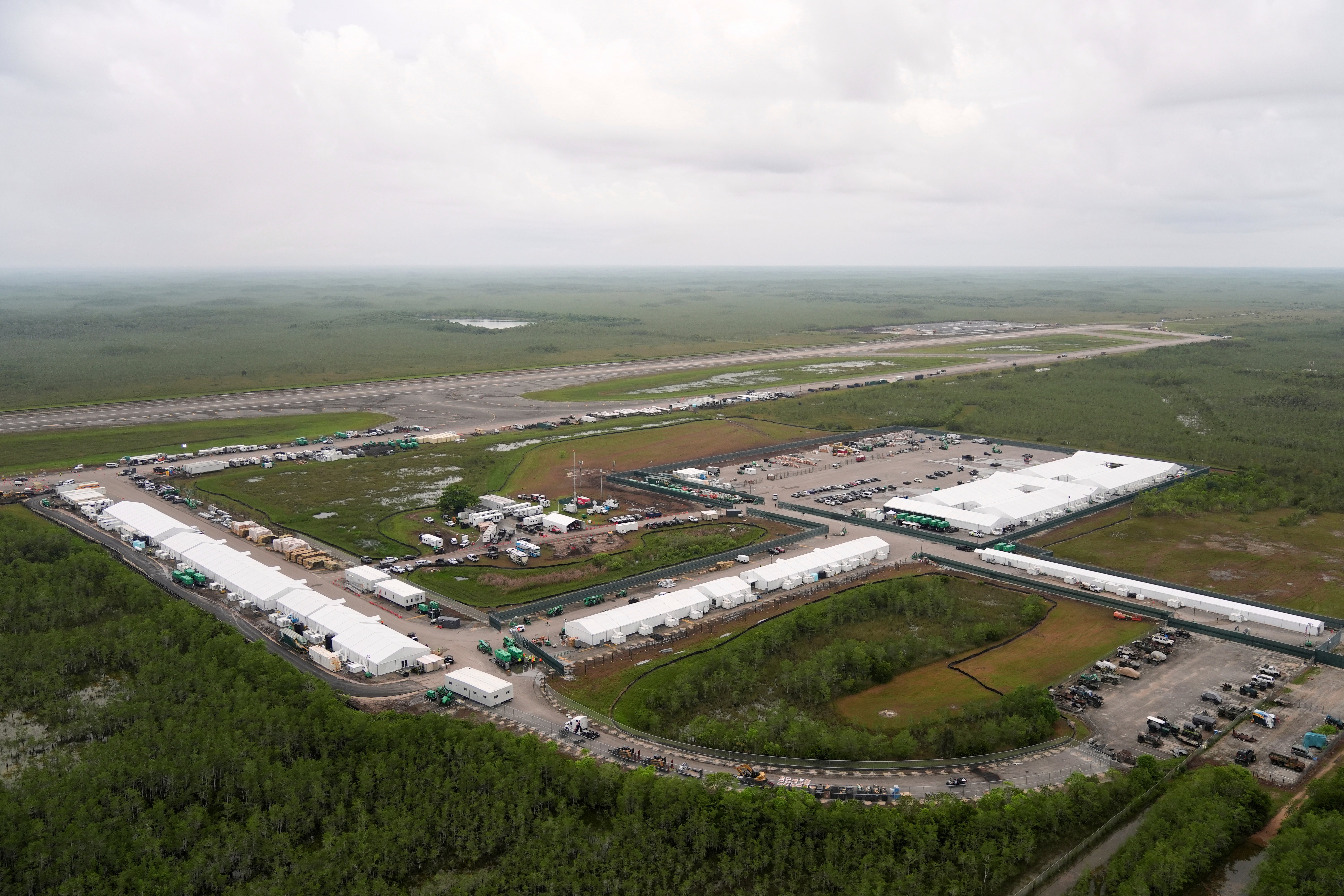
On Saturday Florida lawmakers from both parties took a state-arranged tour of the new 3,000-bed detention center that the state rapidly built on an isolated airstrip surrounded by swampland in the Everglades.

Speaking at a press conference following the tour, Wasserman Schultz said that the walk-through had been “sanitized” but conditions were nonetheless “appalling.”


open image in galleryDebbie Wasserman Schultz, who represents Florida's 25th congressional district, said that pictures of the ‘Alligator Alcatraz’ facility ‘don’t do it justice’ and that detainees were being ‘packed into cages’ (AP)

Lawmakers visit 'Alligator Alcatraz,' but some wonder how much they'll get to see

“They are essentially packed into cages, wall-to-wall humans, 32 detainees per cage,” she told reporters. “The only thing inside those cages are their bunk beds, and there are three tiny toilets.”

The units, Wasserman Schultz said, have sinks attached to the toilet resulting in detainees having to “brush their teeth where they poop.” There was minimal privacy for any person inside, she added.


open image in galleryOn Saturday Florida lawmakers from both parties took a state-arranged tour of the new 3,000-bed detention center that the state rapidly built on an isolated airstrip surrounded by swampland in the Everglades (AP)

“This place needs to be shut the hell down. They're abusing human beings in cages,” the congresswoman later added in a post on X.

Trump and his allies, including Florida Governor Ron DeSantis, have touted the makeshift detention center — an agglomeration of tents, trailers and temporary buildings constructed in a matter of days — as an efficient and get-tough response to the president’s call for mass deportations.


open image in galleryTrump and his allies, including Florida Governor Ron DeSantis, have touted the makeshift detention center as an efficient and get-tough response to the president’s call for mass deportations (AP)

Described as temporary, the detention center is meant to help the administration reach its goal of boosting the U.S. migrant detention capacity from 41,000 people to at least 100,000.

The Florida facility's remote location and its name — a nod to the notorious Alcatraz prison that once housed federal inmates in California — are meant to underscore a message of deterring illegal immigration.


open image in galleryPresident Donald Trump visits 'Alligator Alcatraz' in Florida with Governor Ron DeSantis and Homeland Security Secretary Kristi Noem (AP)

Despite the outrage of Democrats like Wasserman Schultz, other Republicans who took the tour said the conditions were “clean, air conditioned and well-kept.”

“The rhetoric does not match the reality,” said State Senator Blaise Ingoglia, a DeSantis ally. “It’s basically all political theater coming from the [Democrats]. What they’re saying is pure bullshit.”
'If I wasn't here, people could die': Trump public media cuts could hit rural America


Thomas Copeland
BBC World Service
JULY 13, 2025

BBC
Desiree Hagan broadcasts across a coverage area the size of Indiana


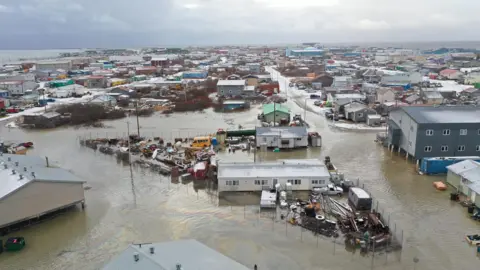
A gale-force storm hit north-eastern Alaska last winter. Residents of Kotzebue, a town of about 3,000, are used to polar conditions, so Desiree Hagan still had to get to work.

"The snow was so intense you could not see in front of you," Ms Hagan remembers. "I was walking backwards to work."

Ms Hagan is a reporter at a public radio station, KOTZ, which airs across Kotzebue and its 12 surrounding villages.

She also happens to be the only US journalist stationed inside the Arctic Circle, so as the storm intensified, she had to get on the air.

"It's go time, I have to report on this," recalls Ms Hagan. "We have to make sure we know where people can go. Oh, the electric is out. Okay, now the airport is flooded."


Two homes were destroyed by the flooding and 80 residents were evacuated


"Winter is not a joke here, it is life and death," she tells the BBC. "As a reporter I try not to make emotional statements like, if I wasn't here, people could die, but that is a reality."

On the other side of the country in Washington DC, however, a historic vote could bring federal support for KOTZ to an end.

The Senate must decide by the end of the week whether to claw back $1.1bn (£800m) from the Corporation for Public Broadcasting, the body that distributes federal funding to public radio and television stations.

While the public media cuts are part of a broad spending package, which includes requests to rescind $8.3bn from the United States Agency for International Development and other foreign aid programmes, they are especially dear to President Donald Trump, who frequently accuses media of bias.

The president has now threatened to pull his support from any Republican senator who does not support the cuts.

President Trump said he would be "honoured" to end funding for NPR and PBS

"It is very important that all Republicans adhere to my Recissions Bill and, in particular, DEFUND THE CORPORATION FOR PUBLIC BROADCASTING (PBS and NPR), which is worse than CNN & MSDNC put together," Trump posted on Truth Social Thursday night.

Executives at National Public Radio (NPR) and the Public Broadcasting System (PBS) reject accusations of bias and say they abide by all journalistic standards.

Republican voters, however, are about three times less likely than Democrats to consume or trust news coverage from either outlet, according to the Pew Research Center.

While the cuts will affect national broadcasters like NPR and PBS, more than 70% of federal funding goes to local media stations and about 45% of the stations that received funding in 2023 are in rural areas.

For half of those rural stations, federal grants made up a quarter or more of their revenue. At KOTZ in Kotzebue, public funding constitutes 41% of its income.

EPA
The impacts of the cuts on rural constituents have made some senators balk.

"By no means is it assured of being passed in the Senate, where many of the Republican senators represent rural states that really do benefit from the Corporation for Public Broadcasting," Democratic congressman Dan Goldman, co-chair of the Public Broadcasting Caucus, told the BBC World Service's Weekend programme.

Republican Senator Lisa Murkowski of Alaska has said she opposes the cuts to public media stations, warning that "what may seem like a frivolous expense to some has proven to be an invaluable resource that saves lives in Alaska".

"Almost to a number, they're saying that they will go under if public broadcasting funds are no longer available to them," Murkowski told a Senate hearing last month.

Other Republican senators, including Susan Collins of Maine and Mitch McConnell of Kentucky, have expressed concern about cuts to foreign aid programmes.


Reuters
Goldman told the BBC the president is deliberately targeting independent media

Cutting federal funding for public broadcasting has been an ambition of Republican administrations for decades and was regularly raised by President Trump during his first term.

"It is unfair to ask conservative Americans to pay for a service that mocks them, that has nothing but a derisive attitude towards them," says Mike Gonzalez, senior fellow at the Heritage Foundation, a conservative think tank. Last year, a senior NPR editor resigned after accusing the outlet of favouring left-wing voices.

Gonzalez wrote a chapter in the Project 2025 policy blueprint calling for an end to all federal funding for public media.

"If there is a demand for local news, the market will meet it," Mr Gonzalez says. "The idea that the taxpayer is the only surviving business model, I don't think that is the case."

According to Northwestern University, the number of counties in the US without a local news source has risen to 206, with 1,561 counties having just one source.

Almost 55 million Americans now live in these news deserts, three-quarters of which are predominantly rural.

Rural America strongly backed Donald Trump in November's election, leading some to claim that the president's own voters could be hardest hit by cuts to public media.


Bubenik says there is no commercially viable alternative to public media

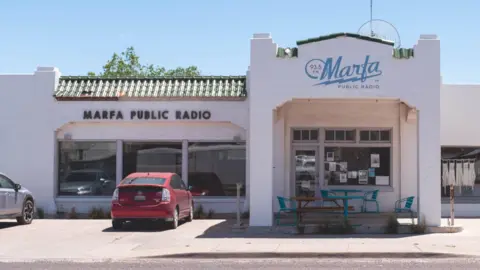
Travis Bubenik is the news director at Marfa Public Radio in rural west Texas. Nearly every county where the station airs overwhelmingly voted Republican in the last election.

Where there is anger about public media, Mr Bubenik says it is directed at the national outlets.

"All I know is that in my experience here at this local station doing local news, people talk to me, they like what we're doing, they understand that we are local, that we live here and that we care about the region," he says.


Marfa Public Radio broadcasts over a coverage area the size of South Carolina


More than a third of the funding for Marfa Public Radio comes from the federal grants that are now under threat.

"It's scary," admits Mr Bubenik. "In the not too distant future this station might be either off the air or just not able to do the same quantity and quality of local news."

The bill has to pass the Senate before 18 July and any changes must be approved by the House before it can make its way onto Trump's desk. If four Republicans decide not to vote for the bill, it won't move forward.


EPA
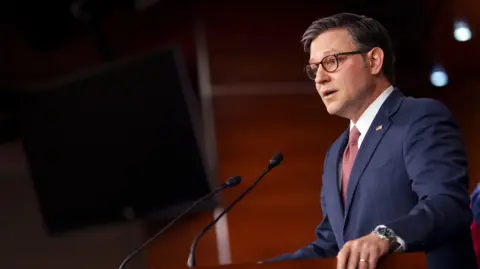
House Speaker Mike Johnson described the public media funding as 'wasteful spending'


Watching an iceberg float by her office window in Kotzebue, Desiree Hagan is hoping enough senators will cross the aisle. She tries not to think about the alternative.

"Even when there's a few moments of dead air here, people think, 'What's wrong?" laughs Ms Hagan.

Around 90% of her audience is Inupiat, an Alaska Native community. Much of the programming is delivered by Elders in the Inupiat language.

"The station is so interwoven into the community," Ms Hagan says. "These cuts would have ripple effects across every aspect of society."

"It would be devastating," she adds.