Friday, August 29, 2025


Council of Europe expert body calls for repeal of Georgia’s ‘foreign agents’ law
Council of Europe expert body calls for repeal of Georgia’s ‘foreign agents’ law
/ archikl via Pixabay

By bne IntelliNews August 28, 2025

The Expert Council on NGO Law, a body of the Conference of INGOs of the Council of Europe, has issued an opinion warning that Georgia’s controversial Foreign Agents Registration Act (FARA) would cause “grave and unjustified” harm to civil society if implemented, and calling for its repeal.

The law, adopted by the ruling Georgian Dream party and taking effect in May 2024, requires organisations and media outlets receiving more than 20% of their funding from abroad to register as “agents of foreign influence”.

Georgian authorities have already begun implementing the law. The country’s Anti-Corruption Bureau has sent inspection notices to seven civil society groups, suggesting their work could constitute “political activity” and demanding explanations for their refusal to register under the Act. The bureau also warned of criminal liability.

The affected organisations insist the law does not apply to them and have refused to register. In its August 25, opinion, the Expert Council said that “the implementation of the Act will cause grave and unjustified damage to civil society in Georgia, will be inconsistent with a wide range of commitments that this member state of the Council of Europe has undertaken and will thus be entirely inappropriate.”

The opinion found that Georgian Dream’s FARA fails to meet the conditions under the European Convention on Human Rights (ECHR) that would allow restrictions on fundamental rights. It noted that the law would affect freedoms of association, expression, and respect for private life, all of which can only be limited if restrictions are prescribed by law, have a legitimate aim, and are necessary in a democratic society. The council concluded that the Georgian legislation failed to meet any of these conditions.

According to the opinion, “the requirements imposed by it cannot be regarded as sufficiently prescribed by law.” At the same time, “there are serious doubts as to whether the adoption of at least some of the provisions in the Act can be regarded as having a legitimate aim.” Furthermore, “the implementation of the Act cannot be regarded as necessary in a democratic society.”

The council also rejected the Georgian government’s defence that the law is based on the United States’ 1938 FARA, noting that the fact it is “an analogue of the US FARA is not in itself a reason to regard its provisions as necessary in a democratic society, not least since it has not been evaluated for compliance with the rights guaranteed by the ECHR.”

The opinion criticised the Georgian law’s scope, saying it could apply to civil society organisations with no actual but only supposed ties to foreign principals. Receiving foreign funding or using outside expertise, it argued, does not mean groups are acting on behalf of foreign powers, adding that many governments themselves receive such foreign assistance.

It further warned that the law’s broad definition of “foreign political party” could inhibit national minorities from maintaining peaceful cross-border contacts or participating in international NGOs. The demand for detailed reporting of “each activity (including political activity)” was deemed an unjustified restriction on freedom of expression and interference with private life.

On requirements to disclose extensive personal data of directors, managers, and employees, the opinion said these were “beyond what is necessary in a democratic society” and excessive compared with the goal of countering foreign interference. It also condemned the obligation for CSOs to keep records for three years after ceasing to operate as “agents,” and for directors to remain responsible for filings even after an organisation is dissolved, describing this as “unduly burdensome.”

The council raised concern that, even though the law does not formally label organisations as “foreign agents,” being subjected to it effectively brands them as such, signalling that they carry out work on behalf of foreign principals. It also warned against “excessive penalties” for non-compliance.

"Having regard to the inevitable effect of the Act’s provisions in precluding NGOs from seeking access to foreign support for the pursuit of objectives entirely consistent with European standards, the excessive obligations to disclose personal data, the unrestricted scope of the demands for supplementary information that can be made, the burdensome record-keeping required and excessive nature of the penalties that can be imposed, the measures contained in the Act cannot be considered necessary in a democratic society," it concluded. The opinion urged the Georgian government to repeal the law.

The controversy comes amid mounting concerns about Georgia’s democratic trajectory. The International Society for Fair Elections and Democracy (ISFED), Georgia’s most prominent election watchdog, has announced it will not observe the upcoming October 4 local elections “with a standard observation mission”, citing the lack of conditions for free, fair, and competitive polls. ISFED pointed to the same three principles outlined by the Venice Commission’s Code of Good Practice in Electoral Matters — respect for fundamental rights, stability of electoral law, and procedural guarantees — which it said had “largely not been met”.

Opposition parties have also announced boycotts of the municipal elections, saying participation would legitimise Georgian Dream’s rule amid ongoing anti-government protests and state repression. With the OSCE/ODIHR not invited to monitor the vote, the elections are likely to proceed without full-scale international oversight.

MURDEROUS MISOGYNY

Murder-suicide attempt in Tajikistan draws attention to domestic violence, mental health issues

Murder-suicide attempt in Tajikistan draws attention to domestic violence, mental health issues
The last dramatic suicide attempt by a young woman in southern Tajikistan has once again brought attention to the plight of women in the country’s conservative society. Tajik women are pictured here in traditional dress in Dushanbe, Tajikistan, on June 11, 2014. / Juris Paiders/Wikimedia/Creative Commons
By Alexander Thompson for Eurasianet August 29, 2025

Since the beginning of the year, at least two young mothers in rural Tajikistan have taken their own lives by drowning themselves.

In a third case, 27-year-old Madina Halimova from the country’s far south allegedly drowned her four children in the Vakhsh River in late June, then attempted to drown herself. Her husband says she snuck out of the house while he slept. Authorities pulled Halimova from the river, saving her life. But she now faces murder charges stemming from the deaths of her children.

Halimova’s husband and his family have said she suffered from untreated mental health issues, while her lawyer has stated she believed her husband was cheating on her, the Tajik media outlet Asia-Plus reported.

Halimova’s case has garnered widespread attention in Tajikistan, Central Asia’s poorest state with a predominantly Muslim population of about 11mn, once again placing a spotlight on women’s rights and their place in society. 

“These cases have had a very big resonance,” Marhabo Olimi, a Tajik expert on gender issues, told Eurasianet. “Women’s low awareness of their rights and their economic dependence very often mean that women don’t have a way out, or don’t see a way out, and they simply take their lives.”

Women also take their children’s lives because they fear their children will suffer as they have, Olimi added.

Tajikistan has a relatively low suicide rate compared to other countries, but about once a year over the past decade a particularly dramatic, and often similar, story of a young mother taking her own life and those of her children generates headlines, according to Radio Ozodi, Radio Free Europe/Radio Liberty’s Tajik service.

The suicides underline that, despite many advances in recent years, women in Central Asia continue to face high rates of domestic violence, unequal treatment and misogyny.

The 2024 trial and conviction of former Kazakh Economy Minister Kuandyk Bishimbayev for his brutal treatment and murder of his wife Saltanat Nukenova brought international attention to the issue, prompting calls for reform by regional officials.

Yet, how much change has occurred remains an open question.

The problem of suicide is not isolated to Tajikistan. In December 2023, Radio AzattykRFE/RL’s Kyrgyz service, reported on a wave of suicides by 10 women in one village in Kyrgyzstan’s rural Batken province.

Elsewhere in the region, cases of domestic violence in Uzbekistan more than doubled to 48,303 during the first half of this year, per figures from the country’s Committee for Family and Women and reported on August 14 by Current Time TV, an RFE/RL affiliate.

Activists suggest that just about the only change in existing patterns is the preferred method of suicide, from self-immolation to jumping off bridges.

The problem of suicides among young women in Tajikistan stretches back decades. In 1985, authorities in the then-Soviet republic of Tajikistan set up a committee to study the issue in response to a series of self-immolations.

During the first half of this year, 102 women and girls took their lives in Tajikistan, Bunafsha Fayziddinzoda, the head of the country’s Committee on Women and Family Affairs, told reporters earlier this month. That is a touch lower than the number over the same period of last year, but instances of suicide among minors increased, according to Fayziddinzoda.

About 90% of suicides in Tajikistan involve women, according to the Republican Center for Clinical Psychology cited by the Cabar news agency in 2021. Untreated mental health issues, poverty, domestic violence and child marriage are often contributing factors, Nargis Saidova, the director of the Tajik NGO Gender and Development, told Eurasianet in an interview.

Women lack access to qualified psychologists in rural areas, Saidova said. The problem is especially acute for young mothers as post-partum depression is poorly understood and rarely addressed, she added.

About 50% of women in Tajikistan reportedly suffer from domestic violence, which is overlooked and not criminalised in Tajikistan, Eurasianet has reported. Roughly 14% of girls under 18 are married either informally through a religious ceremony or legally via exceptions to the country’s ban on child marriage, which judges reportedly grant liberally, according to a 2024 report by the UN Convention on the Elimination of All Forms of Discrimination Against Women.

Conflicts between women and their mothers-in-law are frequently invoked in the Tajik media when discussing suicides. Due to the high rate of labour migration among Tajik men, their wives often live with their husband’s family for years. Relations with relatives do sometimes play a role in suicides, but the underlying issue is the deeply rooted gender stereotypes of women’s role in society, Saidova said. 

The government has conducted several effective mental health campaigns, but what is needed more is stricter enforcement of laws against child marriage and domestic violence, Saidova said. Mental health centres and women’s shelters are also needed, she added.

Closing gaps has become more difficult in recent months since the Trump administration shuttered the US Agency for International Development (USAID) and the US State Department slashed international assistance, Saidova added. Her NGO lost a grant and another NGO closed in the wake of the cuts. But she is not giving up.

“We can’t throw our hands up,” she said.

This article first appeared on Eurasianet here.

Alexander Thompson is a journalist based in Bishkek, Kyrgyzstan, reporting on current events across Central Asia. He previously worked for American newspapers, including the Charleston, S.C., Post and Courier and The Boston Globe.


A look at the Indian industries hardest hit by US tariffs

A look at the Indian industries hardest hit by US tariffs
/ Stijn Dijkstra - Pexels
By bno - Mumbai bureau August 29, 2025

India has emerged as one of the hardest hit nations under fresh tariff measures imposed by the United States, with Indian exports to its largest single market now facing duties of up to 50%. Of this, a punitive 25% is directly tied to Washington’s objection to New Delhi’s continued purchase of Russian oil.

Nearly two-thirds of India’s shipments to the US, amounting to around $60bn, will come under the ambit of these tariffs, NDTV reported. The tariffs came into effect on August 27.

The impact of the higher duties will be felt most acutely in sectors such as seafood, textiles, gems and jewellery, auto components, handicrafts, leather goods, and carpets. India’s status as a competitive supplier across labour-intensive export industries now faces severe disruption, with competing nations poised to replace Indian goods in the US market.

As per the NDTV report, the seafood sector could experience the severest damage. India shipped $2.4bn worth of shrimps to the US in FY2025, making up 32.4% of cumulative shrimp exports. The US is the largest destination for India’s farmed shrimp, particularly peeled, deveined, cooked, and breaded varieties. A steep rise in import costs threatens to wipe out India’s advantage, pushing buyers towards Latin American and Southeast Asian suppliers.

The gems and jewellery industry faces an even greater challenge. With $10bn worth of exports to the US - 40% of India’s total global shipments in the sector - tariffs are set to jump from 2.1% to 52.1%. The increase risks large-scale job losses in hubs such as Surat, Mumbai, and Jaipur, which together employ millions in cutting, polishing, and manufacturing.

The textile and apparel industry, another of India’s largest export earners, will also be hit hard. India’s exports to the US were valued at $10.8bn in FY2025, with apparel alone accounting for $5.4bn. Under the new regime, duties will rise from 13.9% to 63.9%, effectively eliminating any price advantage Indian suppliers hold. Export clusters in Tiruppur, Noida-Gurugram, Bengaluru, Ludhiana, and Jaipur are bracing for severe order losses, as countries such as Bangladesh, Vietnam, Mexico, and those under the CAFTA-DR pact are expected to take over.

Carpets, another traditional stronghold, accounted for $1.2bn in exports to the US in FY2025, with Washington buying 58.6% of India’s global shipments. Tariffs will rise from 2.9% to 52.9%, threatening artisanal livelihoods in Bhadohi, Mirzapur, and Srinagar. Industry watchers say Turkey, Pakistan, Nepal, and China stand to gain at India’s expense, according to NDTV.

Handicrafts, which earned $1.6bn from the US last year, will also be hit as Washington accounts for 40% of India’s exports in this category. Clusters in Jodhpur, Jaipur, Moradabad, and Saharanpur are staring at possible factory closures, while Vietnam, China, Turkey, and Mexico are likely replacements.

Leather goods and footwear, worth $1.2bn in exports to the US, will face the full 50% tariff. Indian exporters fear a sharp loss of market share to competitors in Vietnam, China, Indonesia, and Mexico, dealing a blow to clusters in Agra, Kanpur, and Tamil Nadu’s Ambur-Ranipet region.

Agriculture and processed food products, including basmati rice, tea, and spices worth $6bn, will also be subjected to the full 50% tariff. Analysts believe Pakistan, Thailand, Vietnam, Kenya, and Sri Lanka will move swiftly to capture India’s lost demand.

Goods exempt from tariffs

Not all sectors are affected. Around 30.2% of Indian exports, valued at $27.6bn, will continue to enter the US market duty-free, according to NDTV. The largest beneficiaries are pharmaceuticals and active pharmaceutical ingredients (APIs), which account for 56% of tariff-exempt exports. Electronics have also been exempt, covering smartphones, network switching and routing equipment, integrated circuits, unmounted chips, diode wafers, and solid-state storage devices.

Russian oil

According to Hindustan Times, India sees the tariff move as a direct targeting for its Russian oil imports. In a statement on August 7, the Ministry of External Affairs said New Delhi’s oil purchases are driven by market realities and the overarching need to safeguard the energy security of 1.4bn citizens. India argued that several other countries continue to buy Russian oil and described Washington’s penalties as “extremely unfortunate.”

The government has also labelled the measures “unjustified and unreasonable,” accusing both the US and the European Union of unfairly singling out New Delhi for its trade with Moscow. For India, the tariffs not only jeopardise tens of billions in exports but also threaten to unravel the employment fabric of regions across the country that are deeply dependent on labour-intensive industries.

India set to boost Russian oil imports despite US tariffs

India set to boost Russian oil imports despite US tariffs
/ Ian Simmonds - Unsplash
By bne IntelliNews August 29, 2025

Indian imports of Russian oil are expected to increase in September as New Delhi presses ahead with purchases despite new US punitive tariffs, Reuters reported on August 28.

India has emerged as the largest buyer of Russian crude since Western sanctions disrupted traditional trade flows after Moscow’s 2022 invasion of Ukraine. The discounted barrels have helped Indian refiners secure cheaper supplies, but the purchases have drawn criticism from Washington. On August 27, the US government under President Donald Trump raised tariffs on Indian imports to 50%, a move that New Delhi says it is addressing through dialogue while at the same time boosting diplomatic outreach, including discussions with Russian President Vladimir Putin, Reuters noted.

Traders told Reuters that Indian refiners plan to increase Russian crude imports in September by 10–20% from August levels, equivalent to an additional 150,000–300,000 barrels per day. The rise comes as Russian exporters have more crude available due to refinery outages and Ukrainian attacks on processing facilities that have sidelined up to 17% of Russia’s refining capacity.

India imported about 1.5mn barrels per day of Russian crude in the first 20 days of August, steady from July but below the January–June average of 1.6mn bpd, according to Vortexa data. The volumes equal roughly 1.5% of global supply, with Russian crude covering about 40% of India’s oil needs. Reliance Industries and Nayara Energy, the two biggest Indian buyers, did not immediately comment.

Russian Urals crude for September loading is being sold at a discount of $2–$3 a barrel to dated Brent, deeper than the August discount of $1.50, traders said. Analysts suggest India is unlikely to scale back imports significantly unless economics change sharply or a global ban is enforced. Brokerage CLSA warned that halting Indian purchases could cut global supply by 1mn bpd and briefly drive oil prices towards $100 a barrel.

Meanwhile, the European Union has tightened its price cap on Russian crude to $47.60 per barrel from September 2, restricting Western services for cargoes sold above that threshold. The combined effect of US tariffs and EU restrictions is expected to filter into Indian imports by October, when cargoes booked in the coming days begin arriving.


EU commits to huge increase in energy imports from US - Statista

EU commits to huge increase in energy imports from US - Statista
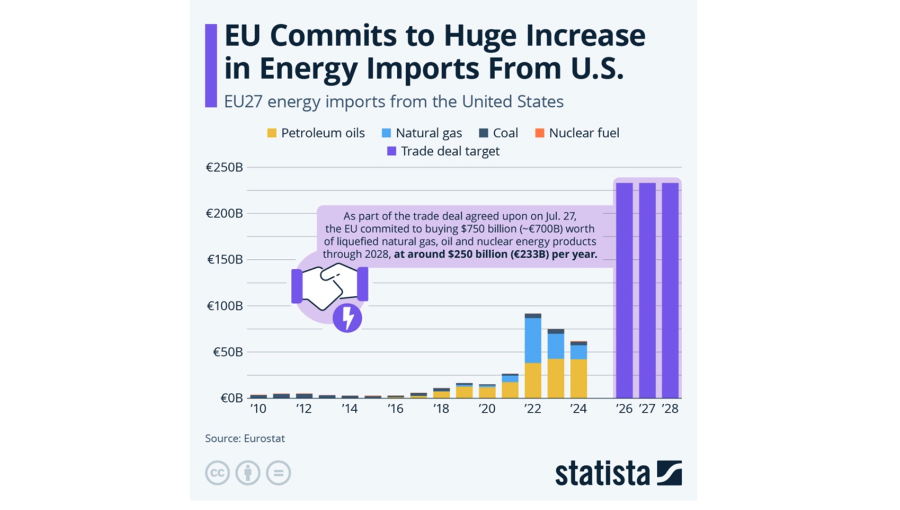
One of the key components of the trade deal between the EU and Trump is a massive ramp up in energy supplies worth $750bn over the next three years. But some critics have pointed out that Europe has broken its dependency on Russia, only to replace it with the same dependency on the US. And that Trum / bne IntelliNews
By Felix Richter of Statistia August 27, 2025

One of the key components of the trade deal that the European Union and the US agreed upon on July 27 is the EU’s commitment to massively ramp up energy imports from the United States, Statista reports.

As part of a joint effort to ensure “secure, reliable and diversified energy supplies”, the EU commits to buy US liquefied gas, oil and nuclear energy products worth $750bn (around €700bn) over the next three years – a goal that many experts deem unrealistically high.

In 2024, EU member states imported €375.9bn worth of energy products from outside the bloc, including petroleum oils, natural gas (both liquefied and in gaseous state) as well as solid fuels (coal, lignite, peat and coke). And while the US was already the EU’s main supplier of oil and liquefied natural gas, accounting for 16.1 and 45.3% of extra-EU imports last year, all energy imports from the US – including nuclear fuel, which is also part of the trade deal – only added up to just over €60bn, or less than a third of the annual total committed to in the trade deal.

In a statement announcing the trade deal, European Commission President Ursula von der Leyen said that the agreement would help the EU diversify its sources of supply and contribute to Europe’s energy security. Critics argue the opposite: that the scale of the planned purchases would make the bloc too dependent on US energy after just having successfully reduced its dependency on Russian oil and gas. The deal would also help Europe replace its remaining energy imports from Russia, President von der Leyen, argued, but even fully replacing them with energy sourced from the US would only add around €25bn to the annual total.

Even if the EU were to try to actually achieve the stated target, which is difficult considering the fact that it’s not the EU but its member states and companies buying the energy, experts argue that it would face insurmountable hurdles on both the demand and the supply side. On the demand side, European energy importers are bound to long-term contracts with other suppliers, making a massive shift towards imports from the US unfeasible over such a short period of time. The same is true for the supply side, where the US would struggle to build the additional infrastructure needed to ramp up exports so quickly and at this scale.

Considering all these factors, the $750bn figure should be seen as more of a pledge rather than a binding commitment. During Trump’s first presidency, he made a similar deal with China, under which China agreed to massively increase imports from the US In the end, the target was never met and everybody moved on regardless.

Thursday, August 28, 2025

Caterpillar lifts 2025 tariff hit estimate to as much as $1.8 billion

Story by Reuters


FILE PHOTO: The Caterpillar logo is seen in this illustration taken August 3, 2025. REUTERS/Dado Ruvic/Illustration/File Photo© Thomson Reuters

(Reuters) -Caterpillar on Thursday raised its estimate of tariff-related costs for 2025, citing additional levies and clarifications, sending its shares down 3% in extended trading.

Sweeping tariffs have raised costs across Caterpillar's supply chain, as the company imports key components such as sensors, even as manufacturers race to localize production.

The Trump administration's latest tariffs, announced on July 31, target imports from dozens of countries, including major trading partners such as Canada, the European Union, Japan, India and several Southeast Asian nations.

"While the company continues to take initial mitigating actions to reduce this impact, trade and tariff negotiations continue to be fluid," Caterpillar said in a regulatory filing on Thursday.

Caterpillar now expects a tariff hit of $1.5 billion to $1.8 billion this year, up from its prior forecast of up to $1.5 billion.

The company had issued its previous expectations along with its second-quarter earnings results earlier this month.

On Thursday, it said the higher costs will push its adjusted operating profit margin toward the bottom of its target range, though it left its full-year sales and revenue outlook unchanged.

Industrial machinery makers are grappling with higher costs from Trump's expansive tariffs on imports, while weak demand and elevated interest rates limit their ability to pass on the burden to customers.

The heavy equipment maker also raised its estimate for third-quarter tariff costs to as much as $600 million, from a prior forecast of up to $500 million.

(Reporting by Shivansh Tiwary in Bengaluru; Editing by Maju Samuel and Alan Barona)


We must develop thinkers, not crammers and fact experts


One teacher education researcher blows the whistle on the decline of geography as a subject in schools


Norwegian University of Science and Technology

Hilde Storrøsæter 

image: 

Hilde Storrøsæter has analysed the national curricula for geography in upper secondary school across 9 different countries. They have examined what the plans say about what is taught and how it is to be taught.

Despite the fact that the concept of "geographical thinking" is the foundation of geography, none of the nine countries' curricula have described it clearly.

view more 

Credit: Sølvi W. Normannsen/NTNU


Hilde Storrøsæter is worried about the teaching of geography in schools.

Geography as a school subject is under pressure. There aren't enough qualified teachers and it loses out to other subjects in school. In many countries, important aspects are left out of the geography curricula. 

"Alarm bells should be ringing, both in the field and among teachers in schools. The development we are seeing in geography as a subject is critical. This failure affects the students' ability to understand how things are connected in a troubled and confusing world," she said.

Storrøsæter is a geographer and assistant professor at the Norwegian University of Science and Technology's Department of Teacher Education. She works with teacher education, and addresses issues that are important for the justification and selection of subject matter, teaching and learning in the subject.

Thinking geographically

Along with colleagues in nine countries, Storrøsæter has analysed the national curricula for geography in upper secondary school. They have examined what the plans say about what is taught and how it is to be taught.

Despite the fact that the concept of "geographical thinking" is the foundation of geography, none of the nine countries' curricula have described it clearly.

"Geographical thinking is a way of understanding and interpreting the world through geographical knowledge," Storrøsæter said.

Thinking "geographically" means  understanding challenges such as climate change, globalization and resource management. And about seeing connections between places, people, the environment and development.

Critical deficiencies found

Another important concept is place.  Researchers call this a fundamental core concept in geographic thinking. Surprisingly; In the subject curricula, this is hardly emphasized.

"We see these as critical shortcomings," says Storrøsæter.

The study "An international perspective on geography curricula: paving a way forward for geographical thinking" was published in International Geographical and Environmental Education on 6 June 2025.

The nine countries studied are Australia, China, the Czech Republic, Denmark, France, Norway, Slovakia, South Africa and the United States.

Sustainability, nature loss and choice

"Geography is the only school subject that connects topics within nature and society. It builds a bridge between us humans and the world we have created and live in," Storrøsæter said.

The tension between nature and society is becoming more and more prevalent around us. It's particularly visible in issues of sustainability and development, the loss of nature in favour of roads, or choices that took everyone by surprise: the UK's Brexit from the EU, and Donald Trump's first victory in the US presidential election.

"People vote differently based on where they live. They may live in places that have exploited their environment and their resources. When society then develops in a different direction, many are filled with a great sense of loss. This, in turn, has an impact on how people vote in elections," she said.

Missing the big picture

The study also addresses ways of thinking, such as creative and future-oriented thinking, and about how we think. This is almost completely absent from several countries' curricula. The consequence of this may be that teaching geography only becomes relevant to the classroom and not to life outside school.

"If we remove the thinking, we are left with the facts. Then we lose the whole," she said.

Buying water in a plastic bottle

If students are to be able to assess the consequences of their own choices, such as what they eat, how they travel, or where they live, they need to master forward-looking and geographical thinking. Being able to analyse a world situation, or a local situation such as oil exploration off Lofoten, equips pupils for the world they are growing up in and will inherit.

"It's about connecting one's own actions to global contexts, and imagining different futures. Take plastic pollution. What do you actually pay for when you buy bottled water? After all, clean water is free, so what you're really paying for is the production of plastic bottles," Storrøsæter said.

The teachers' toolbox

The subject curricula constitute the somewhat slim toolbox that teachers bring with them into the classrooms. There, they are meant to ensure that the young people practice their ability to think, understand, interpret and cope with challenges in everyday life - now and in the future. Many of the tools to make this happen have to be created by the teachers  themselves.

Teachers often talk about complicated relationships, such as climate change.

"To understand climate change, pupils must be able to see the connection between local floods and global emission patterns. This does not only require knowledge of weather and climate. It requires the ability to see the big picture and chains of causes that cut across countries and scales," Storrøsæter said. She herself has 9 years of experience as a teacher in Norwegian upper secondary schools.

Locked in France, wide open in Norway

The study is the first of its kind, and was put into practice because geography is under pressure in many countries.

The researchers hope to contribute to more precise curricula, better education policies, and better support for teachers. The analysis emphasizes whether learning objectives are mentioned in the subject curricula and does not say anything about the extent to which they are included.

Comparison was not a goal, but some differences became clear. France's curriculum is concrete and inflexible. There, the subject is composed of geography and history, with many more history teachers than geography teachers teaching the subject. Norway and Denmark have very open and interpretable goals.

Missing critical thinking

No country scores high on everything, but Norway generally comes out well. The important creative and future-oriented thinking and metacognitive thinking that is about how we think is completely absent in Denmark and France.

Some of this may be due to the fact that in Denmark, geography is a science subject, while in France it is taught together with history. Metacognitive thinking is also not mentioned in South Africa and the United States' curricula. Australia lacks clearly stated curriculum goals on 7 out of 8 points that deal with ways of thinking, China lacks 5 out of 8, and the Czech Republic 6 out of 8.

"The plan gives room, but not direction"

In Norway, the plan provides a lot of room, but little direction, Storrøsæter said. Geography is a social science in Norway, and  the country lacsk teachers. Pupils can go through their entire school education without encountering a single teacher with special expertise in geography.

The subject has been cut down to 90 minutes a week in upper secondary school. New students present with increasingly weaker prior knowledge. Those who educate geography teachers see that the subject is becoming less and less important.

"When the teachers who are going to interpret the open Norwegian curriculum do not have enough academic ballast, the teaching is further weakened,"  Storrøsæter said.

Not just crammers

Are you worried on behalf of your own profession?

"Yes, but also hopeful. I'm concerned because teacher shortages, lack of requirements for the teacher's competence and weak subject curricula result in low quality of pupils' learning. Hopeful because the research and focus on geographical thinking is getting bigger, and I feel it can be used to improve students' learning, teacher education and curriculum development," she said.

"It is certainly not a goal that all countries should end up with the same curricula," Storrøsæter added.

"But we should have some common ambitions. Such as connecting geography to major topics such as sustainability, community development and citizenship. To develop thinkers, not just fact-checkers and crammers," she added.

Reference: Tomáš  Bendl, Hilde Storrøsæter, Lene Møller Madsen, David TrokÅ¡iar, Raphaële de la Martinière, Shanshan Liu, Sizakele Serame, Jerry T. Mitchell, Péter Bagoly-Simó, Yushan Duan, Gillian Kidman: «An international perspective on geography curricula: paving a way forward for geographical thinking» Geographical and Environmental Education https://doi.org/10.1080/10382046.2025.2513535

Political polar opposites may be more alike than they think


Extreme liberals, ultra-conservatives process political information similarly, study says


American Psychological Association


The brains of politically extreme individuals, whether left- or right-leaning, appear to respond to and process political information in surprisingly similar ways, according to research published by the American Psychological Association.

“Both extreme liberals and extreme conservatives consumed the same political content, and even though they held vastly different beliefs, their brains appeared to process the information in a very similar manner,” said Oriel FeldmanHall, PhD, a professor of cognitive and psychological sciences at Brown University and co-author of the study, published in the Journal of Personality and Social Psychology. “In contrast, moderates showed much more diverse brain responses, suggesting that extremity—above and beyond ideology—drives this shared way of processing political information.” 

FeldmanHall and her co-author, Daantje de Bruin, MS, a doctoral student at Brown University, used a combination of fMRI brain scans, skin conductance measures, and eye-tracking on 44 participants with varying political ideologies and levels of extremism, while the participants watched a politically charged video. 

Researchers found extreme individuals—even when they held opposing ideologies—exhibited similar patterns of brain activity when consuming political content that participants with moderate political views did not. This synchronicity was strongest during segments of the video that featured more extreme language.

Individuals with more extreme views were also more physiologically aroused—measured via galvanic skin response—when exposed to political content. These bodily responses appeared to amplify neural synchronization, further suggesting that emotion and arousal help bind people to their political beliefs.

“Regardless of whether someone identified as extremely liberal or extremely conservative, their brain responded to political stimuli in similar ways,” said de Bruin. “This suggests that it’s not just what you believe, but how strongly you believe it and how emotionally reactive you are that shapes your perception of political reality.”

The findings offer scientific support for the “horseshoe theory” of politics, which posits that extremists on both ends of the political spectrum may resemble each other more than they resemble moderates.
“Our findings suggest that individuals with extreme opposing views may be more alike than they realize. Recognizing this shared experience could foster greater empathy and reduce dehumanization across the political divide,” said FeldmanHall.

The researchers caution that the study, which used U.S.-based political content and self-reported ideology measures, may not generalize globally. Future research should explore cross-cultural perspectives and other forms of extremism beyond political ideology, they said.

Article: Politically extreme individuals exhibit similar neural processing despite ideological differences,” by Daantje de Bruin, MS, and Oriel FeldmanHall, PhD, Brown University. Journal of Personality and Social Psychology, published online Aug. 28, 2025.

Contact: Oriel FeldmanHall, PhD can be reached by email at oriel.feldmanhall@brown.edu.