Monday, September 01, 2025

Canada Considers Anti-Immigrant Bills as Haitian Immigrants in the US Flee North

Canada is not making it easy for asylum seekers from the US to find safe harbor.
PublishedAugust 28, 2025

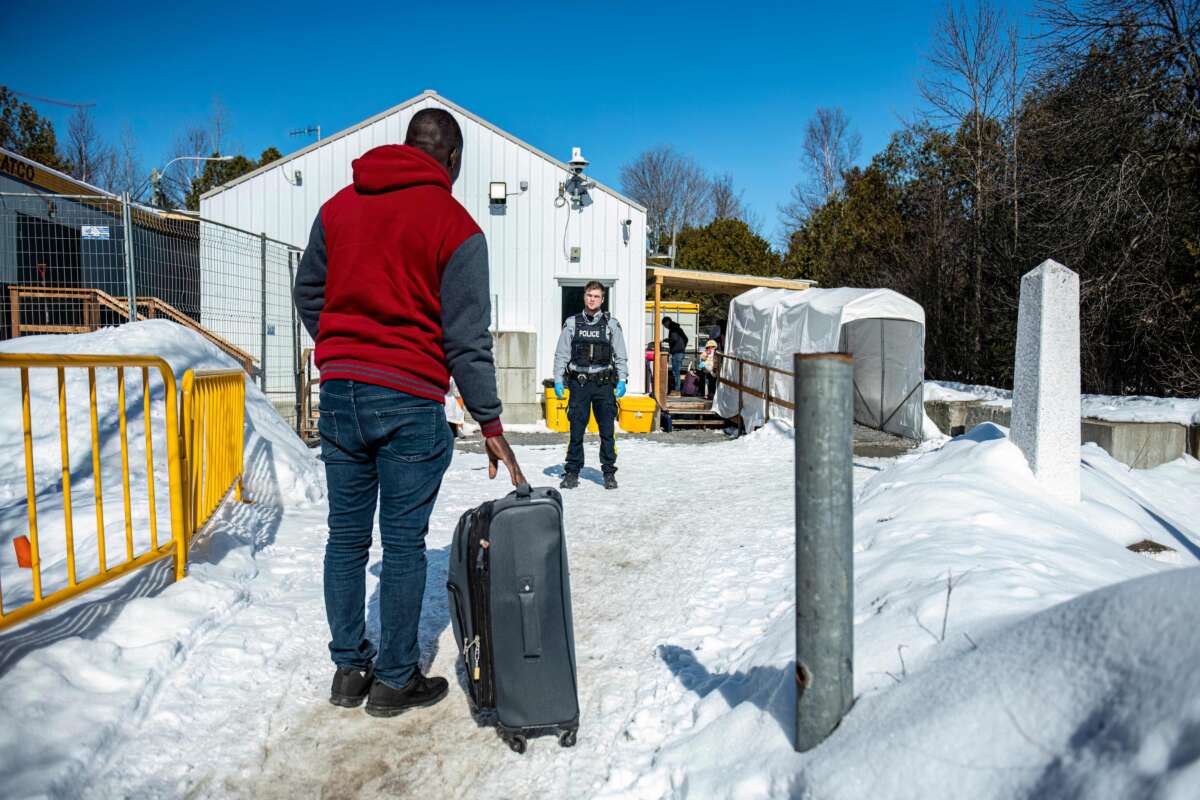
Marcello, who is Haitian and came via Mexico, then the United States, arrives at the Roxham Road border crossing in Roxham, Quebec, on March 3, 2023
.SEBASTIEN ST-JEAN / AFP via Getty Images

For several hours, the woman and her children lay in the mud, hoping not to be found by Canadian authorities. She was in the middle of her 14 days — the amount of time that a person who entered via the United States has to be in Canada before making an asylum claim. During those 14 days, asylum seekers cannot be caught. They have to live underground. And even harder, they have to be able to prove that they were in Canada for 14 days when they go to make their asylum claims. If they’re found or caught, or if they can’t prove Day 1 or Day 14, their claim will be denied, and they will be deported.

On July 13, a U.S. citizen driving an SUV allegedly drunk in southern Quebec crashed into a van carrying 12 people who had entered Canada from the United States. Another van following behind, also carrying migrants, veered away to not be caught by authorities. The first van rolled over, and four people were injured and brought to a hospital. Frantz André, coordinator of the Comité d’Action des Personnes Sans Statut (a committee that supports people without legal status in Canada), is helping some people from both vans, and he says that the remaining eight fled into the woods, as did the passengers in the other van to avoid being caught. The mother who hid in the mud with her children was among this group. After the crash, they lay in the mud for four hours, until another van came to get them.

Experts insist that these kinds of events will continue to increase.

“It’s inhumane” says Jean-Pierre, a Haitian refugee who crossed into Canada from the United States with his wife and child and made his request for refugee status in 2021. Sharing his story in an interview with Truthout, he asked to be identified by a pseudonym to avoid repercussions to his refugee claim. He and his family had been living in Indiana and are now in Western Canada. Jean-Pierre cannot work as he’s been waiting for a work permit since April.

Haitians in the United States have had a Temporary Protected Status since 2010, and the status has been canceled, appealed, and renewed many times since then. After U.S. Secretary of Homeland Security Kristi Noem declared that Haiti no longer meets the program requirements for Temporary Protected Status, the status was set to expire on September 2, 2025. A judge has temporarily blocked this order, extending the Temporary Protected Status designation again until February 3, 2026, but the Trump administration says it “vehemently disagrees” with the judge’s ruling and “is working to determine next steps.”

Related Story

Canada Is Poised to Become a Partner in the US Assault on Immigrants
Canada is rapidly militarizing its borders as a sweetener deal to placate Trump and dodge the worst of his tariffs. By Ray Mwareya , Truthout March 23, 2025


All of this uncertainty has driven many Haitians, like Jean-Pierre, to cross into Canada, usually at Quebec. But now, people are even more afraid, and Canada has made it even harder than before for Haitians and anyone else fleeing the United States to be given asylum.

Already, the largest group of migrants ever tried to enter Canada in the back of an unventilated cube van, just a few weeks ago. The Canadian Press reports that 44 people, mostly Haitians, crossed into Canada on foot on August 3, and were picked up by the cube van. Once the van was intercepted, the migrants were sent to be processed. If they don’t have a first-degree relative living in Canada, it is likely that they will be sent back to the United States.

That’s because the primary way for someone who is Haitian to stay in Canada is to have a first-degree relative, rather than simply claiming asylum, and Canada has no plans to make it easier for anyone coming from the United States to claim asylum in Canada. Immigration, Refugees and Citizenship Canada spokesperson Matthew Krupovich told Truthout that the government of Canada has extended to November 19, 2025, a temporary measure in place to allow people who have a first-degree relative in Canada to enter through a special program. “These measures help keep families together and give Haitian nationals in Canada a safe place to work and study,” he said.

André is critical of the program, which he describes as being a family reunification program rather than a true asylum program. André argues that by allowing Haitians who have first-degree relatives to stay in Canada while not accepting people who are claiming asylum from the United States, Canada is not upholding its responsibilities under international law to accept refugees. Moreover, he says he has seen situations where families are broken up because one person has a direct relative in Canada but the other person in a couple does not.

There are 80,000 Haitians who live in Montreal, and 47,550 of them were born in Haiti, and 140,000 people of Haitian descent who live in Quebec. The vast majority chose Quebec because it is North America’s only majority French-speaking jurisdiction.

But the passage into Canada has been made particularly perilous due to the “Safe Third Country Agreement” — a policy that says immigrants who are crossing into Canada from the U.S. cannot immediately seek refugee status in Canada because they are coming from a country deemed to be “safe”; once they have been in Canada for at least 14 days, however, they are then allowed to seek refugee status in Canada.

While the Supreme Court of Canada found parts of the Safe Third Country Agreement to be constitutional in 2023, it bounced the question of rights violations back to a lower court. In February, the Canadian Council of Refugees and Amnesty International renewed their call for the agreement to be scrapped. They wrote, “Canada’s assertion that the United States remains a safe country for refugees under the Trump administration is a cruel irony to those fleeing persecution today. It must be urgently rescinded, and tariff threats must not blur the plight of those at immediate risk.”


“Canada’s assertion that the United States remains a safe country for refugees under the Trump administration is a cruel irony to those fleeing persecution today.”

Canada has no plans to eliminate the agreement, though. In fact, rather than preparing for more people to come to Canada as a result of the end of the American Temporary Protected Status, Canada’s new Liberal government’s second bill would make it even more difficult for people to seek asylum from the United States. If passed, Bill C-2 will eliminate the 14-day period that people are currently waiting before they make a refugee claim and instead make it impossible for someone to make a claim at all if they cross into Canada from the United States, whether via an official port of entry or not. The bill was presented on June 3, 2025.

André says Canada’s confusing asylum rules aren’t enforced evenly and can change depending on which agent someone deals with, and the stakes are considerably higher now that Trump’s administration has stepped up deportations. He tells the story of a man living in the United States who had both a Canadian and American visa, and who had applied for Temporary Protected Status. He planned to visit Canada for a few weeks. Upon trying to enter Canada, he was told that he couldn’t bring a scooter he had with him to give to a family member, as it didn’t meet certain standards. The man was given two choices: either leave the scooter at the border or go back. The man decided to go back into the United States with the scooter and within days, he was captured by Immigration and Customs Enforcement and sent to an immigration jail where he currently awaits deportation.

What’s worse is that while the Canadian government is squeezing migrants at the border, the government of Quebec has doubled down on ethnic nationalism as a political strategy, demonizing immigrants and refugees in general and Haitians in particular. While the federal government controls Canada’s asylum system, Quebec is the only province that manages its own immigration levels. The province is currently in a process to determine its immigration levels for the next four years, though the governing Coalition Avenir Québec has made it clear that it does not support making it easier for people to claim asylum from the United States.

In a statement given to Truthout in French, Xavier Daffe-Bordeleau, a representative of Quebec’s Ministry of Immigration, Francisation and Integration, explained, “Quebec remains committed to offering a dignified and secure welcome to asylum seekers, with help from … community groups, who have already done a lot over the years to welcome asylum seekers. The cumulative effect over the past many years has placed pressure on the Quebec public and we have largely surpassed our capacity.”

Quebec’s government has formally requested that the Canadian government reduce the number of work permits and refugee status granted from 416,000 in 2024 to 200,000 by 2029, especially in the greater Montreal region, even though cutting immigration levels has already placed Quebec into population decline.

Neither the Canadian nor the Quebec governments have demonstrated meaningful regard for the humanity of asylum seekers, and neither have any plans for the inevitable wave of people who will request asylum in Canada when the Temporary Protected Status ends. The situation in Haiti continues to deteriorate, with the UN-coordinated police force from Kenya having largely been a failure. And with Erik Prince’s Vectus Global about to deploy mercenaries in Haiti, most Haitians in North America are left with only one option: asylum in either the U.S. or Canada.

Despite the crisis, Canada knowingly sends people back to the U.S. where they can face deportation, a kind of deportation by proxy, says André, when really, all they want is the safety and security that every person wants.

“What they need and are looking for is a safe place to rebuild, to build a life and to eventually have their family reunite with them,” André told Truthout. “That was the perception of Canada years ago, which is no longer what’s happening.”


This article is licensed under Creative Commons (CC BY-NC-ND 4.0), and you are free to share and republish under the terms of the license.

Nora Loretois a writer and activist based in Quebec City. She is also the president of the Canadian Freelance Union.


Tribes Condemn Trump for Backing Out of Columbia River Deal for Salmon Recovery


Tribal leaders and environmental advocates warn salmon populations will go extinct without remediation efforts.
PublishedAugust 31, 2025
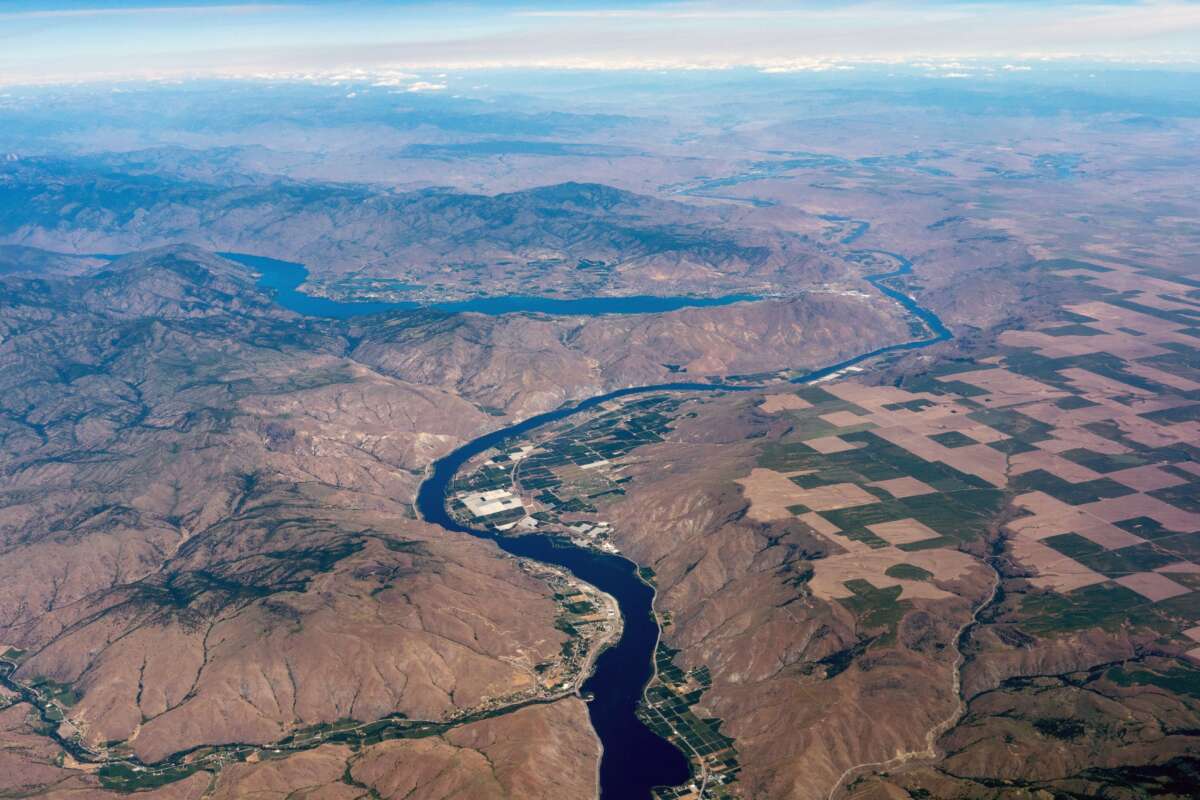
Aerial view of Columbia River and Lake Chelan, Washington.Marli Miller / UCG / Universal Images Group via Getty Images

Time is running out for wild salmon in the Columbia River Basin in the Pacific Northwest. Their populations, as well as those of some other native fish, have been declining for decades. Now, President Donald Trump is attacking the progress that had been made to restore those once-abundant salmon runs.

In June 2025, Trump signed a memorandum signaling his administration’s unwillingness to consider dam removal on the lower Snake River, a tributary of the Columbia River, and reneging on a landmark agreement that would have provided more than a billion dollars over the next decade to Pacific Northwest tribes for renewable energy projects and salmon recovery.

The federal government entered into the Resilient Columbia Basin Agreement under the Biden administration in December 2023 after two years of negotiations. Other parties to the agreement include environmental advocates; Oregon; Washington; and the Umatilla, Nez Perce, Warm Springs, and Yakama tribes. Those tribes entered into treaties with the U.S. government in the mid-1850s, ceding land but maintaining a perpetual right to their fishing grounds in the Columbia River Basin. The government has failed to ensure the tribal fishing rights it promised to protect in those treaties.

Yakama Nation Tribal Council Chair Gerald Lewis said in a statement that the Trump administration’s withdrawal “echoes the federal government’s historic pattern of broken promises to tribes.” Still, others who were involved in negotiations to secure that agreement have vowed to continue efforts to restore salmon populations and fulfill treaty obligations even as the federal government seeks to undermine them.

“The Trump administration’s decision to pull out of this agreement is short-sighted and regrettable,” Miles Johnson, legal director at Columbia Riverkeeper, told Truthout. “But folks in the Pacific Northwest who care about salmon, and salmon cultures and our rivers, we don’t get to stop working on this just because it becomes more challenging.”

Related Story

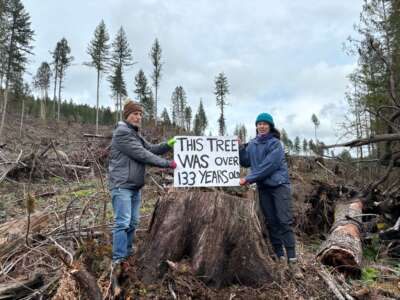
Forest Protectors Launch Tree Sit and Lawsuits to Stop Ecocidal Logging in WA
Forest protectors are defending mature forests from logging after dam removal and restoration on the Elwha River.
By Curtis Johnson , TruthoutJuly 6, 2025


Dozens of hydroelectric dams built beginning almost a century ago on the Columbia River and its largest tributary, the Snake River, eliminated spawning grounds, blocked fish passage between spawning and rearing habitats, and altered river ecology in ways that can impair a salmon’s immune system or undermine their natural migration instincts. More recently, climate change has placed additional stress on salmon populations.


Experts now agree that dam removal is essential to stop the decline of native fish populations.

The dams in the Columbia River Basin have been disastrous for fish populations: The number of wild Chinook salmon on the Snake River fell from about 90,000 in the mid-1950s, when there was just one dam on the waterway, to a mere 10,000 in 1980, seven additional dams later. Four species of salmon in the Columbia River Basin have been listed for protection under the Endangered Species Act since 1991.

Congress acknowledged that wild salmon populations in the Columbia River Basin were dwindling and committed to funding hatcheries meant to stop their decline more than 80 years ago. But the facilities have fallen short of that goal. Today, even the hatcheries are threatened, as salmon survival rates have dropped so low that some struggle to collect enough fish for breeding.

“The truth is that extinction of salmon populations is happening now,” Shannon Wheeler, chairman of the Nez Perce Tribe, said in a June 2025 statement in response to the Trump administration’s withdrawal from the Resilient Columbia Basin Agreement.

Experts now agree that dam removal is essential to stop the decline of native fish populations. One proposal, in particular, which argues for the removal of four dams on the lower Snake River in southeastern Washington, has garnered widespread support from scientists and advocates, as well as other tribal leaders. “We’ve learned over the last 30 to 40 years of studying these fish intensely that those four dams on the lower Snake River are four dams too many,” Johnson told Truthout.

The Resilient Columbia Basin Agreement stopped short of calling for the removal of those dams, but it committed to meaningful steps in that direction. The agreement promised funding to study and develop solutions to mitigate the effects of dam breaching on transportation, recreation, irrigation and energy production in the region. It also committed funding to tribal-led alternative energy projects, which could have compensated for the eventual winddown of the hydroelectric dams.

“The concepts behind that agreement remain a really responsible, well-thought-out and careful path that sought to ensure a win-win scenario for all the different constituencies that depend on a healthy Columbia River,” Michael Garrity, special assistant at the Washington Department of Fish and Wildlife (WDFW), told Truthout.

Even though the agreement takes what Garrity and other experts characterize as a measured approach, Trump called it “radical environmentalism” in an effort to slander it and labeled concerns about climate change “misplaced” in his memorandum.

Critical funding will be lost with the Trump administration’s decision to withdraw from the agreement. This includes $500 million to improve underfunded and aging hatcheries across the Pacific Northwest and $100 million for wild fish restoration efforts. Much of the promised federal funding would have been disbursed via the Bonneville Power Administration (BPA), a federal agency that operates like a business, marketing power from dams on the Columbia River.


“The NGOs, states, and tribes are not going to quit on this issue.”

Still, many aspects of the agreement will move forward in some form thanks to continued buy-in from state and tribal governments and the committed backing of environmental advocates. “The partnership between our four tribes and the states of Oregon and Washington endures,” said Jeremy Takala, chair of the Columbia River Inter-Tribal Fish Commission and a tribal councilman of the Yakama Nation, in a statement. “We are still united in the cause of protecting salmon and rivers.”

Amanda Goodin, an attorney at Earthjustice representing the environmental advocates that signed the Resilient Columbia Basin Agreement, echoed Takala. “The NGOs, states, and tribes are not going to quit on this issue,” she told Truthout. “We’re going to be looking for other avenues for the next few years and waiting for the moment that we have a federal administration that actually cares about our natural heritage, obligations to tribes, and following the law, and we’ll be ready when that time comes.”

Those other avenues are almost sure to include legal battles over the impact of hydroelectric dams on salmon in the Columbia River Basin. Litigation had been ongoing for decades before it was halted as part of the Resilient Columbia Basin Agreement. Federal agencies have lost in court in previous cases. Even John Hairston, administrator and CEO of BPA, welcomed the agreement when it was signed, saying it would help provide “a reliable, affordable power supply to the Pacific Northwest” and put an end to “costly, unpredictable litigation.” Now, Goodin told Truthout, “It’s likely we’re going to see continued litigation.”

Earthjustice is also advocating for Columbia River Basin fish in Congress, where a series of bills have been introduced that could further undermine plans laid out in the Resilient Columbia Basin Agreement. “Those bills are not just salmon extinction bills, they’re also anti-solution bills,” Cameron Walkup, an associate legal representative working for Earthjustice in Washington, D.C., told Truthoutof the Northwest Energy Security Act, the Defending Our Dams Act, and the Protecting Our Water Energy Resources Act. “These bills would essentially double down on what the president did in June in terms of trying to turn back the clock on progress toward comprehensive solutions for salmon recovery, and also dealing with interconnected issues like making sure we have reliable and affordable energy.”

Columbia Riverkeeper, Earthjustice, and NGO partners are engaged in organizing sign-on campaigns to demonstrate support for dam removal and oppose the harmful bills introduced in Congress. Walkup also told Truthout that his organization is prepared to engage with members of Congress if it appears the bills could garner enough support to come to a hearing. “We’re certainly doing everything we can to uplift all the issues with these bills to make sure that if Republicans do choose to make this part of their agenda, that they’re fully opposed by the Democrats and don’t make it through Congress,” he told Truthout.

For their part, Washington’s state agencies responsible for studying the effects of dam breaching on the lower Snake River are continuing that work even as federal partners have withdrawn. “WDFW, working with the governor’s office, is committed to finding a path forward to restore healthy and abundant salmon and steelhead in the Columbia Basin in a way that respects and addresses the non-salmon benefits of the river,” Garrity told Truthout.

Johnson of Columbia Riverkeeper said his message to those who are concerned about the Trump administration’s decision to renege on the historic Resilient Columbia Basin Agreement is simple: “We absolutely need our representatives to understand how much people care about salmon and steelhead and having enough fish in our rivers that people can go fishing, we can meet our obligations to tribes and protect tribal cultures,” he told Truthout. “That starts with individuals, businesses, leaders and anyone else making their voices heard. It’s critical to build a groundswell of support.


This article is licensed under Creative Commons (CC BY-NC-ND 4.0), and you are free to share and republish under the terms of the license.


Marianne Dhenin is an award-winning journalist and historian. Find their portfolio or contact them at mariannedhenin.com.
Trump threatens American capitalism with profits that may only enrich the elite


August 31, 2025 

Is the Trump administration trying to reshape American capitalism? Recent moves by Washington, such as taking a 10% share of semiconductor maker Intel, point to a shift in that direction. For decades, Washington has supported free-market capitalism. Today, the government appears to be supporting a new direction – state-directed capitalism.


As a professor at the Questrom School of Business who studies different economic systems, I find this reversal striking. My research is supported by the Ravi K. Mehrotra Institute, which is trying to understand how business, markets and society interact. My previous research – finding, for example, that U.S. news coverage of capitalism was far more negative in the 1940s than it is now – suggests capitalism isn’t in retreat but is rather evolving.

In what direction is the Trump administration pushing it?

Types of capitalism


While many people bandy around the term “capitalism,” it actually comes in many different forms. The most basic definition of capitalism is when the means of production – such as factories, farms and offices – are owned by private individuals.

Capitalism is driven by profit. Some of the earliest descriptions of the profit motive that drives the whole system come from Adam Smith. As he wrote in 1776, “It is not from the benevolence of the butcher, the brewer or the baker that we expect our dinner, but from their regard to their own interest.”

Who gets the profits and who controls the means of production determine the specific forms of capitalism. While there are many types, I want to focus on three of the most important.

Free-market capitalism, also called laissez-faire capitalism, is when the government takes a hands-off approach to the economy. The U.S. after the Civil War is a good example of free-market capitalism. During the late 1800s, the federal government imposed few regulations on businesses.

State-guided capitalism is when the government chooses industries or companies to support. Favored sectors are given money and face looser regulations than nonfavored sectors. China today is an example of state-guided capitalism, where the state provides support for industries such as shipbuilding, steel and AI.

Oligarchic capitalism is when a very small part of the population owns key industries and controls the economy. Russia today is an example of this type of capitalism.

Each form of capitalism has its strengths and weaknesses. For example, free-market capitalism provides the most incentives to grow the economy, but the lack of rules often leads businesses to run roughshod over consumers. U.S. historians describe the late 1800s as the era of robber barons.

State-guided capitalism can dramatically boost the output of favored industries. However, if the government invests in the wrong industries, huge amounts of money can be wasted propping up dying firms.

Oligarchic capitalism can rapidly invest in new areas and shift resources, but the profits enrich only a tiny elite.

Recent changes


The U.S. currently appears to be operating under a hybrid model of capitalism, blending free-market principles with elements of state capitalism.

One of the most recent changes is the Trump administration’s decision to take a 10% stake in Intel. Congress passed the multibillion-dollar CHIPS and Science Act in 2022 to bolster U.S. computer chipmakers. Intel is slated to receive US$11.1 billion in grants from the program and other government funding. The current administration has converted that public support into a 10% ownership of the semiconductor maker.

Intel isn’t alone. The government has recently become a shareholder in other companies it views as strategically important – a trend that seems likely to continue and possibly result in the creation of a “sovereign wealth fund.” In July 2025, the Department of Defense agreed to buy $400 million of convertible preferred stock in MP Materials. MP Materials is the only U.S. rare-earth minerals mine with integrated production capacity. The company said the Department of Defense would be positioned to become its largest shareholder.

The government is also requiring a share of revenue from large computer chip manufacturers. Nvidia and AMD will have to remit 15% of revenue from certain chip sales to China as a condition for export licenses.

Why the US change is important

The CHIPS and Science Act has already funneled billions into U.S. semiconductor manufacturing via grants, tax credits and R&D support. MP Materials and Intel could serve as pilot models for further strategic intervention. However, the U.S. government spends trillions each year, and the amounts invested in American industries and companies represent only a small percentage of total spending.

While the CHIPS and Science Act was passed in 2022 under the Biden administration, the implementation relied on traditional tools of industrial policy such as grants, tax credits and milestone-based funding. In contrast, the Trump administration has converted these grants into equity arrangements, with officials stating the government should get a return on its investment.

This shift from an incentive-based approach to a direct ownership model represents one of the most fascinating experiments in modern American capitalism. The real question is what happens if – or when – this strategy expands. The government could become more involved in energy, biotech and AI, or any place where markets show signs of lagging or supply chains are geopolitically fragile.

The U.S. isn’t rejecting capitalism but recalibrating its boundaries. The next few years will show exactly how Washington’s interventions will reshape U.S. capitalism.

H. Sami Karaca, Professor of Business Analytics, Questrom School of Business, Boston University

This article is republished from The Conversation under a Creative Commons license. Read the original article.

'Ugly tradition': Paul Krugman drops bombshell concern of being targeted in bogus Trump probe


Economist Paul Krugman in Rio de Janeiro, Brazil on September 25, 2023
 (A. Paes/Shutterstock.com)

August 30, 2025 
ALTERNET

President Donald Trump is not only trying to remove Lisa Cook as a U.S. Federal Reserve governor — he also wants her investigated for mortgage fraud allegations, although she hasn't been charged with anything.

Liberal economist and former New York Times columnist Paul Krugman discussed Trump's campaign against Cook during a Saturday, August 30 appearance on MSNBC. Krugman warned that a range of Trump economic policies — from steep new tariffs to efforts to destroy the Fed's independence — risk getting the United States into a major economic crisis. And he pointed to the mortgage fraud claims about Cook as a glaring example of Trump's willingness to use the U.S. Department of Justice (DOJ) as a weapon against political opponents regardless of a case's merit.

Trump, Krugman warned, is risking an "inflation crisis" and a "financial crisis" with his "completely insane" policies.

The economist told host Ali Velshi, "We have Donald Trump saying, at a time when inflation is rising, that he wants the Federal Reserve to cut interest rates by 300 basis points — three full percentage points, which is completely insane. We have him insisting that there is no inflation, which is false…. He gets a bad jobs report, he fires the head of the Bureau of Labor Statistics….. We already know that we have somebody who shouldn't be allowed within a mile of setting monetary policy…. So this is not a hypothetical disaster. This is something where we know that things will go very, very badly if he gets away with this."

Krugman noted that friends are wondering if he could be targeted for some type of bogus investigation by the Trump Administration given how critical of the president he has been.

"You know, once you have the principle that we can rummage through your records and try to find something that can be considered dirt, anybody could be in the line of fire," Krugman told Velshi. "I mean, I've been getting a bunch of e-mails from friends saying: I bet the FHA is rummaging through your mortgage records right now. Me personally, which seems quite likely. And, you know, I think it was (Josef) Stalin's chief of secret police who said, 'Show me the man, and I'll find you the crime.' And that's kind of the America that we're becoming."

Attorney Lauren Libby examined the Trump Administration's use of mortgage fraud allegations as a weapon in an article published by Slate on August 30.

Libby observed, "It's a new twist on a long, ugly tradition. Trump's use of mortgage fraud is relatively novel, but he's far from the first president to use the federal government's vast trove of financial data as a political cudgel. Just this Monday, Trump fired Federal Reserve Board Governor Lisa Cook after accusing her of falsifying records on past mortgage applications. In recent weeks, Sen. Adam Schiff and New York Attorney General Letitia James have faced the same allegation. Mortgage fraud, for the uninitiated, typically means intentionally misstating something on a loan application, such as income, assets, or even whether you intend to live in the house."

Watch the full MSNBC video with Paul Krugman below or at this link.

'Holy tariff mess, Batman!' Nobel-winner Paul Krugman 'shocked' by​ Trump's tariff blow


Daniel Hampton
August 29, 2025
RAW STORY

President Donald Trump's tariff battle suffered a major defeat Friday when a federal appeals court ruled that his most extensive tariffs were illegal, saying he overstepped his authority. And Nobel Prize-winning economist Paul Krugman expressed "shock."

The court found that the law Trump used to hand down steep tariffs did not grant him the power to enforce them. The ruling's implementation was suspended until Oct. 14, however, to allow the administration to appeal to the Supreme Court.

The ruling challenged Trump's use of emergency powers for trade deficit and other economic concerns.

Writing on his blog, Krugman reacted to the ruling writing, "Holy tariff mess, Batman."

"Wow. An appeals court, backing up the Court of International Trade, has just ruled the majority of Trump’s tariffs illegal. We kind of knew this was coming, but the reality still comes as a shock," he said.

Krugman emphasized that the court didn't find the tariffs were unlawful; rather, the way Trump went about implementing them was, specifically, by claiming an economic emergency.

"But just saying 'I am the Tariff Man, and here are my tariffs' isn’t OK," remarked Krugman.

The former New York Times columnist pointed out that the president is declaring an economic emergency while simultaneously proclaiming the economy has never been stronger.

"So how can things both be terrific and an emergency calling for drastic action?" he asked.

Krugman then mocked the president over his furious reaction on Truth Social, in which he declared the ruling, if upheld, would "literally destroy" America.

"Take away these tariffs, and the county will revert to the blasted wasteland it was on … April 1, just before Trump made his big tariff announcement," he wrote.

Krugman conceded that an "utterly craven" Supreme Court could hand Trump an eventual win — or they could "balk." Either way, Krugman called it a "self-inflicted disaster," since Trump could have just had Republican lawmakers vote on the tariffs.


He concluded that if the tariffs are ultimately declared illegal, it won't embarrass America, as Treasury Secretary Scott Bessent has claimed.

"It will embarrass Trump and Bessent. If anything, it might reassure the rest of the world that some vestige of rule of law yet remains in this nation," he said.


'Boom!' Critics rejoice as court deals 'big blow' to Trump’s tariffs

Daniel Hampton
August 29, 2025 
RAW STORY

A demonstrator holds a placard depicting U.S. President Donald Trump during a protest against tariffs on Brazilian products imposed by U.S. President Donald Trump, outside the U.S. Consulate in Sao Paulo, Brazil August 1, 2025. REUTERS/Amanda Perobelli

President Donald Trump's tariffs suffered a "big blow" in court on Friday, and critics could not hide their satisfaction.

A federal appeals court ruled Trump had no legal right to impose sweeping global tariffs using emergency authority, finding those tariffs unconstitutional. However, the court left the tariffs in place temporarily while the matter is appealed further, likely to the Supreme Court.

The ruling largely upheld a May decision by a specialized federal trade court in New York. It comes as experts warn of "staggering" price hikes that could hit Americans.

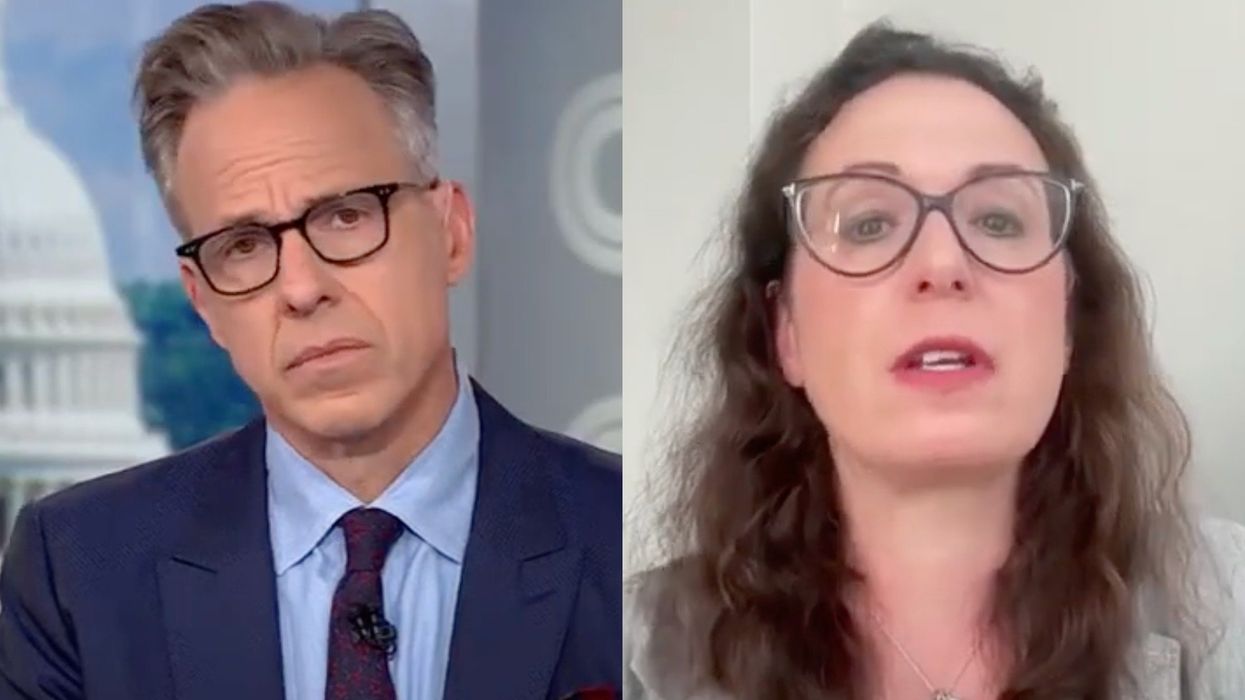
CNN's Jake Tapper called it a "big blow" on air to Trump's agenda. New York Times reporter Maggie Haberman told Tapper the same during a brief interview after the ruling dropped.

Reaction was swift across the internet.


Frank Amari‪, a former public defender, joked on Bluesky, "So much winning!!"


Historian and writer Trent Nelson wrote on Bluesky, "Yea. Obviously."

Economist Justin Wolfers‪ cheered the ruling on Bluesky, but warned the fight isn't over.

"BOOM. The federal appeals court rules Trump's tariffs illegal, because they are. There's no national emergency, and so the power to tariff a country rests with Congress. Trump admin has lost at every stage of the process, but stay tuned for the Supremes to chime in."


He noted, "This won't end all tariffs. This ruling applies to tariffs applied to entire countries (which is most of the tariff agenda). The industry-specific tariffs use a different legal authority, and will remain. The White House has other (more limited) tariff powers it'll dust off."

Dmitry Grozoubinski‪, author of "Why Politicians Lie About Trade," wrote on Bluesky, "Appeals court says Trump's fentanyl and reciprocal tariffs are unlawful. Looking forward to the 6-3 SCOTUS decision which upholds them anyway because the Constitution clearly states Trump is an omnipotent God-Emperor destined to reign upon the Golden Throne until all is returned to dust."

Analyst and writer Christian Roselund‪ wrote on Bluesky, "This is the second court ruling to affirm that #Trump 's use of the International Emergency Economic Powers Act (IEEPA) to set sweeping, economy-wide tariffs is illegal. The Trump Admin will almost certainly appeal. Not sure what the next stop is."

 'Our country would be destroyed': Trump continues attack on judges who blocked his tariffs

Robert Davis
August 31, 2025 
RAW STORY


A court ruling that blocked the president's signature tariff agenda seemed to stick under his skin over the weekend.

In a Truth Social post on Sunday, President Donald Trump raged against the seven appellate judges who ruled on Friday that his tariff policy was illegal. The 7-4 opinion states that Trump's reasoning for the tariffs did not constitute an emergency; therefore, any tariffs that were implemented under the auspices of an emergency were declared null.

Trump responded to the court's decision in a Truth Social post on Sunday.

"Without Tariffs, and all of the TRILLIONS OF DOLLARS we have already taken in, our Country would be completely destroyed, and our military power would be instantly obliterated," Trump wrote on Truth Social.

The president also seemed to congratulate one of the judges who voted to leave the tariffs in place.

" In a 7 to 4 Opinion, a Radical Left group of judges didn’t care, but one Democrat, Obama appointed, actually voted to save our Country," Trump wrote. "I would like to thank him for his Courage! He loves and respects the U.S.A."

Trump rampages that tariff blow will ‘literally destroy’ America if upheld


Matthew Chapman
August 29, 2025 
RAW STORY


President Donald Trump released a furious rant on his Truth Social platform after the U.S. Court of Appeals for the Federal Circuit upheld a lower court ruling that his tariff policies are illegal.

The ruling held that the president does not have authority under the International Emergency Economic Powers Act to enact the type of global tariffs he has claimed authority for.

Trump particularly drew attention to the fact that the ruling is delayed from taking effect until October, and vowed to fight the decision at the Supreme Court.

"ALL TARIFFS ARE STILL IN EFFECT!" wrote Trump. "Today a Highly Partisan Appeals Court incorrectly said that our Tariffs should be removed, but they know the United States of America will win in the end. If these Tariffs ever went away, it would be a total disaster for the Country. It would make us financially weak, and we have to be strong."

"The U.S.A. will no longer tolerate enormous Trade Deficits and unfair Tariffs and Non Tariff Trade Barriers imposed by other Countries, friend or foe, that undermine our Manufacturers, Farmers, and everyone else," he continued. "If allowed to stand, this Decision would literally destroy the United States of America. At the start of this Labor Day weekend, we should all remember that TARIFFS are the best tool to help our Workers, and support Companies that produce great MADE IN AMERICA products. For many years, Tariffs were allowed to be used against us by our uncaring and unwise Politicians."

"Now, with the help of the United States Supreme Court, we will use them to the benefit of our Nation, and Make America Rich, Strong, and Powerful Again!" wrote Trump. "Thank you for your attention to this matter."

Trump Tariffs Bound for Supreme Court After Another Legal Loss

If the president's policies are struck down, the administration may have to repay billions of dollars in duties, which customs and trade experts warn "would be a logistical nightmare."


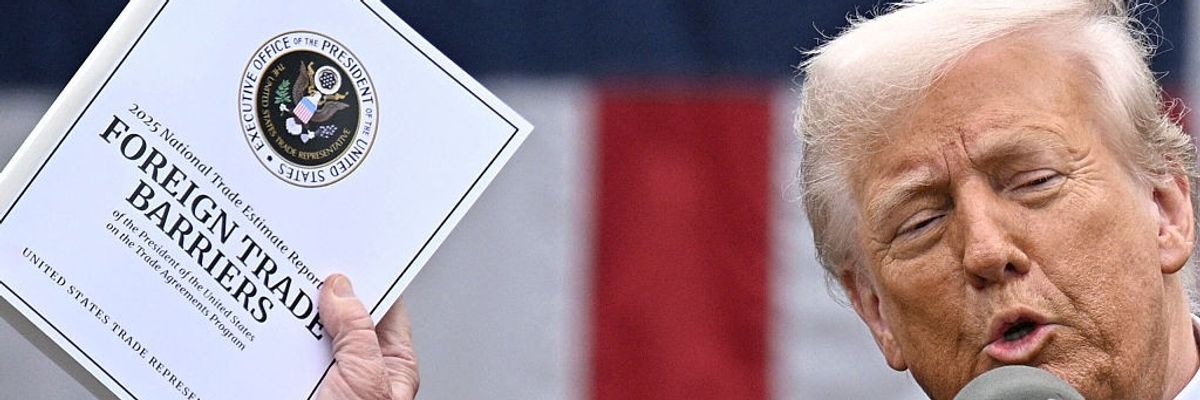
US President Donald Trump delivers remarks on what he claimed are reciprocal tariffs during an event at the White House in Washington, DC, on April 2, 2025.
(Photo by Brendan Smialowski/AFP via Getty Images)

Jessica Corbett
Aug 29, 2025
COMMON DREAMS

As working-class Americans endure the pain from US President Donald Trump's tariff war, the Republican signaled that he plans to keep fighting for the levies after a loss at the US Court of Appeals for the Federal Circuit.

Trump is the first president to impose tariffs by citing the International Emergency Economic Powers Act (IEEPA) of 1977. In a 7-4 ruling, the appellate court's majority found that most of his tariffs are illegal.


Grocery Chains Are Passing Trump Tariff Costs on to US Consumers With Higher Prices: Report

The court said that "tariffs are a core congressional power" and "we discern no clear congressional authorization by IEEPA for tariffs of the magnitude of the reciprocal tariffs and trafficking tariffs."

The decision affirms a May ruling from the US Court of International Trade, which also found that Trump exceeded his authority.

Friday's ruling is paused until October 14, to give the White House time to appeal to the nation's highest court. Trump suggested he would do so in a post on his Truth Social platform, writing:

ALL TARIFFS ARE STILL IN EFFECT! Today a Highly Partisan Appeals Court incorrectly said that our Tariffs should be removed, but they know the United States of America will win in the end. If these Tariffs ever went away, it would be a total disaster for the Country. It would make us financially weak, and we have to be strong. The U.S.A. will no longer tolerate enormous Trade Deficits and unfair Tariffs and Non Tariff Trade Barriers imposed by other Countries, friend or foe, that undermine our Manufacturers, Farmers, and everyone else. If allowed to stand, this Decision would literally destroy the United States of America. At the start of this Labor Day weekend, we should all remember that TARIFFS are the best tool to help our Workers, and support Companies that produce great MADE IN AMERICA products. For many years, Tariffs were allowed to be used against us by our uncaring and unwise Politicians. Now, with the help of the United States Supreme Court, we will use them to the benefit of our Nation, and Make America Rich, Strong, and Powerful Again! Thank you for your attention to this matter.

Politico noted that the Friday decision opens the door "for the administration to potentially have to repay billions worth of duties," and pointed to recent warnings from customs and trade experts "that repayments would be a logistical nightmare, and would likely trigger a wave of legal challenges from other businesses and industry groups seeking reimbursement."

Trump's latest legal loss on the tariff front follows various analyses and polling that show the harm his policies are causing. One Accountable.US report from this month highlights comments from grocery executives about passing costs on to consumers, and a recent survey found that 90% of Americans consider the price of groceries a source of stress.

Democrats on the Joint Economic Committee also released a related report earlier this month. As JEC Ranking Member Maggie Hassan (D-N.H.) said at the time, "While President Trump promised that he would expand our manufacturing sector, this report shows that, instead, the chaos and uncertainty created by his tariffs has placed a burden on American manufacturers that could weigh our country down for years to come."

Another mid-August analysis from the Century Foundation and Groundwork Collaborative details the surging cost of school supplies as American families prepared for the 2025-26 academic year. TCF senior fellow Rachel West said that "from his reckless tariffs to his budget law slashing food assistance and federal student loans, Trump's back-to-school message to America's families is crystal clear: Don't expect help, just expect less."


'Big blow to the president's agenda': NYT's Haberman details major Trump setback in court


CNN host Jake Tapper and New York Times White House correspondent Maggie Haberman on CNN on August 29, 2025 (Image: Screengrab via CNN / YouTube)


August 29, 2025  
ALTERNET

On Friday, the U.S. Court of Appeals for the Federal Circuit upheld a previous decision by a lower court that the vast bulk of President Donald Trump's tariffs — which he imposed by claiming emergency powers — were unconstitutional. And according to New York Times White House correspondent Maggie Haberman, it's one of the biggest legal setbacks yet for Trump's second administration.

During a segment with CNN host Jake Tapper, Haberman said that the decision was highly anticipated by everyone in the administration who works on trade issues. She added that administration officials had been fearing that it would be "difficult" to defend Trump's assumed emergency powers before the federal judiciary.

"The U.S. is going to end up in a position, if the Supreme Court upholds this ruling, and it's almost certainly going to go to the Supreme Court, the U.S. is now going to be in a position to pay people — countries, excuse me — back, for tariffs. That gets very complicated," she said. "So this is a big blow to the president's agenda. He has sometimes ignored courts. We'll see what this looks like."

Haberman's point that tariffs could have to be paid back to countries affected by them could prove expensive for taxpayers. The Associated Press reported that as of July, total year-over-year tariff revenue exceeded $159 billion. Trump imposed the tariffs by invoking the International Emergency Economic Powers Act (IEEPA) of 1977, which allows a president to assume certain new powers under an economic emergency. But during oral arguments, one of the judges hearing the case pointed out that the IEEPA statute doesn't even mention tariffs.

Moreover, Article I, Section 8 of the U.S. Constitution stipulates that only Congress has the power to levy tariffs, stating that the legislative branch "shall have Power To lay and collect Taxes, Duties, Imposts and Excises, to pay the Debts and provide for the common Defence and general Welfare of the United States; but all Duties, Imposts and Excises shall be uniform throughout the United States."

Shortly after the decision was announced, Trump took to his Truth Social platform to blast the judges (who he deemed "Highly Partisan" in his signature style of oddly-placed capital letters) that struck down his tariffs. He also insisted that "ALL TARIFFS ARE STILL IN EFFECT!"

"If these Tariffs ever went away, it would be a total disaster for the Country. It would make us financially weak, and we have to be strong. The U.S.A. will no longer tolerate enormous Trade Deficits and unfair Tariffs and Non Tariff Trade Barriers imposed by other Countries, friend or foe, that undermine our Manufacturers, Farmers, and everyone else," he wrote. "If allowed to stand, this Decision would literally destroy the United States of America."

Watch Haberman's segment below, or by clicking this link.


Op-Ed: Trump tariffs illegal but SCOTUS will probably support them. There’s a problem with that.

By Paul Wallis
EDITOR AT LARGE
DIGITAL JOURNAL
August 29, 2025


On April 2, US President Donald Trump, with Commerce Secretary Howard Lutnick beside him, unveiled sweeping tariffs on almost all trading partners - Copyright AFP/File Brendan SMIALOWSKI

The Trump administration’s tariffs are universally unpopular worldwide. American importers have to pay the extra costs, which are passed on to consumers. The increased costs inevitably mean fewer goods are sold. Countries are targeted individually with weaponized tariffs. Global trade is an appalling mess.

These tariffs are raised under the International Emergency Economic Powers Act (IEEPA). The US Court of Appeals for the Federal Circuit in Washington, DC, held in a 7-4 ruling that the statute does not empower the imposition of tariffs. In fact, the Act makes no mention of tariffs.

Meaning that many of the controversial tariffs now imposed also exceed the authority granted by the Act. Therefore, they’re illegal. It’s expected that the administration will appeal to the Supreme Court, and that the Supreme Court will uphold the tariffs.

In the meantime, the administration maintains that the tariffs are legal. It’s a Yes or No situation. If only it were that simple.

But –

The problem with these tariffs and their legalities or lack of legalities is that the US isn’t the only party involved. US importers can fairly say that if the statutory basis of the tariffs is illegal, they shouldn’t have to pay those billions in extra costs. Industry lobbies are likely to put a lot of pressure on the administration as the effects of tariffs become clearer.

That issue’s not likely to go away. The administration has nailed itself to tariffs as an instrument of international economic policy. There’s even a level of “prestige” in sticking to tariffs as the only way to do business. If the tariffs go, the whole house of cards goes with them.

The Supreme Court is in a particularly thankless position. If the Appeals Court is correct in that tariffs are not specifically empowered by the Act, any and all tariffs could be challenged in individual court actions.

Here’s the twist. The Supreme Court would have to make a blanket ruling that all tariffs stand to support the administration. That would lock in added costs for importers and consumers. There would be a lot of pushbacks from the various economic sectors and other countries. Any negotiation with any other country would have to start with trade.

Alternatively, any decision that the tariffs are not empowered by the Act effectively demolishes the entire tariff structure. That means that tariffs as a nominal source of revenue to pay for the ideologically sacred tax cuts would also be scuttled as a budgetary option.

In practice, of course, it’s much worse. A brief overview of the last 200 years of tariffs is hardly encouraging. Tariffs just don’t work. The current range of tariffs are already seen as a major threat to prices. Tariffs are the antithesis of free trade, the supposed basis of modern capitalism.

Nothing can move fast on this subject. As expected by just about everyone, the inherent constipation of the tariffs dogma will prevent movement.

“Sic transit ingloria.” So goes the inglorious.

___________________________________________________________

Disclaimer
The opinions expressed in this Op-Ed are those of the author. They do not purport to reflect the opinions or views of the Digital Journal or its members.


Hard Lessons From Katrina We’re Still Learning 20 Years Later


Hurricane Katrina not only exposed the vulnerability of communities to extreme weather events exacerbated by climate change, but also systemic injustices and a deeply flawed US insurance system.


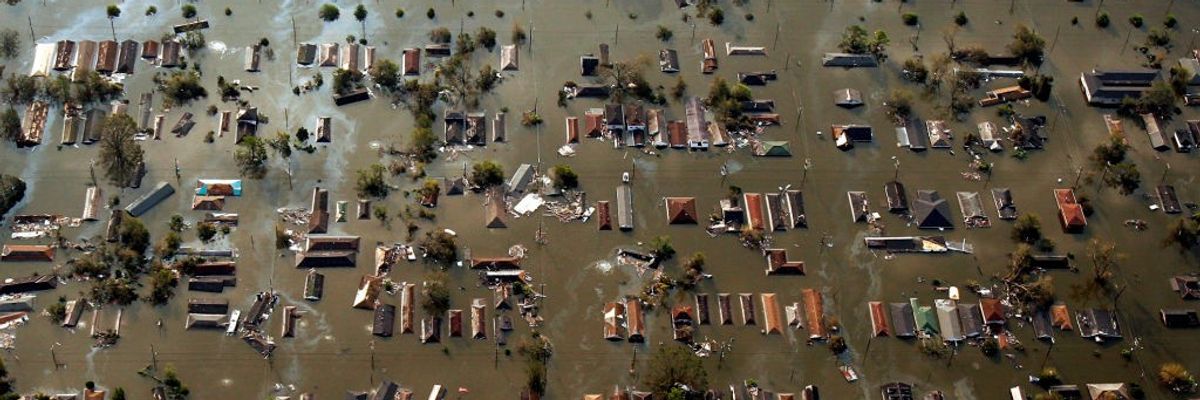
Water surrounds homes in the devastated Ninth Ward in this aerial view of damage from Hurricane Katrina in New Orleans on August 30, 2005.
(Photo by Smiley N. Pool/Houston Chronicle via Getty Images)

CIEL Blog

It’s been 20 years since Hurricane Katrina struck the Gulf Coast of the United States, wreaking havoc in Louisiana, Mississippi, and Alabama. An estimated 1,833 people died in the hurricane and the flooding that ensued. The storm destroyed or damaged more than a million housing units and more than 200,000 homes, causing one of the largest relocations of people in US history.

In the months and years that followed, entrenched inequalities, questionable policy choices, and predatory practices by private insurers decided who could return home and rebuild. For instance, countless residents impacted by the hurricane learned too late that their standard homeowners’ insurance offered no protection against flood damage, leaving them to shoulder devastating repair costs themselves. In cities such as New Orleans, these dynamics further marginalized Black residents, who were more likely to live in flood-prone neighborhoods. The result was widespread and often permanent displacement, with longtime communities effectively erased from the map.


Hurricane Katrina not only exposed the vulnerability of communities to extreme weather events exacerbated by climate change, but also systemic injustices and a deeply flawed US insurance system. Private insurers pour billions of dollars into the fossil fuel industry, which is the main contributor to climate change. Thus, insurers help fuel the very crisis that is driving more frequent and severe climate disasters like Hurricane Katrina. Meanwhile, they are passing the financial risk of the escalating impact of climate change onto policyholders and forcing them to bear the costs of the crisis the industry itself helps perpetuate.

As climate-driven storms grow more frequent and increasingly destructive, the same insurance failures, housing crises, and inequitable recovery that followed Katrina now threaten communities nationwide. Two decades later, Katrina’s hard lessons cannot be ignored. Everyone deserves to live in safety and the opportunity to stay in the place they call home. Corporate greed and government negligence cannot continue to undermine these rights.

The Hurricane

On August 29, 2005, Hurricane Katrina made landfall with winds that reached 140 miles per hour. These high-velocity winds drove a storm surge that raised sea levels 25 to 28 feet above normal along parts of the Mississippi coast, and 10 to 20 feet along the southeastern Louisiana coast. The surge breached protective levees, causing catastrophic flooding. Two days after the hurricane struck, 80% of the city of New Orleans was underwater. Other coastal towns and cities in Louisiana, Mississippi, Alabama, and along the western Florida panhandle also experienced significant storm surges and destructive winds, which caused widespread flooding and damage to homes.

The Great Displacement

Approximately 1.5 million people aged 16 years and older had to leave their residences in Louisiana, Mississippi, and Alabama because of Hurricane Katrina. In New Orleans, where the mayor issued a mandatory evacuation order, a population of around 500,000 was reduced to a few thousand people within a week of the storm.

As water was pumped out of the flooded areas and basic services and infrastructure were restored, New Orleanians were allowed to return. But tens of thousands were not able to do so. One year after Katrina, approximately 197,000 residents had not come back to the city; many relocated to the relatively close cities of Houston and Baton Rouge, but others as far away as Alaska and Massachusetts. Still today, many of those who evacuated the city, hoping to return, remain displaced. New Orleans’s metropolitan area population remains 20% below pre-Katrina levels.

The Impact On Black Communities


The development of New Orleans has been fraught with injustices. Racial segregation, redlining, and chronic underinvestment in Black communities pushed residents and renters into areas with crumbling infrastructure, poorer-quality homes, and greater exposure to environmental hazards and contaminants.

When Katrina hit, Black residents were concentrated in the most vulnerable parts of New Orleans, located well below sea level and poorly protected by inadequate levees. Accordingly, neighborhoods with the highest percentages of Black residents saw greater housing destruction from the storm.

Did You Know?


The disparate impact of climate disasters on property and infrastructure in US minority communities is the result of nearly a century of discriminatory home lending and insurance policies.

In the 1930s, the US federal government used a rating system in its low-cost home loan program to assess lending risk. Assessors created maps ranking the perceived risk of lending in certain neighborhoods, with race often used as the determining factor in assessing a community’s risk level. Black and immigrant neighborhoods were typically rated as “hazardous” and outlined in red, warning lenders that the area was a perilous place to lend money. Known as redlining, these and other discriminatory practices led to a lack of investment in minority communities.

This lack of financial access resulted in shoddy construction and poor infrastructure that have made minority neighborhoods less resilient to climate disasters and more prone to other financial risks. For instance, insurers are more likely to increase premiums if they determine that properties are less resilient to climate damage. This new financial practice is known as bluelining, and it occurs when insurers raise their prices or pull out of areas that they perceive to be at greater environmental risk.

Reconstruction: A New Pathway to Segregation?

For Lousina’s Black residents, Katrina’s damage was compounded by discriminatory recovery policies that deepened inequalities. After the storm, the federally funded Road Home program was launched to help residents repair or rebuild damaged homes. It offered grants of up to $150,000 per homeowner, but payments were based on whichever was lower—the home’s pre-storm value or the cost to rebuild.

Because property values in Black neighborhoods were often far lower than in white neighborhoods, this meant many Black homeowners would receive only a fraction of what they needed to rebuild. In one case, a woman had rebuilding costs of over $150,000, but because the estimated value of her home pre-storm was much lower, she would’ve received an essentially useless grant of $1,400. As a result, the program was alleged to discriminate against Black homeowners, and a federal class action suit was filed on November 12, 2008, on behalf of 20,000 homeowners. The litigation settled with Louisiana agreeing to reward approximately 1,300 homeowners with $62 million in additional compensation.

The Blow to Affordable Housing

Renters fared no better. Hurricane Katrina damaged or destroyed 82,000 rental units in Louisiana, 20% of which were affordable to extremely low-income households. The impact on public and federally subsidized rentals was especially severe. In New Orleans, public-housing residents were displaced at a rate of nearly 90%. And reconstruction policies only exacerbated the disparities these residents faced.
Consider this.

Before the storm hit and floodwaters rose, the Housing Authority of New Orleans evacuated all residents living in its 7,379 public housing units. After the waters receded, residents were allowed to return to approximately 1,600 units. Most other units were sealed off with steel doors and barbed wire—officially due to storm damage—before being slated for demolition. Yet, the redevelopment that followed included far fewer mixed-income apartments. By 2010, five years after the hurricane, less than half of the original 7,379 units were open in any form. The dramatic decrease in public housing contributed to the permanent displacement of many of New Orleans’ longtime residents.

After Katrina, renters faced a range of economic pressures. Many landlords delayed repairs or rebuilding, especially in low-income areas, which are seen as less profitable. Some used the disaster as an opportunity to renovate and target higher-paying tenants, further shrinking the supply of affordable rentals. Within five years of the Hurricane, the stock of mid-priced housing units in New Orleans had declined by more than two-thirds, pushing the median rent from $689 in 2004 to $876 in 2009. These rising costs hit Black residents hardest, forcing many to leave and permanently altering the city’s character.

Even those who could afford to return to New Orleans and buy a new home after Katrina faced soaring prices—up 14% in the first year alone—as demand outpaced the reduced housing supply. In addition, homeowners’ insurance premiums jumped 22% in Louisiana between 2005 and 2007, adding yet another barrier to homeownership.

The Flood Exclusion Trap


Then, as now, and to the surprise of many victims of the Hurricane, standard home insurance policies in the US did not protect homeowners from floodwater damage. This means residents must buy additional flood insurance to be protected in the event of a disaster like Katrina.

New Orleans residents had among the highest participation rates in the country in the National Flood Insurance Program (NFIP), a federal government program that provides flood insurance to homeowners, renters, and businesses. However, the majority of residents in areas affected by Katrina had not purchased flood insurance. Uninsured property losses due to flooding were economically devastating, exceeding an estimated $41.1 billion (USD 100 billion in 2024 prices). In addition, the NFIP incurred some $16.1 billion in losses and a deficit exceeding $18 billion as a direct result of the flooding caused by Katrina.

Even for New Orleanians with flood insurance, coverage likely fell short. Policies typically covered about $152,000—the city’s median house price at the time. But this was rarely enough to replace the damaged household contents or to pay residents for temporary housing while their home was uninhabitable.

More and more, whether people hit by climate-driven storms get anything from their insurers depends not on the fact that their homes were damaged, but on how they were damaged.

While the standard home insurance policy does not cover water damage from a hurricane, it does cover wind damage. This gap left residents and insurers arguing about whether Katrina’s destruction to their homes was caused by its high-velocity winds or the flooding that followed, with multiple lawsuits challenging the validity of flood exclusions in insurance policies. Even before the flooding receded and residents of Louisiana and Mississippi could start to rebuild their lives, courts were inundated with litigation, with about 6,600 insurance-related lawsuits being instigated in the US District Court. Yet, Katrina’s destructive flooding was driven by a storm surge powered by the hurricane’s high winds—the very peril homeowners’ policies are supposed to cover.

On September 15, 2005, Mississippi’s Attorney General Jim Hood filed a case against five of the largest homeowners’ insurers in the state. Attorney General Hood sought a court declaration that the flood exclusion provision in standard home insurance policies was “void and unenforceable” and in violation “of the public policy of the State of Mississippi.” However, in that case and others, courts ruled that the flood exclusions were spelled out clearly in homeowners’ insurance policies and did not violate public policy.

The exclusion of water damage from insurance coverage remains a present issue for existing homeowners. According to the Federal Emergency Management Agency, since 1996, 99% of US counties have been impacted by flooding, but only 4% of homeowners have flood insurance. And, more importantly, over half (56%) of American homeowners don’t know that their home insurance policy excludes flood damage. As hurricane season intensifies, many homeowners will be shocked to learn that their insurance does not cover flood loss.

Insurers’ Favorite Loophole: Wind vs. Water Damage


After Katrina, some insurers exploited the false dichotomy between wind and water damage, classifying losses as water damage to shift liability onto homeowners or the NFIP.

In 2013, a federal jury in Mississippi found that State Farm Fire and Casualty Co. defrauded the NFIP after avoiding covering a policyholder’s wind losses from Katrina by blaming the damage on storm surge, which is covered by federal flood insurance. Almost 10 years later, in August 2022, State Farm settled the case, agreeing to pay $100 million to the federal government.

State Farm was not the only insurer engaged in nefarious behavior, attributing Hurricane Katrina damage to flooding instead of wind. In oral argument before the Mississippi Supreme Court in 2009, insurance company USAA publicly admitted that it shifted its own costs to the NFIP and thus taxpayers.

The false dichotomy between the wind and water damage resulting from a hurricane remains nebulous. The damage caused by Hurricane Ian in Florida, North Carolina, and South Carolina in 2022, with its record-high wind speeds, generated $63 billion in private insurance claims. In contrast, 2018’s Hurricane Florence primarily caused water—not wind—damage in North and South Carolina, leaving uninsured flood losses estimated at nearly $20 billion and letting private insurers largely escape liability. More and more, whether people hit by climate-driven storms get anything from their insurers depends not on the fact that their homes were damaged, but on how they were damaged.

Regulators Must Act: People over Profit


Hurricane Katrina exposed widespread gaps in home insurance coverage that persist today. In the 20 years since Katrina, unmitigated climate change has fueled rising temperatures and made extreme weather events such as hurricanes both more frequent and more severe. As storms grow costlier and more destructive, insurers have raised home insurance premiums and declined to renew many policies, leaving households with fewer options for protection. This escalating cycle has produced today’s insurance crisis.

Federal and state lawmakers must respond. The federal government must reform the NFIP to improve federal flood insurance and ensure it provides affordable coverage for more hazards. At the same time, the NFIP should do more to support community-based mitigation. States, meanwhile, must use their regulatory authority over insurance markets to address skyrocketing insurance costs and growing coverage gaps resulting from mounting climate change impacts.

Regulators should adopt legislation, like New York’s Insure Our Future bill, to prohibit insurers from underwriting new fossil fuel projects, require them to phase out support for existing projects, and force insurers to divest from fossil fuel companies.

The insurance industry cannot ignore its role in fueling the very crisis it now faces. Climate change-induced disasters are indisputably driven by fossil fuel emissions. And insurance companies facilitate climate change by investing in fossil fuel companies and underwriting fossil fuel projects. US insurance companies have investments of more than $500 billion infossil fuel-related assets, including coal, oil, and gas. In 2022 alone, insurers worldwide collected $21 billion in premiums for underwriting fossil fuel projects—directly enabling their expansion.

Regulators should adopt legislation, like New York’s Insure Our Future bill, to prohibit insurers from underwriting new fossil fuel projects, require them to phase out support for existing projects, and force insurers to divest from fossil fuel companies. Without bold action, insurers will continue to profit from climate destruction while leaving families and communities to bear the costs.


© 2024 Center for International Environmental Law


Charles Slidders
Charles Slidders is the senior attorney for financial strategies in CIEL’s Climate & Energy Program.
Full Bio >

Alexandra Colon-Amil
Alexandra Colon-Amil is the communications campaign specialist at the Center for International Environmental Law.
Full Bio >