Showing posts sorted by relevance for query HURRICANE KATRINA. Sort by date Show all posts

Thursday, September 02, 2021

Hurricane Ida shows the increasing impact of climate change since Katrina & SANDY

September 2, 2021 

Hurricane Ida made landfall in Louisiana 16 years to the day after Hurricane Katrina. (Hilary Scheinuk/AP Pool)

Sixteen years to the day that Hurricane Katrina made landfall, Hurricane Ida struck at Port Fourchon, La., on Aug. 29, as a Category 4 hurricane with 240 kilometres per hour winds. Given the date and location of the area affected, Katrina and Ida comparisons are being made.

While no two disasters are the same, looking at differences between past and present disasters can help us to better understand what is needed to prepare for future disasters. As a professor of emergency management, I was on the ground in New Orleans in the aftermath of Katrina, making observations to study aspects of the hurricane’s impact and hurricane evacuations.

Given the scope of the emerging impacts of Hurricane Ida, we see that while this is not a repeat of a Katrina disaster, questions are being raised about the effect of climate change and the resiliency of lifeline infrastructure like electricity.

Remembering Katrina


When Hurricane Katrina made landfall as a Category 3 hurricane in 2005, its associated storm surges were among its most significant impacts. The levees that separated New Orleans from Lake Pontchartrain failed. Katrina’s toll was 1,833 killed with US$163 billion in economic losses, making it the costliest weather disaster in the past 50 years.

In looking back at Katrina, forces of nature were not the only causative factors for the disaster. Human-caused circumstances, such as a history of economic and engineering decisions that over time replaced natural coastal wetland buffers against storm surges with a 120-kilometre long industrial canal, were in part to blame for the disaster.

In addition, numerous disaster response debacles complicated the immediate aftermath of Katrina. The disaster exposed racial- and class-based segregation that resulted in disproportionate disaster impacts being felt by racialized populations. What started as a natural disaster played out more like a complex humanitarian emergency.

As the aftermath of Hurricane Ida continues to play out, it remains to be seen if the disaster recovery and the economic losses will approach those of Katrina.
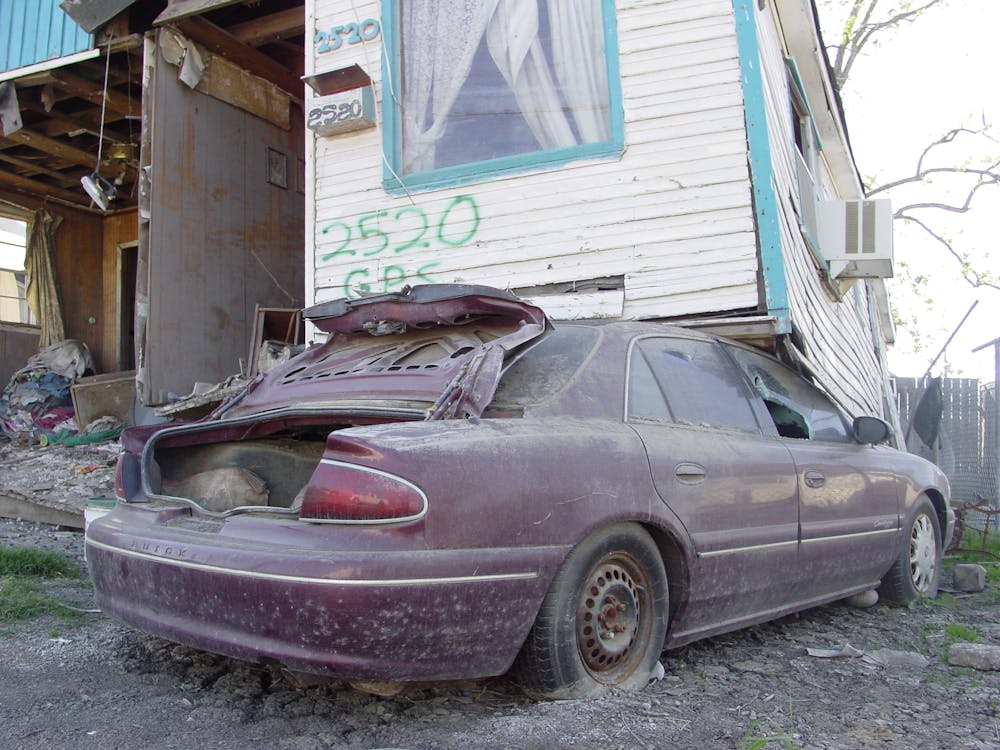

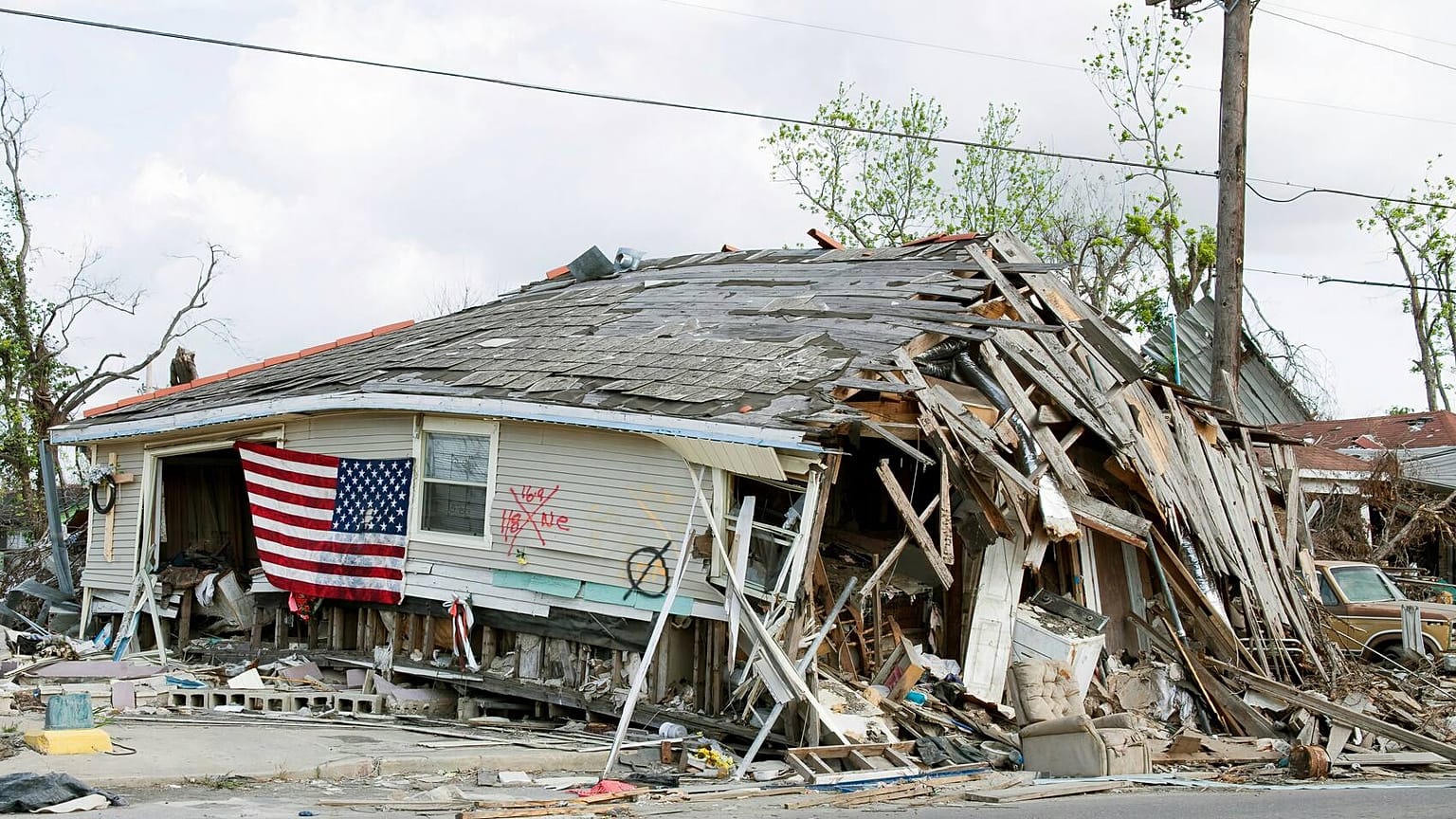
The damage caused by Hurricane Katrina in New Orleans’ Lower Ninth Ward in April 2006. (Jack Rozdilsky)
, Author provided

Differences in hurricane behaviour


A hurricane’s behaviours related to disaster damage include the combination of the effects of high-speed damaging winds, intense periods of rainfall and storm surge flooding in low lying coastal areas.

Katrina’s behaviour is remembered for its devastating water-related hazards with storm surges inundating New Orleans neighbourhoods such as the Lower Ninth Ward.

For Ida, the entire breadth of the storm’s wind field stood out as significant. The storm’s behaviour will be remembered for its wind-related hazards. Ida had a slow path of inland movement with highly destructive sustained winds of 200 kilometres per hour for eight hours over a 120-kilometre long path through portions of Jefferson and LaFourche parishes.

In 2005, Katrina crossed a cooler water column in the Gulf of Mexico as it neared the shore, weakening it from a Category 5 to a Category 3 storm at landfall. In 2021, Ida did not encounter any cooler waters, resulting in its rapid intensification. Rising water temperatures in the Gulf of Mexico are related to climate change.


New preparedness challenges

While the situation remains tenuous in hurricane-stricken locales, at least Ida’s casualty count appears to be nowhere near that of Katrina. As of Sept. 1, Ida’s death toll was at six and counting. It is too early to estimate Ida’s economic losses.

Unlike the situation in 2005 with Hurricane Katrina, the levees and drainage systems protecting New Orleans held up under the stress of Ida’s storm surge. Since Katrina, the U.S. federal government has spent $14.5 billion on levees, pumps, seawalls, floodgates and drainage. Apparently, in the case of Hurricane Ida, that investment in hazard mitigation paid off.

However, while preparations to protect against Katrina-like storm surge flooding appeared to be successful, other aspects of preparation did not fare as well. The region’s electrical grid did not remain functional under the hours of sustained hurricane force winds. Local utilities serving Louisiana said it would take days to assess the damage to their equipment and weeks to fully restore service across the state as problems with the electrical grid continue. All the eight main transmission lines bringing electricity from power plants into New Orleans were knocked out, and more than one million people remain without power three days after landfall.

Without power, the situation is becoming increasingly desperate. As one example of the collateral damages related to a lack of electricity, the gasoline distribution system imploded. As conditions degrade due to a prolonged electrical outage, people who did not evacuate during the storm may be forced to, and those who evacuated will be prevented from returning.

Looking at the aftermath of Hurricane Ida illustrates how climate change is making hurricanes more devastating. While studies continue to assess the climate change contribution to hurricane intensity, there is little doubt that the increased frequency and intensity of hurricanes impacting the Gulf Coast of the U.S. is being influenced by global warming.

Sixteen years of additional climate change since Hurricane Katrina adds to preparation needs. Even if we are doing better with challenges like protecting against storm surge flooding, the impacts of future hurricanes call for additional measures. These include increasing the resiliency of our infrastructure to better meet the risks of a changing climate.

Author
Jack L. Rozdilsky
Associate Professor of Disaster and Emergency Management, York University, Canada
Disclosure statement
Jack L. Rozdilsky is a Professor at York University who receives funding from the Canadian Institutes of Health Research as a co-investigator on a project supported under operating grant Canadian 2019 Novel Coronavirus (COVID-19) Rapid Research Funding.

Wednesday, August 24, 2022

Children of climate change come of age in ‘Katrina Babies’
BY DREW COSTLEY
yesterday

1 of 7
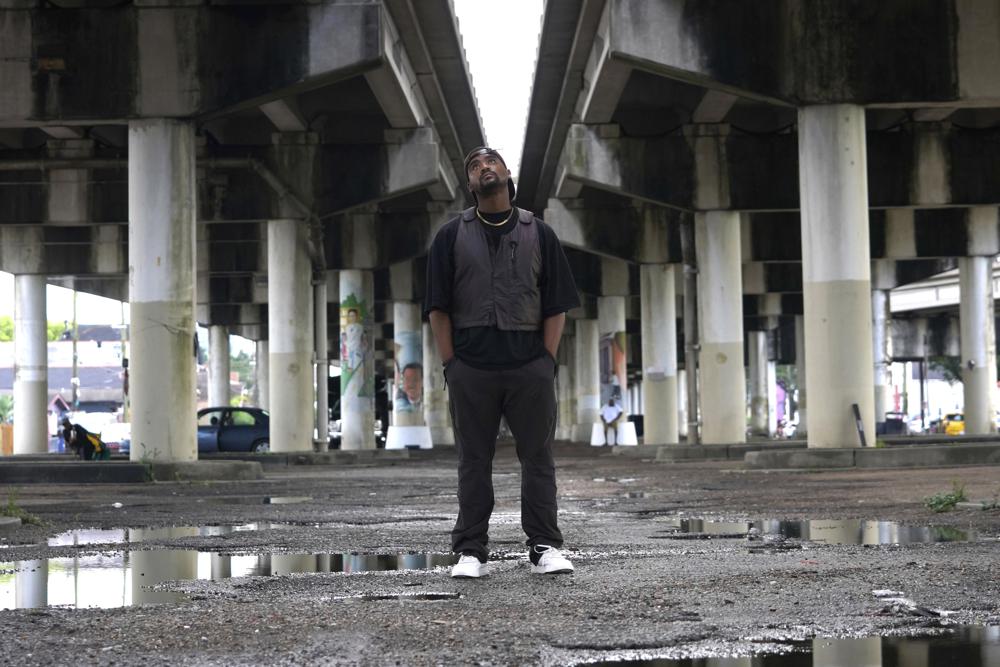
Edward Buckles, Jr., a New Orleans native who was 13 when Hurricane Katrina hit and directed the documentary "Katrina Babies," poses underneath the Claiborne Avenue overpass for a photo in the city on Friday, Aug. 19, 2022. The film looks at how a generation of New Orleans residents coming of age after Hurricane Katrina, are reconciling with the catastrophic storm that transformed their lives. (AP Photo/Chansey Augustine)


Edward Buckles, Jr. was 13 when Hurricane Katrina hit New Orleans and completely upended his life. Buckles and his family moved from New Orleans to Lafayette, Louisiana for several months while their hometown began to recover from the catastrophic storm.

He told The Associated Press he doesn’t remember much from those months living in Lafayette, grasping for a sense of normalcy in the aftermath of one of the most destructive hurricanes in American history.

His community was experiencing so much destruction. Now as an adult, he views that blank spot in his memory as a response to the trauma of what he witnessed.

Buckles’ parents asked him at the time if he was okay, but he wasn’t quite able to figure that out for himself in the moment. Later the trauma resurfaced. With kids, he said, “what’s responsible and what’s important is that you set them up to deal with that trauma once it surfaces.”

But the filmmaker said in his new documentary “Katrina Babies” that not all the children who were traumatized by living through the hurricane and its aftermath had adults checking in on them. So that’s what he set out to do, capturing several New Orleans residents as they reconcile with a childhood marred by Hurricane Katrina.

The documentary, which has garnered critical praise, will be available for streaming on HBO Max on August 24 and debuts on HBO the same day at 9 pm ET, 17 years and a day after the hurricane formed in the Atlantic Ocean.

It shows how New Orleans and its people were changed by the storm. It depicts the childhood trauma it caused for a generation coming of age after one of the United States’ first major climate-related disasters. New Orleanians featured in the documentary share stories of seeing dead people and pets, of leaving home and returning to communities destroyed, while they were still children.

The film looks at climate past and present and, the filmmakers hope, sounds alarm bells for the climate future.

“I hope this is a local and American story that will motivate people to want to do better and care about human beings, and about how intrinsically linked we are with nature and that the future is clear: There is going to be more of this,” said Audrey Rosenberg, lead producer of the film.

Buckles said that while Hurricane Katrina might has been a formative experience for him and the youth of New Orleans at the time, more waters have come through since. Though he isn’t a climate scientist, he knows firsthand the repeated damage wrought on his hometown by hurricanes and tropical storms made more intense by climate change.

“My grandmother lost her home due to flooding from Hurricane Katrina,” he said. “She has been flooded seven more times just from tropical storms.”

Cierra Chenier, 26, was featured in the documentary and also knows people who have had to rebuild multiple times since Hurricane Katrina due to subsequent hurricanes and storms.

She said the loss of culture and history in New Orleans due to repeated climate-related disasters like Hurricane Katrina shaped her decision to become a local historian and writer.

“I got into wanting to preserve our history because of how quickly I felt my childhood became history,” she said. Even though the storm was 17 years ago, she said, it continues to shape the present.

“In preserving our stories, writing about those stories and narrating those stories, it’s always connected to the present and we can form better solutions for the future,” she said.

Chenier, Buckles and the other youth affected by Hurricane Katrina have a lot to say about the future, having experienced years of government inaction to limit climate change or prepare and recover from climate disasters. Year after year, New Orleanians and the state and federal government know that hurricane season is going to come and be potentially catastrophic because of climate change, Buckles said.

And still, he said, Hurricane Ida, which hit New Orleans 16 years to the day after Hurricane Katrina, affected people in his community in eerily similar ways to the 2005 storm. The relief measures, he said, were nearly as slow.

As a result, people in his community have become more resilient. But he said he wonders whether government agencies are relying on those harmed by climate-related disasters to help themselves when what they really need is public planning and preparation.

“The youth are tired of dealing with this, myself included,” he said. “And we cannot forget to hold accountable those who need to be held accountable.”


Follow Drew Costley on Twitter: @drewcostley.

The Associated Press Health and Science Department receives support from the Howard Hughes Medical Institute’s Department of Science Education. The AP is solely responsible for all content.

Saturday, August 30, 2025


20 years after Hurricane Katrina: Could cuts to disaster preparedness leave the US vulnerable again?

New Orleans recognizes Hurricane Katrina 20 years after it devastated the city
Copyright The Library of Congress/Unsplash

By Craig Saueurs
Published on 

Experts warn that another Hurricane Katrina isn’t just possible, but it’s also likely.

Twenty years ago this week, Hurricane Katrina ripped into Louisiana and left New Orleans flooded. Nearly 2,000 people died. Entire neighbourhoods were lost. It was the costliest storm in US history, and it reshaped how the country responds to disasters.

But the systems built in Katrina’s wake are now under threat.

Scientists and emergency managers are warning that cuts to forecasting and federal response systems risk leaving the US exposed in the midst of hurricane season, and as climate change fuels ever stronger storms.

The storm that changed America

Katrina made landfall on 29 August 2005 as a Category 3 hurricane. The wind was brutal, but it was the flooding that devastated New Orleans.

Built by the Army Corps of Engineers to help ships navigate the Mississippi River, the flood walls and concrete levees surrounding the city failed, leaving 80 per cent of it submerged for weeks.e

Thousands clung to rooftops waiting to be rescued. Others were crammed into the city’s Superdome stadium without food or medicine

In all, 1,833 people died across five states, and the economic cost was staggering. Adjusted for inflation, damages topped $200 billion (€170 billion), according to the National Oceanic and Atmospheric Administration (NOAA).

The city’s population has never recovered. From nearly half a million before the storm, it has dropped to 384,000 today. Many who fled Katrina never returned.

Forecasting gains are suddenly under threat

The scale of the failure forced many changes. FEMA was restructured. And NOAA launched a major research effort to sharpen its hurricane forecasts. New levees were built to protect cities from floodwaters. 

Since 2005, forecast accuracy has improved 50 per cent, according to NOAA data cited by the non-profit Ocean Conservancy. Tracking and intensity predictions have become more precise, saving billions by allowing tighter evacuation zones and faster response.

In the last three years alone, predictions about the tracks hurricanes will follow have improved 8 per cent and intensity forecasts 10 per cent, according to Ocean Conservancy.

Those gains have come from long-term investment. NOAA’s Hurricane Forecast Improvement Project, launched in 2007, built the research backbone for better models and data. Its Hurricane Analysis and Forecasting System, operational since 2023, now provides seven-day forecasts on storm tracks, intensity, surge, rainfall and even tornado risk. Upgrades planned for 2025 now aim to capture how multiple storms interact across vast distances, providing unprecedented detail to forecasters.

But all of this depends on NOAA’s full system being operational – its satellites, ocean sensors, planes, supercomputers and data from international partners. US lawmakers are now weighing cuts that would slash that system and reduce the staff who oversee it.

“NOAA saves lives. Period,” Jeff Watters of Ocean Conservancy said in a press release this week. “Cut any link in that chain and you weaken the whole and put people at risk.”

The warning comes as the Atlantic has started producing stronger storms than ever.

Hurricane Helene in 2024 was the eighth Category 4 or 5 hurricane to hit the US in just eight years – equal to the number that struck in the previous 50 years combined.

FEMA in crisis

NOAA is not the only American agency in turmoil.

According to a letter signed by more than 180 current and former employees at FEMA – the US Federal Emergency Management Agency created by President Jimmy Carter in 1978 – around one-third of the agency’s permanent staff have left since January. It follows criticism and threats of closure from the Trump administration. Senior officials were pushed out while inexperienced political appointees took over, the authors note.

In the letter – titled the ‘Katrina Declaration’ – they accused the Trump administration of ignoring the lessons that lawmakers wrote into the Post-Katrina Emergency Management Reform Act.

“Hurricane Katrina was not just a natural disaster, but a man-made one,” they wrote. “Two decades later, FEMA is enacting processes and leadership structures that echo the conditions [that law] was designed to prevent.”

The letter comes in the middle of a hurricane season that NOAA expects to be above-normal, and just a month after deadly floods in Texas killed at least 135 people, including 37 children. Experts say FEMA’s weakened capacity worsened the death toll.

New Orleans remembers Katrina’s devastation

In New Orleans, the 20th anniversary stands as both a memorial and a warning.

Survivors and community leaders plan to gather in the Lower Ninth Ward, where a levee breach inundated a predominantly Black neighbourhood.

The commemoration, organised by Katrina Commemoration Inc. and Hip Hop Caucus, will include a wreath-laying ceremony, exhibitions from local artists and a brass band second line parade – a New Orleans tradition rooted in African American jazz funerals.

Organisers say the event is also meant to highlight the city’s fragile infrastructure, gentrification and growing vulnerability to climate change. Local leaders are hoping to keep these issues at the forefront of people’s minds as they push for the anniversary to be recognised as a state holiday.

Could Hurricane Katrina happen again?

Experts say yes. Stronger storms, a weakened FEMA and threatened cuts to NOAA make another Katrina not only possible but also more likely.

“The inexperience of senior leaders and the profound failure by the federal government to deliver timely, unified and effective aid left survivors to fend for themselves,” the FEMA letter warns. 

Two decades later, those same conditions are being recreated, the authors argue.

“Hurricane Katrina took nearly 2,000 lives and caused [billions] in damage. We learned hard lessons and built world-class forecasting as a result,” says Watters.

“Cutting those systems now – on the 20th anniversary and at the height of hurricane season – would be reckless.”

Monday, September 01, 2025

Hard Lessons From Katrina We’re Still Learning 20 Years Later


Hurricane Katrina not only exposed the vulnerability of communities to extreme weather events exacerbated by climate change, but also systemic injustices and a deeply flawed US insurance system.


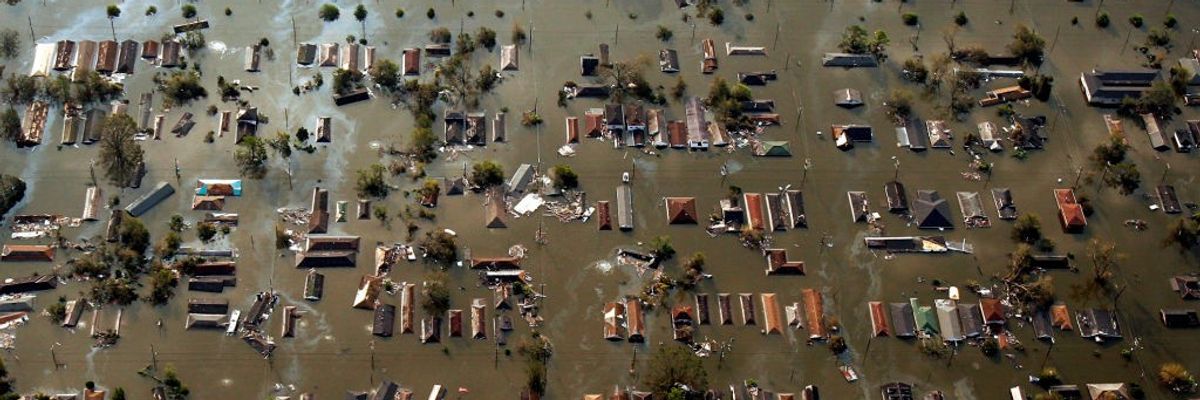
Water surrounds homes in the devastated Ninth Ward in this aerial view of damage from Hurricane Katrina in New Orleans on August 30, 2005.
(Photo by Smiley N. Pool/Houston Chronicle via Getty Images)

CIEL Blog

It’s been 20 years since Hurricane Katrina struck the Gulf Coast of the United States, wreaking havoc in Louisiana, Mississippi, and Alabama. An estimated 1,833 people died in the hurricane and the flooding that ensued. The storm destroyed or damaged more than a million housing units and more than 200,000 homes, causing one of the largest relocations of people in US history.

In the months and years that followed, entrenched inequalities, questionable policy choices, and predatory practices by private insurers decided who could return home and rebuild. For instance, countless residents impacted by the hurricane learned too late that their standard homeowners’ insurance offered no protection against flood damage, leaving them to shoulder devastating repair costs themselves. In cities such as New Orleans, these dynamics further marginalized Black residents, who were more likely to live in flood-prone neighborhoods. The result was widespread and often permanent displacement, with longtime communities effectively erased from the map.


Hurricane Katrina not only exposed the vulnerability of communities to extreme weather events exacerbated by climate change, but also systemic injustices and a deeply flawed US insurance system. Private insurers pour billions of dollars into the fossil fuel industry, which is the main contributor to climate change. Thus, insurers help fuel the very crisis that is driving more frequent and severe climate disasters like Hurricane Katrina. Meanwhile, they are passing the financial risk of the escalating impact of climate change onto policyholders and forcing them to bear the costs of the crisis the industry itself helps perpetuate.

As climate-driven storms grow more frequent and increasingly destructive, the same insurance failures, housing crises, and inequitable recovery that followed Katrina now threaten communities nationwide. Two decades later, Katrina’s hard lessons cannot be ignored. Everyone deserves to live in safety and the opportunity to stay in the place they call home. Corporate greed and government negligence cannot continue to undermine these rights.

The Hurricane

On August 29, 2005, Hurricane Katrina made landfall with winds that reached 140 miles per hour. These high-velocity winds drove a storm surge that raised sea levels 25 to 28 feet above normal along parts of the Mississippi coast, and 10 to 20 feet along the southeastern Louisiana coast. The surge breached protective levees, causing catastrophic flooding. Two days after the hurricane struck, 80% of the city of New Orleans was underwater. Other coastal towns and cities in Louisiana, Mississippi, Alabama, and along the western Florida panhandle also experienced significant storm surges and destructive winds, which caused widespread flooding and damage to homes.

The Great Displacement

Approximately 1.5 million people aged 16 years and older had to leave their residences in Louisiana, Mississippi, and Alabama because of Hurricane Katrina. In New Orleans, where the mayor issued a mandatory evacuation order, a population of around 500,000 was reduced to a few thousand people within a week of the storm.

As water was pumped out of the flooded areas and basic services and infrastructure were restored, New Orleanians were allowed to return. But tens of thousands were not able to do so. One year after Katrina, approximately 197,000 residents had not come back to the city; many relocated to the relatively close cities of Houston and Baton Rouge, but others as far away as Alaska and Massachusetts. Still today, many of those who evacuated the city, hoping to return, remain displaced. New Orleans’s metropolitan area population remains 20% below pre-Katrina levels.

The Impact On Black Communities


The development of New Orleans has been fraught with injustices. Racial segregation, redlining, and chronic underinvestment in Black communities pushed residents and renters into areas with crumbling infrastructure, poorer-quality homes, and greater exposure to environmental hazards and contaminants.

When Katrina hit, Black residents were concentrated in the most vulnerable parts of New Orleans, located well below sea level and poorly protected by inadequate levees. Accordingly, neighborhoods with the highest percentages of Black residents saw greater housing destruction from the storm.

Did You Know?


The disparate impact of climate disasters on property and infrastructure in US minority communities is the result of nearly a century of discriminatory home lending and insurance policies.

In the 1930s, the US federal government used a rating system in its low-cost home loan program to assess lending risk. Assessors created maps ranking the perceived risk of lending in certain neighborhoods, with race often used as the determining factor in assessing a community’s risk level. Black and immigrant neighborhoods were typically rated as “hazardous” and outlined in red, warning lenders that the area was a perilous place to lend money. Known as redlining, these and other discriminatory practices led to a lack of investment in minority communities.

This lack of financial access resulted in shoddy construction and poor infrastructure that have made minority neighborhoods less resilient to climate disasters and more prone to other financial risks. For instance, insurers are more likely to increase premiums if they determine that properties are less resilient to climate damage. This new financial practice is known as bluelining, and it occurs when insurers raise their prices or pull out of areas that they perceive to be at greater environmental risk.

Reconstruction: A New Pathway to Segregation?

For Lousina’s Black residents, Katrina’s damage was compounded by discriminatory recovery policies that deepened inequalities. After the storm, the federally funded Road Home program was launched to help residents repair or rebuild damaged homes. It offered grants of up to $150,000 per homeowner, but payments were based on whichever was lower—the home’s pre-storm value or the cost to rebuild.

Because property values in Black neighborhoods were often far lower than in white neighborhoods, this meant many Black homeowners would receive only a fraction of what they needed to rebuild. In one case, a woman had rebuilding costs of over $150,000, but because the estimated value of her home pre-storm was much lower, she would’ve received an essentially useless grant of $1,400. As a result, the program was alleged to discriminate against Black homeowners, and a federal class action suit was filed on November 12, 2008, on behalf of 20,000 homeowners. The litigation settled with Louisiana agreeing to reward approximately 1,300 homeowners with $62 million in additional compensation.

The Blow to Affordable Housing

Renters fared no better. Hurricane Katrina damaged or destroyed 82,000 rental units in Louisiana, 20% of which were affordable to extremely low-income households. The impact on public and federally subsidized rentals was especially severe. In New Orleans, public-housing residents were displaced at a rate of nearly 90%. And reconstruction policies only exacerbated the disparities these residents faced.
Consider this.

Before the storm hit and floodwaters rose, the Housing Authority of New Orleans evacuated all residents living in its 7,379 public housing units. After the waters receded, residents were allowed to return to approximately 1,600 units. Most other units were sealed off with steel doors and barbed wire—officially due to storm damage—before being slated for demolition. Yet, the redevelopment that followed included far fewer mixed-income apartments. By 2010, five years after the hurricane, less than half of the original 7,379 units were open in any form. The dramatic decrease in public housing contributed to the permanent displacement of many of New Orleans’ longtime residents.

After Katrina, renters faced a range of economic pressures. Many landlords delayed repairs or rebuilding, especially in low-income areas, which are seen as less profitable. Some used the disaster as an opportunity to renovate and target higher-paying tenants, further shrinking the supply of affordable rentals. Within five years of the Hurricane, the stock of mid-priced housing units in New Orleans had declined by more than two-thirds, pushing the median rent from $689 in 2004 to $876 in 2009. These rising costs hit Black residents hardest, forcing many to leave and permanently altering the city’s character.

Even those who could afford to return to New Orleans and buy a new home after Katrina faced soaring prices—up 14% in the first year alone—as demand outpaced the reduced housing supply. In addition, homeowners’ insurance premiums jumped 22% in Louisiana between 2005 and 2007, adding yet another barrier to homeownership.

The Flood Exclusion Trap


Then, as now, and to the surprise of many victims of the Hurricane, standard home insurance policies in the US did not protect homeowners from floodwater damage. This means residents must buy additional flood insurance to be protected in the event of a disaster like Katrina.

New Orleans residents had among the highest participation rates in the country in the National Flood Insurance Program (NFIP), a federal government program that provides flood insurance to homeowners, renters, and businesses. However, the majority of residents in areas affected by Katrina had not purchased flood insurance. Uninsured property losses due to flooding were economically devastating, exceeding an estimated $41.1 billion (USD 100 billion in 2024 prices). In addition, the NFIP incurred some $16.1 billion in losses and a deficit exceeding $18 billion as a direct result of the flooding caused by Katrina.

Even for New Orleanians with flood insurance, coverage likely fell short. Policies typically covered about $152,000—the city’s median house price at the time. But this was rarely enough to replace the damaged household contents or to pay residents for temporary housing while their home was uninhabitable.

More and more, whether people hit by climate-driven storms get anything from their insurers depends not on the fact that their homes were damaged, but on how they were damaged.

While the standard home insurance policy does not cover water damage from a hurricane, it does cover wind damage. This gap left residents and insurers arguing about whether Katrina’s destruction to their homes was caused by its high-velocity winds or the flooding that followed, with multiple lawsuits challenging the validity of flood exclusions in insurance policies. Even before the flooding receded and residents of Louisiana and Mississippi could start to rebuild their lives, courts were inundated with litigation, with about 6,600 insurance-related lawsuits being instigated in the US District Court. Yet, Katrina’s destructive flooding was driven by a storm surge powered by the hurricane’s high winds—the very peril homeowners’ policies are supposed to cover.

On September 15, 2005, Mississippi’s Attorney General Jim Hood filed a case against five of the largest homeowners’ insurers in the state. Attorney General Hood sought a court declaration that the flood exclusion provision in standard home insurance policies was “void and unenforceable” and in violation “of the public policy of the State of Mississippi.” However, in that case and others, courts ruled that the flood exclusions were spelled out clearly in homeowners’ insurance policies and did not violate public policy.

The exclusion of water damage from insurance coverage remains a present issue for existing homeowners. According to the Federal Emergency Management Agency, since 1996, 99% of US counties have been impacted by flooding, but only 4% of homeowners have flood insurance. And, more importantly, over half (56%) of American homeowners don’t know that their home insurance policy excludes flood damage. As hurricane season intensifies, many homeowners will be shocked to learn that their insurance does not cover flood loss.

Insurers’ Favorite Loophole: Wind vs. Water Damage


After Katrina, some insurers exploited the false dichotomy between wind and water damage, classifying losses as water damage to shift liability onto homeowners or the NFIP.

In 2013, a federal jury in Mississippi found that State Farm Fire and Casualty Co. defrauded the NFIP after avoiding covering a policyholder’s wind losses from Katrina by blaming the damage on storm surge, which is covered by federal flood insurance. Almost 10 years later, in August 2022, State Farm settled the case, agreeing to pay $100 million to the federal government.

State Farm was not the only insurer engaged in nefarious behavior, attributing Hurricane Katrina damage to flooding instead of wind. In oral argument before the Mississippi Supreme Court in 2009, insurance company USAA publicly admitted that it shifted its own costs to the NFIP and thus taxpayers.

The false dichotomy between the wind and water damage resulting from a hurricane remains nebulous. The damage caused by Hurricane Ian in Florida, North Carolina, and South Carolina in 2022, with its record-high wind speeds, generated $63 billion in private insurance claims. In contrast, 2018’s Hurricane Florence primarily caused water—not wind—damage in North and South Carolina, leaving uninsured flood losses estimated at nearly $20 billion and letting private insurers largely escape liability. More and more, whether people hit by climate-driven storms get anything from their insurers depends not on the fact that their homes were damaged, but on how they were damaged.

Regulators Must Act: People over Profit


Hurricane Katrina exposed widespread gaps in home insurance coverage that persist today. In the 20 years since Katrina, unmitigated climate change has fueled rising temperatures and made extreme weather events such as hurricanes both more frequent and more severe. As storms grow costlier and more destructive, insurers have raised home insurance premiums and declined to renew many policies, leaving households with fewer options for protection. This escalating cycle has produced today’s insurance crisis.

Federal and state lawmakers must respond. The federal government must reform the NFIP to improve federal flood insurance and ensure it provides affordable coverage for more hazards. At the same time, the NFIP should do more to support community-based mitigation. States, meanwhile, must use their regulatory authority over insurance markets to address skyrocketing insurance costs and growing coverage gaps resulting from mounting climate change impacts.

Regulators should adopt legislation, like New York’s Insure Our Future bill, to prohibit insurers from underwriting new fossil fuel projects, require them to phase out support for existing projects, and force insurers to divest from fossil fuel companies.

The insurance industry cannot ignore its role in fueling the very crisis it now faces. Climate change-induced disasters are indisputably driven by fossil fuel emissions. And insurance companies facilitate climate change by investing in fossil fuel companies and underwriting fossil fuel projects. US insurance companies have investments of more than $500 billion infossil fuel-related assets, including coal, oil, and gas. In 2022 alone, insurers worldwide collected $21 billion in premiums for underwriting fossil fuel projects—directly enabling their expansion.

Regulators should adopt legislation, like New York’s Insure Our Future bill, to prohibit insurers from underwriting new fossil fuel projects, require them to phase out support for existing projects, and force insurers to divest from fossil fuel companies. Without bold action, insurers will continue to profit from climate destruction while leaving families and communities to bear the costs.


© 2024 Center for International Environmental Law


Charles Slidders
Charles Slidders is the senior attorney for financial strategies in CIEL’s Climate & Energy Program.
Full Bio >

Alexandra Colon-Amil
Alexandra Colon-Amil is the communications campaign specialist at the Center for International Environmental Law.
Full Bio >


Saturday, August 23, 2025

One of Hurricane Katrina’s Most Important Lessons Isn’t About Storm Preparations – It’s About Injustice


THE CONVERSATION
August 22, 2025

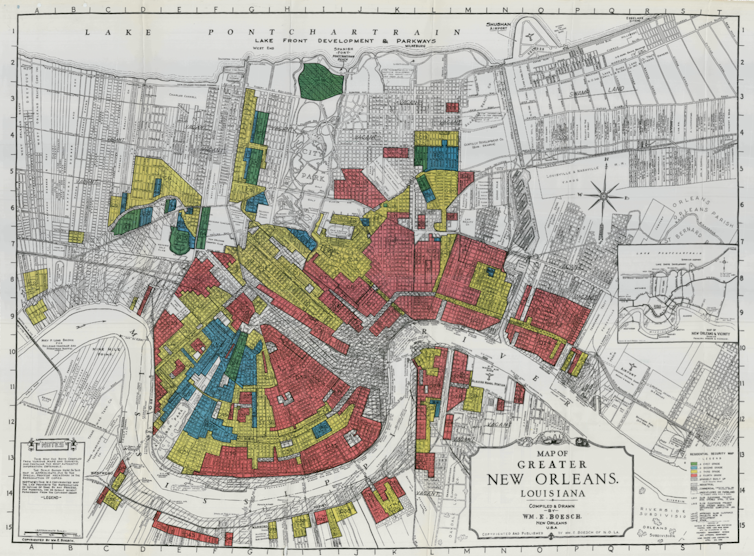
In this 1939 map prepared for the Federal Home Loan Bank Board, redlining separated New Orleans into grades. Green is an A, or first grade; followed by blue, yellow and red, which is last as a D, or fourth grade. The Lower Ninth Ward is the red block farthest to the right.
National Archives via Mapping Inequality/University of Richmond

Twenty years after Hurricane Katrina swept through New Orleans, the images still haunt us: entire neighborhoods underwater, families stranded on rooftops and a city brought to its knees.

We study disaster planning at Texas A&M University and look for ways communities can improve storm safety for everyone, particularly low-income and minority neighborhoods.

Katrina made clear what many disaster researchers have long found: Hazards such as hurricanes may be natural, but the death and destruction is largely human-made.

How New Orleans built inequality into its foundation

New Orleans was born unequal. As the city grew as a trade hub in the 1700s, wealthy residents claimed the best real estate, often on higher ground formed by river sediment. The city had little high ground, so everyone else was left in “back-of-town” areas, closer to swamps where land was cheap and flooding common.

In the early 1900s, new pumping technology enabled development in flood-prone swamplands and housing spread, but the pumping caused land subsidence that made flooding worse in neighborhoods such as Lakeview, Gentilly and Broadmoor.

Then redlining started in the 1930s. To guide federal loan decisions, government agencies began using maps that rated neighborhoods by financial risk. Predominantly Black neighborhoods were typically marked as “high risk,” regardless of the actual housing quality.

This created a vicious cycle: Black and low-income families were already stuck in flood-prone areas because that’s where cheap land was. Redlining kept their property values lower. Black Americans were also denied government-backed mortgages and GI Bill benefits that could have helped them move to safer neighborhoods on higher ground.

Hurricane Katrina showed how those lines translate to vulnerability.

When history came calling

On Aug. 29, 2005, as Hurricane Katrina battered New Orleans, the levees protecting the city broke and water flooded about 80% of the city. The damage followed racial geography − the spatial patterns of where Black and white residents lived due to decades of segregation − like a blueprint.

About three-quarters of Black residents experienced serious flooding, compared with half of white residents.

Between 100,000 and 150,000 people couldn’t evacuate. They were disproportionately people who were elderly, Black, poor and without cars. Among survivors who did not evacuate, 55% did not have a car or another way to get out, and 93% were Black. More than 1,800 people lost their lives.

This lack of transportation — what scholars call “transportation poverty” — left people stranded in the city’s bowl-shaped geography, unable to escape when the levees failed.

Recovery that made things worse

After Hurricane Katrina, the federal government created the Road Home program to help homeowners rebuild. But the program had a devastating design flaw: It calculated aid based on prehurricane home value or repair costs, whichever was less.

That meant low-income homeowners, who already lived in areas with lower property values due to the history of discrimination, received less money. A family whose US$50,000 home needed $80,000 in repairs would receive only $50,000, while a family whose $200,000 home needed the same $80,000 in repairs would receive the full repair amount. The average gap between damage estimates and rebuilding funds was $36,000.

As a result, people in poor and Black neighborhoods had to cover about 30% of rebuilding costs after all aid, while those in wealthy areas faced only about 20%. Families in the poorest areas had to pay thousands of dollars out-of-pocket to complete repairs, even after government help and insurance, and that slowed the recovery process.

This pattern isn’t unique to New Orleans. A study examining data from Hurricane Andrew in Miami (1992) and Hurricane Ike in Galveston (2008) found that housing recovery was consistently slow and unequal in low-income and minority neighborhoods. Lower-income families are less likely to have adequate insurance or savings for quick rebuilding. Low-value homes with extensive damage still had not regained their prestorm value four years later, while higher-value homes sustaining even moderate damage gained value.

Ten years after Katrina, while 70% of white residents felt New Orleans had recovered, only 44% of Black residents could look around their neighborhood and say the same.

Community-led solutions for climate resilience

Katrina’s lessons in the inequality of disasters are important for communities today as climate change brings more extreme weather.

Federal Emergency Management Agency denial rates for disaster aid remain high due to bureaucratic obstacles such as complex application processes that bounce survivors among multiple agencies, often resulting in denials and delays of critical funds. These are the same systemic barriers that added to the reasons Black communities recovered more slowly after Hurricane Katrina. FEMA’s own advisory council reported that institutional assistance policies tend to enrich wealthier, predominantly white areas, while underserving low-income and minority communities throughout all stages of disaster response.

The lessons from New Orleans also point to ways communities can build disaster resilience across the entire population. In particular, as cities plan protective measures — elevating homes, buyout programs and flood-proofing assistance — Hurricane Katrina showed the need to pay attention to social vulnerabilities and focus aid where people need the most assistance.

The choice America faces

In our view, one of Katrina’s most important lessons is about social injustice. The disproportionate suffering in Black communities wasn’t a natural disaster but a predictable result of policies concentrating risk in marginalized neighborhoods.

In many American cities, policies still leave some communities facing a greater risk of disaster damage. To protect residents, cities can start by investing in vulnerable areas, empowering a community-led recovery and ensuring race, income or ZIP code never again determine who receives help with the recovery.

Natural disasters don’t have to become human catastrophes. Confronting the policies and other factors that leave some groups at greater risk can avoid a repeat of the devastation the world saw in Katrina.The Conversation

This article is republished from The Conversation under a Creative Commons license. Read the original article.

Ivis García, Associate Professor of Landscape Architecture and Urban Planning, Texas A&M UniversityDeidra Davis, Instructional Assistant Professor in Landscape Architecture and Urban Planning, Texas A&M University, and Walter Gillis Peacock, Professor of Urban Planning, Texas A&M University