Showing posts sorted by relevance for query BUSH KATRINA. Sort by date Show all posts

Thursday, August 30, 2007

After Katrina

George W. Bush failed to be on site in New York immediately after 9/11. He failed again when Katrina devastated New Orleans.

On September 14, 2001 he cruised over WTC site in a helicopter, shades of flying over New Orleans, and does his famous photo-op with the Firemen at Ground Zero.


==Around mid-afternoon on Friday, Bush finally appears in New York City
with a large Congressional delegation and takes a quick helicopter tour of the devastated area with Mayor Giuliani and Governor Pataki as warplanes fly overhead. Afterwards, Bush visits Ground Zero, where he engages in a rare impromptu exchange with a crowd. As rescue personnel chant “U.S.A! U.S.A.!,” Bush climbs atop a small pile of rubble and uses a bullhorn to thank them for their efforts. When some workers call out that they can’t hear, Bush responds "I can hear you! I can hear you! The rest of the world hears you, and the people who knocked these buildings down will hear all of us soon!" The crowd reacts with cheers and more chants of “U.S.A.!” Workers at Ground Zero are clearly encouraged by Bush’s visit, but there is also annoyance over the two hour shutdown of rescue work caused by the extremely tight security measures. [nyt.Sep.14.2001 / cnn.Sep.14.2001 / dmn.Sep.15.2001]

After talking to state officials and emergency teams in New York, the president flew to Camp David for what a senior US official called a "decision-making meeting" later on Saturday with top advisors.

September 14: President Bush declares a national emergency. The Senate adopts a resolution authorizing the use of U.S. armed forces against those responsible for the attacks. President Bush visits the World Trade Center site. Federal officials release names of the 19 hijackers. Bush declares a "national day of prayer and remembrance." Many Americans attend religious services. Congress unanimously approves $40 billion for emergency aid, including $20 billion for New York. President Bush activates 50,000 national guard and reserve members to help with recovery and security.

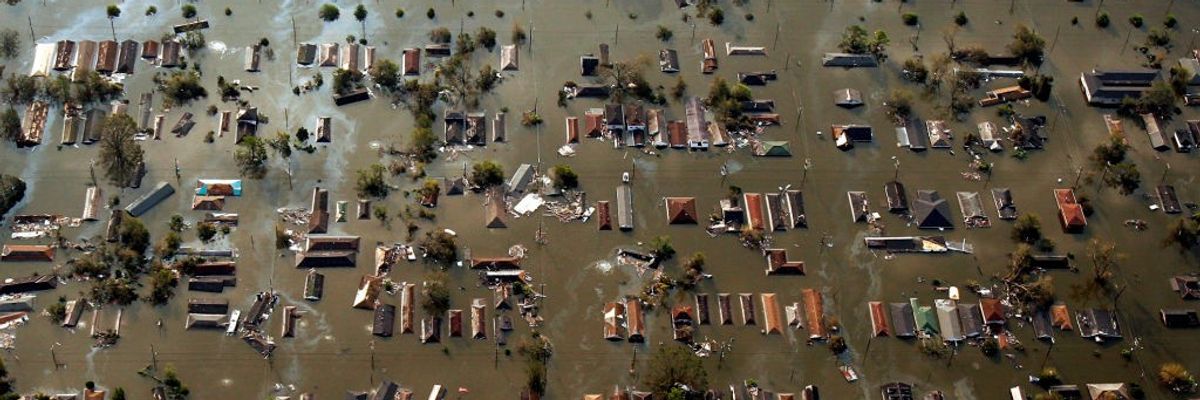
After Katrina he failed to visit New Orleans until the anniversary of 9/11. Weeks after the hurricane hit. And then it was for another photo op like 9/11.


NEW ORLEANS, Louisiana (CNN) Sunday, September 11, 2005;

-- President Bush arrived in Louisiana Sunday as the official death toll from Hurricane Katrina climbed past 400 and the search for bodies continued nearly two weeks after the storm hit the Gulf Coast.

The visit is Bush's third to the region but his first chance to get a first-hand look at the streets of New Orleans, which were flooded after levees protecting the low-lying city broke.

Two days after the storm hit, Bush surveyed Katrina's destruction from Air Force One on his way back to Washington from Crawford, Texas, where he'd spent a month's vacation. He visited other parts of the region in two subsequent visits.

He was on vacation prior to Katrina as he was prior to 9/11.

“News coverage has pointedly stressed that W.'s month-long stay at his ranch in Crawford is the longest presidential vacation in 32 years. Washington Post supercomputers calculated that if you add up all his weekends at Camp David, layovers at Kennebunkport and assorted to-ing and fro-ing, W. will have spent 42 percent of his presidency ‘at vacation spots or en route.’” Charles Krauthammer, “A Vacation Bush Deserves,” The Washington Post, August 10, 2001.


Yesterday he commemorated his regimes failure to support the people of New Orleans then and now. And as usual there was no mea culpa.

President Bush and other officials observed the second anniversary of Hurricane Katrina, honoring the dead and touring still ruined neighborhoods.


However the real scandal is not that he arrived late after Hurricane Katrina, but that after two years the City has not been rebuilt, funds have been squandered.

A recent report from the RFK Center for Human Rights and the Institute for Southern Studies estimated that the Bush administration was overstating federal funding for the Gulf Coast rebuilding campaign by as much as 300%, with about $35 billion of an estimated $114 billion actually spent.


With America's largest black city and thousands of blacks stranded in the immediate aftermath of the storm the failure to rescue them smacked of racism.

That the federal government has utterly failed in these lethal days is universally obvious.

Is it because so many of these people are black and poor? Is it because Bush has successfully stolen a second term and just doesn't care? Is it because this gouged and battered organization that was once our government has been so thoroughly exhausted by war and corruption that it cannot or will not manage so basic a task as bringing the necessities of life to its needlessly dying citizens?

But to hear of dead bodies being stacked outside a professional football stadium to avoid further stench where ten thousand Americans can't get water, food or sanitary facilities.To see dazed elders who've just lost their homes or hospital rooms being laid on sidewalks to die. To watch crying children stretched out on the ground, separated from their parents, dehydrated, overheated, starving....this is too much to bear.

How utterly can our nation have failed? How totally bankrupt can we be?

And the guy in charge of all this who should have been fired; Homeland Security boss Chertoff, wasn't.

Congressional investigators lambasted the U.S. government for its response to Hurricane Katrina, saying a lack of a clear chain of command hindered relief efforts and that Homeland Security Secretary Michael Chertoff or another top official should have been the point person on relief efforts.

The Government Accountability Office also found that the government still lacks sufficient plans and training programs to prepare for catastrophic disasters like the Aug. 29 storm that devastated much of the Gulf Coast area. But it also singled out Chertoff in several shortcomings.

Until now, Chertoff has largely escaped widespread criticism of the government's sluggish response to Katrina. By contrast, then-FEMA Director Michael Brown, the principal federal official at the disaster site, quit his job after becoming the public face of the failures.

The report said that neither Chertoff nor any of his deputies in the disaster area acted as President George W. Bush's overall storm coordinator, "which serves to underscore the immaturity of and weaknesses relating to the current national response framework."

After all Katrina was not a surprise to the administration since they had anticipated it.


Before 9/11 the Federal Emergency Management Agency listed the three most likely catastrophic disasters facing America: a terrorist attack on New York, a major earthquake in San Francisco and a hurricane strike on New Orleans. "The New Orleans hurricane scenario," The Houston Chronicle wrote in December 2001, "may be the deadliest of all."

Some critics are suggesting President Bush was as least partly responsible for the flooding in New Orleans. In a widely quoted opinion piece, former Clinton aide Sidney Blumenthal says that "the damage wrought by the hurricane may not entirely be the result of an act of nature," and cites years of reduced funding for federal flood-control projects around New Orleans.

Our fact-checking confirms that Bush indeed cut funding for projects specifically designed to strengthen levees. Indeed, local officials had been complaining about that for years.


And with a lame duck President and an administration running on the spot nothing has changed. The failures that led to the destruction of New Orleans plague the White House still.

When investigating the bungled response to Hurricane Katrina, a House of Representatives select committee cited a “failure of initiative” at all levels of government. The storm killed 1,836 people, caused an estimated $81 billion in damage, and displaced some two million people. The population of New Orleans is currently about 66 percent of its pre-Katrina level, and the city’s uneven recovery is examined in depth in this New York Times interactive feature. The Department of Homeland Security has since quadrupled its stockpiles of emergency supplies and sought to improve emergency planning at the community level. The 9/11 Commission Recommendations Act signed by President Bush in August promises to provide increased funding for emergency communications and first responders. Yet some experts believe the lessons of the disaster appear to have gone unlearned. In his recent book, The Edge of Disaster, CFR’s Stephen Flynn says the levees that failed to protect New Orleans two years ago are being rebuilt to the same standard as before, capable only of enduring a Category 3 hurricane.

Now compare Bush's slow response to President Johnson's visit to hurricane ravaged New Orleans after Hurricane Betsy. And a visit to the same lower ninth ward that Bush visited yesterday.

Lyndon Johnson received high marks for visiting the Lower Ninth Ward and victims in shelters a day after Hurricane Betsy ravaged New Orleans. ("I put aside all the problems on my desk to come to Louisiana as soon as I could," Johnson said.)

President Lyndon Baines Johnson flew into New Orleans the day after Hurricane Betsy in September 1965 and announced at the airport, "I am here because I want to see with my own eyes what the unhappy alliance of wind and water have done to this land and people."
The day after. Not a week later.

LBJ believed in the 'Great Society'. Bush believes in 'compassionate conservatism'. The latter is an ideological reaction to the former. And it has proven to be more of a failure than the Great Society ever was.


SEE:

Our Living Earth

Surge Blackout

What He Didn't Say

Soul of a City

Remember Katrina and Rita?

Katrina Mission Accomplished

Katrina: It's a Dog-Gone Crime

This is What Global Warming Looks Like

A Paradox called Katrina


Find blog posts, photos, events and more off-site about:
, , , , , , , , , , , ,
, , , , ,
, , , , , , , , ,
, , ,
, , , ,

Wednesday, September 05, 2007

Blaming Others

The reason for the failures in Iraq are not George Bush's fault they are the fault of others.
Just whose brilliant idea was it to disband the Iraqi army? The former U.S. boss of Iraq, L. Paul Bremer, says President Bush knew about and supported his plans to dissolve Saddam's military, according to letters he released to the New York Times yesterday.

Annoyed that Bush was quoted in a recent book as suggesting that he had gone a bit Rambo out in the desert, Bremer disclosed his spring 2003 correspondence with the president.

The impetus for Bremer's action was Bush's interview with Robert Draper, author of the new book "Dead Certain," in which the president sounded as if he had been taken aback by the decision.

"The policy had been to keep the army intact; didn't happen," Bush told Draper. When Draper asked how he had reacted when the policy changed, Bush replied, "Yeah, I can't remember. I'm sure I said, 'This is the policy, what happened?'"

Rumsfeld also serves as a major, if absent, character in today's sweeping USA Today investigation tracking the Defense Department's slowness to equip the troops in Iraq with protective gear like body armor and devices to jam signals from detonators.

Even as the president and Pentagon officials claimed they were doing all they could to get these items for the soldiers, the paper digs up documents suggesting that "the military cut or underfunded several programs and moved so slowly and grudgingly that members of Congress" had to step in with "extraordinary measures."

Interviewed officials complained of a refusal among top military brass at the beginning of the war to believe that the fighting would be anything but brief. Once things started to get bogged down, there was a "peacetime mentality" guiding acquisition of "up-armored vehicles," the paper reports.

In one particularly striking example, Pentagon officials "balked at pleas from battlefield commanders and their own analysts to provide the lifesaving MRAP, or Mine Resistant Ambush Protected vehicle, for patrols and combat missions." Only after Rummy left and Robert Gates took over did the Pentagon embrace the MRAP.

Draper's account of the bulk of Bush's presidency sheds light on a loyal and secretive inner circle that, at least privately, was not always on the same page. Draper tells of an April 2006 dinner at which Bush asked aides for a show of hands on whether his divisive defence secretary, Donald Rumsfeld, should be fired.

The vote: 7-4 to get rid of him, with Bush siding with those who wanted him kept on for the time being. Rumsfeld was replaced after the elections that fall switched control of the House and Senate to Democrats.

White House aides who wanted Rumsfeld out were privately dismayed when retired generals called publicly for his ouster, fearing that would steel Bush's resolve to keep his defence chief, the book says.

Bush, without addressing that meeting, suggested to the author that the ex-generals did get under his skin. "My reaction was, 'No military guy is gonna tell a civilian how to react,"' he said.

Just like his failure to deal with Hurricane Katrina.

The latest book published about George W Bush reveals that the US president was not fully engaged in key policy areas, including the disbandment of the Iraqi army and the build-up to Hurricane Katrina.

At a briefing at his Crawford ranch the day before the hurricane made landfall, Mr Bush was "gassed" after an 80-minute bike ride and asked no supplementary questions following a briefing from advisers. He merely assured them the federal government was prepared to help.


SEE:

Daddy's Boy


Find blog posts, photos, events and more off-site about:
, , , , , , , , , , , ,

, , , , ,
, , , , , , , , ,
, , ,
, , , ,
, , ,
, , , , , , ,

, , ,
, , , ,
, , , , , , , , , , , , , , , , , ,
, , , , , , , , , , ,

Tuesday, October 04, 2005

Two Solitudes-In Amerika

In Canada we often speak of Two Solitudes, in reference to Quebec and the Rest of Canada (ROC).

In Amerika there are still two solitudes 140 years after Slavery ended. There are Two Americas, one Black and one White. And Afro-America is still poor, illiterate, and subject to the whims of capitalist exploitation as these two stories show. Idol Winner Fanatasia reveals the reality of being working class African American, making a sham of the so called American Dream. Sure she is America's Idol, if being illiterate and being raped is anyting to idolize. Yet it is the harsh reality of everyday life for working class women of colour in racist America. And typical of the American culture of 'you can make it if you work hard enough', she blames herself.

And the announcement of the layoffs of New Orelans city workers reveals the same false American Dream for working class Afro Americans. I guess they can blame themselves to for being in the wrong place at the wrong time. Or for not being one of George II's Texas pals, who get all the plumb jobs.

Say what was that promise George II made about rebuilding New Orleans? Oh did he forget to mention it will be by the private sector to benefit the private sector, with taxpayer money. With the layoffs of municipal workers in New Orleans, FEMA will be known as Firing Employees of Muncipalities in America.....
The American Dream is only available for a few, they are White and Rich.

Idol winner Fantasia reveals she's illiterate

Fantasia Barrino performs on ABC's 'Good Morning America' in July, 2005.

Fantasia Barrino performs on ABC's 'Good Morning America' in July, 2005. (AP Photo/Jeff Christensen, File)


Associated Press

NEW YORK -- "American Idol" winner Fantasia Barrino reveals in her memoirs that she is functionally illiterate and had to fake her way through some scripted portions on the televised talent show, which she won in 2004.

"You're illiterate to just about everything. You don't want to misspell," Fantasia told ABC's "20/20." "So that, for me, kept me in a box and I didn't, wouldn't come out."

The 21-year-old R&B singer says she's signed record deals and contracts that she didn't read and couldn't understand. But the hardest part, she said, is not being able to read to Zion, her 4-year-old daughter.

"That hurts really bad," she said, adding that she is now learning to read with tutors.

In her memoir, "Life is Not a Fairy Tale," which she dictated to a freelance writer, Fantasia also said she was raped in the ninth grade by a classmate. She says the boy was disciplined, but she blamed herself for the attack.

She dropped out of high school that year and became an unwed mother at 17.

US housing official: rebuilt New Orleans will have fewer poor blacks

President Bush’s secretary of Housing and Urban Development acknowledged the administration’s real vision for New Orleans when he told reporters last week that the city would have far fewer poor black residents once reconstruction is completed.

In an interview with the Houston Chronicle, HUD Secretary Alphonso Jackson predicted New Orleans would slowly bring back as many as 375,000 people, but that only 35 to 40 percent of the population would be black. Prior to Hurricane Katrina the city had nearly 500,000 residents, more than two-thirds of whom were African-American.

“Whether we like it or not, New Orleans is not going to be 500,000 people for a long time,” Jackson said. “New Orleans is not going to be as black as it was for a long time, if ever again.”


New Orleans lays off 3,000 city workers

Associated Press

October 4, 2005

NEW ORLEANS - Mayor Ray Nagin said Tuesday the city is laying off as many as 3,000 employees -- or about half its workforce -- because of the financial damage inflicted on New Orleans by Hurricane Katrina.

Nagin announced with "great sadness" that he had been unable to find the money to keep the workers on the payroll.

He said only non-essential workers will be laid off and that no firefighters or police will be among those let go.

[So sewer workers, truckers, paramedics, and other support staff aren't essential?! New Orleans is Not a City, it's a Police State! EP]

"I wish I didn't have to do this. I wish we had the money, the resources to keep these people," Nagin said. "The problem we have is we have no revenue streams."

Nagin described the layoffs as "pretty permanent" and said that the city will work with the U.S. Federal Emergency Management Agency to notify municipal employees who fled the city in the aftermath of Katrina, which struck about a month ago.

The mayor said the move will save about $5 million US to $8 million US of the city's monthly payroll of $20 million US. The layoffs will take place over the next two weeks.

Eased Out of the Big Easy
by Jesse Jackson

After his administration's incompetence and indifference had lethal consequences in Katrina's wake, President Bush has been scrambling to regain his footing. He's called for an "unprecedented response to an unprecedented crisis." In religious services at the National Cathedral, he called on America to "erase this legacy of racism" exposed by those abandoned in Katrina's wake. He's called on Congress to appropriate more than $60 billion in emergency relief and outlined a recovery program likely to cost up to $200 billion, or nearly as much as the Iraq War.

All this has led the press to compare his plans to Franklin Roosevelt's New Deal or Lyndon Johnson's Great Society. Don't fall for it. A close look at the Bush plan reveals that this is a bad deal from a deck stacked against the poor who suffered the most in Katrina's wake.

The first clue came from Bush's first act. He issued orders erasing the prevailing wage for work on rebuilding the Gulf, and his administration gave Halliburton a lucrative no-bid contract to begin the work. Then he designated Alabama, Mississippi and Louisiana an enterprise zone, and, using emergency authority, waived all worker protections in the region -- protections for equal employment, for minority contractors, for health and safety, for environmental protection.

We're learning that when Bush promised to remove the legacy of racism in New Orleans, he meant he'd remove the poor who were victims of that racism. Bush's secretary for Housing and Urban Development, Alphonso Jackson, revealed that to the Houston Chronicle.

"Whether we like it or not, New Orleans is not going to be 500,000 people for a long time," the HUD secretary said. "New Orleans is not going to be as black as it was for a long time, if ever again." Jackson predicted New Orleans will slowly draw back as many as 375,000 people, but that only 35 percent to 40 percent of the post-Katrina population would be black. (Before Katrina, New Orleans was two-thirds black.) "I'm telling you, as HUD secretary and having been a developer and a planner, that's how it's going to be." Jackson revealed that he advised Mayor Ray Nagin not to rebuild the overwhelmingly black 9th Ward.

The people of the 9th Ward are the maids and waiters who serve New Orleans tourists. They are the musicians who give the city its blues. They are the cops and government clerks who are struggling to bring the city back. Half of the houses there are owned, not rentals. Many of these workers are dispersed -- dispatched to over 40 states. Many still are in shelters.

No one could figure out why the Bush administration wouldn't give the evacuees housing vouchers to rent housing in and around New Orleans. Instead, FEMA has ordered tens of thousands of trailers and is struggling to build trailer parks -- Bushvilles -- to shelve Katrina's victims.

Now we know. Bush's isn't planning urban renewal, he's planning urban removal. The administration has given the victims of Katrina a one-way ticket out with no plan for their return. Instead, the planners will turn New Orleans into a gentrified theme park. They'll rebuild the white communities -- even those like middle-class Gentilly and wealthy Lakeview that are as prone to severe flooding as the 9th Ward.

Congress should insist that Katrina's victims have a right to return -- and FEMA should develop a plan to make their return possible. They should have preference for the jobs that will be created in rebuilding the city. They should be provided vouchers to use for nearby housing. If necessary, local military bases should be opened, with public transportation to get them to and from work. They should be paid the prevailing wage, with decent health-care benefits. The people of the 9th Ward should decide the fate of their homes, not urban planners intent on building a New Orleans without its black people. If their neighborhoods are not rebuilt, then affordable and public housing should be built in other parts of New Orleans.

That's not what Alphonso Jackson and the administration are planning, so it will take street heat and congressional action to make them see the light. Katrina destroyed its victims' homes; we shouldn't let the administration make them exiles from their own city.

© 2005 Chicago Sun Times

Growing Gulf Between Rich and Rest of US
by Holly Sklar


Guess which country the CIA World Factbook describes when it says, "Since 1975, practically all the gains in household income have gone to the top 20 percent of households."

If you guessed the United States, you're right.

The United States has rising levels of poverty and inequality not found in other rich democracies. It also has less mobility out of poverty.

Since 2000, America's billionaire club has gained 76 more members while the typical household has lost income and the poverty count has grown by more than 5 million people.

Poverty and inequality take a daily toll seldom seen on television. "The infant mortality rate in the United States compares with that in Malaysia -- a country with a quarter the income." says the 2005 Human Development Report. "Infant death rates are higher for [black] children in Washington, D.C., than for children in Kerala, India."

Income and wealth in America are increasingly concentrated at the very top -- the realm of the Forbes 400.

You could have banked $1 million a day every day for the last two years and still have far to go to make the new Forbes list of the 400 richest Americans.

It took a minimum of $900 million to get on the Forbes 400 this year. That's up $150 million from 2004.

"Surging real estate and oil prices drove up several fortunes and helped pave the way for 33 new members," Forbes notes.

Middle-class households, meanwhile, are a medical crisis or outsourced job away from bankruptcy.

With 374 billionaires, the Forbes 400 will soon be billionaires only.

Bill Gates remains No. 1 on the Forbes 400 with $51 billion. Low-paid Wal-Mart workers can find Walton family heirs in five of the top 10 spots; another Wal-Mart heir ranks No. 116.

Former Bechtel president Stephen Bechtel Jr. and his son, CEO Riley Bechtel, tie for No. 109 on the Forbes 400 with $2.4 billion apiece. The politically powerful Bechtel has gotten a no-bid contract for hurricane reconstruction despite a pattern of cost overruns and shoddy work from Iraq to Boston's leaky "Big Dig" tunnel/highway project.

The Forbes 400 is a group so small they could have watched this year's Sugar Bowl from the private boxes of the Superdome.

Yet combined Forbes 400 wealth totals more than $1.1 trillion -- an amount greater than the gross domestic product of Spain or Canada, the world's eighth- and ninth-largest economies.

The number of Americans in poverty is a group so large it would take the combined populations of Louisiana, Mississippi, Alabama and Texas, plus Arkansas to match it. That's according to the Census Bureau's latest count of 37 million people below the poverty line.

Millions more Americans can't afford adequate health care, housing, child care, food, transportation and other basic expenses above the official poverty thresholds, which are set too low. The poverty threshold for a single person under age 65 was just $9,827 in 2004. For a two-adult, two-child family, it was just $19,157.

By contrast, the Economic Policy Institute's Basic Family Budget Calculator says the national median basic needs budget (including taxes and tax credits) for a two-parent, two-child family was $39,984 in 2004. It was $38,136 in New Orleans and $33,636 in Biloxi, Mississippi.

America is becoming a downwardly mobile society instead of an upwardly mobile society. Median household income fell for the fifth year in a row to $44,389 in 2004 -- down from $46,129 in 1999, adjusting for inflation. vThe Bush administration is using hurricane "recovery" to camouflage policies that will deepen inequality and poverty. They are bringing windfall profits to companies like Bechtel while suspending regulations that shore up wages for workers.

More tax cuts are in the pipeline for wealthy Americans who can afford the $17,000 watch, $160,000 coat and $10 million helicopter on the Forbes Cost of Living Extremely Well Index.

More budget cuts are in the pipeline for Medicaid, Food Stamps and other safety nets for Americans whose wages don't even cover the cost of necessities.

Without a change in course, the gulf between the rich and the rest of America will continue to widen, weakening our economy and our democracy. The American Dream will be history instead of poverty.

Holly Sklar is co-author of "Raise the Floor: Wages and Policies That Work for All Of Us" (www.raisethefloor.org). She can be reached at hsklar@aol.com.

© 2005 Holly Sklar

Sunday, August 27, 2006

Katrina Mission Accomplished

A year after Katrina,just like Iraq, it is Mission Accomplished for the Bush team and their disaster/war profiteer pals....while they blame the victims for fraud.....
A review of congressional testimony and other documents by Gulf Coast Reconstruction Watch found a total of at least $136.7 million in corporate fraud in Katrina-related contracts. In addition, government investigators have highlighted contracts cumulatively valued at $428.7 million that they found troubling because of lack of agency oversight or misappropriation.Profiting from Disaster: Greed Has Stallled Gulf Coast Recovery ...


Taxpayers around the nation who urged the federal government to pay for relief and reconstruction after Hurricane Katrina probably didn’t expect their money to be spent on $279 meals and $2,500 tarps. But according to a newly released report, corporations hired by the federal government have not only inflated costs but committed labor abuses and delayed the reconstruction process, making millions while local companies and workers have been left behind. Katrina Recovery Funds Wasted by Contractors, Govt.


NOLAEver wonder what happened to all the foreign donations given to the United States in the aftermath of Katrina? It's not good news. It turns out that, like so much of the federal response to the crisis, the largest influx of foreign assistance to the US in memory was met with foot-dragging and clumsy bureaucracy. None of the donated funds has actually made its way to evacuees. What happened to the foreign cash for Katrina victims?


More Than Half of Congress' Katrina Money Unspent

Katrina Victims See Scant Evidence of Bush Funds in New Orleans


See Internationl Relief scams and scandals plaque the US just as they did the victims of the Tusanami in Indonesia and the earthquake in Pakistan. The difference is that under state capitalist regimes in Asia it is government inefficiency in the U.S. it is just the opposite.

Find blog posts, photos, events and more off-site about:
, , , , , , , , , , ,

Monday, March 30, 2020

Hurricane Katrina was a ‘dress rehearsal’ for ‘our current nightmare of bad leadership’: Paul Krugman

 March 30, 2020 By Alex Henderson, AlterNet


Economist and veteran New York Times columnist Paul Krugman has been vehemently critical of President Donald Trump’s handling of the coronavirus pandemic. And Krugman was drawing an obvious parallel between Trump’s coronavirus response and the George W. Bush Administration’s response to Hurricane Katrina when, on March 29, he tweeted, “Katrina was a dress rehearsal for our current nightmare of bad leadership.”

With that tweet, Krugman linked to his September 2, 2005 column — which found him lambasting President George W. Bush’s administration and asserting, “Why have aid and security taken so long to arrive? Katrina hit five days ago — and it was already clear by last Friday that Katrina could do immense damage along the Gulf Coast. Yet the response you’d expect from an advanced country never happened. Thousands of Americans are dead or dying.”

Remembering this. Katrina was a dress rehearsal for our current nightmare of bad leadership https://t.co/BOVyPaxn3E
— Paul Krugman (@paulkrugman) March 29, 2020

In that column, Krugman went on to ask, “Did the Bush Administration destroy FEMA’s effectiveness? The Administration has, by all accounts, treated the emergency management agency like an unwanted stepchild, leading to a mass exodus of experienced professionals.”

Krugman denounced the Bush Administration as a “can’t-do government” 15 years ago, and similarly — in his March 28, 2020 column — he attacked the Trump Administration for being so slow to respond to the coronavirus crisis

“Let me summarize the Trump Administration/right-wing media view on the coronavirus: it’s a hoax or anyway, no big deal,” Krugman wrote in that March 28 column. “Besides, trying to do anything about it would destroy the economy. And it’s China’s fault, which is why we should call it the ‘Chinese virus.’”

Krugman added that “epidemiologists who have been modeling the virus’ future spread have come under sustained attack, accused of being part of a ‘Deep State’ plot against Donald Trump — or maybe free markets.”

The right wing simply doesn’t know how to govern, something they’ve proven time after time. And even if they did know how to govern, they’d have no interest in doing so.
— Roger Matile (@rmatile1) March 29, 2020

In recent columns, Krugman has stressed that the GOP’s dysfunction didn’t begin with Trump. And as Krugman sees it, Trump’s coronavirus response is an indictment of the Republican Party in general.

“The bottom line is that as with so many things Trump, the awfulness of the man in the White House isn’t the whole story behind terrible policy,” Krugman wrote in his March 28 column. “Yes, he’s ignorant, incompetent, vindictive and utterly lacking in empathy. But his failures on pandemic policy owe as much to the nature of the movement he serves as they do to his personal inadequacies.”


---30---

Saturday, September 17, 2005

Katrina: The Good, The Bad, and The Ugly

See my other blog postings on Katrina:

A Paradox called Katrina

Katrina: It's a Dog-gone Crime

Two weeks after Hurricane Katrina blasted the hell out of the Gulf Coast of the US what can we say about this. Well there was the good, the bad and the ugly.

THE GOOD: The thousands of people, ordinary citizens who helped each other and volunteered to bring food and supplies to the Gulf Coast without the help of the state or so called civil society; NGO's and humanitarian bueraucrats. I will even give credit here to a San Diegeo Oil magnate and a movie star who both filled private airplanes with supplies and without media fanfare delivered the goods to those in need. To the thousands of people who are currently rescuing animals that the state forced to be left behind in their hasty post Katrina evacuation. The expressions of genuine mutual aid and self organiziation that is the hallmark of Anarchy.

New Orleans has been governed throughout this entire debacle. Don't blame anarchy for government's failures. If anything, this helps illustrate the case for self-government.
Enjoy Every Sandwich

Yep it was Anarchy in New Orleans and the Gulf Coast, chaos was created mnot by the storm but by the disorganization of the agents of law and order, but real anarchy arose in the actions of citizens. Self government was created in the disaster areas, to deal with the disaster.

Dhalgren in New Orleans
What an old science-fiction novel can tell us about the Big Easy
Bidisha Banerjee

Like Kid, who leaves the city after losing Lanya and other friends in the fire and confusion resulting from a race riot, those who choose to stay in New Orleans will, in all likelihood, come to harm. But, I hope, not before glimpsing more than the city's nightmares. About two dozen people in New Orleans refused to accept the cancellation of the Southern Decadence gay pride parade scheduled for last weekend. They donned wigs and beads, and celebrated in the streets. A restaurant started giving away $20,000 worth of free food, and two bars in the (mostly dry) French Quarter remained open through the hurricane. In the absence of any controlling legal authority, residents even formed ad hoc defense committees. You wouldn't know it from the blathering of countless columnists, but while Katrina was busy disproving some non-existent policy of "small government," private citizens from Wal-Mart to New Orleans hoteliers proved their ability to keep functioning in an unreal city. It's a start—not only for the city's will to rebuild itself, but also for the inhabitants who hope to stick it out until then. There are many stories about the bodies still afloat in New Orleans, but this one, with its detail about a corpse with one shoe on and one shoe off (an image that haunts Samuel Delany's work, Dhalgren) stands apart.


THE BAD: The State, NGO's and humanitarian agencies that percipitated this disaster by not evacuating everyone or having a plan of evacuating everyone, or a plan period. Reacting too late to a crisis which had they evacuated on Friday before Katrina hit would have had lots of time to get everyone out of New Orleans at least. The Greyhound bus company that removed its buses from New Orleans on Saturday before the hurricane.

The STATE at all levels failed, the limited government created by the neo-cons created a STATE which cannot govern in times when it is needed most, during disasters. The reduction in taxes, in the rational governing of resources, and the increasing authoritarian Securtiy State of the Bush Administration met their Waterloo in Katrina.

And all this could have been avoided if the STATE had listened to the government, in this case the Hurricane Emergency Adisory agency in Louisiana which do its duty, understaffed and underpaid, warned all STATE agencies, local, state and federal, of the pending disaster. But nobody listened.

Fed Response to Katrina Gets Thumbs Down
September 4, 2005--Just 28% of Americans give say that the federal government has done a good or an excellent job responding to Hurricane Katrina. Another 25% say the government has done a fair job while 45% say poor.

Poll: Respondents dissatisfied with Katrina response
Tuesday, September 13, 2005 Posted: 1546 GMT (2346 HKT)
(CNN) -- A majority of Americans surveyed in a CNN/USA Today/Gallup poll released Monday said they disapproved of President Bush's handling of the response to Hurricane Katrina

THE UGLY: Gretna, Louisiana across the bridge from New Oreleans, armed racist police refused access to survivors from NO. The police guarding the bridge between Gretna and NO generously refered to the evacuee's as 'looters'.

This should be no surprize, except to those 70% of white Americans polled who said that race was not a factor in the failure to evacuate or rescue victims of Katrina.

Poll shows wide racial divide on views of Katrina
Six in 10 African-Americans say the fact that most hurricane victims were poor and black was one reason the federal government failed to come to the rescue more quickly. Whites reject that idea; nearly 9 in 10 say those weren't factors. In New Orleans, Bush on Monday said race played no role.

The New York Times Leads the Pack in Scapegoating Black Americans
Race, Katrina and the Media By ISHMAEL REED

Of course there was no racism, this is the gentile land of Southern Gentlemen and Southern Belles after all.


A Guide to Southern Hospitality The Deep South has always taken great pride in its reputation for “Southern Hospitality”. Yet Jefferson Parish, a suburban bedroom community of New Orleans, Louisiana, harbors a dark and shameful culture of racism. Throughout its history, from the prolific lynchings in the 1890's to the senseless diatribes of its extremist politicians in the 1980's, Jefferson Parish is gifted with the ignoble distinction of “America’s Johannesburg.”

Nope no racism in the Deep South.

When Hate Came to Town: New Orleans' Jews and George Lincoln Rockwell,

Gretna is the stomping grounds of white supremascist/neo-nazi and former Klansman, David Duke.

David Duke a Biography

David Duke on Stormfront-Neo Nazi Site.

There's an old sheriff in town: The legacy of racism in the parish that blocked N.O. from fleeing Hell
"If there are some young blacks driving a car late at night in a predominantly white area, they will be stopped. If you live in a predominantly white neighborhood and two blacks are in a car behind you, there's a pretty good chance they're up to no good. It's obvious two young blacks driving a rinky-dink car in a predominately white neighborhood - I'm not talking about on the main thoroughfare, but if they're on one of the side streets and they're cruising around - they'll be stopped."

-- Jefferson Parish, La., Sheriff Harry Lee in 1986.

In 2005, Harry Lee is still the sheriff of Jefferson Parish -- a county that also once sent David Duke to the statehouse and tried to erect physical barriers from a mostly black New Orleans community. And last week, his deputies took part in what may become the most notorious racial incident of our young new millennium.

After Blocking the Bridge, Gretna Circles the Wagons

City of Gretna Louisiana-The most evil, racist city in America.

Police Trapped Thousands in New Orleans

13 Sep 2005 23:56:54 GMT
Source: Reuters
GRETNA, Louisiana, Sept 13 (Reuters) - Three suburbs of New Orleans announced they will reopen on Wednesday, saying residents have safe water, electricity and sewer service 15 days after Katrina struck. The cities of Gretna, Westwego and Lafitte, Louisiana, said residents could come back starting at 5 a.m. on Wednesday morning but cautioned that they would face a strict curfew "The city now is open for business," Westwego mayor Robert Billiot told WWL radio. "We are going to rebuild Westwego. We look forward to you coming home." The three cities are all in Jefferson Parish, a county of suburbs that borders New Orleans on both sides of the Mississippi River. They are on the south side of the river, the so-called West Bank, and did not suffer the widespread, continued flooding that other areas hav

Monday, September 01, 2025

Hard Lessons From Katrina We’re Still Learning 20 Years Later


Hurricane Katrina not only exposed the vulnerability of communities to extreme weather events exacerbated by climate change, but also systemic injustices and a deeply flawed US insurance system.


Water surrounds homes in the devastated Ninth Ward in this aerial view of damage from Hurricane Katrina in New Orleans on August 30, 2005.
(Photo by Smiley N. Pool/Houston Chronicle via Getty Images)

CIEL Blog

It’s been 20 years since Hurricane Katrina struck the Gulf Coast of the United States, wreaking havoc in Louisiana, Mississippi, and Alabama. An estimated 1,833 people died in the hurricane and the flooding that ensued. The storm destroyed or damaged more than a million housing units and more than 200,000 homes, causing one of the largest relocations of people in US history.

In the months and years that followed, entrenched inequalities, questionable policy choices, and predatory practices by private insurers decided who could return home and rebuild. For instance, countless residents impacted by the hurricane learned too late that their standard homeowners’ insurance offered no protection against flood damage, leaving them to shoulder devastating repair costs themselves. In cities such as New Orleans, these dynamics further marginalized Black residents, who were more likely to live in flood-prone neighborhoods. The result was widespread and often permanent displacement, with longtime communities effectively erased from the map.


Hurricane Katrina not only exposed the vulnerability of communities to extreme weather events exacerbated by climate change, but also systemic injustices and a deeply flawed US insurance system. Private insurers pour billions of dollars into the fossil fuel industry, which is the main contributor to climate change. Thus, insurers help fuel the very crisis that is driving more frequent and severe climate disasters like Hurricane Katrina. Meanwhile, they are passing the financial risk of the escalating impact of climate change onto policyholders and forcing them to bear the costs of the crisis the industry itself helps perpetuate.

As climate-driven storms grow more frequent and increasingly destructive, the same insurance failures, housing crises, and inequitable recovery that followed Katrina now threaten communities nationwide. Two decades later, Katrina’s hard lessons cannot be ignored. Everyone deserves to live in safety and the opportunity to stay in the place they call home. Corporate greed and government negligence cannot continue to undermine these rights.

The Hurricane

On August 29, 2005, Hurricane Katrina made landfall with winds that reached 140 miles per hour. These high-velocity winds drove a storm surge that raised sea levels 25 to 28 feet above normal along parts of the Mississippi coast, and 10 to 20 feet along the southeastern Louisiana coast. The surge breached protective levees, causing catastrophic flooding. Two days after the hurricane struck, 80% of the city of New Orleans was underwater. Other coastal towns and cities in Louisiana, Mississippi, Alabama, and along the western Florida panhandle also experienced significant storm surges and destructive winds, which caused widespread flooding and damage to homes.

The Great Displacement

Approximately 1.5 million people aged 16 years and older had to leave their residences in Louisiana, Mississippi, and Alabama because of Hurricane Katrina. In New Orleans, where the mayor issued a mandatory evacuation order, a population of around 500,000 was reduced to a few thousand people within a week of the storm.

As water was pumped out of the flooded areas and basic services and infrastructure were restored, New Orleanians were allowed to return. But tens of thousands were not able to do so. One year after Katrina, approximately 197,000 residents had not come back to the city; many relocated to the relatively close cities of Houston and Baton Rouge, but others as far away as Alaska and Massachusetts. Still today, many of those who evacuated the city, hoping to return, remain displaced. New Orleans’s metropolitan area population remains 20% below pre-Katrina levels.

The Impact On Black Communities


The development of New Orleans has been fraught with injustices. Racial segregation, redlining, and chronic underinvestment in Black communities pushed residents and renters into areas with crumbling infrastructure, poorer-quality homes, and greater exposure to environmental hazards and contaminants.

When Katrina hit, Black residents were concentrated in the most vulnerable parts of New Orleans, located well below sea level and poorly protected by inadequate levees. Accordingly, neighborhoods with the highest percentages of Black residents saw greater housing destruction from the storm.

Did You Know?


The disparate impact of climate disasters on property and infrastructure in US minority communities is the result of nearly a century of discriminatory home lending and insurance policies.

In the 1930s, the US federal government used a rating system in its low-cost home loan program to assess lending risk. Assessors created maps ranking the perceived risk of lending in certain neighborhoods, with race often used as the determining factor in assessing a community’s risk level. Black and immigrant neighborhoods were typically rated as “hazardous” and outlined in red, warning lenders that the area was a perilous place to lend money. Known as redlining, these and other discriminatory practices led to a lack of investment in minority communities.

This lack of financial access resulted in shoddy construction and poor infrastructure that have made minority neighborhoods less resilient to climate disasters and more prone to other financial risks. For instance, insurers are more likely to increase premiums if they determine that properties are less resilient to climate damage. This new financial practice is known as bluelining, and it occurs when insurers raise their prices or pull out of areas that they perceive to be at greater environmental risk.

Reconstruction: A New Pathway to Segregation?

For Lousina’s Black residents, Katrina’s damage was compounded by discriminatory recovery policies that deepened inequalities. After the storm, the federally funded Road Home program was launched to help residents repair or rebuild damaged homes. It offered grants of up to $150,000 per homeowner, but payments were based on whichever was lower—the home’s pre-storm value or the cost to rebuild.

Because property values in Black neighborhoods were often far lower than in white neighborhoods, this meant many Black homeowners would receive only a fraction of what they needed to rebuild. In one case, a woman had rebuilding costs of over $150,000, but because the estimated value of her home pre-storm was much lower, she would’ve received an essentially useless grant of $1,400. As a result, the program was alleged to discriminate against Black homeowners, and a federal class action suit was filed on November 12, 2008, on behalf of 20,000 homeowners. The litigation settled with Louisiana agreeing to reward approximately 1,300 homeowners with $62 million in additional compensation.

The Blow to Affordable Housing

Renters fared no better. Hurricane Katrina damaged or destroyed 82,000 rental units in Louisiana, 20% of which were affordable to extremely low-income households. The impact on public and federally subsidized rentals was especially severe. In New Orleans, public-housing residents were displaced at a rate of nearly 90%. And reconstruction policies only exacerbated the disparities these residents faced.
Consider this.

Before the storm hit and floodwaters rose, the Housing Authority of New Orleans evacuated all residents living in its 7,379 public housing units. After the waters receded, residents were allowed to return to approximately 1,600 units. Most other units were sealed off with steel doors and barbed wire—officially due to storm damage—before being slated for demolition. Yet, the redevelopment that followed included far fewer mixed-income apartments. By 2010, five years after the hurricane, less than half of the original 7,379 units were open in any form. The dramatic decrease in public housing contributed to the permanent displacement of many of New Orleans’ longtime residents.

After Katrina, renters faced a range of economic pressures. Many landlords delayed repairs or rebuilding, especially in low-income areas, which are seen as less profitable. Some used the disaster as an opportunity to renovate and target higher-paying tenants, further shrinking the supply of affordable rentals. Within five years of the Hurricane, the stock of mid-priced housing units in New Orleans had declined by more than two-thirds, pushing the median rent from $689 in 2004 to $876 in 2009. These rising costs hit Black residents hardest, forcing many to leave and permanently altering the city’s character.

Even those who could afford to return to New Orleans and buy a new home after Katrina faced soaring prices—up 14% in the first year alone—as demand outpaced the reduced housing supply. In addition, homeowners’ insurance premiums jumped 22% in Louisiana between 2005 and 2007, adding yet another barrier to homeownership.

The Flood Exclusion Trap


Then, as now, and to the surprise of many victims of the Hurricane, standard home insurance policies in the US did not protect homeowners from floodwater damage. This means residents must buy additional flood insurance to be protected in the event of a disaster like Katrina.

New Orleans residents had among the highest participation rates in the country in the National Flood Insurance Program (NFIP), a federal government program that provides flood insurance to homeowners, renters, and businesses. However, the majority of residents in areas affected by Katrina had not purchased flood insurance. Uninsured property losses due to flooding were economically devastating, exceeding an estimated $41.1 billion (USD 100 billion in 2024 prices). In addition, the NFIP incurred some $16.1 billion in losses and a deficit exceeding $18 billion as a direct result of the flooding caused by Katrina.

Even for New Orleanians with flood insurance, coverage likely fell short. Policies typically covered about $152,000—the city’s median house price at the time. But this was rarely enough to replace the damaged household contents or to pay residents for temporary housing while their home was uninhabitable.

More and more, whether people hit by climate-driven storms get anything from their insurers depends not on the fact that their homes were damaged, but on how they were damaged.

While the standard home insurance policy does not cover water damage from a hurricane, it does cover wind damage. This gap left residents and insurers arguing about whether Katrina’s destruction to their homes was caused by its high-velocity winds or the flooding that followed, with multiple lawsuits challenging the validity of flood exclusions in insurance policies. Even before the flooding receded and residents of Louisiana and Mississippi could start to rebuild their lives, courts were inundated with litigation, with about 6,600 insurance-related lawsuits being instigated in the US District Court. Yet, Katrina’s destructive flooding was driven by a storm surge powered by the hurricane’s high winds—the very peril homeowners’ policies are supposed to cover.

On September 15, 2005, Mississippi’s Attorney General Jim Hood filed a case against five of the largest homeowners’ insurers in the state. Attorney General Hood sought a court declaration that the flood exclusion provision in standard home insurance policies was “void and unenforceable” and in violation “of the public policy of the State of Mississippi.” However, in that case and others, courts ruled that the flood exclusions were spelled out clearly in homeowners’ insurance policies and did not violate public policy.

The exclusion of water damage from insurance coverage remains a present issue for existing homeowners. According to the Federal Emergency Management Agency, since 1996, 99% of US counties have been impacted by flooding, but only 4% of homeowners have flood insurance. And, more importantly, over half (56%) of American homeowners don’t know that their home insurance policy excludes flood damage. As hurricane season intensifies, many homeowners will be shocked to learn that their insurance does not cover flood loss.

Insurers’ Favorite Loophole: Wind vs. Water Damage


After Katrina, some insurers exploited the false dichotomy between wind and water damage, classifying losses as water damage to shift liability onto homeowners or the NFIP.

In 2013, a federal jury in Mississippi found that State Farm Fire and Casualty Co. defrauded the NFIP after avoiding covering a policyholder’s wind losses from Katrina by blaming the damage on storm surge, which is covered by federal flood insurance. Almost 10 years later, in August 2022, State Farm settled the case, agreeing to pay $100 million to the federal government.

State Farm was not the only insurer engaged in nefarious behavior, attributing Hurricane Katrina damage to flooding instead of wind. In oral argument before the Mississippi Supreme Court in 2009, insurance company USAA publicly admitted that it shifted its own costs to the NFIP and thus taxpayers.

The false dichotomy between the wind and water damage resulting from a hurricane remains nebulous. The damage caused by Hurricane Ian in Florida, North Carolina, and South Carolina in 2022, with its record-high wind speeds, generated $63 billion in private insurance claims. In contrast, 2018’s Hurricane Florence primarily caused water—not wind—damage in North and South Carolina, leaving uninsured flood losses estimated at nearly $20 billion and letting private insurers largely escape liability. More and more, whether people hit by climate-driven storms get anything from their insurers depends not on the fact that their homes were damaged, but on how they were damaged.

Regulators Must Act: People over Profit


Hurricane Katrina exposed widespread gaps in home insurance coverage that persist today. In the 20 years since Katrina, unmitigated climate change has fueled rising temperatures and made extreme weather events such as hurricanes both more frequent and more severe. As storms grow costlier and more destructive, insurers have raised home insurance premiums and declined to renew many policies, leaving households with fewer options for protection. This escalating cycle has produced today’s insurance crisis.

Federal and state lawmakers must respond. The federal government must reform the NFIP to improve federal flood insurance and ensure it provides affordable coverage for more hazards. At the same time, the NFIP should do more to support community-based mitigation. States, meanwhile, must use their regulatory authority over insurance markets to address skyrocketing insurance costs and growing coverage gaps resulting from mounting climate change impacts.

Regulators should adopt legislation, like New York’s Insure Our Future bill, to prohibit insurers from underwriting new fossil fuel projects, require them to phase out support for existing projects, and force insurers to divest from fossil fuel companies.

The insurance industry cannot ignore its role in fueling the very crisis it now faces. Climate change-induced disasters are indisputably driven by fossil fuel emissions. And insurance companies facilitate climate change by investing in fossil fuel companies and underwriting fossil fuel projects. US insurance companies have investments of more than $500 billion infossil fuel-related assets, including coal, oil, and gas. In 2022 alone, insurers worldwide collected $21 billion in premiums for underwriting fossil fuel projects—directly enabling their expansion.

Regulators should adopt legislation, like New York’s Insure Our Future bill, to prohibit insurers from underwriting new fossil fuel projects, require them to phase out support for existing projects, and force insurers to divest from fossil fuel companies. Without bold action, insurers will continue to profit from climate destruction while leaving families and communities to bear the costs.


© 2024 Center for International Environmental Law


Charles Slidders
Charles Slidders is the senior attorney for financial strategies in CIEL’s Climate & Energy Program.
Full Bio >

Alexandra Colon-Amil
Alexandra Colon-Amil is the communications campaign specialist at the Center for International Environmental Law.
Full Bio >


Wednesday, September 05, 2007

Daddy's Boy


So come January 2009 what will Ex-President Bush be thinking about? His failed war in Iraq? His failed war on Terrorism? All the homes not built in New Orleans? Crumbling American infrastructure? Nope. True to form he will be thinking of how he can make a buck off being an Ex-Pres. Just like Daddy does. And of course he has to keep up with the Clinton's.

After he leaves office, President Bush is quoted as telling Draper that he wants to build what he calls a "Fantastic Freedom Institute" in Dallas. He describes it as being a place where young leaders can come, write and lecture.

But first, Bush tells Draper, he wants to make some money to "replenish the ol' coffers,” noting he can make "ridiculous” money on the lecture circuit.

“I don't know what my dad gets. But it's more than 50, 75 [thousand] … Clinton's making a lot of money," the president is quoted as saying.

Given his failed presidency the only place that would welcome him on the lecture circuit is Albania.


Find blog posts, photos, events and more off-site about:
, , , , , , , , , , , ,
, , , , ,
, , , , , , , , ,
, , ,
, , , ,
, , ,
, , , , , , ,

, , ,
, , , ,
, , , , , , , , , , , , , , , , , ,
, , , , , , , , , , ,