Saturday, September 06, 2025


Trump and the International Criminal Court

Blunting Justice


The International Criminal Court bash fest is getting ever more frenetic in Washington and among the law shredding members of the Netanyahu cabinet in Israel. Last month, the Trump administration smacked sanctions on judicial members Kimberly Prost of Canada and Nicolas Guillou of France via Executive Order 14203. Prosecutors also received a chastening, sanctioning experience, including Nazhat Shameem Khan of Fiji and Mame Mandiaye Niang of Senegal.

The US Secretary State Marco Rubio, who occupies more administrative posts than he can identify, confirmed the line of his boss, President Donald J. Trump.  The ICC was “a national security threat that had been an instrument for lawfare against the United States and our close ally Israel.”  In an August 20 press statement, Rubio insisted that the individuals in question had sought to investigate, arrest, detain, or prosecute US and Israeli nationals “without the consent of either nation”.  While Rubio has an undergraduate’s acquaintance with the principle of consent regarding the jurisdiction of the court, he should also be aware the involvement of the ICC can still take place regarding a non-signatory to the Rome Statute in certain cases.

In the case of the murder, mayhem and orgiastic slaughter being visited upon Palestinians by the Israeli forces, the ICC has assumed jurisdiction given Palestinian ratification of the treaty.  As the alleged breaches of humanitarian law have taken place on Palestinian soil, Israel has fallen within the court’s investigative and judicial scope.  In November 2024, Israeli Prime Minister Benjamin Netanyahu and former Defence Minister Yoav Gallant were issued with arrest warrants.  Rubio, nonetheless, repeats the usual charge sheet and insists that actions are necessary “to protect our troops, our sovereignty, and our allies from the ICC’s illegitimate and baseless actions.”  With depths of sheer cravenness, he insists that signatories to the Rome Statute appreciate that the freedom of many of the ratifiers “was purchased at the price of great American sacrifices”.

The response from the ICC to such head spinning conspiracy could do no more than summarise the important point: that the sanctions were “a flagrant attack against the independence of an impartial judicial institution.”  The move was “also an affront against the Court’s States Parties, the rules-based international order and, above all, millions of innocent victims across the world.”  With admirable pluck, the body went on to declare that it would persist in “fulfilling its mandate, undeterred, in strict accordance with its legal framework as adopted by the State Parties and without regard to any restriction, pressure or threat.”

UN spokesperson Stephane Dujarric also told the press that the decision by Washington imposed “severe impediments on the functioning of the office of the prosecutor and respect for all the situations that are currently before the court.”

Such impositions, and the broader attempt to place the US outside the gravitational pull of the ICC, has become routine.  American exceptionalism is always cited as the mainstay principle in doing so, despite the fact that drafting the original Rome Statute involved considerable interest from the American legal fraternity.  The first Trump administration saw the issuing of Executive Order 13928 in June 2020, which imposed travel and financial sanctions on ICC personnel and their family members.  President Joe Biden revoked the measure in April, 2021, with his Secretary of State Antony Blinken reasoning that the order had been “inappropriate and ineffective”.

Last year, the House of Representatives passed the Illegitimate Court Counteraction Act which blustered against international law while shielding US citizens and entities, along with non-US citizens lawfully resident in the country.  Were the ICC to investigate, arrest, detain or prosecute such “protected” persons, the President would “impose visa- and property-blocking sanctions against the foreign persons that engaged in or materially insisted in such actions”.  Sanctions blocking the visas of immediate family members of those targeted would also be implemented.

In January this year, the same bill failed by 54-45 votes to pass, though Democrat and Senate Minority Leader Chuck Schumer could still offer considerable support for the instrument.  “However, as much as I oppose the ICC bias against Israel, as much as I want to see that institution drastically reformed and reshaped, the bill before us is poorly drafted and deeply problematic.”

In February, Trump reprised his role as assaulter-in-chief of the ICC by issuing Executive Order 14203, reviving the provisions of the moribund Illegitimate Court Counteraction Act.  He warned that the Court’s “recent actions against Israel and the United States set a dangerous precedent, directly endangering current and former United States personnel, including active service members of the Armed Forces, by exposing them to harassment, abuse, and possible arrest.”  Accordingly, any non-American person or organisation can be sanctioned if they directly engage in any actions on the part of the ICC to investigate, arrest, detain, or prosecute a “protected person” without consent of that individual’s country or nationality.  (Such persons are defined as US nationals and US military personnel, including persons who are citizens or lawful residents of a US NATO ally or “major non-NATO ally”.)

Anyone supplying material assistance, including sponsorship, financial, material or technological assistance to the Court’s activities, can also be sanctioned.  As before, these can take the form of blocking assets within the US and bans on entry into the US for any sanctioned persons including their families.  Most prominently on the list is ICC Prosecutor Karim Khan.

While criticism of these battering responses from Trump has been forthcoming from various Rome Statute member states, they constitute a mere smattering.  Trump’s hostility to the regime of international justice and accountability is one shared, overtly or otherwise, by various allies and adversaries.  Netanyahu knows, for instance, that the ICC arrest warrant will carry no truck in certain countries, however sentimental they claim to be about international humanitarian law.  France’s Foreign Ministry is notably adamant that he is immune from arrest, as Israel is not a party to the ICC.  Hungarian Prime Minister Viktor Orbán stoutly flouted the warrant by inviting the Israeli PM to Budapest and also announcing his country’s withdrawal from the Rome Statute.  Czech Prime Minister Petr Fiala, preferring a certain obliqueness, called the ICC decision “unfortunate”, undermining “its authority in other cases when it equates the elected representatives of a democratic state with the leaders of an Islamist terrorist organization.”  With supporters like these, the blunting and sundering of international judicial processes is always assured.

Binoy Kampmark was a Commonwealth Scholar at Selwyn College, Cambridge. He lectures at RMIT University, Melbourne. Email: bkampmark@gmail.comRead other articles by Binoy.
Cold War 2.0 Is Against China

Trump’s military spending for the coming fiscal year is $1 trillion 
ENTITLEMENTS
and this is all about targeting China in an attempt to stave off U.S. hegemonic decline.

by Gary Olson / September 5th, 2025

“Globally, all available resources are to be focused on a zero-sum increase in U.S. power and on the defeat of China as the newly arising rival.” — John Bellamy Foster, “The Trump Doctrine and the New MAGA Imperialism

On September 3, China staged a grand gathering of over 20 foreign leaders to commemorate the 80th anniversary of the victory in the Chinese People’s War of Resistance Against Japanese Aggression and the World Anti-Fascist War. China’s loss of some 20 million people was second only to the USSR in terms of deaths in WWII. We also need to acknowledge the 30,000 killed in the Nanjing Massacre of 1937 and the fact that 10 million Chinese were enslaved.

Before the parade in Beijing, the Summit Meeting of the Shanghai Cooperation Organization (SCO) took place in Tianjin from August 31 to September 1. The meeting was the largest in the group’s decade-old history. In his Keynote Address, President Xi called on SCO member states to continue to resist “hegemonism and power politics,” and instead advocate for “an equal and orderly multipolar world and a universally beneficial and inclusive globalization.”

Each of these meetings takes the multipolar world a step further, as they transition from a “talk shop” to substantive and cooperative projects that “bypass the US-led system toward one that protects these countries from the West.” This formidable coalition is saying, “You can bully your European vassals into obedience, but not us.” All available evidence suggests that we are witnessing the emergence of a new coalition, the end of Western domination of the global system, and the advent of a new era — provided the world remains intact.

Photos of Chinese President Xi Jinping embracing Russian President Vladimir Putin and India’s Narendra Modi brings to mind Zbigniew Brzezinski’s famous warning in his book, The Grand Chessboard: American Primacy and its Geostrategic Imperatives (1997), when he wrote “the most dangerous scenario would be a grand coalition of China, Russia and perhaps India, an ‘anti-hegemonic’ coalition united not by ideology but by complementary grievances.” Little did Brzezinski know how rapidly the US would push India into a closer relationship with China and Russia, which gives multipolarity a tremendous boost. Nor did Brzezinski foresee the accelerating pace of common grievances and how quickly the multipolar world he feared would emerge.

I should note that the final declaration made no mention of Ukraine. My sense is that although the war will drag on, Russia has won and Ukraine is already in the rearview mirror. Not coincidentally, the developments in Beijing happened just as the neocons lamentably realized the long-term US military strategy of a major proxy war with Russia in Ukraine has, in all essentials, failed. Here, it’s important to note that for some within the national security establishment, Ukraine was seen as a mistaken use of limited US military resources, but now there is an overwhelming consensus that China must be taken on.

It is China’s economic growth and alternative development model that strikes fear into the capitalist ruling class. As Asia expert, Danny Haiphong, has asserted, “Without China’s economic development, there would be none in the Global South. These countries want to replicate China’s success.” In short, China is threatening a US-controlled world order that only benefits U.S. capitalists.

This apprehension accounts for the fact that on November 17, 2011, former President Barack Obama announced his administration’s “Pivot” or “rebalance” to China, which heralded a decade of increased levels of US imperialism toward Beijing. Arguably, today’s most influential iteration of this bellicose approach toward China is the work of Elbridge Colby, the current Under Secretary of Defense, who is known to “prioritize” China and has been called “The China Hawks’ China Hawk.”

Colby, grandson of former CIA Director William Colby, was a co-author of the 2018 National Defense Strategy, which argued that the U.S. should refocus its military might on the Pacific and that Europe and the Middle East were of secondary importance. (Incidentally, Bernie Sanders criticized Colby for halting arms shipments to Ukraine). Colby believed that two-front wars against Russia and China were dangerously stretching US military resources.

In his 2021 book, Strategy of Denial: American Defense in an Age of Great Power Conflict (Yale University Press, 2021), Colby advocates, as one reviewer states, “magnifying threats and increasing fears in order to build support among attentive publics and capitalist ruling class leaders for a possible war, this time, with China.” He urges the massive forward deployment of US military power in the Pacific to augment the existing 400 US military bases surrounding China. Furthermore, he counsels constructing an anti-China coalition that would include: Japan, Taiwan, South Korea, Australia, Vietnam, India, and Myanmar. It’s not lost on the Chinese that many of these former Japanese colonies are now US colonies.

Further, Colby seeks to build support within the higher circles of the monopoly capitalist class — and by extension, ordinary Americans — for a possible “limited” war to prevent China from “dominating a key region of the world.” Under certain circumstances, Colby endorses a “limited nuclear war which would achieve victory for the United States.” As journalist and geopolitical analyst KJ Ngo warns, Colby posits a seamless continuum between nuclear weapons and conventional war. At other points, Colby suggests that “selective friendly nuclear proliferation may be the least best option, though this would not be a panacea and would be dangerous.” His fear-mongering reaches a fever pitch when he warns that, “If China succeeds, we can forget about housing, food, savings, affordable college for our kids, and other domestic needs.” In sum, Colby recognizes China’s new position of strength, wants to deny it “regional hegemony,” and in doing so, he’s willing to risk a nuclear catastrophe.

Foremost in curbing China’s rise is the effort to portray it as a full-spectrum, moral enemy and threat to so-called “Western democracy.” This manufacture of consent to prepare for war requires a massive propaganda campaign, and in 2024, Congress approved 25 anti-China bills in just one week. It was hailed as “China Week” by the House Select Committee on the Chinese Communist Party. One of the bills passed during the week allocated $1.6 billion, or $ 325 million per fiscal year 2023-2027, to subsidize media worldwide to demonize China. The legislation passed 351-36, revealing conclusive bipartisan agreement to counter China.

The new law specifically targeted China’s highly successful Belt and Road Initiative (BRI), under which China has built infrastructure and cemented ties with Latin America, Asia, and Africa. The U.S. Council on Foreign Relations, the semi-official voice of U.S. imperialism, has warned that the BRI “poses significant risks to U.S. economic and political interests and to longer-term security implications,” and the bill characterized the BRI as China exercising its “malign influence.” What’s so striking about this and other claims is that there’s never any evidence to support them. The “Chinese Threat” is simply assumed to be true and therefore perfectly legitimate, and even “morally right” to oppose China.

Finally, of the 100 countries surveyed by the Democracy Perception Index, more than three-quarters have a more favorable view of China than of the United States. Conversely, the Pew Research Center’s polling in 2025 indicates that Americans’ negative opinions of China are slightly less unfavorable than in 2024 — 81% in 2024 to 77% this year. Still, 42% see China as the country posing the “greatest threat” to the U.S.

We know that Americans are the most heavily propagandized people in the world. If the public is to be de-brainwashed about China, social media must take on an uphill but critically important role.


Recommending Reading on China:

Ken Hammond, CHINA’S REVOLUTION AND THE QUEST FOR A SOCIALIST FUTURE (NY: 1804 Books), 2023.

Carlos Martinez, THE EAST IS STILL RED (Glasgow, Scotland: Praxis Books, 2023).

Jeff Brown, CHINA RISING: Capitalist Roads, Socialist Destinations – The True Face of Asia’s Enigmatic Colossus (Brewster, NY: Punto Press Publishers, 2016).

Deborah Brautigan, THE DRAGON’S GIFT (New York: Oxford University Press, 2009)
.

Gary Olson is Professor Emeritus at Moravian College, Bethlehem, PA. Contact: glolson416@gmail.com. Per usual, thanks to Kathleen Kelly, my in-house ed. Read other articles by Gary.

 Veterans For Peace Condemns the Deployment of National Guard in Washington, DC, and the Misuse of U.S. Troops and ICE to Create Terror in Our Cities


Veterans For Peace unequivocally condemns President Trump’s unlawful deployment of the National Guard to Washington, DC. This follows the outrageous deployment of National Guard and U.S. Marines to the streets and parks of Los Angeles in support of ICE terror tactics in a city where as many as one in ten residents are undocumented workers. Even U.S. military veterans have been targeted and deported.

The crime rate in Washington, DC, is at a 30-year low. The claim that an emergency exists requiring military policing is a blatant lie. The use of the U.S. military for domestic policing violates the Posse Comitatus Act, which reserves law enforcement for civilian authorities, not federal troops.

Is it a coincidence that the cities targeted for occupation by federal forces are Democratic-led and often with Black mayors? Furthermore, the deployment of National Guard units without the consent of state governors, as in California, is highly questionable and likely illegal.

Equally disturbing is the role of Immigration and Customs Enforcement (ICE) in terrorizing entire communities. Wearing masks, without identification, often in plain clothes and unmarked vans, ICE personnel are becoming shock troops more reminiscent of fascist, totalitarian regimes. In recent days, at least one man was killed when he ran into traffic to avoid being detained by masked men. There are now reports of women being abducted and assaulted by violent criminals posing as ICE. How can anyone tell the difference?

The ICE budget in Trump’s “Big Beautiful Bill” is larger than that of any branch of the armed services and larger than the entire federal prison system. New prisons—such as “Alligator Alcatraz” in Florida, effectively concentration camps—are being built to imprison nonviolent immigrants with no criminal records whatsoever. Meanwhile, Trump brands undocumented workers as violent criminals and drug-dealing gang members—another blatant lie.

The deployment of tens of thousands of U.S. soldiers to the border with Mexico threatens border communities and Mexico itself, with Trump even claiming the right to invade with drones and the U.S. military in pursuit of “cartels.” U.S. leaders have leveled unsubstantiated claims, such as accusing Venezuelan president Nicolás Maduro of running a drug cartel, while dangling multimillion-dollar bounties. These are the hallmarks of regime-change propaganda.

Veterans For Peace stands opposed to racist violence in our communities. Behind the masks and lies of the Trump administration, we see the face of White Supremacy—and a growing trend of domestic repression. As the old warning goes: First they came for the immigrants and communities of color…

The U.S. Supports Genocide in Gaza and Escalates Toward Global War

At the very same time, the U.S. government continues to provide bipartisan support for the genocide and starvation of Palestinian men, women, and children in Gaza. The U.S. supplies the bombs that fall on Palestinian neighborhoods and the political cover for the systematic destruction of an entire people.

The U.S. has bombed Yemen and Iran, both countries that sought to aid Palestinians. The Pentagon is openly planning war against China, simply because the Chinese economy challenges U.S. dominance. Military planners even discuss using tactical—or first-strike strategic—nuclear weapons. The U.S. is also fueling a devastating proxy war in Ukraine, where the priority should be to cease hostilities and pursue genuine negotiations. Meanwhile, escalating threats toward Iran risk plunging the region into another catastrophic war.

When Veterans For Peace and antiwar activists protest, will we find ourselves in ICE’s concentration camps?

Military Members: “This Is Not What We Signed Up For!”

As veterans of the U.S. military—and too many questionable wars—we stand with our brothers and sisters, sons and daughters in today’s armed forces. They did not enlist to chase immigrants around parking lots or into traffic. They did not sign up to invade Mexico or Venezuela. They do not want to stand on the front lines of a nuclear war. Increasingly, we are hearing from GIs questioning their deployments and seeking advice on their legal rights and alternatives.

Veterans For Peace will continue to support members of the military who are questioning whether their orders are morally or legally justified. We encourage military personnel and their families to call the GI Rights Hotline at 877-447-4487 to learn more about their rights and how to seek a discharge.

Peace at Home, Peace Abroad!

Veterans For Peace joins the majority of people in the U.S. who reject the deployment of National Guard, U.S. troops, and ICE to terrorize our communities and prepare the ground for fascist repression. We will work with civil society organizations resisting these illegal, authoritarian measures.

We call for peace at home and abroad: an end to U.S. support for genocide in Gaza, an end to provocative military actions against China, Iran, Venezuela, and Mexico, and a permanent peace agreement in Ukraine.

We invite like-minded people—especially fellow veterans—to join us in defending our communities and building a future of Peace at home and peace abroad.

Veterans For Peace is a national organization founded in 1985 by military veterans opposed to the Reagan administration's war against the people of Central America. It includes men and women veterans of all eras and duty stations spanning the Spanish Civil War, World War II, Korea, Vietnam, Panama, Persian Gulf, Bosnia, Afghanistan, Iraq, other conflicts and periods in between. Read other articles by Veterans for Peace, or visit Veterans for Peace's website.
‘Pessimist patriots’: hard-right Reform UK widens appeal

By AFP
September 6, 2025


Farage believes he can be Britain's next prime minister
 - Copyright AFP Oli SCARFF

Joe JACKSON

Joanne Woodhouse and Henry Godwin live at opposite ends of England and used to sit on opposite sides of the political fence — until both decamped to Nigel Farage’s Reform UK party.

Woodhouse, a one-time Labour voter in northwest England, and Godwin, a former Tory (Conservative) based near London, were among those at the hard-right party’s annual conference Saturday, as it celebrated its surging popularity.

The middle-aged pair appeared typical examples of anti-immigration Reform’s ability to draw disaffected voters from both its right-wing Conservative rival and centre-left Labour, as it builds on an unprecedented performance in local elections in May.

“I want to see a big change,” Woodhouse, an independent local elected official in Merseyside who joined Reform two months ago, told AFP at the two-day event in Birmingham, central England.

The 57-year-old voted for Brexit in 2016 because she “wanted our borders to be closed” and backs Reform “to protect our community, our traditions”.

“I’m totally disappointed by Labour — disappointed by everything they are doing. People are struggling.”

Godwin, 52, a free speech advocate most concerned by perceived curbs on freedom of expression, signed up for Reform after Labour won power 14 months ago, following 14 years of Conservative rule.

“The Tories in my mind have completely lost their way… they’ve lost their conservativeness,” he said.

“So, as far as I’m concerned, there’s only one party to vote for, and that’s Reform.”


– ‘Vast disillusionment’ –


Reform’s growing appeal mirrors advances by far-right parties across Europe and US President Donald Trump’s “Make America Great Again” movement in the United States, but at breakneck speed.

Reform won 14 percent of the vote in the 2024 general election, netting it five MPs under Britain’s first-past-the-post election system, which has long suited the two established parties.

It has since trebled its membership to over 240,000, seized control of 12 local authorities across England in May and led in all national polls over recent months.

Late-August fieldwork by conservative pollster James Johnson unveiled at Reform’s conference showed it on 32 percent support, 10 points ahead of Prime Minister Keir Starmer’s Labour.

The surveys indicated immigration and patriotism were key to its appeal, with almost half of supporters classed as “pessimist patriots” — typically older, non-graduates who backed Brexit and oppose climate change mitigation policies.

They were uniformly downbeat about the country’s trajectory.

Crucially, according to Johnson, there are plenty more such voters still unclaimed by Reform ahead of the next election, not due until 2029.

“It’s very rare in politics to have… voters that you need to win looking a bit like your existing base — that’s a great place to be,” he told AFP.

“They’re flocking to Reform because they basically feel they have no other option,” he added, citing “vast disillusionment” and “vast lack of trust” in the long-established parties.

While acknowledging “four years of being a frontrunner is tough,” Johnson could see Reform attaining a 35 percent share of the vote at the next election.

“If they’re in a two-party system, that wouldn’t be enough. But they’re in a fractured system, and that will get them a stonking majority.”


– ‘Hope’ –


For many Reform converts, the appeal of ever-present Eurosceptic Farage, a longtime ally of Trump, appeared as important as key policy issues like immigration.

Amelia Randall, a Reform councillor in Kent, southeast England, where the party won control four months ago, believed Farage had “a very good chance to be the next prime minister”.

“The spirit is rising a lot inside the party,” she told AFP as its leader addressed the conference Friday.

Like Johnson’s research, new polling by More in Common found the party’s base was becoming increasingly mainstream, with the number of female Reform supporters fast catching up with men.

“He’s giving us hope,” retiree Karen Dixon told AFP of Farage.

She became a party member nine months ago after growing up in a Labour-voting family and later siding with the Conservatives.

“I didn’t want to vote anymore,” she said.

Some younger voters also appeared attracted by Reform, though not yet in the numbers Labour typically draws, according to pollsters.

“He definitely shows leadership, that’s what I’m getting,” student Marcus Ware said after becoming a “young member” and turning up to hear Farage speak.

“I don’t see why young people can’t be interested in this.”

He said he liked Reform’s low-tax message, though noted concerns that its tax-and-spend numbers at the last election did not “add up”.

He dismissed criticism that the party’s hard-right agenda was divisive.

“The label of being divisive and too extreme is very subjective,” he said.


Nigel Farage branded a ‘Trump sycophant’ and ‘fringe party leader’ during US congress visit

4 September, 2025 
Left Foot Forward 


Farage was grilled on his support for MAGA and why ReformUK bans journalists from its events


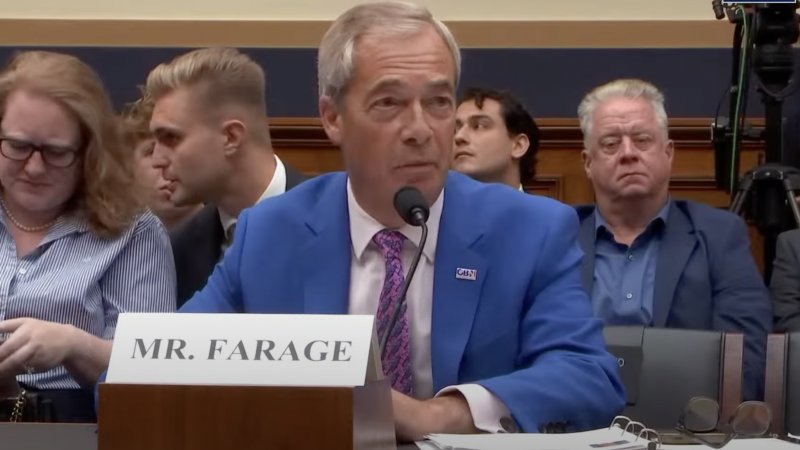
Nigel Farage was grilled by Democrat politicians over his support for Donald Trump and Reform’s banning of journalists during a visit to the US Congress yesterday.

Farage skipped PMQs to give evidence on freedom of speech at the US House Judiciary Committee.

Democratic representative Hank Johnson questioned Farage on his regular appearances at Make America Great Again (MAGA) rallies, accusing him of trying to “ingratiate himself” with tech billionaires so he can become prime minister.

The congressman asked Farage to confirm his party has four MPs. Johnson then said: “So you are indeed the leader of a fringe party. As a fringe party leader seeking to run for prime minister of Great Britain, you need a lot of money in order to blow up like the Maga (Make America Great Again) movement has blown up.”

“You need money from Elon Musk in order to get elected prime minister of Great Britain, that’s the bottom line,” he added.

He also said to Farage: “You’re trying to ingratiate yourself with the tech bros by coming over here.”

Johnson also accused Farage of advocating for the UK to pay tariffs if tech companies are not allowed to violate British laws.

Farage called the Online Safety Act “a danger” to trade between the US and the UK and said he hoped American companies and politicians have honest conversations with the British government about the legislation. He said he has not suggested sanctions.

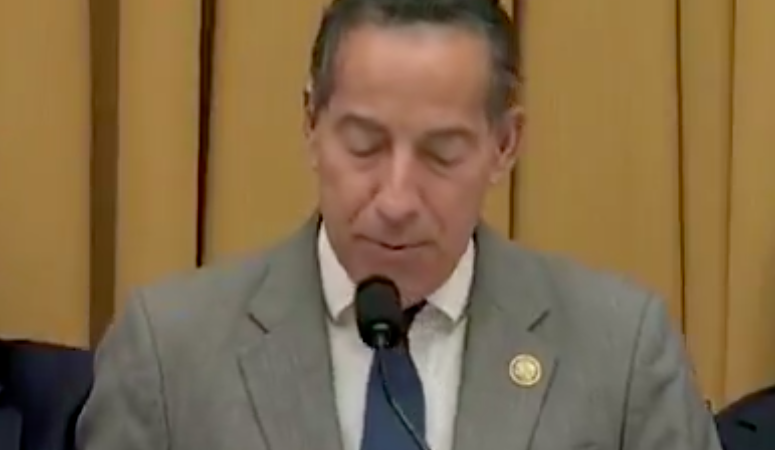
Congressman Jamie Raskin asked Farage why Reform bans journalists who oppose his party’s views. Farage claimed “I am the most open person to any journalist”.

“Undoubtedly, you’re the most handsome person in the world, but that’s not my question. My question is why do you ban journalists you disagree with from your political events, like from your convention?,” Raskin added.

Farage denied any recollection of having banned media organisations from Reform conference or other events. “If I go back the last 25 years, I can’t think of banning anybody. But I mean, maybe somebody else did,” he said.

Last September, Byline Times and investigative climate outlet were banned from attending Reform conference, as well as ex-Guardian journalist Carole Cadwalladr.

In a statement to the British public, Raskin said: “To the people of the UK who think this Putin-loving free speech impostor and Trump sycophant will protect freedom in this country: come on over to America and see what Trump and Maga are doing to destroy our freedom […] and turn the government into a money-making machine for Trump and his family. You might … think twice before you let Mr Farage make Britain great again.”

Olivia Barber is a reporter at Left Foot Forward

US congressman shows UK media how to expose Nigel Farage for his hypocrisy and love of autocrats


4 September, 2025 

One can only dream of sections of the right-wing press in the UK holding Farage to account in the same way.


A US congressman is being praised for taking apart Nigel Farage is a blistering speech, in which he highlighted the Reform UK leader’s hypocrisy over free speech and his cosying up to dictators and autocrats.

Rather than return to Parliament after the summer recess, Farage decided to once more jet off to the U.S. where he not only rubbed shoulders with Trump loyalists but also to attend a Congressional inquiry into freedom of speech, where he falsely claimed that freedom of speech is under attack in the UK.

As part of evidence given to the House of Representatives Judiciary Committee, Farage said: “On the question of civil liberties, Britain has, unfortunately, now lost her way.

“I will do my part, as a participant in UK democracy, to help our country find its way back to the traditional freedoms which have long bound together our two countries in friendship.”

However, one Congressman was having none of it. Jamie Raskin, the U.S. representative for Maryland’s 8th congressional district since 2017, slammed Farage as a “Putin-loving free speech imposter”.

In a blistering speech, Mr Raskin said: “To the people of the UK who think this Putin-loving free speech imposter and Trump sycophant will protect freedom in your country, come on over to America and see what Trump and Maga are doing to destroy our freedom … You might think twice before you let Mr Farage ‘make Britain great again’.”

He also told Farage there is ‘no free speech crisis in Britain’, and added: “UK Prime Minister Keir Starmer has not shutdown GB News where Mr Farage has his own show, just because Mr Farage has used his airtime to call for banning peaceful protests that he disagrees with, no one has stopped him from going on Russian TV, 17 times and saying that the one world political leader he most admired is Vladimir Putin, even though Putin is a war criminal and dictator.”

One can only dream of sections of the right-wing press in the UK holding Farage to account in the same way. Indeed, in just over two minutes, a US congressman has done more to expose Nigel Farage’s hypocrisy on free speech and his love of autocrats and dictators like Putin, than sections of the press in the UK have for decades.

British-American journalist and commentator Mehdi Hasan posted on X: “I have spent years saying I wished the US were more like the UK when it comes to tough interviews, but here’s a turning of the tables: @jamie_raskin grilling @Nigel_Farage in a way the UK media rarely does.”

Basit Mahmood is editor of Left Foot Forward

Nigel Farage skips Parliament to go to hard-right US conference but misses speaking slot


Olivia Barber 
3 September, 2025 
Left Foot Forward 

Farage arrived in Washington DC too late to speak


Nigel Farage skipped the start of the first week back in Parliament to attend a hard-right conference in the US, only to miss his speaking slot due to “transport issues”.

Farage was supposed to give a speech at the National Conservatism conference yesterday, but was a no show due to arriving in Washington DC too late.

According to The Mirror, Farage was scheduled to speak about “getting mass deportations done”, alongside Donald Trump’s Director of National Intelligence Tusli Gabbard and his former advisor Steve Bannon.

The ex-MP for Clacton and co-founder of Vote Leave, Douglas Carswell, who now lives in the US, was present at the hard-right event.

Hedge fund manager and Republican donor Tom Klingenstein filled in for Farage, giving a speech about “white guilt”, which he argued was “the problem of our time”.

Today, Farage will miss PMQs to give evidence at the US Congress’ Judiciary Committee, as part of its investigation into “Europe’s threat to American Speech and Innovation”.

The Reform leader is expected to speak to the committee about the case of Lucy Connolly, who was jailed after pleading guilty to inciting racial hatred against asylum seekers, as evidence of supposed threats to freedom of expression in the UK.

Connolly called for hotels housing asylum seekers to be set on fire.

Farage also said he will speak about Graham Linehan, who was arrested yesterday on suspicion of inciting violence on social media, after sharing his views on trans rights.

While Farage speaks about the importance of free speech in the US, back in the UK a Reform-led council has banned journalists from reporting on its activities.

Deputy leader of Reform Richard Tice and Lee Anderson have spoken in support of Nottinghamshire County Council’s decision.

Olivia Barber is a reporter at Left Foot Forward


Nigel Farage goes to America to complain about a lack of free speech in UK, while Reform bans journalists at home
3 September, 2025 


So much for Reform’s tolerance of free speech.


TweetShareWhatsAppMail


You couldn’t make it up! Nigel Farage is once more being accused of breathtaking hypocrisy, after he jetted off to the U.S. once again, missing the opening of Parliament, to complain about a ‘lack of free speech’ in the UK, while his own party bans journalists at home.

As well as speaking alongside Trump loyalists, Farage will also attend a Congress inquiry into freedom of speech, where he will falsely claim that freedom of speech is under attack in the UK. He is expected to raise the case of Lucy Connolly, the Tory councillor jailed for a tweet calling for asylum hotels to be set on fire, as an example of how free speech is being hampered in the UK.


Of course, it doesn’t matter to Farage that Connolly was jailed after pleading guilty to inciting racial hatred.

As part of evidence given to the House of Representatives Judiciary Committee, Farage said: “On the question of civil liberties, Britain has, unfortunately, now lost her way.

“I will do my part, as a participant in UK democracy, to help our country find its way back to the traditional freedoms which have long bound together our two countries in friendship.”

However, Farage’s hypocrisy really is quite something, especially since Reform’s own politicians in the UK are banning journalists from speaking to them.

Last week, a Reform UK council leader’s decision to ban his councillors from engaging with a prominent local newspaper just because he didn’t like what was reported was slammed as a “massive attack on local democracy”.

Nottinghamshire county council, which is run by Reform, said it would no longer deal with the Nottingham Post, its online edition and a team of BBC-funded local democracy journalists that it manages, after they didn’t like a story about plans for a local government restructure.


So much for Reform’s tolerance of free speech.

Basit Mahmood is editor of Left Foot Forward


Australian state halts logging for koala haven


By AFP
September 6, 2025


The koala population in Australia's eastern state of New South Wales is threatened with extinction, environmentalists say - Copyright AFP DAVID GRAY

Australia’s eastern state of New South Wales halted logging in a large stretch of woodland Sunday to create a retreat for koalas and save the local population from extinction.

The state government imposed a ban effective from Monday on logging across 176,000 hectares (435,000 acres) of forest on the north coast for a Great Koala National Park, hitting six timber mills and about 300 workers.

Without action, it warned that koalas in Australia’s most populous state could die off by 2050.

Environmentalists say koala numbers in New South Wales have suffered a dramatic decline in recent decades due to deforestation, drought and bushfires.

“Koalas are at risk of extinction in the wild in NSW — that’s unthinkable. The Great Koala National Park is about turning that around,” said New South Wales Premier Chris Minns.

“We’ve listened carefully and we’re making sure workers, businesses and communities are supported every step of the way.”

State officials contacted each affected mill, the government said in a statement, vowing to provide payments to cover workers’ salaries and business costs while offering free access to training, financial, health and legal services.

The state government first announced the planned koala haven in 2023 but it only stopped logging in 8,400 hectares of forest. The plan was also criticised for not protecting trees immediately.

– Gliding marsupials –

The Great Koala National Park will provide a refuge to more than 12,000 koalas, 36,000 greater gliders — nocturnal marsupials with a membrane that lets them glide — and more than 100 other threatened species, officials said.

The government said it would invest Aus$6 million (US$4 million) to support new tourism and small business opportunities in the area.

It also boosted funding to create the park by Aus$60 million — in addition to Aus$80 million announced in 2023.

“This park will ensure future generations will be able to see koalas, greater gliders and other threatened species in the wild for many years to come,” said Gary Dunnett, chief executive of the state’s National Parks Association.

“The permanent protection of this magnificent area will also safeguard critical water catchments for the people of the Coffs Coast, protect sacred Indigenous sites and open up huge economic opportunities for regional green tourism. It is truly a win-win for the people of NSW and nature.”

When connected with existing national parks, the koala haven would create a 476,000-hectare reserve, the state government said.

Final creation of the koala park will depend on it being registered by the federal government as a carbon project for improved management of native forest, the state said. That assessment was underway.
‘Build, baby, build’: Canada PM’s plan to counter Trump


By AFP
September 6, 2025


Copyright Trans Mountain Corporation/AFP Handout


Geneviève NORMAND

On the night he won Canada’s election, Prime Minister Mark Carney summarized his plan to jumpstart the country’s economy in response to President Donald Trump’s threats.

“Build, baby, build!” Carney told a jubilant crowd of Liberal party supporters in April.

In the early weeks of his first term, Carney’s plans to build have taken shape, headlined by the new “Major Projects Office”, launched last month to spearhead the construction of ports, highways, mines and perhaps a new oil pipeline — a contentious subject for groups concerned about the environment.

The office, which is expected to announce its priorities in the coming days, was formed after Carney’s Liberals secured cross-party support to pass legislation empowering his government to fast-track “nation-building projects.”

“We are moving at a speed not seen in generations,” Carney said, a level of urgency he argues is required as Trump reshapes the global economy.

Trump’s threats to annex Canada have eased, but his trade war is hurting the Canadian economy.

US tariffs on autos, steel and aluminum have squeezed the three crucial sectors and led to job losses.

The unemployment rate hit 7.1 percent in August, the highest level since 2016 outside of the pandemic.

That “adds to evidence that the trade war is taking its toll on Canadian labor markets,” RBC senior economist Claire Fan said this week.


– ‘Economy in peril’ –


Since entering politics earlier this year, Carney has insisted Canada needs to break its decades-long reliance on US trade by revitalizing internal commerce while pursuing new markets in Europe and Asia.

During a visit to Germany last month, Carney said his government was “unleashing half a trillion dollars of investment” in infrastructure for energy, ports and other sectors.

Jay Khosla, an energy expert at the Public Policy Forum, said the momentum to build would not have been possible without Trump.

“We know our economy is in peril,” he said, noting Canada was effectively “captured economically,” because of its closeness to the United States.


– ‘Energy superpower’? –


Canada is the world’s fourth largest oil exporter and its crude reserves are the world’s third largest.

Most of its resources are in the western province of Alberta, which exports almost exclusively to the United States, as Canada lacks the infrastructure to efficiently get energy products to other foreign markets.

Former prime minister Justin Trudeau, Carney’s predecessor, put climate change at the center of his political brand and faced criticism from some over his perceived lack of support for the energy sector.

In a shift from the Trudeau era, Carney’s Liberals now support exporting liquefied natural gas (LNG) to Europe.

“What we heard loud and clear from German LNG buyers and LNG users is they believe there is demand and they want to buy our products” Energy Minister Tim Hodgson said in Berlin las

But not everyone is enthusiastic about that plan.


Greenpeace has accused the prime minister of backing “climate-wrecking infrastructure” while ignoring clean energy.

Carney could likely press ahead despite concerns from pro-climate NGOs, but support from Indigenous leaders — for whom safeguarding the environment is top priority — is seen as essential.

Despite Carney’s efforts to secure Indigenous backing for his major projects push, their concern persists.

“We know how it feels to have Trump at our border. Let’s not do that and have Trump-like policies,” said Cindy Woodhouse, the national chief of the Assembly of First Nations, in a swipe at Carney’s backing for energy infrastructure.

“Let’s take the time and do things properly.”
Salmon are being harmed by pharmaceutical pollution


Pharmaceutical pollutants are an emerging global issue


By Dr. Tim Sandle
EDITOR AT LARGE SCIENCE
DIGITAL JOURNAL
September 6, 2025


Salmon like these are dying prematurely at fish farms in Norway - Copyright AFP BAY ISMOYO

With pharmaceutical waste, the goal is maintaining safety, environmental responsibility, and legal compliance.

Despite some technological advances and greater adherence to regulations, pharmaceutical waste remains an environmental concern. In many parts of the world, water entering the streams from wastewater treatment plants that are designed to break down pharmaceutical manufacturing waste contains concentrations of pharmaceuticals between multiple times higher than water released into the environment from standard utility plants.

Pharmaceutical waste includes antimicrobials (fuelling antimicrobial resistance among pathogenic species of bacteria), muscle relaxants, and opioids.

As well as environmental pollution, there are concerns about pharmaceuticals that are not processed but instead enter into illegal markets. Many nations have regulations designed to prevent this, such as the US Drug Enforcement Administration (DEA), which requires all controlled substances to be destroyed in a way that renders them “non-retrievable”; however, this does not entirely prevent theft and illegal trading.

Clobazam pollution


In terms of environmental impact, a recent study conducted in Sweden demonstrates the risks. Research reveals commonly detected environmental levels of clobazam — a medication often prescribed for sleep disorders — increased the river-to-sea migration success of juvenile salmon in the wild.

Salmon pens belonging to the Tassal company located off Charlotte Cove, in the d’Entrecasteaux Channel in Tasmania. – Copyright AFP Gregory PLESSE

In addition, traces of the drug shortened the time it took for juvenile salmon to navigate through two hydropower dams along their migration route — obstacles that typically hinder successful migration.

Clobazam is used for its anxiolytic effect and as an adjunctive therapy in epilepsy. The drug is a type of benzodiazepine, a class of central nervous system depressant medications. Clobazam has two major metabolites: N-desmethylclobazam and 4′-hydroxyclobazam, the former of which is active.

The scientists from the Swedish University of Agricultural Sciences employed slow-release pharmaceutical implants and animal-tracking transmitters to monitor how exposure to clobazam and the opioid painkiller tramadol — another common pharmaceutical pollutant — affected the behaviour and migration of juvenile Atlantic salmon (Salmo salar) in Sweden’s River Dal as they migrated to the Baltic Sea.

Atlantic salmon are the largest species in the genus Salmo. After two years at sea, the fish average 71 to 76 cm (28 to 30 in) in length and 3.6 to 5.4 kg (7.9 to 11.9 lb) in weight.

This is significant because any change to the natural behaviour and ecology of a species is expected to have broader negative consequences both for that species and the surrounding wildlife community.

While the recent decline of Atlantic salmon is primarily attributed to overfishing, habitat loss, and fragmentation — leading to their endangered status — the study highlights how pharmaceutical pollution could also influence key life-history events in migratory fish.

Pharmaceutical pollutants are an emerging global issue


Commenting on the research, Dr Marcus Michelangeli from Griffith University’s Australian Rivers Institute states: “Pharmaceutical pollutants are an emerging global issue, with over 900 different substances having now been detected in waterways around the world. Of particular concern are psychoactive substances like antidepressants and pain medications, which can significantly interfere with wildlife brain function and behaviour.”

By designing drugs that break down more rapidly or become less harmful after use, pharmaceutical companies can improve and significantly mitigate the environmental impact of pharmaceutical pollution.

The research appears in the journal Science, titled “Pharmaceutical pollution influences river-to-sea migration in Atlantic salmon (Salmo salar)”.
REST IN POWER
Rosa Roisinblit, activist for Argentina’s ‘stolen’ children, dies at 106

By AFP
September 6, 2025


Rosa Tarlovsky de Roisinblit photographed at her home in Buenos Aires on July 20, 2016 - Copyright AFP/File JUAN MABROMATA

Rosa Tarlovsky de Roisinblit, a prominent activist for victims of Argentina’s 1976-1983 dictatorship, died Saturday, her organization said. She was 106.

“We only have words of gratitude for her dedication, her solidarity and the love with which she searched for the grandsons and granddaughters until the very end,” the Grandmothers of the Plaza de Mayo campaign group said in a statement.

Roisinblit was born in 1919 in Moises Ville, a town of Jewish immigrants in central Argentina, and was an obstetrician by trade.

Alongside other mothers whose family members disappeared during Argentina’s dictatorship, Roisinblit demanded to know the whereabouts of her missing relatives.

Her pregnant daughter Patricia Roisinblit and son-in-law — both militants of the armed Peronist group Montoneros — were kidnapped in 1978.

Patricia is believed to have given birth in a basement before the baby was taken from her. She and her husband’s bodies were never found.

More than 20 years later, in 2000, Roisinblit was reunited with her grandson Guillermo through her activist organization.

He was among 140 people that the Grandmothers group has reunited with their families.

Roisinblit also fought for decades to see the military personnel involved in her daughter’s kidnapping brought to justice.

In 2016, she was in the courtroom when two former air force commanders and an ex-intelligence officer were sentenced to prison on charges of kidnapping and torture.

“The pain is still there, this wound never heals… But to say I’m stopping? No, I’ll never stop,” she told AFP at the time, at the age of 97.

Campaigners say 30,000 people were victims of forced “disappearances” under Argentina’s military dictatorship.

Roisinblit’s group says there are 300 “stolen grandchildren” — born in captivity or kidnapped with their parents — yet to be found.

“We fight but the heroes are our children who rose up against a fierce dictatorship and gave their lives for a better country,” she told AFP in 2016.

How a Century of Anti-Communism Cleared the Way for Trump’s Authoritarianism

This trope has long been used to justify repression of anarchists, communists, liberals, immigrants, and unions.


September 3, 2025

Listening to the incendiary rhetoric emanating from Trump and MAGA world, one would think the United States of today, decades after the collapse of the communist bloc, was enmeshed in an existential struggle against communism. Even before his election win in 2024, Trump claimed his opponents’ economic policies were at the extremes of leftism. Kamala Harris, he said, had gone “full communist.” With Trump setting the tone — and now ensconced in the White House — his minions have amplified that rhetoric as a way of justifying their repressive onslaught. For example, Homeland Security Director, and anti-immigrant stormtrooper, Kristi Noem told the press in July that liberals “are actually turning out to be a bunch of communists and Marxists.” In like fashion, Trump’s Deputy Chief of Staff Steven Miller — speaking in Washington’s Union Station after the military was dispatched to that city, proclaimed, “We’re not going to let the communists destroy a great American city.” The tenor and tone of all this show no signs of abating, as the fascistic moves and raw assertion of power continues.

That the trope of anti-communism is being invoked and retains such power, is in no small measure a testament to the legacy of the anti-communist initiatives of the 20th century. This writer’s forthcoming book, Menace of Our Time: The Long War Against American Communism, takes a deeper dive into that history. Given the moment we find ourselves in, it is worth exploring some.
Beginnings

In 1901, President William McKinley was assassinated at the Pan-American Exposition in Buffalo, New York. What followed was a wave of repression in which his assassin, an erstwhile anarchist named Leon Czolgosz, was tried and executed, all within two months of the shooting. In the aftermath, New York State passed a law proscribing what it called “criminal anarchy,” making it a felony to advocate — not plan for, let alone move to carry out — revolution. The law would serve as a major weapon against organized leftists, specifically communists, who emerged in the early years of the 20th century.

Fast-forward 18 years, and an anarchist bombing at the home of U.S. Attorney General A. Mitchell Palmer triggered the Palmer Raids, a key chapter of what would come to be called the First Red Scare — a government roundup of thousands of anarchists and communists, hundreds of whom would be deported. Arrested in this period and prosecuted under the criminal anarchy law was the then-communist Benjamin Gitlow, convicted and imprisoned for publishing a document called The Left-Wing Manifesto. The conviction, appealed all the way to the Supreme Court, was upheld. As the court wrote in its opinion, “It cannot be said that the State is acting arbitrarily or unreasonably when, in the exercise of its judgment as to the measures necessary to protect the public peace and safety, it seeks to extinguish the spark without waiting until it has enkindled the flame or blazed into the conflagration.” This principle of anti-advocacy — a fundamental negation of the First Amendment — would remain the law of the land for decades. It would also be a major instrument leveled against domestic communists.

This period also saw the rise of a young up-and-comer in the U.S. Justice Department: J. Edgar Hoover. Hoover, who was modernizing the Bureau of Investigation (later the Federal Bureau of Investigation), created a filing system of anarchists and communists that would be a cornerstone of the FBI’s work going forward. The bureau also deployed government informants who gathered intelligence, facilitated raids, and spread insidious rumors about the loyalty of dedicated comrades. It was a methodological template that would come to serve the FBI well.

Related Story

The Red Scare Overlapped With Another State-Sanctioned Panic: The Black Scare
Rooted in white people’s fear of Black Nationalism, the Black Scare was conjoined with the anti-communist Red Scare. By Charisse Burden-Stelly 
UniversityofChicagoPress/TruthoutFebruary 2, 2024

While the fallout from the Palmer Raids subsided by the mid-1920s, the communists, who would cohere into the Communist Party USA (CPUSA or CP), would become the preeminent target of the FBI and other anti-communist forces. In doing so, it confronted the repressive bite of not only the bureau, but also the anti-syndicalism and criminal anarchy laws that had been passed in nearly every state in the U.S. — to say nothing of the routine harassment by right-wing forces and local police.
Depression and World War

Such was the situation as the country entered the Great Depression. It was during this time that rank-and-file communists and their supporters fought for unions, the unemployed, and opposed lynchings and the larger Jim Crow system. In doing so, they confronted unceasing pushback — firings, violent attacks on their meetings, arrests on the picket lines, beatings by police, and even killings. All of this was facilitated by a media sounding a hyperbolic alarm against a communist menace.

That alarm would grow shriller as the country approached World War II. The communists, whose initial anti-war position was at cross purposes with the administration of Franklin Delano Roosevelt, were targeted by early predecessors of the House Committee on Un-American Activities. They also saw their leader, Earl Browder, imprisoned for traveling under a false passport. At the same time, new anti-communist laws were enacted: the Voorhis Act, requiring the registration of agents of a foreign power (i.e., the CP); the Hatch Act, proscribing communists in government; and the Smith Act against teaching the principles of revolution. It was also during this time that Roosevelt bestowed extraordinary powers on the FBI to target domestic communism. That led to measures such as the creation of a custodial detention list — essentially a concentration camp scheme to round up communists if an emergency order was given. When the communists abandoned their anti-war position with the Nazi invasion of the Soviet Union, the repression abated — though hardly ended. It was a circumstance that would not last.
Dangerous Public Opinion

With the onset of the Cold War, the government undertook its most aggressive wave of anti-communist repression ever, imprisoning or holding under indictment dozens of the party’s top leaders by way of the Smith Act. This formal repression also fostered a social climate where communists became pariahs of the first order.

An indication of how deeply anti-communist sentiment penetrated the public consciousness could be seen in a 1954 poll by the Opinion Research Corporation. When asked if congressional committees hurt innocent people, 49 percent of the respondents said yes. Then, when asked if innocent people could be hurt in the process, 58 percent said, hurt or not, it was more important to uncover communists. The vast majority of Americans also said that communists should be stripped of citizenship, that the government should be allowed to tap their phones, and that it was a good idea “for people to report to the FBI any neighbors or acquaintances whom they suspected of being communists.” That this repression garnered such support — despite the modest actual influence of U.S. communists — was an example of how a negative consensus could be built through unrelenting demagoguery. In the fifties and to a lesser degree in the sixties, it was communism; in the eighties and nineties, it was terrorism, in the wake of 9/11 it was Islam, first Al Qaeda, then ISIS, and now again it is “the communists” and “the woke left.” The names may have changed, but the methodology has not.

A Vicious COINTELPRO

While the fever pitch of the Second Red Scare would lessen as the fifties gave way to the sixties, the pursuit of the CP did not. This era witnessed the initiation of the FBI’s Counterintelligence Program (COINTELPRO) aimed at the CPUSA, the first and most extensive in this notorious disruption effort.

One example can offer insight into the program’s myriad operations: the case of Aaron Libson, a closeted gay man and communist activist living in Philadelphia. In 1966, Libson was arrested by undercover police in a “tearoom” — a restroom in a public park used for gay encounters — on a sodomy charge. When the FBI, who knew Libson was a communist, learned of the arrest, they snapped into action with a COINTELPRO operation. As an FBI memorialized, the point was to “neutralize Libson with the party and embarrass the party generally.” To achieve this, they anonymously called James Dolsen, the head of the Philadelphia CP, as well as one of their press contacts “who has been used quite successfully in the Counterintelligence Program and has always protected the Bureau’s interests.”

Libson describes what followed:

“When I had the arrest, I pleaded nolo contendere — I do not wish to contend — on a Friday. The next day, Saturday, I woke up and got ready for work, and as I looked at the paper that morning, there was a small article saying, ‘Local Red arrested.’ I had a suicide plan ready just in case it came out, so I thought, OK, this is it and I carried out the plan. … I wasn’t going to do anything at my house where my family would find me, so I rented a room at the Arch Street YMCA. I’d packed some of the crystal stuff you clean toilets in some tin foil, and I swallowed that and laid down and waited for something to happen. Nothing happened. In the interim, I’d called a friend of mine. While I was waiting for something to happen with the poison, I got up and sat on the window ledge — the room was on the fifth floor. As I realized the poison wasn’t working.”

Fortunately, the friend stopped things from going further. For its part, the Bureau counted this as a victory. As the noted in a memo detailing various COINTELPRO operations, “After Libson entered a guilty plea in February 1967, the fact was published in a newspaper, Daniel Rubin, National Organizational Secretary, stated Libson was dropped from the CP.”

While COINTELPRO officially came to an end after being exposed in the early 1970s, the surveillance and attention to the CP did not. In 1978 Congress established the Foreign Intelligence Surveillance Court which allowed for the legal wiretapping of those the US considered foreign agents, which included the pro-Soviet, CPUSA. The Bureau also kept in place its informant Morris Childs, who was acting as CP General Secretary Gus Hall’s liaison with the Soviets — a paradoxical circumstance of the Bureau both facilitating the funding of the CP, something Child’s was responsible for, while also garnering precious intelligence — and then there was the FBI’s investigation of the Committee in Support of the People of El Salvador (CISPES) because of perceived communist infiltration. With the collapse of the USSR in 1991, the extraordinary attention to the CPUSA ended, if not the legal and extralegal measures against other perceived enemies.

Were all this a matter of the past, it would be bad enough, but this history has thrust itself into the present. The Alien Enemies Act of 1798, used against communists and anarchists during the Palmer Raids of 1920, was leveled in 2025 against Kilmar Abrego Garcia and Mahmoud Khalil. Trump has talked about stripping immigrant citizens of naturalization; meanwhile, the MAGA shock troops have set their sights on the political opposition. Elise Stefanik, the MAGA congresswoman from New York, has called New York City’s mayoral candidate Zohran Mamdani a “raging antisemite communist.” The methodology behind this is hardly concealed. Trump, while running for president in the summer of 2024, made this clear: “All we have to do is define our opponent as being a communist or a socialist or somebody who is going to destroy our country.”

While this effort has not been wholly successful, it is a significant problem that no small number of people are swayed by this. In that sense, knowing a little history can serve as a weapon.


This article is licensed under Creative Commons (CC BY-NC-ND 4.0), and you are free to share and republish under the terms of the license.

Aaron J. Leonardis an author and historian. His current book is Menace of Our Time: The Long War Against American Communism (Rutgers University Press).