Saturday, September 06, 2025

Gaza’s Looming Cancer Epidemic

The Many Ways Bombs Can Kill


by  | Sep 5, 2025 | 

Originally appeared at TomDispatch.

Honestly, can you believe it? Only a couple of weeks after Israeli forces targeted and killed four Al Jazeera journalists in a tent outside al-Shifa Hospital in Gaza City, it happened again. This time, at least five journalists, including one who “had reported for The Associated Press on children being treated for starvation at the same facility,” died in a second Israeli air strike on Nasser Hospital in the city of Khan Younis in southern Gaza, after rescuers (and journalists covering them) rushed to deal with the initial strike on the top floor of one of that hospital’s buildings. All told, in fact, it seems that nearly 200 journalists and media workers of various sorts have been killed (or should the word be slaughtered?) since the war in Gaza began.

Even for wars, such figures are staggering — and, of course, they’re only part of the almost unimaginable toll of dead and wounded in that remarkably small 25-mile strip of land that’s been the focus of Israeli devastation since the nightmarish Hamas attack on Israel occurred almost two years ago.

And worse yet, as TomDispatch regular Joshua Frank reports today, whatever the casualty figures from that ongoing slaughter may prove to be when the fighting finally stops (assuming it does someday), it will be anything but the final count. At least it won’t be if you include all of the human beings devastated by the conflict. Sadly, in some fashion, we really do need to add to that count a potential epidemic of casualties from cancer that are likely to be caused by that nightmarish war. Let Frank explain. ~ Tom Engelhardt


Gaza’s Looming Cancer Epidemic

By Joshua Frank

A week after the Hamas attacks on October 7, 2023, a large explosion incinerated a parking lot near the busy Al-Ahli Arab Hospital in Gaza City, killing more than 470 people. It was a horrifying, chaotic scene. Burnt clothing was strewn about, scorched vehicles piled atop one another, and charred buildings surrounded the impact zone. Israel claimed the blast was caused by an errant rocket fired by Palestinian extremists, but an investigation by Forensic Architecture later indicated that the missile was most likely launched from Israel, not from inside Gaza.

In those first days of the onslaught, it wasn’t yet clear that wiping out Gaza’s entire healthcare system could conceivably be part of the Israeli plan. After all, it’s well known that purposely bombing or otherwise destroying hospitals violates the Geneva Conventions and is a war crime, so there was still some hope that the explosion at Al-Ahli was accidental. And that, of course, would be the narrative that Israeli authorities would continue to push over the nearly two years of death and misery that followed.

A month into Israel’s Gaza offensive, however, soldiers of the Israel Defense Forces (IDF) would raid the Indonesian Hospital in northern Gaza, dismantling its dialysis center with no explanation as to why such life-saving medical equipment would be targeted. (Not even Israel was contending that Hamas was having kidney problems.) Then, in December 2023, Al-Awda Hospital, also in northern Gaza, was hit, while at least one doctor was shot by Israeli snipers stationed outside it. As unnerving as such news stories were, the most gruesome footage released at the time came from Al-Nasr children’s hospital, where infants were found dead and decomposing in an empty ICU ward. Evacuation orders had been given and the medical staff had fled, unable to take the babies with them.

For those monitoring such events, a deadly pattern was beginning to emerge, and Israel’s excuses for its malevolent behavior were already losing credibility.

Shortly after Israel issued warnings to evacuate the Al-Quds Hospital in Gaza City in mid-January 2024, its troops launched rockets at the building, destroying what remained of its functioning medical equipment. Following that attack, ever more clinics were also targeted by Israeli forces. A Jordan Field Hospital was shelled that January and again this past August. An air strike hit Yafa hospital early in December 2023. The Nasser Medical Complex in Khan Younis in southern Gaza was also damaged last May and again this August, when the hospital and an ambulance were struck, killing 20, including five journalists.

While human-rights groups like the International Criminal Court, the United Nations, and the Red Cross have condemned Israel for such attacks, its forces have continued to decimate medical facilities and aid sites. At the same time, Israeli authorities claimed that they were only targeting Hamas command centers and weapons storage facilities.

The Death of Gaza’s Only Cancer Center

In early 2024, the Turkish-Palestinian Friendship Hospital, first hit in October 2023 and shuttered in November of that year, was in the early stages of being demolished by IDF battalions. A video released in February by Middle East Eye showed footage of an elated Israeli soldier sharing a TikTok video of himself driving a bulldozer into that hospital, chuckling as his digger crushed a cinderblock wall. “The hospital accidentally broke,” he said. Evidence of Israel’s crimes was by then accumulating, much of it provided by the IDF itself.

When that Turkish-Palestinian Friendship Hospital opened in 2018, it quickly became Gaza’s leading and most well-equipped cancer treatment facility. As the Covid-19 pandemic reached Gaza in 2020, all oncology operations were transferred to that hospital to free up space at other clinics, making it the only cancer center to serve Gaza’s population of more than two million.

This hospital will help transform the health sector,” Palestinian Health Minister Jawad Awwad said shortly before its opening. “[It] will help people who are going through extreme difficulties.”

Little did he know that those already facing severe difficulties due to their cancer diagnoses would all too soon face full-blown catastrophe. In March 2025, what remained of the hospital would be razed, erasing all traces of Gaza’s once-promising cancer treatment.

Before October 7, 2023, the most common cancers afflicting Palestinians in Gaza were breast and colon cancer. Survival rates were, however, much lower there than in Israel, thanks to more limited medical resources and restrictions imposed by that country. From 2016 to 2019, while cases in Gaza were on the rise, there was at least hope that the hospital, funded by Turkey, would offer much-needed cancer screenings that had previously been unavailable.

“The repercussions of the current conflict on cancer care in Gaza will likely be felt for years to come,” according to a November 2023 editorial in the medical journal Cureus. “The immediate challenges of drugs, damaged infrastructure, and reduced access to specialized treatment have long-term consequences on the overall health outcomes of current patients.”

In other words, lack of medical care and worse cancer rates will not only continue to disproportionately affect Gazans compared to Israelis, but conditions will undoubtedly deteriorate significantly more. And such predictions don’t even take into account the fact that war itself causes cancer, painting an even bleaker picture of the medical future for Palestinians in Gaza. 

The Case of Fallujah

When the Second Battle of Fallujah, part of America’s nightmarish war in Iraq, ended in December 2004, the embattled city was a toxic warzone, contaminated with munitions, depleted uranium (DU), and poisoned dust from collapsed buildings. Not surprisingly, in the years that followed, cancer rates increased almost exponentially there. Initially, doctors began to notice that more cancers were being diagnosed. Scientific research would soon back up their observations, revealing a startling trend.

In the decade after the fighting had mostly ended, leukemia rates among the local population skyrocketed by a dizzying 2,200%. It was the most significant increase ever recorded after a war, exceeding even Hiroshima’s 660% rise over a more extended period of time. One study later tallied a fourfold increase in all cancers and, for childhood cancers, a twelvefold increase.

The most likely source of many of those cancers was the mixture of DU, building materials, and other leftover munitions. Researchers soon observed that residing inside or near contaminated sites in Fallujah was likely the catalyst for the boom in cancer rates.

“Our research in Fallujah indicated that the majority of families returned to their bombarded homes and lived there, or otherwise rebuilt on top of the contaminated rubble of their old homes,” explained Dr. Mozghan Savabieasfahani, an environmental toxicologist who studied the health impacts of war in Fallujah. “When possible, they also used building materials that were salvaged from the bombarded sites. Such common practices will contribute to the public’s continuous exposure to toxic metals years after the bombardment of their area has ended.”

While difficult to quantify, we do have some idea of the amount of munitions and DU that continues to plague that city. According to the International Atomic Energy Agency, the United States fired between 170 and 1,700 tons of tank-busting munitions in Iraq, including Fallujah, which might have amounted to as many as 300,000 rounds of DU. While only mildly radioactive, persistent exposure to depleted uranium has a cumulative effect on the human body. The more you’re exposed, the more the radioactive particles build up in your bones, which, in turn, can cause cancers like leukemia.

With its population of 300,000, Fallujah served as a military testing ground for munitions much like those that Gaza endures today. In the short span of one month, from March 19 to April 18, 2003, more than 29,199 bombs were dropped on Iraq, 19,040 of which were precision-guided, along with another 1,276 cluster bombs. The impacts were grave. More than 60 of Fallujah’s 200 mosques were destroyed, and of the city’s 50,000 buildings, more than 10,000 were imploded and 39,000 damaged. Amid such destruction, there was a whole lot of toxic waste. As a March 2025 report from Brown University’s Costs of War Project noted, “We found that the environmental impact of warfighting and the presence of heavy metals are long-lasting and widespread in both human bodies and soil.”

Exposure to heavy metals is distinctly associated with cancer risk. “Prolonged exposure to specific heavy metals has been correlated with the onset of various cancers, including those affecting the skin, lungs, and kidneys,” a 2023 report in Scientific Studies explains. “The gradual buildup of these metals within the body can lead to persistent toxic effects. Even minimal exposure levels can result in their gradual accumulation in tissues, disrupting normal cellular operations and heightening the likelihood of diseases, particularly cancer.”

And it wasn’t just cancer that afflicted the population that stuck around or returned to Fallujah. Infants began to be born with alarming birth defects. A 2010 study found a significant increase in heart ailments among babies there, with rates 13 times higher and nervous system defects 33 times higher than in European births.

“We have all kinds of defects now, ranging from congenital heart disease to severe physical abnormalities, both in numbers you cannot imagine,” Dr Samira Alani, a pediatric specialist at Fallujah General Hospital, who co-authored the birth-defect study, told Al Jazeera in 2013. “We have so many cases of babies with multiple system defects… Multiple abnormalities in one baby. For example, we just had one baby with central nervous system problems, skeletal defects, and heart abnormalities. This is common in Fallujah today.”

While comprehensive health assessments in Iraq are scant, evidence continues to suggest that high cancer rates persist in places like Fallujah. “Fallujah today, among other bombarded cities in Iraq, reports a high rate of cancers,” researchers from the Costs of War Project study report. “These high rates of cancer and birth defects may be attributed to exposure to the remnants of war, as are manifold other similar spikes in, for example, early onset cancers and respiratory diseases.”

As devastating as the war in Iraq was — and as contaminated as Fallujah remains — it’s nearly impossible to envision what the future holds for those left in Gaza, where the situation is so much worse. If Fallujah teaches us anything, it’s that Israel’s destruction will cause cancer rates to rise significantly, impacting generations to come.

Manufacturing Cancer

The aerial photographs and satellite footage are grisly. Israel’s U.S.-backed military machine has dropped so many bombs that entire neighborhoods have been reduced to rubble. Gaza, by every measure, is a land of immense suffering. As Palestinian children hang on the brink of starvation, it feels strange to discuss the health effects they might face in the decades ahead, should they be fortunate enough to survive.

While data often conceals the truth, in Gaza, numbers reveal a dire reality. As of this year, nearly 70% of all roads had been destroyed, 90% of all homes damaged or completely gone, 85% of farmland affected, and 84% of healthcare facilities obliterated. To date, Israel’s relentless death machine has created at least 50 million tons of rubble, human remains, and hazardous materials — all the noxious ingredients necessary for a future cancer epidemic.

From October 2023 to April 2024, well over 70,000 tons of explosives were dropped on Gaza, which, according to the Euro-Med Human Rights Monitor, was equivalent to two nuclear bombs. While the extent and exact types of weaponry used there are not fully known, the European Parliament has accused Israel of deploying depleted uranium, which, if true, will only add to the future cancer ills of Gazans. Most bombs contain heavy metals like lead, antimony, bismuth, cobalt, and tungsten, which end up polluting the soil and groundwater, while impacting agriculture and access to clean water for years to come.

“The toxicological effects of metals and energetic materials on microorganisms, plants, and animals vary widely and can be significantly different depending on whether the exposure is acute (short term) or chronic (long term),” reads a 2021 report commissioned by the Guide to Explosive Ordnance Pollution of the Environment. “In some cases, the toxic effects may not be immediately apparent, but instead may be linked to an increased risk of cancer, or increased risk of mutation during pregnancy, which may not become evident for many years.”

Given such information, we can only begin to predict how toxic the destruction may prove to be. The homes that once stood in the Gaza Strip were mainly made of concrete and steel. Particles of dust released from such crumbled buildings can themselves cause lung, colon, and stomach cancers.

As current cancer patients die slow deaths with no access to the care they need, future patients, who will acquire cancer thanks to Israel’s genocidal mania, will no doubt meet the same fate unless there is significant intervention.

“[A]pproximately 2,700 [Gazans] in advanced stages of the disease await treatment with no hope or treatment options within the Gaza Strip under an ongoing closure of Gaza’s crossings, and the disruption of emergency medical evacuation mechanisms,” states a May 2025 report by the Palestinian Centre for Human Rights. “[We hold] Israel fully responsible for the deaths of hundreds of cancer patients and for deliberately obliterating any opportunities of treatment for thousands more by destroying their treatment centers and depriving them of travel. Such acts fall under the crime of genocide ongoing in the Gaza Strip.”

Israel’s methodical destruction in Gaza has taken on many forms, from bombing civilian enclaves and hospitals to withholding food, water, and medical care from those most in need. In due time, Israel will undoubtedly use the cancers it will have created as a means to an end, fully aware that Palestinians there have no way of preparing for the health crises that are coming.

Cancer, in short, will be but another weapon added to Israel’s ever-increasing arsenal.

Joshua Frank, a TomDispatch regular, is co-editor of CounterPunch and co-host of CounterPunch Radio. He is the author of Atomic Days: The Untold Story of the Most Toxic Place in America, and the forthcoming Bad Energy: The Deep Sea Miners, Rogue Lithium Extractors, and Wind Industrialists Who are Selling Off Our Future, both with Haymarket Books.

Copyright 2025 Joshua Frank

Follow TomDispatch on Twitter and join us on Facebook. Check out the newest Dispatch Books, John Feffer’s new dystopian novel, Songlands (the final one in his Splinterlands series), Beverly Gologorsky’s novel Every Body Has a Story, and Tom Engelhardt’s A Nation Unmade by War, as well as Alfred McCoy’s In the Shadows of the American Century: The Rise and Decline of U.S. Global Power, John Dower’s The Violent American Century: War and Terror Since World War IIand Ann Jones’s They Were Soldiers: How the Wounded Return from America’s Wars: The Untold Story.

Manufactured Famines in Gaza Began Almost Two Decades Ago, So Why Haven’t They Been Halted?

Recently, international media has highlighted the mass famine in Gaza. Yet, there have been effectively three waves of famine in Gaza since spring 2024. First weaponized 18 years ago in the Strip, these hunger games could have been preempted several times. Why weren’t they?


by  | Sep 5, 2025 | 

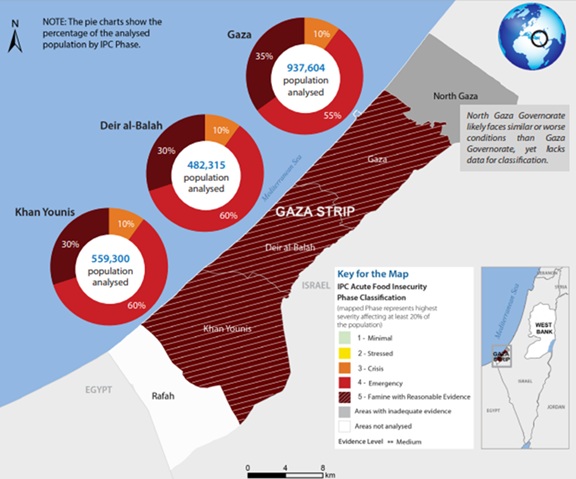
On Friday, August 22, the Integrated Food Security Phase Classification (IPC), the global famine watchdog, declared widespread famine in Gaza. The IPC is regarded as the international gold standard in nutritional crises.

As international media was quick to point out, the declaration meant that a quarter of all Palestinians in Gaza are starving – more than 500,000 people – with that number expected to rise to more than 640,000 within six weeks.

Projected Acute Food Insecurity | 16 August – 30 September 2025

Source: IPC, Aug 22, 2025

What was most damning to most international media is that this outbreak of full famine as described by the IPC and UN agencies had been fully avoidable.

What should be far, far more damning is that several waves of famines have been widespread in Gaza for some 20 months and that precarious conditions of life and episodic famines have prevailed episodically in the Strip since 2007 – that is, for almost two decades.

The blockade since 2006   

In the 2006 Palestinian election, when Hamas won a clear majority in all occupied Palestinian territories, Israel and the Middle East Quartet—U.S., Russia, the UN and EU—launched economic sanctions against the Palestinian Authority, Hamas’s parliamentarians and Palestinian territories. The sanctions were coupled with a blockade, Israel’s attempt to push the Gazan economy “to the brink of collapse,” according to a U.S. diplomatic cable released by Wikileaks.

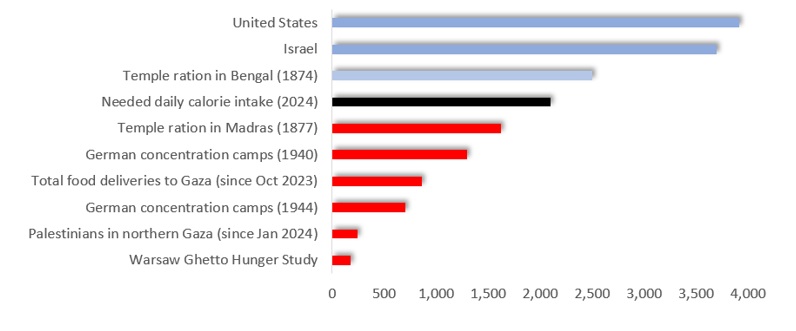
With the inception of its blockade in 2007, the Israeli government estimated how many daily calories were needed to prevent or to cause malnutrition in Gaza. The average daily calorie intake critical to survival is estimated at 2,100 kilocalories (kcal) per day. The Israeli “Red Line” document used a calculation of 2,279 calories per person.

During the 2008–2009 Gaza War, the Strip was subjected to a “Shoah” (Hebrew for Holocaust), as Deputy Defense Minister Matan Vilnai said. The idea was to “send Gaza decades into the past,” stated then commanding general Yoav Gallant.

Some 15 years later, Gallant was targeted by an International Criminal Court warrant “for the war crimes of starvation as a method of warfare.” But in 2009, he and other Israeli leaders complicit in the starvation games were ignored by international community.

The first wave of famine              

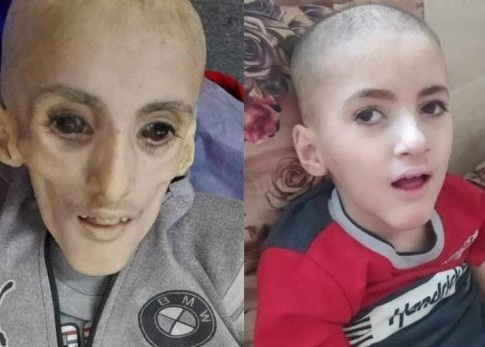
By early 2023 – months before October 7 – four of five Gaza’s residents were largely dependent on humanitarian aid and many suffered from widespread food insecurity, thanks to the Israeli total blockade. In March 2024, the 10-year-old Palestinian boy, Yazan al-Kafarneh, became the face of Gaza’s children. He died from malnourishment.

Yazan al-Kafarneh before the Gaza catastrophe and shortly before his death in March 2024
Source: B’Tselem

Then, just two days after the Hamas offensive of October 7, 2023, Israel blocked the entry of food and water into the Gaza Strip, as it initiated a massive, largely indiscriminate bombardment, with subsequent ground operations.

By December 2023, over 90 percent of the Gaza population was estimated to face high levels of acute food insecurity, with 40 percent at emergency levels and over 15 percent at catastrophe levels. The UN experts cautioned of genocide, warning that Israel was destroying Gaza’s food system and using food as a weapon against the Palestinian people.

Despite mounting evidence, the head of Israel’s Coordination of Government Activities in the Territories (COGAT) for Gaza stated there was no food shortage in Gaza. The IDF alleged Hamas stole humanitarian aid, killed people seeking humanitarian aid and kept its own supply reserves. Yet, both the U.S. and the UN denied Israeli claims that Hamas caused the famine.

It was the first wave of famine in Gaza.

The second wave of famine       

By June 2024, the IPC reported that the entire Gaza population remained at high risk of famine. Three months later, the UN concluded that through its “total siege… Israel’s use of starvation as a method of war would affect the entire population of the Gaza Strip for decades to come, with particularly negative consequences for children.”

As the IPC estimates indicated, the second wave was expected to peak in early 2025. That it did not happen was due to the ceasefire in January 2025.

A second bout of famine was to be facilitated by a controversial General’s Plan,” led by Maj. Gen. (ret.) Giora Eiland, to lay siege to northern Gaza. It was a plan PM Netanyahu was considering. Eiland argued that “Gaza women are the mothers, sisters, and spouses of Hamas murderers.” So, “epidemics in the South [of Gaza] will bring victory closer.”

In late 2024, the IPC projected that through spring 2025, Gaza would remain in an emergency state regarding food insecurity. Some 345,000 people would face extreme lack of food, starvation and exhaustion of their livelihoods and almost 900,000 would be in emergency state.

When the ceasefire fell apart, the second famine wave ensued and Israel blocked all humanitarian assistance to Palestinians in Gaza after March 1, 2025. A month later, at least 60,000 children in Gaza were at risk of serious health complications due to malnutrition.

Toward the third famine wave   

By the end of September, more than 640 000 people across Gaza will face Catastrophic levels of food insecurity; classified as IPC Phase 5. An additional 1.14 million people in the territory will be in Emergency (IPC Phase 4) and a further 396 000 people in Crisis (IPC Phase 3) conditions.

Conditions in North Gaza are estimated to be as severe – or worse – than in Gaza City.

In comparative historical view, weaponized mass starvation is the common denominator of settler colonialism, including American Indian Wars, the German Herero and Nama genocide, the Nazi Hungerplan all the way to the Yemeni civil war and the genocidal atrocities in Gaza. In this role, it is often associated with ethnic cleansing, as the pioneer of the Genocide Convention Raphael Lemkin noted, “after removal of the population and the colonization of the area by the oppressor’s own nationals”.

What about Gaza? Measured in terms of total food deliveries into the Strip since October 2023, the calorie intake was about 860 kcal, a third less than in the Nazi camps over eight decades ago. As the German invasion of the Soviet Union failed and the tide of World War II shifted, the Nazi camps deteriorated, with the daily intake shrinking to 700 kcal in 1944. That’s almost three times the intake of 245 kcal in northern Gaza in the first half of the year 2024, when the New York Post famously headlined that there was no famine in the Strip.

Weaponization of Starvation: Selected Historical Examples

Source: Dan Steinbock (2025) The Obliteration Doctrine, Chapter 1

Missed preemption opportunities 

In May 2018, the UN Security Council adopted unanimously resolution 2417 condemning the starving of civilians as a method of warfare and the unlawful denial of humanitarian access to civilian populations. Yet, in the course of the Gaza catastrophe, most tenets of UNSC Resolution 2417 have been consistently violated.

The recent “moral outrage” can be seen as the West’s belated effort at absolution. In the past 18 years, the path to Gaza’s genocide and mass starvation could have been preempted several times.

  • In 2006, instead of sanctions, the West could have accepted the results of the Palestinian democratic elections. Instead of the subsequent blockade and other regime change efforts, the West could have fostered peaceful development.
  • In 2007, the US could have condemned Israel’s deliberate effort to cause a widespread famine in Gaza.
  • Subsequently, the West could have intermediated peace talks between Israel and Hamas/Palestinian Authority. As Mossad’s ex-chief Efraim Halevy has said, mutual recognition is not a necessary precondition of talks, but the preferred end result.
  • In fall 2023, when Israel declared unilateral siege against Gaza, the West could have preempted the effort with appropriate pressure – U.S. by halting arms transfers, the EU by pausing trade – and used the opportunity to initiate the peace process.
  • In 2024 when Israel triggered the second famine wave in Gaza, the West could have escalated pressure, halt all arms sales and trade with Israel.
  • In 2025, when Israel rejected the ceasefire and intensified Gaza’s mass starvation, the West could have insulated the country from the UN and international community, as it once did with South Africa. When several Israeli intelligence and security leaders openly charge their country for apartheid rule, it is exceedingly hard to understand why the Western powers of the international community would ignore such charges.

That each of these fatal steps in the path to mass starvation and genocide were purposely ignored by the West and vetoed by the United States suggests that “moral outrage” became useful only when the entire Gaza had been decimated and an entire generation of Gazans had been butchered.

It is this deliberate sanctification of mass butchery that will cast a long dark shadow over the West and everything it claims to represent in the early 21st century.

Dr Steinbock’s new book, The Obliteration Doctrine builds on his previous The Fall of Israel.

Dr. Dan Steinbock is an internationally recognized visionary of the multipolar world and the founder of Difference Group. He has served at the India, China and America Institute (US), Shanghai Institutes for International Studies (China) and the EU Center (Singapore). For more, see https://www.differencegroup.net.

This commentary was originally published by Informed Comment (US) on September 2, 2025

“We Will Not Be Silent:” Hearing Stilled Voices of the Gaza Genocide

In his last minutes of freedom before Israeli Defense Forces arrested him, Dr. Hussam Abu Safiya, clad in a medic’s white coat, walked alone toward two Israeli tanks. His captors awaited him amid the rubble of Gaza’s Kamal Adwan hospital. An artist swiftly created a dramatic poster showing Dr. Safiya striding through the ruins of the hospital he directed. The artist, David Solnit, recently updated the poster’s caption. It now reads:   Free Dr. Abu Safiya   Eight months in prison Dec. 27, 2024 – August 27, 2025.

Dr. Safiya had already endured agonizing losses at the Kamal Adwan hospital. In late October 2024, an Israeli drone attack killed his son, also a doctor. In a November 2024 attack on the hospital, Dr. Safiya was wounded by shrapnel, but continued working, insisting he would not close the hospital. He witnessed his colleagues being humiliated, beaten, and marched off to prison. By December 27, 2024, when Dr. Safia’s ordeal as a prisoner began, most hospitals in Gaza were non-functional.

On August 28, 2025, Dr. Safiya’s lawyer, Ghaid Ghanem Qassem, visited him in the Ofer Prison. She reports he has lost one-third of his body weight. While imprisoned in the Sde Teiman military Detention Center, located in an Israeli military base in the Negev desert, he showed signs of torture. Subjected to beating with electric shocks and batons, he sustained blows that may also cause him to lose his right eye. Yet his message remains intact:

“I entered in the name of humanity, and I will leave in the name of humanity… We will remain on our land and continue to provide healthcare services to the people, God willing, even from a tent.”

Regimes conducting a genocide have more than one reason to eliminate brave professionals attempting, life by precious life, to undo their inhuman work: doctors not only seek to slow down the dying, but they, like the journalists the Israeli regime so frantically targets, are specially positioned and specially qualified to accurately report on the intensity and nature of Israel’s extermination campaign. Silencing the citizens most capable of reporting on genocidal savagery is a key objective of genocide.

In one of the most egregious efforts to eliminate a key eyewitness, Israeli naval forces, on May 9, 2025, killed twelve-year-old Mohammed Saeed al-Bardawil, who, as a passerby alongside his father, had witnessed Israel’s March 23rd pre-dawn execution of 15 unarmed emergency rescue workers. The murdered paramedics had driven their clearly marked ambulances to a spot where they intended to retrieve victims of an earlier attack. The bullets that killed them were fired over six minutes as Israeli soldiers advanced to shoot directly into the survivors’ heads and torsos, afterwards using earth-moving equipment to bury their corpses and vehicles. On that day, Mohammed and his father were detained and made to lie face down near a burning ambulance. He is listed as a source in a well-documented NYT video on the massacre, dated May 2nd. Eleven days later, an Israeli gunboat fired on his father’s fishing boat, killing Muhammed in his father’s presence off the coast of Gaza’s southern Rafah governate.

It was less than two weeks ago, on August 25th, that Israel killed Reuters camera operator Hussam Al Masri and nineteen others, four of them also journalists, in a series of double-tap precision-guided aerial attacks on buildings and a stairway of the Al Nasser Hospital. Al Masri was easily targetable as he broadcast a live video feed from a Reuters outpost on a top floor of the hospital. Describing the second wave of the attack,  Jonathan Cook writes:  “And when Israel struck 10 minutes later with two coordinated missiles, it knew that the main victims would be the emergency workers who went to rescue survivors from the first strike and journalists — al-Masri’s friends—who were nearby and rushed to the scene … Nothing was a “mishap.” It was planned down to the minutest detail.”

Snipers and weaponized drone operators routinely kill Palestinians who courageously continue to don bulletproof press jackets, set up cameras, and report on Israel’s atrocities. Israel refuses entry to foreign journalists, and when brave, grieving, impassioned young Palestinians insist on carefully documenting their people’s agony for Western news outlets, Israel carefully targets them using the traceable phone and broadcasting equipment necessary to their work, before posthumously branding them Hamas operatives. Craven Western officials watch from within Israel’s patron states, discounting brown lives on whatever flimsy pretexts white authorities offer them. Almost daily, new faces appear in an assemblage of photos showing hundreds of journalists Israel has killed.

Health care workers and journalists who are still alive do their work amid struggles to prevent their families, their colleagues, their neighbors, and, of course, themselves from deaths not just by direct massacre but by militarily imposed starvation and its handmaiden, epidemic disease. Surgeons speak of being too weak to stand throughout an operation. Reporters document their own starvation.

Palestinians long for protection, but even the prospect of UN-mandated protective forces carries terrifying possibilities. What if “peacekeepers” assigned to monitor Palestinians collect data that the Israelis will use to control them? Weaponized “stabilizing forces,” equipped with U.S. surveillance technology, could be used to target, imprison, assassinate, and starve even more Palestinians.

In the summer of 1942, in Munich, Germany, five students and one professor summoned astonishing courage to defy a genocidal regime to which we, reluctantly, have to look if we want to find a racist cruelty comparable to that currently seizing not just Israel’s leadership but, in poll after poll, strong majorities of its non-native population. The students’ collective, called The White Rose, distributed leaflets denouncing Nazi atrocities. “We will not be silent” was the final line of each leaflet. Hans Scholl, age 24, and his sister, Sophie Scholl, age 21, hand-delivered the leaflets to their university campus in February 1943. The Gestapo arrested them after a janitor spotted them disseminating the leaflets. Four days later, Hans and Sophie, as well as their colleague Christopher Probst, were executed by guillotine.

With Israel’s nuclear arsenal capable of out-killing the Nazi regime over the course of a few minutes, and in the process inciting humanity’s final war; and with its leadership and populace radicalized through decades of fascist impunity to the point of endorsing not just a genocide but multiple, preemptive military strikes upon most of its neighbors at once, we may well be arriving at the moment when, as a result of our having let Israel assassinate, with impunity, the reporters of its crimes, there will be no-one in the outside world left to receive reports.

The silence we allow ourselves today may soon be involuntary and absolute. Let us summon up a fraction of Dr. Safiya’s, of young Mohammad’s, of Sophie Scholl’s, and Hussam al-Masri’s courage and speak while we can.

Kathy Kelly (kathy.vcnv@gmail.com) is the board president of World BEYOND War (worldbeyondwar.org) and a co-coordinator of the Merchants of Death War Crimes Tribunal. (merchantsofdeath.org). Read other articles by Kathy.
At least 21,000 children disabled in Gaza war: UN committee


By AFP
September 3, 2025


Restrictions on humanitarian aid being brought into the Gaza Strip are disproportionately impacting the disabled, said the committee - Copyright AFP Bashar TALEB


Robin MILLARD

At least 21,000 children in Gaza have been disabled since the war between Israel and Hamas began on October 7, 2023, a United Nations committee said Wednesday.

Around 40,500 children have suffered “new war-related injuries” in the nearly two years since the war erupted, with more than half of them left disabled, said the UN Committee on the Rights of Persons with Disabilities.

Reviewing the situation in the Palestinian territories, it said Israeli evacuation orders during the army’s offensive in Gaza were “often inaccessible” to people with hearing or visual impairments, “rendering evacuation impossible”.

At a news conference, committee member Muhannad Al-Azzeh cited the example of a deaf mother in Rafah killed alongside her children, unaware of instructions to evacuate.

“Reports also described people with disabilities being forced to flee in unsafe and undignified conditions, such as crawling through sand or mud without mobility assistance,” the committee said.

Restrictions on humanitarian aid being brought into the Gaza Strip were disproportionately impacting the disabled, said the committee.

“People with disabilities faced severe disruptions in assistance, leaving many without food, clean water, or sanitation and dependent on others for survival,” it said.

– Gaza aid restrictions –

The decision to centralise aid distribution in Gaza has also made it far more difficult for the disabled to access desperately needed assistance, the committee warned.

While the new private US- and Israel-backed Gaza Humanitarian Foundation has four distribution points across the territory, the UN system it has largely replaced had about 400.

“We can’t expect children with disabilities… to be able to run and go to the (aid) points,” said Azzeh.

“This is why one of our main recommendations is that children with disabilities must be reached out to,” as a high priority for humanitarian aid, he said.

Physical obstacles, such as war debris and the loss of mobility aids under the rubble, have also prevented people from reaching the relocated aid points.

The committee said 83 percent of disabled people had lost their assistive devices, with most unable to afford alternatives such as donkey carts.

It voiced concern that devices like wheelchairs, walkers, canes, splints and prosthetics were considered “dual-use items” by the Israeli authorities and were therefore not included in aid shipments.

The committee called for the delivery of “massive humanitarian aid to persons with disabilities” affected by the war.

It said it had been informed of at least 157,114 people sustaining injuries, with over 25 percent at risk of life-long impairments, between October 7, 2023 and August 21 this year.

There were “at least 21,000 children with disabilities in Gaza as a result of impairments, acquired since October 7, 2023”, it said.

The committee urged Israel to adopt specific measures for protecting children with disabilities from attacks, and implement evacuation protocols that take into account persons with disabilities.

Israel should ensure disabled people are “allowed to return safely to their homes and are assisted in doing so”, it added.
UK police arrest 150 people in latest Palestine Action demo

Palestine Action was banned under the UK’s Terrorism Act of 2000

Critics, have condemned the ban as legal overreach and a threat to free speech.

By AFP
September 6, 2025


An elderly protester was taken away by police at the 'Lift The Ban' demo
 - Copyright AFP Tiziana FABI

Some 150 people were arrested in London on Saturday during a tense protest in support of the Palestine Action group, which has been banned under terror laws, police said.

Several hundred people demonstrated in front of the UK parliament, with some holding placards that read: “I oppose genocide. I support Palestine Action.”

The capital’s Metropolitan Police force (Met) had warned people that it would not hesitate to arrest anyone who explicitly expressed support for the prohibited group.

“We are not terrorists,” 74-year-old retiree Polly Smith told AFP, adding: “The ban must be lifted.”

Nigel, a 62-year-old CEO of a recycling company who declined to give his surname, said the government’s ban imposed in July was “totally inappropriate”.

“They should spend more time working on trying to stop genocide, rather than trying to stop protesters,” he told AFP before being arrested as protesters chanted “Shame on you!” at police.

Skirmishes broke out between officers and demonstrators who tried to prevent arrests.

Some of the alleged offences committed included “assault on a police officer”, the Met said on X.

Palestine Action was banned under the UK’s Terrorism Act of 2000 following acts of vandalism including at a Royal Air Force base, which caused an estimated £7 million ($10 million) in damage.

Critics, including the United Nations and campaign groups such as Amnesty International and Greenpeace, have condemned the ban as legal overreach and a threat to free speech.

More than 800 people had already been arrested before Saturday’s demonstration, with 138 charged with supporting or encouraging support for a proscribed organization.

Most face six months in prison if convicted but organisers of the rallies could be sentenced to up to 14 years if found guilty.


The government has been granted permission to appeal an earlier ruling which allowed Palestine Action co-founder Huda Ammori to challenge the ban.

A separate pro-Palestinian demonstration saw several thousand people take to the streets elsewhere in London on Saturday, as Israel launched new strikes on Gaza, with the stated aim of seizing Gaza City to defeat the militant group Hamas.