Wednesday, October 15, 2025

Solar-powered lights keep sea turtles out of fishing nets


In a win-win for endangered sea turtles and the fishing industry, researchers at Arizona State University worked with fishers to develop a practical solution to drastically reduce bycatch in coastal gillnet fisheries, a new study finds


Arizona State University

Measuring a hawksbill turtle 

image: 

Felipe Cuevas Amador (left), ASU researcher Jesse Senko (middle), and Juan Pablo Cuevas Amador (right) measure a critically endangered East Pacific hawksbill turtle in Isla el Pardito, La Paz, Baja California Sur, Mexico. (Photo by Lindsay Lauckner Gundlock/Arizona State University)

view more 

Credit: Photo by Lindsay Lauckner Gundlock/Arizona State University


Studies have shown that lighted nets can reduce bycatch of sea turtles and sharks, but the idea has faced many hurdles to adoption. The batteries are short lived, expensive to replace and raise disposal concerns. The lights are too heavy and prone to snagging nets. Fishers find them difficult to work with.

To get past these hurdles, researchers at Arizona State University collaborated with a team of coastal gillnet fishers to develop solar-powered lights that function as buoys, like any others threaded onto the float line of a fishing net. The LED lights flash on and off to conserve energy and can stay active for over five days with no sunlight.

The net-illuminating gear is highly effective at preventing sea turtles from entanglement in gillnets, ASU marine biologist Jesse Senko and colleagues report in a new study published in Conservation Letters. In controlled experiments in Mexico’s Gulf of California, sea turtle bycatch rates were 63% lower in the solar-powered illuminated nets compared to unlit control nets. And the lighted buoys did not interfere with fishing success. The researchers recorded higher catch rates of targeted yellowtail fish in the illuminated nets, although the difference was not statistically significant.

“The results were pretty exciting,” said Senko, an assistant professor in the ASU School of Ocean Futures. He said the study is the first to show the effectiveness of harnessing solar energy and flashing light to deter sea turtles from fishing nets. “It's a win-win in the sense that you're getting a light that lasts significantly longer, and it also seems to reduce bycatch just as effectively as lights that require replaceable batteries.”

Fishing gear entanglement is a primary threat to endangered sea turtles, along with climate change, pollution, habitat loss and emerging diseases. Despite signs of recovery among some species, current population numbers remain a small fraction of the total that once existed.

“Sea turtles are important for maintaining healthy oceans, which are needed to sustain resilient fisheries,” Senko said. “They have been around for over a hundred million years, and they fulfill ecological roles that no other species fulfill.”

Senko has made it a priority in his lab to work with fishers to develop ways to make fishing gear less harmful to sea turtles, sharks and other threatened species. The goal is to develop practical solutions that can be widely deployed to reduce wasteful bycatch while maintaining productive fisheries.

In coastal North Carolina, where many forces have threatened the fishing way of life, Senko Lab members are collaborating with fishers to reduce bycatch in pound nets, bottom-anchored net systems that funnel fish into a trap. The ASU researchers are comparing the numbers of turtles, sharks and other species caught in nets on days with or without solar-powered lights. They are also gathering observations of sea turtle behavior never seen before using custom-designed underwater video cameras and data recorders.

Sustaining resilient fisheries

Small-scale coastal fisheries provide nearly half of the world’s seafood, Senko points out, and they are crucial to sustaining coastal communities with food, income, and livelihoods.

The idea for integrating solar-powered LED lights into buoys came from fishermen in Mexico, brothers Juan Pablo Cuevas Amador and Felipe Cuevas Amador, who are co-authors of the new study.

"They took us into account and gave us the freedom to give our opinions and make modifications,” said Juan Pablo Cuevas Amador. “For us, it's important that it be done in collaboration because with what they know and what we know, we can do quite interesting things.”

Senko said fisher-led ideas are “where the real magic happens; that's the meaningful innovation. Because their ideas went into it, they're more likely to want to use it and to share that information with their friends and their community and with neighboring communities.”

After completing the fishing experiments, the Cuevas Amador brothers asked Senko if they could keep the solar-powered lighted buoys. The gear made fishing easier because they no longer had to waste much time and effort removing turtles from nets.

“When I heard that, I knew we were onto something,” Senko said. “And they've been fishing with these lights ever since. As far as we know, they are the only fishers on the planet fishing with solar-powered lighted nets.”

Senko and colleagues are now working with a manufacturer, Fishtek Marine, to produce commercially available solar-powered lighted buoys for fishing nets. Senko said it’s possible to make them available for purchase within 2 to 3 years. Research on their effectiveness could encourage conservation organizations and government agencies to provide grants or subsidies to help fishers buy them. Senko has received funding for the research from Schmidt Marine Technology Partners, the Disney Conservation Fund, and the National Philanthropic Trust.

The researchers are pursuing future studies to understand the behavioral responses of sea turtles to flashing light, and use that knowledge to maximize the deterrent effects of net illumination.

“A 63% reduction in sea turtle bycatch is a magnificent starting point. However, there's no reason why that can't be improved, right?” Senko says. “My goal is how do we get that 63% reduction to a 95% reduction.”

ASU researcher and conservation scientist Jesse Senko, right, deploys a solar-powered illuminated net in the Sea of Cortez. (Photo by Lindsay Lauckner Gundlock/Arizona State University)

Credit

Lindsay Lauckner Gundlock/Arizona State University


Journal

New study finds that ALS and MS likely share an environmental cause


Research finds a phenomenon that may have been previously masked by the data


New York University

Figure 1: Geographic patterns of MS and ALS in the US 

image: 

Heat maps showing the geographic patterns of ALS and MS in the US. 

view more 

Credit: Melissa Schilling. Figure based on data from the US CDC Wonder database.


A new study published in Nature’s Scientific Reports indicates that amyotrophic lateral sclerosis (ALS) and multiple sclerosis (MS) have an extremely high geographic association, even after controlling for race, gender, wealth, latitude, and access to neurological healthcare. 

“The results of the study are surprising because previous studies have typically concluded there was no evidence for a mechanistic or genetic link between the two diseases,” explains study author Melissa Schilling, a professor at New York University’s Stern School of Business who specializes in analyzing large-scale datasets using econometrics.

Heat maps in accompanying Figure 1 show the geographic patterns of the diseases in the US. 

The study also shows that the relationship between the two diseases has likely been overlooked until now because of a “Simpson’s Paradox”—a statistical phenomenon whereby a trend appears in different groups of data but disappears or reverses when the groups are combined. 

In this case, the groups are based on gender: As shown in accompanying Figure 2, both women and men show a strong positive correlation (greater than 70 percent) in the geographic distribution of ALS and MS, but when the data are pooled across gender, these relationships are obscured because, on average, ALS is more common in men and MS is more common in women

For several decades researchers have noted a north-south gradient in the distribution of MS. This led to speculation that UV light or vitamin D might play a role in the disease, but studies that supplemented MS patients with UV light or vitamin D had minimal or inconsistent results. 

The findings in the new Scientific Reports study indicate that MS and ALS have a much stronger geographic relationship with each other than with latitude, suggesting that both diseases may share a connection to a factor that varies imperfectly with latitude. 

“I started gathering and analyzing every dataset I could find relevant to ALS about nine years ago when a friend with ALS asked me if I would take a look at the data,” says Schilling. “I was very surprised to find such a strong geographic pattern as most of the research on ALS does not emphasize the role of geography. I was even more surprised to find that ALS has a very strong association with the geography of MS. 

“This finding is important because it suggests that an environmental factor likely plays a significant role in both diseases, and that could provide clues that help us determine what causes them and how they might be avoided or treated.” 

Elements of the environment that vary imperfectly with the north-south gradient include natural things like viruses, parasites, algae, and molds, as well as human-made elements or practices like the use of heating oil, agricultural practices, industrial practices, mining, and chemical contamination of fisheries. 

“The list of suspects is long, but comparing across geographies and, in particular, across outlier locations, such as the Faroe Islands, where MS increased strikingly after military troops arrived there in the 1940s, could significantly narrow the hunt,” observes Schilling.

The study combined mortality and demographic data obtained from the US Centers for Disease Control and Prevention WONDER database (in the US, the collection of mortality data is mandatory and standardized) with latitude data, economic data, and data on access to neurological healthcare. The primary results are based on US crude mortality rates at the state level. The analysis was then replicated at the global level using mortality data from the World Health Organization and obtained nearly identical results. 

About New York University
Founded in 1831, NYU is one of the world’s foremost research universities (with more than $1 billion per year in research expenditures, it is ranked seventh among private research universities) and is a member of the selective Association of American Universities. NYU has degree-granting university campuses in New York, Abu Dhabi, and Shanghai; has 13 other global academic sites, including London, Paris, Florence, Tel Aviv, Buenos Aires, and Accra, and US sites in Washington, DC, Los Angeles, CA, and Tulsa, OK; and both sends more students to study abroad and educates more international students than any other U.S. college or university. Through its numerous schools and colleges, NYU is a leader in conducting research and providing education in the arts and sciences, law, medicine, business, dentistry, engineering, education, nursing, the cinematic and performing arts, music and studio arts, public service, social work, public health, and professional studies, among other areas.

 SCI-FI-TEK 70 YRS IN THE MAKING

World’s largest superconducting fusion system will use American technology to measure the plasma within


Princeton Plasma Physics Laboratory partners with Japan and Europe on groundbreaking fusion energy research


Princeton University

Fusion leaders from the U.S., Europe and Japan. 

image: 

Fusion leaders from the U.S., Europe and Japan met to discuss research collaborations. From left: Masaya Hanada, director general of Naka Institute for Fusion Science and Technology at the National Institutes for Quantum Science and Technology (QST); Emma Quigg, special adviser to the undersecretary for science at the U.S. Department of Energy (DOE); Christian Newton, chief of staff for the Office of Science at DOE; Jean Paul Allain, associate director of Fusion Energy Sciences at DOE; Hisayoshi Itoh, executive director of QST; Masayuki Ono, principal research physicist at the Princeton Plasma Physics Laboratory; Guy Phillips, head of the Broader Approach and Roadmap Projects Unit at F4E and project leader for the Satellite Tokamak Programme at Europe’s Fusion for Energy.

view more 

Credit: QST


When the experimental fusion system known as JT-60SA comes online in 2026, it will be the world’s largest fusion machine: a crowning achievement for Japan and Europe, which partnered to build it. Now, the research team has turned to the U.S. Department of Energy’s (DOE) Princeton Plasma Physics Laboratory (PPPL) for critical measurement equipment.

The effort is part of a new agreement between PPPL, the National Institutes for Quantum Science and Technology (QST) of Japan and Europe’s Fusion for Energy (F4E), allowing for broader collaboration between the researchers.

“PPPL is among the first U.S. institutions to have its equipment installed directly into JT-60SA,” said Luis Delgado-Aparicio, head of advanced projects at PPPL. He leads the PPPL team working on the project along with PPPL Principal Research Physicist Masayuki Ono

Under the agreement, the Lab will provide a measurement tool, or diagnostic, called an X-ray imaging crystal spectrometer (XICS). XICS will help scientists better understand and control the plasma inside JT-60SA. The four-ton tool will be installed in winter 2026 and will begin collecting data in that summer. Placing the XICS on the largest fusion tokamak in the world positions the U.S. and its strategic partnership with Japan at a new level.

The valve that will connect the XICS diagnostic to JT-60SA manufactured by Metal Technologies Company of Japan. The valve was specially designed by a team at PPPL, QST and MTC led by Luis F. Delgado-Aparicio and Masayuki Ono, who stand fifth and sixth from left. (Photo credit: Luis F. Delgado-Aparicio)

Precise measurements will be needed to produce commercial fusion

The XICS measures X-rays emitted by the plasma to determine critical information, including the temperature, speed and direction of flow of the plasma particles, as well as the density of impurities — unwanted particles that can cool the plasma. While in some ways this cooling can be beneficial, the plasma temperature needs to be carefully monitored to achieve maximum efficiency of the fusion system. These measurements are essential to keeping the fusion reaction stable and preventing the plasma from escaping its magnetic containment and damaging the inside of the fusion system.

Similar systems sometimes provide inaccurate measurements if the temperature shifts. But PPPL’s XICS has an advanced calibration system that ensures every measurement is highly accurate, regardless of changes in density and temperature. This level of precision is crucial for achieving the stable, high-performance plasma conditions needed for commercial fusion power plants.

PPPL: Contributing to the world’s most important fusion systems

JT-60SA represents a crucial stepping stone toward someday achieving commercial fusion energy. The machine uses superconducting magnets, which can operate continuously without losing energy to electrical resistance as long as the magnets are kept at an extremely cold temperature. In normal electrical systems, some energy is always lost as heat due to resistance. But when superconducting magnets are cooled to incredibly low temperatures, they lose all resistance and become highly efficient. This makes JT-60SA more similar to future power plants than older experimental machines.

It will be the most powerful tokamak before ITER is operational, the multinational fusion facility under construction in France. Despite being smaller than ITER, JT-60SA’s power density — or power per unit volume — will be exceptionally high, allowing scientists to explore new plasma behaviors and test concepts for future power plants. 

“This calibration scheme has never been implemented before at this scale,” said Delgado-Aparicio. “Because JT-60SA will be such a powerful machine, we will access operating conditions that we have never achieved before. The measurements need to be very accurate for us to learn the science of those new regimes.”

PPPL was the natural choice when JT-60SA’s operators decided to seek international collaboration for their diagnostic systems, as the Lab pioneered and refined the diagnostic over the last two decades. The Lab also has a long history of developing diagnostic systems used around the world. PPPL’s XICS system has already been installed on several fusion systems worldwide, including the Large Helical Device in Japan and Wendelstein 7-X in Germany.

“The XICS is essential. You need something like it to get the data from plasma and do the physics. That’s one reason we were chosen to be the first U.S. institution to collaborate with JT-60SA,” Ono said.

The collaboration extends beyond providing equipment for the tokamak or fusion system. PPPL scientists will operate the diagnostic locally and remotely, analyze the data and share findings with the international fusion community. The knowledge gained will inform the design and operation of similar diagnostics on ITER and future demonstration power plants.

“Taking advantage of facilities overseas is very important for fusion research in the U.S. to be world-class,” said Ono.

Funding for this work was provided by DOE’s Fusion Energy Sciences program.

PPPL is mastering the art of using plasma — the fourth state of matter — to solve some of the world’s toughest science and technology challenges. Nestled on Princeton University’s Forrestal Campus in Plainsboro, New Jersey, our research ignites innovation in a range of applications including fusion energy, nanoscale fabrication, quantum materials and devices, and sustainability science. The University manages the Laboratory for the U.S. Department of Energy’s Office of Science, which is the nation’s single largest supporter of basic research in the physical sciences. Feel the heat at https://energy.gov/science and https://www.pppl.gov

The valve that will connect the XICS diagnostic to JT-60SA manufactured by Metal Technologies Company of Japan. The valve was specially designed by a team at PPPL, QST and MTC led by Luis F. Delgado-Aparicio and Masayuki Ono, who stand fifth and sixth from left. 

Credit

Luis F. Delgado-Aparicio


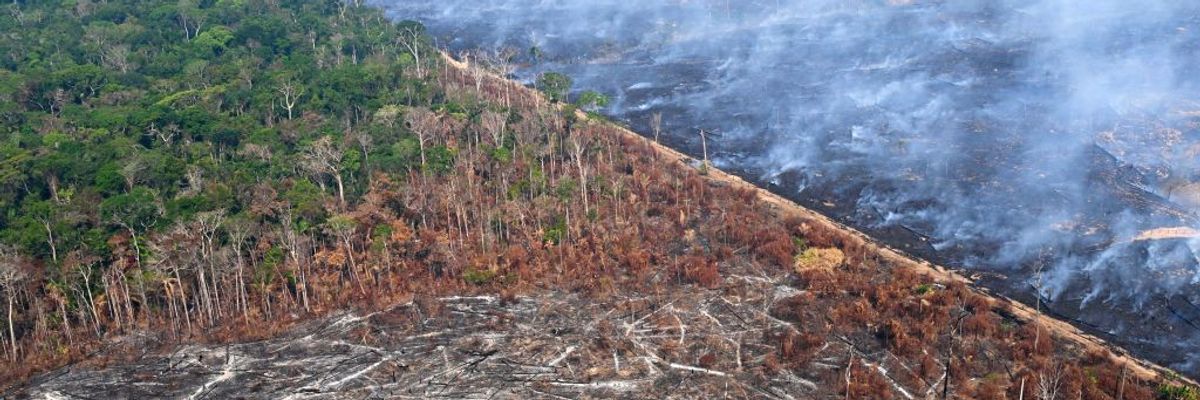
World’s Forests ‘Still in Crisis’ Halfway to Deadline to End Deforestation: Report

“The 2025 Forest Declaration Assessment is out and can broadly be summarized as, ‘We suck,’” said one climate scientist.


An aerial view shows a large swath of the Amazon rainforest deforested by illegal fire in the municipality of Labrea, Amazonas State, Brazil, on August 20, 2024.
(Photo by Evaristo Sa/AFP via Getty Images)


Brett Wilkins
Oct 14, 2025
COMMON DREAMS


The world’s governments are falling far short of their goal to tackle forest destruction by the end of the decade, according to a key annual report published Monday.

At the 2021 United Nations Climate Change Conference, or COP26, in Scotland, 145 countries adopted the Forest Declaration, pledging to end deforestation and forest degradation and restore 30% of all degraded ecosystems by 2030.

Annual Forest Declaration Assessment reports—which are published by a coalition of dozens of NGOs—track progress toward achieving the objectives established at COP29. Although stopping and reversing deforestation by 2030 is crucial to averting the worst consequences of the climate and biodiversity crises, every annual report has highlighted how the world is failing to adequately protect its forests.

This year is no different. According to the 2025 Forest Declaration Assessment, “in 2024, forests continued to experience large-scale destruction, with nearly 8.1 million hectares permanently lost globally.”

“Primary tropical forests continue to be cleared at alarming rates, with 6.73 million hectares lost last year alone, releasing 3.1 billion metric tons of greenhouse gases,” the report continues. “Losses in forested Key Biodiversity Areas reached 2.2 million hectares, up 47% from the previous year, threatening irreplaceable habitats.”


The assessment notes:
Deforestation remains overwhelmingly driven by clearance for permanent agriculture, accounting for an average of about 86% of global deforestation over the past decade, with other drivers such as mining exerting growing pressure. Because deforestation commodities are both consumed domestically and exported internationally, deforestation represents a systemic problem; national land-use policies and practices are deeply intertwined with global demand. This highlights the urgent need for structural change in how production and trade are regulated, monitored, and ultimately governed.

Furthermore, according to the report, “financial flows are still grossly misaligned with forest goals, with harmful subsidies outweighing green subsidies by over 200:1,” and “despite new pledges, the flow of funds to forest countries and local actors remains far below what’s necessary to deliver on 2030 goals.”

“‘Global forests remain in crisis’ is not the headline we hoped to write in 2025,” the publication states. “As the halfway point in the decade of ambitious forest pledges, this year was meant to be a turning point. Despite the indispensable role of forests, the verdict is clear: We are off track.”

The news isn’t all bad—the report highlights how “restoration efforts are expanding, with at least 10.6 million hectares hosting forest restoration projects worldwide. But global data remain too fragmented to determine whether the world is recovering forests at the scale required.”

The assessment offers the following recommendations for policymakers:Governments must act to value forests, including through regulations and pricing in the real cost of deforestation;
Action must become integrated, not siloed, as the climate emergency, biodiversity crisis, and social inequality are all interconnected; and
Decision-making must be inclusive and participatory, as rapid progress toward 2030 forest goals requires the participation of Indigenous peoples, local communities, women, and civil society.

“At the halfway point to 2030, the world should be seeing a steep decline in deforestation,” the assessment says. “Instead, the global deforestation curve has not begun to bend.”

The new Forest Declaration Assessment comes ahead of next month’s UN climate conference, or COP30, in Belém, located in the Brazilian Amazon.

“This COP30 is extremely crucial for us to move these pledges to actions,” Sassan Saatchi, founder of the non-profit CTrees and a former NASA scientist, told Climate Home News on Tuesday.

“The nice thing about COP30 being in Belém,” Saatchi added, “is that there is a recognition that the Global South has really come forward to say: ’We are going to solve the climate problem, even though we may not have been historically the cause of this climate change.‘”

Global goal to end deforestation nowhere near being met: experts


By AFP
October 13, 2025


Globally, deforestation is driven overwhelmingly by the expansion of agriculture. - Copyright AFP Lillian SUWANRUMPHA

Deforestation “has not meaningfully declined” despite a global pledge to halt forest destruction, but next month’s UN climate summit in the Amazon could mark a turning point, experts said Tuesday.

Last year an area of the world’s forests larger than Scotland was cleared primarily to make way for agriculture, according to an annual deforestation assessment by a broad global coalition of researchers and activists.

Tropical primary forests — particularly carbon rich and ecologically biodiverse environments — were the hardest hit, with 6.7 million hectares (16.6 million acres) lost in 2024.

The report also highlighted persistent but overlooked levels of forest degradation, where land is damaged but not razed entirely, mostly owing to logging, road building and fires lit to clear land.

Rates of deforestation remain stubbornly high despite a commitment made by more than 140 leaders at the UN COP summit in 2021 to stamp it out by the end of the decade.

“Deforestation has not meaningfully declined since the beginning of the decade, and we’re already halfway through,” Erin Matson, an expert at the Climate Focus think tank and co-author of the latest assessment, told reporters.

“Every year we are losing this level of forests.”

Deforestation worldwide in 2024 was 3.1 million hectares above the maximum possible level to align with meeting the 2030 goal, the report said.

Globally, deforestation is overwhelmingly driven by the expansion of permanent agriculture, which accounted for 85 percent of all forest loss over the past decade.

“But another important and growing driver is mining and extractives for gold, for coal, and increasingly for the metals and minerals required for the renewable energy transition,” Matson said.


– ‘Forest COP’ –


Matson said she was cautiously optimistic the cause could be revived at next month’s COP30 summit in Brazil, the first time the annual UN climate conference has been held in the Amazon region.

“This is the forest COP. I think there’s a lot of opportunity there,” she said.

Brazil’s President Luiz Inacio Lula da Silva chose to host the world’s most important climate talks in Belem, the gateway to the Amazon, to spotlight the role of forests in absorbing carbon dioxide.

At COP30, Brazil will launch an innovative new fund that rewards countries with high tropical forest cover — mostly developing nations in Asia, Africa and Latin America — that protect trees rather than chopping them down.

The Tropical Forests Forever Fund (TFFF) aims to raise up to $25 billion from donor countries and another $100 billion from the private sector, which is invested on financial markets. Brazil has already thrown in $1 billion.

“What is new about this initiative… it’s the scale, it’s the simplicity, it’s the long-term vision, and it’s the leadership of the Global South,” said Elisabeth Hoch, international portfolio lead from the Climate and Company, a think tank.

“From a political point of view, the initiative has a lot of value but it has not yet reached a stage of maturity sufficient to be fully launched,” said a French government source on Friday.

Matson said “political courage” was needed at COP30 to correct course and put the fight for forests back on the global agenda.

“Looking at the global picture of deforestation, it is dark, but we may be in the darkness before the dawn,” she said.