Wednesday, November 19, 2025

Former Tory PM slams Brexit as ‘an act of collective folly’ in outspoken attack

Basit Mahmood
Today
Left Foot Forward


“National interest was brushed aside by false hopes and promises. False hopes and promises that even a cabinet dominated by frontline Brexit enthusiasts was unable to deliver.”


A former Tory leader has slammed Brexit as an ‘act of collective folly’ in what amounts to an outspoken attack on his party after its decision to hold a referendum to leave the EU.

John Major said Britain’s “enemies celebrated and our friends despaired” at the result of the 2016 referendum.

His comments come as the economic harm caused by Brexit becomes increasingly clear. Earlier this week, a new study based on nearly a decade of data, found that Brexit had severely damaged the UK economy.

According to the National Bureau for Economic Research (NBER), which has based its findings on a decade of data since the referendum, the UK’s GDP (Gross Domestic Product) had fallen by as much as 8% from where it should be since 2016.

And according to new data released by the economists at Stanford University, the Bank of England, and the National Institute of Economic and Social Research has found that business investment loss by this year could be £275 billion or £400 billion.

Major accused senior Tories such as Boris Johnson and Michael Gove of ‘spreading misinformation’.

The Huffpost reports Major as saying: “It left our country poorer, weaker and divorced from the richest free trade market that history has ever seen.

“National interest was brushed aside by false hopes and promises. False hopes and promises that even a cabinet dominated by frontline Brexit enthusiasts was unable to deliver.”

He added: “The nation saw Project Fear become Project Reality very easily. It’s no consolation that the majority of the public now overwhelmingly recognises that it was misled in their moments of triumph.

“Brexiteers predicted other countries would follow their lead and leave the European Union. None have. All saw only too clearly that Brexit was packed with disadvantages.”


Brexit caused UK GDP to reduce by 8%, new study finds
Yesterday
Left Foot Forward News


So much for the land of milk and honey promised by Brexiteers.


Yet another study shows that Brexit has severely damaged the UK economy, as the evidence of the economic harm done by the decision to leave piles up.

According to the National Bureau for Economic Research (NBER), which has based its findings on a decade of data since the referendum, the UK’s GDP (Gross Domestic Product) had fallen by as much as 8% from where it should be since 2016.

The NBER says that increased uncertainty and reduced demand following the decision to leave had an adverse effect on the UK economy. It states: “We estimate that investment was reduced by between 12% and 18%, employment by 3% to 4% and productivity by 3% to 4%. These large negative impacts reflect a combination of elevated uncertainty, reduced demand, diverted management time, and increased misallocation of resources from a protracted Brexit process.”

It comes after another report last week which found that UK business investment is 12 to 18 per cent lower than it would have been if Britain had stayed in the EU.

New data released by the economists at Stanford University, the Bank of England, and the National Institute of Economic and Social Research has found that business investment loss by this year could be £275 billion or £400 billion.

So much for the land of milk and honey promised by Brexiteers.

Basit Mahmood is editor of Left Foot Forward
Opinion

Hands off our BBC: Trump’s tug of war over the BBC narrative
Today
Left Foot Forward

A sloppy edit turns Trump into a crusader against bias, stepping in to protect us from a broadcasting corporation already leaning his way


The debate over the BBC’s misleading edit of Donald Trump’s Capitol Hill speech is quite a muddle. Trump is performatively posturing with a line about how the BBC has deeply wounded his reputation by wilfully presenting him as a ‘radical, aggressively stirring violence at the White House, when in fact he’s simply a benign, peace-loving moderate’.


Tangled in the rigging

The muddle begins with Trump effectively accusing the BBC of rigging his speech. However, the speech was itself delivered to support protests about the alleged rigging of the 2020 election results to steal victory from Trump.

Furthermore, Trump’s sob story is, arguably, a ruse to conceal his and his UK far-right accomplices’ intentions. Having persuaded the world that the BBC is hopelessly woke, the aim is then to either replace it with a suitable propaganda vehicle for the far-right, or transform it into a full-throttle far-right mouthpiece. So, Trump’s attack on the BBC is evidently also a rigged campaign with a (poorly concealed) agenda.

The BBC has apologised for its careless edit. But, predictably, Trump doesn’t want to lose this golden opportunity to trash an organisation he can present as dangerously insurgent. So he is ignoring the apology and steaming ahead with suing the BBC to the tune of $1bn – $5bn.

Toy throwing

After some debate, the BBC has decided to ‘do a Hugh Grant’ and ‘stand up to the US bully’, rather than backing off and instead perhaps offering an out-of-court settlement for Trump to add to his lucrative collection of extortions from other media organisations.

It’s worth saying that the honourable route is risky because it’s hard to see how a court case could avoid quickly leading to stand offs between the BBC and Trump over whether he was, in fact, instrumental in inciting violence on 6 Jan; also on whether the 2020 election was, in fact, egregiously stolen from him.

If Trump can’t even handle the notion that the BBC misreported him, he definitely won’t cope with this latest bete noir telling the world’s front pages that he incited violence and in service to specious lies about stolen elections.

Even if Trump loses the court case, which is likely, this ‘nasty truth-telling’ could trigger a toy-throwing meltdown, a comprehensive hate campaign that would make a mockery of Starmer’s carefully curated Trump appeasements.

We could find ourselves showered with all manner of punishments including an even bigger BBC penalty for taxpayers, a ceremonial tearing up of the UK tariff agreement, plus anything else this interfering child despot can conjure, from occupying Guernsey to designating our fishing fleets as drug cartels.

Bullies make terrible partners but separation is somewhere between unpleasant and horrendous. A neurotic, spiteful narcissist feeling cruelly spurned by his special friend is a loose cannon. It’s not that one should defer to bullies, only that we should strap in for some outlandish consequences.

The new bias

But aside from the debate over who is doing the rigging, who the real propaganda mouthpiece is here, and how to respond, there’s a further complication.

The UK commentariat has rallied quickly to the BBC’s side, earnestly appealing to its impartiality to counter Trump’s devious far-right onslaught. But the corporation isn’t impartial, at least, not any more.

The BBC news rightly deserves its traditional global reputation as a trusted voice of authority and fine journalism. But over the last 15 years it has lost its prized impartiality status. Why?

Leaning right

The right-wing has a little cache of cases to ‘prove’ that, in fact, the BBC is a left-leaning rag which Trump has rightly observed needs cleaning up. Aside from the editing fiasco, they roll out examples such as the BBC’s alleged anti-Israel bias and pro-Hamas reporting on Gaza.

But there are more compelling reasons for viewing the BBC as leaning the other way.

 Here’s five:

First, BBC bias has to be viewed in the context of the heavily right-wing makeup of its top team. To help deliver Brexit, Boris Johnson infiltrated the corporation with numerous Conservative figureheads. It is completely implausible to insist that key political appointments such as Robbie Gibb and Tim Davie have no influence on output.

Second, the BBC became increasingly vulnerable because of financial difficulties arising from ever-increasing competition with other forms of media and changing public tastes in news consumption. This fuelled a rightward shift because it became increasingly necessary to appease the dominant establishment view. So, journalistic independence began to shrink. As Lewis Goodall notes, BBC journalists were told to write “as if they had the Daily Mail on their shoulder”.

Third, and in line with the above, studies show numerous instances of right-wing bias: the BBC gave 33 times more attention to Israeli than Palestinian deaths in the Gaza conflict. Domestically, right-wing politicians generally receive over 50% more BBC airtime than left-wing politicians. Question Time is a clear example of massive BBC “over-platforming” of Reform.

Fourth, these instances are just part of a relentless daily drip-feed of anti-left commentary across platforms from a whole stable of BBC journalists. This subtle spread of bias is a ubiquitous feature of the BBC’s slanted reporting, setting “a tone across articles, topics and time, that is cumulatively formidable”.

Fifth, in attacking BBC left-wing bias, the far-right, insatiable as ever, is demanding its pound of flesh. The BBC’s attempts to appease the right can never go far enough. Shouting at the corporation for being ‘woke left’ when it’s already manifestly right-leaning is both an exercise in gaslighting and a flogging whip to make the horse canter rightwards even faster.

Newsflash: Trump gets it right

Thus we have a curious and even more complicated situation where we have to acknowledge that Trump’s accusation is partly correct. The BBC is biased, just not typically in the way he claims.

If we accept that the UK establishment’s assiduous defence of BBC impartiality is false then this puts the BBC in further jeopardy. As is so often the case with far-right attacks, they begin with little truths and build on these to create large bodies of lies. So, Trump will exploit this weakness in our defence to strengthen his campaign to destroy the BBC (as we knew it).

What next?

It’s right that the BBC hasn’t acquiesced to Trump’s demands. This would effectively have been to concede that his attack on the BBC as a leftie propaganda mouthpiece is fair. The BBC would then be considerably more vulnerable to being removed or drastically weakened with the floodgates opened to receive GB News style far-right content.

It would also have meant that the BBC is permanently on trial and every step of its reportage minutely examined with gestapo-style vigilance. Its journalists would become chilled to the bone and coerced into truly ugly right-leaning narratives that are far more explicit and extravagent than we’ve seen so far.

But nor should the outcome be that the UK stays resolutely behind a false defence of the BBC as impartial. This cannot stand and is just grist for the far-right’s mill.

A turning point

The Trump episode should provide a turning point. A fortuitous gap has appeared through the resignations of Director General Tim Davie and Head of News Deborah Turness. As Secretary of State for Culture and Media, Lisa Nandy must take this opportunity to fill this gap with independent directors and also replace Gibb with a non-political appointment. The government has to ensure that the top personnel at the BBC are genuinely independent and not guided by partisan interests.

The episode also calls for a public Levison-style inquiry involving government-funded scientific research into BBC reporting. It should cover the last 15 years and provide rigorous and comprehensive analyses of the true extent of bias in BBC news coverage and commentary.

Making the BBC great again

Taking these steps to put our own publishing house in order would be a patriotic reminder to the UK far-right that Trump has no right to interfere with our news corporations.

At the same time, Trump’s absurd attack also provides a long-awaited moment finally to get our most cherished and valuable news institution on a properly independent footing, away from the political intereference which, since Johnson’s tenure, has been steadily corrupting it, and away from the new threat of far-right take-overs.

In this age of disinformation, returning the BBC to its position as a global beacon of trustworthy news reporting would be one of the most worthwhile and democracy-preserving actions the government could possibly take.

Claire Jones writes and edits for West England Bylines and is co-ordinator for the Oxfordshire branch of the progressive campaign group, Compass

 BBC vs King Con


Published November 19, 2025 
DAWN


NEITHER Donald Trump nor any of his associates expressed any righteous indignation over an episode of BBC TV’s Panorama when it was broadcast more than a year ago. After all, it wasn’t aired in the US.

Now that it has been brought to his attention, the American president has threatened to sue Britain’s public broadcaster for $1bn (perhaps even $5bn) for its editorial audacity in stitching together two tiny segments of his warm-up speech to the mob that stormed the Capitol on Jan 6, 2021. The words “We’re going to walk down to the Capitol” were separated by more than 50 minutes from the advice: “And we fight. We fight like hell.” By splicing together the 12-second segment, the BBC show is accused of suggesting that Trump explicitly invited the violence that followed.

Frankly, no one who listened to the entire speech or observed Trump’s subsequent actions could have come to a different conclusion. Shortly afterwards, the House of Representatives impeached him for a second time on that very basis. The BBC’s editing could have been more judicious, but it hardly qualifies as a billion-dollar error — or a substantial reason for heads to roll.

Hitherto, Trump has only tried suing US media entities (as part of a broad vendetta that stretches from individuals to universities), for facetious reasons, and corporations such as Paramount and Disney have caved in by donating millions to the future presidential library foundation. Reparations have also been extracted from Meta and YouTube. His $15bn suit against The New York Times for critical coverage has gone nowhere, much like his bid to sue The Wall Street Journal for revealing Trump’s salacious 50th birthday message to the paedophile and human trafficker Jeffrey Epstein.


The broadcaster is defensible, unlike Trump.

Any defamation case against the BBC filed in Florida (as Trump has indicated) is unlikely to bear fruit, given everything he has said about the events of Jan 6. Trump himself, mind you, is a media owner whose personal Truth Social feed is a relentless stream of pernicious blather (some of it potentially defamatory) alternating with self-aggrandising re-posts.

At the same time, it’s hard to empathise with the BBC, whose claims to independence and impartiality have often been suspect. The silly argument that the broadcaster must be doing something right if it regularly comes under attack from both the left and the far right continues to be occasionally regurgitated. But it can be said that since its inception more than 100 years ago, it has often been seen to be aligned with the British establishment.

Sure, it has every now and then incurred government wrath and faced takeover threats. Such instances mostly flowed from disputes within the ruling elite, rather than reflecting a nod towards popular discontent. For instance, robust reporting on the ‘dodgy dossier’ used to justify Britain’s participation in the 2003 military assault on Iraq followed secret briefings that indicated scepticism among the intelligence agencies about Baghdad posing an imminent threat. The Suez and Falklands wars also stirred a degree of BBC dissent (and a predictable backlash) for similar reasons.

The BBC’s global recognition testifies to its diminishing but still significant role as a conduit for Britain’s soft power. But no one can seriously deny that it has, over the decades, served as a home for many worthy journalists, and still does. Domestically, news operations are only one part of the media behemoth, and it has so far survived the challenges posed by new technologies and changing patterns of news consumption — plus a ser­ies of sex and paedophilia sca­­ndals.

Its biggest current challenge comes from cult­ure warriors such as board member Robbie Gibbs — a “proper That­ch­e­rite conservative” (by his own description), former Tory spin doctor and linked to GB News, who in 2020 rescued the Jewish Chronicle with undeclared resources — and others who wish to turn it another far-right outfit, or destroy it.

Political appointments to its executive cadre are the bane of the BBC, and its licence fee and charter. Among its various other missteps and follies, it has failed to adequately push back against charges of being unfair towards Israel, despite plenty of evidence to the contrary in the face of a genocide that echoes its hostility towards anti-fascist opinions in the run-up to World War II. Its pointless efforts to strike a ‘balance’ are reflected in the airtime offered to Nigel Farage and climate change denialists. Beyond its multifarious inadequacies in the news and current affairs sphere, there is much to cherish among its cultural output.

It remains to be seen whether the BBC can be rehabilitated as a relatively reliable source of news and views, but at least that is a possibility, however remote. Who could honestly make the same claim about King Con’s White House enterprise?

mahir.dawn@gmail.com


Published in Dawn, November 19th, 2025


BBC on the Rack


So Trump suddenly threatens to sue the BBC for $1 billion for a misleading splice-up of video clips broadcast over a year ago. A BBC news editor — Raffi Berg — is suing journalist Owen Jones for exposing his biased judgement in reporting Gaza war news. And two top knobs at the BBC, Director-General Tim Davie and CEO of news Deborah Turness, jump before they’re pushed.

The British public are angry enough at having to pay the BBC’s extortionate TV licence fee only to have biased news beamed at them. If Trump were to win his $1 billion claim he’d be paid off with licence payers’ money which would infuriate the public even more.

If Berg were to proceed against Jones it would open a whole new can of worms and magnify what’s already known about pro-Israel bias inside the state broadcaster.

And the departure of the two top post-holders from the BBC leaves too many iffy editors still in place and the bias problem still unresolved.

Mismanaging news standards

When, in November 2023, BBC senior management attended a meeting with at least 100 staffers to discuss coverage of Gaza, Deborah Turness called out, in an attempt to assert control of the meeting: “We’ve got to all remember that this all started on 7 October.” Erasing the decades of Israeli occupation before October 7 was a stunning example of how distorted the mindset of those at the top can be.

As for Berg, Mint Press points to his former employment with the US State Department’s Foreign Broadcast Information Service, a unit widely regarded as a CIA front.   “Berg is currently the subject of considerable scrutiny after thirteen BBC employees spoke out, claiming, among other things, that his ‘entire job is to water down everything that’s too critical of Israel’ and that he holds ‘wild’ amounts of power at the British state broadcaster, that there exists a culture of ‘extreme fear’ at the BBC about publishing anything critical of Israel, and that Berg himself plays a key role in turning its coverage into ‘systematic Israeli propaganda’.”

BBC journalists also claimed Davie and Turness stood in the way of change. Both were aware of concerns about Berg but ignored them.

And according to Owen, at a ‘listening session’ meeting between staffers and Tim Davie “they noted Berg’s history and associations as indicative of bias, pointing to instances where journalists’ copy had been changed prior to publication. They made specific requests: that stories should, as a rule, emphasize that Israel had not granted the BBC access to Gaza, that the network should end the practice of presenting the official Israeli versions of events as fact, and that the BBC should do more to offer context about Israeli occupation and the fact that Gaza is overwhelmingly populated by descendants of refugees forcibly driven from their homes beginning in 1948. While Davie told staff that management would ‘look into’ staff objections, to date no response ever came back.”

In response to a request for comment, the BBC said it unequivocally stood by Berg’s work and asserted that the BBC was “the world’s most trusted international news source” and its “coverage should be judged on its own merits and in its entirety. If we make mistakes we correct them.”

But complaints have continued, for example the use of emotional words like ‘massacre’ and ‘atrocities’ to describe Hamas’s attacks but not in reference to the slaughter perpetrated by Israeli forces. A failure to provide historical context, crucial omissions, and a lack of critical engagement with Israel’s claims, were also mentioned.

Staffers acknowledged the pressure the BBC faces from pro-Israel lobbyists and emphasize that their sole objective was to uphold the BBC’s values of fairness and impartiality and to produce content “without fear or favour” — principles they felt had been cast aside in deference to Israeli narratives. The website, headed by Raffi Berg, was considered the BBC’s worst violator of editorial standards. They also raised concerns about Robbie Gibb, one of five people who serve on the BBC’s editorial guidelines and standards committee along with Davie, Turness, the Chairman of the Arts Council Nicholas Serota, and BBC Chair Samir Shah.

Gibb is responsible for helping to define the BBC’s commitment to impartiality and respond to complaints about the BBC’s coverage on Israel and Palestine. But between 2017 and 2019 he’d served as director of communications for Conservative Prime Minister Theresa May, and in 2020 he led a consortium to rescue the Jewish Chronicle from bankruptcy. He then joined the BBC board as a non-executive director while continuing his involvement with the Jewish Chronicle, saying in his Declaration of Personal Interests that he was the 100% owner of that newspaper until a venture capitalist took over in August 2024. According the Companies House Gibb was sole director of Jewish Chronicle Media from April 2020 to August 2024 and was succeeded by Ian Austin (Lord Austin of Derby) and Jonathan Kandel. The Jewish Chronicle Ltd was dissolved in February 2023. Gibb’s links to the Jewish Chronicle and its slavish pro-Israel stance were widely known, so it’s puzzling how he could ever have been thought sufficiently impartial for a key position managing the BBC’s editorial standards.

Openness and transparency are not BBC strong points either. Back in March campaigner Deborah Mallender, in a Freedom of Information request, asked the BBC:

(1) Is it true that your Chief of your Middle East desk Raffi Berg has collaborated with Mossad and worked for the CIA as per this widely distributed media report?
(2) How does that affect your claim of impartiality, unspun news and claims of upholding the integrity of professional journalism?
(3) Have you received any complaints from your own journalists about this employee?
(4) Have you received any communication from any politician about this appointment nationally or internationally? How many? Who communicated?
(5) Have you received any complaints from members of the public about this? How many?

The BBC’s reply?

“In response to parts 1 and 2 of your request, please be advised that we do not consider this to constitute a valid request under the FOI Act. The Act gives a general right of access to information that we hold in our records, e.g. in writing. We are not required to create new information to respond to a request, or to give a judgement, opinion or comment that is not already recorded. In response to parts 3, 4 and 5 of your request, please be advised that section 12 of the FOI Act states the BBC to does not have to deal with a request where it estimates that it would exceed the ‘appropriate limit’ (defined in the Fees Regulations) to comply with the request.”

Meanwhile, Trump has received an apology from the BBC for its “error of judgement”, and that should be enough. It is surely beneath any normal US president to pursue the broadcasting arm of an allied power for such a preposterous sum, though not in Trump’s case. Nor should the BBC even consider stroking this conceited man’s bloated ego and forking out one penny of British public’s licence fee money. On the other hand I would gladly pay that fee if the BBC were to force Trump to bring his action in the UK High Court. My understanding is that it must be done within 1 year and Trump is out of time. Case dismissed.

Stuart Littlewood, after working on jet fighters in the RAF, became an industrial marketing specialist. He served as a Cambridgeshire county councillor and a member of the Police Authority, produced two photo-documentary books including Radio Free Palestine (with foreword by Jeff Halper), and has contributed to online news and opinion publications over many years. Read other articles by Stuart, or visit Stuart's website.
UK Government’s asylum proposals ‘cross a dangerous line’, warn campaigners and MPs
Yesterday
Left Foot Forward

"This is headline chasing, not problem solving - a Government bowing to anti-immigrant, anti-rights politics."


Charities and MPs have condemned Shabana Mahmood’s hardline plans to make it harder for asylum seekers and refugees to settle in the UK.

The proposals Mahmood set out yesterday include reviewing people’s refugee status every 30 months and forcing refugees to return to their home country if it becomes safe. The changes would mean those with asylum status would have to wait 20 years, rather than five, to become UK citizens.

Mahmood also said she would amend laws that guarantee housing and financial support to asylum seekers facing destitution.

The government also plans to make asylum seekers contribute to accommodation costs if they own a large number of “high-value” belongings.

In addition, the government will attempt to change how the European Convention on Human Rights (ECHR) is interpreted to stop asylum seekers using their rights to family life to avoid deportation.

Reform MP Danny Kruger invited Mahmood to join Reform UK, and far-right activist Tommy Robinson backed Mahmood’s reforms, sparking concerns among Labour backbenchers.

Amnesty International said that the proposals represent “a historic weakening of refugee protection” and warned that ministers are undermining the European Convention on Human Rights (ECHR) while claiming they want to remain within it.

Steve Valdez-Symonds, Amnesty International UK’s Refugee and Migrant Rights Director, called the Home Secretary’s plans “cruel, divisive and fundamentally out of step with basic decency”.

He added: “This is headline chasing, not problem solving – a Government bowing to anti-immigrant, anti-rights politics instead of standing up for the basic principles that protect us all.

“The moment a Government decides that fundamental rights can be switched off for certain people, it crosses a dangerous line that should never be crossed. This is how universal protections begin to rot. Once you strip rights from one group, you hand the licence to whoever comes next to strip them from others.

“This headline-chasing cruelty will not fix the immigration system. It will only fuel fear, worsen instability and give legitimacy to the most divisive politics. Anyone who cares about universal human rights needs to act now, because if rights aren’t upheld for everyone – especially those who lack public sympathy – then they are not rights at all, but mere concessions that those in power may permit or withhold as they please.”

Andrea Vukovic, Co-Director of Women for Refugee Women, said: “The Home Secretary stated that ‘illegal migration is tearing the UK apart’. The only thing tearing the UK apart is a politics devoid of humanity, compassion and dignity. These plans – borrowed from hostile systems around the world – represent more cruelty, more uncertainty and more hostility for people seeking safety here. It tells those with refugee status in the UK – who have fled war, persecution, and violence – that their protection is temporary and that they will never be welcome here. This is a dangerous step in the wrong direction.”

A Refugee Action spokesperson, said: “Politicians are tearing Britain apart. Instead of fixing our NHS, making housing affordable and reducing wealth inequality they are rolling out the red carpet for the far right.

“This racist package of hostility against people seeking safety will further divide our communities and create a two-tier society divided into people who are told they belong, and those who are told they don’t.”

The spokesperson added: “Deterrence policies like these may be a great distraction for a government worried about next week’s budget and wracked by political infighting, but they won’t stop Channel crossings nor build inclusive, thriving communities.”

The spokesperson also noted that in the UK, fifty families hold more wealth than half the population, warning that the government should focus on fair taxation and tackling inequality “instead of tormenting people who have done nothing to cause these problems”.

Former Labour leader Jeremy Corbyn said that Mahmood was “trying to appease the most ghastly right-wing forces all across Europe in undermining and walking away from the European Convention on Human Rights.”

Naomi Smith, chief executive of Best for Britain, said: “The fact that these proposals are being cheered by far-right extremists should give the government pause – but beyond being a clear moral failure, the data shows it is also a profound misjudgment of political strategy.”

Smith also highlighted that studies by election analysts show that “ramping up ever-harsher rhetoric on immigration and asylum never wins over Reform-curious voters, but does drive Labour voters toward the Lib Dems and Greens in England, and the SNP and Plaid in Scotland and Wales”.

“The government would be wiser to make the case for the international institutions and protections we all depend on.”

Green Party MP, Carla Denyer, called the plans “a new low”, saying the government was “plumbing the depths of performative cruelty, in hopes that the public won’t notice they have no answers to the real issues facing communities across this country”.

“Confiscating the belongings of people fleeing war and violence, and trapping refugees in perpetual limbo, where even those who have been granted asylum would have the constant threat of deportation hanging over their heads, undermining integration and making it impossible to put down roots. These are extreme, inhumane proposals from a desperate and failing government.

“The only way to prevent people making dangerous crossings by small boats is to open safe and managed routes for people to claim asylum in the UK. There are hints Mahmood could introduce such schemes – a sensible government would focus on this workable policy rather than divisive gimmicks.”

Olivia Barber is a reporter at Left Foot Forward


‘This is not triangulation, it is capitulation’


This week, the Home Secretary announced a programme of migration and asylum reforms, taking inspiration from Denmark’s immigration system.

That the centre left is also tipped to lose Copenhagen for the first time in the city’s electoral history should be a flashing warning sign for Labour. In Denmark, years of tightening immigration rules and ceding rhetorical ground to the far right did not neutralise the issue – it normalised it. In the process, it hollowed out the moral core of social democracy and left voters questioning what the centre left was for. Labour now risks repeating the same mistake.

When a Labour government begins to sound indistinguishable from the hard right on immigration, when its spokespeople parrot phrases like “golden ticket” and boast about making life harder for refugees – this is not triangulation, it is capitulation, and it represents a profound betrayal of Labour values. More dangerously sti

The fixation on so-called ‘pull factors’ is one of the most persistent myths in the migration debate. The idea that refugees risk their lives crossing seas because Britain’s asylum system is too generous has been repeatedly disproven by researchers, refugee agencies, and even the Government’s own evidence. People flee because of the push factors of war, persecution, famine, state collapse – not because of marginal differences in welfare entitlements or processing rules. No parent puts their child in a dinghy because of a generous British welfare system. For those escaping the Taliban, Assad, or Russian bombardment, the “choice” is not between hardship abroad and comfort in the UK; it is between danger and survival. The pull-factor narrative is not only false, it is a convenient distraction used to justify ever-harsher policies that do nothing to reduce crossings, succeeding only in dehumanising the people it affects. This is why so-called ‘deterrent’ policies always fail.

Subscribe here to our daily newsletter roundup of Labour news, analysis and comment– and follow us on BlueskyWhatsAppX and Facebook.

The UK has seen an increase in asylum applications in recent years compared to our EU neighbours, but it is worth considering this in context. Germany (250,550), Spain (166,145), Italy (158,605) and France (157,460) all received more applications than the UK (108,138) in 2024. Adjusted per capita, the UK still trends behind other EU nations, ranking 14th among the EU27 plus UK.

A humane system is possible: one built on safe routes that prevent dangerous crossings; on integration rather than exclusion; on tackling the backlog; where asylum seekers have the right to work and can contribute through taxation.

To build this system requires moral courage. It is about saying that the far-right don’t have the answers, but we on the left do. Above all, it requires honesty about the real source of deprivation in our communities: those who spent 14 years stripping public services to the bone while profiting from division, not people seeking safety.

Asylum debate: Labour divisions laid bare as Mahmood stands her ground

James Moules 18th November, 2025

RogerMechan/Shutterstock.com

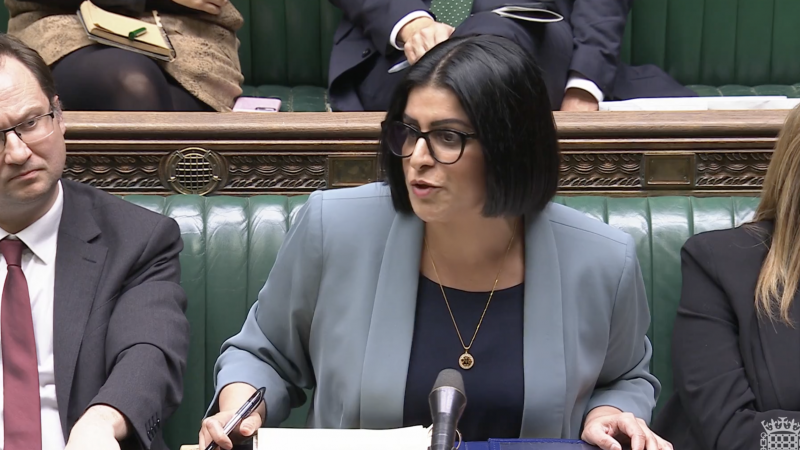
Shabana Mahmood came out fighting in the House of Commons yesterday after more than a dozen Labour MPs made their displeasure at the government’s asylum reforms known.

The Home Secretary told MPs: “If we fail to deal with this crisis, we will draw more people down a path that starts with anger and ends in hatred.”

But her new asylum measures have proved divisive on the Labour backbenches. Some MPs have voiced their support for the controversial proposals, but there has been no shortage of those expressing their visceral discomfort too.

Around 20 Labour MPs so far have gone public with their opposition to Mahmood’s plans, with many condemning the reforms in the strongest of terms.

York Central MP Rachael Maskell told Times Radio: “The dehumanisation of people in desperation is the antithesis of what the Labour Party is about.

Stroud MP Simon Opher said that “we should push back on the racist agenda of Reform rather than echo it.”

Allies of the government argue these measures are an essential tool to get a grip on a crisis that they claim is driving more and more voters into the arms of Farage and Reform.

Mahmood spoke of how the issue had been raised in her constituency, saying: “What unites all Britons, regardless of their background, is a desire for fairness and for a good system in which people can have confidence.”

But critics argue that many of the proposed reforms stretch the bounds of decency, and will only see more Labour voters abandon the party for the Liberal Democrats, Greens and Your Party.

Some left wing and soft left figures have argued the government should be placing greater focus on improving the cost of living and healthcare instead of leaning to the right on immigration.

Divisions deepen
However, Mahmood still has plenty of vocal backers in the PLP, with Hartlepool MP Jonathan Brash and Peterborough MP Andrew Pakes being among those to speak out in favour.


Could we see another rebellion? Possibly. It’s likely more Labour MPs will publicly express discomfort as the row rumbles on. But the Home Secretary has made it clear she’s up for the fight.

During the debate, Mahmood brought up her own experience of racism in Britain. “I wish I had the privilege of walking around this country and not seeing the division that the issue of migration and the asylum system is creating across this country,” she said.

The controversial plans include fast-tracked deportations, changes to the appeals process, and new rules to return those granted asylum to their home countries once those places are deemed safe.

It will also quadruple the length of time to achieve permanent status – from five years to 20.

Nottingham East MP Nadia Whittome said much of the reform programme “flies in the face of decency and compassion”.

The wider debate
The government’s proposals haven’t just sparked backlash within the PLP, with many left wing groups and humanitarian campaigners voicing concerns about the measures.

Dr Dora-Olivia Vicol, CEO of the Work Rights Centre said: “These changes will force refugees – people fleeing war, torture, persecution – into a state of permanent precarity for two decades.

“It is very difficult for people with time-limited leave to secure good work, as most employers look for certainty. Shutting refugees out of sustainable, secure work only pushes them closer to precarious roles where they can be exploited for profit.”

But at the same time, think tank More in Common polled several “Danish model” asylum policies ahead of the announcement and found strong public support for many measures – including pushing asylum seekers to return to their home countries once these places become safe.


A spokesperson for the union BFAWU said: “The BFAWU Executive Council is alarmed by the Home Secretary’s announcement yesterday, and by the direction it signals for the UK’s asylum system.

“The government’s statement that refugee status will become temporary, that the pathway to settlement will be significantly lengthened, and that support for people seeking safety may be withdrawn raises profound concerns about fairness, human rights, and the functioning of our economy.”


Government asylum reforms greeted with outrage within Labour

NOVEMBER 18, 2025

“The Home Secretary sounds like a Reform supporter,” said Nigel Farage. “Well done patriots,” said Tommy Roboinson. Shabana Mahmood’s proposed reforms to Britain’s immigration rules have drawn fulsome support from some obnoxious quarters – and outrage from Labour MPs and progressives.

There is so much wrong with the new regime proposed for refugees that it is difficult to know where to begin. Let’s start with motive.

“The new asylum proposals outlined by the Home Secretary are not driven by humanity, fairness or even economics,” writes  Labour’s former Director of Policy Andrew Fisher. “They are driven by political cowardice.”

With reports of a new 20-year wait to secure indefinite leave to remain for those claiming asylum and populist gimmicks like seizing jewellery and assets from small boat migrants to help pay for accommodation, Keir Starmer’s 2020 pledge to have “an immigration system based on compassion and dignity” is well and truly dead.

If the aim of the changes is to halt the rise of Reform, they are likely to fail on this front. Manchester University Politics Professor Rob Ford points out: “Labour can never be the party of those who reject the asylum principle. Hardline immigration conservatism is owned by the right. Low-trust radical right voters will never believe an approach like this because they know it runs against the grain of the Party’s core electorate and history – so will fail.”

He concludes: “Labour seem to now come up with a new kamikaze nosedive operation to alienate social liberals while failing to attract Reform-curious voters every month.” He adds that, like Labour’s fiscal policy, it reinforces a belief among naturally Labour- leaning progressives that under Keir Starmer’s leadership, Labour “is a hostile environment to their values. But it substitutes nothing else.”

Labour MPs speak out

As well as accelerating the drift of Labour voters to the Greens, Lib Dems and others, Shabana Mahmood’s proposals are likely to provoke more internal division within the Party. Even moderate Labour MPs are incensed. Stella Creasy MP described the reform as “not just performatively cruel, it’s economically misjudged,” adding that “if you can’t stabilise your status, you will always struggle to get a job, a bank account or a mortgage, making it more likely you will be dependent on state or charity support.” She warned that “ICE-style raids on Britain’s streets” would be the only achievement of the Government’s “brutal” reforms.

Another usually loyal MP, Tony Vaughan, said the Government was taking a wrong turning: “The idea that recognised refugees need to be deported is wrong.” He added: “The rhetoric around these reforms encourages the same culture of divisiveness that sees racism and abuse growing in our communities.”

John McDonnell MP pointed out that Vaughan was “certainly not what the media would call a ‘usual suspect’. I suspect he is reflecting here what many in the PLP feel.”

Apsana Begum MP tweeted: “Policies to punish asylum seekers and refugees are a defeatist attempt to outdo Reform. There’s no dignity nor compassion in treating people fleeing persecution with appalling hostility and suspicion. It’s morally, politically and economically wrong and will only pave the way for a far-right government.”

Nadia Whittome MP agreed: “The government should be ashamed that its migration policies are being cheered on by Tommy Robinson and Reform. Instead of standing up to anti-migrant hate, this is laying the foundations for the far-right.”

Richard Burgon MP agreed, saying: “This approach isn’t just morally wrong; it’s politically disastrous.” He concluded: “This failing Labour leadership is choosing to fight on terrain set by Farage. In doing so, it is paving the way for the first far-right government in our history.”

Sarah Owen MP argued it was possible to take tough stance on illegal immigration, while having a “compassionate, fair and legal path for those seeking refuge.”

She added: “Taking jewellery from refugees is akin to painting over murals for refugee children. These repugnant ‘deterrents’ did not work for the Tories, and they won’t work for us.”

Stroud MP Simon Opher said Labour should “stop the scapegoating of immigrants because it’s wrong and cruel,” adding: “We should push back on the racist agenda of Reform rather than echo it.”

Alloa and Grangemouth MP Brian Leishman, who only recently had the Labour whip restored after being suspended for voting against the two-child benefit cap, also spoke out, as did Stourbridge MP Cat Eccles who said: “I’m massively disappointed and angry about what the Home Secretary is saying.”

MP for York Central Rachael Maskell said: “The dehumanisation of people in desperation is the antithesis of what the Labour Party is about,” and Middlesborough and Thornaby East MP Andy McDonald called the proposals “cruel, unfair and unworkable”.

Poole MP Neil Duncan-Jordan, who also recently got the Labour whip restored, said trying to steal votes from Reform was an “electoral dead end,” adding: “Kicking out recognised asylum seekers doesn’t speak to any of our values.”

Montgomeryshire and Glyndwr MP Steve Witherden said: “The problems the country faces won’t be solved by demonising asylum seekers.” Ian Byrne MP agreed, calling the reforms “morally bankrupt and politically disastrous.”

Diane Abbott MP was excoriating: “Draconian, unworkable and potentially illegal anti-asylum policies only feed Reform’s support. The government has learnt nothing from the period since the general election.”

Bell Ribeiro-Addy agreed: “The government’s latest asylum proposals seem calculated to do nothing but inflict more misery and uncertainty on people seeking safety in this country. This is not opposing the politics of hatred and division, this is holding the door open for them.”

In a detailed statement, Kim Johnson MP called the proposals “contemptible”. She added: “the government is choosing to attack the wrong 1%. Instead of taking from the most vulnerable, they’d do far better to focus on the billionaires who are really tearing this country apart.”

Paul Nowak, General Secretary of the Trades Union Congress, also added his voice. Speaking to Byline Times in advance of the Government’s latest plans, he said: “I’ve been very clear in terms of Labour: I don’t think you can out-Farage Farage.”

What is to be done?

A sensible debate about asylum would look at why record numbers of people are fleeing their home countries. As Andrew Fisher points out, “Our far-from-ethical foreign policy sees British weapons currently brutalising innocents from Sudan to Palestine. We have a responsibility to stop funding conflict, but instead we are cutting international aid and continuing arms exports and political support for dictatorships and warmongers.”

“We need to do more to integrate asylum seekers quickly – that means allowing them to work, if they’re able, to support themselves – and providing language and health support for those who currently cannot,” says Fisher. But the last Tory Government cut free English lessons for those whose first language isn’t English and Labour has not restored them. Such an approach would not just be more ethical: it could save the Government money on asylum costs and provide extra tax revenues for the Treasury.

Olivia Blake MP agrees: “We often claim that the UK is welcoming, but these reforms undermine that narrative. Punishing people who have already fled danger, and stripping recognised refugees of stability, does not strengthen the system.”

She adds: “If we want an asylum system that works, the answer is simple: safe routes, faster decisions, the right to work for asylum seekers, and meaningful support for integration.”

Take action

Speaking this morning, Lord Alf Dubs described the proposals as  “shabby” and called for more compassion in politics. Momentum agreed, adding: “Labour adopting anti-refugee rhetoric risks emboldening Reform to promote even more racist and radical measures against migrant communities.”

draft motion for Constituency Labour Parties on the issue is being circulated.

Image: Shabana Mahmood KC MP https://www.flickr.com/photos/uk_parliament/54087412451/in/photostream/ Copyright: House of CommonsAttribution-NonCommercial-NoDerivs 2.0 Generic CC BY-NC-ND 2.0 Deed

UK Labour to Let Authorities Take Jewelry From Asylum-Seekers as Part of Sweeping New Immigration Crackdown

“Labour won’t redistribute wealth from billionaires,” said former party Leader Jeremy Corbyn. “But they will seize belongings from those fleeing war and persecution.”


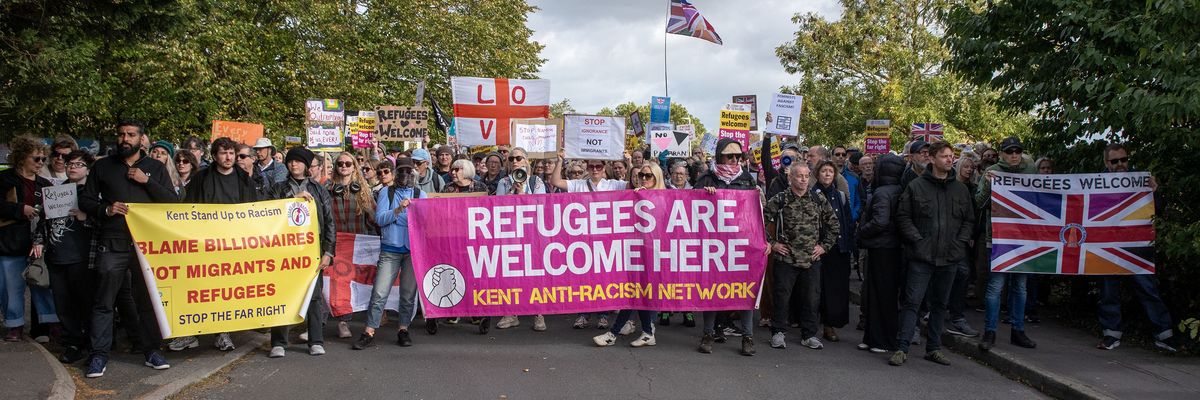
Protesters hold their banners, placards, and flags while they block the road during an anti-fascist counterprotest against a far-right anti-immigration protest on October 5, 2025, outside the Acacia Court in Faversham, UK.
(Photo by Krisztian Elek/SOPA Images/LightRocket via Getty Images)


Stephen Prager
Nov 17, 2025
COMMON DREAMS


A new asylum policy announced Monday by the UK Labour Party will allow authorities to confiscate the jewelry and other belongings of asylum-seekers in order to pay for their claims to be processed.

The policy, which some critics said was “reminiscent of the Nazi era,” was just one part of the Labour Party’s total overhaul of the nation’s asylum system, which it says must be made much more restrictive in order to fend off rising support for the far-right.

In a policy paper released Monday, the government announced that it would seek to make the status of many refugees temporary and gave the government new powers to deport refugees if it determines it to be safe. It also revoked policies requiring the government to provide housing and legal support to those fleeing persecution, while extending the amount of time they need to wait for permanent residency to 20 years, up from just five, for those who arrive illegally.

The UK government also said it will attempt to change the way judges interpret human rights law to more seamlessly carry out deportations, including stopping immigrants from using their rights to family life under the European Convention on Human Rights (ECHR) to avoid deportation.

In an article for the Guardian published Sunday, UK Home Secretary Shabana Mahmood called the reforms “the most significant and comprehensive changes to our asylum system in a generation.” She said they were necessary because the increase in migration to the UK had stirred up “dark forces” in the country that are “seeking to turn that anger into hate.”

Nigel Farage, the leader of the far-right Reform UK Party, is leading national polls on the back of a viciously anti-immigrant campaign that has included calls to abolish the UK’s main pathway for immigrants to become permanent residents, known as “leave to remain.”

Meanwhile, in September, over 100,000 people gathered in London for an anti-immigrant rally led by Tommy Robinson, a notorious far-right figure who founded the anti-Muslim English Defence League (EDL). The event saw at least 26 police officers injured by protesters.

Last summer, riots swept the UK after false claims—spread by Robinson, Farage, and other far-right figures—that the perpetrator of the fatal stabbing of two young girls and their caretaker had been a Muslim asylum-seeker. A hotel housing asylum-seekers was set on fire, mosques were vandalised and destroyed, and several immigrants and other racial minorities were brutally beaten.

Mahmood said that if changes are not made to the asylum system, “we risk losing popular consent for having an asylum system at all.”

But as critics were quick to point out, the far-right merely took Labour’s crackdown as a sign that it is winning the war for hearts and minds.

Robinson gloated to his followers that “the Overton window has been obliterated, well done patriots!” while Farage chortled that Mahmood “sounds like a Reform supporter.”

Many members of the Labour coalition expressed outrage at their ostensibly Liberal Party’s bending to the far-right.

“The government should be ashamed that its migration policies are being cheered on by Tommy Robinson and Reform,” said Nadia Whittome, the Labour MP for Nottingham East. “Instead of standing up to anti-migrant hate, this is laying the foundations for the far-right.”

In a speech in Parliament, she chided the home secretary’s policy overhaul, calling it “dystopian.”

“It’s shameful that a Labour government is ripping up the rights and protections of people who have endured unimaginable trauma,” she said. “Is this how we’d want to be treated if we were fleeing for our lives? Of course not.”

The UK has signed treaties, including the ECHR, obligating it to process the claims of those who claim asylum because they face persecution in their home countries based on race, religion, nationality, group membership, or political opinion. According to data from the Home Office, over 111,000 people claimed asylum in the year from June 2024-25, more than double the number who did in 2019.

The spike came as the number of people displaced worldwide reached an all-time high of over 123.2 million at the end of 2024, according to the Norwegian Refugee Council, with desperate people seeking safety from escalating conflicts in Sudan, Ukraine, Myanmar, the Democratic Republic of Congo, and across the Middle East.

In her op-ed, Mahmood lamented that “the burden borne by taxpayers has been unfair.” However, as progressive commentator Owen Jones pointed out, the UK takes in far fewer asylum-seekers than its peers: “Last year, Germany took over twice as many asylum-seekers as the UK. France, Italy, and Spain took 1.5 times as many. Per capita, we take fewer than most EU countries. Poorer countries such as Greece take proportionately more than we do.”

The Labour government, led by Prime Minister Keir Starmer, alread boasts that it has deported more than 50,000 people in the UK illegally since it came to power in 2024, but it has predictably done little to satiate the far-right, which has only continued to gain momentum in polls despite the crackdown.

Under the new rules, it is expected that the government will be able to fast-track many more deportations, particularly of families with children.

The jewelry rule, meanwhile, has become a potent symbol of how the Labour Party has shifted away from its promises of economic egalitarianism toward austerity and punishment of the most vulnerable.

“Labour won’t redistribute wealth from billionaires,” said former party leader Jeremy Corbyn, who is now an independent MP. “But they will seize belongings from those fleeing war and persecution.”

What changes to the UK asylum system are the Labour Government proposing?


17 November, 2025
Left Foot Forward

Amid the threat posed by Farage and Reform’s rise in the polls, the government recognises that unless it can assert control and grip over the problem, there is a real risk it could lose to Reform.


With concern over immigration growing, and the issue now ranked by the public as one of the most important facing the country, the Labour government has made tackling illegal immigration a major priority.

Amid the threat posed by Farage and Reform’s rise in the polls, the government recognises that unless it can assert control and grip over the problem, there is a real risk it could lose to Reform.

Home Secretary Shabana Mahmood’s changes to the asylum system, billed as the most radical since the second world war, have caused a stir even among her own backbenchers. So, what are the major changes being set out?

1. Temporary settlement

Those granted asylum will have to wait 20 years to apply to settle permanently. Previously, they could begin this process after five years. Some have criticised this move, saying in the end the lack of clarity on status will prove more costly to the state.

In another major change, asylum status will only be granted on a temporary basis and subject to regular review every two-and-a-half years, meaning people could be returned to their home nation if it is deemed safe.

2. Changes to Right to family life

Amid growing frustration that human rights laws were being used to block deportations, the government is also looking to overhaul how human rights legislation is applied to migration court cases. Mahmood will bring forward a Bill to change how article 8 of the European Convention on Human Rights (ECHR), the right to family life, is applied in migration court cases.

3.Fewer appeals

Under the proposed changes fewer appeals will be allowed, with asylum seekers restricted to a single appeal, which, if fails, will see them deported.

4.New legal routes to the UK to be introduced

While the government is determined to tackle the pull factors on illegal immigration, it also says that it will introduce new legal routes for asylum seekers to the UK as a way to reduce the number of dangerous journeys in small boats.

The routes will be capped and are designed to give communities a greater say about the presence of refugees.

5. Visa bans

The government has also threatened to stop granting visas to people from three African countries – Angola, Namibia and the Democratic Republic of Congo – if their governments do not improve co-operation on removals of illegal migrants.

6. Asylum seekers with assets to contribute to cost of accommodation

The home secretary is also expected to announce that asylum seekers who have assets will be expected to contribute to the cost of their accommodation.

Basit Mahmood is editor of Left Foot Forward