Wednesday, November 19, 2025


When the Muslim Presence Stops Explaining Itself
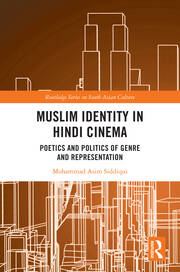

This article unfolds from the wager that Prof. Asim Siddiqui’s book Muslim Identity in Hindi Cinema: Poetics and Politics of Genre and Representation (2025) contains, beneath its patient encyclopedic sweep, a set of conceptual provocations that the book itself states only in passing. Siddiqui’s method is descriptive, empirical, archivally wide, committed to cataloguing currents, genres, types, and exceptions across decades of Hindi cinema. Yet embedded within this encyclopedic ambition are moments of disorienting creativity, ideas introduced in a matter-of-fact tone that nevertheless gesture toward a far more radical rethinking of Muslim presence in Hindi cinema. My aim is to extract these latent insights, to elaborate and extrapolate them into a coherent conceptual argument. What appears in Siddiqui as scattered remarks – about incidental identity, playful dissolution of genres, decontextualised worlds, or presences that refuse narrative burden – can be read as a subterranean philosophy of representation. Through a close reconstruction of these implicit lines of thought, this article seeks to show that Siddiqui’s work points toward an entirely different vocabulary for imagining Muslim representation.

Logics of Representation

Siddiqui’s survey of “meaningful marginality” operates within a recognisable critical horizon: the desire to redeem tokenism by foregrounding Muslim characters who, despite occupying small narrative spaces, exert decisive ethical influence, anchor value-systems, or embody a secular ethos. Imam Sahib in Sholay, Rahim Chacha in Deewar, or Abu Mian in Mirch Masala form a catalogue of corrective figures who elevate the moral tone of their worlds. Their marginality becomes meaningful because they provide narrative ballast, ethical clarity, or spiritual depth. Siddiqui repeatedly emphasises how these figures “shape the action, movement, and values of the film,” thereby countering the superfluity of mere representational placeholders. This approach remains tied to an overarching project: a cinema where Muslim presence acquires dignity through integration into the narrative’s moral core.

Yet this remains a reformist answer to tokenism, grounded in the logic of representation itself. Muslim presence becomes meaningful precisely when the character is culturally intelligible, ethically resonant, or narratively indispensable. In this model, the minor Muslim figure’s worth derives from his capacity to stabilise communal harmony, enrich moral discourse, or stand as a repository of secular ideals. The village of Ramgarh reveres Imam Sahib; Rahim Chacha offers the rationality behind Vijay’s anger; Dr Farid personifies the intimacy of interreligious coexistence; Fakir Baba and Abu Baba supply spiritual or ethical depth. These figures overcome tokenism through a compensatory elevation: they are small presences with large moral stakes. This logic preserves the classificatory matrix through which Muslim identity becomes legible. Even when marginal, the Muslim character must bear cultural meaning, moral example, or spiritual symbolism.

The more radical, playful solution Siddiqui gestures toward elsewhere sits askance to this entire reformist orientation. Where “meaningful marginality” operates through integration and moralisation, the playful solution that I am trying to extrapolate from his book begins from a refusal of representational burden. According to him, the classificatory apparatus of “Muslim social,” “Muslim historical,” and “Muslim courtesan film” already installs a regime of legibility in which Muslim presence must register through recognisable narrative templates, aesthetic markers, or thematic clusters. Siddiqui cites Ira Bhaskar and Richard Allen’s widely used taxonomy as “very useful,” yet he positions it as insufficient precisely because it presumes that Muslim identity requires a stable narrative container. What interests him is the cinematic field that spills beyond these containers, where “Hindi films … touch Muslim philosophical and mystical subjects without necessarily being about Muslims.” This formulation signals a dissolution of the boundary between essence and milieu, a cinema where Islamicate sensibilities circulate as affective and aesthetic currents rather than as representational obligations.

The invocation of Iqbal Masud’s reading of Devdas marks the first step in this displacement. Masud perceives “Hindu and Arabic–Persian traditions of Radha–Krishna and Laila–Majnu in Devdas,” a canonical text of Hindu melodrama. In this reading, the Islamicate is neither a separate genre nor a minority fragment. It becomes a spectral inflection, a set of thematic resonances that traverse the film without resolving into identity markers. Cinema, in this expanded sense, becomes a space where love, suffering, and devotion draw from multiple cultural lineages that remain entangled rather than segregated. Siddiqui uses this insight to pry open the rigid schema of Muslim genres, showing how certain films generate Islamicate atmospheres without requiring Muslim characters or recognisably Muslim worlds.

This playful solution rejects the demand for a “stable Muslim presence” by showcasing films where Muslim characters appear within mainstream genres without delivering legible cultural pedagogy or symbolic multiculturalism. A film like Lagaan embeds Ismail within the broader national allegory of anti-colonial struggle, where his partnership with Bhuvan arises from shared vulnerability rather than from token inclusion. Similarly, Iqbal refracts the difficulties of a Muslim protagonist through the grammar of sports melodrama rather than through a programmatic minority narrative. These films exhibit what might be called dispersed Muslimness: a presence fully absorbed into the narrative’s horizon of action, desire, and conflict, without becoming a cultural specimen.

The case of Chak De India brings the logic of dispersed Muslimness into sharp relief because the film builds its central crisis on an act of communal suspicion while refusing to organise its narrative around that suspicion. Kabir Khan misses a decisive penalty stroke in an India–Pakistan match, and this single sporting failure is immediately interpreted by the media and by his neighbours as evidence of betrayal. His “identity is criminalized,” as Siddiqui notes, since “he was charged as a Muslim for collaborating with Muslims,” and the ferocity of this accusation forces him into seven years of exile. Crucially, however, the film does nothing to narrativise or work through this communal wound. Kabir’s Muslimness remains the silent precondition for his ostracisation, yet the narrative declines to treat his identity as an object of exploration, confession, defence, or explanation. Instead, the film absorbs him into the mechanics of sporting redemption, allowing his identity to remain untheorised, even opaque. This refusal to monumentalise identity provides a counter-move to tokenism. The Muslim figure escapes assimilation through moral overdetermination and escapes marginalisation through decorative inclusion; he becomes a character whose identity is neither erased nor thematised.

Siddiqui’s conceptual wager – or the implicit line of thought that I reconstruct here – lies here: a cinema that suspends the requirement that Muslim presence carry representational weight opens a field where the Islamicate operates as a wandering affect, a tonal undercurrent, a narrative intensity. By declining to stabilise Muslim identity through genres, markers, or pedagogical functions, such films stage a different kind of pluralism, one grounded in shared narrative worlds rather than in curated diversity. This mode of representation carries a radical potential since it breaks the pact between identity and legibility. Muslimness circulates freely, unanchored in pre-given forms, allowing the cinematic world to articulate coexisting sensibilities without resorting to classificatory closure.

Thus, we can detect a structural tension between two approaches in Siddiqui’s book. The corrective paradigm requires morally weighty Muslim figures whose minor roles carry maximal ethical force. The playful paradigm loosens this requirement by allowing Muslimness to drift through unexpected genres, affective registers, and narrative environments. It refuses the expectation that Muslim characters must rescue the narrative from ethical deficit or solidify its secular promise. Films like LagaanIqbal, or Chak De India exemplify this shift: Muslim characters participate in narrative action without embodying a pedagogical function. Kabir Khan’s trauma remains unworked through in communal terms; Ismail’s partnership with Bhuvan arises from action rather than symbolic multiculturalism; Iqbal’s journey unfolds within sports melodrama rather than identity ethics. In this schema, Muslim presence gains freedom precisely because it ceases to serve as the conscience of the cinematic world.

Whatever Muslim

This cinematic freedom is strikingly visible in Siddiqui’s category of the “incidental Muslim,” which opens a representational field that aligns strikingly with Giorgio Agamben’s notion of “whatever being.” These characters neither conform to the older regime of visible markers (sherwani, skull cap, chaste Urdu) nor serve as the ethical correctives that populate Siddiqui’s catalogue of meaningful marginal figures. Instead, they inhabit the cinematic world as ordinary presences whose Muslimness neither disappears nor crystallises into a narrative function. Their identity is “incidental,” yet this very quality reveals a new mode of cinematic singularity: a Muslim character presented “such that it always matters,” to borrow Agamben’s re-reading of quodlibet. These characters refuse the reduction of Muslimness to properties or predicates and appear instead as singularities that carry their identity without being confined by it.

Agamben’s key insight is that the whatever being “relates to singularity not in its indifference with respect to a common property… but only in its being such as it is.” This perfectly captures the status of figures like Inspector Khan, Jaan Nisar Khan, Sultan Ali Khan, Rizwan Ahmed, or Dr Jahangir Khan. In each case, the film acknowledges the character’s Muslim identity, yet declines to convert that identity into an interpretive anchor. Rizwan Ahmed in Baazar announces his full name “without any self-consciousness,” and the film retains his Muslimness without structuring his narrative fate through it. Jahangir Khan’s presence in Dear Zindagi does the same: his name signals a Muslim lineage, but his function in the narrative arises entirely from his skill as a therapist, his wit, his charisma, his professional ethics. These characters are neither assimilated into anonymous secular universality nor curated as emblems of multicultural depth. They appear instead as Muslims “in their being such,” free from the classificatory compulsion that ordinarily governs cinematic identity.

Through this lens, Siddiqui’s incidental Muslim approximates Agamben’s singularity freed “from its having this or that property, which identifies it as belonging to this or that set… reclaimed… for its being-such.” These characters neither perform Muslimness nor abandon it; they simply carry it, lightly but irrevocably. Sultan Ali Khan’s Haryanvi-inflected world foregrounds regional belonging far more strongly than religious identity. Yet the nikah ritual, the ziyarat at the tomb of Syed Sahib, and the Muslim names in the narrative surface without narrative weight or cultural exposition. These gestures preserve identity at the level of appearance without making it the ground of meaning. The films thus stage Muslimness as a mode of appearing rather than a category that demands narrative justification.

Agamben’s formulation that “whatever singularity… is lovable” illuminates precisely this form of representation. The incidental Muslim is presented in such a way that the audience’s attachment stems neither from stereotype nor from pedagogical elevation. Inspector Amjad Khan’s comic eccentricity in Qurbani or Jaan Nisar Khan’s image of domestic joy in Andhaa Kaanoon creates affection through manner, gesture, vulnerability, and force of personality rather than through emblematic identity. The viewer encounters a Muslim character who is desired, admired, or remembered “with all of its predicates, its being such as it is.” In Agamben’s language, these characters allow identity to function not as a classifying predicate but as part of a singular constellation of traits that draw love and recognition.

Crucially, this mode breaks the older representational dialectic between stereotype and token transcendence. The incidental Muslim no longer stands as the moral conscience of the village, the wise old man, or the custodian of secular harmony. Siddiqui’s earlier figures overcame tokenism through moral depth; the incidental figures sidestep tokenism by releasing identity from moral or symbolic labour. This creates a cinematic analogue of Agamben’s “intelligibility of an intelligibility,” where the character’s presence communicates a form of belonging without the weight of representation. Javed Siddiqui’s role in Uunchai or Lateef Zaidi’s in Chehre exemplify this shift: eloquence, intelligence, and decisiveness shape the viewer’s relation to the character, while Muslimness remains a fact that neither structures the plot nor demands interpretive decoding.

We see the emergence of the “whatever Muslim,” a being who belongs without being bound, who appears without becoming exemplary, and whose presence matters not because it fills a representational quota or corrects a stereotype, but because it embodies “being-such” within the cinematic world. This mode holds the promise of a new politics of representation in Hindi cinema: one that neither fetishises identity nor evacuates it, but allows Muslimness to circulate as an ordinary, lovable, fully singular presence.

Siddiqui’s reading of the “decontextualised world” of gangster films reveals a further mutation in Muslim representation, one that extends and radicalises the logic of incidental identity. In these narratives, Muslim gangsters inhabit a cinematic space stripped of political referents, real-life communal conflicts, and recognisable ideological coordinates. Their Muslimness remains legible primarily through names (Musa, Sultan, Jibran, Abdul Khan) yet the films decline to bind these names to cultural or religious predicates. The world itself is stylised, insulated from real history, operating in what Siddiqui calls “a decontextualised world of crime where there is no reference to any political ideology, political party, or government.” This evacuation of context paradoxically generates a new mode of Muslim presence: freed from both stereotype and the burden of positive pedagogy, Muslim characters appear as singularities, neither exemplary nor emblematic.

Characters like Musa Bhai in Plan or Abdul Khan in Parinda function within a stylised universe where identity cues lose their explanatory force. Musa’s regret that he could not perform kanyadan blurs the religious code entirely; Abdul Khan’s refusal to return Iqbal’s salaam foregrounds gang loyalty over communal solidarity. These gestures detach Muslimness from its usual narrative functions (victimhood, moral conscience, bearer of composite culture) and reposition it as a trait among others. Agamben writes that “singularity is freed from its having this or that property… for its being-such,” and Siddiqui’s decontextualised gangsters embody this state. Their Muslim identity neither determines their morality nor aligns them with communal narratives; it instead appears as one element in a constellation of qualities (loyalty, cruelty, wit, weakness, aspiration) that define them as singular cinematic beings.

This decontextualisation provides a solution to the impasse of Muslim representation by suspending the demand that Muslim identity signify. Earlier models oscillated between stereotype (gangster, fakir, qawwal) and corrective tokenism (moral guide, secular conscience, guardian of harmony). Even Siddiqui’s “meaningful marginality” preserved this logic by requiring Muslim figures to enrich the ethical universe of the film. The decontextualised gangster breaks that cycle. The films sidestep both burden and sympathy; Muslim characters neither redeem the narrative nor threaten it with communal meaning. In Agambenian terms, their identity is encountered as style, gesture, rhythm, rather than semiotic content.

This dynamic becomes especially vivid in Parinda through the figure of Abdul Khan, a Muslim gangster whose presence unsettles the viewer through an unexpected aesthetic register. Siddiqui emphasises that Abdul is “the most trusted man of Anna,” a violent enforcer who “cuts throats of people,” yet the film repeatedly shows him in moments of stillness, absorbed in playing the flute. This juxtaposition is central. In Hindi cinema, the flute often carries associations of refinement, classical training, or mystical interiority, and these associations are themselves historically entangled with the prominence of Muslim ustads in classical music. Parinda invokes this cultural resonance only to fracture it. Abdul does not play the flute as an emblem of cultural sophistication or as a coded indicator of an Islamicate interior life. Instead, his playing appears in odd, quiet moments that offer no narrative explanation or psychological backstory. The film refrains from linking his musical skill to a tradition, a lineage, or a stereotype.

What emerges instead is a moment of eerie singularity. The police officer’s line – “the way he plays the flute in the same way he cuts throats of people” – collapses two registers that are usually kept apart: aesthetic modulation and violent precision. Abdul’s flute becomes neither a sign of refinement nor a symbol of moral contradiction; it becomes a purely cinematic gesture, an unexpected texture that complicates the viewer’s sense of who he is without resolving him into a type. This is precisely where the scene departs from the usual representational patterns that attach Muslim identity to musical artistry. Siddiqui calls this juxtaposition “a subversion of the association of classical music with a lot of well-known Muslim artists,” but the key point is that the film does nothing to stabilise this subversion into commentary or critique. It simply lets the incongruity stand.

Abdul’s flute playing, therefore, exemplifies the “whatever” mode of Muslim presence: a trait that gestures toward cultural memory without collapsing into it, a behaviour that enriches the character without explaining him, a moment that belongs to the visual and sonic logic of the film rather than to an identity script. The conjunction of “music and crime” becomes an aesthetic quality, an unsettled, atmospheric detail, rather than a cultural message. In this way, Abdul Khan’s character contributes to the larger movement in Siddiqui’s analysis: Muslimness appears as a lightly held, untheorised presence that refuses both stereotype and symbolic weight.

Moreover, the decontextualised world creates a space where Muslimness appears without being mobilised as a marker of community politics. When Tyson’s Christian gang, Jibran’s Muslim gang, and Jindal’s Hindu identity appear in Mohra, the configuration mirrors “the power dynamics of Indian social structure” yet refrains from moralising or politicising these identities. Religion becomes a background texture, an as rather than an essence. Jibran can survive, betray, or align himself without his Muslimness offering narrative justification. This loosening of identity from function allows Muslim characters to exist outside the usual dialectic of visibility and burden.

Finally, this mode reconfigures the Muslim presence beyond the politics of recognition. The decontextualised gangster does not seek inclusion, does not serve as a stand-in for secular harmony, and does not embody the threat stereotype. The character’s name may echo real-life resonance (Yusuf Pathan, Billa Jilani) yet the film withholds sociological explanation, refusing to translate the character into a symptom of Muslim criminality or minority marginalisation. This refusal creates a representational openness: Muslim identity becomes a free-floating signifier, part of the world’s texture rather than its problem. In this sense, Siddiqui shows how decontextualisation enables a “whatever” mode of representation: Muslimness appears without obligation, without typology, without symbolic weight. It becomes part of the cinematic world’s taking-place, a presence that matters precisely because it no longer must matter in the old ways.

A Muslim Without Qualities

Siddiqui’s reading of Company provides a striking instance of what may be called a presencing without essence, a mode of Muslim representation that refuses both erasure and fixation. The marriage scene becomes the conceptual hinge of this mode. Malik performs a Hindu fire ritual to please Saroja, and Siddiqui emphasises that this gesture carries no capacity to “determine his identity.” This refusal of determination is the point. Malik’s willingness to step into a ritual associated with another community exposes identity as a wearable surface rather than a deep predicate.

This mode of appearance places Muslim identity in the realm of the incidental, the lightly held, the lived rather than the declared. The film avoids dwelling on Malik’s background, history, or religious commitments. His name circulates as a sign with dual resonance in Hindu and Muslim settings. His actions supply no interpretive anchor that would allow the viewer to classify him within a religious framework. Identity becomes something he carries rather than something he performs. In this sense, the marriage scene stages a form of identity as gesture, an embodied flexibility that avoids both assimilationist erasure and essentialist visibility.

The contrast with Chandu’s world sharpens this insight. Chandu’s marriage is saturated with visual cues and ritual indicators that affirm a Hindu domestic setting. Siddiqui highlights “religious symbolism” in Chandu’s surroundings precisely to show the asymmetry: Hindu identity is thematised, foregrounded, placed within a frame of social recognition, while Malik’s identity remains suspended, indeterminate, neither concealed nor highlighted. The result, however, is not an erasure of Muslim presence. Instead, Malik’s Muslimness enters the frame as a possibility, a horizon, an as that structures how he is read without enclosing him in a fixed type.

Chandu’s companions complete this conceptual field. Hasan wears a skull cap and immediately signals Muslim identity. Koda Singh marks Sikh presence. The small gang becomes a miniature tableau of secular plurality, yet Malik stands apart as a figure whose identity appears through relation rather than symbolism. His connection to Chandu, his participation in ritual for love rather than doctrinal fidelity, and his position within a mixed religious world all create a form of Muslim presence grounded in lived interaction rather than archetype.

This produces a new representational possibility. Instead of affirming Muslim identity through visible markers or narrative functions, the film allows Muslimness to appear as an aspect of social being that emerges through action, affection, and environment. It dramatizes a world where Muslim identity gains presence by entering shared rituals, shared life, shared risk, and shared ambition, without losing its distinctiveness or becoming a stereotype. It shows a Muslim figure who belongs through gesture rather than through explicit cultural coding, allowing representation to escape the rigid binary of hypervisibility and invisibility.

Conclusion

What emerges from this excavation of Siddiqui’s text is a para-political theory of futurity. The eccentric Muslims of Hindi cinema – Kabir Khan coaching the nation after being hounded out as a traitor, Malik stepping calmly into a Hindu fire ritual, Abdul Khan playing the flute between murders, Rizwan Ahmed circulating in corporate boardrooms without anxieties about his name – constitute, in their very implausibility, a political archive of possibility. They are absurd, yes, because the world that surrounds Indian Muslims today offers little space for such unburdened existence. Yet cinema’s absurdity becomes its strength. It conjures forms of Muslimness that social reality disallows, producing figures neither governed by the stabilising demands of secular reassurance nor trapped in the punitive gaze of majoritarian suspicion.

These cinematic Muslims expose the poverty of our political imagination. Against a public sphere where Muslim identity is constantly policed, explained, defended, or pathologised, Hindi cinema inadvertently generates Muslims who neither apologise nor signify, who neither embody minority trauma nor enact multicultural aspiration. They simply exist – irregularly, unpredictably, as beings whose presence cannot be reduced to pedagogy, grievance, or stereotype. In these figures, identity appears as gesture, accident, style, attachment, mood. Their very unseriousness becomes politically serious, for it breaks the monopoly of state and society over what counts as a “proper” Muslim life.

The “whatever Muslim” gestures toward a mode of belonging that escapes the traps of hypervisibility and invisibility. It hints at a future where Muslimness circulates without pre-scripted meaning: a future where one can be a therapist, a gangster, a lover, an athlete, a trader, a neighbour, a traitor, a saint, a nobody, or all at once, without each role collapsing back into a single communal essence. It invites us to imagine Indian Muslims as beings whose possibilities exceed the representational grids that have long trapped them in the dialectic of threat and token.

This, finally, is the political provocation of Siddiqui’s accidental philosophy: that Hindi cinema, through its most casual gestures, its throwaway details, its narrative indifference, sketches the outlines of Muslims who remain irreducible to the categories that dominate the nation’s imagination. These are Muslims without qualities, without assigned meanings, without explanatory burdens. And in a moment when the Indian Muslim is relentlessly fixed into legible roles – loyal patriot, dangerous outsider, secular friend, demographic fact – the cinematic figure who walks through fire for love, refuses to return a salaam, snorts drugs, lifts a hockey team to victory, or plays a flute between killings becomes profoundly political. These are beings who refuse to be what they are told they are.

In their unpredictability lies a lesson: that identity can be lived without weight, that belonging can occur without permission, and that Muslim life in India might yet inhabit forms that exceed both fear and representation. Here, in the strange freedom of these cinematic presences, we glimpse what Indian Muslims can become: lives unshackled from the compulsion to signify, lives allowed to be as they are, lives that stake a claim to the world simply by appearing within it.

Yanis Iqbal is a student and freelance writer based in Aligarh, India. Read other articles by Yanis.

Why New York City Needs a Public Bank


We will build a city-owned bank — not to serve shareholders, but to serve you. A bank that invests in housing, in transit, in climate resilience. A bank that puts our money to work for our people.
— Zohran Mamdani, Victory Speech, Nov. 4, 2025

New York City has elected a mayor who dares to challenge the status quo. Zohran Mamdani swept into office on a platform of affordability, municipal ownership and economic justice. But Mamdani’s plan to fund his reforms through $9 billion in new taxes on corporations and high earners is already bumping up against political and fiscal realities.

Income taxes are the province of the state, not the city, and NY State Governor Kathy Hochul is standing firm in her resistance to raising them. Pres. Trump has vowed to “cut off the lifeline” to the city, pledging to reduce federal aid to the legal minimum. And Mamdani’s proposals are said to be triggering capital flight. Wall Street is mobilizing. The city’s budget is strained. So where will the money come from?

The Public Bank Alternative

Raising taxes on the wealthy is not Mamdani’s only funding proposal. His vision for economic justice and municipal ownership also includes a public bank. In his June 2025 primary speech, he pledged to create a city-owned bank to fund housing, transit and climate resilience — calling it “a tool to break Wall Street’s grip on our future.” In his victory speech on Nov. 4, 2025, he again referenced public banking as a pillar of his economic agenda. He described the election as “a mandate for change” and a rejection of politics “that answers only to the few.”

These statements align with his legislative record. Mamdani was a co-sponsor of Assembly Bill A3352, the New York Public Banking Act, and he has consistently advocated for public finance alternatives during his tenure in the State Assembly.

What Is a Public Bank and What Can It Do?

A public bank is a bank owned by the people through their government (local or federal). It can hold public funds, issue loans for public purposes and reinvest profits in the community. This is not a utopian idea; it’s a proven model. The proof is in an unlikely state, conservative North Dakota.

While New York City entrusts its public funds to Wall Street banks — paying billions in interest to private lenders — the state of North Dakota has taken a radically different approach. Its public funds are held in the Bank of North Dakota (BND), a state-owned institution that reinvests profits locally, finances infrastructure, and cushions the blow of economic shocks. While NYC relies on private-profit-driven banks to finance public needs, BND operates as a public utility — prioritizing resilience, affordability and sovereignty.

How North Dakota Escaped the Shutdown

This difference has become particularly evident during the 2025 federal government shut down. While other states suffered SNAP disruptions and budget shortfalls, North Dakota leveraged BND funds without waiting for Washington:

BND’s 2024 Performance: A Model for NYC

According to its latest annual report, the BND has over $10.8 billion in assets and more than $200 million in net income, much of it reinvested in agriculture, education, and sustainable  development. More than $1 billion was transferred to the state’s general fund and special programs through 2018, most of it in the previous decade. That is a substantial sum for a state with a population that is only about one-tenth that of New York City (780,000 versus 8.3 million). The BND keeps interest payments in-state, funds infrastructure and cushions shocks that would seriously impair other states’ budgets. In October 2024, Truth in Accounting’s annual Financial State of the States report rated North Dakota #1 in fiscal health, with a budget surplus per taxpayer of $55,600.

The average ROE (return on equity) of the BND from 2000 through 2023 was 19.4%. Compare JPMorgan Chase (JPM), by far the largest bank in the country, with 2.4 trillion in deposits. Its average ROE from 2000-23 was 11.38% over the same period. For a detailed breakdown, see here. New York City pays an estimated $4 billion annually in interest to private banks — money that could instead be recycled through a municipal bank to fund housing, transit and clean energy.

How could the BND have outperformed JPM, the nation’s largest bank? The BND has substantially lower costs and risks than private commercial banks. It has no exorbitantly paid executives; pays no bonuses, fees, or commissions; has no private shareholders, branches or ATMs; and has low borrowing costs. It partners with local banks in “participation loans,” avoiding loan origination costs. It engages in old-fashioned conservative banking and does not speculate in derivatives, so it has no losses or risk from derivative trades gone wrong. It makes productive loans that are non-inflationary, avoiding loans that create bubbles and crashes.

An engaging video explaining what a public bank can do is on the website of the Public Bank NYC Coalition, which advocates for a NYC public bank. Another informative series of explanatory videos is on the Public Banking Institute website here.

How to Capitalize the Bank

New York City is well-positioned to capitalize a public bank. According to the Comptroller’s FY2025 report, the city began the year with over $10.4 billion in cash-on-hand, and it maintains an average balance of $10.1 billion. Its annual revenues exceed $100 billion, and its total assets—including real estate, infrastructure and pension funds—are even greater.

The pension funds alone are a vast reservoir of potential capital — managing nearly $295 billion across five systems as of mid-2025. Scott Baker, Economics Editor at OpEdNews and New York State Coordinator for the Public Banking Institute, observes in a November 2025 article that current pension investments are seriously underperforming after fees. Former NYC Comptroller Scott Stringer produced a report showing that for the 10-year pension period ending in 2015, the NYC pension funds generated zero ROI (return on investment) when he included $2.5 billion in management fees.

In 2024, the city contributed $9.6 billion to the funds, while employees contributed about $2.5 billion. Offset by $2.5 billion in management fees, the total contribution for investment was $9.6 billion, the sum coming from the city. Assuming a 10% capital requirement, this $9.6 billion could capitalize $96 billion in loans. $9.6 billion is only one-third of 1% of the total assets of the NYC pension funds, a very modest investment that could generate an average 19% ROI if used to capitalize a public bank on the BND model. In fact, $1 billion would be enough to capitalize a bank the size of the BND.

Banks, Not the Government, Create the Money Supply 

How can a public bank lend billions more than the capital it actually has? The answer is in a little-known secret of banking: banks don’t lend existing money. They create it. When a bank issues a loan, it doesn’t hand out cash from a vault. It creates a deposit in the account of the borrower, backed by the borrower’s promise to repay the loan with interest; and these deposits are counted in the money supply. Roughly 95% of the U.S. money supply is created in this way — by private banks, for private profit.

A public bank does the same thing, but in the public interest. It monetizes future productivity — housing that will generate rent, roads and rail that will transport workers, solar panels that will lower energy costs. To “monetize” means to turn future productivity into something that can be spent now — e.g. spent on the labor and materials necessary to create the products that will repay the loan. The money is created into existence, circulates through the economy and is extinguished upon repayment.

Isn’t That the Sort of “Money Printing” That Drives Up Prices? 

No. Price inflation is a function of supply and demand: prices go up when too much money is chasing too few goods. Injecting new money (demand) does not drive up prices as long as the money creates new supply to absorb it, keeping prices stable.

China’s development model illustrates this principle. Over the past 29 years, its money supply has increased by a whopping 5,500%. Yet price inflation has remained modest, because the increase in money was matched by an increase in goods and services. The China Development Bank — one of the largest banks in the world — along with other Chinese public banks fund infrastructure, housing and manufacturing, creating real assets that absorb the new currency in the marketplace.

Taking on Wall Street 

The New York Public Banking Act (S1754/A3352), which Mamdani co-sponsored in the NY Assembly in 2023, would allow cities in the state to obtain charters for their own public banks. Modeled on California’s AB857, it has broad legislative support. However, it remains stalled in the legislature — likely due to pressure from entrenched financial interests. New York State is home to some of the largest and most powerful banks in the world, and they are in the heart of New York City.

New York City is also the home of the most powerful branch of the Federal Reserve, the New York Fed, and like all Fed branches, it is 100% owned by the banks in its district. Because of its proximity to Wall Street and its operational responsibilities, the New York Fed is often considered the heart of the Federal Reserve System. Its Wall Street owners are not likely to relinquish control of that megacity’s finances without a fight.

To operate in the banking system, the new city-owned bank will need a Federal Reserve master account. Without it, the bank cannot clear payments or interact with the broader financial system. The bank will also need “reserves,” either as “vault cash” (Federal Reserve notes and coins distributed by the Fed) or as digital reserves originated by the Fed. The bank can get the needed reserves from the city’s deposits held by the bank, but to get a master account is a trickier issue. The Fed is now requiring that new banks be FDIC insured. The BND, which was founded in 1919 and was grandfathered in, does not have or need FDIC insurance. The state is virtually its only depositor, and FDIC insurance would cover only $250,000 of its $7.6 billion in deposits from that single entity. But the current FDIC requirement could be a chokepoint for New York City.

Mamdani also has powerful supporters, however, and he would have the ability to challenge the Fed and the FDIC in court if necessary, following the precedent set by Custodia Bank and others seeking equal access to the payments system. The Custodia bid for a master account failed — likely because it threatened to siphon deposits out of the U.S. dollar system into cryptocurrencies, destabilizing Wall Street’s grip on liquidity. But public banking is not crypto. It is not speculative, extractive, bubble-producing, inflationary or offshore. It is sovereign infrastructure designed to channel capital into the real economy — into goods, services, and livelihoods that nourish communities. Public banking keeps money local and accountable. It’s not a drain on liquidity but a new source of available funds.

Recapturing the Money Power

A recent proposal by the Money on the Left Editorial Collective titled “Democratic Public Finance: A Radical Vision for Mamdani’s New York City” urges the incoming Mamdani administration to consider legal action to challenge federal monetary constraints. While not officially affiliated with the campaign, the authors build on Mamdani’s platform and offer strategic guidance for deepening public finance reform, including by expanding municipal credit capacity through public banking. They propose a long-term campaign to contest what they call “deep legal structures,” including balanced budget amendments and constitutional interpretations that enforce austerity. These challenges, they argue, are essential to unlocking the full crediting capacity of municipal governments. The authors conclude:

Without a doubt, Zohran Mamdani’s vision for New York City represents the most politically savvy and fiscally robust undertaking in decades. This document argues that Mamdani’s transformative vision can be further enhanced if it directly confronts the myth of money scarcity and frames our collective capacities as the source of shared prosperity.

Freed of regulatory blockages, a New York City public bank could hold NYC’s public deposits; finance housing, transit, and energy; reinvest profits locally; and reduce reliance on Wall Street middlemen. In short, it could fund Mamdani’s vision without triggering capital flight.

While businesses are fleeing NYC, North Dakota was rated by Forbes Magazine the best state in the country in which to start a business in 2024. It escaped the 2025 shutdown by reclaiming the power to create money as credit through its own state-owned bank. NYC can fund its future by doing the same.

Ellen Brown is an attorney, co-chair of the Public Banking Institute, and author of thirteen books including Web of DebtThe Public Bank Solution, and Banking on the People: Democratizing Money in the Digital Age. She also co-hosts a radio program on PRN.FM called “It’s Our Money.” Her 400+ blog articles are posted at EllenBrown.com. Read other articles by Ellen.


Cuba’s Internationalist Legacy in Africa — Part I: Doctors of Liberation


No Truth in the World


African blood flows freely through our veins. We shall defend Angola and Africa!

— Fidel Castro1

History remembers wars and generals, but too often forgets healers. Cuba’s internationalist mission in Africa began not with weapons, but with medicine. In the 1960s and 70s, as newly independent nations struggled to build health systems, Cuba sent doctors, nurses, and medical brigades across the continent. Their work was not charity—it was solidarity.

Healing as Resistance

In 1963, Cuba dispatched its first medical team to Algeria, only months after independence from France. That gesture set the tone for decades of commitment. Cuban doctors treated malaria, tuberculosis, and maternal health crises in regions abandoned by colonial powers.2 They built hospitals, trained local staff, and established public health infrastructures where none existed.

For Cuba, medicine was a weapon against imperial neglect. Fidel Castro declared that “health is not a commodity, but a right of the people.”3 By sending doctors abroad, Cuba challenged the logic of empire: that Africa should remain dependent, sick, and vulnerable.

The Humanitarian Frontline

Unlike mercenaries or aid contractors, Cuban medical brigades were volunteers. Many were young graduates who left behind families to serve in remote villages. They lived simply, often without electricity or running water, but their presence transformed communities. Literacy campaigns were paired with health campaigns, making education and medicine inseparable tools of liberation.4

African leaders recognized this. Amílcar Cabral of Guinea-Bissau praised Cuba’s doctors as “soldiers of humanity,” noting that their work strengthened the very foundations of independence.5

Beyond Cold War Propaganda

Western narratives often dismissed Cuba’s medical missions as propaganda or political maneuvering. Yet the reality was undeniable: thousands of African lives were saved, and entire health systems were built from scratch. By the 1980s, Cuba had sent more doctors abroad than the World Health Organization itself.6

This was not imperial expansion but internationalist solidarity. The Cuban doctors became living proof that small nations could wield moral power greater than military might.

The Legacy of Healing

The legacy of Cuba’s doctors in Africa is profound. They were healers of resistance, embodying the principle that liberation is not only political but biological—the right to live free from disease and neglect. Their work laid the groundwork for future generations of African physicians and nurses, many trained in Havana’s medical schools.7

As Part I of this series shows, Cuba’s internationalist legacy begins with medicine. It is the story of how healing became a revolutionary act, and how the “doctors of liberation” carried the torch of solidarity across continents.

ENDNOTES:

  • 1
    Fidel Castro, speech at mass rally in Havana, December 1975, reprinted in Cuba and Angola: Fighting for Africa’s Freedom and Our Own (Pathfinder Press, 2013).
  • 2
    Cuba’s first medical mission to Algeria, 1963. In Vladia Rubio, “Five Truths About 62 Years of Cuba’s Internationalist Medical Cooperation,” CubaSí, May 30, 2025.
  • 3
    Fidel Castro on health as a human right. Speech at the Closing Ceremony of the Health Ministers’ Meeting of the Non-Aligned Countries, Havana, June 26, 1998.
  • 4
    Cuban literacy and health campaigns in Africa, 1960s–70s. Helen Yaffe, “Cuban Medical Internationalism: A Paradigm for South–South Cooperation,” International Journal of Cuban Studies, Pluto Journals, 2020.
  • 5
    In Piero Gleijeses, Conflicting Missions: Havana, Washington, and Africa, 1959–1976 (UNC Press, 2002).
  • 6
    Comparative figures: Cuban doctors abroad vs. WHO, 1980s. John M. Kirk, “Cuba’s Medical Internationalism: Development and Rationale,” Bulletin of Latin American Research, Vol. 28(3) (2009).
  • 7
    Latin American School of Medicine (ELAM), founded 1999, hosting ~19,550 students from 110 countries. Rádio Havana Cuba, “Africans in the Latin American School of Medicine,” Nov. 23, 2024.

Sammy Attoh is a Human Rights Coordinator, poet, and public writer. A member of The Riverside Church in New York City and The New York State Chaplains Group, he advocates for spiritual renewal and systemic justice. Originally from Ghana, his work draws from ancestral wisdom to explore the sacred ties between people, planet, and posterity. Read other articles by Sammy.


 Pastor’s “MAGA vs. Jesus” TikTok Series Dismantling Right-Wing Theology Draws Millions


FILE - President Donald Trump holds a Bible as he visits outside St. John's Church, June 1, 2020, in Washington. Former President Trump's support from white evangelicals and other conservative Christians is as strong as ever. And he's increasingly infusing his campaign events with Christian rhetoric and imagery. This has frustrated a minority of conservative evangelicals who see Trump as an unrepentant poser, using the Bible and prayer sessions for photo props. (AP Photo/Patrick Semansky, File)

Trump holds a Bible as he visits outside St. John’s Church, June 1, 2020, in Washington.

Reverend Dr. Caleb J. Lines, the pastor at University Christian Church in San Diego, California, had heard enough bull-puckery from MAGA Christians about their interpretation of the Bible. According to The Daily Dot’s Rachel Kiley, Rev. Lines has created “a series of videos in which he uses Bible verses and Jesus to rebuke MAGA talking points.”

“The teachings of MAGA are simply incompatible with the teachings of Jesus Christ,” Lines says, so he established a “MAGA vs. Jesus” series on TikTok. And the series is drawing millions to his videos. The videos are short-form, social-media friendly (TikTok, Reels, etc.), often framed with Lines holding signs or delivering direct statements like “MAGA says real Christians support Trump.”

In “MAGA vs. Jesus,” Rev. Lines  “goes through MAGA talking points and fires back with Bible verses that contradict them,” Kiley reported. “In his most popular video, which has racked up over 5.5 million views, Reverend Lines tackles abortion, cancel culture, the need for manly men, and ‘fake news’” (https://www.dailydot.com/viral-politics/pastor-refutes-maga-talking-points-with-bible-verses-jesus/?utm_source=substack&utm_medium=email).

Over the years, conservative Christian preachers and political activists have weaponized The Bible to enrage their followers, engage them in political campaigns and supporting candidates, while at the same time, building personal financial empires. They frequently use the Bible as a political tool, selectively highlighting verses that reinforce their cultural grievances or policy goals while ignoring the broader context of scripture. Immigration, LGBTQ rights, racial justice, and public education are recast not as policy debates but as spiritual warfare, with dissenters portrayed as enemies of God.

As The Daily Dot’s Rachel Kiley noted “The Bible contains so much, with various translations and interpretations, that cherry-picking verses can bring people to just about any conclusion.

“Christians (and certainly MAGA Christians) are known to do this, and those who disagree with Reverend Lines’ perspective would likely accuse him of doing the same. But even if he’s only matching a single verse to each claim, he still makes good points—often rooted in Biblical teachings—along the way.”

In one video, refuting the notion that “real Christians support Trump,” Rev. Lines cites 1 John 4:20: “Those who say they love God but hate their neighbor are lying.”

“You cannot follow Jesus Christ while actively supporting politicians or policies that hurt your neighbor. You know, like cutting their food aid or their healthcare,” he says.

In these days of rising Christian nationalism and new and powerful religious movements like the New Apostolic Reformation, Rev. Dr. Lines is doing … dare I say it … God’s work!

Bill Berkowitz is a longtime observer of the conservative movement. Read other articles by Bill.


Mechanical Mikey and the Theater of War


If you could hear, at every jolt, the blood/Come gurgling from the froth-corrupted lungs . . . . My friend, you would not tell with such high zest / To children ardent for some desperate glory, / The old lie: Dulce et decorum est / Pro patria mori  [It is a sweet and fitting thing to die for one’s country]

– Wilfred Owen, Dulce Et Decorum Est

On the morning of November 11, I was passing through Pittsfield, Massachusetts, heading north. The traffic was stopped as a Veteran’s Day parade headed south. It was a sight for a musing mind, so that is exactly what I did, sitting in my car watching the parade’s celebration of the patriotism of military veterans.

I asked myself: What are they still marching for?

I was once in the U.S. Marines but became a conscientious objector during the U.S. war against Vietnam and have opposed US militarism and wars ever since. I was brought up to be a patriot, and the marching men – mostly old – with their ancient rifles teetering on their shoulders as the season’s first snowflakes peppered their faces and the marching band drummed up a martial beat to counter the dreary morning, touched me in a melancholic and twisted way. They seemed to be barely holding on – but to what? I wondered – war, their youths, past bonds, a lost country, some meaning in once having a cause to fight for, the best times of their lives, false nostalgia, the joy of killing?

Young, smiling, and excited 11-13 year-old girls ran alongside, handing out small American flags to any occupant of the halted cars who would open their windows. I was about to do so, despite a lifetime of rejecting the flag waving (but not the country) that has come to represent war mongering for me, but the cops motioned the traffic on. The marchers waved to the very few people scattered along the sidewalks who waved back. I drove on wondering why my heart opened to the marchers. It surprised me. Waves of conflicting emotions flowed over me.

When I arrived at my destination, there was a television playing in the waiting room of the office. I took a seat and watched it, something I usually avoid. It was a History Channel program about U.S. soldiers killed and wounded in Vietnam, the Medevac helicopters flying into combat zones and medics evacuating fellow soldiers. Very dangerous work by courageous men. Hearing the program’s narrator blather on about patriotism as it showed gruesome pictures of bloodied and dead soldiers, erased any previous sentiment I felt about the parade marchers. Like the documentary, the parade typically did not mourn the millions of victims of the endless U.S. wars nor did it picture or in any way illustrate all the U.S. dead, wounded, and crippled soldiers. The marchers’ smiles were pasteboard masks concealing the grim reality of war.

I felt rage rising in me, even as I admired the bravery of the evacuation teams bringing out their comrades. My blood boiled at the way the program was using bravery as a cover to continue to promote war, to say these soldiers had been defending their country and were therefore patriots when they were attacking another country over eight thousand miles away for the lies of son of a bitch politicians (LBJ and Richard Nixon, both of whom were elected as peace candidates) who always wage wars so easily, using the flesh and blood of young people as cannon fodder. Yes, the old lies told by jackals with smiling faces.

I wanted to grab the politicians by their turkey necks and force their hands into the massive bloodied hole in an 18 year old boy’s entrails, to push their lying faces low to smell the blood and guts of their easy-going wars.

I wanted to force them to drink their martinis sitting among the hundreds of slaughtered Vietnamese women, children, and old people in a Vietnamese village massacred in a U.S. “search and destroy” mission; force them to walk in their shiny shoes though the body parts in Iraq and Libya and Gaza and all the places soaked in blood by their decisions; make them spend their vacations locked up in the world-wide CIA torture black sites to listen to the screams of the victims.

I could understand how young draftees could have been hoodwinked by the government’s lies about the wars, but I was still flabbergasted by how veterans could still march in support of America’s wars after all the lies have been exposed so many times, not just about Vietnam but Iraq, Syria, Ukraine, Latin America, etc. An endless tapestry of lies told to support criminal wars, genocide, and the subversion of countries around the world. In the words of  the English playwright Harold Pinter: “The crimes of the United States have been systematic, constant, vicious, remorseless, but very few people have actually talked about them.”

When I was earlier sitting in my stationary car, I felt as though I was sitting in a front row seat in a theater, watching a play. Then I realized that I was doing exactly that, and that the annual march was a reenactment of war’s death march – “the theater of war” – and the old soldiers were still playing their parts – but now as survivors – to remind the audience of the dead and their “sacrifices” for the flag, a reminder meant to celebrate wars while the band played on.

The little wind-up mechanical tin toy soldier I was given as a toddler –  a World War I (the “Great War”) doughboy that I called Mechanical Mikey after the neighbor who gave it to me – reminds me of the theatrical nature of child’s play, wars, the military, and their parades – all social life actually. The ways play is a way for adults to catch children in the social net of lies, imitation, and violence, not necessarily out of cruelty but ignorant love. And for the adults to play their parts of eternal innocents on the social stage where performing is de rigueur.

Such child’s play is a dress rehearsal (etymology: to bring back the hearse) for death and a life of repeating the dead hand of the past, but no child would know this. Death is hidden in the play, the roles serving a distancing technique: “now back to real life.” I wonder if I was choking Mikey in this photo. His key was on his left side. Had I wound him up and then decided to stop him in his tracks as he marched across the rug? Was the boy aware at some level that some day he would be following the words of the singer Phil Ochs, I Ain’t Marching Anymore. I know Eddie became Eddy, a name change that suggested that a whirlpool was brewing down river.

In The Great War and Modern Memory, Paul Fussell writes the following: “Seeing warfare as theater provides a psychic escape for the participant: with a sufficient sense of theater, he can perform his duties without implicating his ‘real’ self and without impairing his innermost conviction that the world is still a rational place.”

Those who march in military parades are acting out parts in a play that both repeat and prepare for the next show. The parade serves a double function, just as my toy soldier had a key for me to wind him up again and again to create a form of psychic socialization through repetition. The key being repetition. Repeat, Rehearse, Remember – do it again.

Norman Brown puts it thus in Love’s Body: “Ancestral voices prophesying war; ancestral spirits in the dance macabre or war dance; Valhalla, ghostly warriors who kill each other and are reborn to fight again. All warfare is ghostly, every army an exercitus feralis, every soldier a living corpse.”

Watching the parade and then the History Channel’s documentary, I realized I was watching live and taped versions of repetitive religious performances of sacrificial rituals of a mythic nature, similar to the election every four years of the U.S. president. They are two liturgies of the national religion rooted in war-making, lying, and an economy dependent on killing. But most people act as if they are not choosing to pretend such parades and television documentaries are about remembering and honoring past “sacrifices,” when they are endorsement for future wars.

Likewise, the presidential elections serve to promote the illusion that the the next president will be different from his predecessor and will end the U.S. wars, which never end. The most recent example is the election in 2024 of Donald Trump, with some diehard Trump supporters continuing to believe in Trump’s irenic intentions despite his blatant betrayal of his antiwar promises, just like his recent predecessors Bush, Obama, and Biden. These men are elected to wage war, support the military industrial complex, and therefore the U.S. economy based on war.

It does not matter which political party is in power in Washington, D.C. Their political platforms are meaningless; they are sops thrown to an electorate desperate for illusions, as anyone with a smidgen of historical knowledge would know. Yet many justify the ruthless war-making of the American empire and how it underlies the entire economy by arguing that the parties differ on domestic policies, which is often true. But the lesser of two evils is still the evil of two lessers and another form of bad faith, for the domestic economy, being dependent on warfare and funded by the politicians of both parties, is an economy of death. Harold Pinter said it truly in his Nobel Award Address:

The crimes of the United States have been systematic, constant, vicious, remorseless, but very few people have actually talked about them. You have to hand it to America. It has exercised a quite clinical manipulation of power worldwide while masquerading as a force for universal good. It’s a brilliant, even witty, highly successful act of hypnosis.

But as with every religion – maybe more so – as Dostoevsky said of conventional Christianity, such political belief also depends on miracles, mystery, and authority rather than freedom. The flight from freedom is commonplace, despite all the rhetoric that uses it to justify the wars and the war makers.

The problem we are faced with is an issue of objectivity and reality wherein the public as audience suspends its disbelief in the theater of politics and war and plays its part as audience, as if war and politics were a Broadway show. It’s one big show with everyone in on the act. It is mass hypnosis, a passive surrender to what is perceived to be superior power. Ernest Becker, in his stunning book, The Denial of Death, when commenting on Freud’s work on group psychology and people’s tendency to abandon their judgment and common sense writes:

Freud saw right away what they did with it: they simply became dependent children again, blindly following the inner voice of their parents, which now came to them under the hypnotic spell of the leader. They abandoned their egos to his, identified with his power, tried to function with him as an ideal.

This is another way of saying that on the stage of social life few people choose to not play their assigned roles as obedient children to authority. It is a protection racket, what Jean Paul Sartre calls bad faith – mauvaise foi – and what Hemingway fictionalizes in his masterful story, “A Clean Well-Lighted Place.”

Such bad faith can probably not be countered by an essay like this. Maybe Liam Clancy’s compelling version of Eric Bogle’s great song about a non-mechanical Aussie doughboy in WW I might pierce the heart and break the spell in a better way.

Edward Curtin: Sociologist, researcher, poet, essayist, journalist, novelist....writer - beyond a cage of categories. His new book is At the Lost and Found: Personal & Political Dispatches of Resistance and Hope (Clarity Press). Read other articles by Edward, or visit Edward's website.