Wednesday, December 03, 2025

Three Agencies with Antarctica Stations Charter Ship for Resupply Missions

containership for Antarctica resupply
Mary Arctic was chartered to take on the annual supply missions to Antarctica for the UK, Norway, and Germany (Silversea)

Published Dec 2, 2025 9:07 PM by The Maritime Executive


Three European countries with research stations in Antarctica have formed a unique partnership that involves joint operations to resupply their stations. The project aims to ease the logistical pressures and costs that come with voyages to the southern continent.

The British Antarctic Survey (BAS), the Norwegian Polar Institute (NPI), and Germany’s Alfred Wegener Institute (AWI) have joined forces to share an ice-capable vessel. It will carry out resupply missions to their respective Antarctic research stations for the next 10 years.?

Through the collaboration, the three agencies intend to jointly charter the containership Silver Mary to undertake resupply missions to the UK’s Halley VI station, Norway’s Troll station, and Germany’s Neumayer station. The first voyage for the Norwegian-flagged 113-meter (371-foot) vessel under the partnership will be in January next year. The ship’s AIS shows it is currently making its way to South Africa.

Built in 2005 by the Polish yard Remontowa Shipyard in Gdansk, the vessel was originally called Mary Arctica (6,365 dwt). The ship sailed for Royal Arctic Line before being sold in 2023. Designed for ice operations, the ship has the ability to load up containers in three cargo holds as well as on deck.

For the three research agencies, the groundwork for the partnership was laid following the success of the UK-German collaboration that resupplied the Halley station in the 2023-24 season using the chartered general cargo ship Malik Arctica. In the expanded arrangement, NPI will operate the annual voyages south, with BAS typically joining every other season and sharing voyage costs with NPI and AWI.

BAS is highlighting that the arrangement makes good economic sense as it accords the agency more flexibility to increase calls to the Halley VI station when the need for additional science projects arises. More critically, the collaboration enables BAS to achieve significantly better value than chartering vessels independently.?

The new logistics model also brings about other significant benefits to BAS, specifically creating valuable capacity for its research vessel RRS Sir David Attenborough, which has been carrying out the resupply operations alongside its research missions in Antarctica. By removing Sir David Attenborough from the resupply voyages, the agency has managed to create 40-60 days of ship time that can be dedicated to research cruises and science delivery elsewhere.

With all three agencies committing to decarbonize their operation, the use of one shared vessel instead of multiple national expeditions is expected to contribute to these goals by reducing the carbon footprint of Antarctic logistics. BAS has already secured funding from the UK Natural Environment Research Council to procure low-carbon sustainable fuel for Silver Mary, something that means that over 40 percent of the entire voyage will be done using sustainable fuel.

“By combining logistics and sharing skills, we reduce costs, cut our environmental impact, and strengthen the vital exchange of best practice between Antarctic operators. We can deliver more critical science and make Antarctica a safer place by working together,”?said?Oliver Darke, BAS Director of Polar Operations, Engineering and Infrastructure.

Use of Silver Mary to resupply Halley VI marks a return to normal operations after ice shelf fissures made it impossible to access the station between 2019 and 2023. Access only became possible following the significant calving of the Brunt Ice Shelf in 2023.

CONSPIRACY THEORY OF THE WEEK

DC shooting suspect may have been blackmailed into carrying out attack: report

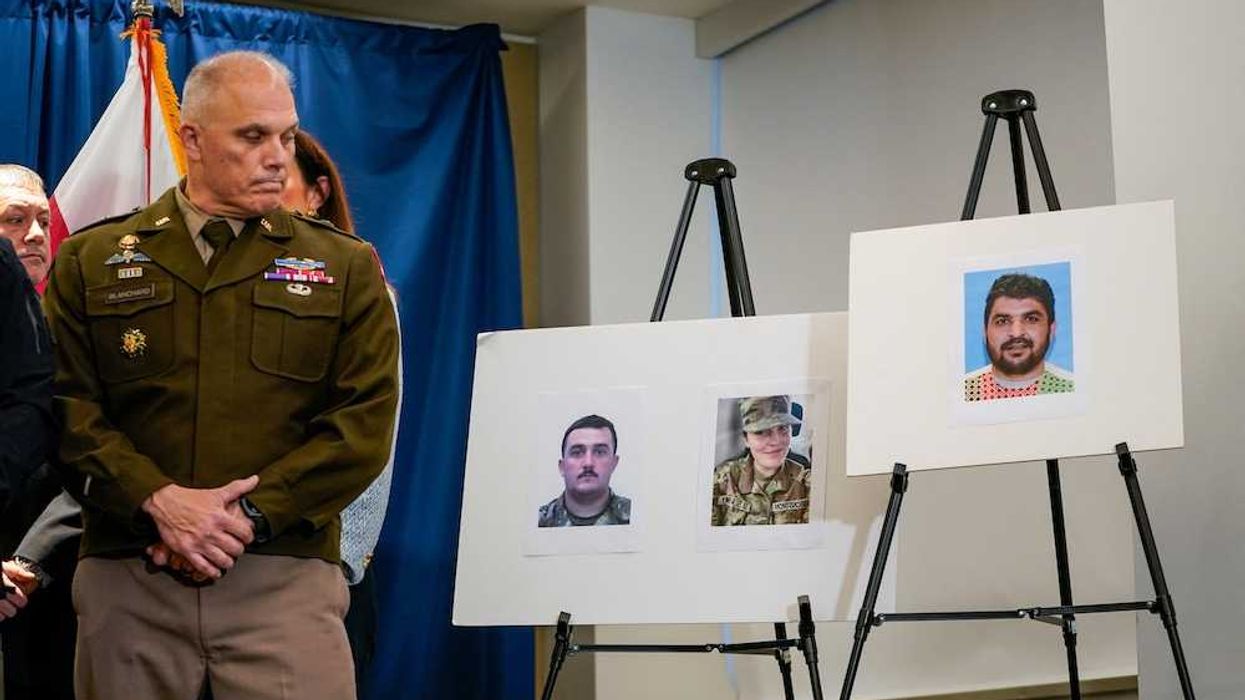
Brigadier General Leland D. Blanchard II looks towards pictures of two National Guard members who were shot in Washington on November 26, along with a picture of a suspect, Afghan national Rahmanullah Lakanwal, at a press conference with FBI Director Kash Patel, attorney Jeanine Pirro and other authorities in Washington, D.C., U.S., November 27, 2025. REUTERS/Nathan Howard

December 02, 2025 
ALTERNET

Alleged Washington D.C. shooter Rahmanullah Lakanwal may have been coerced into carrying out last week's attack on two members of the West Virginia National Guard, according to a new report.

The Daily Beast's "The Swamp" newsletter reported Tuesday that U.S. intelligence sources are investigating whether the Taliban may have blackmailed the 29 year-old Lakanwal into shooting 24 year-old Andrew Wolfe and 20 year-old Sarah Beckstrom. Wolfe remains in critical condition, while Beckstrom died from her injuries. Lakanwal was also shot during the ambush-style attack and remains hospitalized.

According to one unnamed intelligence source, Lakanwal may have felt pressured to drive across the country from his home in Bellingham, Washington to the nation's capital, if Taliban fighters gave him an ultimatum to either attack U.S. troops or have his family killed. The source noted that the threat may have been particularly effective given that Lakanwal helped the U.S. fight the Taliban during the 20-year war in Afghanistan.

"It is by no means our only line of inquiry," the Beast's source said. "People in this country have no idea about the level of stress these people are under. Most of them have families back home, and if the Taliban cannot get to them, they are making it very clear that they will go after their families."

In Afghanistan, Lakwanwal was a member of the Afghan Scorpion Forces, who worked with the Central Intelligence Agency (CIA) as a GPS tracking specialist. Lakanwal was on one of the very last flights to the U.S. out of Kabul along with more than 120,000 other Afghan refugees, who feared retribution from the Taliban if left to fend for themselves.

The Beast further reported that the Taliban has since formed a military unit dubbed "Yarmouk 60" whose mission is to track down and kill Afghans who helped the United States. The outlet's source said that one member of the "Afghan Triples" unit that was set and funded by the United Kingdom escaped to Germany and hoped his family would follow. However, Yarmouk 60 fighters ended up killing his wife, his father and four of his children.

Lakanwal has been charged on one count of murder, two counts of assault with the intent to kill and one count of possession of a firearm during a crime of violence. ABC News reported that he was arraigned remotely from his hospital bed in Washington D.C.

Click here to read the Beast's full report (subscription required).
The ‘COP of Truth’ Just Normalized a New Kind of Climate Denialism

The new denialism no longer bellows about hoaxes; it asks for more studies, more modelling, more consultations, always in the service of delay.


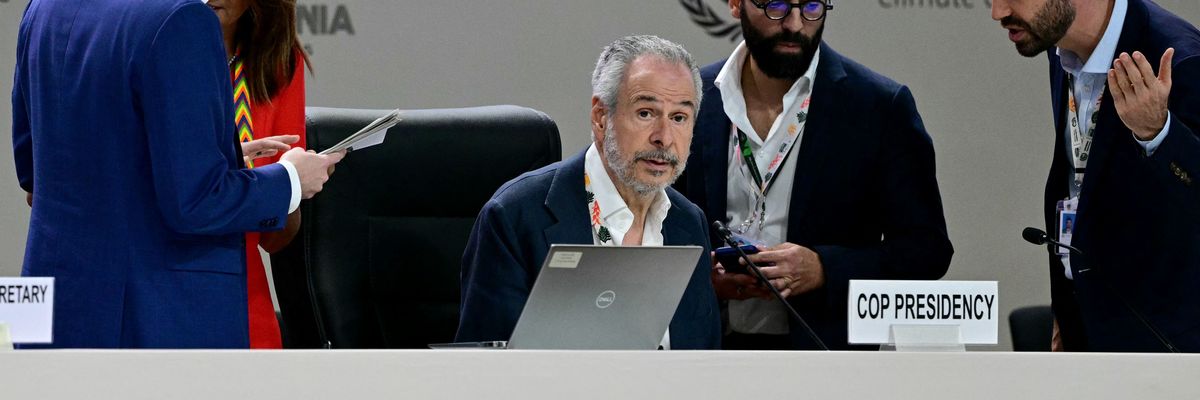
COP30 President Andre Correa do Lago (C) listens to an adviser upon arrival for a plenary session of the COP30 UN Climate Change Conference in Belém, Para State, Brazil on November 21, 2025.
(Photo by Pablo Porciuncula / AFP via Getty Images)

Sara Yassi
Dec 02, 2025
Common Dreams

Belém promised a “COP of truth.” What unfolded was a courteous unravelling of ambition, as denialism left global climate action wobbling at the moment it needs steel.

As the Chair of the UK’s COP30 youth delegation, I realized within hours that this United Nations climate conference would be defined by its optics—not its outcomes. The venue teemed with political hopefuls more interested in cameras than commitments, and with a record 1,600 fossil fuel and 531 carbon-capture lobbyists, 1 in every 25 attendees served commercial interests.

Then came the negotiations, where delegates quietly diluted the science. References to the Intergovernmental Panel on Climate Change (IPCC), long regarded as the global lodestar of climate knowledge, were either softened into ambiguity or dropped altogether. Several companies went even further, trumpeting improvements in emissions intensity as if they were genuine reductions.

It was greenwashing par excellence, a polite fiction to excuse keeping emissions exactly where they are.

After the failures of COP29 and COP30, the process will only matter again if governments are finally pushed toward honesty and supported by tools that can hold them to it.

So it was no surprise when the negotiations titled toward erasure, governing not just the deal but the language that framed it. The term “fossil fuel” vanished from the final Belém Political Package, replaced with sweeping and unenforceable vows to renewables and adaptation funding.

We should have foreseen how settled climate science would be twisted and spun. After all, one investigation found more than 14,000 pieces of COP-related disinformation in just the three months before Belém. Much of it was generated by AI, including a widely shared fake video that showed the host city swallowed by floods.

This version of climate denialism reveals the moral credibility of climate action is being leveraged to keep emissions frozen in place. It no longer bellows about hoaxes, except by Donald Trump who has happily dragged America back into isolationism. In the diplomatic world it asks for more studies, more modelling, more consultations, always in the service of delay. It is denialism wearing the mask of governance, and it is far more corrosive than the loud bluff it replaced.

The timing could hardly be worse. The IPCC’s carbon budget for a 50% chance of staying below 1.5°C will vanish by 2029 if emissions continue at today’s pace. This is also the first year after the Global Stocktake that mandates governments to draft national plans that will set our course until 2030.

And what happens now determines the shape of the decisive decade. Crossing 1.5°C sharply raises the risk of irreversible cryosphere collapse—rapid ice loss in Antarctica and Greenland which will lock the world into meters of sea-level rise that imperil coastal megacities across every hemisphere. At 2°C, another billion people will face severe water scarcity—especially in the Global South where adaptation capacity is lowest and exposure is highest. This reality is why the deliberate sidelining of climate science is not just exasperating but catastrophic.

And COP30’s lone nod to honesty—the Declaration on Information Integrity—feels painfully thin. The declaration, which promises to counter climate falsehoods, was only signed by 12 countries. And with no sanctions or accountability, it is a gesture at truth in the exact moment truth needed teeth.

We need a global firewall for climate truth: binding rules for climate information, a UN body capable of verifying data with transparent AI, and legal duties on platforms to curb the algorithmic spread of lies. Climate inaction is becoming a matter of legal liability. That burden should fall equally on those who deliberately twist the science.

There must be a counterweight capable of tracing disinformation, naming the culprits of confusion, and dragging the debate back to the science that anchors it. Only then can we hope to restart global climate momentum. And in an irony worthy of our age, the technology that helped generate the mess—AI—may be the only thing sharp enough to cut through it.

According to Sachin Dev Duggal, Britain’s foremost expert on applied artificial intelligence and EY’s Entrepreneur of the Year in 2023, the internet is now a space where reliable information sits beside convincing fabrications, and no amount of earnest climate communication will fix this without tools that can separate accuracy from invention at scale.

AI is already showing what those tools might look like. It can review millions of words in seconds and test claims against established climate data with a consistency no human team can match. We are already seeing this in practice. For example, the machine-learning model ClimateBERT has analysed corporate reports and exposed misleading emissions claims. Another model, CLIMINATOR, has also been trained to hold political and corporate actors to account by checking whether their climate statements align with the evidence or contradict it. And the FactCrisis project, cofounded by the EU, has used AI during heatwaves to track false statistics and identify accounts pushing them, offering a glimpse of what becomes possible when AI and international bodies finally start reinforcing one another.

Duggal argues that the next step is a decentralized verification model. Climate data from satellites, sensors, and national inventories would sit in a shared public ledger that no ministry or corporation can quietly revise. When a government or company makes a claim about progress, anyone could check it against a record that does not bend to convenience. It would make the small acts of creative reporting that feed climate denialism far harder to get away with.

Yet today’s AI carries a flaw that limits its usefulness. Large language models are fluent but ungrounded, reproducing the language of climate science without retaining the facts that give it weight, which makes them unreliable referees in a space awash with motivated distortions. Duggal sees that any serious AI tool must reconnect claims to their evidence, trace where the data came from, and reveal the steps that turned information into a conclusion. This is the direction of his SeKondBrain project, which concentrates on how to build these evidential scaffolds so that an AI system can point to the exact documents, numbers, or assumptions that shaped its judgement. That kind of traceability matters because it gives climate negotiators and regulators something concrete to interrogate. And without systems built to preserve and expose the evidence behind their outputs, AI will remain too opaque to play any serious role in protecting science.

After the failures of COP29 and COP30, the process will only matter again if governments are finally pushed toward honesty and supported by tools that can hold them to it. Without that basic partnership, we may have reached the point where another COP has nothing left to say.


Our work is licensed under Creative Commons (CC BY-NC-ND 3.0). Feel free to republish and share widely.


Sara Yassi
Sara Yassi is the chair of the UK’s official youth delegation to COP30. She was a 2024 Young Concordia leadership fellow, an inaugural fellow of the Common Purpose MENA Diaspora Leadership Programme, and is currently a fellow of the Transatlantic Inclusion Leaders Network at the German Marshall Fund. Sara holds a BA from the University of Oxford and was a Tejumola Olaniyan creative writer-in-residence fellow at The Africa Institute.
Full Bio >
Spending More Money on New Nukes Is a Moral Obscenity

The world remains on even more of a nuclear hair-trigger, the pistol loaded and cocked to our collective heads, just waiting for news that will push us over the edge.


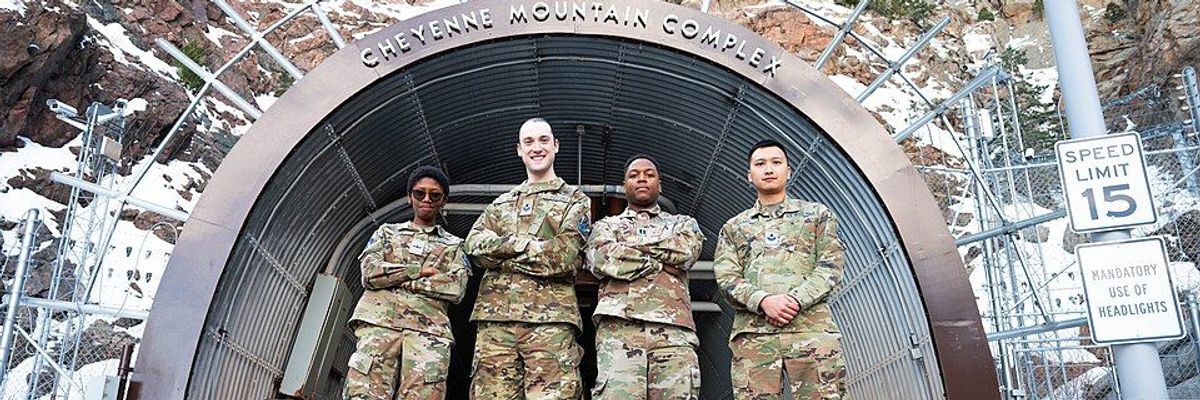
Four service members pose at Cheyenne Mountain Space Force Station in Colorado on February 15, 2024
(Photo by US Air Force)

William Astore
Dec 02, 2025
TomDispatch

It’s been 20 years since I retired from the Air Force and 40 years since I first entered Cheyenne Mountain, America’s nuclear redoubt at the southern end of the Front Range that includes Pikes Peak in Colorado. So it was with some nostalgia that I read a recent memo from General Kenneth Wilsbach, the new chief of staff of the Air Force. Along with the usual warrior talk, the CSAF vowed to “relentlessly advocate” for the new Sentinel ICBM, or intercontinental ballistic missile, and the B-21 Raider stealth bomber. While the Air Force often speaks of “investing” in new nukes, this time the CSAF opted for “recapitalization,” a remarkably bloodless term for the creation of a whole new generation of genocidal thermonuclear weapons and their delivery systems.

(Take a moment to think about that word, “creation,” applied to weapons of mass destruction. Raised Catholic, I learned that God created the universe out of nothing. By comparison, nuclear creators aren’t gods, they’re devils, for their “creation” may end with the destruction of everything. Small wonder J. Robert Oppenheimer mused that he’d become death, the destroyer of worlds, after the first successful atomic blast in 1945.)

In my Cheyenne Mountain days, circa 1985, the new “must have” bomber was the B-1 Lancer and the new “must have” ICBM was the MX Peacekeeper. If you go back 20 to 30 years earlier than that, it was the B-52 and the Minuteman. And mind you, my old service “owns” two legs of America’s nuclear triad. (The Navy has the third with its nuclear submarines armed with Trident II missiles.) And count on one thing: It will never willingly give them up. It will always “relentlessly advocate” for the latest ICBM and nuclear-capable bomber, irrespective of need, price, strategy, or above all else their murderous, indeed apocalyptic, capabilities.

At this moment, Donald Trump’s America has more than 5,000 nuclear warheads and bombs of various sorts, while Vladimir Putin’s Russia has roughly 5,500 of the same. Together, they represent overkill of an enormity that should be considered essentially unfathomable. Any sane person would minimally argue for serious reductions in nuclear weaponry on this planet. The literal salvation of humanity may depend on it. But don’t tell that to the generals and admirals, or to the weapons-producing corporations that get rich building such weaponry, or to members of Congress who have factories producing such weaponry and bases housing them in their districts.

So, here we are in a world in which the Pentagon plans to spend another $1.7 trillion (and no, that is not a typo!) “recapitalizing” its nuclear triad, and so in a world that is guaranteed to remain haunted forever by a possible future doomsday, the specter of nuclear mushroom clouds, and a true “end-times” catastrophe.

I Join AF Space Command Only to Find Myself Under 2,000 Feet of Granite

My first military assignment in 1985 was at Peterson Air Force Base in Colorado with Air Force Space Command. That put me in America’s nuclear command post during the last few years of the Cold War. I also worked in the Space Surveillance Center and on a battle staff that brought me into the Missile Warning Center. So, I was exposed, in a relatively modest way (if anything having to do with nuclear weapons can ever be considered “modest”), to what nuclear war would actually be like and forced to think about it in a way most Americans don’t.

Each time I journeyed into Cheyenne Mountain, I walked or rode through a long tunnel carved out of granite. The buildings inside were mounted on gigantic springs (yes, springs!) that were supposed to absorb the shock of any nearby hydrogen bomb blast in a future war with the Soviet Union. Massive blast doors that looked like they belonged on the largest bank vault in the universe were supposed to keep us safe, though in a nuclear war they might only have ensured our entombment. They were mostly kept open, but every now and then they were closed for a military exercise.

I was a “space systems test analyst.” The Space Surveillance Center ran on a certain software program that needed periodic testing and evaluation, and I helped test the computer software that kept track of all objects orbiting the Earth. Back then, there were just over 5,000 of them. (Now, that number’s more like 45,000 and space is a lot more crowded—perhaps too crowded.)

It angers me that all of us, whether those like me who served in uniform or your average American taxpayer, have sacrificed so much to create genocidal weaponry and a distinctly world-ending arsenal.

Anyhow, what I remember most vividly were military exercises where we’d run through different potentially world-ending scenarios. (Think of the movie War Games with Matthew Broderick.) One exercise simulated a nuclear attack on the United States. No, it wasn’t like some Hollywood production. We just had monochrome computer displays with primitive graphics, but you could certainly see missile tracks emerging from the Soviet Union, crossing the North Pole, and ending at American cities.

Even though there were no fancy (fake) explosions and no other special effects, simply realizing what was possible and how we would visualize it if it were actually to happen was, as I’m sure you can imagine, a distinctly sobering experience and not one I’ve ever forgotten.

That “war game” should have shaken me up more than it did, however. At the time, we had a certain amount of fatalism about the possibility of nuclear war, something captured in the posters of the era that told you what to do in case of a nuclear attack. The final step was basically to bend over and kiss your ass goodbye. That was indeed my attitude.

Rather than obsess about Armageddon, I submerged myself in routine. There was a certain job to be done, procedures to be carried out, discipline to adhere to. Remember, of course, that this was also the era of the rise of the nuclear freeze protest movement that was demanding the US and the Soviet Union reach an agreement to halt further testing, production, and deployment of nuclear weapons. (If only, of course!) In addition, this was the time of the hit film The Day After, which tried to portray the aftermath of a nuclear war in the United States. In fact, on a midnight shift in Cheyenne Mountain, I even read Tom Clancy’s Red Storm Rising, which envisioned the Cold War gone hot, a Third World War gone nuclear.

Of course, if we had thought about nuclear war every minute of every day, we might indeed have been cowering under our sheets. Unfortunately, as a society, except in rare moments like the nuclear freeze movement one, we neither considered nor generally grasped what nuclear war was all about (even though nine countries now possess such weaponry and the likelihood of such a war only grows). Unfortunately, that lack of comprehension (and so protest) is one big reason why nuclear war remains so chillingly possible.

If anything, such a war has been eerily normalized in our collective consciousness and we’ve become remarkably numb to and fatalistic about it. One characteristic of that reality was the anesthetizing language that we used then (and still use) when it came to nuclear matters. We in the military spoke in acronyms or jargon about “flexible response,” “deterrence,” and what was then known as “mutually assured destruction” (or the wiping out of everything). In fact, we had a whole vocabulary of different words and euphemisms we could use so as not to think too deeply about the unthinkable or our possible role in making it happen.

My Date With Trinity


After leaving Cheyenne Mountain and getting a master’s degree, I co-taught a course on the making and use of the atomic bomb at the Air Force Academy. That was in 1992, and we actually took the cadets on a field trip to Los Alamos where the first nuclear weapon had largely been developed. Then we went on to the Trinity test site in Alamogordo, New Mexico, where, of course, that first atomic device was tested and that, believe me, was an unforgettable experience. We walked around and saw what was left of the tower where Robert Oppenheimer and crew suspended the “gadget” (nice euphemism!) for testing that bomb on July 16, 1945, less than a month before two atomic bombs would be dropped on the Japanese cities of Hiroshima and Nagasaki, destroying both of them and killing perhaps 200,000 people. Basically (I’m sure you won’t be surprised to learn), nothing’s left of that tower except for its concrete base and a couple of twisted pieces of metal. It certainly does make you reflect on the sheer power of such weaponry. It was then and remains a distinctly haunted landscape and walking around it a truly sobering experience.

And when I toured the Los Alamos lab right after the collapse of the other great superpower of that moment, the Soviet Union, it was curious how glum the people I met there were. The mood of the scientists was like: hey, maybe I’m going to have to find another job because we’re not going to be building all these nuclear weapons anymore, not with the Soviet Union gone. It was so obviously time for America to cash in its “peace dividends,” and the scientists’ mood reflected that.

Now, just imagine that 33 years after I took those cadets there, Los Alamos is once again going gangbusters, as our nation plans to “invest” another $1.7 trillion in a “modernized” nuclear triad (imagine what that means in terms of ultimate destruction!) that we (and the rest of the world) absolutely don’t need. To be blunt, today that outrages me. It angers me that all of us, whether those like me who served in uniform or your average American taxpayer, have sacrificed so much to create genocidal weaponry and a distinctly world-ending arsenal. Worse yet, when the Soviet Union collapsed in 1991, we didn’t even try to change course. And now the message is: Let’s spend staggering amounts of our tax dollars on even more apocalyptic weaponry. It’s insanity and, no question about it, it’s also morally obscene.

The Glitter of Nuclear Weapons


That ongoing obsession with total destruction, ultimate annihilation, reflects the fact that the United States is led by moral midgets. During the Vietnam War years, the infamous phrase of the time was that the US military had to “destroy the town to save it” (from communism, of course). And for 70 years now, America’s leaders have tacitly threatened to order the destruction of the world to save it from a rival power like Russia or China. Indeed, nuclear war plans in the early 1960s already envisioned a massive strike against Russia and China, with estimates of the dead put at 600 million, or “100 Holocausts,” as Daniel Ellsberg of Vietnam War fame so memorably put it.

Take it from this retired officer: You simply can’t trust the US military with that sort of destructive power. Indeed, you can’t trust anyone with that much power at their fingertips. Consider nuclear weapons akin to the One Ring of Power in J.R.R. Tolkien’s The Lord of the Rings. Anyone who puts that ring on is inevitably twisted and corrupted.

Freeman Dyson, a physicist of considerable probity, put it well to documentarian Jon Else in his film The Day After Trinity. Dyson confessed to his own “ring of power” moment:
I felt it myself. The glitter of nuclear weapons. It is irresistible if you come to them as a scientist. To feel it’s there in your hands, to release this energy that fuels the stars, to let it do your bidding. To perform these miracles, to lift a million tons of rock into the sky. It is something that gives people an illusion of illimitable power, and it is, in some ways, responsible for all our troubles—this, what you might call technical arrogance, that overcomes people when they see what they can do with their minds.


I’ve felt something akin to that as well. When I wore a military uniform, I was in some sense a captive to power. The military both captures and captivates. There’s an allure of power in the military, since you have a lot of destructive power at your disposal.

Of course, I wasn’t a B-1 bomber pilot or a missile-launch officer for ICBMs, but even so, when you’re part of something that’s so immensely, even world-destructively powerful, believe me, it does have an allure to it. And I don’t think we’re usually fully aware of how captivating that can be and how much you can want to be a part of that.

Even after their service, many veterans still want to go up in a warplane again or take a tour of a submarine, a battleship, or an aircraft carrier for nostalgic reasons, of course, but also because you want to regain that captivating feeling of being so close to immense—even world-ending—power.

The saying that “power corrupts, and absolute power corrupts absolutely” may never be truer than when it comes to nuclear war. We even have expressions like “use them or lose them” to express how ICBMs should be “launched on warning” of a nuclear attack before they can be destroyed by an incoming enemy strike. So many years later, in other words, the world remains on even more of a nuclear hair-trigger, the pistol loaded and cocked to our collective heads, just waiting for news that will push us over the edge, that will make those trigger fingers of ours too itchy to resist the urge to put too much pressure on that nuclear trigger.

No matter how many bunkers we build, no matter that the world’s biggest bunker tunneled out of a mountain, the one I was once in, still exists, nothing will save us if we allow the glitter of nuclear weapons to flash into preternatural thermonuclear brightness.

© 2023 TomDispatch.com

William Astore
William J. Astore is a retired lieutenant colonel (USAF), who has taught at the Air Force Academy, the Naval Postgraduate School, and he taught History at the Pennsylvania College of Technology.
Full Bio >


'Betrayal': Trump DOJ sides with Roundup maker over cancer victims in Supreme Court case
Common Dreams
December 2, 2025

FILE PHOTO: A general view of the U.S. Supreme Court building in Washington, U.S. November 10, 2020. REUTERS/Hannah McKay/File Photo

The Trump administration is pushing for the US Supreme Court to shield the manufacturer of Roundup from thousands of state lawsuits alleging that its widely used herbicide product causes cancer.

On Monday, US Solicitor General D. John Sauer recommended that the high court agree to hear a challenge to a Missouri jury’s verdict in 2023 that awarded $1.25 million to a man named John Durnell, who claimed that the product caused him to develop non-Hodgkin lymphoma.

Bayer, the agribusiness giant that purchased the manufacturer of Roundup, the agribusiness giant Monsanto, in 2018, immediately challenged the verdict.

In 2015, the World Health Organization’s International Agency for Research on Cancer (IARC) classified glyphosate, the active ingredient in Roundup, as “probably carcinogenic to humans” based on “limited evidence.”

That evidence became less limited in 2019, when a prominent meta-analysis by a team of environmental health researchers found that people exposed to glyphosate at the highest levels had a 41% higher risk of developing non-Hodgkin lymphoma than those who weren’t.

There are nearly 4,500 Roundup claims currently pending in federal court, and at least 24 cases have gone to trial since October 2023. They make up just a fraction of the more than 170,000 claims filed.

According to Bloomberg, Bayer has already been forced to pay out more than $10 billion in verdicts and settlements over the product, which has caused a massive drain on the company’s stock price.

In what it said was an effort to “manage litigation risk and not because of any safety concerns,” Bayer removed glyphosate-based herbicides from the residential market in 2023, switching to formulas that “rely on alternative active ingredients.”

That didn’t stop the lawsuits from coming. Durnell’s victory was the first successful case brought against Bayer outside California, the only state that labels the product as carcinogenic. That in Missouri opened the floodgates in other states, and plaintiffs subsequently won sizable payouts in Georgia and Pennsylvania.

But now the Trump administration is trying to help the company skirt further accountability. Sauer, who is tasked with arguing for the government in nearly every Supreme Court case, filed a 24-page brief stating that there is a lack of clarity on whether states have the authority to determine whether Bayer and Monsanto violated the law by failing to warn customers about potential cancer risks from Roundup.

Bayer argues that these cases are preempted by the Federal Insecticide, Fungicide, and Rodenticide Act (FIFRA), which forbids states from enacting labeling requirements more stringent than those recommended by the federal government.

Sauer agreed with Bayer, stating in the brief that the US Environmental Protection Agency “has repeatedly determined that glyphosate is not likely to be carcinogenic in humans, and the agency has repeatedly approved Roundup labels that did not contain cancer warnings.”

In 2016 and again in 2020, the EPA indeed classified glyphosate as “not likely to be carcinogenic to humans” following agency assessments. However, in 2022, the 9th US Circuit Court of Appeals voided this assessment, finding that the agency applied “inconsistent reasoning” in its review of the science.

Among the justifications for the ruling were that the EPA relied heavily on unpublished, non-peer-reviewed studies submitted to regulators by Monsanto and other companies that manufacture glyphosate. The agency also largely disregarded findings from animal studies included by the IARC, which showed a strong link between glyphosate and cancer.

“The World Health Organization has recognized glyphosate as a probable carcinogen while the EPA continues to twist itself into pretzels to come to the opposite conclusion,” Lori Ann Burd, a staff attorney and director of the Center for Biological Diversity’s environmental health program, told Common Dreams.

Notably, Health and Human Services Secretary Robert F. Kennedy Jr. built his national profile campaigning against the dangers of pesticides and railing against regulatory capture by big business.

Kennedy served as an attorney for Dewayne Johnson, the first plaintiff to win damages against Monsanto in 2018, where a jury determined that Roundup had contributed to his cancer.

“If my life were a Superman comic, Monsanto would be my Lex Luthor,” Kennedy said in a 2020 Facebook post. “I’ve seen this company as the enemy of every admirable American value.”

During Kennedy’s 2024 presidential run, he pledged to “ban the worst agricultural chemicals already banned in other countries.”

But after he was sworn in as President Donald Trump’s HHS Secretary, he began to sing a different tune. As Investigate Midwest noted, his “Make America Healthy Again” commission’s introductory report made no mention of glyphosate.

Meanwhile, he reassured the pesticide industry that it had nothing to worry about: “There’s a million farmers who rely on glyphosate. 100% of corn in this country relies on glyphosate. We are not going to do anything to jeopardize that business model,” he said during a Senate Appropriations Committee hearing.

The Trump EPA has deregulated toxic chemicals across the board over the past year. It rolled back protections against per- and polyfluoroalkyl substances (PFAS), often referred to as “forever chemicals,” in drinking water, which have many documented health risks. It has also declined to ban the widely used insecticide chlorpyrifos, which has been linked to neurodevelopmental disorders in children.

Elizabeth Kucinich, the former director of policy at the Center for Food Safety, described the US Department of Justice’s effort to shield Bayer as another “betrayal of MAHA health promises.” Her husband, the two-time Democratic presidential candidate Dennis Kucinich, worked as the campaign manager for RFK Jr.'s 2024 presidential bid.

“This is regulatory capture, not public protection,” she said. “This action shields chemical manufacturers from accountability by elevating a captured federal regulatory process over the lived harm of real people. That is anti-life, and it is exactly what millions of MAHA voters believed they were voting against.”

Food & Water Watch staff attorney Dani Replogle said the DOJ filing “encourages the Supreme Court to slam judiciary doors in the faces of cancer patients across the country.”

“No political posturing can undo the clear message this brief sends to sick Americans harmed by toxic pesticides,” she continued. “Trump has Bayer’s back, not theirs.”


Republicans suddenly care about US airstrike massacres — but only Obama’s

Brett Wilkins,
 Common Dreams
December 2, 2025 


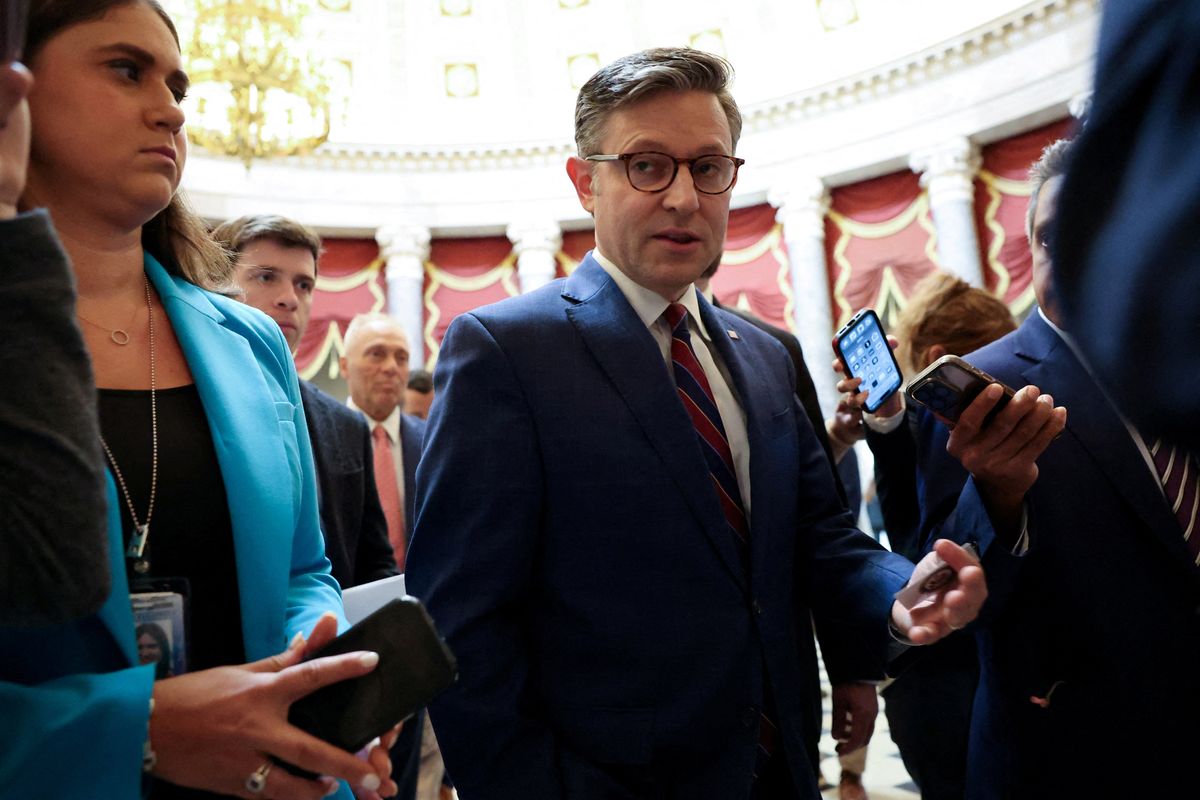
U.S. House Speaker Mike Johnson (R-LA) speaks to reporters. REUTERS/Jonathan Ernst

Republicans on Tuesday invoked drone strikes during then-President Barack Obama’s tenure in a dubious effort to justify what experts say is the Trump administration’s illegal boat bombing campaign against alleged drug traffickers, while falsely claiming that Democrats and the media ignored airstrikes ordered by the former president.

US House Speaker Mike Johnson (R-La.) was asked during a Tuesday press conference about a so-called “double-tap” airstrike—military parlance for follow-up strikes on survivors and first responders after initial bombings—that killed two men who survived a Sept. 2 attack on a boat in the southern Caribbean Sea.

Although US Defense Secretary Pete Hegseth has denied it, he reportedly gave a spoken order to “kill everybody” in the boat, which was supposedly interpreted by Adm. Frank M. “Mitch” Bradley as a green light for launching a second strike after the discovery that two of the 11 men aboard the vessel were alive and clinging to its burning wreckage.

Responding to the question concerning the strike’s legality, Johnson pointed to upcoming congressional consultations on the matter and said that such attacks are “not an unprecedented thing.”

“Secondary strikes are not unusual,” he noted. “It has to happen if a mission is going to be completed.”

“It’s something Congress will look at, and we’ll do that in the regular process and order,” Johnson continued, referring to a classified briefing with Bradley and some lawmakers scheduled for Thursday. “I think it’s very important for everybody to reserve judgment and not leap to conclusions until you have all the facts.”

“One of the things I was reminded of this morning is that under Barack Obama... I think there were 550 drone strikes on people who were targeted as enemies of the country, and nobody ever questioned it,” he said

The lack of attention to Obama’s strikes claimed by Johnson is belied by congressional hearings, lawsuits, and copious coverage—and condemnation—of such attacks in media outlets including Common Dreams.

Progressive lawmakers and Republican Sen. Rand Paul of Kentucky were among the numerous US officials who criticized Obama-era drone strikes.

Trump administration officials have reportedly cited the Obama administration’s legal rationale for bombing Libya to justify the boat strikes to members of Congress.

Other Republican lawmakers and right-wing media figures noted on Tuesday that Obama—who bombed more countries than his predecessor, former President George W. Bush and was called the “drone warrior-in-chief”—ordered strikes that resulted in massacres of civilians at events including funerals and at least one wedding.

At least hundreds of civilians were killed in such strikes, including 16-year-old US citizen Abdulrahman al-Awlaki, who, according to an Obama administration official, was in the wrong place at the wrong time when he was slain in Yemen in 2011. This, after al-Awlaki’s father—an accused terrorist who was also American—was assassinated by a drone strike ordered by Obama.


Asked by a reporter about the legality of assassinating US citizens without charge or trial, then-White House Press Secretary Robert Gibbs infamously asserted in October 2012 that Abdulrahman al-Awlaki should have had “a far more responsible father.”

Buried deep in a New York Times article published earlier that year was the revelation that Obama’s secret “kill list” authorized the assassination of US citizens, and that his administration was counting all military-age males in a strike zone as “combatants” regardless of their actual status in an effort to artificially lower the reported number of civilian casualties.

“Turns out I’m really good at killing people,” Obama once boasted, according to the 2013 Mark Halperin and John Heilemann book Double Down. “Didn’t know that was gonna be a strong suit of mine.”

A third member of the al-Awlaki family, 8-year-old Nawar al-Awlaki—also an American citizen—was killed in a US commando raid in Yemen ordered by President Donald Trump in early 2017.

Tens of thousands of civilians were killed by US airstrikes in Afghanistan, Iran, Libya, Pakistan, Somalia, Syria, and Yemen during the Bush, Obama, Trump, and Biden administrations as part of the decadeslong so-called Global War on Terror, in which more than 900,000 people were slain, according to the Costs of War Project at Brown University’s Watson Institute for International and Public Affairs.

At least thousands of civilians have been killed or wounded by US bombs and bullets in Afghanistan, Iran, Iraq, Somalia, Syria, and Yemen during Trump’s first and second terms, during which rules of engagement aimed at protecting noncombatants have been loosened.

At least 83 people have been killed in 21 strikes on alleged drug-running boats in the Caribbean Sea and Pacific Ocean since early September, according to Trump administration figures. Officials in Venezuela and Colombia, as well as relatives of victims, claim that some of them were civilians uninvolved in narcotrafficking.

Maduro Vows Venezuela Will Be a ‘Colony Never Again’ as Trump Intensifies Threats

He has described President Donald Trump’s push for regime change as a “colonial threat” to “seize” Venezuela’s oil.


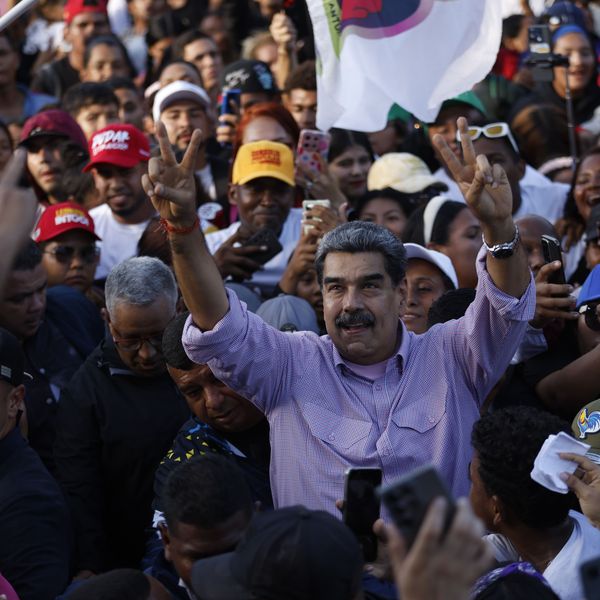
President Nicolás Maduro of Venezuela waves a Venezuelan flag during a protest to support him on December 1, 2025, in Caracas, Venezuela.
(Photo by Jesus Vargas/Getty Images)


Stephen Prager
Dec 02, 2025
COMMON DREAMS

Venezuelan President Nicolás Maduro remained defiant on Monday as US President Donald Trump plotted “next steps” against the South American nation with top national security brass.

Before thousands of Venezuelans at a rally in Caracas, the nation’s embattled president said he would not accept peace on US terms unless it came “with sovereignty, equality, and freedom.”


‘No More Endless Wars,’ Maduro Says to American People, Calling for ‘Peace’ in Face of Trump Threats


“We do not want a slave’s peace, nor the peace of colonies! Colony, never! Slaves, never!” he said.

The speech came days after Trump announced that the US would close Venezuelan airspace, which many interpreted as a final step before a series of strikes on the mainland.

The US has framed its military buildup in the Southern Caribbean as part of a campaign to stop drug smuggling, the same justification it has used to carry out the extrajudicial bombings of more than 20 boats in the region—which have killed at least 83 people—while disclosing zero proof of the victims’ involvement with drug trafficking.

Trump has also accused Maduro of being the leader of the so-called “Cartel de los Soles,” which he slapped with the label of “Foreign Terrorist Organization” last month, even though it is not an “organization” at all, but a media shorthand to refer to alleged connections between Venezuelan leaders and the drug trade.

Meanwhile, both US and international assessments have found that Venezuela is but a minor player in the global drug trade.

The US has amassed more than 15,000 troops outside Venezuela, the most it’s sent to the region since 1989, when the administration of former President George H.W. Bush launched a land invasion of Panama to overthrow its drug-running dictator Manuel Noriega. Documents obtained by The Intercept last week suggested that the US seeks to maintain “a massive military presence in the Caribbean” for years to come.

“By a factor of at least 10, the US presence is too great for even an intensified anti-drug operation,” wrote US national editor Edward Luce in the Financial Times on Tuesday.

Trump’s motive for stopping drug trafficking was further called into question after he pardoned former Honduran President Juan Orlando Hernández, a onetime US ally who was sentenced last year to 45 years in prison for helping to traffic at least 400 tons of cocaine to the US. The pardon was issued as part of Trump’s efforts to influence Honduras’ upcoming election to secure the victory of right-wing candidate Nasry “Tito” Asfura.

The goal of regime change was essentially confirmed on Monday when Reuters reported that Trump had offered Maduro safe passage out of Venezuela if he were willing to abdicate power during a phone call on November 21.

“You can save yourself and those closest to you, but you must leave the country now,” Trump reportedly told Maduro.

Maduro reportedly said he’d be willing to accept the offer if his family members were granted complete amnesty and the US removed sanctions against them, as well as over 100 other Venezuelan officials. He also asked for the case against him before the International Criminal Court (ICC) to be dropped.

Trump rejected that deal, and his offer of safe passage expired on Friday, the day before the US announced it had closed Venezuelan airspace. Trump confirmed to the press on Sunday that the talks had happened, but provided few additional details.

Maduro has categorically denied involvement with drug trafficking and has portrayed the White House’s sabre-rattling as a “colonial threat.” Last week, while brandishing the sword of South American anticolonial hero Simón Bolívar, he pledged that Venezuela would be a “colony never again.”

On Sunday, he accused Trump of trying to “seize” the nation’s oil reserves. He has called for the Organization of the Petroleum Exporting Countries (OPEC) to step in to help the country counter what he said were “growing and illegal threats” from Trump.

Venezuela has the world’s largest proven oil reserves—about a fifth of the Earth’s total, and more than Iraq had at the time of the George W. Bush administration’s 2003 invasion. However, US sanctions against Venezuela largely block American oil companies from accessing the reserves, which are controlled by the nation’s state-owned oil company Petróleos de Venezuela. These sanctions, which have limited Venezuela’s ability to export its most valuable natural resource, are considered one of the primary reasons for the nation’s economic instability in recent years.

While at a rally in 2023, Trump said he regretted not having “taken [Venezuela] over” during his first term. “We would have gotten to all that oil; it would have been right next door,” he said.

“We’ve seen this tragic play before,” wrote Richard Steiner, a former marine professor with the University of Alaska, this weekend in Common Dreams. “The Bush administration justified its disastrous 2003 invasion of Iraq with the pretext that Iraq had weapons of mass destruction, which, as it turned out, it didn’t. And as US Central Command commander General John Abizaid admitted about the Iraq war at the time: ‘Of course it’s about oil, it’s very much about oil, and we can’t really deny that.’”

“A similar pretext—this time ‘drug interdiction’—is being used to justify a potential US invasion and regime change in Venezuela,” he continued. “But this is not about stopping the flow of dangerous drugs, it is about actually increasing the flow of the dangerous drug some pushers want to keep us all hooked on—oil.”
Second US Strike on Boat Attack Survivors Was Illegal—But Experts Stress That the Rest Were, Too

“It is blatantly illegal to order criminal suspects to be murdered rather than detained,” said one human rights leader.


US President Donald Trump and Secretary of Defense Pete Hegseth announced that they bombed another boat in the Caribbean on October 3, 2025.
(Photo: screenshot/Donald Trump/Truth Social


Jessica Corbett
Dec 02, 2025
COMMON DREAMS


As the White House claims that President Donald Trump “has the authority” to blow up anyone he dubs a “narco-terrorist” and Adm. Frank M. “Mitch” Bradley prepares for a classified congressional briefing amid outrage over a double-tap strike that kicked off the administration’s boat bombing spree, rights advocates and legal experts emphasize that all of the US attacks on alleged drug-running vessels have been illegal.

“Trump said he will look into reports that the US military (illegally) conducted a follow-up strike on a boat in the Caribbean that it believed to be ferrying drugs, killing survivors of an initial missile attack. But the initial attack was illegal too,” Kenneth Roth, the former longtime director of the advocacy group Human Rights Watch, said on social media Monday.


Roth and various others have called out the US military’s bombings of boats in the Caribbean and Pacific as unlawful since they began on September 2, when the two strikes killed 11 people. The Trump administration has confirmed its attacks on 22 vessels with a death toll of at least 83 people.

Shortly after the first bombing, the Intercept reported that some passengers initially survived but were killed in a follow-up attack. Then, the Washington Post and CNN reported Friday that Bradley ordered the second strike to comply with an alleged spoken directive from Defense Secretary Pete Hegseth to kill everyone on board.

The administration has not denied that the second strike killed survivors, but Hegseth and the White House press secretary, Karoline Leavitt, have insisted that the Pentagon chief never gave the spoken order.

However, the reporting has sparked reminders that all of the bombings are “war crimes, murder, or both,” as the Former Judge Advocates General (JAGs) Working Group put it on Saturday.


Following Leavitt’s remarks about the September 2 strikes during a Monday press briefing, Roth stressed Tuesday that “it is not ‘self-defense’ to return and kill two survivors of a first attack on a supposed drug boat as they clung to the wreckage. It is murder. No amount of Trump spin will change that.”

“Whether Hegseth ordered survivors killed after a US attack on a supposed drug boat is not the heart of the matter,” Roth said. “It is blatantly illegal to order criminal suspects to be murdered rather than detained. There is no ‘armed conflict’ despite Trump’s claim.”

The Trump administration has argued to Congress that the strikes on boats supposedly smuggling narcotics are justified because the United States is in an “armed conflict” with drug cartels that the president has labeled terrorist organizations.

During a Sunday appearance on ABC News’ “This Week,” US Sen. Chris Van Hollen (D-Md.) said that “I think it’s very possible there was a war crime committed. Of course, for it to be a war crime, you have to accept the Trump administration’s whole construct here... which is we’re in armed conflict, at war... with the drug gangs.”

“Of course, they’ve never presented the public with the information they’ve got here,” added Van Hollen, a member of the Senate Foreign Relations Committee. “But it could be worse than that. If that theory is wrong, then it’s plain murder.”


Michael Schmitt, a former Air Force lawyer and professor emeritus at the US Naval War College, rejects the Trump administration’s argument that it is at war with cartels. Under international human rights law, he told the Associated Press on Monday, “you can only use lethal force in circumstances where there is an imminent threat,” and with the first attack, “that wasn’t the case.”

“I can’t imagine anyone, no matter what the circumstance, believing it is appropriate to kill people who are clinging to a boat in the water... That is clearly unlawful,” Schmitt said. Even if the US were in an actual armed conflict, he explained, “it has been clear for well over a century that you may not declare what’s called ‘no quarter’—take no survivors, kill everyone.”

According to the AP:
Brian Finucane, a senior adviser with the International Crisis Group and a former State Department lawyer, agreed that the US is not in an armed conflict with drug cartels.

“The term for a premeditated killing outside of armed conflict is murder,” Finucane said, adding that US military personnel could be prosecuted in American courts.

“Murder on the high seas is a crime,” he said. “Conspiracy to commit murder outside of the United States is a crime. And under the Uniform Code of Military Justice, Article 118 makes murder an offense.”

Finucane also participated in a related podcast discussion released in October by Just Security, which on Monday published an analysis by three experts who examined “the law that applies to the alleged facts of the operation and Hegseth’s reported order.”

Michael Schmitt, Ryan Goodman, and Tess Bridgeman emphasized in Just Security that the law of armed conflict (LOAC) did not apply to the September 2 strikes because “the United States is not in an armed conflict with any drug trafficking cartel or criminal gang anywhere in the Western Hemisphere... For the same reason, the individuals involved have not committed war crimes.”

“However, the duty to refuse clearly unlawful orders—such as an order to commit a crime—is not limited to armed conflict situations to which LOAC applies,” they noted. “The alleged Hegseth order and special forces’ lethal operation amounted to unlawful ‘extrajudicial killing’ under human rights law... The federal murder statute would also apply, whether or not there is an armed conflict.”

Goodman added on social media Monday that the 11 people killed on September 2 “would be civilians even if this were an armed conflict... It’s not even an armed conflict. It’s extrajudicial killing.”

When Obedience Becomes Complicity: From Mỹ Lai to Today’s Military Conscience


The bravest act is sometimes the one that defies orders, safeguards the innocent, and enforces the law.


President Donald Trump announced a US military strike on a fifth boat
 in the Caribbean on October 14, 2025.
(Image: screenshot/Donald Trump/Truth Social)
Common Dreams

Courage is rarely convenient. Sometimes it is condemned. Ask Hugh Clowers Thompson Jr.

On March 16, 1968, Thompson, a young Army helicopter pilot in the 123rd Aviation Battalion of the 23rd Infantry Division, flew over the South Vietnamese village of Sơn Mỹ and witnessed something unimaginable. American soldiers were systematically killing unarmed civilians—women, children, and the elderly. There were no enemy combatants. This was not war. This was a massacre.

Most soldiers either did not see or refused to confront the truth. Thompson did. He acted decisively: He hovered his helicopter between the troops and the villagers; ordered his crew, Glenn Andreotta and Lawrence Colburn, to fire on American soldiers if the killing continued; and personally escorted terrified civilians to safety. He radioed repeated warnings to Task Force Barker headquarters. Eventually, his actions forced command to halt the massacre.

For Thompson, the cost of moral courage was immense. He endured ostracism, post-traumatic stress disorder, alcoholism, and personal strife for years. In 1970, he testified in a closed congressional hearing about what he had seen, facing hostility from some quarters of government and military leadership. Congressman Mendel Rivers (D-SC) even declared that Thompson was the only soldier at Mỹ Lai who should be punished, attempting to have him court-martialed for turning his weapons on fellow troops. As the US government tried to cover up the massacre, Thompson was vilified and received death threats. Recognition came decades later when the Army awarded him the Soldier’s Medal, a belated acknowledgment of moral courage under fire.

When the chain of command conflicts with the Constitution or the law, the obligation to act ethically supersedes the obligation to obey.

Decades later, Thompson’s example has returned to the national conversation. Recently, a group of Democratic lawmakers, including Sens. Mark Kelly (D-Ariz.) and Elissa Slotkin (D-Mich.) and Reps. Jason Crow (D-Colo.), Chrissy Houlahan (D-Penn.), Chris Deluzio (D-Penn.), and Maggie Goodlander (D-NH), released a video urging active-duty military and intelligence personnel to refuse illegal orders. “You can refuse illegal orders…you must refuse illegal orders,” the lawmakers said. “No one has to carry out orders that violate the law or our Constitution.” They framed their guidance as a duty to uphold the oath to the Constitution, not to any individual leader.

The reaction was swift and incendiary. President Donald Trump called the statement “seditious behavior at the highest level,” while Pentagon officials warned it could undermine “good order and discipline.” Some lawmakers were reportedly notified of an FBI inquiry. Social media amplified threats, escalating beyond rhetoric into menace. On Truth Social, a user openly called for the lawmakers to be hanged—a post the president reposted. Senate Minority Leader Chuck Schumer (D-NY) denounced the act, stating from the Senate floor that Trump was “calling for the execution of elected officials” and emphasizing, “This is an outright threat, and it’s deadly serious.” When questioned in an interview, Trump insisted he was “not threatening” the lawmakers, but added, “I think they’re in serious trouble. In the old days, they would have [been] dead.”

Yet legal experts insist the lawmakers’ message was not only lawful—it was accurate. “They did not encourage unlawful action,” explained Brenner Fissell, professor of law at Villanova University and vice president of the National Institute of Military Justice. “They were not encouraging the disobedience of lawful orders; they were encouraging the disobedience of unlawful orders. And that is a correct statement of the law.” Under the Uniform Code of Military Justice (UCMJ), service members must obey lawful orders, but there is a strong presumption that orders are lawful. At the same time, service members may refuse patently illegal commands, including those that constitute war crimes, and can even face prosecution for carrying them out.

The stakes of following orders have never been abstract. Recent reporting has raised alarms that American military officials may have been ordered to commit grave violations of the laws of war. A Washington Post report described a September strike in the Caribbean in which boats suspected of smuggling drugs were attacked, and survivors were allegedly targeted in a follow-up strike. According to the report, Defense Secretary Pete Hegseth had given a verbal order to “kill everyone aboard” the boats, prompting a military commander to carry out a second strike on those who initially survived.

Lawmakers across the aisle responded with alarm. Rep. Mike Turner, a Republican and former Intelligence Committee chair, called the act “very serious” and “an illegal act.” Sen. Tim Kaine, Democrat of Virginia, said the report—if accurate—“rises to the level of a war crime.” And Sen. Mark Kelly echoed the concern, stating plainly on CNN: “It seems to.”

The ethical unease is not just theoretical, it is coming from inside the chain of command. The Orders Project, founded five years ago to provide independent legal guidance to US service members, has seen a noticeable uptick in calls over the past three months. Staff officers involved in planning the Caribbean strikes have reached out seeking guidance, as have National Guard members concerned about potential domestic deployments. Some callers even express fear of legal complicity in what they describe as potential atrocities abroad, including US weapons being used in Gaza.

“These are people who are performing some sort of role in between,” explained retired Lieutenant Colonel Frank Rosenblatt, an Army lawyer and president of the National Institute of Military Justice, which runs The Orders Project. “They’re not the ones on the operations themselves, but they are concerned that the guidance they’re being asked to provide has been very disfavored. They’re feeling pressure from their higher-ups to convert a ‘nonconcur’ into a ‘concur.’”

From Sơn Mỹ to Capitol Hill, and now to the Caribbean, the principle is clear: Silence in the face of wrongdoing is complicity; conscience in the face of authority is courage. As historian Howard Zinn once observed, “There is no flag large enough to cover the shame of killing innocent people.” Thompson drew a line between duty and obedience, risking his career, reputation, and personal safety to protect the innocent. Today, lawmakers and service members alike are grappling with the same lesson: Patriotism is not measured by conformity—it is measured by integrity.

This is more than a legal debate; it is a moral one. History offers no ambiguity. When the chain of command conflicts with the Constitution or the law, the obligation to act ethically supersedes the obligation to obey. Thompson’s helicopter hovering over the bodies in Sơn Mỹ, the lawmakers’ warning to military personnel, the threats that followed, reports of potential unlawful strikes in the Caribbean, and internal military concerns about legal complicity are chapters of the same story: one of conscience, courage, and accountability.

In a time when authority can intimidate, mislead, or threaten the nation’s foundational laws, the lesson of Hugh Thompson Jr. endures. True service is not blind obedience. It is the willingness to say no, to defend the innocent, and to honor the Constitution, even when doing so invites condemnation, career jeopardy, or worse. Democracy is not measured by the strength of its institutions alone, but by the moral courage of those entrusted to uphold them.The challenge is timeless: The bravest act is sometimes the one that defies orders, safeguards the innocent, and enforces the law. From the rice paddies of Sơn Mỹ to the halls of Capitol Hill, and across oceans to the Caribbean, the measure of our nation, and its soldiers, is in the courage to act rightly, even when it costs everything. As General Omar N. Bradley once reminded the world, “Leadership is intangible, and no weapon ever designed can replace it.”


Our work is licensed under Creative Commons (CC BY-NC-ND 3.0). Feel free to republish and share widely.


George Cassidy Payne
George Cassidy Payne is a writer, educator, and social justice advocate. He lives in Irondequoit, New York.
Full Bio >