Thursday, February 05, 2026

George Will slams Trump for ignoring 'financial crisis' threat
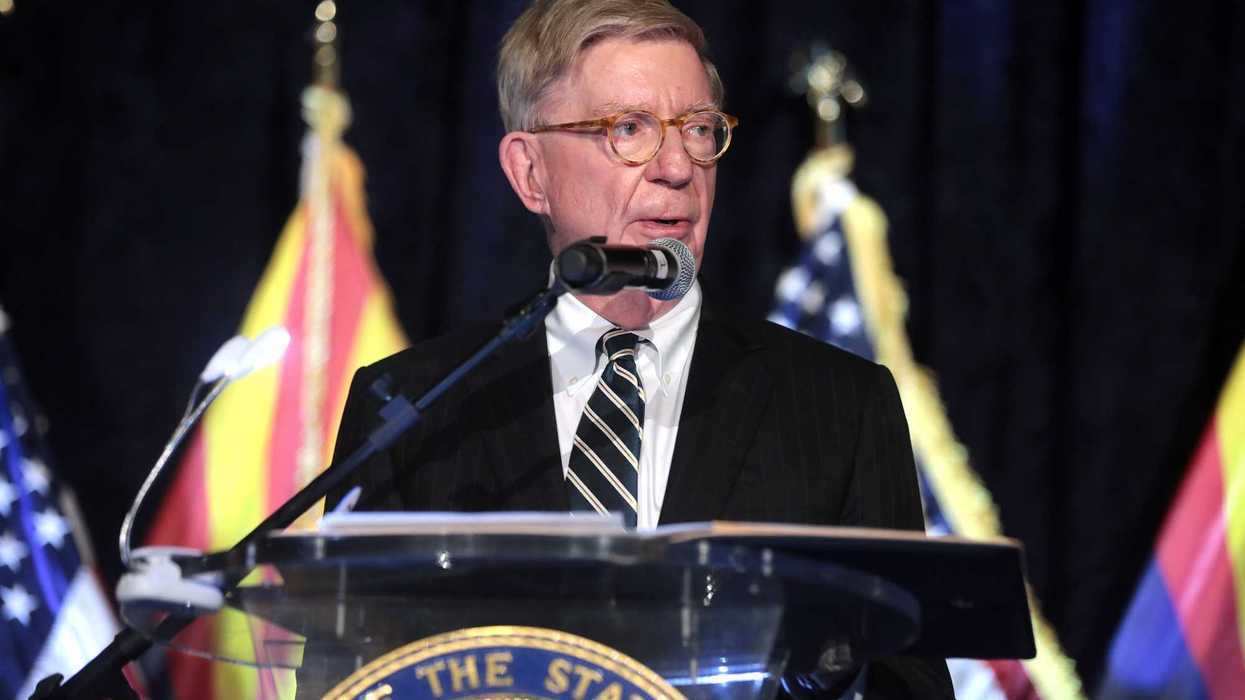


Conservative Washington Post columnist George Will in Scottsdale, Arizona

February 04, 2026  
ALTERNET

When President Donald Trump signed the Big, Beautiful Bill Act of 2025 into law, his MAGA loyalists praised it as a recipe for major economic growth. But Trump's critics saw the spending package as the worst of both worlds: a bill that would weaken the United States' social safety net while causing the already-huge federal deficit to increase.

The U.S., many of them argued, could not afford $75 billion in new funding for U.S. Immigration and Customs Enforcement (ICE) along with $64 billion in new funding for U.S. Customs and Border Protection (CBP). Between ICE and CBP, the Big, Beautiful Bill set aside $139 billion in new funding.

Never Trump conservative George Will, in his February 4 column for the Washington Post, emphasizes that the United States' national debt has reached an historic high and warns that "spiraling debt" could "provoke a financial crisis."

"As the national debt is a few months from reaching $39 trillion, and perhaps $40 trillion by the end of this year," the 84-year-old Will laments, "it is puzzling how unperturbed the political class is…. A bipartisan congressional consensus, more alarming than partisan rancor, is: There are no long-term fiscal gains without intense short-term political pains. So, because today's congressional careers do not yet seem likely to coincide with coming dire consequences, let them come."

Will continues, "In 2016, a budget expert was allotted 20 minutes to brief Donald Trump on those possible consequences. After five minutes, Trump said, 'Yeah, but I'll be gone.' He was perfectly in sync with the political mainstream he professes to supplant."

But ignoring the United States' federal debt, Will stresses, will not make it go away.

The conservative columnist lists "six possible crisis scenarios": (1) "Upwardly spiraling debt could provoke a financial crisis," (2) "An Everest of debt is an incentive for an inflation crisis to reduce the value of existing debt by paying lenders with debased dollars," (3) "An austerity crisis would occur with a large and abrupt combination of tax increases and spending reductions," (4) "A currency crisis would result from a depreciating dollar incentivizing foreign governments and private investors to diversify away from U.S. debt," (5) "A default crisis, although unlikely, would have the merit of bluntness," and (6) "The most probable, and most ominous, outcome would be a gradual crisis."

"In 2021, debt service consumed less than 10 percent of federal revenue," Will explains. "In 2025: 18 percent. By being gradual, a protracted crisis would mean a demoralized nation slowly accommodating perpetual economic sluggishness, waning investments in research and development, social stagnation, diminished contribution from the entrepreneurial energies of talented immigrants, and waning U.S. geopolitical influence."
Economist Paul Krugman: Praise for Trump FED Chair nominee shows 'very low bar'


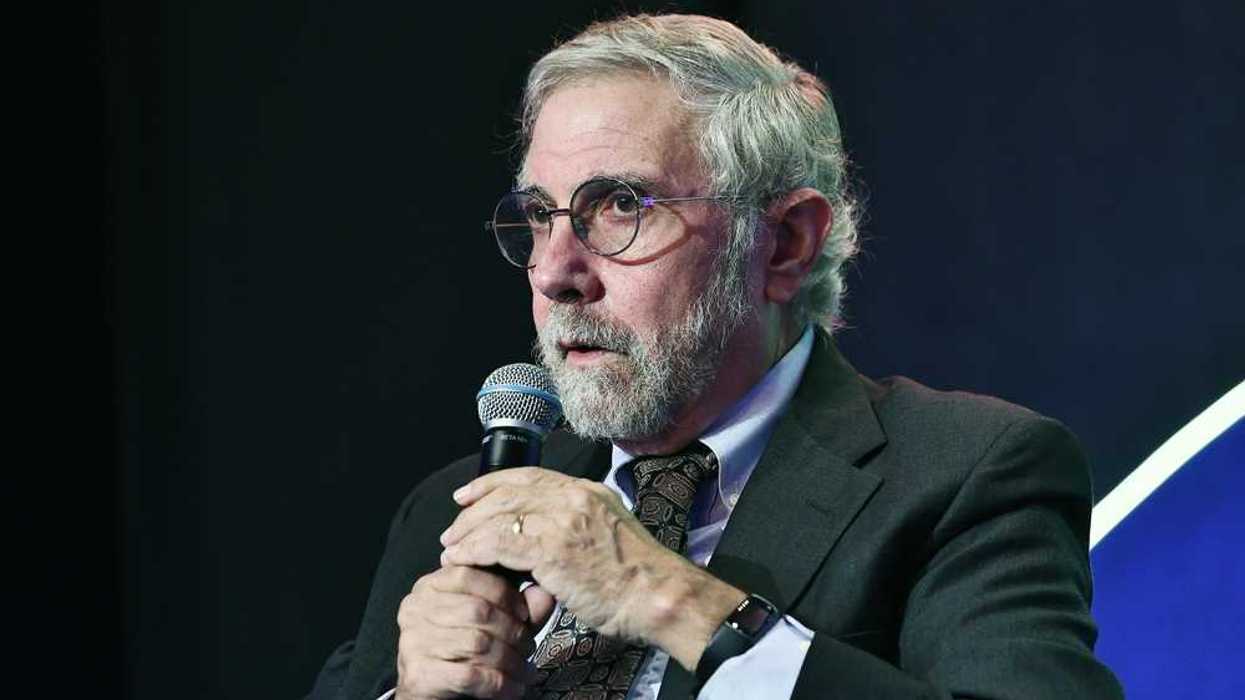
Economist Paul Krugman  at the Windsor Hotel in Rio de Janeiro, Brazil 
 (A.PAES/Shutterstock.com)

February 02, 2026 
ALTERNET


On Friday, January 30, President Donald Trump announced his nominee to replace U.S. Federal Reserve Chairman Jerome Powell: Kevin Warsh, who served on the Fed's Board of Directors under two former presidents: Republican George W. Bush and Democrat Barack Obama. Powell's term as Fed chair ends in May.

Some economists, MS NOW host and former Washington Post columnist Catherine Rampell noted in a February 1 op-ed for the New York Times, "breathed a sigh of relief" — as Warsh "seemed pretty normal" compared to "some of the overtly partisan, sycophantic candidates for the gig."

Although Rampell described Warsh as a "dramatically better option than some of the alternatives Mr. Trump was considering," she warned, "They should not be so sanguine. Mr. Warsh's record suggests that he may soon become one of the worst economic forecasters ever appointed to the chairmanship. Plus, he may be much more partisan than his boosters hope."


Liberal economist Paul Krugman shares Rampell's concerns in a February 2 column posted on Substack, although he says she is expressing them "more politely" than him.

Krugman describes Warsh as a "political weathervane," arguing that "he's for tight money when Democrats are in power, but all for running the printing presses hot when a Republican is in the White House."

"Warsh was very hawkish in the years following the 2008 financial crisis," Krugman argues. "But he turned abruptly dovish after Donald Trump won in 2024…. Why was Warsh so opposed to easy money after the 2008 financial crisis? Initially, he argued against low interest rates and quantitative easing because, he warned, they would lead to excessive inflation. He was, however, completely wrong, and it would have been a disaster if the Fed had followed his advice."


Although Krugman acknowledges that Trump could have made a worse pick for Fed chair than Warsh, he is far from enthusiastic about him.

"Given this history, why have so many established economists rushed to say nice things about Warsh?," Krugman writes. "Well, I'm an economist too, and we're supposed to think about incentives. Imagine yourself as a policy-oriented economist who tries to have contact with and influence over policymakers. Do you want to risk making a bitter enemy out of the next chair of the Federal Reserve? I'm personally wondering how I'll be greeted at some of the conferences I'm supposed to attend over the next few months."

Krugman adds, "Still, readers deserve to be told the truth. Warsh might surprise us all by showing unexpected integrity, but don't count on it. He may be better than the alternatives, but that's a very low bar, which mainly tells us how sorry a state economic policymaking — actually, policymaking of any kind — has reached in the age of Trump."

Trump's Fed chair nominee is a 'political animal' and a 'hack': Nobel economist
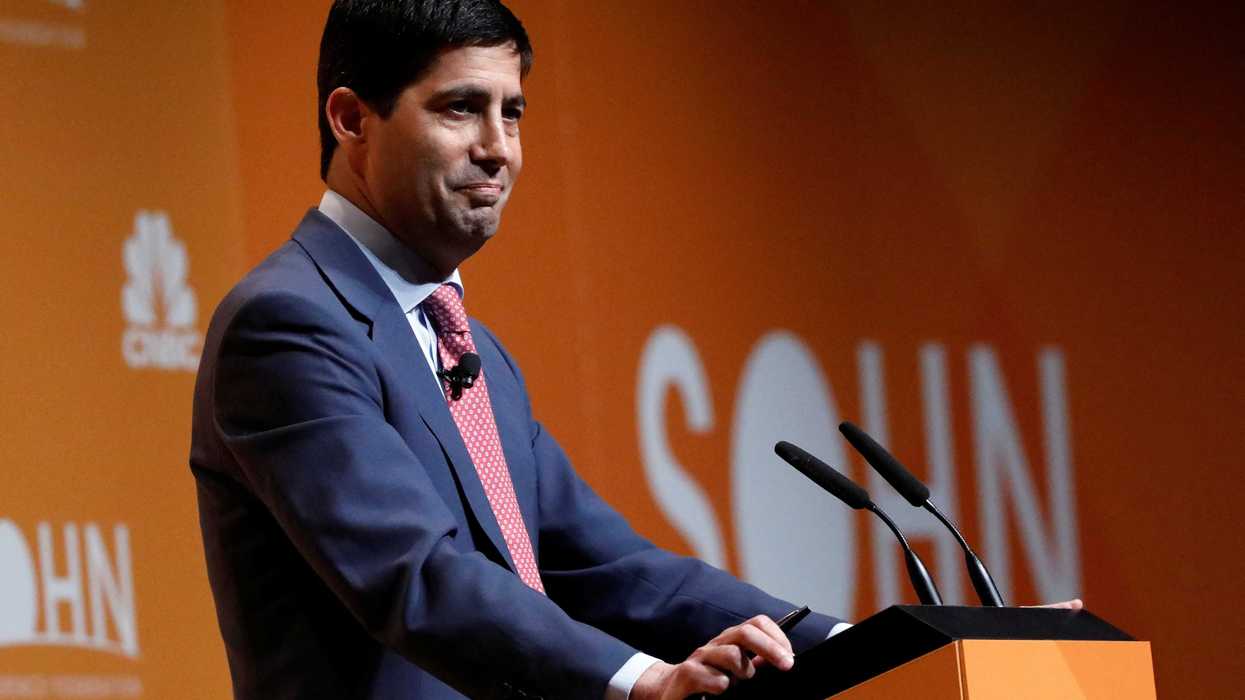

Kevin Warsh, Fellow in Economics at the Hoover Institution and lecturer at the Stanford Graduate School of Business, reacts during the Sohn Investment Conference in New York City, U.S., May 8, 2017. REUTERS/Brendan Mcdermid

January 30, 2026   
ALTERNET

When President Donald Trump was weighing his options for a U.S. Federal Reserve nominee to replace the current chairman, Jerome Powell — whose term ends in May — his search was described as a "tale of two Kevins": National Economic Policy (NEC) Director Kevin Hassett, and financier/attorney Kevin Warsh (who served on the Fed's Board of Governors under former Presidents George W. Bush and Barack Obama).

Trump announced his decision early Friday morning, January 30, nominating Warsh rather than Hassett.


Liberal economist Paul Krugman analyzes Trump's Warsh pick in a January 30 column posted on Substack, and he isn't enthusiastic. The former New York Times columnist views Warsh as a "political" partisan who won't serve the Fed well.

"The Fed is a republic, not a dictatorship; key decisions are made by a committee in which the chairperson has only one vote," Krugman explains. "Fed chairs can only drive policy through persuasion — and Warsh lacks the intellectual and moral credibility to be effective on that score. But God help us if we enter a crisis that requires decisive Fed leadership, the kind Fed Chair Ben Bernanke showed during the financial crisis, or Jay Powell is now showing against Trump's attacks."

Krugman adds, "Absent a crisis, my prediction is that the majority of Warsh's colleagues will largely ignore him, albeit without expressing their contempt openly…. While I don't think Warsh will do too much damage to monetary policy, he, along with his fellow Trumper Michelle Bowman, the vice chair for financial supervision, may well eviscerate the Fed's role as a financial regulator."

The Nobel laureate economist disagrees with reporters who are describing Warsh as a "monetary hawk."

"That's a category error," Krugman writes. "Warsh is a political animal. He calls for tight money and opposes any attempt to boost the economy when Democrats hold the White House. Like all Trumpers, he has been all for lower interest rates since November 2024. Depressingly, some Democratic-leaning economists are stepping up to reassure us about Warsh's qualifications. This is reminiscent of the way many economists rallied around the selection of Kevin Hassett as chair of the Council of Economic Advisers in 2017, although he was an obviously ludicrous hack."

Krugman describes Warsh as a "Republican loyalist" who "always wants to slam the economic brakes when Democrats are in power and step on the gas when Republicans rule."

Immigrants Delivered $14.5 Trillion Surplus to US Economy Over Last 30 Years: Report

“MAGA’s claim that immigrants are a drain on government budgets? It’s a lie.”


The analysis by the (LIBERTARIAN) Cato Institute shows in detail why it’s a lie to believe that immigrants are “sucking us dry,” a familiar argument by anti-immigrant nativists like Stephen Miller.
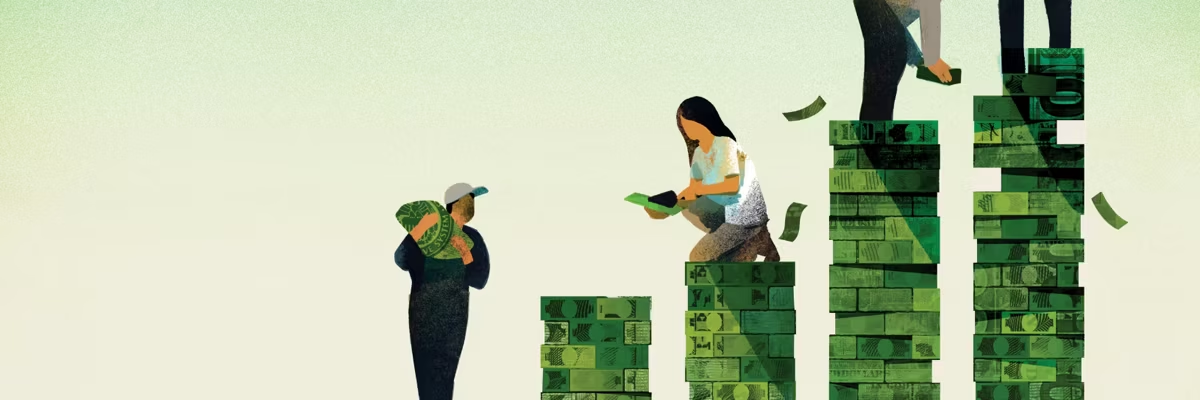
(Image: Keith Negley/via Cato Institute report art)

Jon Queally
Feb 04, 2026
COMMON DREAMS

A groundbreaking new report released Tuesday details how immigrants in the United States over the last three decades have contributed a massive surplus to the nation’s economy, resulting in a total of more than $14 trillion over that period due to the fact that immigrant families generate significantly more benefits to fiscal health than they take away in the form of benefits received or downside costs.

The white paper by the libertarian free-marketeers at the Cato Institute, not a left-leaning outfit, builds on an existing model developed by the National Academies of Sciences, Engineering, and Medicine (NASEM) to create a first-of-its kind analyses to determine “how immigrants, both legal and illegal, and their children affect government budgets” in a cumulative manner.

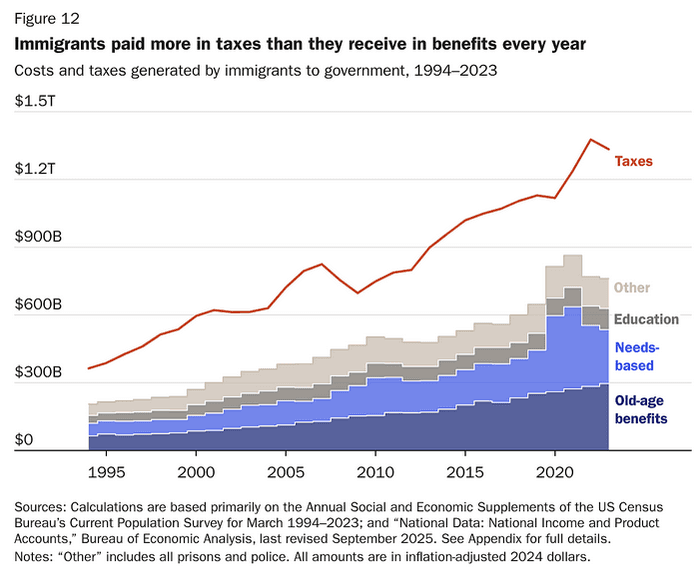
Looking at 30 years of data, the 95-page report—titled “Immigrants’ Recent Effects on Government Budgets: 1994-2023”—discovered that immigrants overall “generated a fiscal surplus of about $14.5 trillion” over those years. In part, the NASEM-Cato model shows:Every year from 1994 to 2023, immigrants have paid more in taxes than they received in benefits.
Immigrants generated nearly $10.6 trillion more in federal, state, and local taxes than they induced in total government spending.
Accounting for savings on interest payments on the national debt, immigrants saved $14.5 trillion in debt over this 30-year period.
Immigrants cut US budget deficits by about a third from 1994 to 2023, and fiscal savings grew to $878 billion in 2023.

The paper concludes that “the average immigrant is much less costly than the average US-born American, and that immigrants impose lower costs per person on old-age benefit, education, and public safety programs.”

The findings arrive with the US embroiled in a heated debate about immigration enforcement as President Donald Trump—backed by far-right xenophobes in his inner orbit, including White House deputy chief of staff for policy Stephen Miller and Department of Homeland Security Kristi Noem—has unleashed violent federal agents into communities nationwide to sweep up undocumented workers and their family members.

In a video produced for social media, David J. Bier, director of Immigration Studies at Cato and one of the report’s co-authors, said the analysis shows in detail why it’s a lie to believe that immigrants are “sucking us dry,” a familiar argument by anti-immigrant “nativists” like Miller.


In summary, the report notes that immigrants produce a net fiscal benefit in the US economy because:The United States collected more in taxes from the average person than it spent on benefits (excluding pure public goods).
Immigrants paid higher-than-average taxes because their higher-than-average employment rate led to higher-than-average incomes.
Immigrants cost the government less than average because they did not add to the cost of the government’s largest expenditure (pure public goods) and received lower-than-average benefits for other major items, particularly old-age benefits and education.

As shown in the figure below, the difference between taxes paid by immigrants and the public benefits they receive “has grown from $158 billion to $572 billion in real terms since 1994.” Just to look at 2023, working immigrants that year paid $1.3 trillion in taxes yet received only $761 billion in benefits.


This trend, despite endless cries from far-right pundits and xenophobic lawmakers that immigrants are a drain on public coffers, has held steady for decades—with no sign of it ending in the future.

“For decades, nativists have sold America this narrative that immigrant welfare is behind our deficits and debt,” said Bier. “This figure shows how absurd that is.”


The report argues that “rather than treating [immigrants—both documented and undocumented] as the cause of America’s fiscal struggles, we should consider immigrants part of the solution.”

Mark D. Levine, comptroller of New York City, was among the public officials pointing to the report as timely evidence that the Trump-Miller-Noem narrative about immigration is built on a foundation of falsehoods.

“MAGA’s claim that immigrants are a drain on government budgets? It’s a lie,” said Levine.


‘Tariffs Haven’t Helped’: 72,000 Manufacturing Jobs—and Counting—Obliterated Since Trump’s Liberation Day

“There’s very little in our product portfolio that has benefited from tariffs,” said the CEO of one North Carolina-based steel product company.


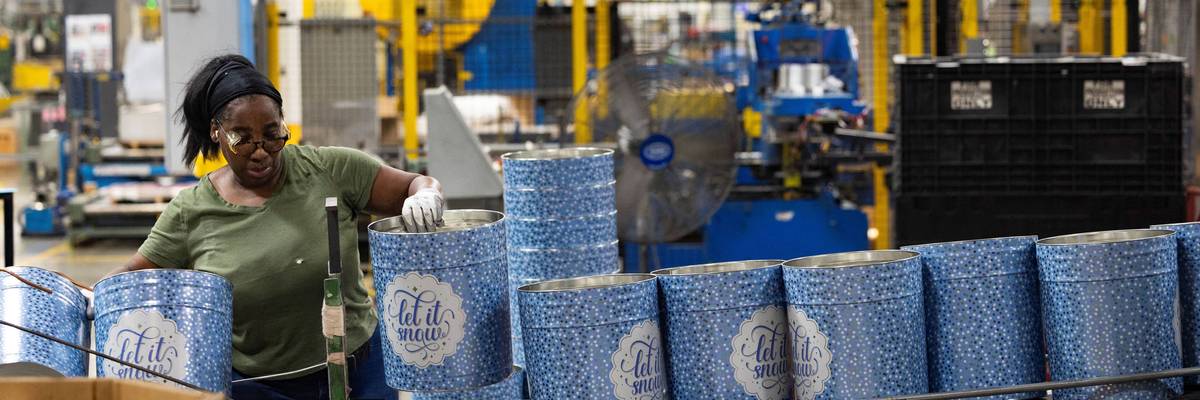
An employee of Independent Can Company works on the manufacturing line in Belcamp, Maryland, on June 25, 2025.
(Photo by Ryan Collerd/AFP/Getty Images)


Julia Conley
Feb 03, 2026
COMMON DREAMS

US President Donald Trump pledged that the manufacturing industry would come “roaring back into our country” after what he called “Liberation Day” last April, which was marked by the announcement of sweeping tariffs on imported goods—a policy that has shifted constantly in the past 10 months as Trump has changed rates, canceled tariffs, and threatened new ones.

But after promising to turn around economic trends that have developed over decades—the shipping of jobs overseas, automation, and the obliteration of towns and cities that had once been manufacturing centers—Trump’s trade policy appears to have put any progress achieved in the sector in recent years “in reverse,” as the Wall Street Journal reported on Monday.

Federal data shows that in each of the eight months that followed Trump’s Liberation Day tariffs, manufacturing companies reduced their workforce, with a total of 72,000 jobs in the industry lost since April 2025.

The Census Bureau also estimates that construction spending in the manufacturing industry contracted in the first nine months of Trump’s second term, after surging during the Biden administration due to investments in renewable energy and semiconductor chips.

“But the tariffs haven’t helped,” said Hanson.

Trump has insisted that his tariff policy would force companies to manufacture goods domestically to avoid paying more for foreign materials—just as he has claimed consumers would see lower prices.

But numerous analyses have shown American families are paying more, not less, for essentials like groceries as companies have passed on their higher operating costs to consumers, and federal data has made clear that companies are also avoiding investing in labor since Trump introduced the tariffs—while the trade war the president has kicked off hasn’t changed the realities faced by many manufacturing sectors.

“While tariffs do reduce import competition, they can also increase the cost of key components for domestic manufacturers,” wrote Emma Ockerman at Yahoo Finance. “Take US electric vehicle plants that rely on batteries made with rare earth elements imported from overseas, for instance. Some parts simply aren’t made in the United States.”


At the National Interest, Ryan Mulholland of the Center for American Progress wrote that Trump’s tariffs have created “three overlapping challenges” for US businesses.

“The imported components and materials needed to produce goods domestically now cost more—in some cases, a lot more,” wrote Mulholland. “Foreign buyers are now looking elsewhere, often to protest Trump’s global belligerence, costing US firms market share abroad that will be difficult to win back. And if bad policy wasn’t enough, US manufacturers must also contend with the Trump administration’s unpredictability, which has made long-term investment decisions nearly impossible. Perhaps it’s no surprise, then, that small business bankruptcies have surged to their highest level in years.”

Trump’s unpredictable threats of new tariffs and his retreats on the policy, as with European countries in recent weeks when he said he would impose new levies on countries that didn’t support his push to take control of Greenland, have also led to “a lost year for investment” for many firms, along with the possibility that the US Supreme Court could soon rule against the president’s tariffs.

“If Trump just picked a number—whatever it was, 10% or 15% to 20%—we might all say it’s bad, I’d say it’s bad, I think most economists would say it’s bad,” Dean Baker, senior economist at the Center for Economic and Policy Research, told Yahoo Finance. “But the worst thing is there’s no certainty about it.”

Constantly changing tariff rates make it “very difficult for businesses... to plan,” said Baker. “I think you’ve had a lot of businesses curtail investment plans because they just don’t know whether the plans will make sense.”

While US manufacturers have struggled to compete globally, China and other countries have continued exporting their goods.

“There’s very little in our product portfolio that has benefited from tariffs,” H.O. Woltz III, chief executive of North Carolina-based Insteel Industries, told the Wall Street Journal.

US Rep. Marcy Kaptur (D-Ohio) noted Monday that the data on manufacturing job losses comes a week after Vice President JD Vance visited his home state to tout “record job growth.”

“Here’s the reality: Families face higher costs, tariffs are costing manufacturing jobs, and over $200 million in approved federal infrastructure and manufacturing investments here were cut by this administration,” said Kaptur. “Ohio deserves better.”
Senators Demand Answers on Equifax Plan to ‘Profiteer’ Off GOP’s Medicaid Work Requirements

“Corporate consultants and vendors are getting to make a killing off of Medicaid work requirements’ administration machinery while our patients will lose healthcare and suffer,” said one advocate.


The Equifax Atlanta headquarters is seen  in Atlanta, Georgia.
(Photo by Kevin Dietsch/Getty Images)


Julia Conley
Feb 05, 2026
COMMON DREAMS

Three of the US Senate’s top critics of corporate greed and anticompetitive behavior are investigating a scheme by credit report firm Equifax that they say will allow the company to profit from Republican policies that are set to rip away healthcare coverage and food assistance from millions of Americans.

Sens. Elizabeth Warren (D-Mass.), Ron Wyden (D-Ore.), and Bernie Sanders (I-Vt.) wrote to Equifax CEO Mark Begor on Tuesday with several questions about the company’s anticipated profits from provisions in the One Big Beautiful Bill Act (OBBBA) that imposed work requirements on recipients of Medicaid and Supplemental Nutrition Assistance Program (SNAP) benefits.

Begor told investors last summer that the policy presented a “massive” business opportunity for Equifax, as a product owned by the company called the Work Number is used by many states to instantly verify the wages and work hours of Medicaid applicants.

At least 99 million workers across the country are covered by Equifax’s database, which the company has filled with data through exclusive contracts with employers and payroll firms. Equifax has frequently imposed steep price hikes on the product and has been accused of having a monopoly on providing income data to state agencies.

North Carolina’s Medicaid program was hit with a 24% price increase in 2022 and a 36% hike in 2024.

“We have very little leverage and recourse to back out,” state Medicaid director Jay Ludlam told the New York Times in November.

Luke Farrell, a former employee of the US Digital Service under the Biden administration, told the Times that Equifax owns “a product that has become a core piece of the safety net. I’ve never seen another vendor do such price hikes across public benefits.”

With the new work requirements set to go into effect in January 2027, states will be required to check the database more frequently.

The OBBBA’s $1 trillion in cuts to SNAP and Medicaid are projected to cause “over 5 million people to lose their health insurance and over 3 million people to pay higher grocery prices within the next few years,” wrote the senators this week.

“But for Equifax, these new threats to Americans’ food assistance and health insurance coverage ‘represent the chance to become a lot richer,’” they wrote, quoting the Times’ article from November about Equifax’s plan to price-gouge states.

The senators continued:
Because Equifax is already dominant in this market, the law’s new red tape requirements allow the company to consolidate power even further, using extractive contracts to price-gouge states, squeeze competitors, and drive up profits. In fact, Equifax is laying the groundwork to cash in by proactively building out a platform called “TotalVerify,” which is specifically marketed as a tool to help “Prepare Your Agency For H.R.1.” Equifax also pitched the platform as a “single-source” for states and government agencies to be able to verify employment, income, incarceration status, consumer address, and phone number history and claims to “help state and government agencies manage the complexities of SNAP and Medicaid programs.” Given that Equifax’s tight grip on this business has “border[ed] on a monopoly,” Equifax stands to gain even more as OBBBA’s red-tape requirements take effect nationwide.

The lawmakers noted that judging from history, the work requirements are unlikely to “be effective at anything but increasing red tape,” as the vast majority of Medicaid and SNAP recipients who are eligible to work already do and states have already run “failed” experiments with Medicaid work requirements.

In 2018, Arkansas’ program resulted in 18,000 low-income people losing coverage in under a year, with people who had no home internet access and those who qualified for an exemption from the work requirement most likely to lose their benefits.

“Now, President Trump and Republicans in Congress have expanded this policy in a move that will ensure more Americans get tangled up in red tape and lose essential healthcare coverage and food assistance as a result,” wrote Warren, Wyden, and Sanders. “That these requirements could allow Equifax to profiteer off of this ‘solution’ [makes] them even more egregious.”

Adam Gaffney, former president of Physicians for a National Health Program, summarized the senators’ objections to Equifax’s price-gouging practices: “Corporate consultants and vendors are getting to make a killing off of Medicaid work requirements’ administration machinery while our patients will lose healthcare and suffer. Meanwhile taxpayers will fund the bureaucratic lard.”

The senators demanded to know Equifax’s per-query costs for each state contract for the Work Number, the number of OBBBA-related contracts it expects to bid for in 2026 and 2027, the company’s lobbying expenditures over the past five years for federal, state, and local governments, and whether Equifax plans to retain a clause in its contracts that allows it the “categorical right” to change prices with 30 days’ notice.

“Equifax’s long history of anti-competitive behavior,” said the senators, “raises serious concerns about the company’s potential moves to price gouge states and taxpayers.”


Meet the Top 7 Oligarchs Controlling Your Online News

The internet has not democratized news in any meaningful way; instead, the media monopoly has simply migrated to digital spaces.


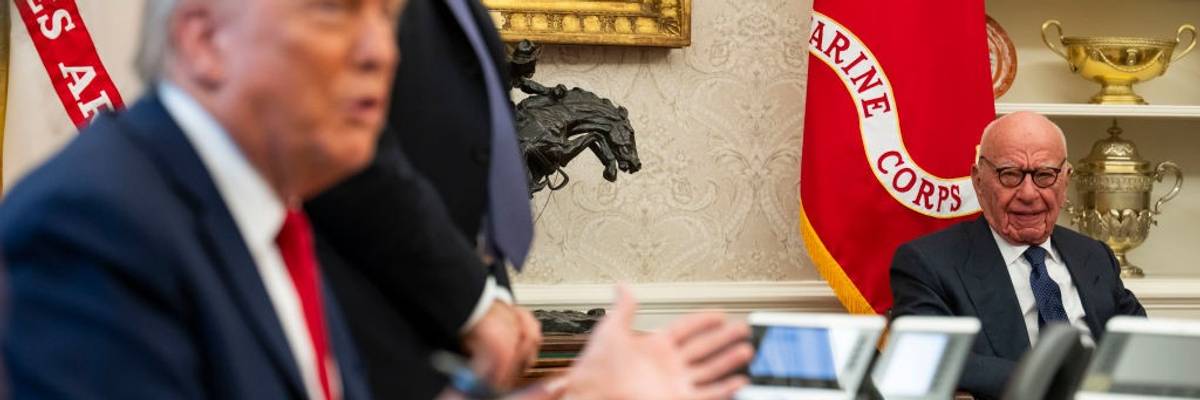
Media mogul Rupert Murdoch looks on as President Donald Trump speaks to members of the media as he signs proclamations, initiatives, and appointments inside the Oval Office at the White House in Washington, DC on February 03, 2025.
(Photo by Craig Hudson for The Washington Post via Getty Images)

Caitlin Scialla
Feb 04, 2026
FAIR


When Ben Bagdikian, an esteemed journalist and early FAIR contributor, published his groundbreaking book The Media Monopoly in 1983, he painted a troubling picture of US media consolidation, reporting that 50 corporations controlled the media business. With each reprint, that number dwindled (FAIR.org, 6/1/87). When FAIR replicated his analysis in 2011 (Extra!, 10/11), it stood at 20.

Now, over 40 years after the initial release of The Monopoly Media, the media landscape has transformed drastically. Even Bagdikian’s later editions, written at the dawn of the internet, could not fully anticipate how profoundly digital technology would reconfigure the media oligarchy.


77% of Global Millionaires Agree: Extreme Wealth Allows Uber-Rich to Buy Political Influence

“News” is increasingly synonymous with online news. Over half the US public (56%) say that they “often” get news through their digital devices—compared to less than 1 in 3 (32%) who often get news from TV, 1 in 9 from radio, and only 1 in 14 from print publications like newspapers or magazines (Pew, 9/25/25).

Which raises the question: Who owns the leading online news sites—and, by extension, largely shapes the ideas and information that reach millions of Americans?

The pervasive presence of billionaires and the entrance of private equity firms in FAIR’s Top 7 suggest even further shifts away from democratic, truth-telling media.

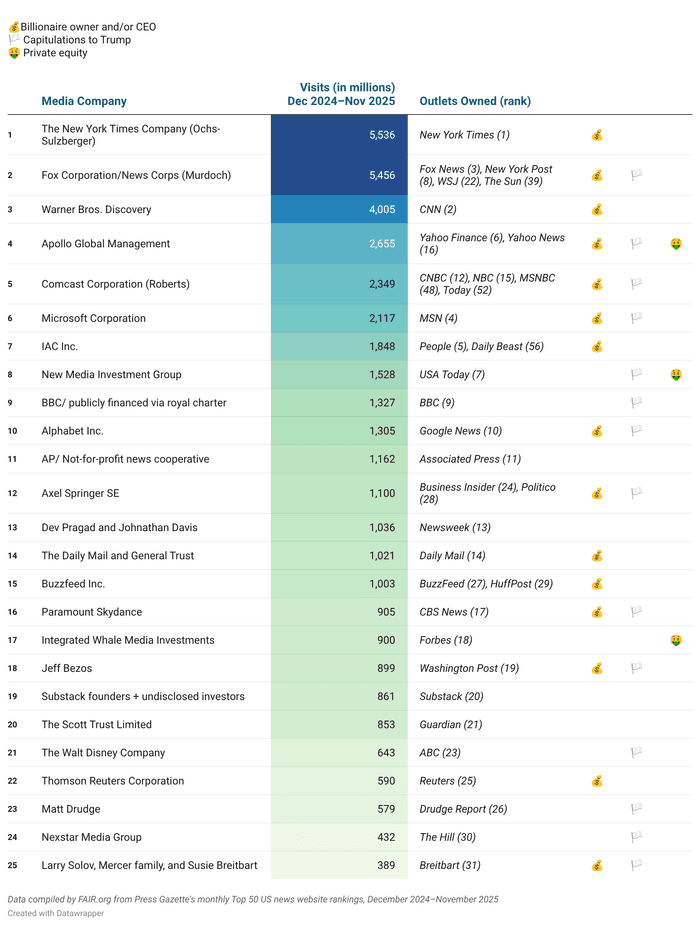
Each month, Press Gazette, a London-based magazine for the journalism industry, ranks the top 50 news websites in the US in order of monthly visits, based on data from the marketing firm Similarweb. FAIR tallied Press Gazette‘s results over a 12-month span, from December 2024 to November 2025, to get a figure for total US visits to major news sites over that period: 45.6 billion.

More than half of those visits, nearly 25.5 billion, went to news sites controlled by just seven families or corporate entities.


1. Ochs-Sulzberger Family (New York Times): 5.54 billion

The owner that commands the largest share of news site viewership–a staggering 5.5 billion over one year—is the Ochs-Sulzberger family, the media dynasty that acquired the New York Times in 1896. Control of the Times has since passed through four generations, cemented by a family trust; over a century later, scion A.G. Sulzberger currently sits as the chair and publisher. As its reach greatly expanded in the digital age, the paper continues its tradition of allegiance to the establishment and opposition to what it sees as excessively progressive policies.

2. Murdoch Family (News Corp, Fox): 5.46 billion

The No. 2 spot (just under 5.5 billion views) is occupied by the Murdoch family. Billionaire right-winger Rupert Murdoch built an expansive global media empire encompassing Fox News, the Wall Street Journal, the New York Post, and British tabloid the Sun, all of which made the US Top 50 list, as well as many other media outlets in the US, Britain, and Australia.

The empire is now under two corporate umbrellas, News Corp (the papers) and Fox Corporation (TV); both are led by Rupert’s billionaire son, Lachlan Murdoch, who inherited the role following a messy succession battle. He was apparently chosen for his dedication to maintaining the right-wing political advocacy that has long characterized the Murdoch media portfolio.

Rupert Murdoch, who has always cultivated political connections, has a relationship with President Donald Trump going back decades, with Murdoch even acting as an informal adviser during Trump’s first administration. That chumminess has not been enough to protect Murdoch from Trump’s assault on the news media: Trump is currently suing the Wall Street Journal for $10 billion for publishing an incriminating birthday letter to Jeffrey Epstein that features his signature. Still, Murdoch and Trump were recently reported to be dining together at the White House.


3. Warner Bros. Discovery (CNN): 4.0 billion


Warner Bros. Discovery (WBD), a US media and entertainment conglomerate, comes in third in terms of news audience reach (4 billion), solely on the basis of its ownership of CNN. (The media group also owns extensive non-news holdings, including the Warner Bros. movie studio and HBO.)

WBD accepted a buyout bid from Netflix for an estimated $83 billion, but the deal does not include CNN or any of Warner Bros. cable networks, which would be consolidated into the separate corporation Discovery Global next year.

The Netflix-Warner Bros. deal appears to have survived numerous hostile takeover bids by Paramount Skydance that sought to include CNN. But there are more obstacles ahead: Aside from antitrust concerns raised by Democrats over the streaming giant taking over a major Hollywood studio, Trump’s connections to Larry and David Ellison of Paramount—and the fact that ownership of CNN is still very much up for grabs—means that the battle over this set of influential media properties is far from over.

Warner Bros. already has a track record of capitulating to the demands of the Trump administration, but a loud and proud Trump ally at the helm of CNN would be a major escalation.

Trump has pledged personal involvement in the federal government’s review of the merger, warning that “it could be a problem.” He has insisted that CNN be sold in any Warner Bros. deal, signaling his intent to install pro-Trump ownership and steer the network’s political angle.

Gaining control of CNN would bring Paramount to the No. 3 spot, and would grant David Ellison—son of billionaire technocrat Larry Ellison, both vocal Trump supporters who have pledged to use their power to further advance Trump’s own—a new level of control over the US media landscape. Warner Bros. already has a track record of capitulating to the demands of the Trump administration, but a loud and proud Trump ally at the helm of CNN would be a major escalation.

Consider the rapid changes implemented at CBS following Skydance’s August 2025 acquisition of Paramount, which hugely expanded the Ellisons’ media empire. As documented by FAIR (7/24/25, 10/9/25, 11/6/25), this merger has resulted in blatant “ideological restructuring,” with the appointment of “anti-woke” ideologue Bari Weiss to CBS editor-in-chief, the cancellation of the famously Trump-critical “Late Show With Stephen Colbert,” and a wave of politically motivated layoffs.


4. Apollo Global Management (Yahoo): 2.7 billion

At No. 4 is private equity firm Apollo Global Management, which since 2021 has owned the Yahoo group. Yahoo News and Yahoo Finance together generated 2.7 billion views during the analyzed period. These sites primarily aggregate content from other news outlets, with occasional original articles, and rely heavily on algorithm-based personalization. Apollo’s current CEO, billionaire Marc Rowan, has recently donated millions to Republicans.

Rowan was also heavily involved in developing Trump’s “Compact for Academic Excellence in Higher Education,” a proposal, as the New York Times (10/3/25) reported, that would provide financial incentives and preferential treatment to schools that sign and, in turn, agree to limit international students, protect conservative speech, generally require standardized testing for admissions, and to adopt policies recognizing “that academic freedom is not absolute,” among other conditions.


5. Brian Roberts (Comcast): 2.4 billion

Ranked No. 5 with 2.35 billion visits during the analyzed period, Comcast is a media and technology company with extensive holdings—of which NBC News, CNBC, MSNBC, and Today all made appearances in the Top 50. Comcast’s billionaire CEO, Brian Roberts, is the controlling shareholder.

FAIR (6/11/16, 4/23/18) has long criticized the corporate skew of Comcast-owned media. More recently, however, this bias has devolved into patent deference to the Trump administration. Trump has repeatedly criticized Comcast and its news subsidiaries for bias against him. In February 2025, his FCC targeted Comcast for its “promotion of DEI.” Comcast quickly “confirmed it had received [FCC chair Brendan] Carr’s letter,” noting that it will be “cooperating with the FCC to answer their questions.” (The Hill, 2/12/25).

Changes to accommodate Trump’s demands were swift and severe. As covered by FAIR (3/6/25), MSNBC overhauled its staff soon afterward:
The news channel has nixed or demoted their most progressive anchors, all of whom are people of color. These are the hosts who have drawn the most ire from Donald Trump’s online warriors, according to Dave Zirin of The Nation (2/28/25).

Comcast further demonstrated its subservience to Trump with a recent donation to the new White House ballroom.

In January 2026, Comcast completed its spin-off of many of its news and cable holdings, including CNBC and MSNBC (rebranded as MS Now), to Versant Media—a company that Roberts retains control over.


6. Microsoft (MSN): 2.1 billion

Coming in at No. 6, Microsoft, the technology conglomerate that owns MSN, also donated to Trump’s ballroom. Similar to Yahoo, MSN is an algorithm-based republisher of news stories, which pulled in 2.1 billion views over the studied time frame. Given Microsoft’s obsession with AI, it is perhaps unsurprising that MSN has started to lean heavily on auto-generated content, coming under fire for promoting unreliable sources and publishing blatant misinformation.

Microsoft’s ownership is dominated by institutional shareholders, with mutual fund giant Vanguard leading the way at 9%. Microsoft’s billionaire CEO, Satya Nadella, is known to have a friendly relationship with Trump—they have met and dined together on several occasions. In fact, before helping to fund Trump’s East Wing ballroom, Microsoft contributed $1 million to Trump’s inauguration fund.

7. IAC (People): 1.9 billion

No. 7 IAC Inc. owns numerous media and internet brands, including Top 50 sites People and Daily Beast. Taken together, these two sites generated 1.9 billion views over 12 months. Billionaire founder Barry Diller serves as chair, senior executive and the largest individual shareholder of IAC. It should be noted that Diller has publicly criticized Trump on several occasions, standing out as the only one among the Top 7, aside from New York Times publisher Sulzberger, to do so.
Old Wine in a New Bottle

While not a replica of the original Bagdikian study, which took into account all major forms of media rather than focusing on the dominant medium (then television), FAIR’s research shows the continuation of the dynamics he described in a pre-internet age. The internet has not democratized news in any meaningful way; instead, the media monopoly has simply migrated to digital spaces.

At the same time, the pervasive presence of billionaires and the entrance of private equity firms in FAIR’s Top 7 suggest even further shifts away from democratic, truth-telling media.

The growing presence of private equity in media is a relatively new phenomenon, highlighting the usefulness of expansive media portfolios as vehicles for profit extraction. Along with the burgeoning influence of billionaires on the media landscape, the control of capital over media has become, if possible, even more apparent.

Almost three decades ago, the late media scholar Robert McChesney (Extra!, 11–12/97) wrote presciently of the globalization of media behemoths in the digital age:
It is a system that works to advance the cause of the global market and promote commercial values, while denigrating journalism and culture not conducive to the immediate bottom line or long-run corporate interests.

Some once posited that the rise of the internet would eliminate the monopoly power of the global media giants. Such talk has declined recently as the largest media, telecommunication and computer firms have done everything within their immense powers to colonize the internet, or at least neutralize its threat.

What is tragic is that this entire process of global media concentration has taken place with little public debate, especially in the US, despite the clear implications for politics and culture. After World War II, the Allies restricted media concentration in occupied Germany and Japan because they noted that such concentration promoted anti-democratic, even fascist, political cultures. It may be time for the United States and everyone else to take a dose of that medicine. But for that to happen will require concerted effort to educate and organize people around media issues. That is the task before us.


Research assistance: Priyanka Bansal, Saurav Sarkar, Lara-Nour Walton

© 2023 Fairness and Accuracy In Reporting (FAIR)

Caitlin Scialla
Caitlin Scialla is a freelance writer based in Brooklyn. She has worked with The Progressive magazine and Fairness and Accuracy in Reporting (FAIR).
Full Bio >

Read All About It! 

Tycoon Tires of Playing Media Magnate, Kills Major Daily to Spend More Time With Trophy Wife


 February 5, 2026

The kindest explanation that could be put forward for Jeff Bezos slashing the Washington Post staff by over a third –- that’s over 300 jobs—with more to come, is that this is a dilettante retailer whose wealth is estimated this year at $230–$266 billion who got bored with playing media tycoon and maybe decided to spend more time with his wife for a while.

The stated reason for the evisceration of one of the country’s storied daily papers– the one that brought down Richard Nixon in its heyday – was that it had lost $100 million in 2024 and is continuing to hemorrhage even more readers, or what the company refers to more generically as “customers.”

But that’s silly. $100 million is chump change to Bezos. In fact, even at the lower end of his estimated wealth, $100 million is just 0.0435% of his personal stash. That is to say, it’s not 4.35% pf his loss in 2024, or 0.4% of his loss, but just 0.04% of his stash. If it were rounded on a Bezos tax form, it would be rounded down to zero.

But of course, Bezos isn’t destroying the Washington Post because he’s tired of playing media magnate. It’s because he’s not getting the bennies he had hoped for from President Trump by taking control of the Washington PR shop for the Washington power elite. Try as he might to get the professional staff to play the fawning role of Trump lickspittles, they still couldn’t occasionally resist committing journalism.

And even a little was too much. The coverage of the heroic Twin Cities’ residents as they harass, document, and forewarn their vulnerable immigrant neighbors of the arrival of ICE and Border Security “Gestapo” thugs has actually been quite disturbing, as was the reporting on the murder of two native-born US citizens, Renee Nicole Good and Alex Pretti.

Bezos couldn’t fire his reporters for doing a good job (within the constraints of mainstream reporting conventions), so he’s killing the paper, or at least cutting it off at the knees.

Given the man’s origin story as lowly bookseller with one original “big idea”— a delivery service that eliminates brick-and-mortar bookstores and the need to wander around the shelves to find something to read-–It’s likely that the Post will end up as have so many local newspapers across the nation, taken over by media giants, and becoming another a free advertising rag with no staff, that just runs ads and corporate and government press releases verbatim.

What will the CIA do when its mouthpiece is gone?

This article by Dave Lindorff appeared originally in ThisCantBeHappening! on its new Substack platform at https://thiscantbehappening.substack.com/. Please check out the new site and consider signing up for a cut-rate subscription that will be available until the end of the month.