Saturday, February 07, 2026

Trump fuels EU push to cut cord with US tech

By AFP
February 5, 2026


Since Donald Trump's Greenland climbdown, top officials have stepped up warnings that Europe is dangerously exposed to geopolitical shocks - Copyright AFP Justin TALLIS
Raziye Akkoc

Until President Donald Trump’s return a year ago, when the EU talked about cutting economic dependency on foreign powers — it was understood to mean China. But now Brussels has US tech in its sights.

As Trump ramps up his threats — from strong-arming Europe on trade to pushing to seize Greenland — concern has grown that the unpredictable leader could, should he so wish, plunge the bloc into digital darkness.

Since Trump’s Greenland climbdown, top officials have stepped up warnings that the European Union is dangerously exposed to geopolitical shocks and must work towards strategic independence — in defence, energy and tech alike.

The 27-country bloc relies on foreign countries for over 80 percent of digital products, services, infrastructure and intellectual property, according to a 2023 EU report.

Europe has already begun chipping away at its reliance on US tech.

The latest step came last week when France told state employees they would soon be required to use a domestic alternative to tools like Zoom or Microsoft Teams.

Brussels’ wake up call came last year when Washington sanctioned judges at the International Criminal Court, cutting them off from US tech such as Amazon or Google.

The move laid bare the US stranglehold over many tools that underpin European lives.

“During the last year everybody has really realised how important it is that we are not dependent on one country or one company when it comes to some very critical technologies,” EU tech tsar Henna Virkkunen said.

“Dependencies… can be weaponised against us,” she warned.

– Technology ‘no longer neutral’ –

Virkkunen will in March unveil a major “tech sovereignty” package covering cloud, artificial intelligence and chips — areas where the EU hopes to build greater autonomy.

“Digital technologies are no longer neutral tools,” European Digital SME Alliance’s secretary general, Sebastiano Toffaletti, told AFP.

“When core infrastructures like cloud, AI or platforms are controlled from outside Europe, so are the rules, the data and ultimately the leverage.”

Among EU member states, France and Germany have been leading the charge.

The northern German state of Schleswig-Holstein became a poster child for digital sovereignty last year by ditching Microsoft in favour of open-source software.

Digitalisation minister Dirk Schroedter said the move was economically-driven at first, before “political tensions” shifted the focus.

“Dominance of a few tech corporations in public infrastructure limits… our flexibility, threatens our security and inflates our software costs,” Schroedter told AFP.

Over six months, the state migrated more than 40,000 mailboxes from Microsoft Exchange and Outlook to open-source solutions Open-Xchange and Thunderbird.

There were challenging areas during the transition — for example in document‑sharing with other federal states and the national government — but Schroedter said the state showed “digital independence is possible”.

Meanwhile, the European Parliament is reviewing its reliance on Microsoft among other tools after a cross-party group of lawmakers urged it to adopt European alternatives.

– ‘Leverage against US’ –

Moves are also underway at EU level.

French firm Mistral and German giant SAP agreed to work on a European AI-driven cloud solution at a Franco-German digital sovereignty summit in November.

And France, Germany, Italy and the Netherlands teamed up last year in a push to create common European digital infrastructure, steered by the European Commission.

Much of EU policymaking is now being viewed through the prism of sovereignty.

The bloc has long been working on a digital euro, which dozens of economists — including Thomas Piketty — called an “essential safeguard of European sovereignty” in an open letter last month.

That follows the 2024 launch of Wero, a European payments alternative to Mastercard, Visa and PayPal backed by several major banks.

But Zach Meyers of CERRE, a Brussels-based think tank, warns the EU must be clear about what “tech sovereignty” is meant to achieve.

If the goal is to withstand political pressure, the EU may be better off focusing on gaining “more leverage against” the United States, Meyers argued.

To that end, he said the most effective strategy is not to cut back on American tech use in Europe but “rather to double down on parts of the tech value chain where the US is dependent on Europe” — from chip-building machinery to corporate software or telecoms equipment.
DEREGULATION

Trump reinstates commercial fishing in protected Atlantic waters


By AFP
February 6, 2026


A Right Whale surfaces as biologists from the Center for Coastal Studies research the mammals in Cape Cod Bay, Massachusetts - Copyright AFP/File Joseph Prezioso

President Donald Trump on Friday issued a proclamation reopening commercial fishing in protected waters off the Atlantic coast, in a region renowned for its rich biodiversity.

The Northeast Canyons and Seamounts Marine National Monument spans nearly 5,000 square miles — larger than Yellowstone National Park.

Long a focus of scientific interest, the monument lies about 130 miles southeast of Cape Cod, Massachusetts, and was established in 2016 by former Democratic president Barack Obama, who warned it was threatened by overfishing and climate change.

In a familiar political yo-yo, Republican Trump reopened the monument to commercial fishing during his first term, only for the decision to be reversed by former president Joe Biden. Biden’s administration cited the monument as part of its pledge to conserve 30 percent of US land and waters by 2030.

Explaining the latest reversal, Trump’s proclamation said the plants and animals in question were already protected under existing laws, making a ban on commercial fishing unnecessary.

The move, expected since last year, was welcomed by the New England Fishermen’s Stewardship Association (NEFSA).

“For decades, overregulation has stopped fishermen from making a living and putting wild, heart-healthy, American-caught products on store shelves. NEFSA is pleased that the Trump administration is committed to making America’s natural resources available to all Americans,” said NEFSA CEO Jerry Leeman in a statement last May.

Conservation groups, however, are likely to push back.

During an aerial survey last August, the New England Aquarium documented more than 1,000 marine animals in the area, including an endangered fin whale and calf, an endangered sperm whale, pilot whales, and a wide array of other whales, dolphins, and rays.
Countries using internet blackouts to boost censorship: Proton

By AFP
February 5, 2026


Image: — © Digital Journal


Nina LARSON

As countries step up their use of internet shutdowns to muzzle dissent, some are also taking advantage of the blackouts to increase censorship firewalls, internet privacy company Proton warned in an interview with AFP.

Switzerland-based Proton, known for its encrypted email and virtual private network (VPN) services, has for years observed how authoritarian governments apply “censorship as a playbook”, lead product manager Antonio Cesarano told AFP in a recent interview.

But increasingly they are observing governments in countries like Iran and Myanmar emerging from internet shutdowns with a supercharged ability to censor internet access.

VPNs delivered by Proton and others provide a secure, encrypted connection over the internet between a user and a server, giving users greater anonymity and often allowing them to avoid local restrictions on internet use.

But now the company worries governments are using long blackouts to beef up their ability to counter VPNs.

In several cases, Cesarano said that internet shutdowns saw countries’ censorship capabilities “going from nothing, or something laughable, to something very skilled”.

– ‘Censorship as service’ –

Proton’s VPN general manager David Peterson said in an email that this sudden jump in capabilities could indicate that “censorship as a service” technology “is being sold by other countries that have more know-how”.

“For example, over the past couple of years, we’ve seen the Chinese ‘great firewall’ technology used by Myanmar, Pakistan, and some African nations,” he said.

The trend is emerging as the willingness to impose total internet shutdowns is also growing, warned Proton, which runs a non-profit VPN Observatory that tracks demand for its free VPN services to detect government crackdowns and attacks on free speech.

Switzerland-based Proton tracks demand for its free virtual private network (VPN) services to detect government crackdowns and attacks on free speech 
– Copyright AFP/File Fabrice COFFRINI

Cesarano, who serves as spokesman for Proton’s internet censorship and online freedom work, pointed out that the extreme and once almost unthinkable measure has “happened three times in six months”.

He highlighted the latest dramatic shutdown in Iran, when the country’s more than 90 million people were forced offline for nearly three weeks, obscuring a crackdown on country-wide protests which rights groups say killed thousands of people.

There was also the weeklong shutdown implemented in Uganda in the days prior to the elections last month, and Afghanistan’s internet and telecoms blackout last year.

Iran also completely shuttered the internet for a week last June amid the conflict with Israel.

– VPN ‘honeypots’ –

Blacking out the internet completely was “very concerning, because it is very extreme”, Cesarano said, pointing out that a country’s entire economy basically grinds to a halt when the internet shuts down.

“It’s very dangerous and costly for the population,” he said.

Cesarano said Proton was in contact with NGOs in the field working with people on how to counter censorship by educating them on what VPNs are, how to use them, and which ones to pick.

“It is a cat and mouse game,” he said.

In some countries like Myanmar, where VPN use is illegal, the authorities deploy fake VPNs “as honeypots” to detect dissidents, he said.

In Myanmar and other countries, police may also stop people on the streets and search their phones for VPNs.

Proton spokesman Vincent Darricarrere said the company had therefore launched a special feature “to disguise the VPN app and to disguise it as a different app, like a weather app or the calculator”, to help people escape detection.

There is certainly appetite for using VPNs to try to sidestep censorship.

The VPN Observatory can predict that a clampdown is coming from spikes in sign-ups, said Cesarano.

“When we see something on our infrastructure, we can predict that something is happening,” he said, pointing to “huge spikes in demand” seen in countries like Iran, Uganda, Russia and Myanmar even before the crunch comes.

Right before Iran’s latest internet shutdown took effect on January 8, the VPN Observatory noted a 1,000-percent rise in use of Proton’s VPN services over the baseline, indicating an awareness of the coming clampdown.

And it saw an 890-percent hike in VPN sign-ups in Uganda in the days before last month’s elections as the government signalled a suspension of public internet was looming.

VPN usage also surged in Venezuela at the start of this year, jumping 770 percent in the days after the US ousted long-term president Nicolas Maduro, according to the observatory.
Greenpeace slams fossel fuel sponsors for Winter Olympics


By  AFP
February 5, 2026


Greenpeace said fossil fuel emissions were threatening winter sports - Copyright AFP WANG Zhao

Greenpeace activists staged a protest in Milan on Thursday against the sponsorship of the Milan-Cortina Olympics by energy giant Eni, warning that fossil fuel emissions were threatening the viability of winter sports.

Bearing banners saying “Kick polluters out of the Games”, the activists set up a model of the Olympic rings covered in black oil in front of the cathedral in central Milan.

The protest came the day before the opening ceremony of the Winter Olympics in the northern Italian city on Friday.

“Sponsorships like Eni’s for Milan-Cortina 2026 are not innocent, they are a distraction to make us forget the damage these companies are causing to the planet,” Greenpeace Italia said in a statement.

Eni’s “emissions are helping to eliminate the snow and ice on which the Olympics themselves depend!”

The International Olympic Committee confirmed on Wednesday it has received a petition bearing 21,000 signatures calling for an end to fossil fuel companies sponsoring winter sports.

IOC president Kirsty Coventry told reporters her team had met with the petition organisers, adding: “It’s really nice athletes have a platform to speak up.”

“We are having conversations in order to be better, and for our stakeholders to be better. But that takes time,” she said.

Christophe Dubi, the IOC executive director for the Olympic Games, added: “We make a point to receive those petitions, and we have to recognise climate is a challenge for all of us.

“What we have to do as an organisation is to be at the forefront of sustainability, and our principles are very clear.”

Eni created the Olympic and Paralympic Torches for the Games, and has provided around 250 electricity generators fuelled by HVO (hydrotreated vegetable oil) diesel biofuel, which it says contributes to a reduction in greenhouse gases.

The firm says on its website that it has a shared vision with the Games organisers — “a commitment to increasingly sustainable, equitable and accessible energy”.

Italy foils Russian cyberattacks targeting Olympics


By AFP
February 4, 2026


The number of hacks has been increasing worldwide. — © AFP/File Noel Celis

Italy has thwarted a series of Russian cyberattacks targeting the Milan-Cortina Winter Olympics, the foreign minister said Wednesday, as security operations ramp up with just hours to go.

Political leaders, including US Vice President JD Vance, are expected to attend Friday’s opening ceremony, and security has become a fraught topic after it emerged that agents from a controversial US immigration enforcement agency would be present.

Italy’s interior minister Matteo Piantedosi stressed Wednesday that the agents from ICE would have an advisory role only.

ICE’s Homeland Security Investigations (HSI) arm will operate within US diplomatic missions only and “are not operational agents” and “have no executive function”, he told parliament.

Just hours before the first sporting events, which begin Wednesday, Foreign Minister Antonio Tajani said Italy has “foiled a series of cyberattacks” of “Russian origin”.

The attacks were “on foreign ministry offices, starting with Washington, and also some Winter Olympics sites, including hotels in Cortina”, he said during a trip to the US city.

His office did not provide further details. AFP requested comment from the International Olympic Committee (IOC).


The Milan-Cortina Winter Olympics take place from Friday to February 22 – Copyright AFP PIERO CRUCIATTI

Some 6,000 police plus nearly 2,000 military personnel are being deployed across the Games area, which stretches across half a dozen sites from Milan to the Dolomites.

Bomb disposal experts, snipers, anti-terrorism units and skiing policemen are among those deployed, according to Piantedosi.

The defence ministry is also providing 170 vehicles plus radars, drones and aircraft.

The prospect of ICE agents, currently embroiled in an often brutal crackdown on illegal immigration in the United States, operating on Italian soil has sparked widespread outrage in the country.

Piantedosi noted it was standard for countries to send security officials to the Olympics, with Italy having sent them to Paris for the 2024 Games.

He said the anger over their presence, which included the Milan mayor warning they were not welcome in the city during the February 6-22 Games, was “completely unfounded”.

– ‘Strictly advisory’ –

The HSI investigates global threats, including the illegal movement of people, goods and weapons, and is separate from the department carrying out the US immigration crackdown that has sparked widespread protests.

“ICE does not and will never be able to carry out operational police activities on our national territory,” Piantedosi emphasised.

The US State Department said that the HSI has in the past taken part in other Olympic events.

The US ambassador to Italy, Tilman J. Fertitta, previously said the HSI will be “strictly advisory and intelligence-based, with no patrolling or enforcement involvement”.

“At the Olympics, HSI criminal investigators will contribute their expertise by providing intelligence on transnational criminal threats, with a focus on cybercrimes and national security threats,” he said last week.

But the row continues. A pop-up hospitality house organised by US Figure Skating, USA Hockey and US Speedskating at a hotel in Milan has even changed its name from “Ice House” to “Winter House”.

Several protests have been planned for the opening weekend of the Games, focusing on their environmental impact as well as the politics of the event.

Pro-Palestinian activists are planning a demonstration during the arrival of the Olympic flame in Milan on Thursday, to protest Israel’s participation in the Games due to the war in Gaza.

Demonstrations are also expected to coincide with the opening ceremony at Milan’s San Siro stadium on Friday, with a further march planned in the city on Saturday.

One protest organisation in Milan calls itself the Unsustainable Olympics Committee — a play on the official International Olympic Committee (IOC).

Critics of the Winter Games complain about the impact of infrastructure — from new buildings to transport — on fragile mountain environments, as well as the widespread and energy-intensive use of artificial snow.

‘No One Should Have a Copyright on Vance Being Booed’: Video From Olympics Blocked on X

The vice president attended the opening ceremony in Milan, where people also protested the presence of US Immigration and Customs Enforcement agents at the Winter Olympics.


US Vice President JD Vance and his wife, Usha Vance, watch the opening ceremony of the Olympic Games at the San Siro stadium in Milan, Italy, on February 6, 2026.
(Photo by Andreas Rentz/Pool/AFP via Getty Images)


Jessica Corbett
Feb 06, 2026
COMMON DREAMS


US Vice President JD Vance was booed at the opening ceremony of the Olympic Games in Italy on Friday, but at least one widely shared video of it was swiftly scrubbed from X, the social media platform controlled by former Trump administration adviser Elon Musk.

Acyn Torabi, or @Acyn, “is an industrialized viral-video machine,” the Washington Post explained last year, “grabbing the most eye-catching moments from press conferences and TV news panels, packaging them within seconds into quick highlights, and pushing them to his million followers across X and Bluesky dozens of times a day.”


Demonstrators Rally in Milan to Say ‘FCK ICE’ as Winter Olympics Kick Off


In this case, Torabi, who’s now senior digital editor at MeidasTouch, reshared a video of the vice president and his wife, Usha Vance, being booed that was initially posted by filmmaker Mick Gzowski.

However, the video was shortly taken down and replaced with the text, “This media has been disabled in response to a report by the copyright owner.”

Noting the development, Torabi, said: “No one should have a copyright on Vance being booed. It belongs to the world.”

As of press time, the footage is still circulating online thanks to other X accounts and across other platforms—including a video shared on Bluesky by MeidasTouch editor in chief Ron Filipkowski.


The Vances’ unfriendly welcome came after a Friday protest in the streets of Milan over the presence of US Immigration and Customs Enforcement agents at the Winter Olympics, with some participants waving “FCK ICE” signs.

The Trump administration has said the ICE agents—whose agency is under fire for its treatment of people across the United States as part of the president’s mass deportation agenda—are helping to provide security for the vice president and other US delegation members, including Secretary of State Marco Rubio.


JD Vance mercilessly booed at Olympics as US athletes denounce Trump admin

David Edwards
February 6, 2026 
RAW STORY


CBC/Olympics/screen grab

Vice President JD Vance was reportedly booed at the Milan Cortina Winter Games as U.S. Olympians denounced President Donald Trump's administration.

video shared on social media showed the audience booing Vance as the camera panned by him during the Opening Ceremony on Friday.

"Those are a lot of boos for him," one announcer noted.

At a press conference, members of the U.S. figure skating team were asked about the Trump administration's use of Immigration and Customs Enforcement to crack down on migrants.

"I feel heartbroken about what's happened in the United States when, you know, I'm pretty sure you're referencing ICE and some of the protests and things like that," freestyle skater Chris Lillis told reporters. "I think that as a country, we need to focus on respecting everybody's rights and making sure that we're treating our citizens as well as anybody with love and respect."

"It brings up mixed emotions to represent the U.S. right now, I think. It's a little hard," skater Hunter Hess agreed. "There's obviously a lot going on that I'm not the biggest fan of, and I think a lot of people aren't."

"Just because I'm wearing the flag doesn't mean I represent everything that's going on in the U.S.," he added. "So yeah, I just kind of want to do it for my friends and my family and the people that support me getting here."


Big pharma's dirty secret finally met its wrecking ball

Robert Reich
February 6, 2026 
RAW STORY


FILE PHOTO: A pharmacist stands in the background as a sign rests on a counter at a Walgreens pharmacy store in Austin, TX, U.S., March 26, 2018. Picture taken on March 26, 2018. REUTERS/Mohammad Khursheed/File Photo

Today I want to talk about prostates. (Wait! Don’t delete this post! Give me a minute to explain why you might be interested.)

All of us are getting older, and some of us are becoming quite old.

Many old men, like Joe Biden and me and several million others in the United States, have prostates that contain cancerous cells.

But because prostate cancer grows very slowly, most of us old geezers will die with it rather than because of it.

Yet some prostate cancers will threaten our lives if we do nothing about them. (A tip-off is if a man’s prostate-specific antigen — PSA — starts rising.)

Biden’s is reported to be aggressive, prompting a wave of sympathy from normal, empathetic people. (Not surprisingly, the moment the news came out, Mr. Compassion in the Oval Office made the baseless claim that Biden had covered up his cancer while he was in the White House.)

What to do? The standard treatment is a combination of radiation and drugs to lower testosterone levels (prostate cancer needs testosterone to grow). My understanding is Biden is getting both.

Unfortunately, testosterone-lowering drugs have some unpleasant side effects — fatigue, weight gain, declining bone and muscle mass, reduced sex drive, impotence and erectile dysfunction, hot flashes, mood changes, liver damage, and greater risk of heart attack.

Think menopause for men.

Long story short, I was about to take a testosterone-reducing drug when a doctor offered a second opinion, urging me to use estrogen (estradiol) patches instead. She told me about recent research in the U.K. showing the patches to be just as effective as testosterone-reducing drugs in lowering testosterone and fighting prostate cancer — but without most of the awful side effects.

Oh, and the patches are far cheaper than the drugs.

So, you may ask: Why are testosterone-reducing drugs still being prescribed when they have all sorts of lousy side effects, and when estrogen patches are just as effective without most of those side effects, and they’re cheaper?

Answer: because pharmacy benefit managers (PBMs) prefer the more expensive drug treatment.

Okay, now I need to give you a bit of background on PBMs.

PBMs rake in big profits by controlling the pharmaceutical market and siphoning off some of the profits to the biggest insurance companies, from which they extract rebates.

Ergo, they have every incentive to push for pricier drugs because that’s where the money is. (This also explains why research into cheaper remedies is so often done in the U.K. and elsewhere rather than in the United States, where the PBMs have a lot of influence over what’s researched.)

Under former Federal Trade Commission Chair Lina Khan (whom I spoke with recently), the FTC released a series of damning reports on PBMs — and filed a critical antitrust case against them for inflating the prices of insulin.

The FTC found that the big three PBMs — Caremark Rx, LLC (affiliated with CVS), Express Scripts, Inc. (with ESI), and OptumRx, Inc. (with OptumRx) — marked up generic drugs dispensed at their affiliated pharmacies by thousands of percent.

Lina Khan says these include many lifesaving drugs, such as those to treat cancer.

Which is why Pharmacy Benefit Managers have been pushing more expensive drugs to treat prostate cancer — drugs that also have worse side effects than estrogen patches.

But here’s the good news. Congress has just reined in PBMs.

Based on the work of Senators Ron Wyden (D-OR) and Mike Crapo (R-ID), Congress issued rules that prohibit PBMs from discriminating against smaller pharmacies or keeping any part of the rebates they extract, limiting them to flat dollar amounts rather than percentages of a drug’s price, and requiring them to give their customers full pricing information.

The new rules were included in the Department of Health and Human Services spending bill that Trump signed into law Tuesday. Most of these changes will go into effect in 2028.

(I don’t know how Joe Biden is doing but, should you be wondering, my patches and the radiation seem to have done exactly what they needed to do. Enough said.)

Be well, my friends. And be safe.


Robert Reich is an emeritus professor of public policy at Berkeley and former secretary of labor. His writings can be found at https://robertreich.substack.com/. His new memoir, Coming Up Short, can be found wherever you buy books. You can also support local bookstores nationally by ordering the book at bookshop.org
‘Strongest-in-the-Nation’ Data Center Moratorium Proposed in NY

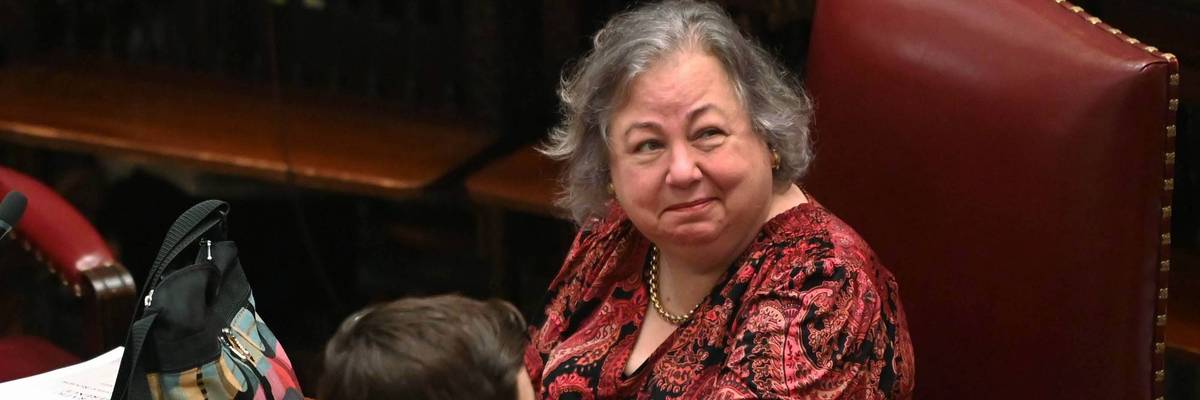
“New Yorkers are suffering from an affordability crisis and a climate crisis, and data centers are going to make both of those much harder to deal with,” said state Sen. Liz Krueger, one of the bill’s sponsors.


New York state Sen. Liz Krueger (D-28) looks to the gallery in the Senate chamber of the Capitol on June 9, 2025, in Albany, New York.
(Lori Van Buren/Albany Times Union via Getty Images)


Stephen Prager
Feb 06, 2026
COMMON DREAMS

In response to rising concerns about the extreme energy demands of artificial intelligence data centers, Democratic legislators in New York are proposing a three-year pause on their creation in the state.

The environmental group Food & Water Watch called the proposal, introduced Friday by state Sen. Liz Krueger (D-28) and Assemblymember Anna Kelles (D-125), the “strongest data center moratorium bill in the country,” the sort that is in increasing demand as the public becomes aware of the staggering energy costs required to power the centers.

Last month, a study by the Union of Concerned Scientists found that US electricity demand could increase by 60% to 80% over the next quarter century, with data centers accounting for more than half the increase by 2030—costing anywhere from $886 billion to $978 billion and pumping anywhere from 19% to 29% more planet-heating carbon dioxide into the atmosphere.

In large part due to data centers, New York’s power grid may fall as much as 1.6 gigawatts short of reliability requirements, according to a projection from the New York Independent System Operator last year.

“Massive data centers are gunning for New York, and right now we are completely unprepared,” Krueger said. When one of these energy-guzzling facilities comes to town, they drive up utility prices and have significant negative impacts on the environment and the community—and they have little to no positive impact on the local economy.

“New Yorkers are suffering from an affordability crisis and a climate crisis, and data centers are going to make both of those much harder to deal with,” she added.

The bill would halt new data center projects exceeding 20 megawatts for three years and require the state to conduct environmental reviews and propose new regulations to address any identified impacts.

“Data centers are being built rapidly and with little meaningful oversight, despite the serious strain they place on our energy system, water resources, and local communities,” explained Assemblymember Jessica González-Rojas (D-34), another supporter of the legislation.

“These facilities increase pollution, drive up electricity costs, and threaten farmland and natural land, while disproportionately impacting low-income communities and Black, Brown, and Indigenous communities that have long faced environmental injustice,” she said.

According to Politico, pushes to curb data center growth are gaining steam around the country:
New York is the largest state where lawmakers have proposed a moratorium on data centers. But concerns about the growing issue are bipartisan, with Republicans and Democrats backing moratoriums in various states.

Similar measures have been introduced in Maryland, Georgia, Oklahoma, Virginia, and Vermont. A Republican legislator in Michigan—where dozens of local governments have already passed moratoriums—has said she’ll introduce a statewide measure there, as well. In Wisconsin, a Democratic gubernatorial candidate has also called for a moratorium.

Eric Weltman, senior New York organizer at Food & Water Watch, said the bill was necessary to curb “one of the biggest environmental and social threats of our generation.”

“This expansion is rapidly increasing demand for dirty energy, straining water resources, and raising electricity rates for families and small businesses,” Weltman said. “New Yorkers are paying the price while Big Tech rakes in the riches. This strongest-in-the-nation moratorium bill is logical, it’s timely, and it will deliver the results we need.”

Yvonne Taylor, vice president of Seneca Lake Guardian, said the bill “not only safeguards our shared future here in New York, but sets a powerful precedent for states across the nation.”
Trump greenlights media merger critics say will have ‘devastating consequences’

Alexander Willis
February 7, 2026 
RAW STORY


U.S. President Donald Trump attends the premiere of the documentary film "Melania" at the John F. Kennedy Center for the Performing Arts, recently renamed to include U.S. President Donald Trump's name, in Washington, D.C., U.S., January 29, 2026. REUTERS/Kevin Lamarque

President Donald Trump gave the greenlight Saturday to the proposed media merger between broadcasters Nexstar and Tegna, a merger that critics warn would have “devastating consequences” for the media landscape.

“We need more competition against THE ENEMY, the Fake News National TV Networks,” Trump wrote Saturday on his social media platform Truth Social.

“Letting Good Deals get done like Nexstar – Tegna will help knock out the Fake News because there will be more competition, and at a higher and more sophisticated level. Those that are opposed don’t fully understand how good the concept of this Deal is for them, but they will in the future. GET THAT DEAL DONE!”

The proposed merger has proved controversial, with Sen. Michael Bennet (D-CO) and Rep. Joe Neguse (D-CO) warning that the deal would “directly” violate federal law by giving the hypothetical merged company a collective reach of around 80% of U.S. households, far above the Federal Communications Commission’s cap of 39%.

Nexstar executives have directly appealed to Trump in their efforts to have the merger approved, even adopting “buzzword language that Trump often uses” in its plea for approval.

“To be clear, in an age of disinformation and political agendas, we are the anti-fake news,” reads Nexstar’s application to the FCC.

“Our news is delivered by trusted, familiar voices – journalists who live in the community – not a chat-bot or social media influencers. And yet, we are prohibited from broadcasting trusted local news and programming to hundreds of communities across the country because of antiquated regulatory constraints.”


‘Industry Cronies’ at Trump’s EPA Reapprove Dangerous Pesticide Dicamba

“It’s hard to see how Making America Healthy Again was anything but another broken campaign promise,” said one critic.


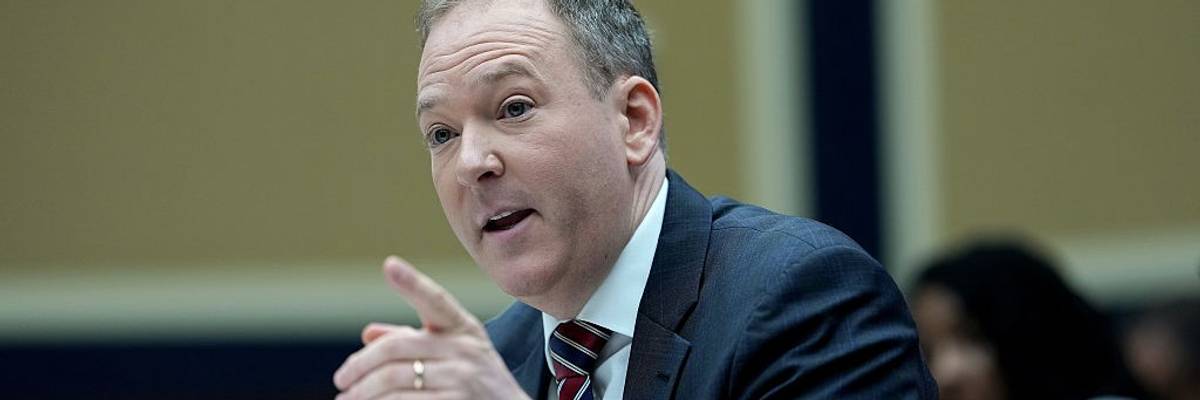
US Environmental Protection Agency (EPA) Administrator Lee Zeldin testifies before Congress on Capitol Hill in Washington, DC on May 20, 2025.
(Photo by Kevin Dietsch/Getty Images)

Brett Wilkins
Feb 06, 2026
COMMON DREAMS


The US Environmental Protection Agency on Friday announced its anticipated reapproval of dicamba for two key crops, a move which, given the pesticide’s proven health risks, places the EPA at apparent odds with President Donald Trump’s vow to “Make America Healthy Again.”

“The industry cronies at the EPA just approved a pesticide that drifts away from application sites for miles and poisons everything it touches,” Nathan Donley, environmental health science director at the Center for Biological Diversity, said in response to Friday’s announcement.

“With the EPA taking aggressive pro-pesticide industry actions like this, it’s hard to see how Making America Healthy Again was anything but another broken campaign promise,” Donley added. “When push comes to shove, this administration is willing to bend over backward to appease the pesticide industry, regardless of the consequences to public health or the environment.”


The EPA said in a statement that the agency “established the strongest protections in agency history for over-the-top (OTT) dicamba application on dicamba-tolerant cotton and soybean crops,” and that “this decision responds directly to the strong advocacy of America’s cotton and soybean farmers.”

While scientific studies have linked exposure to high levels of dicamba to increased risk of cancer and hypothyroidism and the European Union has classified dicamba as a category II suspected endocrine disruptor, the EPA said Friday that “when applied according to the new label instructions,” it “found no unreasonable risk to human health and the environment from OTT dicamba use.”

This is the third time the EPA has approved dicamba for OTT use. On both prior occasions, federal courts blocked the approvals, citing underestimation of the risk of chemical drift that could harm neighboring farms.

The agency highlighted new restrictions on dicamba use it said will reduce risk of drift.

“EPA recognizes that previous drift issues created legitimate concerns, and designed these new label restrictions to directly address them, including cutting the amount of dicamba that can be used annually in half, doubling required safety agents, requiring conservation practices to protect endangered species, and restricting applications during high temperatures when exposure and volatility risks increase,” it said.

Critics noted that the EPA during the Biden administration published a report revealing that during Trump’s first term, senior administration officials intentionally excluded scientific evidence of dicamba-related hazards, including the risk of widespread drift damage, prior to a previous reapproval.

Others pointed to the recent appointment of former American Soybean Associate lobbyist and dicamba advocate Kyle Kunkler as the EPA’s pesticides chief.

“Kunkler works under two former lobbyists for the American Chemistry Council, Nancy Beck and Lynn Dekleva, who are now overseen by a fourth industry lobbyist, Doug Troutman, who was recently confirmed to lead the chemicals office following endorsement by the chemical council,” the Center for Food Safety (CFS) noted Friday.

The Trump EPA has also come under fire for promoting the alleged safety of atrazine, a herbicide that the World Health Organization says probably causes cancer, and for pushing the US Supreme Court to shield Bayer, which makes the likely carcinogenic weedkiller Roundup, from thousands of lawsuits.

CFS science director Bill Freese said that “the Trump administration’s hostility to farmers and rural America knows no bounds.”

“Dicamba drift damage threatens farmers’ livelihoods and tears apart rural communities,” Freese added. “And these are farmers and communities already reeling from Trump’s [Immigration and Customs Enforcement] raids on farmworkers, the trade war shutdown of soybean exports to China, and Trump’s bailout of Argentina, whose farmers are selling soybeans to the Chinese—soybeans China used to buy from American growers.”
As Amazon Sees Record Profits, Customers Say ‘Start Delivering Climate Action’

“Amazon has an extraordinary opportunity and an obligation to act more swiftly on climate change,” one member of Prime Members for a Cleaner Amazon said.


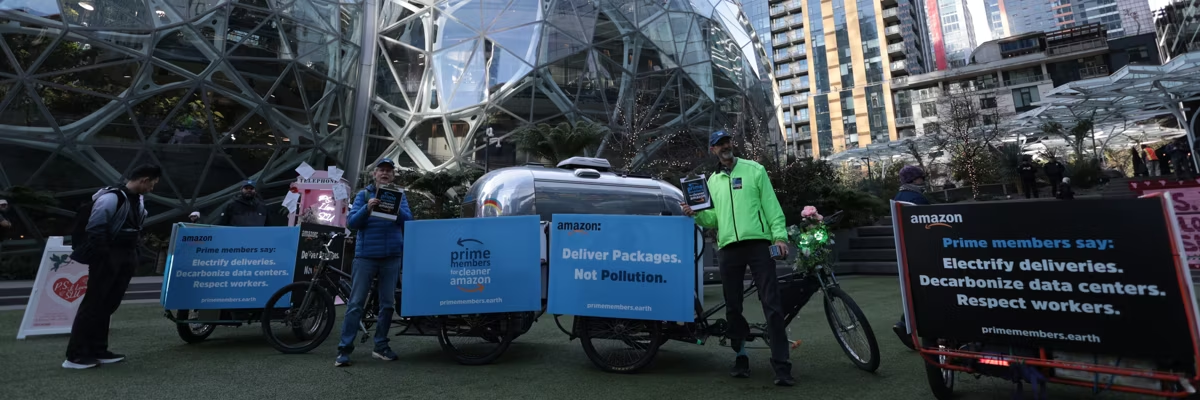
Prime Members for a Cleaner Amazon protest outside Amazon headquarters in Seattle, Washington on February 6, 2026.
(Photo by Aaron Taylor)

Olivia Rosane
Feb 06, 2026
COMMON DREAMS

Friday, the day after Amazon revealed record 2025 profits, 10 members of Prime Members for a Cleaner Amazon staged a pedicab protest in front of its Seattle headquarters, calling on the company to raise its climate ambition to the level of its earnings.

In its fourth quarter report, released Thursday, the tech giant announced that its 2025 income had soared to $77.7 billion, up from $59.2 billion in 2024.


Trump-GOP Law Slashes Amazon’s Tax Bill by 87% as Company Fires 30,000 Workers, Profits Soar

“Amazon has an extraordinary opportunity and an obligation to act more swiftly on climate change,” participant Michael Lazarus told Common Dreams. “It’s a leading provider of consumer goods to consumers who want climate action. It has made broad pledges to take action on climate change, it has made some small steps, but it needs to deliver on immediate action.”

Concerned customers are demanding the company put some of those profits toward speeding up the electrification of its delivery fleet, powering its data centers with renewable energy, and improving working conditions for its employees while respecting their collective bargaining rights. A Morning Consult poll found that 80% of Prime members surveyed wanted the company to reduce its transport and delivery emissions, and 75% would accept slower delivery times in exchange for less climate pollution.

“Profits are up. So is pollution. Prime members say: Deliver more climate action.”

“Amazon’s success is built on us, its customers. Now, we’re asking the company to stop celebrating profits and start delivering climate action,” said Dr. Chris Covert-Bowlds, a Seattle-based member of Prime Members for a Cleaner Amazon and Washington Physicians for Social Responsibility.

The protest took place outside Amazon’s Day 1 building, where CEO Andy Jassy has his office, from around 8:00 am to 10:30 am Pacific time. Participants rode four pedicabs as a subtle suggestion to the company of how to move goods without fossil fuels. The cabs were decorated with billboards with messages such as, “Deliver packages. Not pollution,” and “Profits are up. So is pollution. Prime members say: Deliver more climate action.”

Participants also handed out hundreds of stickers and flyers to Seattle residents and Amazon employees.

Amazon has a history of making sustainability promises it does not keep and retaliating against employees who call it to account. While it has pledged to reach carbon neutrality across its operations by 2040, it is increasingly unclear how it will achieve this given its buildout of energy-intensive data centers and artificial intelligence.

“We’ve been calling attention to Amazon’s failure to align its emissions reductions with the latest climate science for years,” Stand.earth campaigner Joshua Archer told Common Dreams.

However, he said what “makes this moment really unique” is that Amazon is now failing three distinct groups of people: consumers like those at the protest who want it to do better on climate, investors who are concerned about returns from the AI buildout, and the 30,000 employees it laid off since October despite its record profits.

“The company is not respecting the employees on whose backs the company has built its success” just as it’s “not respecting the latest climate science,” Archer said.

Lazarus said that many employees expressed interest in the protesters’ demands. While some zipped past in headphones, others “lit up and were clearly engaged and simpatico.”

He noted that Amazon employees have been organizing for years to pressure the company to increase its climate ambitions through Amazon Employees for Climate Justice, and hoped the addition of consumer advocacy would help “Amazon realize that there’s a groundswell of support for taking more aggressive measures to reduce their climate impact... which is becoming quite monumental given the growth in data cents and the influence that they carry.”

Lazarus told Common Dreams it was also important to him that Amazon ramp up its climate ambitions given President Donald Trump’s determination to double down on fossil fuels and inhibit renewable energy.

“We know that we’re not going to see much climate action at the federal level,” he said. “It becomes all the more important for corporate actors like Amazon to demonstrate that it remains committed to and acts upon its need to reduce emissions.”