Wednesday, October 08, 2025

USA

Is Trump Preparing a Military Coup?

Monday 6 October 2025, by Dan La Botz


The current debate in much of American society is about whether or not President Donald Trump is preparing a coup. It’s everywhere, from popular TV talk shows to sophisticated political journals.


Bill Maher, the liberal host of Real Time, a talk show where he satirizes current events, a show with half a million viewers, said that the Trump government was getting Americans used to seeing a masked police force, people snatched off the streets, and troops in the streets of Washington, D.C., He described it as a “slow moving coup” and suggested that even if Democrats won the 2026 elections, they might not be able take office, comments widely reported in the national news media. The liberal journal Foreign Policy asked, “Is Trump executing a self-coup?” and provided evidence that indeed he appeared to be doing just that. Already back in February, The Guardian ran an editorial titled, “Donald Trump’s power grab: a coup veiled by chaos.”

Today evidence that Trump may try to carry out a military coup is piling up. Trump is going to war—with Americans. He has mobilized the National Guard to patrol Los Angeles and Washington, D.C. and also sent 700 marines to L.A. He now plans to call out the guard in Chicago, though both Illinois governor J.B. Pritzker and Chicago mayor Brandon Johnson say the guard it not needed. Trump was planning to send troops to Portland, Oregon, saying “it looks like a war zone,” but a federal judge has at least temporarily blocked those plans, saying protests there were small, not particularly violent and that there was no danger of rebellion.

Trump uses protests against Immigration and Customs Enforcement (ICE) to justify dispatching he guard or soldiers. It is estimated that there are fourteen million undocumented immigrants in the United States, and they now live in a police state. For them a coup has already occurred. The 5,600 armed and masked agents operating throughout the country, now detain about 60,000 people a day. Some 400,000 immigrants were removed or, under government pressure, self-deported in September. Congress this summer voted for $76.5 billion in new money for ICE which is hiring 10,000 new deportation agents.

Trump knows that in Democratic states, ICE’s arrests in fields, factories, and schools will provoke protests, and then he uses those protests to justify sending in the National Guard or troops.

Trump is now also going after the “enemy within,” that is, his political opponents. In a presidential memorandum on September 25 titled “Countering Domestic Terrorism and Political Violence,” Trump responded to the accusation that he was a fascist saying, “This ‘anti-fascist’ lie has become the organizing rallying cry used by domestic terrorists to wage a violent assault against democratic institutions, constitutional rights, and fundamental American liberties. Common threads animating this violent conduct include anti-Americanism, anti-capitalism, and anti-Christianity; support for the overthrow of the United States Government; extremism on migration, race, and gender; and hostility towards those who hold traditional American views on family, religion, and morality.”

In his remarks to an unprecedented gathering of 800 U.S. generals and admirals called to a special meeting on October 1, he said that the cities run by the radical left Democrats—San Francisco, Chicago, New York, Los Angeles—were “very unsafe places, and we’re going to straighten them out one by one. And this is going to be a major part for some of the people in this room. That’s a war too. It’s a war from within.” He said, “we should use some of these dangerous cities as training grounds for our military, National Guard, but military, because we’re going into Chicago very soon.”

So, it looks like we may face a coup, but if we do, many cities and states and millions of people will resist.

5 October 2025


Attached documentsis-trump-preparing-a-military-coup_a9203.pdf (PDF - 905.2 KiB)
Extraction PDF [->article9203]


Dan La Botz was a founding member of Teamsters for a Democratic Union (TDU). He is the author of Rank-and-File Rebellion: Teamsters for a Democratic Union (1991). He is also a co-editor of New Politics and editor of Mexican Labor News and Analysis.


International Viewpoint is published under the responsibility of the Bureau of the Fourth International. Signed articles do not necessarily reflect editorial policy. Articles can be reprinted with acknowledgement, and a live link if possible.

‘Azad’ Kashmir’s unheard rebellion: Voices from the people’s struggle


First published at Alternative Viewpoint.

Over the past month, Pakistan-Administered Jammu and Kashmir (PAJK) have experienced one of the most significant waves of mass mobilisation in recent years. Triggered by rising electricity tariffs, increased taxation, and widespread economic hardship, the protests, which are led by the Joint Awami Action Committee (JAAC), have evolved into a broader movement advocating for social and economic justice through a 38-point Charter of Demands. The demonstrations have attracted participation from workers, students, traders, and ordinary citizens across the region, highlighting a pervasive discontent with systemic neglect and inequality.

In this interview, Alternative Viewpoint speaks to grassroots activist Haris Qadeer, involved in the ongoing struggle. The discussion explores the political content of the demands, the state’s response, the composition of the movement, and the evolving role of the left in shaping its direction. The conversation also reflects on the resonance of regional and global protest waves—from South Asia to the Middle East and beyond — that have challenged neoliberal austerity and state repression.

The movement in PAJK serves as a powerful reminder that, even in the most militarised and marginalised regions, popular resistance can emerge with striking clarity and determination. 

Alternative Viewpoint : How is the current struggle related to earlier protest movements in Pakistan-administered Jammu Kashmir?

Haris Qadeer : Pakistan-Administered Jammu Kashmir (PAJK) is divided into two primary regions, each governed by distinct administrative structures, yet ultimately under the authority of Pakistan’s federal government. One of these regions is Gilgit-Baltistan, which has been designated as a semi-provincial entity through a presidential order. Historically, this area was administered under colonial-era laws, including the Frontier Crimes Regulation (FCR). The other region comprises the districts of Jammu Kashmir, historically shaped by the former princely state of Poonch and the Kashmir Valley. With its president, prime minister, supreme court, and various state institutions, this region functions as an independent state. Senior officials from Pakistan, along with the Ministry of Kashmir Affairs and Gilgit-Baltistan, effectively oversee both regions.

In the areas under the state government of PAJK, a tradition of struggle and protest dates back to 1932. Initially, the region witnessed the movement for the autonomy of the former Poonch state. Later, in the 1940s, when the sub-state of Poonch was brought directly under the control of the Maharaja of Jammu Kashmir and discriminatory taxes were imposed, a popular movement arose against the Maharaja’s autocratic rule and oppressive taxation. Even before the Indian subcontinent’s partition in 1947, this movement took a violent turn and transformed into an armed rebellion.

After Partition, the armed uprising in Poonch succeeded in gaining control over much of the region. Simultaneously, the newly established Pakistani state dispatched tribal militias from Muzaffarabad towards the state capital, Srinagar, with the aim of capturing the city. These militias advanced through Muzaffarabad, reaching Baramulla and the outskirts of Srinagar. Meanwhile, Maharaja Hari Singh of Jammu and Kashmir, along with the newly independent Indian leadership, began to move towards formal accession to India. The tribal invasion, alongside the indigenous revolt in Poonch, provided a pretext for the deployment of Indian troops and the signing of the Instrument of Accession.

The rebels of Poonch established a provisional government that was a democratic, representative, secular, and independent entity for the people of Jammu and Kashmir. The founding declaration also stated that a plebiscite would determine the political future of Jammu and Kashmir after its complete liberation.

With the arrival of Indian troops in Kashmir, Pakistan’s regular army subsequently entered the conflict to support the tribal forces. This escalation led to the Indo-Pakistani War, which, following a ceasefire, resulted in the permanent division of Jammu and Kashmir into two distinct parts.

This historical background shows that movements in this region are not new. The struggles have not only been directed against the autocratic rule of the Maharaja of Jammu Kashmir but also later against Pakistan’s control over the region. Once the government’s autonomy was undermined, and decision-making shifted to the central government in Pakistan, often exercised through migrant Kashmiri leadership settled in Pakistan, another rebellion broke out in Poonch in May-June 1950. A parallel government was established; afterwards Pakistani troops were sent to suppress it but failed spectacularly, and local rebels disarmed and captured the soldiers. The three-year-long uprising ended only after the government promised to form an election commission and hold representative elections, a promise that was never fulfilled.

In 1955, another rebellion broke out in Palandri (Poonch). This time, the Punjab Constabulary was deployed to crush it. An agreement known as the Baral Accord restored peace after two years of intense conflict and heavy sacrifices.

Subsequently, the local ruling elite crafted an official narrative portraying the region as the “base camp” for the liberation of Indian-administered Jammu Kashmir (IAJK). This pretext replaced the struggle for control over local resources, political autonomy, and fiscal rights with the rhetoric of liberating IAJK. However, the idea of establishing a united, independent Jammu Kashmir, an unfinished mission since 1947, remained deeply rooted within the popular consciousness.

At the local level, struggles for basic rights and autonomy persisted. While the movement for total national liberation remained prominent, the abrogation of Article 370 by India on 5 August 2019 prompted both progressive and nationalist leaders to shift their focus towards securing self-rule within PAJK as a means of furthering the broader freedom struggle. The ineffectiveness of depending on imperialist powers and institutions, such as the UN and the US, became increasingly apparent, especially following the meetings between Modi, Trump, and Imran Khan in 2019, which coincided with India’s decision to revoke Kashmir’s special status.

A segment of the Left has long sought to organise the national liberation struggle along class lines, despite facing criticism from nationalist circles. Nationalists frequently dismissed efforts to address fundamental issues such as the rising prices of basic goods, power load-shedding, and unjust taxes as mere distractions. However, a significant shift began to occur after 2019. Class-based struggles gained momentum, leading to the formation of Action Committees and United Fronts.

After the pandemic, this trajectory gradually converged into a more organised framework under the “Awami Huqooq Tehreek” (People’s Rights Movement), which was centred around a charter of demands. Launched in August 2022, the movement entered a new phase on May 9, 2023. Through long sit-ins, demonstrations, shutter-downs, and wheel-jam strikes, it eventually grew into a statewide movement by September 2023. A 30-member Joint Awami Action Committee (JAAC) was formed as the central leadership, followed by the establishment of local-level action committees across the district level or even at the ward level.

The movement’s central demands were to gain control over locally generated hydroelectric resources, ensure access to hydropower at production cost, and abolish unjust taxation. Additional significant demands included the restoration of wheat subsidies and the removal of privileges held by the ruling elite. The Charter of Demands sought to progressively move towards sovereignty and resource ownership, aiming to rebuild the national liberation movement along class lines.

The forces of the left began to intervene in these movements, while reactionary right-wing forces and state interference intensified. The ad hoc central leadership of the movement largely consisted of second-tier nationalists and representatives of local small-scale trader associations, who found it challenging to grasp the full depth and radical potential of the movement. The right-wing leadership worked in collaboration with the state, aiming to dilute its anti-colonial character. Consequently, the leadership sought to uphold the movement’s “apolitical” stance, implementing standard operating procedures to restrict ideological debate and even discouraging all forms of criticism, including that aimed at colonial structures.

As a result, the movement has now divided into two distinct trajectories; essentially, we can identify a sub-movement within the larger movement. In summary, the current struggle not only continues the legacy of prior movements but also surpasses the articulated charter and limited demands set by its leadership, indicating a more profound and radical evolution of political consciousness in the region.

What are the main demands in the 38-point Charter of Demands?

On September 29, 2025, the movement entered its second or third phase, marked by lockdowns, mass protests, and long marches aimed at addressing the 38-point Charter of Demands.

In May 2024, following a lengthy march, the government agreed to set the electricity price between Rs. 3 and Rs. 6 per unit and to reduce the price of flour by Rs. 1,000 per 40 kg bag. However, other agreed-upon demands were not implemented. A subsequent agreement in December 2024 also went unfulfilled. After the deadline for this agreement expired, a significant public meeting held in Muzaffarabad in May 2025 led to the expansion of the Charter to include new demands such as:

  • Abolition of the 12 legislative seats reserved for Kashmiri refugees settled in Pakistan.
  • Abolition of the 19% job quota reserved for these refugees.
  • Free education and healthcare for all citizens.
  • Ending privileges and perks for the ruling elite.
  • New agreements on hydropower projects with the Muzaffarabad government.
  • Transparency in governance and eradication of corruption.
  • Restoration of student unions.
  • Empowerment of local governments.
  • Construction of tunnels, bridges, and roads to improve transport and connectivity.

While the public narrative highlighted that the movement sought to dismantle the colonial order and reclaim the region’s rights to self-governance, the Charter of Demands did not specifically articulate a direct appeal for decolonisation or sovereignty.

Could you elaborate on the nature of the current struggle? What is the current situation? Have there been any incidents involving arrests, violence, or intimidation?

I believe that in recent days, some truly extraordinary events have unfolded in this region — events that, in terms of popular participation and political maturity, may even surpass the recent significant upheavals in Nepal, Bangladesh, and Sri Lanka. For instance, in all ten districts of Jammu Kashmir under Pakistani administration, hundreds of thousands of people have taken to the streets. For five consecutive days, daily life was effectively brought to a standstill; individuals refrained from driving vehicles, businesses across all towns and cities remained closed, and massive demonstrations were held in numerous locations.

Pakistan deployed a significant number of police and paramilitary forces to suppress the protests. To halt the long march, security forces resorted to repression and violence. Nevertheless, the protesters managed to overcome the security forces, compelling them to lay down their weapons. Following their surrender, the protesters ensured the safe return of the subdued forces. Under the direction of the state, thugs affiliated with the ruling party, operating under police supervision, launched an armed attack on demonstrators in Muzaffarabad, disguised as a “peace march”. The gunfire from these armed individuals led to the death of one young man and injuries to dozens of others. Despite this violence, the protesters maintained their focus on the demonstrations and refrained from engaging in vandalism or rioting.

Only one significant incident throughout these five days could be characterised as violent: in Dhirkot, a suburb of the Bagh district that connects Poonch and Muzaffarabad, police opened fire and shelled the protesters who were trying to advance. This confrontation resulted in five fatalities and over 150 serious injuries, primarily among police personnel. Additionally, police vehicles were set ablaze at the scene.

Overall, during those five days, there were ten fatalities and over 300 injuries. Despite this, the protests did not escalate into a violent movement. Thousands of demonstrators gathered at the entrance to Muzaffarabad, the capital, and held a sit-in that persisted until October 4, when the leadership of the Joint Action Committee (JACC) declared that their demands had been met.

At its core, this movement is anti-colonial and anti-neoliberal, deeply rooted in the grassroots of society. However, the leadership appears to lack full awareness of this character. Similar to traditional trade-union leadership, they often settle for partial concessions after each round of struggle, merely preparing for the next phase, without fully recognising the broader transformative potential of the movement.

Which social groups, such as workers, students, women, peasants, and unemployed youth, are most actively participating in the protests? Additionally, how has the government responded to the ongoing struggle?

To comprehend the situation, it is essential to examine the demographic and economic makeup of the region. Generally, this movement has engaged various segments of society. The area functions predominantly as a consumer society, heavily reliant on remittances sent by migrant workers residing in Europe, America, Africa, and the Middle East. Of the total population, which stands at 4.5 million, approximately 1.5 to 1.8 million are migrant workers abroad. The government employs approximately 100,000 individuals. The peasantry is notably sparse, and the lack of factories and industries means there’s no organised working class in the region. The private sector employs about 300,000 people across small businesses, banks, private schools, and hospitals, frequently paying wages that fall significantly below the legal minimum. Furthermore, both public and private sector employees are prohibited from forming trade unions.

Because of these conditions and the dependence on remittances, a petty-bourgeois or middle-class psychology dominates the society. Consequently, the movement’s nature is popular rather than class-based. Participation from rural areas has been particularly strong. Many participants are unemployed youth, who, because of remittances from family members abroad, can afford to engage full-time in political activities. Thus, a large number of students and young people have taken part in this movement.

Due to the persistence of patriarchal and tribal attitudes, women’s participation in the movement has been limited. Despite their high education levels, women primarily organised separate demonstrations during the early stages. However, on social media, they have played an active and vocal role in shaping the movement’s discourse. In physical protests, their participation has remained minimal; nonetheless, we witnessed unprecedented involvement from women in providing food and other supplies along the route of the long march, along with their crucial solidarity.

The government has taken extensive measures to suppress the movement, with over 500 legal cases filed against activists. The substantial involvement of Pakistan’s intelligence agencies has shaped much of the state’s response. Additionally, a systematic campaign of propaganda and psychological manipulation is currently in progress. It appears that the leadership has been pressured to isolate left-wing and nationalist forces from active participation in the struggle, a tactic aimed at undermining the movement’s anti-colonial character.

Could you provide a brief description of the Jammu Kashmir Joint Awami Action Committee (JAAC) and its activities?

The Jammu Kashmir Joint Awami Action Committee (JAAC) serves as the central coordinating body of the movement. Comprising 30 members, it includes three representatives from each of the ten districts. The committee’s primary activities focus on organising small-scale grassroots conferences at both the village and local levels. More than 200 conferences have taken place over the past two years, drawing thousands of participants. In addition to numerous smaller demonstrations, shutdowns, and wheel-jam strikes throughout the region, the JAAC has initiated three major mass protests to date.

Why are there protests regarding the reserved seats for refugees?

The Legislative Assembly of Pakistan-administered Jammu Kashmir comprises 53 seats, of which 12 are allocated for refugees from Jammu Kashmir who migrated to Pakistan during the 1947 conflict and are now settled across various provinces. The Government of Pakistan oversees the elections for these seats, which represent approximately 450,000 registered voters. Additionally, the government allocates 19% of its job positions for these refugees.

The protests arise for several reasons:

  1. Pakistan uses these reserved seats to reinforce its colonial control over the Muzaffarabad government. Through these assembly members, the Government of Pakistan can easily engineer internal changes, forming or toppling governments at will, a practice that has occurred repeatedly in the past.
  2. The Karachi Agreement of 28 April 1949, signed between the Government of Pakistan and the Government of PAJK (Muzaffarabad), delineated the limits of the latter’s powers. Under this agreement, Pakistan retained authority over the administration of refugee rehabilitation and Gilgit Baltistan.
  3. The refugees were subsequently granted Pakistani citizenship and allocated lands within the country. They also pay taxes in various Pakistani provinces and benefit from representation in Pakistan’s own political institutions.

The protesters contend that assembly members, who do not contribute taxes to the Muzaffarabad government and operate outside its constitutional jurisdiction, lack the authority to legislate for the region. Consequently, the laws they enact do not apply to them.

Additionally, the 19% job quota allocated for these refugees is perceived as a direct infringement on local rights because it favours individuals who are neither residents nor taxpayers of the region. Protesters argue that this arrangement exemplifies the ongoing colonial subjugation disguised as a democratic process.

Could you tell us about the role of the Left in the current struggle?

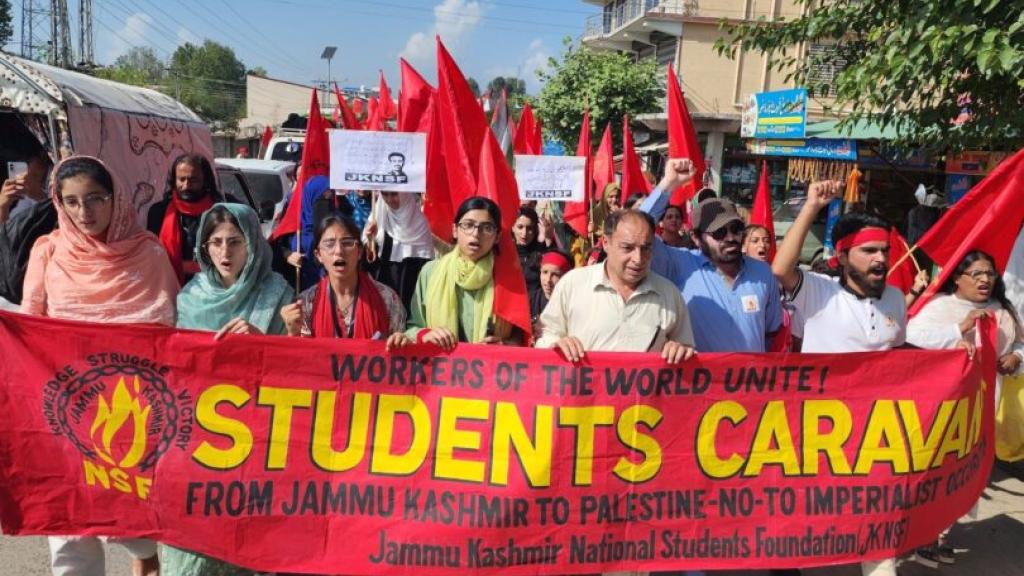
The Left was the original initiator of this movement, but it currently exhibits fragmentation and fragility. A significant faction, the Stalinist nationalist Left, continues to extol the monarchical rule of the Maharaja. Additionally, there exists a small, opportunistic segment of the Left that entirely dismisses the national question. The Jammu Kashmir National Students Federation (JKNSF), the region’s first left-wing student organisation, along with a group of leftist activists who emerged from it, played a pivotal role in establishing the movement’s foundations. Despite this, the central leadership features only one member from the Left within JAAC, although numerous militant left-wing activists have garnered considerable popularity at the local level across various districts and areas.

Due to state pressure, the central government has been hesitant to adopt a left-wing programme. Nevertheless, leftist ideas continue to resonate strongly with the masses, particularly the demands for the establishment of a Constituent Assembly, the recognition of collective ownership of natural resources, the withdrawal of Pakistan’s lent officers, and the dismantling of the colonial structure reinforced by the 1974 Act and the Interim Constitution.

Do you observe any influence from the regional and global protests in this struggle?

Absolutely, regional and global protest movements have profoundly influenced this uprising. Among the most prominent slogans are calls for revolution and freedom. The events in Sri Lanka and the ongoing movements in the peripheries of Pakistan have shaped the current situation. Most recently, the wave of protests in Nepal significantly impacted events occurring between September 29 and October 4. Inspired by Nepal’s movement, people participated on a much larger scale than before, standing resolutely in the face of state repression and a barrage of gunfire.

What potential outcomes do you foresee arising from this movement? What long-term political impact might it have on PAJK?

This movement has fundamentally raised significant questions regarding the colonial structure of governance. It now appears increasingly unlikely that Pakistan’s state institutions will be able to sustain the region’s existing constitutional, political, and financial framework. The movement has profoundly shaken the status quo, leading to a loss of credibility for traditional political parties, particularly the local branches of Pakistani parties. Current and former members of the legislative assembly have become symbols of public disdain and contempt.

Even if this movement does not progress further, stabilising the existing political structure will prove extremely challenging. However, it is inevitable that the movement will persist, as genuine advancement cannot occur without dismantling the colonial framework.

How do you perceive the role of solidarity from Pakistan, India, and international groups? What are your expectations of them?

This region of Jammu Kashmir is situated on the periphery of Pakistan and remains a crucial part of the broader, unresolved question surrounding Kashmir’s political future. Despite the movement’s vibrancy, its ultimate success or a transition towards the abolition of the capitalist system relies heavily on the mobilisation of the working class and oppressed nationalities, particularly within Pakistan and the wider South Asian context. Consequently, solidarity from left-wing forces and the vanguard elements of the working class in both Pakistan and India, as well as the surrounding region, is of paramount importance.

Globally, solidarity from leftist movements, the international working class, and anti-colonial struggles is essential. To end colonial domination and neoliberal imperialist policies, it is crucial to defeat the capitalist system itself. The liberation of Jammu Kashmir remains unattainable as long as the capitalist states of Pakistan and India exist in their current forms; similarly, the liberation of other oppressed nationalities across the subcontinent cannot be realised within these confines. The dismantling of this artificial partition of the subcontinent, alongside the creation of a voluntary socialist federation of independent nations, represents the only viable path to ending national oppression and colonial exploitation, thereby enabling the construction of a truly humane society.

This struggle cannot succeed in isolation or through fragmented efforts. We must not only hope for solidarity; we must actively work towards building alternative revolutionary forces. A significant weakness evident in the current movements across the region is a lack of organised revolutionary leadership grounded in scientific socialist principles. Consequently, it is the historic responsibility of revolutionaries in this region to accelerate the establishment of such leadership, connect the ongoing struggles, dismantle every chain of capitalist oppression, and pave the way for a brighter future for humanity.

India: Rajnath Singh faces Australia test as far right hold protests against diaspora


March for Australia

First published at The Wire.

As Union defence minister Rajnath Singh will soon visit Australia to sign crucial defence deals, the Indian immigrants down under will expect him to engage the Australian government on the growing social antipathy against them.

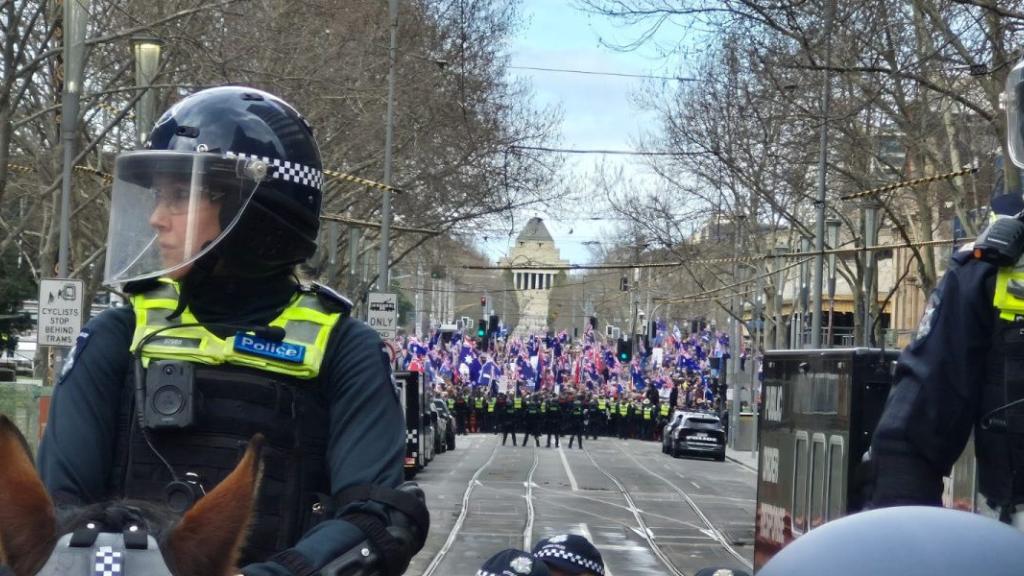
Indian-born migrants have become the latest sticking point between the far-right and anti-fascist forces of Australia. On August 31, four major cities of Australia — Melbourne, Sydney, Brisbane and Adelaide — and some other towns witnessed far-right parties’ rallying against Indian immigrants in what was their biggest-ever mobilisation. These rallies specifically targeted Indian migrants, the second-largest immigrant community in Australia after the British. According to a 2023 estimate by the Department of Home Affairs in Australia, there are 8,45,800 Indian-born migrants in the country.

Far-right parties accused the Indian community of taking over Australia and are blaming them for the housing crisis. These rallies found an unnatural supporter in Liberal Party senator, Jacinta Nampijinpa Price, who went a step further to accuse the Labour government of allowing more Indians into the country because they form a part of its vote bank. Although the Liberal Party has been attempting damage control after Price’s dog-whistling, the message is out.

Indians are likely to become the central reference point in anti-immigration politics in Australia now.

Why have Indians taken precedence in far-right politics?

Unlike in countries such as Canada, the US, and the UK, the Indian diaspora’s participation in Australian politics has been elusive. They have supported both the Liberals and Labour at different times but have not developed direct representational politics in the country. Many first-generation Indians kept their heads down, worked hard, and focused on securing dignity and a better life. However, the changing dynamics of immigration rules in the UK, Europe, Canada, and now the US are closing doors for Indian aspirations abroad, leaving Australia, New Zealand, and a few other countries as the remaining options for migration.

The far right is second guessing this trend. As they are organised, well-funded, and with control over both traditional and new media, they are able to monopolise narratives. Considering their influence in other countries and governments, it was only a matter of time before their exclusionary political rhetoric entered Australia. Similarly, US President Donald Trump’s imposition of tariffs across the world, along with responses from global actors, has given the far right renewed support and energy.

A decade ago, Indians constituted around 378,480 of the population in Australia. Today, the community has doubled in numbers, indicating how Australia has turned out to be a priority destination for them. A look at a few statistics for 2023–24 gives a significant picture for this trend. Over 287,000 temporary visas for Indians in the visitor category were issued by the Australian government in 2023-24. Similarly, student visas stood at 50,516, and Temporary Resident (Skilled Employment) visas at 18,397 for the same year. The total temporary visas under all categories for this year stood at 413,162, making it the second highest number of visas issued to Indians after 2022-23, the year after Covid-19 pandemic when 584, 487 Indians were granted entry.

New South Wales, Victoria and Queensland were the most favoured by Indians in Australia, with these three provinces making up to nearly 70% of student grants and temporary visas grants. The pattern of migration to Australia from India has been through the university route. Indians come to study professional courses like engineering, then take up a job and upon completion of minimum required time apply for Permanent Resident (PR) status and then go on to become Australian citizens.

As a population that has come to earn a dignified living and with families back home waiting for the remittances, the first generation Indians remained consciously aloof from the political conversations and trends in Australia. This made them a silent vote or an invisible diaspora compared to others. However, this is changing; the second generation of the diaspora — the younger generation of Indian immigrants — who are citizens of Australia see things differently.

The questions of racism and equality and their role in Australian politics is not a no-go zone anymore. Be it their participation in continuing protests for Palestine in major cities of Australia or the debates of First Nation people, Indian-origin naturalised citizens have been articulating their concerns.

A small but committed group of young people from the Indian diaspora — who are both young and old — is increasing. The domestic politics of India also has impacted the diaspora in Australia, with organisations belonging to the Sangh parivar actively working to take forward their vision of India. This too is making this small but vocal section of Indian diaspora noticeable.

The early immigrants ended up taking up blue collar jobs but recent ones have filled many jobs in the IT sector, which in turn has facilitated their progress in the Australian society and making them one of the biggest consumers in the housing market.

The nature of immigration policy of Australia has given immigrants, especially Indians, an incentive to reside in regional centers and such suburbs that a decade and two before had no development. The general practice of saving money and working extra jobs to find a dignified place has also made Indians’ position in Australia better than before.

Two critical issues have hit the Australian public the most. One, the prices of decent homes hitting record numbers in the country and literally no public housing available, common working class Australians are feeling the pain of being unable to earn a house. Secondly, with greater automation and technologification of the economy, job opportunities for common people are on the decline. This, coupled with the perception of growing numbers of immigrants and the visibility of Indians who now own small businesses, work better jobs and claim political space among Australian parties — the Liberals and Labour — has given the far right the opportunity to pick the Indian immigrant community as a visible target.

The current Labour government has been quick to condemn the attacks on Indians and has called the far right for spreading hate and division in society. Minister of Home Affairs, Tony Burke and Minister of Multicultural Affairs, Anne Aly speaking to various media outlets in India condemned the hate campaign and reiterated that Australia stands for plurality. The Liberals who found a loyal vote bank in the Indian diaspora are in a fix as a section of their traditional voter base is finding resonance with the narratives of far right.

The growing housing crisis in Australia is giving the far right an opportunity to frame a real concern not as a corollary of a failing welfarist model and steep decline in government spending but as a problem of immigrants. Similar crises in capitalist economies are creating platforms for far right parties to shift the blame on immigrants rather than allowing the society to question and seek changes in the system.

The anti-immigrant narrative, however, is not going unchallenged. On September 13, anti-fascist groups organised rallies in response to far-right mobilisations against immigrants in Melbourne and other places in Australia. Thousands of people including the people of the first nation (indigenous people) marched together condemning hate and racism.

New Delhi, too, has formally shown its concerns over the recent anti-immigrant political upsurge in Australia. After the August 31 anti-immigrant protests in Australia, the Ministry of External Affairs (MEA) in India said it was in touch with the Australian government and the Indian community over the rallies, where Indians were reportedly singled out. The MEA told reporters at the weekly media briefing on September 5 that India’s high commission had conveyed community concerns to Canberra, which acknowledged the demonstrations “may be of concern for Australia’s diverse communities”.

MEA spokesperson Randhir Jaiswal noted that Australian leaders from both the government and opposition reaffirmed the country’s multicultural character and praised the Indian-Australian community’s contributions. He said India remains committed to protecting its citizens abroad and continues to engage closely with Australian authorities and diaspora groups.

Such concerted pushback, with the Australian government’s own recent statements that records its aim to curb anti-immigrant narratives, the far right takeover over Australian politics doesn’t seem easy.

However, considering how the far right is organised, funded and united not just in Australia but world over, the threat to multiculturalism and humanity is real. In such circumstances, the big question is will Singh, who is part of a political party with a conspicuously similar anti-immigrant political approach in India, actively intervene to assure some diplomatic security to the Indian community in Australia?

N. Sai Balaji is a former president of the Jawaharlal Nehru University Students’ Union (JNUSU).


Seeds of Catholic Totalitarian Rule Against Pagans


Catholic Hysteria Against Pagans

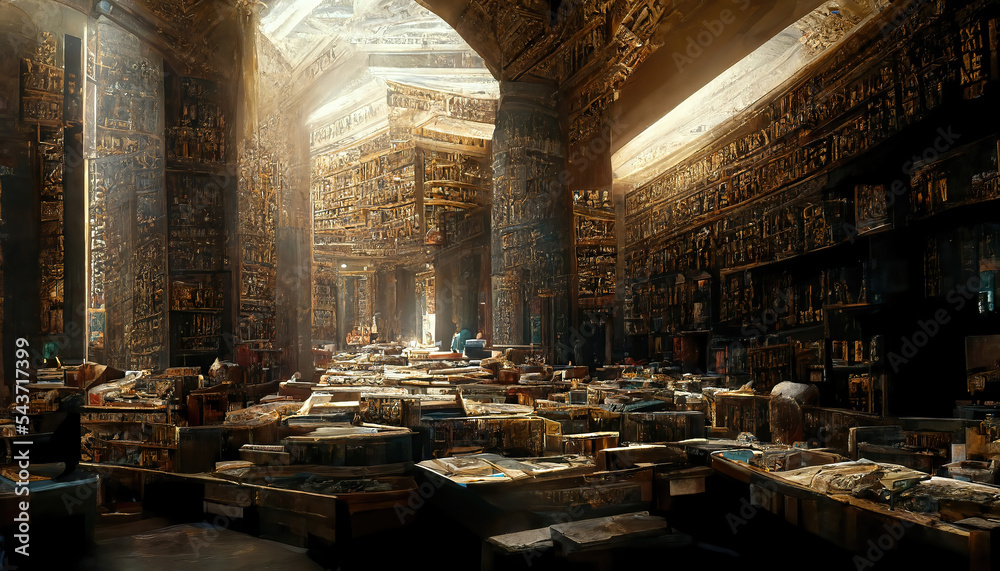
 What is wrong with a sacred tradition that attempts to predict the future? What dangers lurk for those who host feasts are not under Church approved? What is wrong with making images of gods and goddesses? What will happen to you? Why not use chemical hallucinogens to heal and create altered states? Why is it so terrible to leave food and clothing for those who died in case they need them? Why not plot and scheme with elves, dwarfs, giants and trolls? Why must there be only one soul and not two or three? These beliefs and practices were so dangerous that the Catholic Church saw fit to smash images, burn down libraries, and torch forests to keep people from practicing these things? In my article, I link the reactions of the Catholic Church to totalitarian practices centuries before what anti-communists accuse Stalin of. In spite of centuries of effort, pagan practices persisted through the Middle Ages. What was it that a pagan life continued to offer people that the Catholic Church could not destroy? The image of the Alexandrian library before it was destroyed by Christian mobs.

The characteristics of totalitarianism
In my last article, “Dancing with the Devil,” I briefly defined totalitarianism as a loaded political vice word that the CIA saved mostly for the Communism of the Soviet Union and fascism in Germany. Usually the charge of “totalitarianism” includes at least the following:

  • abolition of the right to freedom of speech, assembly and religious worship
  • elimination of all political parties other than the ruling party;
  • subordination of all economic and social life to structural control of the single party bureaucracy;
  • liquidation of free enterprise;
  • destruction of all independent trade unions and creation of labor organizations servile to the totalitarian state;
  • establishment of concentration camps and the use of slave labor;
  • utter disregard for an independent judicial system;
  • social demagogy around race and class;
  • expansion of the military;
  • reduction of parliamentary bodies to rubber-stamp status;
  • establishment of a system of nationwide espionage and secret police;
  • censorship of the press and media;
  • disregard for the rights of other nations and disregard of treaties; and
  • maintenance and encouragement of fifth columns abroad

Claim of the article: The manner in which the Catholic Church treated pagans have totalitarian seeds
In my last article, I argued that the charges of totalitarianism against the Soviet Union were ridiculous. By comparison, the Catholic Church had a much more expanded and integrated totalitarian system.  Over the centuries they destroyed pagan sacred texts, shattered sacred groves around springs, cut down sacred forests and killed and ate their sacred animals. Their process was to:

  • Reshape external collective behavior – public confessions
  • Reshape external individual behavior – secret confession annually to a priest
  • Internal individual behavior – importance of conscience.

This article is based on three books, two by Claude Lecouteux including Return of the Dead and Witches, Werewolves and Faires as well as The Pagan Middle Ages edited by Ludo Milis.

Forbidden Pagan Practices
In the book The Pagan Middle Ages the author names the following practices as forbidden:

  • soothsaying – fate, astrology (as opposed to having faith and assuming free will)
  • sorcery (as opposed to praying to God);
  • unapproved feasting outside the church;
  • reverence for statues (instead of praying to an imageless God;
  • using charms against disease; using chemical stimulants like chewing laurel leaves for altered states or herbs such as mandrake, poppy, henbane and nightshade to stimulate the nervous system and cause hallucinations; Catholic rulers  approved of  states including self-flagellation and sleep deprivation and the use of holy unctions, confession and penance;
  • saturating the senses (as opposed to sobriety);
  • burying the dead with important grave goods or with luxurious clothing (the spiritual world needs no material things);
  • placing food in the graves (the spiritual world needs no material things);
  • animal sacrifice;
  • use of remedies;
  • too much leisure as opposed to hard work;
  • imagining divinity could exist outside a single god. Lower forms beings —dwarves, giants, trolls, elves and white witches – were much harder to fight against than gods and goddesses because they were seldom paid great attention to.
  • believing in the return of the dead (as opposed to going to heaven, hell or purgatory);
  • venerating the ancestors;
  • believing in the existence of two or three souls instead of one; and
  • enjoyment of sex.

Between the fifth and the twelfth centuries books of penance were compiled as judgment guides about sex:

  • distinctions made between adulterous men and adulterous women;
  • age categories introduced;
  • whether the offender was a cleric or a laymen, freeman or self;
  • area where adultery took place;
  • when sex took place (sacred holidays, menstruation);
  • the sexual position; and
  • the number of partners.

These are the very things for which the so-called totalitarianism of Russia would be attacked for. Let us see what the pagans believed.

Strategy of the Catholic Church
At first, the small numbers of the Church forced it to be selective in their approach. They went first to the rulers. The rulers had to grant permission to preach in his territory. Furthermore, before converting, the ruler had to be sure they had the support of nobles. They only went after the slaves or serfs or the peasants at the end. Finally, the missionary could not easily invent new words. They had to use existing native words but give them a new meaning.

The Importance of the Ancestor’s Pagans in the Middle Ages
What happens to people when they die? Catholics say you get a one-way ticket to heaven, hell or purgatory. But can you come back? People in the Middle Ages definitely believed you could return from the dead. In fact, they had no fear of death; they dreaded the dead. The true destiny of a dead person was to become an ancestor—to reincarnate or resurrect – to continue to live among his them. Reverence for the ancestors was of great importance to paganism. The dead are connected to their land, the place where they spent their life and they do not want to be separated from it. The dead need the help of the living. In the Middle Ages, the center of all activity remains the farm, and the family is not limited to the living. The tomb was placed within the borders of the farm. There was no reason to separate the dead from the familial community. These pagans lacked all knowledge of the idea of solitude of we moderns. For them the worst penalty was not death but expulsion of the group. The Church worked very hard to suppress this belief that the dead could return. They only partly succeeded. Why did the church not want the people and the ancestors to have a relationship? What benefits does the Church receive from these spiritual politics?  Le Goff in his book The Birth of Purgatory showed the profound metamorphosis that the dead underwent in the 11th and 12th century.

Where, When and Who of the Dead Returned?
Claude Lecouteux tells us that for as long as humans have existed they have spoken of shades of the departed who return to trouble the living. In fact, in pre-Christian and even Christian times pagans and their peasant base said the dead could come back, either of their own volition or by being evoked. Castles clinging to the tops of peaks of mountains, forests covered in fog are places where we are likely to see apparitions of the dead. We are likely to see them in rural areas rather than in cities. The mountains were understood as an intermediary between humans  and gods. Pagans claimed to have seen them on the longest nights of the year. The mountain dweller and the sailor have experienced ghosts and believed in them because mountains and water were believed to be bodies that are bridges between the material to the spiritual worlds.

Not everyone comes back from the dead. It is those souls who have not integrated well into the community that are claimed to return. Claude Lecouteux tells us a Polish ethnologist analyzed 500 cases of dead people who became revenants and drew up the following demographics about who came back.

The DeadNumber of casesPercentages
Drowning victims10120.2
Unbaptized children9018
Abortions5511
Suicides438,6
Spouses who died on their wedding day408
Dead fetuses387.6
Those dying in violent or unnatural deaths153
Women who died after giving birth but before they arose from the same bed142.8
Fiancées who died right before the wedding142.8
Women who died in labor102
Other cases428.4
Total500100

How far do revenants travel? Usually not far. They are mostly attached to their homes and manifest across their lands (affecting the growth of crops). It is rare for one to attack directly the members of their family. Revenants lived in oral and folk tradition anchored firmly in local culture. They would return and wander as apparitions.

Fear of the Dead
In Rome the deceased were regarded as impure and dangerous. It was necessary to gain the good graces of the dead if they would commit more than one misdeed. The deceased were believed to be the cause of epidemics and cases of madness and possession. In Germany the dead were bound before burial. Why? To prevent them from leaving their tombs. The mounds were solid. Earth and good-sized stones were piled up on top of a wooden chamber framed by standing stones as if it were necessary to keep the dead from leaving. Discoveries made in Scandinavian peat bogs had revealed bodies covered with branches, and logs of stones to prevent escape.

Preparation and Handling of the Body
For those preparing the body, it was necessary to protect themselves from evil and to protect the dead person’s spirit from leaving the corpse. The blindfold over the eyes protected those present from the evil eye. The nostrils and the ass were corked with wax. Nails were hammered into the feet of a corpse to prevent any roving after they died. The custom of keeping vigil over the dead is ancient. Vigils were accompanied by singing, spinning and dancing.

Who Were the Revenants?
Claude Lecouteux wrote that revenants are believed to return from the dead in physical form. The revertant dead man is able to intervene physically in the world of the living. He fights like a man and eats and sleeps like a man. Revenants continue on sensuously into the next world. They are believed not to decay and they continue to meddle in people’s lives. Revenants were not evanescent. They were not images or mists, but flesh and blood individuals. They were imagined to be large, alarming, sometimes black in color and more harmful. They inhabit mounds and are unable to find their peace through return. The strengths of the dead were greater than when they were living. When a body was disintegrated in order to be destroyed, it very often seemed as large as an ox.

When the revenant walks on top of a roof, it is imagined to barely avoid collapsing the structure. The mental powers of the dead are thought to be increased. Lecouteux claims people  have also encountered revenants in animal form such as an ox and seal. The revenant seeks to attract people outside. They stay on the roof and do not seem capable of operating inside the house. The house was considered a good refuge for the family if the door was closed. Revenants can avenge themselves. The dead who caused harm did not get off when they died. The revenants were connected to fertility. They ravaged farms and could bring death to most of the household. They can cause harm to neighbors’ farms and make attacks on herdsman. In other words, whenever a revenant raged, the earth became a dessert, the earth no longer bore fruit.

The Challenge of Revenants to Christianity
The undead who have returned can be divided into two large categories depending on whether they had appeared to people in dreams or while awake. They are:

  • corporal 3 dimensional – awake who are called revenants; and
  • evanescent immaterial beings are known as ghosts – they can be ectoplasms, reflections, or images – rather than being physical, ghosts come only in dreams.

Revenants offer a challenge to the Christian division between the kingdom of the dead and the living. They open a third way with respect to existence beyond the grave. They create a challenge to Catholicism that installed a simple reward  or punishment with three places – hell, purgatory and heaven.

Why Does the Study of Revenants Matter?
Revenants should be understood as far back in time as possible before its mutations and transformations due to the intrusion of the Church. The record of where these events is clearest is in Scandinavian society because Christianity penetrated there much later. More than any other people, Icelanders have preserved sagas that give us foresight of beliefs and practices in other places before the Church disrupted things. Claude’s work seeks to dissipate those shadows by letting the people speak of a bygone age for themselves again. In other countries Christianized earlier and with Christian suppression and the marginalization of paganism, the stories of revenants is difficult to sort out. Therefore, Lecouteux decided to study revenants in the Germanic countries from the 10th to the 13th centuries. In the north there was a transition – co-habitation of pagan and Christian and the coherence of the non-Christian culture were still distinguishable after the 13th century.

Christian Repression and Marginalization
Wanted revenants dead or alive!
Christians want to slam the door on reverence of the ancestors whether they are revenants or ghosts. Christianity encountered in Germany wished to exile the dead to a cemetery around the church starting in the 12th and demons and later became the site where witches were thought held century because of its pagan character.  The mountains became the abode of the fairies their sabbaths. Around 1000 BCE, Burchard of Worms prohibited what was called “singing diabolical songs” as well as playing games and capers in the presence of the dead because they were pagan customs. Revenants were stripped of all physicality. All that really appeared were images, reflections and true copies that would later be called ghosts. Directives served to eliminate the reverence of the dead, a core feature of paganism. Whenever possible the saints replaced the ancestors and liturgical feasts replaced pagan festivals.

Controlling perception
At the same time the causes of the perception of the dead were all nailed down by Christianity. Everything had to come from God. There was no independence for ghosts or reverends. They were either:

  • interventions from God in the form of miracles;
  • diabolical acts of the devil including the creation of delusions;
  • the untrusty nature of the senses due to idolatry or magic; and
  • everyday untrustworthiness of the senses.

The theologians who played the most important role in the history of ghosts and revenants are Tertullian and St. Augustine. For the church, the deceased must have a time and a place, and there could be no wandering around. It was difficult for Christians nourished by the Bible and the church fathers to accept that people could reappear after their death. For them they went to either heaven of hell. When purgatory was established in the 13th century, this third place naturally became the residence of the dead who were not resting peacefully. With purgatory, the dead were banished into the beyond. The evolution that transformed revenants and ghosts into souls undergoing punishment for their sins. Please see Le Goff, The Birth of Purgatory. 

As for dreams, pagans passed on to the Middle Ages a very elaborate dream decoding system where regular dreams were distinguished from visionary dreams. Under Christianity, this system was reduced to the rank of idolatry and was forbidden by the Church in 789 AD.

Spiritual politics of the Church
Now Lecouteux drew up a brief overview of the means the Church used to resolve the problem of revenants:

  • they were discarded and their wandering nature and attributed to it to demons;
  • human perception was implicated because the senses had been blinded;
  • revenants were stripped of all physicality and became ghosts;
  • little by little they were destined to be dismissed as fantasies, illusions or superstitions; and
  • Revenants were gradually repressed into the realm of witchcraft.

The Church transformed the evil-doing dead into demons- for whom tutelary spirits and revenants were pagan devils. The harmful dead became trolls. These clerics had an excellent linguistic tool at their exposure. They only had to erase certain portions, details of the story to make the word draugr (living dead) disappear and replace it with troll. History would then concern itself only with the battles between man and a demon. There was a totalitarian desire to put everything in its place – to shut out the world between here and the beyond.

How Many Souls?
For Catholics, people have one soul. But for most of human history all the way back to the shamans, people had at least three. The soul is borrowed from the old Saxon German word “seele.” Soul did not exist in the Norse language. The idea of a single individual soul is foreign to Germanic paganism. Ancient Egypt religion speaks to us about the ka; the Greeks speak of daimon; the Romans tell us that every man has a genius and every woman a Juno.

The root of the belief in more than one soul is squarely painted in shamanistic concepts of the soul. The soul is a triple entity:

  • lower soul dwells in the bones and leaves humans only at death;
  • the second is not so solidly fixed in the body…it can leave the body during sleep without the sleeper’s awareness; and
  • the third soul separates itself from the body at the time of death and appears to humans in the form of ghost.

These texts suggest that there are two ways of the soul leaving the body. One is involuntarily through sickness. The body must be in a critical state in order for the soul to become free. The second way is voluntary – through asceticism such as fasting sleep deprivation, discipline, mortification and exposure to cold.

The soul was more than the spirit. It was perceived as being reserved for ecstatic voyages to the next world. Stories claim that clerics rarely noted the wounds an individual brought back from an ecstatic voyage as a revenant because they didn’t want to see it. For Christians the soul cannot be marked in any way. The clerics wished to make people believe that ecstasy was a uniquely spiritual phenomenon. For pagans the other world was less the world of the gods and more the world of the dead. It is the reservoir of potentialities of each individual and each family. To the pre-Christian mindset, sleep permits the free movement of genies, spirits and doubles where distance is no obstacle. As long as the corpse of the dead had not completely decomposed, the double does not disappear. When the double is absent the body is extremely vulnerable. It must not be moved or touched or it would lead to death.
There is at least three types of souls in the Scandinavian sagas.

  • Fylga
  • Hamr
  • Hugr

The fylga literally means female follower. She appears as a tutelary genie attached to the man and his family. A person can have several fylgas. It is closely linked to destiny in the Scandinavian tradition. Its primary mission is to protect the person to whom she has attached herself. It has a corporeity and it appears that the animal nature of the

She is linked to sleep and trance and they can travel. She cannot act physically. The fylga takes leave of a man before death while the hamr (see below) remains attached to the body until total disintegration

The hamr is the physical double. Certain individuals were born with the ability to double themselves. However, when the alter ego travels it runs risks, most notably that of not being able to reenter the body. The physical double—hamr is skilled at metamorphosis. The hugr roughly corresponds to the animus and spiritus. It is more or less independent of individuals. The following is a table which contrasts pagan practices with Christian interpretations.

Pagan practice Category of comparisonChristian Interpretation
A person is able to double themselvesBelief in doublesAn evil spirit takes him over
A person isolates himself from the community and has a vision questMeaning of out-of-the-way placesA demon throws them in an out-of-the-way place and abandons him there as if he were dead
Their double takes the form of a wolfPlace of the wolfA demon puts themselves inside of the wolf
The person knows he has a wolf double at his disposalKnowledge of this processThe human believes the wolf is an external being
The double reenters the worldRe-entrance into the physical worldThe human is possessed and the holy man frees him by Christian exorcism

Pagan Resistance
As hard as the Catholic Church tried, its hold was less complete than it was generally assumed. What is not true is that paganism disappeared because it was superstitious. Like any sacred tradition paganism had its superstitious wing and its more reasonable wing. The policy of the Church was to destroy pagan images while taking over and consecrating the temples.

In spite of everything, paganism could still seep into the spiritual landscape because it fulfilled certain religious functions for which Christianity was not concerned with:

  • how to spur their husbands to more love;
  • how love can be activated or reactivated;
  • how sickness in loved ones can be cured;
  • processes for venting hatred on enemies;
  • how can childless produce children; and
  • how to prevent a plague.

19th Century Decline of the Ancestors

The denser the communication network, the stronger the industrialization process became and the more widely pagan beliefs became marginalized. In addition to Christianity, breakup of the family unit during the 19th century helped to lead to less interest in the fate of the ancestors. Today a dead man is just that, a dead man and his wishes were no longer important. In England, the good man’s field was allowed to survive into the 17th century. This was a piece of land that was never plowed or planted and was left instead to be left fallow. No one harbored any doubt that it was reserved for some spirit or demon.

  • The dead were expelled into the underworld;
  • their decedents no longer felt responsible for meeting the requests of the dead ancestors; and
  • The family no longer included the dead and the living in a single community.

Industrialization dealt a blow by shattering of the old familial structures and uprooting individuals. Oral transmission is weakened further. People no longer died at home surrounded by family, but in hospitals and hospices from where they are taken to stone gardens on the periphery of the community of the living and are no longer huddled around a church. They are no longer cherished as before. Cemeteries are no longer meeting places where people go to share the latest news with the dead. People would sit in the cemeteries when important decisions were made. The door to the otherworld has closed and the beyond keeps our elders for eternity.

The Rise of Neopaganism
The Catholic Church and industrial capitalist society did not have the last word. The Romantic movement of the 19th century rebelled against both Christianity and the industrial revolution. Poets, artists and intellectuals sought to bring back Pan and pantheism. At the end of the 19th century there was great interest in renaissance magic and Western mystery tradition. This continued into the 20th century. After World War II interest in witchcraft and covens emerged first in Britain in the 1950s and then in the United States in the 1960s. Today Neopaganism is thriving in both countries.

The Bitter Totalitarian Harvest  of the Catholic Middle Ages

Catholic totalitarianism attempted to control people by anxiety, fear and hatred of life. Let us return to the sixteen characteristics of paganism at the beginning of this article and try to understand the Church. In the first place there is a hatred of life. There is a condemnation of the celebration of leisure, feasting, saturating the senses and sex. Anything this-worldly is forbidden or looked at suspiciously. Secondly, there is a radical separation between spirituality and the material world. The use of charms or hallucinogens is condemned. When pagans buried their dead and feasted on the Day of the Dead, they left food and implements for the dead. This says that for pagans the veil between this world and the next is fluid, a matter of degree rather than kind. For the Catholic Church there is an absolute separation. Thirdly, the heads of the Catholic Church were obsessed with control. They could not tolerate any kind of independent flow between human beings and other spiritual beings. Soothsaying, sorcery, and the use of charms all suggest that spirituality is horizontal, plural, competitive and chaotic. The Church insisted that people narrow their focus to a single God and have faith that there is a time and place for everything. People go to heaven, hell or purgatory. They do not wander around independently. The Church insisted on having faith in an invisible God far away. Altered states of consciousness were only permissible if it made themselves miserable (flogging, sleep deprivation) in the process. Finally, Catholicism insisted that there could only be one soul rather than three, moving in and out of doubles. One soul stayed in one place until told to move on.

Why did people tolerate such a miserable set of beliefs and practices that the Catholic Church advocated? For one thing, the material life in the Middle Ages was difficult. Food production was erratic, disease was rampant, travel was difficult and feudal lords were selfish with had no social vision. The Catholic Church simply presented a spiritual cosmology that explained why people were miserable but the spiritual authorities wanted also to control the peasants and artisans because of the material  resources they provided. On the other hand, pagan life in Greece and Rome was better for both artisans and peasants. It makes sense that a more life-affirming way of sacred life would go with better material circumstances.

Conclusion
I began this article by naming thirteen characteristics of what Cold War anti-communists accuse the Russians of under Stalin. After dismissing this as ridiculous I argue that the Catholic Church over the centuries is a much better candidate for a totalitarian rule. My claim in this article is the way Catholics treated pagans in the Middle Ages have totalitarian seeds. After naming sixteen characteristics of paganism that the Catholic Church objected to, I focus my article on three: return of the dead, veneration of the ancestors, and the plurality of souls. I describe how the Church’s obsession with controlling people insisted that there was to be no open gateway between life and death. The dead could not return. Instead they were assigned either heaven, hell or purgatory. So too, people did not have three souls but one a single one. There are no souls wandering around in astral life or the underworld. When pagan people claimed the contrary they were told they were deluded or fooled by the devil. Pagan beliefs became demonic.

I close my article by claiming that the Church’s attempt at totalitarian control was only partly successful and I argue for the loopholes in the Catholic assessment of people’s needs that allowed pagan beliefs to continue to survive on the margins of the Middle Ages. I also point out the rise of Neopaganism out of Romanticism created a renaissance of interest in paganism that has expanded through today. I ask why people allowed themselves to commit themselves to such an otherworldly, life-negating, hateful, narrow set of beliefs and practices. My answer is that at least as far as the Middle Ages it was the difficulty of material life. We could ask why people continued to let themselves be controlled by the Catholic Church even when life got better in the High Middle Ages. The answer is partly that the Church became less life-denying which made it possible to stay in the Church. In fact, it was the materialistic nature of the Catholic Church that partly explains the emergence Luther’s and Calvin’s protestant opposition.

Bruce Lerro has taught for 25 years as an adjunct college professor of psychology at Golden Gate University, Dominican University and Diablo Valley College in the San Francisco Bay Area. He has applied a Vygotskian socio-historical perspective to his three books found on Amazon. He is a co-founder, organizer and writer for Socialist Planning Beyond Capitalism. Read other articles by Bruce, or visit Bruce's website.