Tuesday, February 03, 2026

GOOD NEWS

Ørsted’s Sunrise Wind Receives Injunction Against Trump Administration
offshore wind farm
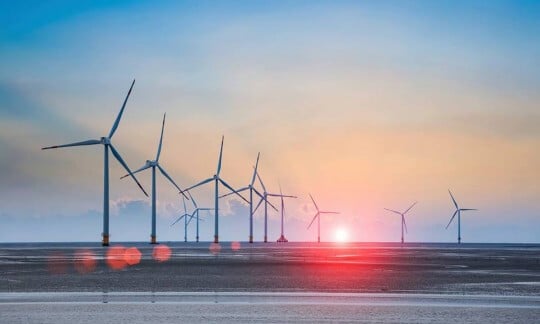
Judge gave Sunrise Wind off New York a preliminary injunction so if can resume offshore construction (BOEM file photo)

Published Feb 2, 2026 3:17 PM by The Maritime Executive


A U.S. District Court Judge issued a preliminary injunction on Monday, February 2, for Sunrise Wind against the Trump administration’s December stop-work order. With today’s ruling, all five of the under-construction offshore wind farms have received permission to resume work despite the administration’s claims of new information about potential radar interference from the wind turbine blades and towers.

Ørsted’s Sunrise Wind had reported in early January that it would follow the lead of the other wind farms and also file seeking a court order. The company said that its project was 45 percent complete, with 44 of its 84 foundations installed as part of a total investment of $7 billion.

The New York Times reports that Judge Royce Lamberth said during a two-hour hearing today that he was unconvinced after reviewing under seal the classified report, which is the basis for the government’s claims about national security issues.

“Purportedly new classified information does not constitute a sufficient explanation,” the judge ruled, according to The New York Times. Lambert reportedly called the administration’s actions “likely arbitrary and capricious” and ruled the company would be irreparably harmed unless work resumed.

Ørsted told the court the stop-work order, which was imposed on December 22, was costing it $2.5 million a day. 

Sunrise Wind is the least advanced of the five projects that were stopped. It is located approximately 30 miles east of Long Island, New York. Due to be completed in 2027, it will have a capacity of 924 MW.

Other judges also questioned the government’s argument. One said the issue, if there is one, relates to operations and not construction. The companies each argued they had spent years in review and received approvals from the Department of Defense and others. 

The orders permit the companies to resume offshore construction work while the courts continue to hear the case challenging the stop-work order. Last week, Dominion Energy confirmed that it had installed the first turbine for its Coastal Virginia Offshore Wind project after receiving its injunction, while Vineyard Wind 1 shipped out its last tower as it nears completion by the end of next month.

In the past, the Department of the Interior has vowed to continue to fight these five cases in the courts. It has also sought to stop other projects, including Maryland’s offshore wind farm, before they begin construction. 

The opposition to offshore wind by the Trump administration has effectively stopped most future development and ended the schedule of future lease sales. The Biden administration was targeting at least 30 GW of offshore wind energy capacity. Bloomberg estimates that the U.S., in the near term, will only reach approximately 6 GW of offshore wind energy capacity due to the Trump administration’s efforts to curtail the industry.


A BEHEMOTH OF THE SEAS

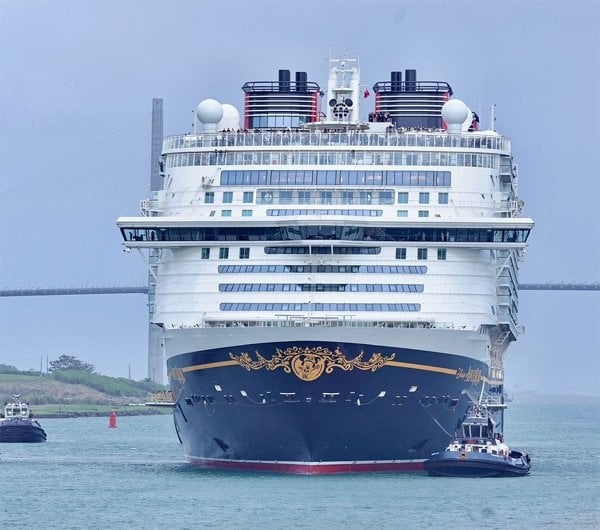
Disney Adventure Becomes Largest Cruise Ship to Transit Panama Canal

cruise ship Panama Canal
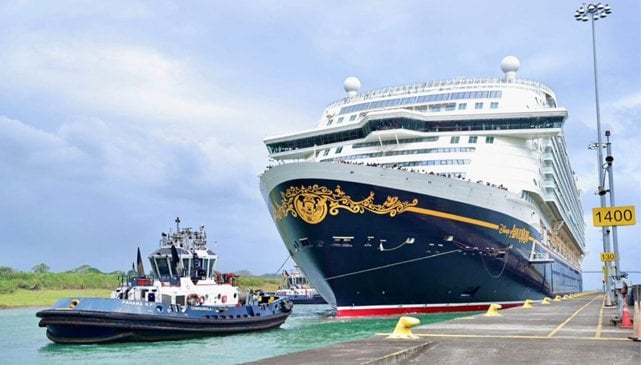
Disney Adventure was the largest and first cruise ship over 200,000 gross tons to transit the Panama Canal (Panama Canal Authority)

Published Feb 2, 2026 5:45 PM by The Maritime Executive


Disney Cruise Line’s ultra-large cruise ship Disney Adventure today, February 2, set a record as the largest cruise ship to transit the Panama Canal as she resumed her repositioning cruise to Asia. She became the largest cruise ship by gross tonnage and capacity, as well as the first 200,000-plus gross ton cruise ship to make the transit.

At 208,100 gross tons, the Panama Canal Authority highlights that the Disney Adventure is 24 percent larger (40,000 gross tons) than the Norwegian Bliss (168,000 gross tons), which had previously held the distinction as the largest cruise ship to make the transit. 

At 342 meters (1,122 feet) in length and 46.4 meters (152 feet) in beam, the Panama Canal Authority highlights her transit required extensive multidisciplinary coordination. The Neopanamax Locks have a maximum capability of handling vessels that are 370 meters (1,215 feet) in length and a beam of 51.25 meters (168 feet), meaning the Disney Adventure had just eight feet of clearance on each side while in the locks. While Disney is the third cruise line to have ships over the 200,000 gross ton threshold, she is the first to make the transit.

The cruise ship had made a stopover in Port Canaveral, Florida, reportedly for crew familiarization and training coordinated with Disney World while she is on her repositioning trip from her builders in Germany to her homeport in Singapore. Over the weekend, she made a brief stop at Curaçao, reportedly for fueling and provisions. 


The ship is on her way to Los Angeles, where she is due next Monday, February 9, for another port call. From there, she is scheduled to proceed to Tokyo and finally to Singapore ahead of her March 10 maiden voyage.

Disney redesigned the ship and completed its outfitting after acquiring it from the bankruptcy of Genting Hong Kong and MV Wesser in Germany. The ship was transformed into the Disney style, with areas highlighting the characters and Marvel themes. She accommodates over 6,700 passengers in 2,111 staterooms. She has a crew of 2,500. The current trip is only being made with staff and crew ahead of the ship’s introduction.

Panama highlights that the transit comes during a busy season for cruise ships, during which it expects 40 Neopanamax cruise ships to make the transit. Last week, the Queen Mary 2 (149,214 gross tons) made her first transit, starting on January 24 and spending the night near Cocolí before continuing her passage under the Bridge of the Americas. This season, other cruise ships making their maiden transits include AIDAdivaBrilliant LadyCelebrity Ascent, and Star Seeker.

In addition to the winter cruises, the Panama Canal sees an influx of cruise ships each spring and fall as ships reposition from the Caribbean to the summer season in Alaska. 


Worldwide Underwater Repair Capability Proven Off the Coast of Congo

Hydrex
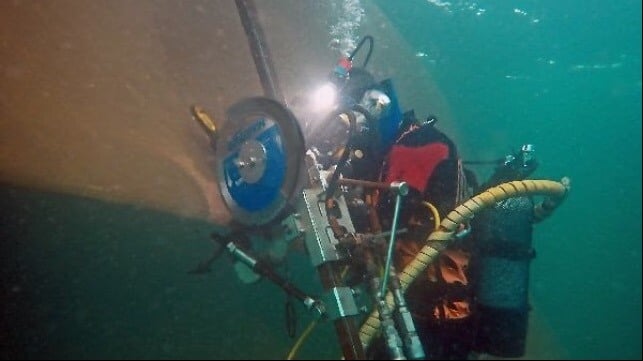
Hydrex Diver Positioning the Blade Cutting Tool Over the Propeller Blade.

Published Feb 2, 2026 9:11 PM by The Maritime Executive


[By: Hydrex]

Shipping operates on a global scale, and when damage occurs, shipowners need repair partners who can respond just as globally. In December, Hydrex once again demonstrated their ability to mobilize anywhere in the world, carrying out a complex underwater propeller repair on a container vessel at anchorage off Pointe Noire, Republic of Congo.

Following reports of a possible grounding incident, an underwater inspection revealed deformation to all six blades of the vessel’s fixed-pitch propeller. With no immediate access to drydock facilities in the region and schedule commitments to maintain, the company was contacted to assess and resolve the situation on-site.

Rapid mobilization in a remote location


Operating far from major ship repair hubs requires careful planning and reliable logistics. Hydrex deployed one of their specialized diving team and equipment to Pointe Noire on short notice. As the vessel remained at anchorage, a dedicated workboat was mobilized to provide safe offshore access and enable the repair without delay.

Upon arrival, the divers conducted a detailed underwater inspection, confirming that all six propeller blades were bent towards the aft side. The bends were too severe to permit bending back to shape with the company’s cold straightening equipment and therefore the blades needed to be cropped. Precise measurements were taken on each blade to assess the extent of deformation and determine the most effective corrective action.

Engineering solutions with class involvement
In close consultation with the attending class surveyor, Hydrex proposed a repair plan tailored to the ship’s condition and schedule. To restore balance and ensure reliable propulsion, it was agreed that all six blades would be cropped to identical dimensions.

The underwater cropping was carried out according to the approved plan. The length of the cuts was approximately 127 cm, and the blades were very thick at this point. The cropping was followed by careful rounding and polishing of all edges. This ensured smooth hydrodynamic performance and reduced the risk of vibration or cavitation, all without requiring drydock facilities.

Added value through on-site operation
While on-site, the team also carried out an additional underwater inspection of the rudder at the request of the vessel’s crew. The inspection confirmed that no grounding-related damage was present, providing immediate reassurance that the ship could sail and steer safely. After sailing, the captain contacted the team leader to confirm that all was well and there was no sign of vibration from the propeller.

By completing this repair at anchorage and far from any traditional repair infrastructure, Hydrex enabled the vessel to continue operations safely and efficiently.

The products and services herein described in this press release are not endorsed by The Maritime Executive.


China and Russia Plan to Hold a Naval Exercise With Iran in February

Nejada file image
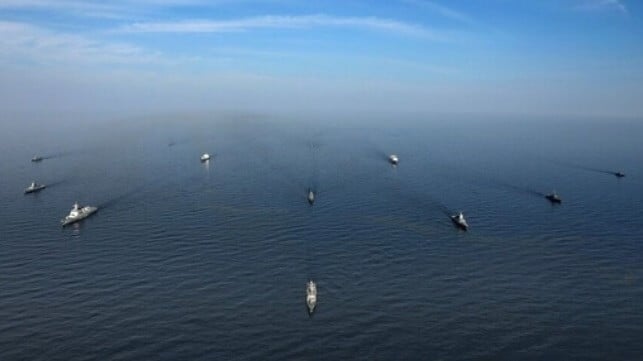
File image courtesy Nejada

Published Feb 1, 2026 5:15 PM by The Maritime Executive


The commander of the regular Iranian navy (Nedaja) Rear Admiral Shahram Irani has announced that Iran will once again host Chinese and Russian naval vessels in Exercise Maritime Security Belt 2026, to be held in the northern Indian Ocean in late February.  There have been no confirmatory announcements as yet from the Chinese and Russians, but the Iranians will be anxious to secure their participation again in this annual exercise, needing the reassurance of having allies alongside at a time of high tension.

The Chinese participants can be expected to be drawn from the People’s Liberation Army Navy (PLAN)’s Djibouti-based 48th Flotilla, made up of the Type 052DL guided-missile destroyer Tangshan (D122), the Type 054A guided-missile frigate Daqing (F576) and the Type 903A replenishment ship Taihu (K889). 

The Russian contingent is likely to consist of the Russian Udaloy Class frigate RFS Marshal Shaposhnikov (F543), still in the region having participated in the DIMDEX 2026 defense exhibition held January 19-20 in Port Hamad, Qatar. The Marshal Shaposhnikov is being supported by the Boris Chilikin Class oiler Boris Butoma (IMO 8842557). Potentially, the Steregushchiy Class corvette Stoykiy (F545) could either supplement or replace these vessels, as it too is still in the region, having participated in Exercise Will for Peace 2026 off Cape Town.

Rear Admiral Irani also has announced that the 103rd Flotilla, also fresh from Will for Peace 2026, is to exercise with an undisclosed partner before returning to Bandar Abbas. The 103rd Flotilla consists of the Bayandor Class corvette IRINS Naghdi (F82) and the Nedaja’s forward base ship IRINS Makran (K441), supported by the IRGC Navy’s converted oil tanker, IRIS Shahid Mahdavi (L110-3).

While elements of the Nedaja are away from home, the business of confronting President Trump’s armada appears to rest with the IRGC Navy. On January 30, the US Central Command warned the IRGC Navy not to use a naval exercise due to start on January 31 as an excuse to overfly, point weapons or maintain collision courses with US Navy vessels.

US naval forces in the region are made up principally of the USS Abraham Lincoln (CVN-72), with its Arleigh Burke Class guided-missile destroyers USS Spruance (DDG-111), USS Michael Murphy (DDG-112) and USS Frank E. Petersen Jr. (DDG-121), with logistics support from USNS Carl Brashear (T-AKE-7).  This carrier strike group (CSG) is supplementing the Bahrain-based Arleigh Burke Class guided-missile destroyers USS Mitscher (DDG-57) and USS McFaul (DDG-74), and three Independence Class littoral combat ships optimized for mine countermeasure missions, namely USS Tulsa (LCS-16), USS Canberra (LCS-30) and USS Santa Barbara (LCS-32), with logistic support from USNS Henry J Kaiser (T-AO-187). 

This force has recently been supplemented by a further Arleigh Burke Class guided-missile destroyer, USS Delbert D. Black (DDG-119), which is believed to be in the northern Red Sea. Thick cloud has covered the US Naval Support Facility at Diego Garcia in recent days, so it is not possible to ascertain if air reinforcements have arrived in theater.

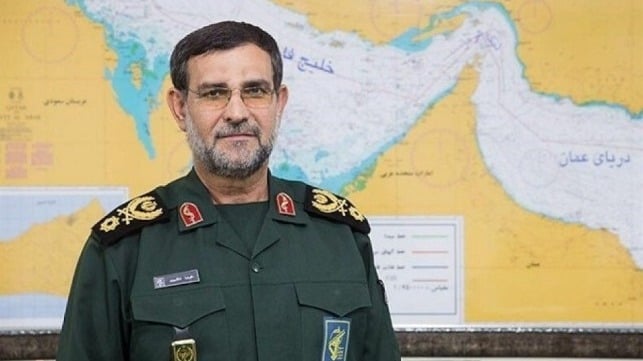
The IRGC Navy issued a statement on January 31 via Tasnim that its commander, Commodore Alireza Tangsiri, had not been killed in an unexplained blast at a residential flat in Bandar Abbas. The statement implied that the blast had been caused by a gas explosion, although local residents have said that the area is not served with natural gas connections.

IRGC Navy commander Commodore Alireza Tangsiri (Iranian Defence / Tasnim)


Yang Ming Captain Arrested on Suspicion of Drug Smuggling

Taiwan port
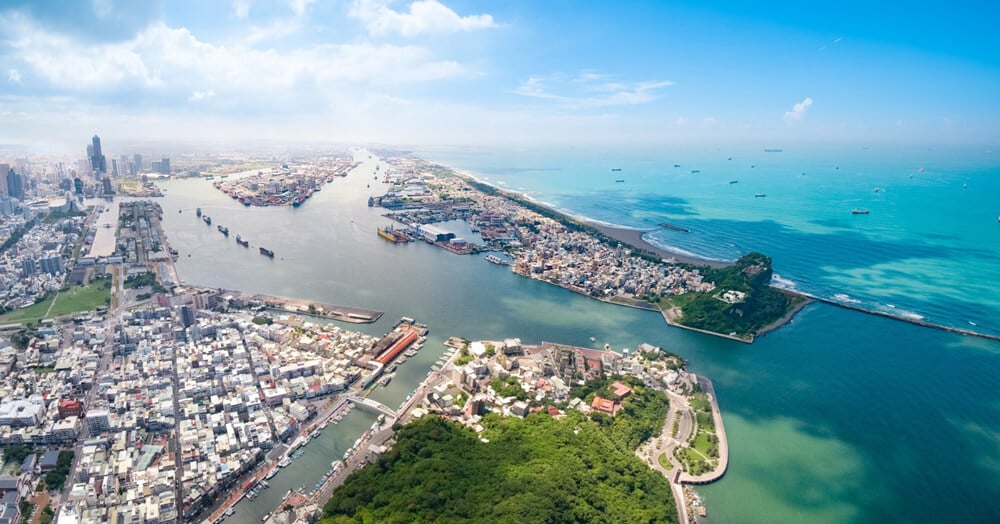
Containership arrived in Taiwan carry a large amount of heroin (Kaohsiung file photo)

Published Feb 2, 2026 4:31 PM by The Maritime Executive


An arrest warrant was issued late on January 30 in Taiwan for the captain of a Yang Ming containership on suspicion of drug smuggling. The captain, who was only identified by the surname of Yu, had been detained earlier in the week after an inspection of his vessel at the Port of Kaohsiung.

The Taiwan-based Yang Ming Marine Transport Corporation said it was cooperating with the authorities after alerting them to the suspected smuggling taking place on one of its vessels.

The YM Horizon (19,100 dwt) had loaded in Vietnam and had been scheduled to make a call in Hong Kong before proceeding to Taiwan. It is unclear why, but the vessel skipped the Hong Kong port call and went directly to Kaohsiung, where it arrived on January 29. The vessel, which was built in 2005 and registered in Taiwan, is a smaller, 1,500 TEU vessel used on the regional service in Asia.

The vessel’s security officer became suspicious after receiving a tip-off from crewmembers on the ship regarding “suspicious” items delivered and loaded onto the vessel. Yang Ming passed the information to the authorities for investigation.

Customs officers boarded the ship when it docked in Taiwan, and during the inspection, they discovered bricks of heroin inside the cargo hold. They referenced it as “a large amount” and are saying it is exceptionally high purity. They also found loose heroin wrapped in oil-paper bags as well as a suspicious white powder, reports CNA.

The master of the containership was detained for interrogation by the prosecutor’s office. They later submitted information to the district court seeking the arrest warrant. No other crewmembers have been detained.

Yang Mng reports it provided the CCTC footage from the vessel and logs to the prosecutor.  The ship departed Taiwan on Monday, February 2, bound for Hong Kong.

Officials said the case is unusual because maritime drug smuggling has mostly involved older cargo ships.


US Seizes $70k in Unreported Currency from COSCO Bulker

seized cash
Over $70,000 in unreported cash was seized from a COSCO bulker in Baltimore (CBP)

Published Feb 2, 2026 1:53 PM by The Maritime Executive


Officials of the U.S. Customs and Border Protection (CBP) seized a large amount of unreported cash from a Chinese-owned bulker while it was in the port of Baltimore. While it is not a crime to have the cash aboard the ship, U.S. officials highlighted the reporting requirements while contending the captain of the ship had made the appropriate reports at other U.S. ports.

The incident began simply enough with a routine inspection of the bulker Sheng Ning Hai (56,716 dwt) when it arrived in the Port of Baltimore on January 21. CBP conducted a routine enforcement boarding of the bulker after it reached the port.

CBP highlights that one element of these inspections is for the vessel’s captain to report to CBP officers how much currency the vessel is carrying. The master of the bulker did not report any currency to CBP officers, although he had filed a report days earlier in Maine.

Under the law, those entering and departing the United States may carry any amount of currency and other monetary instruments that they choose. However, any amounts over $10,000 must be reported on a U.S. Treasury Department Report of International Transportation of Currency or Monetary Instruments form.

The CBP officers noticed that the master of the Sheng Ning Hai had filed a Financial Crimes Enforcement Network 105 submission for $34,480 during an earlier port call in Searsport, Maine. Further, the officers learned that the vessel’s agent gave the master an additional $40,000 while in Maine.

CBP officers returned to the vessel the following day and conducted a more thorough examination of all spaces. The officers discovered a total of $70,737 in the purser’s safe.

“It is rare to see a commercial ship captain deliberately violate our nation’s laws,” said CBP’s Acting Director of the Baltimore Field Office, Matthew Suarez. He said that commercial vessel captains are required to understand and comply with the laws of the nation where they make port calls and that the office would continue to scrutinize foreign-flag vessels arriving at the port.

CBP’s announcement of the incident said the captain was “in hot water” after he failed to file the report for the additional $40,000 or amend the prior report from Maine. The cash was seized from the ship due to the lack of a report. The bulker was released and is continuing its journey. AIS signals show it is bound for Mombasa.


Tanker Orders: Too Much, or Not Enough?

A growing tanker orderbook starts an age-old discussion

iStock tanker
iStock

Published Feb 1, 2026 5:15 PM by Erik Broekhuizen / Poten & Partners


Last week, in our annual forecasting opinion ("A Fool's Game?"), we prognosticated that the tanker orderbook will decline in 2026. We are still early in the year, but the headlines from many of the trade publications seem to indicate that this may not happen. It appears that many shipowners and other investors in our industry a lining up even more newbuilding orders. In this week's tanker opinion, we will give a little more background on why we think (hope?) the orderbook will decline and why we could be wrong.

For an individual shipowner, there are a number of possible reasons to order a new tanker. Fleet renewal, expansion or diversification are some of those reasons. A relatively small group of owners only look at newbuildings when they want to expand their fleet or replace older tonnage. These owners, let's call them "traditional owners", are usually very particular about vessel specifications and vessel maintenance, and will rarely consider buying secondhand tonnage. These traditional owners are not trying to "time the market", they sell vessels and order replacement tonnage throughout the cycle, often against fixed employment contracts. Most of the traditional owners are private companies, who have been in the business for generations and are typically well capitalized.

There is a large group of other owners who take a different, more opportunistic, approach. For fleet replacement and/or expansion, they compare newbuildings with secondhand tonnage and keep a close eye on relative prices and current as well as future earnings. The actions of these "opportunistic" owners are much harder to predict than those of the traditional owners. A lot of the tanker community falls into this category, and their activities have a big impact on global fleet developments. In addition to regular shipowners (both privately owned and publicly traded), this category also includes non-traditional shipowners, such as private equity firms and other financial investors, as well trading houses. The activity of opportunistic owners frequently pushes up secondhand values and newbuilding activity.

The tanker industry is characterized by significant volatility in both earnings and asset values. Geopolitical conflicts and sanctions further amplify these cycles. This often leads to relatively short periods of high earnings, followed by extended periods of underperformance. Tankers are long-term assets with a 20+ year lifespan, which means that brief periods of overbuilding can create long periods of oversupply. Under normal circumstances, our industry should replace about 5% of the fleet every year. Since the lead time for new vessel construction is currently about 3 years (a vessel ordered today will be delivered in late 2028/early 2029), this means that an orderbook of around 15% of the fleet is about right.

However, this also assumes that about 5% of the fleet ages-out every year, i.e. is recycled. That has not been the case in recent years. Despite limited newbuilding deliveries in recent years, the tanker fleet has grown steadily because recycling has been low. Older vessels are sold for further trading into the dark fleet rather than sent to the breakers.

We currently have a situation where the tanker orderbook is rising rapidly, stimulated by a number of drivers: 1) Prices for modern secondhand vessels are high, making newbuildings comparatively attractive; 2) Rates have been strong for an extended period of time and (in particular for VLCCs) have increased even further in recent months; 3) The average age of the fleet is high with a significant percentage of vessels at or approaching retirement age.

Pundits argue that the stage is set for a sustainable bull run in the tanker market. However, there is an alternative scenario. Counter to previous periods with high orderbooks (like the 2004-2008 Supercycle), oil demand is not expected to grow very quickly. The strong rate environment in recent years has more to do with (temporary) market inefficiencies and dislocations due to geopolitics and sanctions, than with fundamental demand. Even if sanctions are lifted, a part of the dark fleet may stick around and the large influx of newbuildings in the coming years could create significant overcapacity and a depressed rate environment. A slowdown in ordering this year may just prevent another boom-bust cycle from happening.

This coverage appears courtesy of Poten & Partners.

The opinions expressed herein are the author's and not necessarily those of The Maritime Executive.


Number of Dual-Fuel Ships Nearly Doubled in 2025, and Strong Orderbook

dual-fuel containership
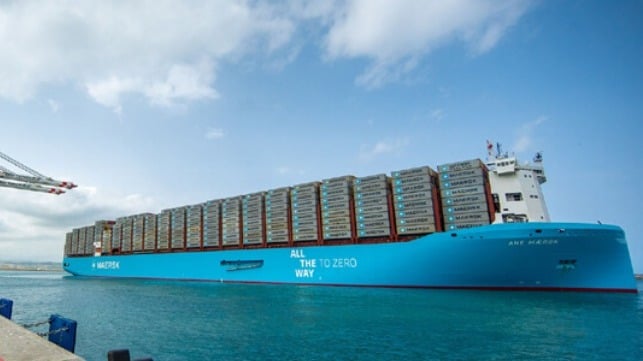
Some carriers such as Maersk are taking advantage of dual-fuel in their branding (Maserk)

Published Feb 2, 2026 8:23 PM by The Maritime Executive


The amount of liner shipping using dual-fuel vessels able to take advantage of the emerging alternative lower emissions fuels nearly doubled in 2025, according to new data from the World Shipping Council. In its year-end update on the Dual-Fuel Fleet Dashboard, WSC highlights continuing strong investments as shipowners push forward with their efforts, not waiting for the IMO and other regulators.

WSC launched the Dual-Fuel Fleet Dashboard as a tool to track the global liner shipping industry’s investments in new ships capable of running on renewable and lower-emission fuels. It presents the data as a snapshot “of how the fleet is preparing for the transition to net-zero 2050.”

While the IMO still searches for member agreement on its framework to govern emissions and the transition, the WSC emphasizes the level of investment coming from shipowners. According to its data, the number of dual-fuel containerships and vehicle carriers reached 400 at the end of 2025, nearly double the 218 at the end of 2024. Further, they calculate a further 726 vessels still on order, maintaining the proportion of dual-fuel ships in the pipeline despite the shift from orderbook onto the water seen in 2025. 

WSC calculates that between the in-service and on-order vessels, the container and vehicle carrier sectors will reach 1,126 dual-fuel vessels, giving it an increase overall of 28 percent last year. They report it represents over $150 billion in investments.

It highlights that containerships and vehicle carriers are leading the adoption of dual-fuel vessels. They report containerships and vehicle carriers are now 74 percent of dual-fuel ships, and 74 percent of containerships and 87 percent of vehicle carrier orders are for dual fuel (by DWT). In other segments it says 21 percent of the orders are (by DWT) dual-fuel ships.

WSC does not report on other segments such as cruise ships, where dual-fuel and even tri-fuel are emerging as strong options, especially in the largest ships. More than 40 percent of the cruise ships on order (31 out of 75) are designed for multi-fuel, mostly LNG, and anticipation of future fuels. By gross tonnage, 59 percent of the cruise ships on order will use alternative fuels, while by berths it is 64 percent of the current order book.

In its analysis of the overall orderbook, DNV sets the number of ships due for delivery between 2026 and 2033 at 1,138. That represents 40 percent of the orders as using alternative fuels and will nearly double the number of alternative fuel vessels over the next eight years.

Last year saw some overall slowing of the momentum for methanol, in part due to concern over supply near-term, but the overall alternative fuel trend continues. Alternative fuel vessels were nearly 40 percent of all the orders placed in 2025.

Jason Stefanatos, Global Decarbonization Director at DNV, highlighted today, February 2, that the momentum continued into 2026. He reported a total of 20 new orders for alternative-fueled vessels in January, with LNG-fueled container vessels continuing to account for the majority of orders (16), with one methanol-fueled offshore vessel and three LPG carriers making up the remainder.


India’s First Chemical Tanker Order Advances Shipbuilding Ambitions

Indian shipyard
SDHI booked its first commercial shipbuilding order which is also India's first chemical tanker newbuild order (SDHI)

Published Feb 1, 2026 3:20 PM by The Maritime Executive


Swan Defence and Heavy Industries Limited (SDHI), located in India, confirmed that it has received its first shipbuilding order as part of the revitalization of its operations. The order, which comes from a European shipowner, is both the country’s first for a chemical tanker and aligns with India’s ambitions to develop into a leading global shipbuilder.

The order was placed by Bergen, Norway-based Rederiet Stenersen, a 50-plus year old operator of chemical/product tankers. The company currently has a fleet of 19 vessels, all equipped to operate in the harsh conditions of the North Europe trade. The order, which is valued at $227 million, is the company’s first foray into Indian shipbuilding, and they note that it was placed after a comprehensive technical and commercial evaluation. A Letter of Intent was signed in November 2025.

The order is for six tankers, each 18,000 dwt and approximately 150 meters (492 feet) in length. The first vessel is due for delivery in 33 months, and the company has an option for six additional vessels after the first group.

The vessels will be designed by Marinform AS and StoGda Ship Design & Engineering and classed by DNV. Built to Ice Class 1A standards, the tankers will feature advanced dual-fuel LNG-ready hybrid propulsion, enabling multiple operational modes supported by high levels of automation.

Swan Defence and Heavy Industries Limited (SDHI), formerly Reliance Naval and Engineering Limited, was acquired and restarted in 2024 after the bankruptcy of the prior owners. The company aspires to be a large, world-class builder of commercial vessels and other projects, including heavy fabrication. They note the revitalized SDHI shipyard, which is located in Pipavav, Gujarat, on India’s west coast, operates the country’s largest dry dock (662 meters by 65 meters) and has a fabrication capacity of 164,000 tonnes per year.

The company’s director, Vivek Merchant, highlighted that the order is a demonstration of India’s growing commercial shipbuilding ecosystem. The government of Prime Minister Narendra Modi is taking steps to realize the Prime Minister’s call for India to become a top 10 global shipbuilding nation by 2030 and a top five shipbuilder by 2047.

The government outlined its Shipbuilding Financial Assistance Scheme as part of the effort to support the industry and attract international interest. The program was amended just days ago to include product/chemical tankers.

The tanker order follows the announcement that CMA CGM intends to build containerships in India. The government and industry have also been courting other major companies, including Maersk and MSC.


Northern Lights has Deals With Shipping Lines to Double CO2 Transport Fleet

LCO2 transport
Northern Lights will double its fleet with larger capacity LCO2 transport vessels (Northern Lights)

Published Jan 29, 2026 8:33 PM by The Maritime Executive


The Norwegian CO2 storage initiative, which became the first commercial operation for carbon capture and storage, announced a new deal that will double the company’s fleet by 2029. This comes just months after the company completed its first injection of liquid CO2 for permanent storage.

Northern Lights, which is a joint venture between Equinor, TotalEnergies, and Shell, reports it has struck a new charter deal with major shipping companies, including existing partner Kawasaki Kisen Kaisha (“K” Line), while adding MISC Berhad and Mitsui O.S.K. Lines (MOL). Under the new agreements, “K” Line and MSC concluded one charter, and a second will be awarded in April 2026. Two additional charter agreements have been awarded to MOL.

Under the terms of the agreements, the three shipping companies will own the new vessels, which will operate under charter to Northern Lights. Northern Light also said it is increasing the size of each vessel, with the first three vessels awarded to each have a capacity of 12,000 cbm of liquified CO2. 

The new ships will be built by Dalian Shipbuilding Offshore in China and by HD Hyundai Heavy Industries. Deliveries will range between the second half of 2028 and the first half of 2029.

HD Hyundai confirmed it has received the order for two vessels from MOL. It reported the 12,000 cbm ships will measure 150 meters (492 feet) in length. The first class of ships currently operated by Northern Lights are 150 meters (426 feet) in length. HD Hyundai said the new class will be among the largest medium-pressure LCO2 carriers designed to transport captured carbon dioxide in liquid form.

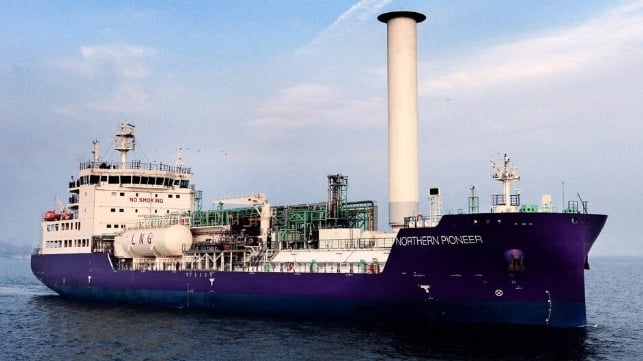
Northern Lights has taken delivery of three 7,500 cbm vessels, Northern PioneerNorthern Pathfinder, and Northern Phoenix. K Line operates these vessels under an agreement with Northern Lights. A further sister is currently under construction in China for delivery this year. It will be owned and operated by Berhard Schulte, a part of the Schulte Group.

Commenting on the new ship orders, Tim Heijn, Managing Director of Northern Lights, said they are building the first dedicated fleet for CO2 shipping. Doubling the number of ships and expanding capacity, he said, will enable Northern Lights to optimize its operations and increase flexibility.

The project received approval to launch the operation in May 2025 and reported it completed its first injection into the permanent storage reservoir 2,600 meters under the seabed in August. Already, the company had also announced plans for Phase 2, which will increase transport and storage capacity from 1.5 million tonnes to a minimum of 5 million tonnes of CO? per year.

As a commercial supplier, Northern Lights contracts with large emitters for the capture of their CO2. It is stored, liquefied, and transported aboard the company’s ships to the receiving facility in Norway. From there it is injected into the offshore permanent storage reservoir.

The company is contracting with major industrial companies, including, Heidelberg Materials’ cement factory in Brevik, and Hafslund Celsio’s waste-to-energy plant in Oslo, Norway. In addition, the Northern Lights JV has signed commercial agreements with Yara in the Netherlands, Ørsted in Denmark, and Stockholm Exergi in Sweden


Port of Baltimore Celebrates Recovery of its Container Business

Baltimore

Published Feb 1, 2026 11:39 PM by The Maritime Executive


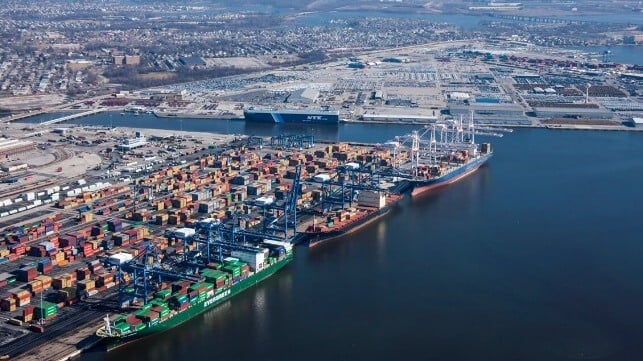
The Port of Baltimore is witnessing a remarkable recovery after the devastating effects of the Francis Scott Key Bridge collapse in March 2024, with container throughput returning to 2023 levels.

Having witnessed its containerized business take a 41 percent nosedive in 2024 to roughly 740,000 TEU due to the Francis Scott Key Bridge disaster, Baltimore is seeing a recovery. Its piers handled 1.1 million TEU in 2025. The throughput exceeded the 2023 record by more than 5,000 TEU and came in a year that was characterized by uncertainty and volatility due to tariffs.

During the year, the port recorded 2,223 cargo vessel visits, surpassing the previous record of 2,137 ships set in 2023, representing a 21 percent increase over 2024. Another notable achievement in 2025 was the arrival of the second-largest ship to ever call at Baltimore. This came in November when the 366-meter Ever Model with a capacity of more than 15,000 containers called at the facility.

Baltimore attributed the arrival of the ship to ongoing business growth efforts centered on the port’s modernization of its infrastructures, among them the reopening of the 50-foot-deep, 400-foot-wide channel, and supersized cranes at the Seagirt Marine Terminal.

Though Baltimore has released the performance of the container business, final cargo volumes and data on roro units handled are still being finalized, though the port is optimistic the numbers will exceed those recorded in 2024.

“We are grateful to the workers whose unwavering commitment and resilience made this progress possible. Our administration will continue to promote our port’s infrastructure to strengthen our supply chains, drive economic growth in our state, and create better-paying jobs for our people,” said Maryland Gov. Wes Moore.

Baltimore is highlighting that with container volumes hitting the 2023 levels, the port is upbeat about significant growth this year driven by the completion of the CSX Howard Street Tunnel project, a $518 million initiative to modernize a 130-year-old freight tunnel in Baltimore. The new freight tunnel will allow the port to accommodate double-stacked container trains, increasing its capacity by 160,000 containers annually and generating nearly 14,000 jobs.

“The commitments we’re making now and in future years will continue to advance our multimodal freight network and further accelerate the port’s growth and generate additional jobs,” said Katie Thomson, Maryland Acting Secretary of Transportation.

The Port of Baltimore remains a cornerstone of Maryland’s economy and one of the most important ports in the U.S., particularly in ro/ro, construction machinery, imported forest products, and imported gypsum. The port generates about 20,300 direct jobs, with more than 273,000 jobs overall in the state linked to the port, and it has an annual economic impact of more than $70 billion.


China Wants to Host the High Seas Secretariat

Chinese trawler

Published Feb 1, 2026 2:46 PM by Dialogue Earth


[By Jiang Mengnan]

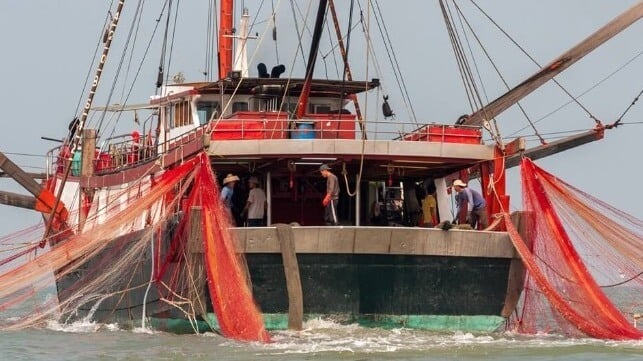
China has joined Chile and Belgium in competing to host the secretariat of the High Seas Treaty. The landmark UN agreement, which entered into force earlier this month, will govern the parts of the ocean located beyond national jurisdictions.

China wants the city of Xiamen, on its southeast coast in the province of Fujian, to become the seat of the secretariat.

Li Shuo, who directs the Asia Society Policy Institute’s China Climate Hub, tells Dialogue Earth the bid "marks a significant escalation in China’s engagement with the treaty and with global governance more broadly." It shows Beijing hopes "to play a more active role in shaping international rules and enhancing its global discourse power," he adds.

A number of experts say the move is particularly significant at a time when the US is withdrawing from multiple international agreements.

Li says it is reminiscent of China’s decision to host the 15th conference of the parties to the UN Convention on Biological Diversity (CBD COP15) during Donald Trump’s first US presidential term: "Beijing stepped forward as Washington pulled back."

High seas, high stakes

The High Seas Treaty, also known as the Biodiversity Beyond National Jurisdiction (BBNJ) agreement, aims to protect and share the benefits of the global ocean outside of national territories. The agreement was adopted in June 2023 and opened for signatures that September.

When its ratification tally hit 60 countries last year, a 120-day countdown began and the treaty officially entered into force on 17 January this year. That tally has since reached 84 signatories, including China and the European Union.

The work of the secretariat is seen as crucial to a well-functioning treaty that delivers its ambitious aims, especially the establishment of large marine protected areas (MPAs) on the high seas. MPAs are vital to delivering the global goal to safeguard 30% of the ocean by 2030, which was agreed to at CBD COP15.

A decision between Belgium, Chile or China will be made later this year, at the High Seas Treaty’s first conference of the parties.

A ‘responsible major country’

The Chinese foreign ministry spokesperson Guo Jiakun spoke of China’s ocean conservation ambitions at a press briefing earlier this month: "China attaches great importance to the protection and sustainable use of the oceans. As a responsible major country, China has been deeply involved in global ocean governance and is both willing and capable of making greater positive contributions to the implementation of the agreement."

Guo added that Xiamen, known for its role as a hub for marine cooperation and its sustainable ocean development practices, would offer favorable, supportive conditions for the secretariat.

In Li’s view, China has long adopted a cautious approach to marine conservation, because of its fisheries interests and geopolitical considerations. However, "the bid also suggests a shift from a traditionally cautious posture to a potentially more proactive, facilitative role," he says.

Competing bids and controversy

China as host of the secretariat could be controversial, however, as political tensions in many marine areas rise. The US, Russia and China are increasingly vying for influence in the Arctic and other waters. Choosing Chile or Belgium as host could circumnavigate this power struggle.

Chile, which has put forward the city of Valparaíso, has framed its bid as a chance to bring a more Global-South-focused multilateral approach to maritime issues. Belgium, which has proposed Brussels, is emphasizing the advantages of its existing "diplomatic ecosystem."

Zhou Wei, an oceans project manager at Greenpeace, says China needs to continue strengthening its capacity to meet its ocean obligations, and accelerate preparations for MPA proposals.

"These efforts would not only be a positive contribution to global ocean governance, but also help enhance the long-term sustainability of China’s own marine activities," she adds.

Dialogue Earth also spoke to ??Lyn Goldsworthy, a veteran Southern Ocean researcher from the University of Tasmania in Australia. She finds China’s bid intriguing, and says there are reasons to be worried, given China has shown reluctance over the creation of MPAs in the Antarctic high seas: "If they are in that influential [position], they can slow things down."

Jiang Mengnan is the strategic communications officer at Dialogue Earth, based in London. She joined in 2022 and is also a journalist specialising in sustainable finance and ESG development. She used to work in ESG consulting and communications in both private and non-profit sectors, and holds the title of Certified ESG Analyst (CESGA) from the European Federation of Financial Analysts Societies (EFFAS).

This article appears courtesy of Dialogue Earth and may be found in its original form here

The opinions expressed herein are the author's and not necessarily those of The Maritime Executive.