Showing posts sorted by relevance for query ANTIFA. Sort by date Show all posts

Thursday, September 03, 2020


Fact check: Antifa.com redirects to Joe Biden's website, but Biden campaign not involved


Miriam Fauzia, USA TODAY•September 3, 2020

The claim: Antifa.com redirects to Joe Biden's campaign website

Viral Facebook posts insinuate ties between Democratic presidential candidate Joe Biden and the left-wing, anti-fascist political movement antifa.

"if you go to Antifa.com, it takes you directly to joe bidens webpage. ... whats that tell ya ... try it yourself," Facebook user Johnathan Thurman wrote in a post that has been shared more than 80,000 times since Aug. 28. Several other Facebook posts claim the same, and videos show the redirect to viewers.

Thurman, whom USA TODAY reached out to via Facebook Messenger, said he knew no further details about the redirect. - ADVERTISEMENT -


Fact or fiction: We're fact checking the news and sending it right to your inbox. Sign up here
Breaking down the domain's history

A search through the digital internet archive Wayback Machine reveals the antifa.com domain has existed since 1999, although no content appears until Dec. 4, 2000. It is unclear who registered the domain, but the content appears to be a predominantly European anti-fascist newsletter available in English and Dutch.

The domain lapsed. It was renewed April 24, 2002, according to domain registration databases Whois.net and the Internet Corporation for Assigned Names and Numbers Lookup. It was never made into an active website.

On Nov. 21, 2008, the domain was offered for $14,410 and remained on sale until May 6, 2017, at which point, a blank page replaced the sale offer. The blank page persisted until another "domain for sale" notice appeared Aug. 10, 2019.

The website was probably bought before or around May 31. Twitter user The Rude Pundit noticed the domain's sale price was nearly $37,000.

"We Are Antifa: Join Us & Take Action Antifa.com," declares text at the top of the home page. Hashtags sympathetic to George Floyd and the Black Lives Matter movement are also visible. Below, a symbol used by the original anti-fascist group, Antifaschistische Aktion, founded by the Communist Party of Germany in 1932, appears in red, black and white.

Days later, more information was added in an extensive paragraph rebutting President Donald Trump's tweet May 31 vowing to designate "ANTIFA as a Terrorist Organization." For a brief time, the website redirected to a YouTube channel before announcing June 25 that an updated website was coming soon.
Biden's site gets tied to antifa

Traffic redirecting to JoeBiden.com began around Aug. 8 before stopping Aug. 13.

On Aug. 16, the domain resumed but forwarded instead to a website called "It's Going Down."

On Aug. 21, traffic redirected to KamalaHarris.org, which was being forwarded to JoeBiden.com. On Aug. 22, it went back to "It's Going Down"; and on Aug. 28, it returned to KamalaHarris.org before settling on JoeBiden.com on Aug. 31.
Democratic presidential nominee Joe Biden has condemned protest violence, no matter what the political ideology.


Domains and redirection

Antifa.com has been registered through NameCheap, a Phoenix-based domain registrar – a company that manages internet domain names, as well as IP address assignments for those domains – since April 2002.

Redirecting a domain to any website is not hard to do. According to Mashable writer Matt Binder, all it requires is "that you type in the URL you want your domain to redirect to in your registrar’s administration panel."

Since NameCheap offers a privacy protection service to its clients, it is impossible to know who exactly owns the domain and set the redirection. USA TODAY was unable to reach NameCheap CEO Richard Kirkendall for comment.
Biden not connected

Matt Hill, deputy national press secretary for the Biden campaign, referred USA TODAY to a tweet Monday from Biden's digital director, Rob Flaherty.

"So whoever owns http://antifa.com is redirecting it to our website as a troll. … The VP very obviously has/wants nothing to do with fringe groups," Flaherty said.
Our ruling: Missing context

We rate this claim as MISSING CONTEXT. It is true the antifa.com domain redirects to JoeBiden.com. It is unknown who exactly owns the domain and has been redirecting traffic to the Biden campaign's website. The claim lacks context given that the Biden campaign denies any association with the antifa.com website.
Our fact-check sources:


Antifa.com via Wayback Machine, Dec. 4, 2000.


Antifa.com via Wayback Machine, Nov. 21, 2008.


Antifa.com via Wayback Machine, Aug. 10, 2019.


Antifa.com via Wayback Machine, May 31.


Antifa.com via Wayback Machine, Aug. 8.


Antifa.com via Wayback Machine, Aug. 16.


Antifa.com via Wayback Machine, Aug. 21.


Antifa.com via Wayback Machine, Aug. 22.


Antifa.com via Wayback Machine, Aug. 28.


Antifa.com via Wayback Machine, Aug. 31.


NameCheap, Jan. 11, 2017, "Where is your company located?"


Cloudflare, "What is a Domain Name Registrar?"


Vox, June 8, "Antifa, explained."


The Rude Pundit, June 1, Twitter thread.


NameCheap, "WhoisGuard."


Donald J. Trump, May 31, Twitter thread.


Mashable, Aug. 12, "No, this doesn't mean that Joe Biden owns antifa.com."


Rob Flaherty, Aug. 31, Twitter thread.


New York Times, June. 29, 2019, "Trump Consultant Is Trolling Democrats With Biden Site That Isn’t Biden’s."

This article originally appeared on USA TODAY: Fact check: Antifa.com redirects to Joe Biden site; he's not involved

Wednesday, June 10, 2020


How The Antifa Fantasy Spread In Small Towns Across The U.S.

Rumors of roving bands of Antifa have followed small protests all over the United States. Why are people so ready to believe them?

Anne Helen Petersen BuzzFeed News Reporter
Posted on June 9, 2020

BuzzFeed News; Getty Images

The rumor that shadowy leftists planned to start trouble in Great Falls, Montana, first appeared on the Facebook group of the Montana Liberty Coalition late last Wednesday afternoon.

“Heads up,” a man named Wayne Ebersole, who owns a local cover crop business, wrote. “Rumor has it that Antifa has scheduled a protest in Great Falls Friday evening at 5 p.m. in front of the Civic Center.” He asked the group if anyone had any more information, or if anyone was available to “protect businesses.”

“It has been confirmed through the police department,” one commenter replied. “They have a permit for tomorrow night and are in town now.”

They weren’t. Police later said they had been “working to quell the rumor.” But that didn’t stop it from sweeping across various right-wing groups. Within 24 hours, a screenshot of Ebersole’s post had been posted to the Facebook Group for the Montana Militia, whose members have recently dedicated themselves to tracking the perceived threat of antifa all over the state, including coordinating armed responses to “protect” their towns. (Ebersole did not respond to a request for comment.)

And by Friday at 5 p.m., as about 500 protesters gathered to protest systemic racism and police brutality, a handful of armed men had massed at the edge of the demonstration.“We heard that a little group called Antifa wanted to show up and not in our town,” one man, who declined to be named, told the Great Falls Tribune. “All it takes is a word and a whisper.”

As protests against police brutality and in support of Black Lives Matter continue to proliferate across the small towns and rural communities, so, too, have rumors of white vans of masked antifa driving from town to town, reportedly intent on destruction. In Hood River, Oregon, antifa were, according to screenshot of a fake Instagram story, calling on followers to “root loot do anything in your power.” In Spring Hill, Tennessee, there was a “busload” staying at the Holiday Inn, prepping to loot Walgreens at noon. In Wenatchee, Washington, bands of men dressed in black were surveilling potential targets. In Payette, Idaho, a plane full of protesters was circling overhead. In Honolulu, antifa had been flown in from the mainland. In Billings, Montana, some claimed agitators had been spotted by the National Guard. In Nebraska, they were creating Craigslist ads offering to pay people $25 a day to “cause as much chaos and destruction as possible.” In Sisters, Oregon, they were planning to show up at the local Bi-Mart.


To be clear: All of these rumors were false. They were all, as the Deschutes County Sheriff’s Office put it, “fourth-hand information.” To combat them, police departments in dozens of towns are holding press conferences, posting announcements on social media, and telling anyone who calls the station that there has been no indication of a planned presence from antifa or any other outside agitators, whether “from Chicago” (code, in many parts of the Midwest, for black people) or “from Seattle” (code for liberals).

Yet these rumors continue to spread. That spread is facilitated by Facebook — where they thrive in groups whose previous focus was protesting pandemic-related shutdowns and circulating conspiracy theories about COVID-19 — and fanned by President Donald Trump, who recently declared his intention to label antifa a terrorist group. This morning, the president raised the antifa menace yet again, tweeting that the protester violently shoved by police in Buffalo, New York, “could be an ANTIFA.” (He was not.)

But the persistence of these rumors suggests a deeper fear of outside incursion, and the necessity of an ever-alert, armed response. As encapsulated in a Reddit thread out of Hood River, Oregon: “I’ll say this much: The people out here are armed to the teeth. If you want to bring mayhem to this area, the end result will likely have you begging for police protection.”


Stephanie Keith / Getty Images
An antifa member passes a fountain during an alt-right rally on Aug. 17, 2019, in Portland, Oregon.

Antifa has become the right’s face of violent leftist protest in the United States, sloppily aligned with, as the president put it on June 1, “professional anarchists, violent mobs, arsonists, looters, criminals, rioters.” In a tweet, Trump claimed the national guard had “shut down” the “ANTIFA led anarchists, among others.” (The DC field office of the FBI reported no antifa involvement in protests, according to the Nation.)

It’s difficult to talk about antifa with any sort of precision. It’s “leftist” insomuch as it’s against, well, fascism, authoritarianism, and white supremacists. There are some local groups, but there’s no national leadership structure. Many antifa dedicate themselves to finding white supremacists in their communities and outing them. Most people within those groups are for violent protest only as a last resort, but a handful are for more forceful displays and destruction. Here in Montana, I encountered a very small handful in January 2017, when they showed up in Whitefish to counter a planned march by the Daily Stormer, a neo-Nazi website.

The most important thing to understand about antifa is that there are very, very few of them: According to the Washington Post, when the group tried to gather nationally, they topped out at a few hundred.

Nevertheless, Trump has been building up the menace of antifa for years. He first began evoking antifa following the Charlottesville “Unite the Right” rally, when he famously claimed that there were “very good people, on both sides.” “Since then Trump has returned to the term often in speeches,” Ben Zimmer writes in the Atlantic, always “with an air of alien menace.”

Lifted by Trump’s rhetoric, that “alien menace” has accumulated around antifa in the public imagination, making it all the easier to believe posts in which fake antifa accounts promise to act in the exact ways Trump has described. On Sunday, May 31, a newly made Twitter account — since linked to the white nationalist group Identity Evorpa — posted: “Tonight’s the night, Comrades,” with a brown raised-fist emoji and “Tonight we say 'F--- The City' and we move into the residential areas... the white hoods.... and we take what's ours …”

The antifa threat has also been co-opted by QAnon, the nation’s most powerful and influential conspiracy theory and movement. At Concordia University, Marc-AndrĂ© Argentino researches the way extremist groups use social media as a tool to recruit, spread propaganda, and incite acts of violence. Last week, he began tracking the uptick in mentions of antifa within QAnon social media forums, which began to rise when “Q” (the anonymous poster who guides the site) began mentioning it on May 30. At least for the moment, QAnon is celebrating the protests (and antifa’s presence) for their potential to spark the apocalyptic “storm” central to the QAnon theology. “Antifa is a nebulous enemy, one that serves as a rallying cry for keyboard warriors and on-the-ground militiamen,” Argentino told me.

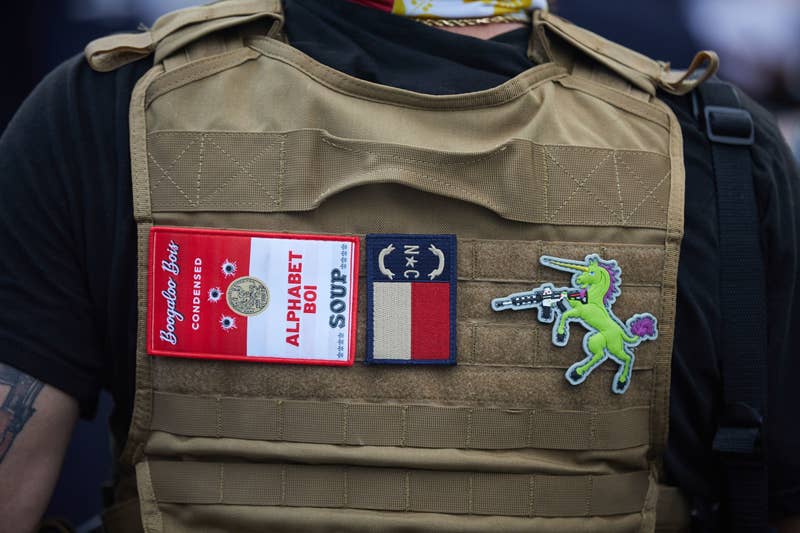
Argentino has been noticing something else, too: a growing cross-pollination between QAnon, which is often referred to simply as a conspiracy group, and more far-right extremist groups, from the so-called Boogaloo Bois and Proud Boys to more straightforward militias.

This intermingling was on display at the Reopen Michigan protests, where American flags waved alongside Confederate ones. And you can see it now all over the West, where the groups that advocated for reopening — often attracting a motley mix of constitutionalists, “patriots,” anti-vaxxers, Second Amendment advocates, anti-government advocates, and just straight up pissed off business people — have shifted their focus to “protection.” In the Tri-Cities area of Central Washington, the shift is so explicit that the Facebook group “Reopen Tri-Cities” has shifted, wholescale, to a second group called “Protect the Tri.”

Aurora Simpson Photography
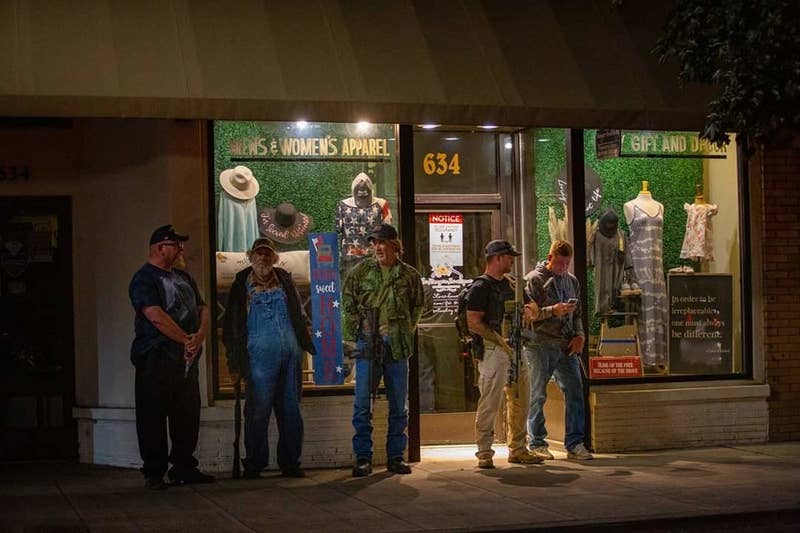
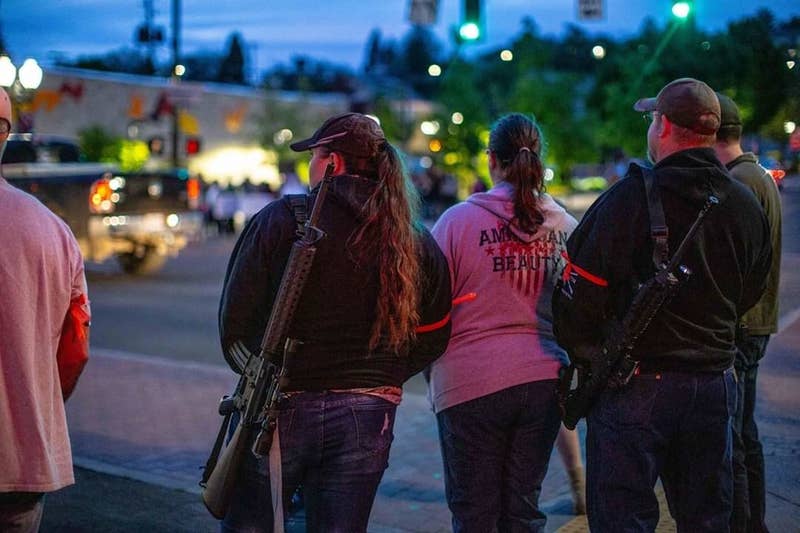
Armed men gather on Main Street in the historic downtown of Klamath Falls, Oregon, on May 31.

In Montana, most of the rumors of antifa presence in the state can be traced back to state Sen. Jennifer Fielder, who warned her followers on June 1 of “multiple reports from credible witnesses” that five white panel vans of antifa were on their way to Coeur d’Alene, Idaho, and would then proceed to Missoula, Montana. Fielder, who lives in Northwest Montana, is known across the state for ultra-right, “liberty-minded” views on everything from public lands (they should be sold) to contact tracing (a form of governmental overreach).

But Fielder didn’t start the antifa rumor. She just brought it to Montana. On Sunday, June 1, over in Klamath Falls, Oregon, the rumors were so compelling that hundreds of armed people showed up to line the Main Street during a planned protest. The next night, in downtown Coeur d’Alene, Idaho, a man with an AR-12, an AR-15, two 9 mm handguns, and a .38 special told reporter Bill Buley that he was there, along with hundreds of others, because he’d heard “there were some people who shouldn’t be here.”

In some cases, the people with guns showing up at these rallies are “supportive” of the groups protesting — at least in so far as they’re supportive of the right to freely assemble. They don’t actually believe the protesters, in many cases local high school students, would turn to violence. Instead, they believe antifa is plotting to infiltrate the otherwise peaceful protests and turn them violent — or, as was suspected in Lewiston, Idaho, use the protest as a decoy in order to ransack the business district.

Which is why, as over a thousand people gathered to march along the Snake River in Lewiston, dozens of others, many heavily armed, lined the streets downtown. One wore a Hawaiian shirt (the “uniform” of the Boogaloo Bois) and held a sign with the name of a III% militia member who had been shot by the police. Another wore a vest covered in Nazi paraphernalia. Others were decked out in flak jackets, in camo, and Clinton Conspiracy shirts. Similar scenes have played out this week in Bozeman, Kalispell, Billings, Sandpoint, and Coeur d’Alene.

Travis McAdam, who’s tracked anti-government and hate groups for 15 years with the Montana Human Rights Network, calls it the “Antifa Fantasy.” A version of this fantasy has long existed, in some form, in militia circles: “An outside, shadowy entity is going to come in,” McAdam recounted, “and whether it’s to disarm the community or attack it, these folks are going to mobilize and fight it off. Antifa is just the bogeyman that they’ve stuck in this narrative.”

Put differently: Militia members get to plan, anticipate, and enact the idea at the foundation of their existence. And they get to do it in a way that positions them as “the good guys,” fighting a cowardly bogeyman easily vanquished by show of force alone. As a popular meme circulating in North Idaho put it, “Remember that time when Antifa said they were coming to Coeur d’Alene / And everyone grabbed their guns and they didn’t come? That was awesome!” It doesn’t matter if antifa was never coming in the first place. They didn’t come, and that’s evidence of victory.

And that victory can then be leveraged into further action — and a means to extend the fantasy. On the Montana Militia page, a man named Tom Allen, whose home is listed on Facebook as Wibaux, Montana, posted that he’d spent the night in Dickenson, North Dakota, “protecting” the veterans monument during a planned protest. A group of bikers showed up to guard the nearby mall, protecting “all of Antifa’s usual targets.” There was no incident. (Allen did not respond to request for comment.)

Afterward, Allen wrote, a man who had helped coordinate the defense followed a group of perceived antifa to an Applebee’s, where he said he overheard them talking about “the waitress and how they wanted to rape her,” “killing cops” and “other violence,” and their future plans: “They’re saying there’s going to be a ‘firestorm’ in Billings this weekend.” The post was shared more than 1,800 times.

Like Argentino, the online researcher, McAdam sees this current “protect” movement as an extension and consolidation of anti-government movements that have been percolating for years. Back in 2008, when tea party rallies began sprouting up all over the United States, many of them were attended and organized by people authentically upset about economic policies. But those protests, like the reopen protests, also drew in anti-government agitators and militia members, who then began to influence and, in some cases, take over the leadership in the tea party groups.

“That dynamic is very similar to what’s happening now,” McAdam said. “A core group of people coming from the anti-government movement are always looking for a crisis, where you have a divisive issue in the community that they can tap into and exploit. The COVID pandemic was one thing, and now we’ve got another avenue.” And people who might not ever consider themselves “militia” or even anti-government, who might have joined a reopen group in frustration, are now exposed, and perhaps more receptive, to rumors of roaming antifa in need of rebuke.

Aurora Simpson Photography
Armed men and women show up in Klamath Falls, Oregon, after rumors of an outside antifa presence at a Black Lives Matter protest.

“You can really see that in the Facebook groups,” dozens of which McAdam monitors. “I would see people posting early on a Tuesday morning, saying, ‘I don’t know if this Antifa rumor is real,’ and then later in the day, they’d be like, ‘Well, I dunno if I believe this, but I’m going to go drive around Missoula and look for these Antifa vans.’”

When someone in your Facebook feed posts a warning to be on the lookout for antifa in your small town, it might seem like low-stakes nonsense. But beneath such a seemingly silly rumor lurks a larger ideological iceberg: the idea that radical leftists are out to defile and destroy, and the only recourse against them is an armed, unrestricted militia. QAnon theory builds on this, suggesting that all of it — the protests, the police reaction, the presence of antifa — has been preordained as part of a coming mass destruction

And QAnon isn’t just a niche conspiracy theory. Tweets from its proponents are regularly retweeted by the president. At least 50 current or former candidates for Congress, plus the Republican nominee for the US Senate in Oregon, are public QAnon supporters. And that doesn’t even include candidates running on the state or local level.

As Adrienne LaFrance argued in the Atlantic, QAnon has become a religion, with clearly defined sides of good and evil, hungry for converts. The antifa fantasy functions similarly. Whether you’re in Lewiston, Idaho, or Klamath Falls, Oregon, it’s so, so easy to believe.

And as QAnon continues to cross-pollinate ideas with violent, extremist groups, “keyboard warriors” may bring their conspiracies into the real world. As Argentino put it, “If you’re in QAnon, and you see your messianic leader, Trump, at risk of losing the election, and the mass arrests that Q has promised is not coming, at some point people are going to question: If the Q team and Q can’t do this themselves, maybe they need the digital patriots to become offline patriots.”


Logan Cyrus / Getty Images
A member of the far-right militia Boogaloo Bois walks next to protesters demonstrating outside Charlotte-Mecklenburg Police Department Metro Division 2 just outside of downtown Charlotte, North Carolina, on May 29.

On June 2, Trump sent out a blast to his email list. The subject line: ANTIFA. “Dangerous MOBS of far-left groups are running through our streets and causing absolute mayhem,” the email said. “They are DESTROYING our cities and rioting — it’s absolute madness.”

That night, in Forks, Washington, a multiracial family from across the state in Spokane pulled up to a local outdoors store. They were in a decommissioned school bus and picking up supplies on their way to go camping. In the parking lot, a group of people from seven to eight cars surrounded them and accused them of being antifa. According to a statement from the sheriff’s office, the family then drove off to their camping site, trailed by a handful of cars. In two of the cars, people were holding semi-automatic weapons. As the family was setting up camp, they heard the sound of chainsaws and gunshots in the distance. When they attempted to leave, they found that trees had been felled onto the road, trapping them on site.

“For lots of folks, it’s much easier to accept the idea that the only people who could be protesting the local police would be from outside the area,” McAdam explained. “It couldn’t possibly be that people of color in our community could have bad experiences with local law enforcement.” Or, for that matter, with locals in general.

“The ‘outsiders’ part of this narrative is just so important,” McAdam said. “It allows people to say, and to believe: ‘We don’t have problems in our community.’”


Anne Helen Petersen is a senior culture writer for BuzzFeed News and is based in Missoula, Montana.

Saturday, October 11, 2025

Opinion

Trump's war on 'antifa' is both buffoonish and sinister

Paul Waldman
Fri, October 10, 2025 
MSNBC

At a bizarre gathering in the White House on Wednesday, President Donald Trump and many of his top aides assembled a group of far-right activists and influencers to discuss the alleged horrors of antifa and what the administration will do about it. And they are going big.

Attorney General Pam Bondi pledged that the government will be “breaking down the organization brick by brick” to “destroy the organization from top to bottom.” FBI Director Kash Patel explained that the administration is taking “a whole-of-government approach” to antifa, deploying resources from multiple agencies. Homeland Security Secretary Kristi Noem wanted everyone to understand the “network of antifa is just as sophisticated as MS-13, as [Tren de Aragua], as ISIS, as Hezbollah, as Hamas, as all of them. They are just as dangerous.”

Here’s the reality: “Antifa” is not a network, or a collective, or a syndicate. It has no headquarters, it holds no assets, and it has no members. It publishes no pamphlets, records no podcasts and sells no branded merch. It has no policy agenda or plan for a national takeover.


It is essentially an idea, one that begins in a place all Americans should support, but unfortunately don’t: opposition to fascism. Then there are a tiny number of (mostly young) people who take antifa to a different place — people who like to go to public gatherings of far-right groups and get into street fights. If a video of someone punching a white nationalist comes up on your social media feed, the one doing the punching probably calls themself antifa.

Yet it seems that in the imaginations of the president and his supporters, there must be a vast conspiracy behind antifa, one that involves huge sums of money and an intricate bureaucracy managing its many tendrils. That’s why the White House confab was filled with talk of the usual liberal suspects: billionaire George Soros, the Tides Foundation, the Democratic Socialists of America — any or all of them simply must be funding people in hoodies. Only a billion-dollar organization could mount a complex political scheme like getting into a shoving match with a Proud Boy. The administration has to follow the money — which apparently the Treasury Department is doing right now.

We know antifa’s arsenal is fearsome; as the White House proclaimed in a news release this week, “For years, an antifa-led hellfire has turned Portland into a wasteland of firebombs, beatings, and brazen attacks on federal officers and property.” At Wednesday’s meeting, Trump painted an even bleaker picture: “I don’t know what could be worse than Portland. You don’t even have stores anymore.” All evidence indicates that, in fact, Portland remains a city with stores.

As easy as it is to mock the president and his staff, they are attempting something quite serious: to convince the public that war must be waged against this imaginary enemy. It is the most extensive government propaganda campaign since the George W. Bush administration’s effort to win support for a war on Iraq.

The difference between that propaganda campaign and this one is that back then there were some true facts propping up the lies. There really was a country called Iraq, which really was led by a man named Saddam Hussein. He didn’t have weapons of mass destruction, but he was a brutal despot.

In this case, there is no antifa organization and no leaders to fight. But the fact that Trump’s version of antifa is imaginary makes it no different from other boogeymen in the history of American conservatism. From communist infiltrators in the McCarthy era to QAnon today, the far right loves a cabal so secret that a lack of evidence becomes the best evidence of all.

Just as important, because this imagined antifa is a phantom, the term becomes infinitely flexible. If you are accused of being a member of the Audubon Society, when in fact you want nothing to do with those bird-huggers, you can rebut the assertion by pointing to the organization’s records. But if you are accused of being part of an imaginary conspiracy, how can you prove it is a lie?

Because antifa is everywhere and nowhere, anyone and everyone could be antifa. Alexandria Ocasio-Cortez? Antifa. Jan. 6 rioters? Actually antifa. Your neighbor who plays his music too loud? Definitely antifa.

For all the buffoonery on display, the Trump administration is doing something sinister. Shortly after Trump issued an executive order declaring antifa a domestic terror organization, the White House issued a “national security presidential memorandum” on “Countering Domestic Terrorism and Organized Political Violence.” According to the memo, “common threads animating this violent conduct include anti-Americanism, anti-capitalism, and anti-Christianity; support for the overthrow of the United States Government; extremism on migration, race, and gender; and hostility towards those who hold traditional American views on family, religion, and morality.”

These remarkably broad terms make it quite clear that the administration sees the war on antifa, at least in part, as a way to designate its political opponents as adjuncts to terrorism, then target them for official harassment. In other words, the war on antifa can, quite easily, become the justification for further steps toward actual fascism. But if you say that, you’re probably antifa.

This article was originally published on MSNBC.com


Sunday, March 28, 2021

FACT CHECK: Antifa was not created by former President Barack Obama and George Soros

Chelsey Cox
USA TODAY
3/27/2021

The claim: Obama and George Soros created antifa

Does anti-fascist movement antifa have ties to the federal government? A Facebook post referencing an alleged Justice Department investigation makes this claim.

The Feb. 4 post is a screenshot of an apparent article or blog entry titled "ANTIFA Leads Directly To Barack Obama."

Former Attorney General William Barr launched an investigation into antifa at the request of former President Donald Trump, according to the claim. Antifa – short for "anti-fascist" – is a political protest group without central leadership. Its members engage in counter-demonstrations at far-right wing events and protests, according to the Anti-Defamation League.

"ANTIFA is the creation of Barack Obama and George Soros," the claim states. "And it is even partially funded with taxpayer money, something that will be coming to a swift end."

USA TODAY reached out to the poster for comment.

Related fact checks:
False claim of facial recognition of antifa members during U.S. Capitol riot
What's true about the Capitol riot, from antifa to BLM to Chuck Norris
Allegations that PepsiCo donated to antifa are false

Barr started an anti-government extremist task force

The Task Force on Violent Anti-Government Extremists was created to investigate perpetrators of violent acts amid peaceful protests in the wake of George Floyd's death, USA TODAY reported in June.

A memo about the task force released June 26 named the far-right wing "boogaloo" movement and antifa. At the time, members of antifa were not identified among the suspects, USA TODAY reported. The task force was referenced in a Sept. 4 press release about the arrest of two "Boogaloo Bois" for attempting to provide support to a foreign terrorist organization.

USA TODAY reached out to the Justice Department for an update on the task force.

Despite Barr's initiative, there is no evidence suggesting the Justice Department discovered an illicit connection between former President Barack Obama and philanthropist George Soros.
Claim has origins in satire

The screenshot in the Facebook post is of the headline and first paragraph of an article from Obamawatcher.com. The blog is a parody site that hosts satirical content, according to an "About us" page.

Obamawatcher's "Kraven Moorehead" wrote that Barr's lead investigator, Joseph Barron, found Soros recruited Obama to help create antifa in exchange for funding the former president's senatorial and presidential campaigns. Soros, a Hungarian businessman and investor, is a prolific donor to the Democratic Party, according to the BBC.

The writer admitted the story was a satirical fabrication at the end of the article.

"Billions of dollars were flowing into the coffers of ANTIFA, the 'grassroots' movement of liberals and leftists. The completely made-up scenario from the president and his supporters was finally coming together," he wrote. "While Trump hid out in the bunker, Barron concluded that the entire thing was much ado about nothing. It was just… Obama’s fault. That’s what he would tell him."

The Facebook claim's satirical origins were not noted on the screenshot or in the post caption.
Our rating: False

We rate this claim FALSE, based on our research. A Facebook post suggesting anti-fascist group antifa was created by former President Barack Obama and Democratic donor George Soros is derived from a work of satire. The article referenced in the claim is clearly labeled satire on its website of origin, but not in the Facebook post.

Our fact-check sources:

Anti-Defamation League, accessed March 23: "Who are Antifa?"
USA TODAY, June 26, 2020: "Attorney General Barr creates task force to investigate anti-government extremists"
Kerri Kupec June 26, 2020, tweet
BBC News, May 31, 2018: "Profile: Billionaire philanthropist George Soros"
Department of Justice, U.S. Attorney’s Office, District of Minnesota, Sept. 4, 2020: "Two Self-Described 'Boogaloo Bois' Charged With Attempting To Provide Material Support To Hamas"
Obamawatcher, accessed March 22: "Barr’s Investigation Of ANTIFA Leads Directly To Barack Obama"
Obamawatcher, accessed March 22: "About us"

Thank you for supporting our journalism. You can subscribe to our print edition, ad-free app or electronic newspaper replica here.

Our fact check work is supported in part by a grant from Facebook.

Friday, November 14, 2025

 Trump DOJ poised to dramatically expand Texas 'antifa' prosecution

Investigative Reporter
November 14, 2025 
RAW STORY


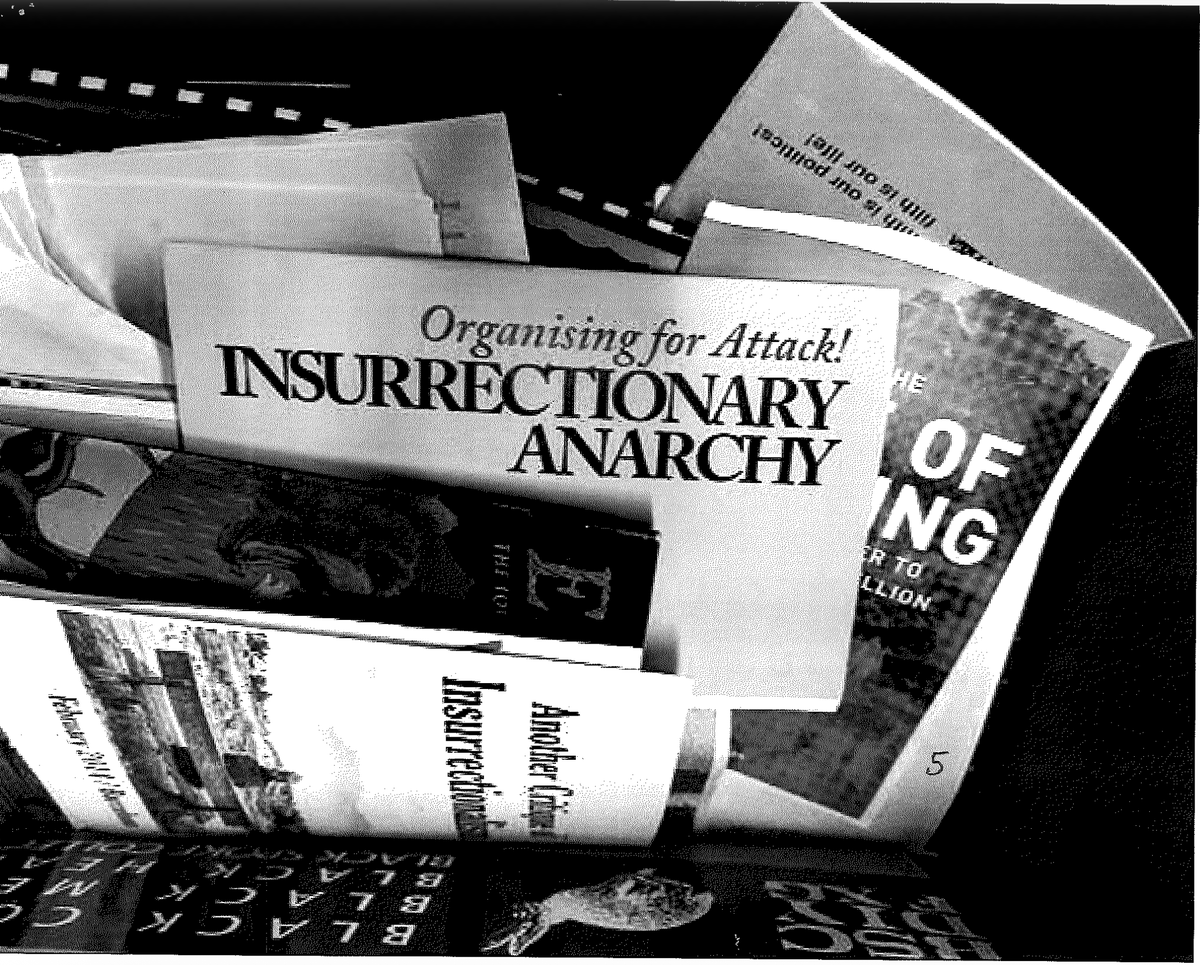
A box of 'antifa materials' described as 'incriminating evidence.' Picture: U.S. Department of Justice

The U.S. government plans to dramatically expand its Texas “antifa” prosecution by adding new defendants to its “militant enterprise” case against two individuals charged with terrorism conspiracy related to a summer attack on an immigration enforcement facility.

Federal prosecutors said in a court filing earlier this month they plan to seek a superseding indictment that would add new defendants to the case against Zachary Evetts and Summer Hill, who are among 15 individuals charged in connection to the July 4 attack on the Prairieland ICE facility in Alvarado, Texas, in which a local police officer sustained a gunshot wound.

The 15 defendants made their first appearances in federal court in Fort Worth on Sept. 23 — one day after President Donald Trump declared “antifa” (short for “anti-fascist”) groups to be “a militarist, anarchist enterprise” and less than two weeks after the assassination of conservative influencer Charlie Kirk prompted a frenzied mobilization by the administration and its allies to crack down on the political left.

Antifa is a decentralized movement with roots in militant opposition to fascism in Europe during the run-up to World War II. Contemporary antifascists typically operate individually or in small, local affinity groups to infiltrate, disrupt and expose violent Nazis, while providing support to marginalized groups targeted by them. Drawing on anarchist and Marxist beliefs that the state is an unreliable partner in protecting people from fascist violence, antifascists are often willing to act outside the bounds of the law.

Among the 15 defendants in Texas, Evetts and Hill were the only two who refused to go along with the government’s motion to continue, forcing prosecutors to take their evidence before a grand jury to obtain a separate indictment. That indictment alleges that those involved in the Prairieland attack were members of “a North Texas Antifa Cell.”

Evetts’ lawyer, Patrick McLain, has said his client went to the ICE facility on July 4 with the intention of protesting and shooting fireworks, and has emphatically denied that Evetts fired a gun at authorities or was even carrying a firearm.

The only defendant the government has identified as an alleged shooter is Benjamin Song, a former Marine Corps reservist with a history of providing firearms training to pro-LGBTQ+ and antifascist activists in north Texas.

Described by the government as “a leader” of “the antifa cell,” Song is among the 13 defendants who went along with the government’s request to continue the cases.

The government has offered plea deals to Song and the other 12 defendants, and prosecutors said in the motion filed on Nov. 3 that they expect “a fair number of the offers will be accepted.”

Any who refuse the plea offers can be expected to be added to the “antifa enterprise” indictment against Evetts and Hill, the motion said.

A federal judge has agreed to the government’s motion to designate the prosecution as a complex case, allowing the government additional time to prepare and pushing back Evetts and Hill’s trial date, originally set for Nov. 24. A new date will be set after the government obtains a superseding indictment, according to the order.

McLain appealed the decision in a federal court filing on Monday, arguing that the government’s request for a complex case designation is motivated by a desire to try all the defendants together rather than give Evetts and Hill a separate trial.


The lawyer argued that the maneuver amounts to “a government effort to make cooperating witnesses better available … by handling their plea agreements first and making their cooperation a condition of their agreement.”

The motion also noted that the case has been widely publicized as the first “antifa” prosecution.

One former Department of Justice counterterrorism lawyer has warned that the government’s choice to define “antifa” as an “enterprise” raises concerns about a potential “dragnet” that could implicate people who may align ideologically but are not involved in violent activity.


“The public has a strong interest in understanding where their constitutional rights end and their exposure to novel criminal prosecution begins,” McLain wrote in the motion.

“While it is pending, this prosecution cannot help but chill the public’s exercise of its constitutional rights.”

Judge Mark Pittman disagreed, turning down Evetts’ request in an order issued on Wednesday.


Pittman has likewise denied requests by McLain to prohibit the government from using the terms “antifa” and “socialist” during jury selection and opening statements, and making reference to any firearms seized.

McLain argued that the charges against his client “are heavily dependent on the actions of others, particularly Coconspirator-1,” whose described actions in the indictment align with the government’s allegations against Song.

The government should prove its case by presenting evidence of Evetts’ “overt acts… in furtherance of a conspiracy or aiding and abetting it,” McLain argued, “rather than through evidence amounting to the exercise of his constitutionally protected rights of assembly and speech under the First Amendment and gun ownership under the Second Amendment.”


The Prairieland defendants’ alleged membership in “antifa” is likely to play a central role in the government’s case.

Prosecutors notified the court earlier this month that in addition to expert witness testimony on gun-shot residue, DNA analysis and fingerprints, the government plans to call an expert witness on counterterrorism “to testify about antifa, its origins and beliefs, and how the attack on Prairieland bore hallmarks of an antifa attack.”

Kyle Shideler, the expert witness, is director and senior analyst for homeland security and counterterrorism at the right-leaning Center for Security Policy. Last month, he testified at a hearing on political violence held by the Senate Subcommittee on the Constitution.

During the Senate hearing, Shideler endorsed the description of “antifa” in the indictment against Evetts and Hill as “a good working definition.”

‘Incriminating evidence’

In a related case, prosecutors have described a box seized by law enforcement that “contained numerous Antifa materials” as “incriminating evidence.”

An indictment unveiled last month alleges that the defendant, Daniel Rolando Sanchez Estrada, conspired with “Coconspirator-1,” understood to be Song, by moving the box from the Fort Worth home of his girlfriend, who had been arrested in connection with the Prairieland attack, to an apartment in Denton.


The government describes the “antifa materials” as “insurrection planning, anti-law enforcement, anti-government, and anti-immigration enforcement documents and propaganda.”

Sanchez is accused of moving the materials with the intent “to conceal the contents of the box and impair its availability for use in a federal grand jury and federal criminal proceeding.”

The materials include a collection of photocopied, staple-bound booklets. Among the titles, according to the complaint, are War in the Streets: Tactical Lessons from the Global Civil War and Another Critique of Insurrectionalism, February 2014/Barcelona.

The preface of War in the Streets, published in 2016, describes a “series of situated and intelligent reflections on black blocs, street clashes and related tactics of confrontation,” intended as a practical guide for refining tactics as they relate “to the larger insurrectional process.”

The collection offers a profusion of passages that prosecutors might reference to make the case that the Prairieland defendants were part of an “antifa enterprise.”

“The practice of conspiracy, of strategic thought, of breathing together,” one reads, “must be a commons of skills and new forms that we all draw from.”


Jordan Green is a North Carolina-based investigative reporter at Raw Story, covering domestic extremism, efforts to undermine U.S. elections and democracy, hate crimes and terrorism. Prior to joining the staff of Raw Story in March 2021, Green spent 16 years covering housing, policing, nonprofits and music as a reporter and editor at Triad City Beat in North Carolina and Yes Weekly. He can be reached at jordan@rawstory.comMore about Jordan Green.


US designates four European anti-fascist groups as terrorist organisations

FILE: The US State Department seal is seen on the briefing room lectern at the State Department HQ in Washington, 31 January 2022
Copyright AP Photo

By Euronews
Published o

The US State Department labelled four European far-left groups as terrorist organisations, including Germany's Antifa Ost and Italy's International Revolutionary Front.

The US government designated four European anti-fascist groups as terrorist organisations as part of President Donald Trump's crackdown on the far left following the assassination of conservative activist Charlie Kirk.

US Secretary of State Marco Rubio said on Thursday that Washington would designate German-based Antifa Ost, Italy-based International Revolutionary Front, and two other groups in Greece, Armed Proletarian Justice and Revolutionary Class Self Defence, as "Specially Designated Global Terrorists".

"Groups affiliated with this movement ascribe to revolutionary anarchist or Marxist ideologies, including anti-Americanism, 'anti-capitalism,' and anti-Christianity, using these to incite and justify violent assaults domestically and overseas," Rubio said.

"The United States will continue using all available tools to protect our national security and public safety and will deny funding and resources to terrorists, including targeting other Antifa groups across the globe," he added.

These groups are accused of "conspiring to undermine the foundations of Western civilisation through their brutal attacks," according to a US State Department statement.

Antifa is short for "anti-fascist," a broad umbrella of loosely affiliated, decentralised activists on the far left of the political spectrum.

Who are the groups Washington blacklisted?

The State Department said the German-based Antifa Ost "committed numerous attacks against people it perceives as 'fascists' or part of the 'right-wing scene' in Germany between 2018 and 2023."

The organisation is also accused of having "conducted a series of attacks in Budapest in mid-February 2023." Hungary had already placed the group on its national terror list at the end of September.

The Italy-based International Revolutionary Front, also known as the Informal Anarchist Federation, first came to public attention in 2003 and 2004, when it sent explosive packages to then-European Commission President Romano Prodi.

The group also sent letter bombs and explosive packages to former Deutsche Bank chief Josef Ackermann, politicians, newspaper offices and foreign embassies in Italy.

Armed Proletarian Justice is the name of a Greece-based group that took responsibility for planting a bomb, which failed to explode, outside the Athens riot police building in December 2023.

Two months later, a bomb detonated at Greece's labour department, and a new network calling itself Revolutionary Class Self-Defence claimed credit.

It also took credit for an explosion earlier this year outside the offices of the country's main train company.

The designation comes into effect on 20 November, according to Rubio.


US State Department Designates European Antifa Groups Foreign Terror Organizations


November 14, 2025 
The Center Square
By Sarah Roderick-Fitch


(The Center Square) – The U.S. State Department officially designated four foreign Antifa groups as foreign terrorist organizations, nearly two months after President Donald Trump designated Antifa a domestic terror organization.

The designations pave the way for the State Department to target individuals or groups by cutting off or freezing their access to global financial systems to curb potential attacks.

The designations come after The Center Square asked the president if he would designate the group a foreign terror organization during a roundtable at the White House on Antifa, comprised of independent journalists, to which Trump responded, “Let’s get it done.”

The State Department identified four European-based organizations, which either claimed or have been accused of carrying out a series of violent attacks in a handful of countries.

The groups include German-based Antifa Ost, which the State Department says has been known for “wielding hammers in premeditated attacks.” The group was designated a terror organization in Hungary in September after a “series” of attacks in Budapest occurring in February 2023. The group has also been accused of several attacks in Germany between 2018 and 2023.


The second group, The International Revolutionary Front, an Italian-based group, is described as a “coalition of violent anarchists,” which has claimed responsibility for a shooting and injured several people after the group “sent a series of bombs” to political leaders, embassies, and civilians. The State Department stated that, despite the group operating out of Italy, it has “proclaimed affiliates” in Europe, South America and Asia.

The third group, a Greek-based organization, the Armed Proletarian Justice group, is described as anarchists who have waged “armed conflict against police officers and state infrastructure.” State said in a failed attack, the group planted a homemade dynamite bomb near a riot police headquarters in 2023.

The final group, also a Greek-based anarchist organization, known as the Revolutionary Class Self Defense, claimed responsibility for an attack on the Greek Ministry of Labor in 2024 and recently targeted major railway offices in April. The State Department says that the group used improvised explosive devices in those attacks.

“Today, building on [President Donald Trump’s] historic commitment to uproot Antifa’s campaign of political violence, the Department of State is designating four Antifa groups as Foreign Terrorist Organizations and Specifically Designated Global Terrorists. The United States will continue using all available tools to protect our nation from these anti-American, anti-capitalist, and anti-Christian terrorist groups,” Secretary of State Marco Rubio posted on X.

The State Department indicated that there could be more organizations designated as the Trump administration continues to “identify and disrupt Antifa’s terror networks across the world.”

The foreign designations are essential in “denying them access to the U.S. financial system and resources,” which can aid in attacks.

“All property and property interests of designated individuals or groups that are in the United State or that are in possession or control of a U.S. person are blocked,” according to a fact sheet from the State Department. “U.S. persons are generally prohibited from conducting business with sanctioned persons. It is also a crime to knowingly provide material support or resources to those designated, or to attempt or conspire to do so.”

The latest designation comes less than two months after The Center Square asked the president in the Oval Office if he would designate the leftist group a domestic terror organization, which he agreed to do. A week later, the group was officially designated a domestic terror organization.

Attorney General Pam Bondi said the federal government is committed to pursuing violent Antifa members but also their funders, in line with the expansion of designating some of the groups as foreign terror organizations.

“We’re not going to stop at just arresting the violent criminals we can see in the streets,” Bondi said. “Fighting crime is more than just getting the bad guy off of the street. It’s breaking down the organization brick by brick. Just like we did with cartels. We’re going to take this same approach, President Trump, with Antifa. Destroy the entire organization from top to bottom.”

The designations follow a recent rise in violent protests in cities like Portland and Chicago, with immigration and customs enforcement facilities and agents being targeted by leftist groups, including Antifa. Most recently, the group has been accused of taking part in a violent protest at Berkeley University during a Turning Point USA event. The protests are now under investigation by the U.S. Department of Justice.


The Center Square

The Center Square was launched in May 2019 to fulfill the need for high-quality statehouse and statewide news across the United States. The focus of their work is state- and local-level government and economic reporting.


Tuesday, June 02, 2020


President Trump says he is designating Antifa as a domestic terror organization following widespread protests. There are no legal consequences to that designation.

Alex Nicoll
May 31, 2020, 1:28 PM

\
Antifa take to the streets in Washington, DC, July 6, 2019. 
Evelyn Hockstein/The Washington Post


America has seen major protests across the country for five nights, with frequent clashes between the police and protestors, following the death of George Floyd. 

President Donald Trump and Attorney General William Barr have both blamed the worst violence on anarchists and Antifa, a left-wing political movement. 

On Sunday, President Trump tweeted that he would designate Antifa as a domestic terrorist organization. 

There are no legal consequences for designating a group as a domestic terror organization, but all 56 regional FBI Joint Terrorism Task Forces have been monitoring the protests. 

President Donald Trump tweeted Sunday afternoon that the United States would be designating the left-wing political movement Antifa a domestic terrorist organization.

The news comes after five nights of protests across America protesting the police killing of George Floyd. Saturday saw the highest tension yet, with police shooting tear gas and less-lethal projectiles at protestors, some of who responded by throwing bricks and bottles and, in some cities, lighting police vehicles on fire and looting stores.

On Saturday, the President blamed Antifa, short for anti-fascist, and other left-wing groups for the riots and looting.

"The memory of George Floyd is being dishonored by rioters, looters and anarchists. The violence and vandalism is being led by Antifa and other radical left-wing groups who are terrorizing the innocent, destroying jobs, hurting business and burning down buildings. The main victims of this horrible, horrible situation are the citizens who live in these once lovely communities," the president said.


The State Department can designate foreign organizations as terrorist organizations, but there is no law governing domestic organizations. At the moment, it is unclear what President Trump's tweet refers to in concrete legal steps. The Patriot Act defines domestic terrorism, but there are no federal crimes tied to domestic terror.

Trump said in July of 2019 that he was considering declaring Antifa an "Organization of Terror."

Another challenge is the nature of Antifa, which is less of an organization, with structure and leaders, than a decentralized movement. Antifa is a global movement largely made up of anarchists, socialists, and other left-wing groups that oppose right-wing authoritarianism and white supremacy, sometimes violently. Unlike other radical groups, there is no controlling organizational structure, choosing instead to operate semi-autonomously and without leaders.

Antifa is known for its black-bloc protest tactics, where protestors wear all black and cover up their face so that they can't be identified by police or right-wing opponents.


Antifa's name comes from the pre-World War 2 German group Antifaschistische Aktion, which resisted the Nazi German state, and birthed the design of Antifa's now infamous flag.
Getty Images

Antifa gained much more public attention under the Trump presidency, as the movement disrupted events with far-right speakers across the country, such as Vice and Proud Boy founder Gavin McInnis's speech at the Metroplitan Republican Club. Most notably, the organization faced off against the white nationalist Unite the Right rally.

Noted black clergyman and left-wing activist Cornel West told Democracy Now that Antifa protected him and other clergy from the worst of the white nationalist violence.

"We would have been crushed like cockroaches were it not for the anarchists and the anti-fascists," he told Democracy Now. "You had police holding back and just allowing fellow citizens to go at each other."


Trump, in his response to the Charlottesville protest, said that he blamed Antifa and the "alt-left" for violence as well.

"What about the alt-left who came charging at the alt-right?" Trump said at a press conference.

Attorney General William Barr also blamed "anarchist and far-left extremist" groups for the violence on Saturday. On Sunday, the Attorney General's office released guidance that said that the his office is working with the 56 regional FBI Joint Terrorism Task Forces to "identify criminal organizers and instigators."

AG Barr: "To identify criminal organizers and instigators, and to coordinate federal resources with our state and local partners, federal law enforcement is using our existing network of 56 regional FBI Joint Terrorism Task Forces (JTTF). " pic.twitter.com/mueuIo8LSa— Zeke Miller (@ZekeJMiller) May 31, 2020

It is unclear what other avenues the federal government may use to pursue enforcement actions against Antifa, but the FBI Agents Association has been lobbying for the creation of a domestic terrorism law.

Wednesday, September 21, 2022

Antifa on trial: How one criminal case could redefine the murky left-wing movement


Will Carless, USA TODAY
Wed, September 21, 2022 

LONG READ


A pedestrian jogs past counter-protesters, some carrying Antifa flags, as they wait to confront a "Patriot March" demonstration in support of Donald Trump near the Crystal Pier on Jan. 9, 2021 in the Pacific Beach neighborhood of San Diego, California.

On Jan. 9, 2021, three days after the insurrection at the U.S. Capitol, a mob of white supremacists, Proud Boys and other supporters of President Donald Trump descended on the neighborhood of Pacific Beach in San Diego.

Wearing body armor and carrying wooden sticks and flagpoles, the group marched through town holding up Nazi salutes, snarling at locals in the beachfront bars, and shouting the same chant that had been used on the streets of the capital days before: “F--- Antifa!”

Waiting to meet the mob was a horde of black-clad self-proclaimed anti-fascists or Antifa, who had organized to “protect” Pacific Beach from these outside provocateurs. As the two groups clashed, despite the efforts of dozens of police officers, brawls broke out. Supporters on both sides plus bystanders of all stripes had their phones up, ready to record the action on video.


Anti-fascists, dressed head-to-toe in black, pepper sprayed Trump supporters in the face, gleefully shouting “Proud Boy killa!” Another group of counterprotesters confronted and attacked a Trump supporter who then drew a knife on them. In an alleyway, away from the main crowd, a group of assorted right-wing extremists surrounded a young man in a George Floyd T-shirt, sucker-punching him and smashing his nose.


In the months that followed, video was reviewed, warrants were issued and homes were searched. And almost a year later, a criminal case emerged, one that now stands to have an impact far beyond San Diego. Experts say it could be a landmark prosecution that changes how American law enforcement tackles the much-misunderstood movement known as Antifa.

San Diego County District Attorney Summer Stephan announced a raft of felony charges for the activities on Jan. 9, after an investigation of “multiple allegations of violent criminal conduct,” “video evidence analysis” and searches and arrests across two counties.

And every person charged was from the Antifa side. No Trump supporter had been charged, or even arrested.


Since then, prosecutors have added charges against more people identified by prosecutors as Antifa, for a total of 11 defendants.

Stephan’s office claims the Antifa side was “overwhelmingly” responsible for the violence. But experts familiar with the case say it was an extraordinary decision to not charge anyone in the far-right group that actually targeted the community, especially given the videos that exist showing them engaging in violence. The question is less about whether the Antifa charges are warranted and more about whether this is a case of selective prosecution, they said.


Counter-protesters, some carrying ANTIFA flags, stand beneath palm trees on the beach awaiting to confront demonstrators for a "Patriot March" demonstration in support of US President Donald Trump on Jan. 9, 2021, in the Pacific Beach neighborhood of San Diego, California.

Only prosecuting one side of a melee raises serious questions about Stephan’s political motives, said Patrick Cotter, a former Chicago federal prosecutor who has practiced criminal law for 40 years.

“When you've got a situation where there's two organized groups who both decided to fight each other, and only one side gets charged and the other side gets to walk, it's idiotic,” Cotter said. “It's an insult to the public's intelligence to suggest that that's a legitimate prosecution. It's not. It's selective prosecution.”

A USA TODAY investigation revealed the victims in the DA's case include people identified by activists as white supremacist agitators notorious for spurring fights in neighborhoods where they're not welcome. At least one has a criminal record and has long been involved with neo-Nazi groups.

The victims also include other Trump supporters, some of whom remain unidentified by the district attorney. Local anti-fascist activists say they have identified several other white supremacists who were present at the rally.

But the first-of-its kind Antifa prosecution could also have implications far beyond the parties to the case.

Influential far-right commentators and conspiracy theorists like Alex Jones and Tucker Carlson and conservative politicians all the way up to former President Donald Trump have long claimed Antifa is not just a disparate social movement but an organized, shadowy army hell-bent on destroying America.

That’s a caricature of Antifa that Stephan herself has previously embraced. She sparked controversy during her election campaign in 2018 when she paid for a website strewn with images of black-clad protesters that shared far-right antisemitic extremist conspiracy theories about billionaire philanthropist George Soros.

If the case against the San Diego 11 succeeds, it could open the doors to conservative prosecutors around the country to target a progressive social movement that has been ill-defined and misunderstood for years, experts said.

“It could be used as ammunition by people who are opposed to Antifa, or what they think of as Antifa,” said Mark Pitcavage, a senior research fellow at the Anti-Defamation League’s Center on Extremism. “And it might also inspire other conservative prosecutors in different places to try similar prosecutions, thinking ‘We might be able to replicate that success.’”

More: Extremist Boogaloo Bois back on Facebook since Mar-a-Lago raid as anger toward feds mounts
'Making a presence and inciting some kind of retaliation'

When San Diego Deputy District Attorney William Hopkins set the scene for the 19 grand jurors gathered to hear the Antifa case in a downtown San Diego court building in May, he described the planned Pacific Beach event as “A conservative demonstration. A flag waving. A patriot march,” according to court records.

People bicycle past counter-protesters, some holding Antifa flags, awaiting demonstrators for a "Patriot March" demonstration in support of US President Donald Trump on Jan. 9, 2021 in the Pacific Beach neighborhood of San Diego, California.


But Mike Brown, who has lived in the Pacific Beach area for 30 years, said he didn’t see much patriotism on display on Jan. 9, 2021.

A history teacher and surfer, Brown said he was riding his bike in Pacific Beach when he was shocked to see the crowds of far-right and far-left protesters in the largely peaceful neighborhood. The pro-Trump group were not your average political crowd, Brown said.

“These guys weren't just Trump supporters, a lot of them were Proud Boys – you know, wearing the black and the yellow,” Brown said. Those outfits can be seen in some of the videos. “I don't know where they were from, but what pissed me off about it all was that they came into our community and disrupted business, took over the streets, created a lot of tension for a whole afternoon and it wasn't even a local grassroots movement.”

What Pacific Beach witnessed that day was a typical incursion into a mostly liberal neighborhood by far-right agitators who wanted to cause trouble, said Brian Levin, director of the Center for the Study of Hate and Extremism at California State University, San Bernardino.

Far-right extremists have long used the same tactics, Levin said: Arranging a hostile display of force in a neighborhood that they know is likely to oppose them, then stirring up violence from anyone who confronts them.

“The history of these paramilitary groups on the far-right is really about two things: making a presence and inciting some kind of retaliation, and then using that as an excuse to significantly escalate violence,” Levin said.

San Diego Police Department logs from the day describe the same chaos seen in the videos. The logs describe people in "Antifa gear" chasing and fighting with others wearing "Trump gear." At 4:31 p.m. the police log reads, "Protest being hijacked by Proud Boys. Very anti-police and refusing to comply."

A pepper ball (L), exits the barrel of a San Diego Police Department (SDPD) officer's Tippmann FT-12 paintball gun while firing pepper balls towards counter-protesters at a "Patriot March" demonstration, Jan. 9, 2021 in the Pacific Beach neighborhood of San Diego, California.


The indictment against the Antifa defendants lists 11 incidents in which prosecutors allege they committed crimes ranging from illegal use of pepper spray to punching, kicking and striking their opponents with a baseball bat.

Antifa activists, holding a banner reading “Antifascist Action” and chanting “racists go home” can also be seen in videos on YouTube attacking people marching on the pro-Trump side. In numerous altercations, black-clad counterprotesters chase people down the street, hit them with flagpoles and skateboards and spray pepper spray in their faces. Antifa activists also faced off against San Diego Police officers, who used less-than-lethal force against them.

But apparent assaults committed by the other side were also caught on camera.

Brown said he witnessed the attack by far-right extremists on the man and his female companion in an alley. He said a group had broken off from the main protest and assaulted the man, who was wearing a shirt with George Floyd’s image on it and the slogan “No Justice, No Peace,” on the back. The attack was unprovoked, Brown said.

“One guy comes up and just totally sucker punches him and takes him to the ground and then they move on,” he said.

Brown’s account is backed up by a video taken by Amie Zamudio, a local homeless activist, who can be heard pleading with the aggressors to leave their victims alone. Zamudio told USA TODAY she was concerned the man might be homeless because he was walking barefoot, and when she approached him, she saw the pro-Trump aggressors attack him without any provocation.

Brown and Zamudio both said they have never been contacted or interviewed by the District Attorney’s office or investigators with the San Diego Police Department. The man seen in that attack has not been publicly identified, and it's unclear if anyone has filed a police report about the incident.

In another incident, a group of black-clad activists chase three men down the street. One of the men turns and advances before them holding a knife in his right hand.

And another video shows one of the Trump supporters picking up a smoke canister and throwing it towards the anti-fascists as at least a dozen San Diego police officers look on.

Levin and others familiar with the case said given the wide array of violence from both groups, it’s hard to understand why only one side of the altercation is facing charges.

“I am not excusing, in any way, possible criminal conduct on the left,” he said. “But when we look at the array of antagonists that showed up, and their record of criminality and violence, it causes a particular question in the public's mind: What kind of fair-handed investigation was done by authorities and what evidence was reviewed?”

Cotter, the former federal prosecutor, said there’s a simple answer to those questions: politics.

“This is about votes,” he said. “It's about politics. It's about some prosecutor trying to burnish their brand, looking at voters, and saying ‘Who can I prosecute that will give me the most votes?’ and, “If I prosecuted these other guys, would that give me votes or cost me votes?”

The San Diego District Attorney’s Office did not agree to an interview with USA TODAY, but provided a statement including:

“When evidence and facts support criminal charges, we will file them, as we did in July 2020 with a white supremacy group that attacked Black Lives Matter peaceful protesters and when we charged a white supremacist with murder and a hate crimes allegation for killing an innocent Jewish woman at the Chabad of Poway synagogue in April 2019. We obtained convictions in both cases.”

More: FBI agents monitor social media. But who are they watching?
Prosecutors want victims' names hidden

In an unusual legal twist, the prosecutors of the San Diego case asked the superior court judge overseeing it to grant a protective order forbidding the defense attorneys from copying or sharing any documents that identify the alleged victims of the attacks by Antifa with anyone outside the legal team.

That means even if they’re asked, the defense attorneys can’t provide documents identifying who the alleged victims are, even to their clients.

The move, usually reserved for cases involving organized crime like the mafia or gang cases, is designed to protect witnesses and victims from being further targeted by their aggressors. In this case, the prosecutors argued, the victim’s names needed to be kept secret because they might be targeted by Antifa’s network of online sleuths, who might “doxx” them – a slang term for publishing personal information about someone on the internet, for the purpose of intimidating or encouraging others to target them.

The timing of the protective order was unusual, too.

The names of several of the victims have already been shared by Antifa-affiliated social media accounts multiple times. Indeed, in making their case to the judge that the names should be kept secret, prosecutors presented a screenshot of a local anti-fascist Twitter account sharing the names of several people USA TODAY confirmed are among the victims attacked by Antifa. That screenshot remains in publicly available court records.

A USA TODAY investigation found that people named in that tweet have histories of associating with white supremacist organizations and local racist groups in the San Diego area. They include two people from San Diego who have been identified by activists marching in several pro-Trump rallies wearing shirts emblazoned with the logo of American Guard, which the ADL describes as “Hard core white supremacists” and which grew out of two other racist organizations.

Almost all of the victims referred to in court documents only by their initials have long been well-known to local anti-fascists. Indeed, that’s why they were targeted with violence in the first place, three local anti-fascist sources told USA TODAY.

USA TODAY confirmed the names publicly announced by the Antifa Twitter account @SDAgainstFash with one of the defense attorneys on the case.
Antifa both 'a real thing' and a boogeyman

Perhaps more than any other extremist group in America, Antifa has been hard for academics and experts to pin down.

Unlike the Ku Klux Klan, which has a defined leadership structure, or the Proud Boys, which has a clear membership process, Antifa typically eschews any sort of organizational architecture. There’s no central leadership, no set membership process, and no real prerequisites for being an anti-fascist other than simply acting like one.

Plus, anti-fascist activists constantly engage in a semantic dance, employing the rejoinder “If you’re not anti-fascist, then you’re a fascist,” defying easy answers about whether anyone is a member of the movement.

This vagueness has led to a concerted effort by far-right-wing commentators, conspiracy theorists and pundits to discredit Antifa whenever possible. In the absence of a clear definition of the group, Antifa is often portrayed, even on mainstream channels like Fox News, as a highly organized, malevolent force with massive numbers and a clearly defined goal: To sow chaos and disorder on America’s streets.

Anti-fascists certainly do communicate with each other, said Mark Bray, a lecturer in history at Rutgers University and author of "Antifa: The Anti-Fascist Handbook." Anti-fascists in certain regions occasionally hold meetings, but the movement is still far from the regulated force that has been depicted.

“As it's become something more well known, it's become a real thing, but it's also become a boogeyman,” Bray said. "A very common phrase in right-wing circles is ‘BLM-slash-Antifa, which is, I think, essentially, their way of saying violent black leftists and violent white leftists.”

Stephan’s 2018 campaign website appeared to endorse this perception of Antifa. The website, which disappeared after negative media attention, claimed that left-wing philanthropist George Soros funded “anti-law enforcement candidates over experienced prosecutors, trying to tip the balance to the criminals.”

In 2020, Stephan again made headlines after her office charged Black Lives Matter activist Denzel Draughn with eight felonies after Draughn pepper-sprayed SDPD officers he said were attacking a fellow protester. Draughn was acquitted of all the charges at trial.

Dawn Perlmutter, the main expert witness who will testify about Antifa for prosecutors, also has a history of writing for right-wing websites. Perlmutter is an academic who teaches police departments about symbology and extremist movements, but she is also an adjunct professor of osteopathic medicine.

In one article, she described the Black Lives Matter racial justice movement as an “anti-police hate fest.” She decried pro-BLM protestors as “self-loathing affluent white middle-aged women attempting to show how woke they are.” Perlmutter acknowledged to USA TODAY that she wrote the stories.

The San Diego prosecution aims to prove that the black-clad people who committed violence on Jan. 9, 2021, in Pacific Beach weren’t just fired up by a common philosophy or hatred of Trump, or animosity towards authority. By charging the defendants with conspiracy, the prosecutors want to make the case that they acted more like a gang, with a unified goal, common symbols and shared tactics.

From a strictly legal perspective, that could have a significant impact on the defendants who are charged with conspiracy, because the charge could effectively double their sentences for other crimes.

People eating a meal at the beach take pictures as counter-protesters, some carrying Antifa flags, march in opposition to demonstrators holding a "Patriot March" in support of President Donald Trump on January 9, 2021 in the Pacific Beach neighborhood of San Diego, California.

But cases like this aren’t just about the individual outcomes for the San Diego 11, said Cotter, the former federal prosecutor. In a country supercharged by political division, animosity and violence, prosecutions like this are often as much about sending a message out into the world as they are about bringing justice to people who may well have committed crimes, he said.

“If a prosecutor anywhere is successful prosecuting any kind of unusual new kind of case, other prosecutors pay attention,” Cotter said.

He compared the Antifa case to the widespread prosecution of American labor organizers in the early 20th Century. Until unionization was protected by Congress, the movement was a soft target for conservative lawmakers obsessed with targeting progressive causes, Cotter said.


”Prosecutors are politicians looking for ways to build their brand,” he said. “If it’s politically to their advantage to be seen prosecuting these kinds of cases, whether it's Antifa or Hells Angels, or Mexican drug cartels, then other prosecutors pay attention and say, OK, well maybe there's a blueprint there.”

One of the San Diego 11 remains in custody. He and the other 10 defendants face a trial that has been continually delayed but will likely start in the spring.

The trial will be closely watched not just by anti-fascists across the country, but also by conservative pundits, politicians and prosecutors who will finally see whether their perception of Antifa as America’s dark, mysterious underbelly really stands up in court.