Trump DOJ poised to dramatically expand Texas 'antifa' prosecution
November 14, 2025
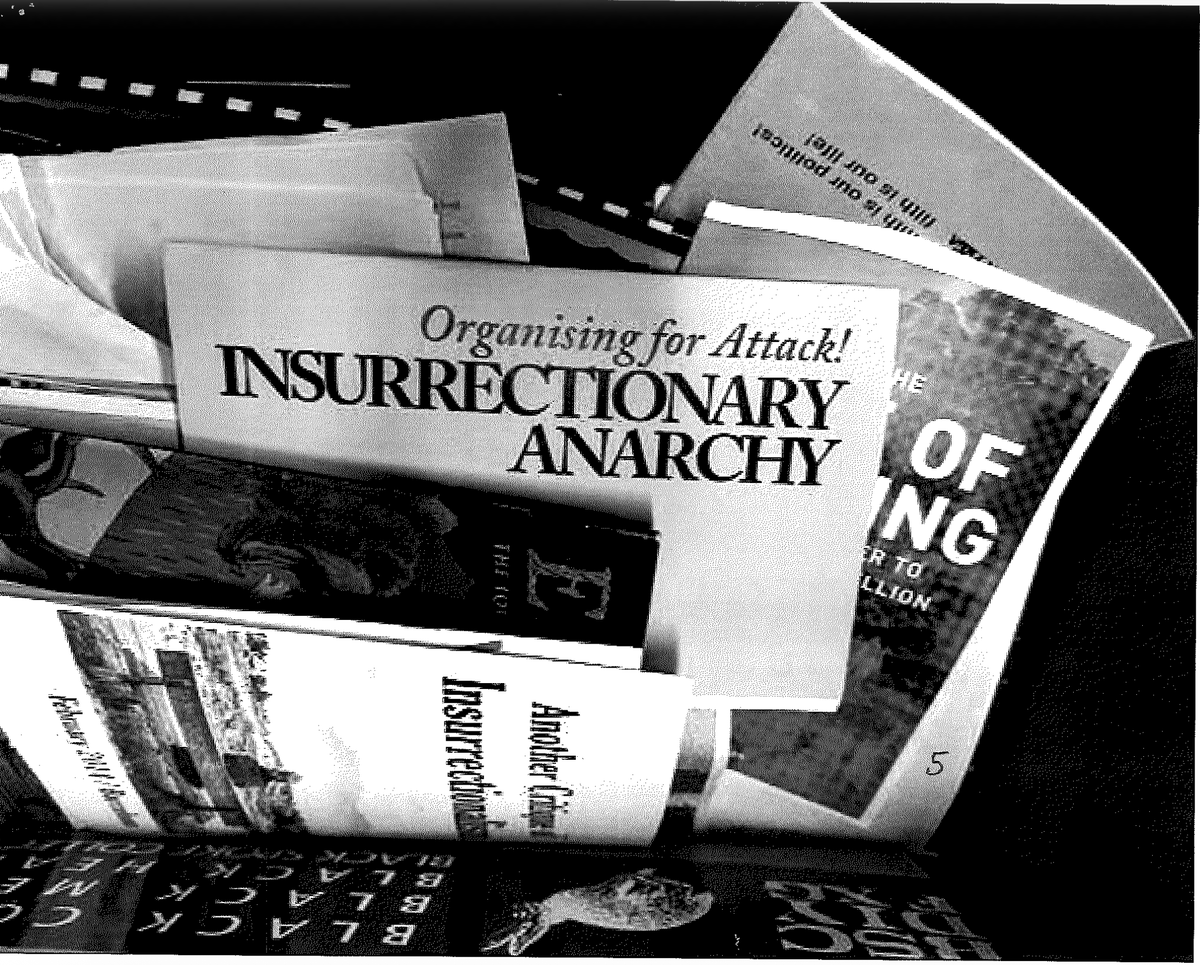
A box of 'antifa materials' described as 'incriminating evidence.' Picture: U.S. Department of Justice
The U.S. government plans to dramatically expand its Texas “antifa” prosecution by adding new defendants to its “militant enterprise” case against two individuals charged with terrorism conspiracy related to a summer attack on an immigration enforcement facility.
Federal prosecutors said in a court filing earlier this month they plan to seek a superseding indictment that would add new defendants to the case against Zachary Evetts and Summer Hill, who are among 15 individuals charged in connection to the July 4 attack on the Prairieland ICE facility in Alvarado, Texas, in which a local police officer sustained a gunshot wound.
The 15 defendants made their first appearances in federal court in Fort Worth on Sept. 23 — one day after President Donald Trump declared “antifa” (short for “anti-fascist”) groups to be “a militarist, anarchist enterprise” and less than two weeks after the assassination of conservative influencer Charlie Kirk prompted a frenzied mobilization by the administration and its allies to crack down on the political left.
Antifa is a decentralized movement with roots in militant opposition to fascism in Europe during the run-up to World War II. Contemporary antifascists typically operate individually or in small, local affinity groups to infiltrate, disrupt and expose violent Nazis, while providing support to marginalized groups targeted by them. Drawing on anarchist and Marxist beliefs that the state is an unreliable partner in protecting people from fascist violence, antifascists are often willing to act outside the bounds of the law.
Among the 15 defendants in Texas, Evetts and Hill were the only two who refused to go along with the government’s motion to continue, forcing prosecutors to take their evidence before a grand jury to obtain a separate indictment. That indictment alleges that those involved in the Prairieland attack were members of “a North Texas Antifa Cell.”
Evetts’ lawyer, Patrick McLain, has said his client went to the ICE facility on July 4 with the intention of protesting and shooting fireworks, and has emphatically denied that Evetts fired a gun at authorities or was even carrying a firearm.
The only defendant the government has identified as an alleged shooter is Benjamin Song, a former Marine Corps reservist with a history of providing firearms training to pro-LGBTQ+ and antifascist activists in north Texas.
Described by the government as “a leader” of “the antifa cell,” Song is among the 13 defendants who went along with the government’s request to continue the cases.
The government has offered plea deals to Song and the other 12 defendants, and prosecutors said in the motion filed on Nov. 3 that they expect “a fair number of the offers will be accepted.”
Any who refuse the plea offers can be expected to be added to the “antifa enterprise” indictment against Evetts and Hill, the motion said.
A federal judge has agreed to the government’s motion to designate the prosecution as a complex case, allowing the government additional time to prepare and pushing back Evetts and Hill’s trial date, originally set for Nov. 24. A new date will be set after the government obtains a superseding indictment, according to the order.
McLain appealed the decision in a federal court filing on Monday, arguing that the government’s request for a complex case designation is motivated by a desire to try all the defendants together rather than give Evetts and Hill a separate trial.
The lawyer argued that the maneuver amounts to “a government effort to make cooperating witnesses better available … by handling their plea agreements first and making their cooperation a condition of their agreement.”
The motion also noted that the case has been widely publicized as the first “antifa” prosecution.
One former Department of Justice counterterrorism lawyer has warned that the government’s choice to define “antifa” as an “enterprise” raises concerns about a potential “dragnet” that could implicate people who may align ideologically but are not involved in violent activity.
“The public has a strong interest in understanding where their constitutional rights end and their exposure to novel criminal prosecution begins,” McLain wrote in the motion.
“While it is pending, this prosecution cannot help but chill the public’s exercise of its constitutional rights.”
Judge Mark Pittman disagreed, turning down Evetts’ request in an order issued on Wednesday.
Pittman has likewise denied requests by McLain to prohibit the government from using the terms “antifa” and “socialist” during jury selection and opening statements, and making reference to any firearms seized.
McLain argued that the charges against his client “are heavily dependent on the actions of others, particularly Coconspirator-1,” whose described actions in the indictment align with the government’s allegations against Song.
The government should prove its case by presenting evidence of Evetts’ “overt acts… in furtherance of a conspiracy or aiding and abetting it,” McLain argued, “rather than through evidence amounting to the exercise of his constitutionally protected rights of assembly and speech under the First Amendment and gun ownership under the Second Amendment.”
The Prairieland defendants’ alleged membership in “antifa” is likely to play a central role in the government’s case.
Prosecutors notified the court earlier this month that in addition to expert witness testimony on gun-shot residue, DNA analysis and fingerprints, the government plans to call an expert witness on counterterrorism “to testify about antifa, its origins and beliefs, and how the attack on Prairieland bore hallmarks of an antifa attack.”
Kyle Shideler, the expert witness, is director and senior analyst for homeland security and counterterrorism at the right-leaning Center for Security Policy. Last month, he testified at a hearing on political violence held by the Senate Subcommittee on the Constitution.
During the Senate hearing, Shideler endorsed the description of “antifa” in the indictment against Evetts and Hill as “a good working definition.”
‘Incriminating evidence’
In a related case, prosecutors have described a box seized by law enforcement that “contained numerous Antifa materials” as “incriminating evidence.”
An indictment unveiled last month alleges that the defendant, Daniel Rolando Sanchez Estrada, conspired with “Coconspirator-1,” understood to be Song, by moving the box from the Fort Worth home of his girlfriend, who had been arrested in connection with the Prairieland attack, to an apartment in Denton.
The government describes the “antifa materials” as “insurrection planning, anti-law enforcement, anti-government, and anti-immigration enforcement documents and propaganda.”
Sanchez is accused of moving the materials with the intent “to conceal the contents of the box and impair its availability for use in a federal grand jury and federal criminal proceeding.”
The materials include a collection of photocopied, staple-bound booklets. Among the titles, according to the complaint, are War in the Streets: Tactical Lessons from the Global Civil War and Another Critique of Insurrectionalism, February 2014/Barcelona.
The preface of War in the Streets, published in 2016, describes a “series of situated and intelligent reflections on black blocs, street clashes and related tactics of confrontation,” intended as a practical guide for refining tactics as they relate “to the larger insurrectional process.”
The collection offers a profusion of passages that prosecutors might reference to make the case that the Prairieland defendants were part of an “antifa enterprise.”
“The practice of conspiracy, of strategic thought, of breathing together,” one reads, “must be a commons of skills and new forms that we all draw from.”
Jordan Green is a North Carolina-based investigative reporter at Raw Story, covering domestic extremism, efforts to undermine U.S. elections and democracy, hate crimes and terrorism. Prior to joining the staff of Raw Story in March 2021, Green spent 16 years covering housing, policing, nonprofits and music as a reporter and editor at Triad City Beat in North Carolina and Yes Weekly. He can be reached at jordan@rawstory.com. More about Jordan Green.
US designates four European anti-fascist groups as terrorist organisations

The US State Department labelled four European far-left groups as terrorist organisations, including Germany's Antifa Ost and Italy's International Revolutionary Front.
The US government designated four European anti-fascist groups as terrorist organisations as part of President Donald Trump's crackdown on the far left following the assassination of conservative activist Charlie Kirk.
US Secretary of State Marco Rubio said on Thursday that Washington would designate German-based Antifa Ost, Italy-based International Revolutionary Front, and two other groups in Greece, Armed Proletarian Justice and Revolutionary Class Self Defence, as "Specially Designated Global Terrorists".
"Groups affiliated with this movement ascribe to revolutionary anarchist or Marxist ideologies, including anti-Americanism, 'anti-capitalism,' and anti-Christianity, using these to incite and justify violent assaults domestically and overseas," Rubio said.
"The United States will continue using all available tools to protect our national security and public safety and will deny funding and resources to terrorists, including targeting other Antifa groups across the globe," he added.
These groups are accused of "conspiring to undermine the foundations of Western civilisation through their brutal attacks," according to a US State Department statement.
Antifa is short for "anti-fascist," a broad umbrella of loosely affiliated, decentralised activists on the far left of the political spectrum.
Who are the groups Washington blacklisted?
The State Department said the German-based Antifa Ost "committed numerous attacks against people it perceives as 'fascists' or part of the 'right-wing scene' in Germany between 2018 and 2023."
The organisation is also accused of having "conducted a series of attacks in Budapest in mid-February 2023." Hungary had already placed the group on its national terror list at the end of September.
The Italy-based International Revolutionary Front, also known as the Informal Anarchist Federation, first came to public attention in 2003 and 2004, when it sent explosive packages to then-European Commission President Romano Prodi.
The group also sent letter bombs and explosive packages to former Deutsche Bank chief Josef Ackermann, politicians, newspaper offices and foreign embassies in Italy.
Armed Proletarian Justice is the name of a Greece-based group that took responsibility for planting a bomb, which failed to explode, outside the Athens riot police building in December 2023.
Two months later, a bomb detonated at Greece's labour department, and a new network calling itself Revolutionary Class Self-Defence claimed credit.
It also took credit for an explosion earlier this year outside the offices of the country's main train company.
The designation comes into effect on 20 November, according to Rubio.

November 14, 2025
The Center Square
By Sarah Roderick-Fitch
(The Center Square) – The U.S. State Department officially designated four foreign Antifa groups as foreign terrorist organizations, nearly two months after President Donald Trump designated Antifa a domestic terror organization.
The designations pave the way for the State Department to target individuals or groups by cutting off or freezing their access to global financial systems to curb potential attacks.
The designations come after The Center Square asked the president if he would designate the group a foreign terror organization during a roundtable at the White House on Antifa, comprised of independent journalists, to which Trump responded, “Let’s get it done.”
The State Department identified four European-based organizations, which either claimed or have been accused of carrying out a series of violent attacks in a handful of countries.
The groups include German-based Antifa Ost, which the State Department says has been known for “wielding hammers in premeditated attacks.” The group was designated a terror organization in Hungary in September after a “series” of attacks in Budapest occurring in February 2023. The group has also been accused of several attacks in Germany between 2018 and 2023.
The second group, The International Revolutionary Front, an Italian-based group, is described as a “coalition of violent anarchists,” which has claimed responsibility for a shooting and injured several people after the group “sent a series of bombs” to political leaders, embassies, and civilians. The State Department stated that, despite the group operating out of Italy, it has “proclaimed affiliates” in Europe, South America and Asia.
The third group, a Greek-based organization, the Armed Proletarian Justice group, is described as anarchists who have waged “armed conflict against police officers and state infrastructure.” State said in a failed attack, the group planted a homemade dynamite bomb near a riot police headquarters in 2023.
The final group, also a Greek-based anarchist organization, known as the Revolutionary Class Self Defense, claimed responsibility for an attack on the Greek Ministry of Labor in 2024 and recently targeted major railway offices in April. The State Department says that the group used improvised explosive devices in those attacks.
“Today, building on [President Donald Trump’s] historic commitment to uproot Antifa’s campaign of political violence, the Department of State is designating four Antifa groups as Foreign Terrorist Organizations and Specifically Designated Global Terrorists. The United States will continue using all available tools to protect our nation from these anti-American, anti-capitalist, and anti-Christian terrorist groups,” Secretary of State Marco Rubio posted on X.
The State Department indicated that there could be more organizations designated as the Trump administration continues to “identify and disrupt Antifa’s terror networks across the world.”
The foreign designations are essential in “denying them access to the U.S. financial system and resources,” which can aid in attacks.
“All property and property interests of designated individuals or groups that are in the United State or that are in possession or control of a U.S. person are blocked,” according to a fact sheet from the State Department. “U.S. persons are generally prohibited from conducting business with sanctioned persons. It is also a crime to knowingly provide material support or resources to those designated, or to attempt or conspire to do so.”
The latest designation comes less than two months after The Center Square asked the president in the Oval Office if he would designate the leftist group a domestic terror organization, which he agreed to do. A week later, the group was officially designated a domestic terror organization.
Attorney General Pam Bondi said the federal government is committed to pursuing violent Antifa members but also their funders, in line with the expansion of designating some of the groups as foreign terror organizations.
“We’re not going to stop at just arresting the violent criminals we can see in the streets,” Bondi said. “Fighting crime is more than just getting the bad guy off of the street. It’s breaking down the organization brick by brick. Just like we did with cartels. We’re going to take this same approach, President Trump, with Antifa. Destroy the entire organization from top to bottom.”
The designations follow a recent rise in violent protests in cities like Portland and Chicago, with immigration and customs enforcement facilities and agents being targeted by leftist groups, including Antifa. Most recently, the group has been accused of taking part in a violent protest at Berkeley University during a Turning Point USA event. The protests are now under investigation by the U.S. Department of Justice.
The Center Square
The Center Square was launched in May 2019 to fulfill the need for high-quality statehouse and statewide news across the United States. The focus of their work is state- and local-level government and economic reporting.


No comments:
Post a Comment