Showing posts sorted by relevance for query BLACKSNAKE. Sort by date Show all posts

Saturday, September 09, 2023

BLACKSNAKE
Feds leave future of Dakota Access pipeline's controversial river crossing unclear in draft review
JACK DURA
Updated Fri, September 8, 2023 

 In this October 2016, file photo, construction continues on the Dakota Access Pipeline. Federal officials on Friday, Sept. 8, 2023, released a draft environmental review of the Dakota Access oil pipeline without a recommendation from five options for the future of the line's controversial river crossing in North Dakota, proposals which include an extensive reroute miles upstream. 
(Tom Stromme/The Bismarck Tribune via AP, File) 

BISMARCK, N.D. (AP) — Federal officials on Friday released a draft environmental review of the Dakota Access oil pipeline, but said they're waiting for more input before deciding the future of the line’s controversial river crossing in North Dakota.

The draft was released over three years after a federal judge ordered the environmental review and revoked the permit for the Missouri River crossing, upstream of the Standing Rock Sioux Tribe's reservation. The tribe is concerned a pipeline oil spill could contaminate its water supply.

North Dakota officials support a decision that ultimately allows the pipeline to continue operating as it has. The tribe is calling for a new review and a pipeline shutdown.

The environmental review is key for whether the federal government reissues the permit. The pipeline has been operating since 2017, including during the environmental review.

The draft environmental impact statement, which is dated in June but was made public Friday, noted that the Corps “has not selected a preferred alternative," but will make a decision in its final review, after considering input from the public and other agencies.

The draft details five options for the pipeline, including denying the easement for the crossing and removing or abandoning a 7,500-foot (2,286-meter) segment. Officials could also approve the easement with measures for “increased operational safety,” or grant the same easement with no changes.

A fifth option is a 111-mile (179-kilometer) reroute of the pipeline to north of Bismarck, over 38 miles upstream from the current crossing. The reroute would require new permits from federal, state and local authorities and regulators, which could take at least two years. The exact path of such a reroute is unknown, according to the draft.

“We are seeking public input on the environmental analysis of each alternative, and that input combined with the environmental analysis will help us to make an informed decision among the alternatives,” Corps Omaha District spokesman Steve Wolf told The Associated Press.

A comment period will end Nov. 13. Public meetings are scheduled Nov. 1-2 in Bismarck.

A final environmental impact statement will follow the public input and environmental analysis, and a formal decision will be made, Wolf said.

Republican U.S. Sen. John Hoeven of North Dakota told the AP a final alternative is expected to come out in fall 2024. He said he hopes for a decision that allows the pipeline to continue operating.

“Clearly they should go ahead and approve it without any additional modifications. The safety measures are in place,” Hoeven said.

Tribal Chairwoman Janet Alkire on Friday said the draft review should be “invalidated” and the Corps should “start from scratch" on a new review, with the pipeline shut down. The tribe is furious, she said.

“The pipeline is an imminent threat to the Missouri River, sensitive habitat and sacred burial sites along the riverbank," Alkire said. "The oil company’s emergency response plans are inadequate, its safety track record is horrendous, and there’s been a stunning lack of transparency with Standing Rock throughout the environmental review process, including inaccurate characterizations of tribal consultation."

She also called on the public to submit comments supporting a new review and a shutdown of the pipeline.

North Dakota's governor-led, three-member Industrial Commission on Thursday heard of the draft's pending release. Republican Gov. Doug Burgum on Thursday called the selection of no preferred alternative “unusual if not unprecedented.”

Burgum in a statement Friday added his support for granting the easement as it was previously issued, citing the pipeline as a safe operation and better than rail.

Hoeven said an Army official had notified him that the Corps wouldn't make a recommendation in the draft, but the agency will do more consultation in addition to the public input. The senator said he emphasized that the Corps consult with the state and the oil-rich Three Affiliated Tribes, whose reservation shares geography with North Dakota's oil patch.

State and federal officials and the pipeline's company say the line is safe. It moves oil from western North Dakota to Illinois. Leaders in North Dakota’s oil industry and state government consider the pipeline to be crucial infrastructure, with far less oil now transported by rail.

The pipeline is moving about 600,000 to 650,000 barrels of oil per day. Its capacity is 750,000 barrels per day. North Dakota produces about 1.1 million barrels of oil per day.

The U.S. Supreme Court last year refused to take up an appeal of the tribe’s lawsuit over the pipeline. The tribe first filed the lawsuit in 2016. Thousands of people gathered and camped near the pipeline's river crossing for protests that lasted months and sparked hundreds of arrests in 2016 and 2017. More than 830 criminal cases resulted from the protests.


CO2 pipeline project denied key permit in South Dakota; another seeks second chance in North Dakota

JACK DURA and STEVE KARNOWSKI
Wed, September 6, 2023

A sign reading "No CO2, no eminent domain" stands along a rural road east of Bismarck, N.D., on Tuesday, Aug. 15, 2023. The sign is in opposition to Summit Carbon Solutions' proposed $5.5 billion, 2,000-mile pipeline network to carry carbon dioxide emissions from dozens of ethanol plants in five states to central North Dakota for permanent storage deep underground. 
(AP Photo/Jack Dura) 

South Dakota regulators on Wednesday denied a construction permit for a carbon dioxide pipeline project, one month after a North Dakota panel did the same to a similar project by another company.

Navigator CO2 Ventures wants to build a 1,300-mile (2,092 kilometers) pipeline network across Illinois, Iowa, Minnesota, Nebraska and South Dakota, to carry planet-warming carbon dioxide emissions from more than 20 industrial plants to be buried over a mile underground in Illinois.

The South Dakota Public Utilities Commission voted unanimously to deny Navigator's application for its Heartland Greenway pipeline. Chair Kristie Fiegen cited myriad reasons in her motion to deny, including the company's lack of promptness and several objections to commission staff questions as well as struggles to notify landowners of routes and meetings. She detailed concerns related to safety, community growth, landowners and emergency responders, among other issues.

The proposed South Dakota route encompassed 112 miles (180 kilometers) and would serve three ethanol plants. The panel’s decision came after evidentiary hearing sessions in July and August.

Navigator expressed disappointment that the permit was denied, and was weighing its options going forward.

"Our commitment to environmental stewardship and safety remains unwavering, and we will continue to pursue our permitting processes in the other regions we operate in,” the company said in a statement.

The decision comes just days before the South Dakota panel is set to begin an evidentiary hearing Monday for a separate CO2 pipeline project, proposed by Summit Carbon Solutions, with a final decision expected by Nov. 15.

Brian Jorde, an attorney for South Dakota landowners opposed to the Navigator and Summit projects, expressed hope that Navigator might now drop the South Dakota leg of the project, given that most of the plants it would serve are in Iowa and other states.

Similar projects are proposed around the country as industries try to reduce their carbon footprints. Supporters say carbon capture will combat climate change. Governments and companies are making big investments in it. But opponents say the technology isn’t proven at scale and could require huge investments at the expense of alternative energy sources such as solar and wind power.

Landowners across the Midwest have opposed such pipeline projects, fearing their land will be taken and that the pipelines could break, spewing hazardous carbon dioxide into the air.

Other states continue to weigh Summit's project, which would encompass a 2,000-mile network from 30-some ethanol plants throughout Iowa, Minnesota, Nebraska, North Dakota and South Dakota to an underground storage site in North Dakota.

The Iowa Utilities Board began its evidentiary hearing for Summit last month. It's expected to last several weeks.

North Dakota's Public Service Commission last month denied Summit a siting permit. The company subsequently asked the panel to reconsider. The regulators have a work session set for Friday to discuss the request. A decision will come after the meeting.

Summit this week withdrew its applications to Oliver County for two permits related to construction of injection wells for its underground CO2 storage site in central North Dakota.

The company's move came after the county's planning and zoning board voted last week to forward a denial recommendation to the county commission. The board had cited a lack of information from Summit, safety concerns and no financial or economic benefit to the county or residents, Oliver County Auditor Jaden Schmidt said.

Summit spokesperson Sabrina Ahmed Zenor said the company would work to address Oliver County's questions and concerns and that it was confident of securing the necessary permits from the county.

Thursday, October 09, 2025

BLACKSNAKE

Report: Trump Administration Considers Rebooting Keystone XL Pipeline

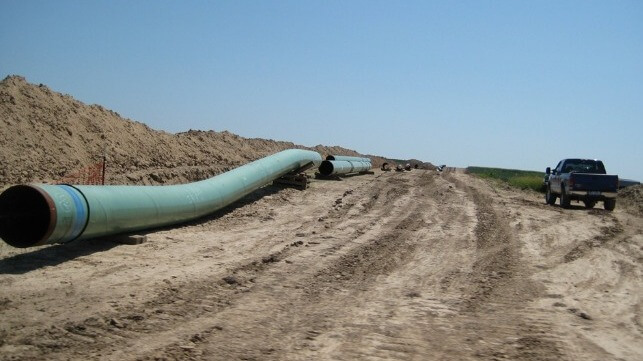
Pipes for the Keystone pipeline network, 2009 (File image courtesy Shannonpatrick17 / CC BY SA 3.0)

Published Oct 8, 2025 10:15 PM by The Maritime Executive


Canadian Prime Minister Mark Carney and U.S. President Donald Trump are in talks to revive the long-dormant Keystone XL pipeline proposal as part of a comprehensive trade deal, according to CBC and BBC. The pipeline's permit was canceled in 2021, and a reboot would give Canada's landlocked tar sands producers a new route to the U.S. Gulf Coast - and the sea. 

Export logistics for Albertan oil are a point of tension in Canadian politics, and the TransCanada (TC Energy) Keystone XL is one of several proposals to address it. If completed, Keystone XL would increase the pipeline capacity connecting Alberta's bitumen fields with refineries and marine export terminals on the U.S. Gulf Coast. In its time, it was a top policy priority for Alberta's government, which provided $1.1 billion in direct funding and $4.2 billion in loan guarantees to support the pipeline's construction. 

However, it was fiercely opposed by environmentalists and native tribes in the United States, who expressed concern about the carbon intensity of the tar sands production process and the potential for a pipeline spill on U.S. soil. Work carried on in fits and starts for more than a decade amidst protests, regulatory actions and lawsuits. In 2015, President Barack Obama ordered a halt to the pipeline's development; President Donald Trump reversed Obama's decision in 2017 and issued a federal permit; and President Joe Biden revoked that permit upon taking office in 2021. A few months later, TransCanada (renamed TC Energy) abandoned the project altogether, leaving behind about eight percent of the completed line.

In 2018, as an alternative to the stalled Keystone, the Canadian government bought and completed the Trans Mountain Expansion (TMX) pipeline from Alberta to Vancouver, B.C., with first oil pumped through in 2024. While TMX is a major addition to Canadian export capacity, the loading terminal is limited to Aframax tankers because of draft restrictions in the harbor, raising cost. Another alternative route backed by the government of Alberta would add a pipeline to the deepwater port of Prince Rupert, B.C. - but the line is opposed by British Columbia. Even if it were built, the Prince Rupert terminal would need exemption from a longtime ban on oil tanker navigation in the northern Inside Passage. 

Keystone XL has none of those limitations, and would give Albertan producers ready access to existing U.S. Gulf Coast loading terminals and connections to global markets. Following initial talks between Trump and Carney, discussions on the possibility of a reboot for construction are under way at the staff level but are still preliminary, sources told BBC.

Any construction would depend upon the interest of the pipeline's inheritor, South Bow, an independent firm spun off from TC Energy last year. A spokesperson for the firm told BBC that it was supportive of the talks, adding that it would "continue to explore opportunities that leverage our existing corridor with our customers."

Pipes for the Keystone pipeline network, 2009 (File image courtesy Shannonpatrick17 / CC BY SA 3.0)

Tuesday, May 25, 2021


#STANDINGROCK    #BLACKSNAKE #WATERISLIFE
Judge: Dakota Access line can stay open pending Corps review


BISMARCK, N.D. (AP) — A federal judge ruled Friday that the Dakota Access oil pipeline may continue operating while the U.S. Army Corps of Engineers conducts an extensive environmental review.© Provided by The Canadian Press

U.S. District Judge James Boasberg made his decision after attorneys for the pipeline's Texas-based owner, Energy Transfer, argued that shuttering the pipeline would be a major economic blow to several entities, including North Dakota, and the Mandan, Hidatsa and Arikara Nation tribe, in the heart of the state’s oil patch.

Boasberg said the Standing Rock Sioux had to “demonstrate a likelihood of irreparable injury” from the pipeline’s continued operation for him to rule in their favor.

The tribe, he said, has “not cleared that daunting hurdle.”

Attorneys for the Standing Rock Sioux and other tribes say the pipeline is operating illegally without a federal permit granting easement to cross beneath Lake Oahe, a Missouri River reservoir near the Standing Rock reservation that is maintained by the Corps. They said preventing financial loss should not come at the expense of the other tribes, “especially when the law has not been followed.”

“The Court acknowledges the Tribes’ plight, as well as their understandable frustration with a political process in which they all too often seem to come up just short. If they are to win their desired relief, however, it must come from that process, as judges may travel only as far as the law takes them and no further. Here, the law is clear, and it instructs that the Court deny Plaintiffs’ request for an injunction.” Boasberg wrote.

The Standing Rock tribe, which draws its water from the Missouri River, says it fears pollution. The company has said the pipeline is safe.

“We believe the Dakota Access Pipeline is too dangerous to operate and should be shuttered while environmental and safety implications are studied — but despite our best efforts, today’s injunction was not granted,” Jan Hasselman, the EarthJustice attorney representing Standing Rock and other tribes, said in a statement.

The pipeline was the subject of months of sometimes violent protests in 2016 and 2017, during its construction.

The $3.8 billion, 1,172-mile (1,886-kilometer) pipeline began operating in 2017 and environmental groups, encouraged by some of President Joe Biden’s recent moves on climate change and fossil fuels, were hoping he would step in and shut down the pipeline. But the Biden administration left it up to Boasberg, even after the judge asked the Corps to state an opinion on paper, if it had one.

Boasberg on Friday also denied the state of North Dakota’s motion to intervene. State Attorney General Wayne Stenehjem had said the Corps has abandoned its lead role in defending its decision to grant an easement for crossing the river and that the agency can no longer “adequately represent” North Dakota’s interests.

In April 2020, Boasberg ordered further environmental study after determining the Corps had not adequately considered how an oil spill under the Missouri River might affect Standing Rock’s fishing and hunting rights, or whether it might disproportionately affect the tribal community. A federal panel later upheld the judge's ruling, but did not go as far as shutting down the pipeline.

Energy Transfer estimated it would cost $24 million to empty the pipeline and preserve the structure, and said maintenance of the line would cost $67.5 million every year it is inoperable.

Former President Barack Obama’s administration originally rejected permits for the project, and the Corps prepared to conduct a full environmental review. In February 2017, after Donald Trump took office, the agency scrapped the review and granted permits, concluding that running the pipeline under the Missouri River posed no significant environmental issues.

___

Kolpack reported from Fargo, North Dakota

Dave Kolpack And James Macpherson, The Associated Press

Wednesday, January 27, 2021


Court upholds ruling invalidating Dakota Access, but doesn't shut down pipeline

A federal appeals court on Tuesday declined to shut down the Dakota Access Pipeline even as it upheld a ruling from a lower court throwing out a decision that allowed its construction.

© Greg Nash Court upholds ruling invalidating Dakota Access, but doesn't shut down pipeline

The three-judge panel ruled that the government should have conducted an environmental impact statement before going forward with the pipeline, and vacated easements granted for its construction to cross federally-owned land.

It also ordered the U.S. Army Corps. of Engineers (USACE), which had granted the easement allowing for the pipeline's construction to be completed, to conduct the environmental assessment.

But the D.C. federal appeals court did not agree with the D.C. federal district court's decision that the pipeline should be shut down. It left the decision on the pipeline's future to USACE.

The panel, made up of a Clinton, Obama and Reagan appointee, decided that shutting down the pipeline isn't automatically necessary because the easement was vacated. They argued that saying so would circumvent court precedent requiring a legal test to decide whether to grant such injunctions.

However, the decision left room for both agency action and additional litigation to potentially shut down the pipeline, leaving its future uncertain.

"It may well be - though we have no occasion to consider the matter here - that the law or the Corps's regulations oblige the Corps to vindicate its property rights by requiring the pipeline to cease operation," the ruling stated.

A spokesperson for Energy Transfer, the company behind the pipeline, didn't immediately respond to a request for comment from The Hill. A request for comment from USACE was also not immediately returned.

Some of the pipeline's opponents, meanwhile, expressed optimism that the Biden administration would shut it down.

"The court is giving the Biden administration the opportunity to get this right but holding the door open to further court action if they do not," said Jan Hasselman, an attorney with Earthjustice, who sued over the pipeline on behalf of the Standing Rock Sioux Tribe.

Meanwhile, some Dakota Access supporters cautioned against administrative action.

"The Army Corps of Engineers should be allowed to proceed as they are without political interference from the Biden Administration. This is not another opportunity to wage war on North Dakota's energy producers," said Sen. Kevin Cramer (R-N.D.) in a statement.

The Dakota Access Pipeline was completed in 2017 after former President Trump ordered for it to be revived, a reversal from when the Obama administration denied a permit for the project.

The controversial project, which carries oil from North Dakota to Illinois has drawn significant opposition from environmentalists and tribes over the years, spurring massive protests.


Saturday, March 13, 2021

As spring thaws the Minnesota ice, a new pipeline battle fires up


By Bill Weir, CNN Chief Climate Corresponden
3/12/2021


In the north woods of Minnesota, the mighty Mississippi River looks like a frozen creek. After a bitter February, you can stroll across it with more fear of windburn than thin ice. And if you stroll one particular spot near Palisade, you'll find giant pipe, heavy machines and competing signs. A few read "No trespassing" in block letters. The rest say "Water is life" and "Stop Line 3" in hand-painted colors. It is the latest front in the pipeline wars.
© Kerem Yucel/AFP via Getty Images An anti-trespass notice is surrounded by signs protesting the construction on the Enbridge Line 3 crude oil pipeline.

BLACKSNAKE TOO 

Originally built in the 1960s, the Enbridge Line 3 crude oil pipeline snakes 1,097 miles from the tar sands of Canada to Superior, Wisconsin. 

Of the roughly 340 miles through Minnesota, the replacement pipeline includes new sections and added capacity and is cutting through some of the most pristine woods and wetlands in North America. In little camps along the way, a small-but-growing group of protesters is out to stop them, driven by ancient prophesy and the promises of a new President.

When Joe Biden killed plans for the Keystone XL pipeline within hours of taking the oath, many Native American tribe members and environmentalists saw it as validation for all the cold nights spent protesting another pipeline at Standing Rock. Though they failed to stop the oil now flowing through the Dakota Access Pipeline, maybe this was a sign Biden would take their side in the David versus Goliath fight to stop Line 3. And maybe people would finally heed an ancient warning known as The Seven Fires Prophecy.

In Ojibwe tribal lore, an environmental moment of reckoning was predicted in the time of the Seventh Fire, when "the light skinned race will be given a choice between two roads," one green and lush, the other black and charred. A wrong choice, it was warned, would "cause much suffering and death to all the Earth's people." The Ojibwe are of the largest groups of Native Americans north of Mexico with tribal members stretching from present-day Ontario in eastern Canada all the way into Montana.

As a half-dozen female tribal elders sing and pray alongside the frozen Mississippi, it's obvious that for some bands, the fight is sacred and eternal. The question is how many will join them in the face of tougher legal challenges, increased pressure from police and the limits of the pandemic.

"There have been over 130 people arrested so far in just the last few months," tribal attorney and activist Tara Houska told CNN. Some are physically arrested at construction sites, but police also watch social media feeds to identify trespassing protesters and send summons in the mail. Before we walked the frozen river, Houska attended her hearing with a judge over Zoom and was ordered to post $6,000 bail.

"They seem to think that it's going to deter us from protecting the land. They are fundamentally missing the point of what water protectors are doing, which is willing to put ourselves our freedom, our bodies, our personal comfort on the line for something greater than ourselves," Houska said.

After living in Washington and fighting Dakota Access and Keystone XL, she is now hoping this movement helps convince the Biden administration that the Army Corps of Engineers and Environmental Protection Agency during the Trump administration were shoddy in their environmental impact studies and too hasty in issuing permits.

But Canadian pipeline giant Enbridge insists that it passed every federal, state and tribal test. The company has been rushing to complete the pipeline before politics or the courts can stop it. Of those 340 miles cutting through The Land of 10,000 Lakes, more than 40% is already in the ground.

"Line 3 is not like the Keystone XL pipeline," Enbridge Chief Communications Officer Mike Fernandez told CNN. "It already exists. And it already is an energy lifeline for literally millions of people in the US and in Canada. And the reality is, even as we see great growth in renewables, we're still going to need some fossil fuels 40 years to come."

But since Biden has built the first White House with a climate agenda at every agency, the biggest argument against the pipeline may be over the kind of energy running through Line 3. Unlike liquid Texas crude hidden in pockets of rock, Alberta's oil is part of the Canadian soil under the boreal forest. It can't be pumped unless it is steamed. As a result, it is the dirtiest and most destructive fossil fuel after coal.

A trip to the tar sands boggles the mind with its scale. Massive, man-made pits crawl with massive dump trucks, filled with what feels like sticky cookie dough and smells like asphalt.

Tens of thousands of tons are moved into massive processing plants each day where the goop is boiled and blasted with Athabasca River water heated with natural gas. To separate the flammable bitumen from the dirt and clay, it takes six gallons of fresh water to produce one gallon of tar sands gasoline and the lakes needed to hold the resulting toxic waste are among the biggest man-made creations in history.

The sheer amount of energy required to turn sticky earth into liquid fuel not only makes Alberta tar sand more expensive, it produces 15% more planet-cooking carbon pollution, according to the Union of Concerned Scientists.

But to the workers building Line 3, pipelines are safer and cleaner than moving oil by truck or train. And if you stop Line 3, they argue, it does nothing to stop the world's voracious demand for the kind of fuels that burn.

"I think, frankly, people have been drawn to pipelines because it's easy to fight pipelines," said Kevin Pranis with the Laborers International Union of North America as cranes lifted 25,000-pound pipes as long as city buses.

"The truth is that the carbon emissions aren't coming from pipelines. They're coming from cars. And so if you really wanted to go directly to the source, you can protest car dealerships, you can protest gas stations. But the problem is, people like car dealerships and they like gas stations and they would be pretty angry about that."

While most of the 5,200 people building Line 3 are from oil states like Texas and Louisiana, "some 400 will be Native Americans," Fernandez told me. "We met with all of the First Nations along that pipeline. We listened, and as a consequence there are 320 or so route modifications."

Enbridge's tribal relations suffered in February, when two men working on Line 3 were caught in a human trafficking sting set up to protect underage Indigenous girls.

"The two individuals that that were arrested have been fired." Fernandez said. "We don't tolerate that kind of activity or behavior and it's prompted us to go to one of the contractors to say 'This is our expectation, that they be trained to a certain level.'"

Follow the pipeline route, and feelings can change by the tribe or the mile.

"You think that people that are scrambling at home, running out of gas with no heat, are thinking about climate change?" said Jim Jones. "They're thinking about how they're going to heat their home and put food on the table."

As a member of the Leech Lake Band of the Ojibwe and a former expert in cultural anthropology for the state, Enbridge hired Jones to walk the pipeline route and ensure no violation of Indigenous spaces or ruins.

"I'm at peace that I've done the best I can to protect what's important to us," he said. "And I can honestly tell you, as of today, nothing of historic context has been unearthed or disturbed."

After the Fond du Lac Band of Lake Superior Chippewa struck a deal with Enbridge to run a part of Line 3 through their reservation, tribal leaders said they were put in an impossible position. Some tribes worked with Enbridge on the route, while others like Winona LaDuke of the White Earth Band of Ojibwe have nothing but scorn for Enbridge.

LaDuke laughed when told of Jones's promise. "He's looking for pot charts and arrowheads. We're live people."

LaDuke is a longtime environmental activist who twice ran for vice president on Ralph Nader's Green Party ticket, but after fighting for Indigenous rights against extractive energy companies for years, she never imagined the fight would come to her.

"Enbridge wants to criminalize us," she said. "I'm a grandmother, you know, graduated from Harvard, ran twice for vice president, at what point did I become a criminal? I'm just asking, 'How much risk should we as Americans take so a Canadian multinational can get a little richer at the end of the tar sands era?'"

She helped convince a sympathetic local to sell them a little piece of land where the pipeline intersects the Mississippi and as the weather warms, the protesters hope their number of tents, yurts and fly-fishing shanties will grow faster than Enbridge can drill under the frozen Mississippi.

"Our people say 'Don't pick a fight with Mother Nature. You can't win, and we're getting we're getting pounded. So why would you pipe the equivalent of 50 new coal fired power plants with this?" LaDuke said, pointing at Line 3.

"The tar sands is the gun. This is the trigger."


Tuesday, February 22, 2022

Dakota Access pipeline suffers U.S. Supreme Court setback


Tue, February 22, 2022
By Lawrence Hurley

WASHINGTON (Reuters) -The U.S. Supreme Court on Tuesday rejected a bid led by Dakota Access oil pipeline operator Energy Transfer LP to avoid additional environmental review of a section that runs under an artificial lake and is opposed by nearby Native American tribes, leaving the pipeline vulnerable to being shut down.

The justices left in place a lower court's decision that ordered the federal government to undertake a more intensive environmental study of the pipeline's route underneath Lake Oahe, which straddles the border of North Dakota and South Dakota. The pipeline, known as DAPL and open since 2017, will continue to operate as the review is carried out.

"We call on the administration to close the pipeline until a full safety and environmental review is complete. DAPL never should have been authorized in the first place, and this administration is failing to address the persistent illegality of this pipeline," said Jan Hasselman, a lawyer for the environmental group Earthjustice who represents the Standing Rock Sioux Tribe.

Related video: Dakota Access urged SCOTUS to reverse pipeline decision in early 2021


BLACKSNAKE


The Dakota Access pipeline has been the subject of a lengthy court battle between tribes seeking its closure and Dallas-based Energy Transfer.

Whether the project should be shut down was not at issue in Energy Transfer's Supreme Court appeal. But Energy Transfer said in court papers that the pipeline remains "vulnerable to a shutdown" with the new environmental review pending. The company did not immediately reply to a request for comment.

The Standing Rock Sioux Tribe, along with the Yankton Sioux Tribe, the Oglala Sioux Tribe and the Cheyenne River Sioux Tribe, have opposed the biggest pipeline out of the Bakken shale basin. The pipeline runs about 1,170 miles (1,885 km) from North Dakota to Illinois. The disputed section on federal property under Lake Oahe, an artificial reservoir on the Missouri River, is 1.7 miles (2.7 km) long.

The tribes draw water from the lake for various purposes, including drinking, and also consider the waters of the Missouri River to be sacred. Their lawyers have said the tribes are worried about a potential oil spill.

The tribes lobbied hard to prevent the easement under the lake from being approved and initially appeared to have succeeded when in 2016 the administration of Democratic former President Barack Obama said it would review its original action to allow construction. But after Republican Donald Trump became president in 2017, the government endorsed the original decision to grant an easement.

Democratic President Joe Biden's administration urged the Supreme Court not to hear the appeal, saying the pipeline operator concerns about a shutdown were overstated.

Washington-based U.S. District Court Judge James Boasberg in 2020 found that the government had violated a law called the National Environmental Policy Act and threw out the approval.

Boasberg ordered a more detailed "environmental impact statement," which was the decision the pipeline operator was challenging. Boasberg subsequently ruled that the pipeline be shut down but the U.S. Court of Appeals for the District of Columbia Circuit blocked that decision while allowing the additional environmental review.

The U.S. Army Corps of Engineers, the federal agency overseeing the permit approval process, has said it expects to complete the review later this year.

(Reporting by Lawrence Hurley; Editing by Will Dunham)