Showing posts sorted by relevance for query DECRIMINALIZE DRUGS. Sort by date Show all posts

Thursday, June 02, 2022

Alberta should follow B.C. in decriminalizing small amounts of drugs, advocates say

CBC/Radio-Canada - Yesterday 

As B.C. plans to decriminalize small amounts of drugs next January, some advocates say similar steps should be taken in Alberta.

Dr. Monty Ghosh, assistant professor at the University of Calgary and University of Alberta, is a clinical physician who researches addiction. He said B.C.'s move to legalize the carrying of small amounts of drugs like opioids, cocaine and MDMA is "a step in the right direction."

"We know that decriminalization decreases poor health outcomes and helps support people into treatment," said Ghosh.

He said if people are not afraid of getting arrested for drug use, they will access support and services more often.

Outgoing Alberta Premier Jason Kenney disagrees.

In a statement released Tuesday in response to B.C.'s decriminalization announcement, Kenney said this move to decriminalize will likely lead to an increase in drug addiction, violence and trafficking.

"We'd be happy to get into a more balanced discussion with the federal government about finding real solutions and not making a bad situation worse," Kenney said in a news conference Tuesday.

Kenney's statement also claimed Prime Minister Justin Trudeau said during the last election that his government would not decriminalize drugs.

While Trudeau did not explicitly say in the election that the Liberals would move to decriminalize drugs, he did say in September that his government would be open to working with provinces like B.C. that are interested in some form of decriminalization.
Creating a path for recovery

Chris Gallaway, executive director of Friends of Medicare, a non-profit based in Edmonton that defends universal public health care, agrees with Ghosh that B.C. is taking a positive step for harm reduction.

Gallaway called Kenney's response to B.C.'s decriminalization "offensive" and "outrageous."

"It felt like the premier chose to take political cheap shots … rather than do his job," said Gallaway.

According to Gallaway, concerns of increased drug use caused be decriminalization is just an example of fearmongering.


"We know that safe consumption sites, for instance, save lives," said Gallaway.

"There's all these kinds of myths around drug use, but really it's about removing stigma for folks who use drugs and actually creating a real path for people to be healthy, to be alive and potentially to seek recovery."

In 2021, Alberta recorded its deadliest year for drug overdoses with more than 1,700 deaths.

"You can't recover if you're dead," Gallaway said.

Gallaway also believes drug decriminalization is quite a widely accepted idea today even if Kenney disagrees with it.

The governments of B.C, Vancouver and Toronto have all filed exemption requests to decriminalize small amounts of drugs. Friends of Medicare also supported the City of Edmonton's call to look at decriminalization.

But Gallaway said part of the struggle with provinces and cities trying to implement decriminalization is that there's still no clear process that the federal government has outlined. He said Ottawa should make that process clearer or decriminalize drugs across the country.
Models for drug decriminalization

Ghosh said there are two main models for drug decriminalization.

One is the Portugal model: in 2000, the country decriminalized small amounts of drugs. Its model involves sending people caught with small amounts of drugs to a tribunal — not the same as a criminal court — where they meet with social workers and health-care workers. These workers decide whether to hand out fines, send people to treatment programs or release individuals with no consequences.

Portugal's approach also involves resources like methadone clinics, clean needle handouts and programs that encourage small businesses to hire people in drug treatment.


© Armando Franca/The Associated Press

Portugal's Institute for Drugs and Drug Addiction exchange used needles for new ones and try to direct drug addicts to treatment centres. Portugal decriminalized the use of all drugs in a groundbreaking law in 2000.

While this model has faced criticisms, Ghosh said that since Portugal implemented it, the country has seen a large decrease in overdose numbers, as well as rates of HIV and AIDS.

The model being introduced in B.C. is different from Portugal's. People caught with small amounts of drugs will simply not be charged by police nor have to access treatment services. Ghosh said this model gives people autonomy and allows them to decide what steps to take.

While B.C.'s model has not yet been tested, Ghosh said any form of decriminalization is a good idea. Additionally, the federal government will be able to study in the coming years how effective B.C.'s decriminalization turns out.

Gallaway said decriminalization is just one piece of the puzzle to help people struggling with drug use. Systemic change is also needed in the justice system, and the housing crisis is making it even more difficult for people to get back on their feet.

"There's layers of issues," he said.

Ghosh ultimately believes drug decriminalization is in the future for Alberta, but which model the province takes is something Albertans will have to decide.

With files from the Calgary Eyeopener and Colleen Underwood

Sunday, May 05, 2019

Trudeau resists pressure to decriminalize drugs in face of opioid crisis

HYPOCRITE IT IS TIME TO DECRIMINALIZE ALL DRUGS AS THE LE DAIN COMMISSION RECOMMENDED BACK UNDER HIS DADDY PRIME MINISTER TRUDEAU SRThe Commission of Inquiry into the Non-Medical Use of Drugs, often referred to as the Le Dain Commission after its chair Dean Gerald Le Dain, was a Canadian government commission that was begun in 1969 and completed its work in 1972.

Trudeau resists pressure to decriminalize drugs in face of opioid crisis

File photo Justin Trudeau (CBC News).
File photo (CBC News).
OTTAWA — Donna May says she’ll no longer tolerate a nod or weepy eyes from politicians over the opioid epidemic — it’s claimed the lives of too many people she loves.
May wants action in the form of drug decriminalization and she’s far from alone in her plea.
The death of May’s 55-year-old brother a year ago in Bolton, Ont., broke her emotionally.
“We have the ability to stop these deaths and we are stepping back from doing what is right,” she says.
“I lost my brother just a year ago, even after losing my daughter and being able to say to him, ‘Look it, all these drugs are poison.”’
May has spent years advocating with mumsDU — “moms united and mandated to saving the lives of Drug Users” — after the death of her 34-year-old daughter Jacey in 2012.
Jacey was a mother of three who developed a fentanyl addiction and ran afoul of the law. She was introduced to opioids through a prescription after she was injured falling down a flight of stairs onto a concrete basement floor.
Seven years after her death, government interventions on the opioid crisis have not prevented thousands more, May says.
“I’m afraid unless we do something that’s effective and immediate, we are going to see a huge increase in the overdose crisis,” she says. “It hasn’t ended. It hasn’t even subsided. It is just growing at exponential rates across Canada.”
Prime Minister Justin Trudeau has refused to pursue decriminalization, even though he’s faced pressure from grassroots Liberal party members and his own caucus.
Last April, at a convention in Halifax, the Liberal rank and file passed a non-binding resolution on decriminalizing simple possession and consumption of all illicit drugs.
Trudeau shot the idea down. “On that particular issue, as I’ve said, it’s not part of our plans,” he said.
During the first nine months of last year, the Public Health Agency reported 3,286 Canadians lost their lives to apparent opioid-related overdoses, bringing the total to more than 10,300 between January 2016 and September 2018.
Fentanyl and other fentanyl-related substances continue to be a major driver of this crisis, the agency added.
In response to the staggering death toll, B.C.’s chief public-health officer Dr. Bonnie Henry recently called for B.C. to decriminalize the possession of controlled substances for personal use, in a 50-page report titled “Stopping the Harm.”
She said her province can’t wait for Ottawa to act, adding that decriminalizing the possession of even hard drugs is an important step to “stem the tide of unprecedented deaths.”
“I have called on the federal government to move toward regulating access to currently controlled drugs, with a focus on reducing harm associated with the use of those substances, as well as the harms associated with the current prohibition-based regulatory regime and its application,” she said.
“But in the context of the continuing overdose crisis that is affecting families and communities across B.C., the province cannot wait for action at the federal level. Immediate provincial action is warranted, and I recommend that the Province of B.C. urgently move to decriminalize people who possess controlled substances for personal use.”
There is widespread global recognition that the war on drugs and the resulting criminalization and stigmatization of people who use them has not reduced drug use but instead has increased health harms, the report added.
The federal NDP has also called for decriminalization, along with a growing number of health experts.
“I certainly think that it can begin a discussion in this country about where we are going and are we on the right track as it relates to drugs, mental health and addictions,” Dr. Jeffrey Turnbull, a former president of the Canadian Medical Association and the previous chief of staff at the Ottawa Hospital, said in a recent interview. A major part of his work is tending to the medical needs of homeless and street-involved people in Ottawa.
“Can we continue to put all these people in our jails or shouldn’t we try and deal with this as a problem of health rather than justice?”
For her part, Canada’s chief public health officer Dr. Theresa Tam is careful to say the federal government is not prepared to decriminalize illicit street drugs “as it stands.”
A major factor in rising overdose numbers is high-potency fentanyl and carfentanil being passed off as lower-strength opioids in street drugs. The more powerful drugs are easier to transport and sell but when users don’t know the potency of the substances they’re taking, overdoses are a big risk.
“We can do much more, I think, in looking at what are the different ways that we can provide people who are using drugs a ‘safer alternative,’ ” Tam says.
Health Canada is funding some pilot projects, Tam says, such as providing pharmaceutical-grade hydromorphone to people who are using street drugs “in an attempt to get them away from the toxic supply.”
The department should be pursuing a safer supply on a broad basis rather than in scattered pilots, May says, adding she sees decriminalization as the “only next step.”
Trudeau’s resistance to it amounts to a “huge disappointment”, she said.
“He gives us his pat answers without any explanation as to why he stands behind these answers and they just don’t make sense,” she says.
“If you take all the reasoning behind why he’s legalized cannabis and you apply it — all those reasons to the opiate crisis, there’s a clear direction that he should be going in the decriminalization (route).”
By Kristy Kirkup — The Canadian Press
 with files from Andy Blatchford

Saturday, January 30, 2021

Vancouver, Feds Take Next Step Towards Decriminalizing Illicit Drug Possession

© Provided by HuffPost Canada A view of Crab Park at Portside and the downtown Vancouver skyline, looking west, in Vancouver on Oct. 10, 2020.


OTTAWA — The City of Vancouver has received a signal from the federal government to start formal discussions around its plan to decriminalize simple possession of illicit drugs.

In a statement Wednesday, Vancouver Mayor Kennedy Stewart called the step “another hopeful and critical milestone on the path towards fully embracing a health-focussed approach to substance use” in the city.

“This news comes at a time when the overdose crisis in our city has never been worse, with a person-a-day still needlessly dying due to poison drugs,” Stewart said.

“While 2020 looks to be the deadliest year on record for overdoses, I am hopeful that this news from Ottawa can mean that 2021 will be different.”

He thanked federal Health Minister Patty Hajdu for her “positive response” to the request..

Though the municipal and federal governments have started formal discussions, Kennedy’s spokesperson told HuffPost Canada there’s no set timeline for how long the process will take.

“The mayor wants them to begin [as soon as possible],” said Alvin Singh.

He explained the first step will be to create an initial framework proposal with consultation from Vancouver Coastal Health, the Vancouver Police Department, community groups and advocates, and individuals with lived experiences.

“Then, we’ll be able to go back and forth with Health Canada,” Singh said. “So sadly, not a lot of detail for timing, but we want it to happen quickly and there is a lot of expertise in Vancouver that will allow us to move towards a framework proposal in short order.”

In a Monday email obtained by HuffPost, Hajdu told Kennedy she is “committed to our continued work to identify options that respond to the local needs of the City of Vancouver.”

She also expressed optimism the partnership will address racial disparities such as the disproportionate representation of racialized people in the criminal justice system

“Recent statistics show that the rate of Indigenous adults admitted to federal custody was six times higher than the rate of non-Indigenous adults, while the rate for Black inmates was two times higher than for non-Black inmates,” the email read.

The COVID-19 pandemic has compounded the impacts of the opioid crisis, and we cannot forget how it has impacted thousands of families in communities across Canada.Cole Davidson, spokesperson for Health Minister Patty Hajdu

HuffPost asked Health Canada for more details about the expected timeline for discussions. A spokesperson for the health minister did not provide additional details.

“Substance use is a health issue, not a moral one,” Cole Davidson, Hajdu’s spokesperson, said in an email. “The COVID-19 pandemic has compounded the impacts of the opioid crisis, and we cannot forget how it has impacted thousands of families in communities across Canada. We have lost too many Canadians to overdoses and all levels of government must redouble efforts to save lives.

“Our approach has focused on harm reduction, including supporting the Good Samaritan Drug Overdose Act, funding programs to divert people who use drugs from the criminal justice system, and enhancing access to safe consumption sites, safer supply, and expanded treatment options.”

MORE ABOUT THE IMPACT OF THE OPIOID CRISIS
© Provided by HuffPost Canada

The development comes seven months after British Columbia Premier John Horgan wrote to Prime Minister Justin Trudeau, asking the federal government to decriminalize personal possession of all psychoactive substances to help eliminate the stigma around drug use.

Advocates have urged politicians to give more attention to the issue given the alarming number of overdose-related deaths linked to the opioid crisis.

Vancouver city councillors unanimously passed a motion in November to ask the federal government to decriminalize small, personal possession of illicit drugs.

The motion called it a “necessary next step to reduce the stigma associated with substance use and encourage people at risk to access lifesaving harm reduction and treatment services.” That month, the city reported 329 overdose deaths in the year to date.
Vancouver following process that led to InSite approval

The City of Vancouver is seeking a federal exemption to the Controlled Drugs and Substances Act, which would allow substance use to be treated as a health issue rather than a criminal justice one.

It traces the same steps the city took to obtain a federal exemption to provisions of the act related to trafficking in 2003. That exemption, granted under Jean Chrétien’s Liberal government, allowed Vancouver to open North America’s first supervised injection site, InSite, in the Downtown Eastside.

Advocates fought for the opening of the facility to reduce needle-sharing and overdose deaths seen in the ’90s. Drug policy experts credited a changed political environment in 2002 and the community activism connections of a newly elected mayor as conduits to the opening of InSite.

There are signs of that sea change happening on the issue of decriminalizing simple possession of illicit drugs. Following in Vancouver’s footsteps, Montreal city council passed a motion Tuesday to ask the federal government to decriminalize simple drug possession.

© Provided by HuffPost Canada Montréal, Québec, Canada, January 4, 2016. -- Montreal is seen from Mount Royal (mont Royal) when the night is coming. 
(Photo by Thierry Tronnel/Corbis via Getty Images)

The current federal government has previously signalled that they have “no plans” to decriminalize illicit drugs, despite the issue being ranked as a top policy item by grassroots members of the Liberal Party at the party’s 2018 convention.
Police chiefs back push to decriminalize simple possession

Last year, the Canadian Association of Chiefs of Police (CACP) released a report asking for substance use to be recognized as a public health issue.

The consensus from police chiefs is that criminally charging substance users with simple possession of illicit drugs won’t save lives.

But decriminalizing illicit drugs is only one piece of the puzzle, the report said, adding that ensuring and monitoring safe supply is another.

“While decriminalization can reduce some harms for people who use drugs, they are still dependent on an illegal market where the contents and strength of drugs are unknown,” states the CACP report.

“The unregulated drug supply in Canada has become toxic, leading to overdoses and death. Determining how best to regulate all drugs would be complicated and take time.”

In August, the Public Prosecution Service of Canada marked a shift by issuing a new directive for federal prosecutors to only focus on the “most serious cases raising public safety concerns for prosecution and to otherwise pursue suitable alternative measures and diversion from the criminal justice system for simple possession cases.”

The deaths of more than 17,600 people between January 2016 and June 2020 have been linked to apparent opioid toxicity, according to government data. A majority of these deaths have been accidental and linked to fentanyl.

It’s been nearly five years since a spike in opioid-related overdose deaths in B.C. prompted the province to declare a public health emergency in April 2016.

RELATED
© Provided by HuffPost Canada

© Provided by HuffPost Canada

© Provided by HuffPost Canada

This article originally appeared on HuffPost Canada.
Canada considering drug decriminalization to fight overdose crisis


By Anna Mehler Paperny
© Reuters/JESSE WINTER A man injects street drugs in an alley in Vancouver

TORONTO (Reuters) - Canada's federal government is considering decriminalization of the possession of opioids and other illicit drugs in its efforts to tackle a spiraling overdose crisis, a government official said this week, even as data show the number of charges rising.

Prime Minister Justin Trudeau's Liberal government is facing pressure to rein in drug overdoses, though it has previously downplayed decriminalization.

Vancouver has asked the federal government to exempt the city from part of the Controlled Drugs and Substances Act, decriminalizing the possession of small amounts of drugs within city boundaries. A spokesman for Health Minister Patty Hajdu said on Wednesday that decriminalization was under consideration and that discussions with Vancouver were under way but would not comment further

That could subject people caught with small amounts of drugs to fines or mandatory treatment.

Canada's opioid toxicity death rate for the first half of 2020, 14.6 per 100,000, was the highest since national data began to be collected in 2016, according to the federal government.

The number of people charged with drug possession of non-cocaine, non-heroin drugs in Canada more than tripled to 13,725 in the past decade to 2019, according to Statistics Canada. The number of people charged with heroin possession almost quintupled, to 1,043.

"The idea that we're kind of becoming more tolerant isn't borne out by the data," said Neil Boyd, director of the School of Criminology at Simon Fraser University.

The COVID-19 pandemic has disrupted illicit drug supply chains, making for a more toxic supply; it has also lessened supports and driven people to use alone, health advocates say.

Health Canada's move to discuss decriminalization "comes at a time when the overdose crisis in our city has never been worse," Vancouver Mayor Kennedy Stewart said in a statement Wednesday.

Many health experts argue decriminalization would encourage drug users to use in safer spaces where they can access medical care.

Trudeau dismissed decriminalization last year, telling the Canadian Broadcasting Corp it was not a "silver bullet."

Portugal decriminalized illicit drug possession and consumption in 2001. In the 2020 election Oregon voted to decriminalize.

This week Montreal's city council also voted to support decriminalization. The Canadian Association of Chiefs of Police came out in support of the move last summer.

(Reporting by Anna Mehler Paperny; Editing by Steve Orlofsky)


Calls to decriminalize drugs grow louder during pandemic
VIDEO Duration: 07:47 
Advocates in British Columbia have long been calling on the federal government to decriminalize drugs, yet action has been slow. Decriminalization means those who are found with small amounts of drugs would no longer face criminal charges, something advocates say would reduce the death toll of the worsening opioid crisis.

Thursday, February 04, 2021

Ottawa Agrees to Explore Drug Decriminalization in Vancouver
Mayor hopes talks will be a step toward a ‘health-focused’ approach to drug policy amid overdose crisis.


Moira Wyton 27 Jan 2021 | TheTyee.ca
Moira Wyton is The Tyee’s health reporter. Follow her @moirawyton or reach her here
This reporting beat is made possible by the Local Journalism Initiative.
Decriminalization means people with drugs for personal use would not have to fear arrest or seizure of their supplies. Photo by Jesse Winter.


The federal government has agreed to begin discussions about decriminalizing drug possession in Vancouver, Mayor Kennedy Stewart said today.

We’ve got a global crisis or two — or three — on our hands. Let’s take these solutions into 2021.

“This is another hopeful and critical milestone on the path towards fully embracing a health-focused approach to substance use in the City of Vancouver,” said Stewart in a news release.

City council backed decriminalization in November, and on Dec. 7 the city wrote to federal Health Minister Patty Hajdu asking for an exemption from possession prohibitions in the Controlled Drugs and Substances Act.

Stewart hopes Vancouver’s decriminalization model would prioritize health interventions for substance use and end arrests and seizures when people have small amounts of drugs for personal use.

In a Monday letter to Stewart and Vancouver Coastal Health chief medical officer Dr. Patricia Daly, Hajdu agreed to discussions.

“Health Canada officials will work with officials from the City of Vancouver and Vancouver Coastal Health to better understand the framework you are proposing,” Hajdu wrote. “I am committed to our continued work to identify options that respond to the local needs of the City of Vancouver.”

At least 367 people died of toxic drug overdoses in Vancouver between January and November 2020 in what is on track to be the deadliest year on record for overdoses in B.C.


NDP and Greens Push Trudeau to Answer Vancouver’s Call to Decriminalize Drugs
READ MORE

“This news comes at a time when the overdose crisis in our city has never been worse, with a person a day still needlessly dying due to poisoned drugs,” said Stewart.

Decriminalization would remove criminal penalties for possession of illicit drugs for personal use. Manufacturing and distributing drugs would remain illegal.

Experts in substance use and public health, including provincial health officer Dr. Bonnie Henry, her predecessor Dr. Perry Kendall and their federal counterpart Dr. Theresa Tam, agree on a public health approach to drug use and have called for decriminalization as a means of curbing skyrocketing overdose fatalities.

Section 56 of the act grants the health minister to issue an exemption to any part of the legislation, including provisions making drug possession illegal, “if, in the opinion of the Minister, the exemption is necessary for a medical or scientific purpose or is otherwise in the public interest.”

It is the same mechanism the city used to establish North America’s first supervised injection site, Insite, in 2003, and more recently to allow health-care providers to prescribe alternatives to street drugs as a part of safer supply measures.

Hajdu also wrote that this is an opportunity to address racism and discrimination in the legal system as it relates to substance use.


Vancouver Voted to Decriminalize Drugs. Now What? READ MORE 


Indigenous peoples in B.C. are more likely to die of an overdose and across Canada are incarcerated at a rate nearly six times higher than non-Indigenous adults.

“We must explore policy measures that reduce harm to racialized communities, and explore alternatives to criminal penalties that can begin to address the systemic inequities these communities face,” said Hajdu.

Stewart said in November he hopes Vancouver’s model will be based on voluntary treatment and expanded support rather than relying on fines and mandatory treatment, as Oregon’s recently approved model does.

“While 2020 looks to be the deadliest year on record for overdoses, I am hopeful that this news from Ottawa can mean that 2021 will be different,” Stewart said in the news release.

Sunday, November 08, 2020

B.C. must look to Oregon on recreational drug decriminalization, legalization of mushrooms: UBC expert

Srushti Gangdev

A UBC expert on drug policy says B.C. should carefully observe what happens in states south of the border that have just decriminalized some or all hard drugs — and see how those policies could hypothetically be applied here.
© (AP Photo/Richard Vogel, File) FILE - 
In this May 24, 2019, file photo a vendor bags psilocybin mushrooms at a pop-up cannabis market in Los Angeles. Oregonians voted Tuesday to legalize the psilocybin for therapeutic use, at regulated treatment centres.

People caught with small amounts of heroin, cocaine, LSD and other drugs will have the option of paying US$100 fines or attending a free addiction recovery centre instead of facing arrest and the possibility of time in prison after Oregonians voted to pass Measure 110 on Tuesday.

“Punishing people for drug use and addiction is costly and hasn’t worked. More drug treatment, not punishment, is a better approach,” reads a statement previously issued by the Oregon Nurses Association, the Oregon chapter of the American College of Physicians and the Oregon Academy of Family Physicians.

B.C. premier calls on federal government for decriminalization of drug possession


Mark Haden, adjunct professor at the UBC School of Population and Public Health, agrees wholeheartedly.

"The drug war needs to come to an end. We need to have a health approach to drugs, not a criminal justice approach," he told Global News.

"And so the more examples that we can see around the United States and Canada of how drugs could be regulated in a way that's helpful to us, the better it is."

Haden said criminalizing people who use drugs has the effect of disproportionately incarcerating people of colour. It also, he said, means governments have to foot the bill for that, and can't collect taxes on the revenue of drug sales as they would be able to if they were regulated.

"Slowly the drug war rhetoric is crumbling under the sheer weight of its own ineffectiveness and harm that it does to all of our society," he said.

Read more: Oregon to become first state to decriminalize hard drugs, other states adopt recreational pot

Oregon also voted Tuesday on Measure 109, which legalizes the psychotherapeutic use of psilocybin — otherwise known as psychedelic mushrooms.

Haden called that decision for state health authorities to therapeutically provide the drug to patients at regulated treatment facilities very exciting and said it's something we should watch very carefully here at home.

"How would it be — if our health authorities started to take psychedelic healing seriously — how would they actually integrate that into their services?"

Haden said the legalization in Oregon will make it much easier for observational research on what patients taking psilocybin would actually experience.

"Normally with research, you have to give somebody a medicine, and then you have to go through a huge number of regulatory hurdles in order to do that, and it can actually cost millions," Haden said.

Read more: B.C.’s top doctor urges province to decriminalize possession of hard drugs to address overdose crisis

"But to be able to just observe, without giving anybody anything — it's given by the health clinic that's currently being legalized — so it makes research a whole lot easier and quite frankly less expensive."

Studies out of New York University and Johns Hopkins University have found psilocybin can significantly improve symptoms of anxiety and depression.

Public health officials in B.C. have strongly voiced support for decriminalizing possession of small doses of drugs for personal use, as has the Canadian Association of Chiefs of Police.

In 2019, provincial health officer Dr. Bonnie Henry released a special report on the matter, which said stigma often leads drug users to hide their usage and creates barriers to accessing harm reduction and treatment services — often with tragic consequences.

Read more: B.C. premier formally asks federal government to decriminalize illegal drugs

In July of this year, B.C. Premier John Horgan formally wrote to Prime Minister Justin Trudeau asking the federal government to act on decriminalization.

“Criminal prohibitions are ineffective in deterring drug use, and criminalization of drug possession directly leads to both individuals and systemic stigma and discrimination that prevent people from seeking services,” Horgan wrote.

According to the B.C. Coroners Service, 1,202 people died of illicit drug overdoses from January to September 2020 — the highest number in at least 10 years.


B.C. declared a public health emergency in April 2016 in response to the opioid crisis.

— With files from Phil Heidenreich and Richard Zussman

Oregon to become first state to decriminalize hard drugs, other states adopt recreational pot

By Phil Heidenreich Global News
Updated November 4, 2020 
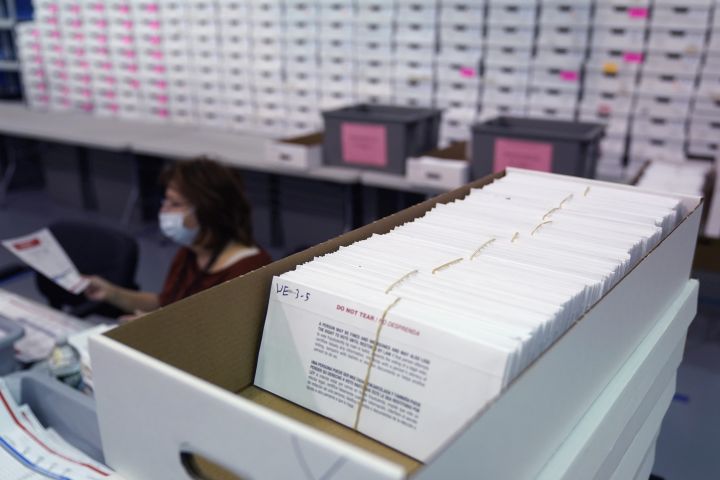
A Board of Election's employee works among stacks of mail-in ballots in Linden, N.J., Thursday, Oct. 29, 2020. AP Photo/Seth Wenig

The possession of small amounts of hard drugs will be decriminalized in Oregon after people in that state voted in favour of the initiative on Tuesday.

With the vote, Oregon will become the first state in the U.S. to adopt such a policy.


When the state implements the provisions included in Measure 110, people caught with small amounts of heroin, cocaine, LSD and other drugs will have the option of paying US$100 fines or attending a free addiction recovery centre instead of facing arrest and the possibility of time in prison.

Measure 110 proposed funding the recovery centres through tax revenue generated by the state’s legal cannabis industry.

The proposal to decriminalize the possession of such drugs was endorsed by several organizations that represent health professionals in the state.

“Punishing people for drug use and addiction is costly and hasn’t worked. More drug treatment, not punishment, is a better approach,” reads a statement previously issued by the Oregon Nurses Association, the Oregon chapter of the American College of Physicians and the Oregon Academy of Family Physicians.

While some district attorneys also backed the initiative, at least two dozen of their counterparts voiced opposition to it.

Oregonians also voted to move ahead with legalizing the therapeutic use of psychedelic mushrooms.

Oregonians voted in 2014 to legalize the recreational use and sale of cannabis.

Before Election Day, 11 U.S. states had fully legalized marijuana’s use for adults and on Tuesday, people in New Jersey and Arizona voted in favour of seeing those states become the latest in the U.S. states to legalize the recreational use of cannabis.

In both New Jersey and Arizona, recreational cannabis use will become legal for people 21 and older. New Jersey will need to pass legislation to set up the cannabis marketplace in that state.

Steve Hawkins, executive director of the Marijuana Policy Project, said the result in New Jersey “will undoubtedly have a rippling effect in the Northeast and add to the increasing pressure in neighbouring states to take action on marijuana legalization.”

The measure passed in Arizona also allows for people convicted of certain crimes related to cannabis to seek to have their records expunged.

Montana and South Dakota also voted on legalizing recreational cannabis. South Dakota, along with Mississippi, also saw people cast ballots on measures regarding the medical use of cannabis.

The legalization of cannabis use has gained momentum since 2012, when citizens of Colorado and Washington state voted in favour of the idea.

–With files from The Associated Press’ David A. Lieb and Andrew Selsky

Monday, August 26, 2024

DECRIMINALIZE  DRUGS
Scotland’s drugs deaths are a public health emergency

People in Scotland are dying from drug use at a rate higher than in any other European country.

By Yuri Prasad
Sunday 25 August 2024
SOCIALIST WORKER Issue


Opioid drugs, such as heroin, are behind around 80 percent of Scottish drug-related deaths

People in Scotland are dying from drug use at a rate higher than in any other European country.

National Records for Scotland last week showed that 1,172 people died as a result of drug use in 2023—an increase of 12 percent over the pre­vious year.

And opioid drugs, such as heroin, morphine and methadone, are impli­cated in around 80 percent of the deaths.

Opioids relax muscles and the brain, including the parts that con­trol breathing, meaning that many drug-related deaths happen because of respiratory failure.

Poverty plays an important part in this story, with the poorest areas of Glasgow, Inverclyde and Dundee being among the worst affected.

Poor people with bad physical and mental health are far more likely than those who are healthy to turn to drugs to ease their pain. They are also more likely to die from an overdose. But poverty alone doesn’t explain what is happening.

The numbers of drug-related deaths in the poorest areas of England and Wales don’t come close to those of Scotland—even though poverty levels are similar.

Instead, Scotland appears to be trapped in a public health emergency.

Trauma is a well-known factor in problematic drug use. And there are now generations of drug users that experienced childhood trauma because their parents were addicts.

Many of them lost family to overdoses or drug-associated diseases and are now themselves vulnerable to the same tragedies.

There are ways to break out of the crisis, but they depend on a massive increase in funding into holistic ser­vices for drug users. And they require a break with the moralism behind state drugs policy.

Despite the Scottish government having formally signed-up to the full range of treatments demanded by experts and users, what services exist are often overwhelmed.

Clinics that help people break from opioid dependency by offer­ing a controlled alternative, such as methadone, are a vital part of a treat­ment strategy.

But a recent report from the Scottish Drugs Forum showed that many people wait months to start treatment, while others have to travel miles to reach a clinic.

One service user reported that her clinic was “just ridiculous. It was just wholeheartedly inaccessible to begin with. I was genuinely phoning up in tears begging for this help, for months.”

And its not just preventative ser­vices that are affected. People who have overdosed can be saved if a medical professional gets to them fast and injects them with a reversal drug, such as Naloxone.

But these long-promised rapid reaction teams are still thin on the ground, with not enough funding to make them truly effective.

There are an estimated 60,000 people in Scotland thought to be at risk of a drugs overdose, but just 40 percent have access to this kind of lifesaving treatment.

If the state is going to tackle the ever-rising number of drugs deaths in Scotland it must treat them as a public health emergency.
‘Expand Glasgow services’

Britain’s first official consumption room for illegal drugs will open in Glasgow in October. Keir McKechnie, a mental health worker in the city, told Socialist Worker the move is long overdue.

“The arrival of synthetic opioid drugs—which can be far stronger than heroin—means there has to be a massive expansion of all drug user services,” he said.

“It’s vital that we take drug users out of the criminal justice system and get them in the public health system instead.

“We need more investment in drug addiction teams, and we need a full range of mental health services that people can access quickly. Problematic drug use cannot be separated from wider mental health problems people are experiencing.

“At the moment, it can take months, and even years, for someone that wants to deal with their addiction to get access to a rehab centre.”

Keir adds that the new consumption rooms must be just the start of a radical change in healthcare for drug users.

“The onset of an opioid crisis means we urgently need drop-in centres where people can have the drugs they’ve bought properly tested,” he says.

“That will at least give people an understanding of what’s in the drugs they plan to take.”

For that to happen, the state must abandon the criminalisation of addiction.
Criminalising drugs—and drug users—doesn’t work

The number of people dying from drug overdoses in Scotland has risen fairly consistently since 1996.

But state attempts to deal with the increase have made little progress for one key reason—the drugs in question are illegal.

The safest way for people to take drugs is for the NHS to offer medical grade substances for free and an environment in which to take them.
Illegality forces users to buy drugs from dealers who cut their products with other substances to make up the weight or increase the high.

And that same illegality creates a stigma that pushes people to administer their drugs behind closed doors, where medical services can’t get to them if they overdose.

The state insists on criminalisation for ideological and financial reasons. By making drugs illegal, it designates drug users as “criminals”. It suggests that it is drug users’ individual failings that are responsible for the harm that comes to them.

That helps the state duck the question of why the poverty, inequality, abuse and pain behind drug use are built into its system. And most of our rulers oppose the higher health spending required to properly treat people who are addicted to drugs.

So it suits them to label drug use as a problem of a “criminal minority”.

Monday, October 11, 2021

#DECRIMINALIZEDRUGS
Vancouver Council Supports Compassion Club for Heroin, Cocaine and Meth

As six people die every day from overdoses in BC, one group wants to hand out tested, clearly labelled drugs.


Jen St. Denis 8 Oct 2021 | TheTyee.ca
Jen St. Denis is The Tyee’s Downtown Eastside reporter. Find her on Twitter @JenStDen.
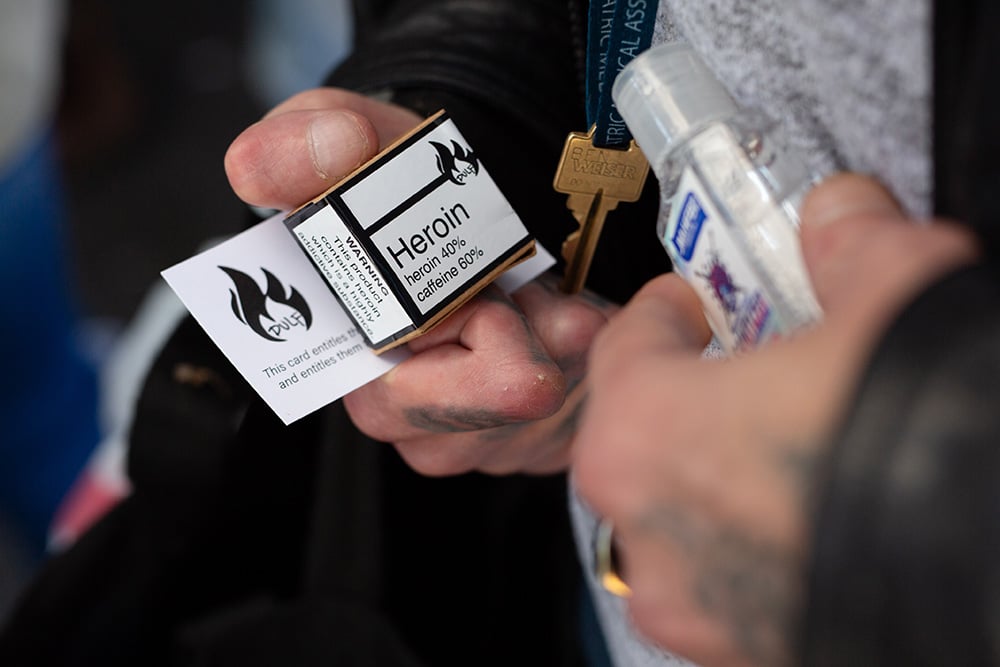
Vancouver’s council has backed a proposal that could help the Drug User Liberation Front provide safer drugs like heroin. The organization has already successfully provided tested drugs on three occasions. Photo by Maggie MacPherson.

Vancouver city council voted Thursday to support an attempt to start a compassion club that would provide drug users with untainted heroin, cocaine and methamphetamines in the midst of B.C.’s deadly overdose crisis.

Mayor Kennedy Stewart said he will now advocate for the model when he visits Ottawa Monday and meets with Prime Minister Justin Trudeau, Deputy Prime Minister Chrystia Freeland and Health Canada staff.

Dozens of speakers called in to tell councillors about their experiences responding to hundreds of overdoses, often getting there too late and finding their lifeless bodies, and of losing friends who had themselves saved others from overdoses before succumbing to tainted drugs.

The motion, brought forward by COPE Coun. Jean Swanson, asked the mayor and councillors to support a request for exemption from Canada’s Controlled Drugs and Substances Act that would let the compassion club procure drugs.

Vancouver Coastal Health also supports the application and will help implement the compassion club model if the exemption is granted.

The Tyee is supported by readers like you Join us and grow independent media in Canada


A group called the Drug User Liberation Front has applied for the exemption after running on three events in the Downtown Eastside where organizers handed out packages of tested and labelled heroin, cocaine and methamphetamine, with no overdoses recorded.

But with no legal, regulated supply of those drugs available in Canada, DULF organizers have had to buy the drugs for each of those events from the dark web.

That was a concern for some councillors, who said they could not support a program that would buy drugs from an unknown source, potentially funding organized crime groups or terrorists.

“It would be disingenuous or naive to suggest that the dark web is not a vehicle for organized crime and people who perpetuate violence on other people, so what it amounts to is: should we endorse that particular model?” said Green Coun. Pete Fry.

“It’s endorsing a harm reduction for some, but (is harm) being perpetuated for others… by the people who are organizing on the dark web? How we get around this to support it in a way that does not endorse that?”

NPA Coun. Melissa de Genova repeatedly raised concerns about the dark web in response to many of the speakers who called in to support the motion, raising the spectre of child pornography and terrorism as well as the illicit drug trade. Independent Coun. Lisa Dominato also said she was concerned that buying from the dark web could support organized crime.

British Columbia’s tainted drug supply is becoming deadlier by the month. In 2020, drug toxicity deaths shot up and they’ve continued to steadily increase this year: 184 people died in July, the deadliest month recorded in 2021. In 2020, 1,734 people died of overdoses. If current trends continue, over 2,000 British Columbians could lose their lives by the end of 2021.

B.C. has the highest rate of drug deaths in Canada, at 40 deaths per 100,000 people — a higher rate than 48 U.S. states, including some of those hardest hit by the crisis like Ohio and Pennsylvania.

The province’s illicit supply is now contaminated with fentanyl — a powerful synthetic opioid — as well as benzodiazepines and other dangerous additives. The mix is unpredictable and changes all the time, making it impossible for drug users to know what will happen when they take drugs.

Donald MacPherson, the executive director of the Canadian Drug Policy Coalition, told council he supports DULF’s application for an exemption and the compassion club model.

MacPherson reminded councillors that other efforts like needle exchanges and safe injection sites were once illegal. But drug user activists persisted and showed how the services could operate and save lives even though they were breaking the law to do so — just as DULF is doing now.

The leadership of civic politicians, like former mayor Philip Owen, also helped to pave the way for Vancouver to adopt harm reduction services that were once taboo, MacPherson said.


In response to Fry and de Genova’s concerns about using the dark web to source drugs, MacPherson said in the absence of a safe, regulated and legal supply of drugs like heroin and cocaine, the DULF model presents a safer choice.

“We’re stuck with a tough dilemma. People are going to go buy drugs tonight from the illegal market, whatever that looks like — they will do that,” MacPherson said.

“The proposal before you acknowledges that that’s very dangerous and presents a way of making it safer, without having the ideal fix — which would be accessing legal regulated drugs, which we’re all trying to get to.”

Safe consumption sites, where drug users take drugs while trained staff or volunteers are on hand to prevent overdoses, work well to prevent death, but they don’t prevent overdoses to begin with.

Drug checking can tell users what’s in their drugs, but it’s also inadequate, Sarah Guzman told council. Guzman, who has worked as a drug checker, said she’s had the experience of telling people what’s in their drugs, but knowing they’ll take them anyway. In one case, she ran after someone to tell them how strong their drugs were, but found the person already overdosing.

Canada’s Controlled Drugs and Substances Act allows the federal health minister to issue an exemption from any part of the legislation “for a medical or scientific purpose or is otherwise in the public interest.”

This Overdose Awareness Day, Activists Will Again Hand Out Safe Drugs
READ MORE

Eris Nyx, one of the founders of DULF, said getting the Section 56 exemption is key to being able to move towards getting the drugs from a regulated and legal supplier.

One of those suppliers could be Fair Price Pharma, a non-profit company set up by former B.C. provincial health officer Dr. Perry Kendall to manufacture injectable heroin. However, those legal supplies are not yet available in Canada.

The end goal for many of the supporters of DULF who spoke to council is legalizing the currently illicit drug supply.

“It is the unpredictability of the drug supply that is killing people,” Jeremy Kalicum, a co-founder of DULF, told council.


NDP and Greens Push Trudeau to Answer Vancouver’s Call to Decriminalize Drugs
READ MORE

“Drug prices are set not at fair market, but at prices that allow maximum financial exploitation, which in turn drives crime.”

In response to the concerns raised about buying drugs from the dark web, Swanson introduced an amendment to her motion, stating that council would support the exemption request as long as DULF gets its supply from a legal, regulated source.

De Genova voted in favour of endorsing DULF’s application for the Section 56 exemption, but against writing to Ottawa to support it and against asking city staff to look at other ways safe drug supply could be provided. The mayor and all other councillors voted in support of the entire motion.

Nyx said council’s support will help, but DULF is committed to running the compassion club with or without the political help.

“We’re going to run this program by hell or high water because it will save lives,” Nyx said. “We’re a radical organization. We don’t need state sanctioning — but it helps. Safe supply by any means necessary.”

* Story updated on Oct. 8 at 12:19 p.m. to correct Lisa Dominato’s party affiliation. In April 2021, Dominato left the Non-Partisan Association to sit as an independent councillor.

Wednesday, November 03, 2021

LEGALIZE DRUGS
B.C. applies to remove criminal penalties for possession of small amounts of drugs

VICTORIA — British Columbia is applying to the federal government to remove criminal penalties for possession of small amounts of illicit drugs in an effort to help more people get care in a health crisis that has claimed 7,700 lives over five years.
© Provided by The Canadian Press

Sheila Malcolmson, B.C.'s mental health and addictions minister, said Monday that substance use and addiction is a public health issue and not a criminal one, which is why the province believes removing the penalties will reduce drug-use stigma and convince more people to seek life-saving treatment.

She said B.C. is the first province in the country to request an exemption from Health Canada under the Controlled Substances Act, asking to decriminalize for personal use up to 4.5 grams of illicit drugs, including heroin, fentanyl, powder and crack cocaine and methamphetamine.

The province's application was applauded widely as a step forward in addressing the toxic drug crisis, but concerns on both sides of the issue were raised about the amount of drugs specified in the application.

"The B.C. Association of Chiefs of Police does not support the recommendations to decriminalize 4.5 grams of illicit drugs for personal use," said association president Howard Chow, deputy chief of the Vancouver Police Department, in a statement.

Instead, the association recommends a more measured approach that will see incremental increases as required and supported by evidence, Chow said in a statement.

Police are concerned drug dealers will exploit the threshold and it could lead to public consumption increases, he said.

The Pivot Legal Society, a legal advocacy group based in Vancouver's Downtown Eastside, said the possession threshold is too low and doesn't adequately protect people who use drugs.

"The threshold of 4.5 grams is cumulative, meaning it refers to the combined quantity of drugs allowed to be carried rather than the amount permitted of each individual substance," it said in a statement on behalf of about 10 groups and organizations, including the Vancouver Area Network of Drugs Users.

Malcolmson said B.C. is taking the next step toward helping people end the stigma of drug use and removing the threat of criminal penalty that keeps many from seeking treatment.

She said she is encouraged the federal government recently created a federal Mental Heath and Addictions Department, appointing Carolyn Bennett as minister.

"I hope this is the first item on her desk," said Malcolmson.

Figures released in September from the BC Coroners Service show there were 1,204 deaths from illicit drugs between January and the end of July, a 28 per cent jump over the same period in 2020.

The coroner says the first seven months of this year were the deadliest since a health emergency was declared in 2016, and July was the 17th straight month in which more than 100 B.C. residents died from a toxic drug supply.

B.C.'s provincial health officer Dr. Bonnie Henry said charging people criminally for possessing small amounts of illicit drugs creates a revolving door where people face the legal system but not their health issues.

"The time to make this change is now," she said. "This toxic drug crisis is not a criminal issue. It's a public health issue."

Sen. Larry Campbell, a former Vancouver mayor and B.C. chief coroner, said he supports decriminalizing small amounts of illicit drugs because he believes it will save lives.

"This is about keeping people alive," he said. "That's it. That's the bottom line. It drives me crazy that people can't get it through their heads that this is a health issue."

Chief coroner Lisa Lapointe said decades of criminalizing drug possession has not worked and a move away from a crime model to a health one has arrived.

"The goal of decriminalization is to reduce suffering and death," she said.

Last month, Toronto said it was also preparing to ask Health Canada for an exemption under the Controlled Drugs and Substances Act to decriminalize the possession of illicit drugs for personal use in the city, following a similar request made by Vancouver in May.

This report by The Canadian Press was first published Nov. 1, 2021.

Dirk Meissner, The Canadian Press

Thursday, February 18, 2021

California bill would decriminalize psychedelics, paving the way for medical treatment

Vivian Ho 

A California lawmaker has introduced legislation that would decriminalize psychedelics in the state, the latest bold step in a movement to end America’s war on drugs.
 
Scott Wiener, the state senator who authored the bill, hopes that in following the lead of places such as Oakland, Santa Cruz and the District of Columbia – all cities which have decriminalized psychedelics – California will move one step closer to decriminalizing the use and possession of all drugs, something that Oregon passed by voter initiative in November.

“People should not be going to jail for possessing or using drugs,” Wiener told the Guardian. “It’s a health issue, not a criminal issue, and I hope that we get all the way there.”

Related: 'The war on drugs failed': California lawmaker will push to decriminalize psychedelics

This bill, unveiled on Thursday, would decriminalize possession and personal use of psilocybin, psilocyn, MDMA, LSD, ketamine, DMT, mescaline and ibogaine – all drugs that can be used for medical treatment. While the decriminalization would apply for any kind of possession or use, not just medical, the bill makes a point to tout the medical benefits of psychedelics, a strategy familiar to drug policy reform advocates.

“That’s how it worked with cannabis,” said Anthony Johnson, a longtime advocate and chief petitioner for Oregon’s Measure 110, the initiative that decriminalized personal possession of small amounts of all illicit drugs. “It’s definitely a way to help people that need it first and foremost, but also then to educate the public about these substances of how the drug war has been a failed policy and how there is a better approach.”

© Photograph: Richard Vogel/AP A vendor packages psilocybin mushrooms at a cannabis market in Los Angeles.

The bill would also expunge criminal records for people convicted of possession or personal use of these substances. It would create a taskforce to recommend which regulatory body would oversee personal and therapeutic use of these substances for mental health treatment.

Wiener did not include peyote as one of the substances because of a shortage of the drug among indigenous practitioners, he said. Peyote is a sacred plant for many indigenous tribes, and at the behest of the native community, the bill will not decriminalize peyote, or mescaline when it is sourced from peyote.

Breaking down stereotypes


In his advocacy, Johnson found that the biggest opponent of decriminalization have been law enforcement, who cite public safety concerns, and those in the private rehabilitation industry. Wiener hopes that testimony from veterans – the bill is sponsored by two groups who help them with PTSD – and therapists who support the therapeutic use of psychedelics will break down prejudices about psychedelics users.

“There’s a stereotype of who’s using psychedelics, but it’s much broader than that and when you have veterans coming into the Capitol talking about how psychedelics help them with PTSD and help them get their lives back, that’s incredibly powerful for legislators,” he said.

Juliana Mercer, 38, is one of those veterans. She graduated boot camp one week before September 11. In her 16 years as a Marine, 10 of which she was active duty, she served two tours: one in Iraq and one in Afghanistan

.
© Provided by The Guardian A bill unveiled in California on Thursday would decriminalize psychedelic drugs, such as LSD. Photograph: RapidEye/Getty Images

Most of her time involved civil affairs, working with local communities and learning of the devastation of war first-hand. For four years, she was in the wounded warriors unit, providing support and services to injured Marines and their families.

“I lost quite a few friends and just saw a lot of a lot of damage and destruction along the way,” said Mercer, who described the experience as leaving her with lingering, unaddressed trauma. “I put all of that stuff away and kind of forgot about it for a while, and once I slowed down it was all just sitting there and I didn’t know what to do with it.”

Mercer’s first foray into psychedelics was recreational. But her experience gave her a feeling of connectedness that she had not felt for a long time, spurring her to reach out to the Heroic Hearts Project, a group that specializes in ayahuasca therapy with military veterans, about a year and a half ago.

Her first session exceeded anything she had expected, releasing “years of grief”.

“I kept hearing that when you do some of these plant medicines, you’ll be able to do 10 years worth of work in one session,” Mercer said. “Just one of my sessions really brought out all of that pain and the grief that I didn’t even know was in there and allowed me to just completely release it and expel it, things that I had no idea were there.”

With the help of her coach and therapist, Mercer was able to “unpack why I was so stuck”.

“It had nothing to do with not knowing who I was or what direction to go, it had to do with just being bogged down with all of these things,” she said.

Lauren Taus, a licensed clinical social worker who facilitates ketamine therapy, is adamant that plant medicine therapy is only a potent tool, not a solution, in mental health work – but one that should be decriminalized as soon as possible.

“We are in a mental health crisis and Covid-19 has exacerbated what was already a crisis,” Taus said. “And the causes of trauma are multiplying way faster than the solutions. Current treatment is generally not very effective. Psychedelic medicine has been engaged with globally for eons. This stuff works and we deserve to have access to solutions that will be sustainable.”

Monday, August 29, 2022

DECRIMINALIZE DRUGS

Illicit drugs are used by one in ten intensive cardiac care unit patients

Reports and Proceedings

EUROPEAN SOCIETY OF CARDIOLOGY

Barcelona, Spain – 26 Aug 2022: Illicit drug use is associated with a nearly nine-fold greater risk of death or life-threatening emergencies in intensive cardiac care unit (ICCU) patients, according to research presented at ESC Congress 2022.1

Study author Dr. Theo Pezel of Hospital Lariboisiere, Paris, France said: “Our study shows that patients with acute cardiovascular conditions who take illegal drugs are more likely to die or experience cardiac arrest or cardiogenic shock while in hospital compared with non-users. Multiple drug users had an 11-fold risk of a poor in-hospital prognosis compared with those taking one drug.”

Illicit drug use has increased by 22% in the past decade to an estimated 275 million people worldwide.2 In the EU, approximately 83.4 million (29%) of 15 to 64 year-olds have ever used an illicit drug.3 Cannabis, cocaine, ecstasy (3,4-methylenedioxymethamphetamine; MDMA), amphetamines, and heroin or other opioids are the most commonly used substances. Illicit drugs have been linked with acute cardiovascular events including heart attacks and aortic dissection4,5 but the prevalence of drug use in ICCU patients, and the short-term consequences, remain unknown.

The Addiction in Intensive Cardiac Care Units (ADDICT-ICCU) study assessed the prevalence of illicit drug use and the association with in-hospital major adverse events in consecutive patients admitted for acute cardiovascular events. From 7 to 22 April 2021, all consecutive patients admitted to ICCU in 39 centres throughout France provided a urine sample which was tested for illegal drugs. The primary outcome was the prevalence of illegal drug use. The secondary outcome was in-hospital major adverse events, defined as death, resuscitated cardiac arrest or cardiogenic shock.

A total of 1,499 patients were screened, of which 70% were men. The average age was 63 years. Reasons for admission included myocardial infarction, acute heart failure, arrhythmias, myocarditis and pulmonary embolism. Some 161 patients (10.7%) had a positive test for at least one illicit drug. Regarding the types of drugs, 9.1% tested positive for cannabis, 2.1% for opioids, 1.7% for cocaine, 0.7% for amphetamines and 0.6% for MDMA.

Patients who used illicit drugs tended to be young: one-third (33%) of patients under 40 years of age were users compared with just 6% of those aged 60 years or above. Some 12% of men were users compared to 8% of women. All patients completed a questionnaire in which they were asked if they currently used illicit drugs. Of those with a positive urine drug test, just 56.5% reported current use while 43.5% claimed they did not use drugs.

During a median hospitalisation of five days, 61 patients (4.1%) had a major adverse event. Illicit drug use was associated with an almost nine-fold odds of major adverse events after adjusting for comorbidities (odds ratio [OR] 8.84; 95% confidence interval [CI] 4.68–16.7; p<0.001). After adjustment for age and sex, cannabis use was associated with a three-fold odds of major adverse events (OR=3.53; 95% CI 1.25–9.95; p<0.001) while cocaine was associated with a five-fold odds (OR=5.12; 95% CI 1.48–17.2; p=0.004).

Of those using drugs, 28% took more than one type of drug. Multiple drug use was associated with a higher incidence of major adverse events than single drug use, with an odds ratio of 11.4 (95% CI 4.31–32.7; p<0.001).

Dr. Pezel said: “Illicit drug use was common in ICCU patients but under-reported. Users admitted for ST-elevation myocardial infarction (STEMI) and acute heart failure had particularly high risks of death, cardiac arrest or cardiogenic shock with odds ratios of 28.8  and 12.8, respectively. Our results suggest that patients admitted to ICCU should be tested for drugs to identify those with an increased likelihood of detrimental outcomes.”


ENDS

Notes to editors

Authors: ESC Press Office
Mobile: +33 (0)7 85 31 20 36
Email: press@escardio.org

The hashtag for ESC Congress 2022 is #ESCCongress.

Follow us on Twitter @ESCardioNews 


Funding: Institutional grant from the ‘Fondation Coeur et Recherche’, Paris, France.

Disclosures: None.


References and notes

1The abstract “Prevalence of illicit drugs use and association with in-hospital major adverse events in patients hospitalised for acute cardiac events: the ADDICT-ICCU Trial” will be presented during the session Acute cardiac care and COVID on Monday 29 August at 15:15 to 16:00 CEST at Station 5.

2World Drug Report 2021. United Nations: Office on Drugs and Crime. //www.unodc.org/unodc/en/data-and-analysis/wdr2021.html

3European Drug Report 2022: Trends and Developments. European Monitoring Centre for Drugs and Drug Addiction. https://op.europa.eu/en/publication-detail/-/publication/2d48883c-ed1f-11ec-a534-01aa75ed71a1/language-en/format-PDF/source-search

4Havakuk O, Rezkalla SH, Kloner RA. The cardiovascular effects of cocaine. J Am Coll Cardiol. 2017;70:101–113.

5Jouanjus E, Lapeyre-Mestre M, Micallef J, Cannabis use: signal of increasing risk of serious cardiovascular disorders. J Am Heart Assoc. 2014;3:e000638.


About the European Society of Cardiology

The European Society of Cardiology brings together health care professionals from more than 150 countries, working to advance cardiovascular medicine and help people lead longer, healthier lives.

About ESC Congress 2022

It is the world’s largest gathering of cardiovascular professionals, disseminating ground-breaking science both onsite in Barcelona and online – from 26 to 29 August. Explore the scientific programme. More information is available from the ESC Press Office at press@escardio.org.