Investigation Demanded as ICE Reports Third Death at Texas Detention Center in 44 Days
“This is the third person who has died in the $1.24 billion privately-run facility that focuses on profits instead of meeting basic standards,” said one lawmaker.

Acting Immigration and Customs Enforcement Director Todd Lyons (C) speaks during a press conference on October 30, 2025, in Gary, Indiana.
(Photo by Jamie Kelter Davis/Getty Images)
Julia Conley
Jan 19, 2026
COMMON DREAMS
Officials in both Texas and Minnesota are calling for accountability and a full investigation into conditions at Camp East Montana, the sprawling detention complex at Fort Bliss in El Paso, Texas, following the third reported death at the facility in less than two months.
Victor Manuel Diaz, 36, was detained by US Immigration and Customs Enforcement officers in Minneapolis, where ICE has been carrying out violent immigration arrests, cracking down on dissent, and where one officer fatally shot a legal observer earlier this month.
.
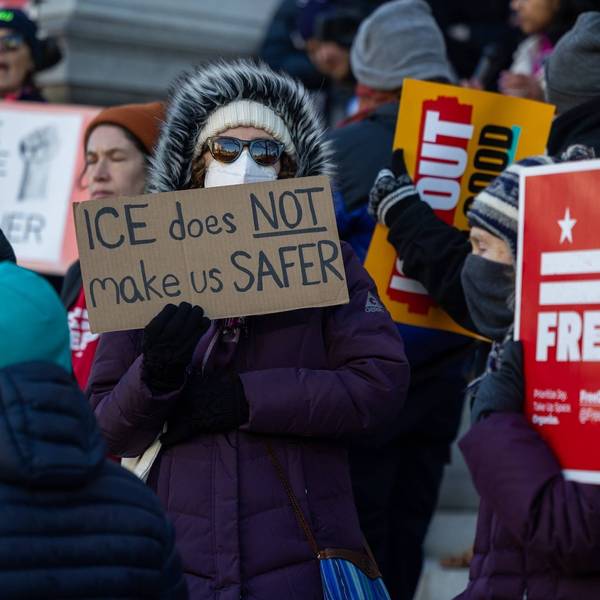
‘ICE Kills’: Guards Reportedly Choked Man to Death at El Paso Detention Center
He was one of roughly 2,903 detainees being held at Camp East Montana at Fort Bliss US Army base, one of the largest ICE detention centers in the country, on January 14 when contract security workers found him “unconscious and unresponsive” in his cell.
He was later pronounced dead and ICE released a statement saying he had died of “presumed suicide,” but officials arre still investigating his cause of death.
Diaz’s death comes days after it was reported that a medical examiner in Texas was planning to classify another death reported at Camp East Montana—that of Geraldo Lunas Campos—as a homicide.
A doctor said Lunas Campos’ preliminary cause of death in early January was “asphyxia due to neck and chest compression.” An eyewitness said he had seen several guards in a struggle with the 55-year-old Cuban immigrant and then saw guards choking Lunas Campos.
A month prior of Lunas Campos’ death, 49-year-old Guatemalan immigrant Francisco Gaspar-Andres died at a nearby hospital; he was a detainee at Camp East Montana. ICE said medical staff attributed his death to “natural liver and kidney failure.”
Minnesota Lt. Gov. Peggy Flanagan called for a “complete and transparent investigation” into what happened to Diaz after his death was announced Sunday.
“We deserve answers,” said Flanagan.
US Rep. Veronica Escobar (D-Texas), who last year expressed concern about the US government’s deal with a small private business, Acquisition Logistics LLC, to run Camp East Montana, said the detention center “must be shut down immediately,” warning that “two deaths in one month means conditions are worsening.”
After the administration awarded a $1.2 billion contract to Acquisition Logistics to build and operate the camp, lawmakers and legal experts raised questions about the decision, considering the small company had no listed experience running detention centers, its headquarters was listed as a Virginia residential address, and the president and CEO of the company did not respond to media inquiries.
“It’s far too easy for standards to slip,” Escobar told PBS Newshour after touring the facility. “Private facilities far too frequently operate with a profit margin in mind as opposed to a governmental facility.”
In September, ICE’s own inspectors found at least 60 violations of federal standards, with employees failing to treat and monitor detainees’ medical conditions and the center lacking safety procedures and methods for detainees to contact their lawyers.
Across all of ICE’s detention facilities, 2025 was the deadliest year for immigrant detainees in more than two decades, with 32 people dying in the agency’s centers.
After Diaz’s death was reported Sunday, former National Nurses United communications adviser Charles Idelson said that “ICE detention centers are functioning like death camps.”
“This is the third person who has died in the $1.24 billion privately-run facility that focuses on profits instead of meeting basic standards,” said one lawmaker.
Acting Immigration and Customs Enforcement Director Todd Lyons (C) speaks during a press conference on October 30, 2025, in Gary, Indiana.
(Photo by Jamie Kelter Davis/Getty Images)
Julia Conley
Jan 19, 2026
COMMON DREAMS
Officials in both Texas and Minnesota are calling for accountability and a full investigation into conditions at Camp East Montana, the sprawling detention complex at Fort Bliss in El Paso, Texas, following the third reported death at the facility in less than two months.
Victor Manuel Diaz, 36, was detained by US Immigration and Customs Enforcement officers in Minneapolis, where ICE has been carrying out violent immigration arrests, cracking down on dissent, and where one officer fatally shot a legal observer earlier this month.
.
‘ICE Kills’: Guards Reportedly Choked Man to Death at El Paso Detention Center
He was one of roughly 2,903 detainees being held at Camp East Montana at Fort Bliss US Army base, one of the largest ICE detention centers in the country, on January 14 when contract security workers found him “unconscious and unresponsive” in his cell.
He was later pronounced dead and ICE released a statement saying he had died of “presumed suicide,” but officials arre still investigating his cause of death.
Diaz’s death comes days after it was reported that a medical examiner in Texas was planning to classify another death reported at Camp East Montana—that of Geraldo Lunas Campos—as a homicide.
A doctor said Lunas Campos’ preliminary cause of death in early January was “asphyxia due to neck and chest compression.” An eyewitness said he had seen several guards in a struggle with the 55-year-old Cuban immigrant and then saw guards choking Lunas Campos.
A month prior of Lunas Campos’ death, 49-year-old Guatemalan immigrant Francisco Gaspar-Andres died at a nearby hospital; he was a detainee at Camp East Montana. ICE said medical staff attributed his death to “natural liver and kidney failure.”
Minnesota Lt. Gov. Peggy Flanagan called for a “complete and transparent investigation” into what happened to Diaz after his death was announced Sunday.
“We deserve answers,” said Flanagan.
US Rep. Veronica Escobar (D-Texas), who last year expressed concern about the US government’s deal with a small private business, Acquisition Logistics LLC, to run Camp East Montana, said the detention center “must be shut down immediately,” warning that “two deaths in one month means conditions are worsening.”
After the administration awarded a $1.2 billion contract to Acquisition Logistics to build and operate the camp, lawmakers and legal experts raised questions about the decision, considering the small company had no listed experience running detention centers, its headquarters was listed as a Virginia residential address, and the president and CEO of the company did not respond to media inquiries.
“It’s far too easy for standards to slip,” Escobar told PBS Newshour after touring the facility. “Private facilities far too frequently operate with a profit margin in mind as opposed to a governmental facility.”
In September, ICE’s own inspectors found at least 60 violations of federal standards, with employees failing to treat and monitor detainees’ medical conditions and the center lacking safety procedures and methods for detainees to contact their lawyers.
Across all of ICE’s detention facilities, 2025 was the deadliest year for immigrant detainees in more than two decades, with 32 people dying in the agency’s centers.
After Diaz’s death was reported Sunday, former National Nurses United communications adviser Charles Idelson said that “ICE detention centers are functioning like death camps.”
At least 32 people died in ICE jails in 2025, and four more have already died in ICE custody this year.
By Mike Ludwig ,
January 17, 2026
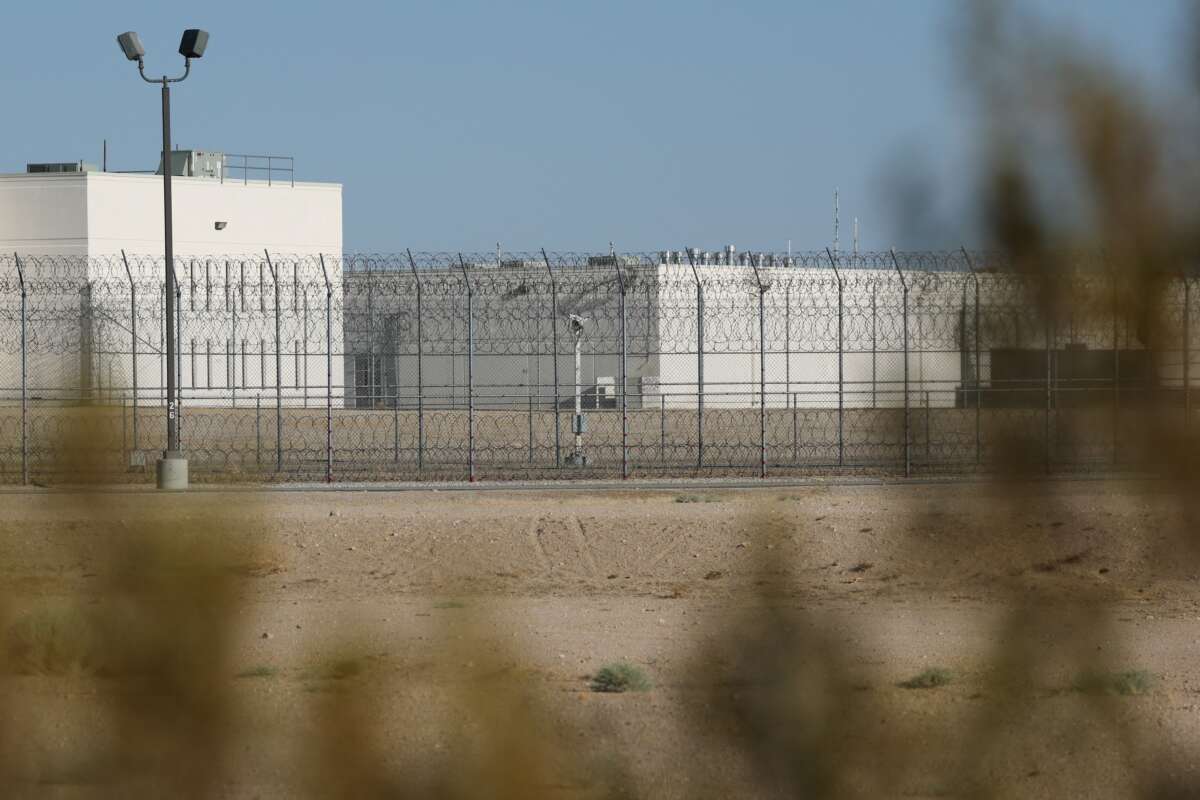
The CoreCivic, Inc. California City Immigration Processing Center stands in the Kern County desert awaiting reopening as a federal immigrant detention facility under contract with Immigration and Customs Enforcement in California City, California, on July 10, 2025.PATRICK T. FALLON / AFP via Getty Images
All eyes are on the Trump administration’s brutal “immigration enforcement” operation in Minnesota, where roving squads of federal agents in Minneapolis are demanding proof of citizenship from people of color on the street and lashing out against residents enraged by the deadly shooting of Renee Nicole Good by an Immigration and Customs Enforcement (ICE) officer last week.
Far less visible is the rapidly expanding, nationwide network of jails and prisons where ICE and Border Patrol lock people up after they are arrested, and that is almost certainly by design. Four people died in federal immigration jails so far in 2026, and at least 32 people died in ICE jails over the course of 2025 as President Donald Trump ramped up his mass deportation campaign. The death count for 2025 constituted the most deaths in ICE jails ever recorded outside the COVID-19 pandemic.
“If we are seeing that sort of outward extreme violence in broad daylight in the streets of Minneapolis and streets across the country, imagine what people must be facing behind closed doors and behind bars in ICE detention centers,” said Setareh Ghandehari, advocacy director at the Detention Watch Network, in an interview with Truthout.
“If we are seeing that sort of outward extreme violence in broad daylight in the streets of Minneapolis, imagine what people must be facing behind closed doors and behind bars in ICE detention centers.”
The number of people imprisoned by ICE increased by 75 percent to nearly 66,000 in 2025, and despite repeated claims by administration officials about targeting “the worst of the worst,” nearly 74 percent have no criminal convictions, according to the Transactional Records Access Clearinghouse immigration database. ICE’s “roving patrols” and “indiscriminate raids” have contributed to a 2,450 percent increase in the number of people with no criminal record held in ICE detention on any given day, according to the American Immigration Council.
Ghandehari told Truthout that ICE has long faced allegations of allowing abuse, medical neglect, inhumane conditions, and solitary confinement in its network of jails and prisons, which are used to incarcerate people facing deportation orders.
ICE Wants to Reopen Notorious California Prison. Locals Are Fighting Back.
FCI Dublin was shut down in 2024 after revelations of abuse against prisoners. Residents want it to stay closed. By Victoria Law , Truthout/TheAppeal December 20, 2025
ICE’s carceral facilities are often run by for-profit prison companies or local sheriffs acting as contractors. While many detainees are held at remote facilities in Louisiana and Texas, far from families and legal support, Ghandehari said ICE is now operating nearly 200 jails nationwide after opening or reopening more than 130 facilities in 2025.
“What we have seen and are seeing in Minneapolis is enraging; it’s unacceptable, it’s out of control, but unfortunately it is unsurprising given that ICE is inherently a violent agency, and what we are now seeing in Minneapolis is really the manifestation of years of ICE being allowed to act with impunity,” Ghandehari told Truthout.
On January 15, the county medical examiner in El Paso, Texas, announced that the death of Geraldo Lunas Campos, a 55-year-old man held at a massive immigration detention center at El Paso’s Fort Bliss military base, was likely a homicide. The Department of Homeland Security (DHS) said Campos was attempting to kill himself and violently resisted when officers intervened but provided no evidence to back up that claim.
“What we are now seeing in Minneapolis is really the manifestation of years of ICE being allowed to act with impunity.”
The most recent deaths among those imprisoned by ICE also include 46-year-old Parady La from Cambodia, who was arrested and jailed by ICE on January 6 and died three days later after receiving “treatment for severe drug withdrawal at the Federal Detention Center” in Philadelphia, Pennsylvania, according to DHS. La was found unresponsive in his cell the next day and was later pronounced dead of brain and organ failure at a nearby hospital.
Withdrawal from certain drugs and alcohol can be fatal but is easily treatable with medical supervision and proper medications. In an attempt to revive La, DHS claims federal officers administered CPR and naloxone, a drug used to treat opioid overdoses, not withdrawal symptoms. The Bureau of Prisons maintains a protocol for safely supervising drug withdrawal in federal detention facilities.
Jonathan Feinberg, an attorney for La’s family, said nobody should die in custody from opiate withdrawal.
“We do not at this point know exactly what happened to Parady La, but the circumstances that have been reported are highly suspicious and concerning,” Feinberg wrote in an email to Truthout on Friday. “We intend to conduct a full investigation and pursue every legal remedy available to his family.”
A 2024 report by Physicians for Human Rights examined 52 deaths in ICE custody from 2017 to 2021 and found that 95 percent were preventable or possibly preventable if appropriate medical care had been provided. Civil liberties and international human rights groups have sounded alarm bells about medical neglect and preventable deaths in ICE custody for over a decade.
ICE did not respond to a request for comment by the time this story was published. However, the official statement on La’s death includes a list of mostly minor drug and alcohol violations and accuses the man of being a “career criminal,” reflecting a larger pattern of ICE smearing people who are harmed at the hands of its agents. After Renee Good was fatally shot by an ICE agent in Minneapolis while attempting to pull away from the scene in her vehicle on January 7, Homeland Security Secretary Kristi Noem baselessly accused the mother and poet of being a “domestic terrorist.”
Other recent deaths in ICE custody include Luis Beltran Yanez-Cruz, 68, who was detained at the Imperial Regional Detention Facility in California and died on January 6, and Luis Gustavo Nunez Caceres, 42, who was detained at the Joe Corley Processing Center in Texas and died on January 5, according to Detention Watch Network.
“You can imagine how bad the conditions have been getting,” Ghandehari said. “It’s not even a full two weeks into this new year, and we already have four deaths in ICE custody.”
ICE cannot place U.S. citizens in detention for extended periods of time, but multiple citizens have reportedly been arrested by ICE under Trump’s crackdown, including George Retes, a U.S. veteran who was wrongly detained by ICE in California for three days after a chaotic raid on a cannabis farm in August.
ICE cannot place U.S. citizens in detention for extended periods of time, but multiple citizens have reportedly been arrested by ICE under Trump’s crackdown.
The Oglala Sioux Tribe, one of the largest tribal nations in the U.S., has accused ICE of illegally holding four members arrested during raids in Minneapolis, according to Axios.
From New Jersey to California to Minnesota, immigration officials have barred Democratic lawmakers from entering ICE jails to conduct unannounced inspections and check on incarcerated constituents. A federal judge recently struck down a policy requiring advance notice from lawmakers, but Noem instituted a new policy that blocked Minnesota Rep. Ilhan Omar and other Democrats from visiting the central ICE holding facility in the Twin Cities shortly after Good was killed.
“When we appropriate funds as members of Congress, we are expected by the public to do oversight because the public requires their money be used with transparency and accountability,” Omar told reporters on January 10. “And what happened today is ICE agents decided that we were no longer allowed to fulfill our constitutional duties.”
Rep. Ro Khanna (D-California) says he may be the only member of Congress to conduct an oversight visit to an ICE jail under the Trump administration. Khanna and a staff member visited ICE California City Detention Center on January 6, the largest ICE prison in California. Khanna made the visit after one of his constituents “was beaten, unlawfully detained, and held at this very facility before being deported,” according to a social media post.
Khanna said he was “deeply disturbed” by his visit to the ICE prison, which currently holds nearly 1,500 people. When he spoke to families in the parking lot, they described their loved ones being subjected to “inadequate food, visible mold, and water that tastes like metal.” A lack of medical care was the most alarming failure, Khanna said, with one detainee telling the congressman that he was urinating blood but still had not received medical care.
“For illnesses like the flu, medicine is rarely provided; at best, [an] ibuprofen is given, but more often detainees are told to buy basic medicine from the commissary at exaggerated, unaffordable prices,” Khanna said. “With reportedly only one doctor for hundreds of people, the neglect is structural.”
Congress faces a self-imposed January 30 deadline to pass legislation funding the government, which gives lawmakers a chance to rein in ICE by defunding the infrastructure that makes Trump’s brutal “immigration” crackdown possible, including the expanding network of ICE jails and prisons, according to Ghandehari. ICE’s budget is set to balloon by $170 billion under the megabill championed by Trump and passed by Republicans in July 2025, but some progressive Democrats are now pushing to defund the agency.
“They can’t do what they are doing without infrastructure that has been built up over decades,” Ghandehari told Truthout, explaining that the only way to stop the Trump administration’s violence is by starting to dismantle ICE’s infrastructure. ”That’s why it’s so important that Congress do the right things this week and start the process of cutting ICE off.”


No comments:
Post a Comment