Battle Over Facial Recognition in New Orleans Will Shape Future of Surveillance
Edith Romero, an organizer in New Orleans, discusses the dangers of the growing surveillance state.
By Ed Vogel , TruthoutPublishedJanuary 17, 2026

The New Orleans City Council and New Orleans Police Department continue to push for facial recognition technology, despite persistent community opposition. John Lund via Getty Images
While New York City, Los Angeles, and Chicago have all received significant attention when it comes to police use of surveillance technologies, the small city of New Orleans has for years been the laboratory for a sophisticated surveillance apparatus deployed by the city’s police department and other policing bodies.
Just last year, New Orleans was in the news as the city considered setting a new surveillance precedent in the United States. First, a privately run camera network, Project N.O.L.A., was exposed for deploying facial recognition technology, including “live use” (meaning Project N.O.L.A. was identifying people in real time as they walked through the city). All of this was done in close collaboration with the local police, despite these uses violating a 2022 ordinance that placed narrow limits on the use of facial recognition.
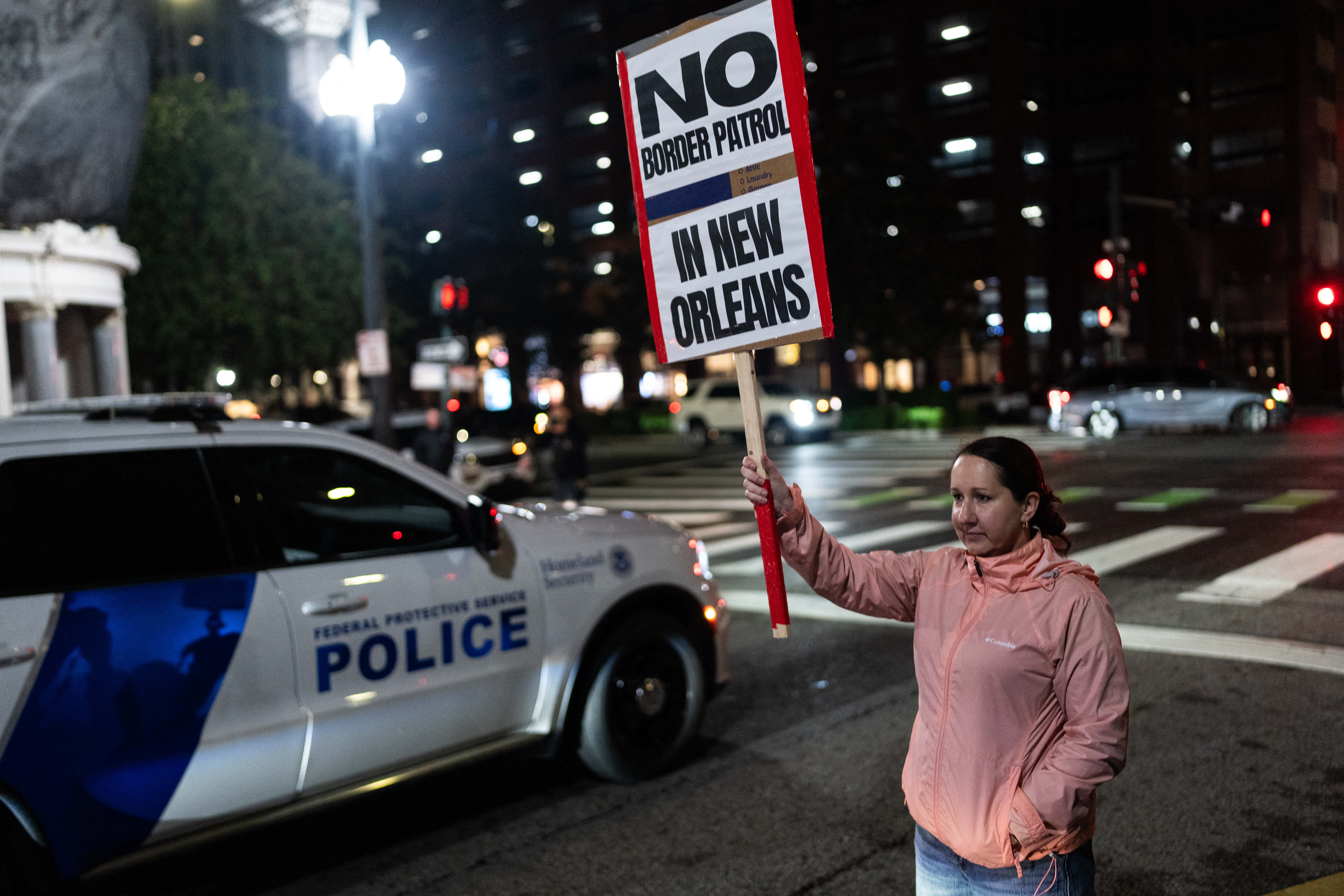
Then the city flirted with formally approving the use of live facial recognition technology, which would have been a first in the United States. If enacted, live facial recognition technology would allow police to identify individuals as they move about New Orleans in real time. All of this occurred in the months before the Trump administration deployed Border Patrol and Immigration and Customs Enforcement (ICE) agents, wielding an array of surveillance technologies, to terrorize and kidnap New Orleans residents. Of course, New Orleans residents have organized and actively fought back against the police and their spying, offering lessons for organizers across the country.
Edith Romero, an organizer with Eye on Surveillance (EOS), spoke with Truthout about the history of Eye on Surveillance, Project NOLA, the use of facial recognition technology in New Orleans and why we should all be watching what’s happening there if we’re concerned about the growing surveillance state.
Ed Vogel: Who is Eye on Surveillance and what do you do?
Edith Romero: In 2020, the Eye on Surveillance (EOS) coalition campaigned for and passed a surveillance ordinance ban that prohibited cell site simulators, facial recognition, and other surveillance technologies. Unfortunately, this ordinance was amended a couple of years later to approve loopholes for the use of facial recognition technology. EOS continues working to halt the expansion of surveillance locally, to change narratives regarding surveillance, and to build a New Orleans that is truly safe for everyone. At this moment while we face the occupation of Customs and Border Protection (CBP), ICE, and National Guard troops, we are even more committed and engaged in the fight against surveillance, with the clear understanding that surveillance is being deployed to kidnap and terrorize our communities of color.
New Orleans Resists ICE Invasion Despite Surveillance and State Repression
Before ICE descended on New Orleans, GOP lawmakers made it a crime to interfere with immigration enforcement. By Mike Ludwig , Truthout/TheAppeal December 9, 2025
EOS has done some amazing organizing to make the problem of surveillance legible in New Orleans and across the country. Can you share more about your organizing strategy to challenge surveillance systems and infrastructure?
Our organizing strategy has always been community and coalition building. Surveillance affects us all, especially our communities of color. That is why we work with immigrants, Black and Brown residents of New Orleans, teacher unions, civic organizations, and local organizations to unite under the same mission: building a New Orleans free of surveillance. Surveillance truly impacts all of us, in every aspect of our lives; we bring forward the interconnectedness of shared struggles via our fight against surveillance through community meetings, teach-ins both in person and virtual, online educational campaigns and creative community events such as community scouting of local surveillance cameras. Relationship building is key for nurturing movements and narrative change towards a world that truly takes care of all of us. Relationship building has not only enabled the victory of getting the live facial recognition surveillance ordinance withdrawn but has strengthened community power and narrative change regarding surveillance and the root causes of safety, resources, and community care.
How have you leveraged your base building towards policy change?
Base building is essential for policy change. We know surveillance is an issue that transcends time, lived experience, and identities. To build a wide coalition that truly represented the broad harm, danger, and systemic inequities that surveillance upholds, we brought together organizations whose work doesn’t necessarily focus on surveillance, but was a reflection of how surveillance permeates almost every aspect of our lives. We worked with formerly incarcerated community leaders who teach about the dangers of surveillance for those on parole, especially in emergency situations, we brought in immigrant community members whose lives are constantly monitored and whose families are separated by ICE/CBP with the aid of surveillance weapons, we talked with teachers who provided insight into the school-to-prison pipeline and how surveillance of our youth is seeping into our education system. Base building enables a holistic perspective regarding the harm and racism that surveillance embodies, countering narratives that erroneously attribute safety to overpolicing and surveillance. The goal is to truly have conversations and demand policy that resources communities rather than corporate interests that sacrifice our wellbeing.
From the outside, it feels like the use of facial recognition technology in New Orleans is a perpetual issue. Can you trace for us what has changed regarding facial recognition technology since the policy victory in 2021?
After our victory with the surveillance ban in 2021, which banned four different surveillance technologies including facial recognition, we had to mobilize continuously against the City Council and NOPD as they continued to push for the approval of facial recognition against persistent community opposition. In 2022, City Council added amendments to the surveillance ban that approved facial recognition for “violent offenses,” opening the door to the use of facial recognition by NOPD. Fast forward to 2025, City Council and NOPD again introduced an ordinance to expand facial recognition and other surveillance technologies even further, with the goal of approving live facial recognition in all the city cameras. NOPD and City Council try to sell surveillance as the ultimate solution for crime and safety, even though research and lessons from history show that safety comes from resourcing community, not surveillance or overpolicing. New Orleans heavily invests in surveillance; for example, the French Quarter is the most surveilled area of all the city, and even so, we still have tragedies like the New Year’s Day attack last year. Surveillance will never bring safety, and as of late we have seen how surveillance is being weaponized through drones, facial recognition apps, and license plate readers to kidnap our communities of color through the violent CBP operation in New Orleans, Catahoula Crunch.
How did you learn that NOPD was using facial recognition in real time?
For a while, we had knowledge about Project NOLA secretly spying on us with banned facial recognition cameras. However, we weren’t aware of the extremely close relationship between Project NOLA and NOPD. In early 2025, The Washington Post reported that NOPD was using Project NOLA to bypass the surveillance ban on facial recognition. Through this reporting we learned that despite the ban, Project NOLA would send alerts and work intimately with NOPD officers, sending live facial recognition alerts to their phones, providing feeds of their cameras to certain officers, or communicating about certain people of interest that they wanted to be tracked through live facial recognition.
Can you contextualize the use of facial recognition in New Orleans and describe the specific communities who are targeted by the police?
Facial recognition in New Orleans has to be considered in the context of the deep history of Black enslavement, Jim Crow, and racism in Louisiana, as well as the fact that Louisiana is the incarceration capital of the world. As we know, facial recognition is a deeply biased technology, one that reinforces the systemic racism that exists in our modern-day society. Research finds that facial recognition misidentifies people of color, leading to arrests of people like Randal Reid, a man from Atlanta, who was arrested by the Jefferson Parish Sheriff’s Office for crimes in Louisiana that he did not commit. Surveillance historically has been used as an excuse to overpolice and criminalize people of color, starting from the lantern laws that were put in place to surveil enslaved Africans when they moved at night through the carrying of lanterns, to the CIA operations that targeted prominent Black civil rights leaders, to the Patriot Act that demonized Muslim and Arab community members to institute surveillance of U.S. citizens and the creation of the Department of Homeland Security.
New Orleans is a majority Black city (55 percent, according to the 2024 census) with a sizable Latine and immigrant community, a city that is constantly being labeled as a sacrifice zone for climate crisis induced hurricanes or cancer-causing factories. It is appalling for New Orleans to constantly be used as a testing ground for racist surveillance, considering the amount of harm this technology would bring to an under-resourced city that depends on hospitality revenue from a Black and Latine labor force.
The NOPD says that they are no longer using real time facial recognition technology but there is an effort to enshrine its use into law. Tell us about the proposed ordinance and how EOS is challenging it?
Ordinance 35,137, introduced in May 2025, was a joint attempt by NOPD and City Council to approve live facial recognition in New Orleans, right after their possibly illegal partnership with Project NOLA was exposed by The Washington Post on a national level. EOS quickly mobilized against this dangerous ordinance, bringing together multiple diverse local organizations to oppose it. This included Step Up Louisiana, Voice of the Experienced (VOTE), Democratic Socialists of America (DSA), and immigrant rights organizations. National organizations such as MediaJustice, Fight for the Future, and Southerners Against Surveillance Systems & Infrastructure (SASSI) also joined the fight against live facial recognition in New Orleans, echoing the understanding that an assault on New Orleans’ through racist surveillance tech is an assault on our collective safety, dignity, and privacy. Surveillance is a danger to everyone, and a coalition of organizations that have diverse perspectives and communities is best situated to denounce the imminent harm posed by live facial recognition. Through public community events, meetings with council members, and campaigns to inform local communities of the danger posed by facial recognition and surveillance, EOS was able to shift public narratives, build diverse coalitions against surveillance and ultimately, get City Council to withdraw the live facial recognition ordinance.
Who is Project NOLA, the organization facilitating this vast camera apparatus?
Project NOLA is a spy network of thousands of private cameras in New Orleans as well as other cities across the country, that uses banned live facial recognition technology through their status as a non-profit. Project NOLA is owned and managed by Bryan Lagarde, an ex-NOPD officer who also hosts Project NOLA footage in reality TV crime shows. He pays himself $220,000 a year for this work and his family populates the executive board of Project NOLA. Project NOLA cameras are installed in business, houses, and private properties throughout Louisiana and even other cities such as Midfield and Fairfield, Alabama. Project NOLA’s purpose is to bypass city law and, through loopholes, facilitate law enforcement with the use of dangerous, racist live facial recognition alongside other highly invasive surveillance technology including license plate readers. Project NOLA has sole discretion and zero community accountability regarding what, how, and where their invasive video footage is stored, disposed, used, or even shared. We know Project NOLA is sharing their video streams with the Louisiana State Police, FBI, and select NOPD officers. If Project NOLA decides to, they could easily share these camera streams with facial recognition with ICE or CBP, facilitating the kidnapping and racial profiling of people of color.
How do the police, elected officials, Project NOLA, and others in New Orleans align and shape the narrative to justify the use of facial recognition and other surveillance tools?
Police, elected officials, Project NOLA, and people who have financial interests that benefit from surveillance justify and sell facial recognition as the ultimate solution for community safety. According to these people in positions of power, more cameras mean less crimes. It also means more incarceration, more profit for private prisons and detention centers, and a lazy, degrading direction to take when trying to ignore the extreme lack of resources in our communities. Real community safety doesn’t take shortcuts, it doesn’t incarcerate, and it surely doesn’t come from surveillance.
Louisiana recently passed Act 399. Can you tell us more about what this legislation does and how it compounds the potential harms of surveillance tools like facial recognition in New Orleans?
Act 399 is a state law designed by right-wing state legislators with the purpose of scaring, intimidating, and silencing any type of action that can seem to be against immigration enforcement in the state of Louisiana. As of December 26, 2025, no one has been prosecuted by this state law, but it has a chilling effect on the people of Louisiana, promoting fear of incarceration for providing mutual aid, recording ICE, or in any way supporting our immigrant communities. ICE, CBP, and our right-wing Gov. Jeff Landry could use Act 399 to force Project NOLA to share their cameras, video streams, and racist surveillance technology with and for violent “immigration enforcement” attacks.
Why do you think people from around the country should be paying attention to this fight in New Orleans?
The fight in New Orleans is one that every city will eventually face. New Orleans is the laboratory for mass surveillance experiments that eventually may spread to the rest of the country. If live facial recognition would have been approved in New Orleans in 2025, it would have provided a blueprint and example for the rest of the country to follow. Surveillance affects us all, whether in one corner of the country or another, or in Palestine where these surveillance technologies were first tested on Palestinians, because it creates a ripple effect of mass surveillance expansion that decimates privacy and constitutional rights, and perpetuates the long history of systemic racism and criminalization of poor people and people of color. At this conjuncture, when the U.S. federal government is increasingly attacking free speech and kidnapping people of color through racial profiling, the threat and danger of surveillance is even more palpable as is the need to fight it and build a better future for our communities.
This article is licensed under Creative Commons (CC BY-NC-ND 4.0), and you are free to share and republish under the terms of the license.
Ed Vogel is a researcher and organizer.
While New York City, Los Angeles, and Chicago have all received significant attention when it comes to police use of surveillance technologies, the small city of New Orleans has for years been the laboratory for a sophisticated surveillance apparatus deployed by the city’s police department and other policing bodies.
Just last year, New Orleans was in the news as the city considered setting a new surveillance precedent in the United States. First, a privately run camera network, Project N.O.L.A., was exposed for deploying facial recognition technology, including “live use” (meaning Project N.O.L.A. was identifying people in real time as they walked through the city). All of this was done in close collaboration with the local police, despite these uses violating a 2022 ordinance that placed narrow limits on the use of facial recognition.
Then the city flirted with formally approving the use of live facial recognition technology, which would have been a first in the United States. If enacted, live facial recognition technology would allow police to identify individuals as they move about New Orleans in real time. All of this occurred in the months before the Trump administration deployed Border Patrol and Immigration and Customs Enforcement (ICE) agents, wielding an array of surveillance technologies, to terrorize and kidnap New Orleans residents. Of course, New Orleans residents have organized and actively fought back against the police and their spying, offering lessons for organizers across the country.
Edith Romero, an organizer with Eye on Surveillance (EOS), spoke with Truthout about the history of Eye on Surveillance, Project NOLA, the use of facial recognition technology in New Orleans and why we should all be watching what’s happening there if we’re concerned about the growing surveillance state.
Ed Vogel: Who is Eye on Surveillance and what do you do?
Edith Romero: In 2020, the Eye on Surveillance (EOS) coalition campaigned for and passed a surveillance ordinance ban that prohibited cell site simulators, facial recognition, and other surveillance technologies. Unfortunately, this ordinance was amended a couple of years later to approve loopholes for the use of facial recognition technology. EOS continues working to halt the expansion of surveillance locally, to change narratives regarding surveillance, and to build a New Orleans that is truly safe for everyone. At this moment while we face the occupation of Customs and Border Protection (CBP), ICE, and National Guard troops, we are even more committed and engaged in the fight against surveillance, with the clear understanding that surveillance is being deployed to kidnap and terrorize our communities of color.
New Orleans Resists ICE Invasion Despite Surveillance and State Repression
Before ICE descended on New Orleans, GOP lawmakers made it a crime to interfere with immigration enforcement. By Mike Ludwig , Truthout/TheAppeal December 9, 2025
EOS has done some amazing organizing to make the problem of surveillance legible in New Orleans and across the country. Can you share more about your organizing strategy to challenge surveillance systems and infrastructure?
Our organizing strategy has always been community and coalition building. Surveillance affects us all, especially our communities of color. That is why we work with immigrants, Black and Brown residents of New Orleans, teacher unions, civic organizations, and local organizations to unite under the same mission: building a New Orleans free of surveillance. Surveillance truly impacts all of us, in every aspect of our lives; we bring forward the interconnectedness of shared struggles via our fight against surveillance through community meetings, teach-ins both in person and virtual, online educational campaigns and creative community events such as community scouting of local surveillance cameras. Relationship building is key for nurturing movements and narrative change towards a world that truly takes care of all of us. Relationship building has not only enabled the victory of getting the live facial recognition surveillance ordinance withdrawn but has strengthened community power and narrative change regarding surveillance and the root causes of safety, resources, and community care.
How have you leveraged your base building towards policy change?
Base building is essential for policy change. We know surveillance is an issue that transcends time, lived experience, and identities. To build a wide coalition that truly represented the broad harm, danger, and systemic inequities that surveillance upholds, we brought together organizations whose work doesn’t necessarily focus on surveillance, but was a reflection of how surveillance permeates almost every aspect of our lives. We worked with formerly incarcerated community leaders who teach about the dangers of surveillance for those on parole, especially in emergency situations, we brought in immigrant community members whose lives are constantly monitored and whose families are separated by ICE/CBP with the aid of surveillance weapons, we talked with teachers who provided insight into the school-to-prison pipeline and how surveillance of our youth is seeping into our education system. Base building enables a holistic perspective regarding the harm and racism that surveillance embodies, countering narratives that erroneously attribute safety to overpolicing and surveillance. The goal is to truly have conversations and demand policy that resources communities rather than corporate interests that sacrifice our wellbeing.
From the outside, it feels like the use of facial recognition technology in New Orleans is a perpetual issue. Can you trace for us what has changed regarding facial recognition technology since the policy victory in 2021?
After our victory with the surveillance ban in 2021, which banned four different surveillance technologies including facial recognition, we had to mobilize continuously against the City Council and NOPD as they continued to push for the approval of facial recognition against persistent community opposition. In 2022, City Council added amendments to the surveillance ban that approved facial recognition for “violent offenses,” opening the door to the use of facial recognition by NOPD. Fast forward to 2025, City Council and NOPD again introduced an ordinance to expand facial recognition and other surveillance technologies even further, with the goal of approving live facial recognition in all the city cameras. NOPD and City Council try to sell surveillance as the ultimate solution for crime and safety, even though research and lessons from history show that safety comes from resourcing community, not surveillance or overpolicing. New Orleans heavily invests in surveillance; for example, the French Quarter is the most surveilled area of all the city, and even so, we still have tragedies like the New Year’s Day attack last year. Surveillance will never bring safety, and as of late we have seen how surveillance is being weaponized through drones, facial recognition apps, and license plate readers to kidnap our communities of color through the violent CBP operation in New Orleans, Catahoula Crunch.
How did you learn that NOPD was using facial recognition in real time?
For a while, we had knowledge about Project NOLA secretly spying on us with banned facial recognition cameras. However, we weren’t aware of the extremely close relationship between Project NOLA and NOPD. In early 2025, The Washington Post reported that NOPD was using Project NOLA to bypass the surveillance ban on facial recognition. Through this reporting we learned that despite the ban, Project NOLA would send alerts and work intimately with NOPD officers, sending live facial recognition alerts to their phones, providing feeds of their cameras to certain officers, or communicating about certain people of interest that they wanted to be tracked through live facial recognition.
Can you contextualize the use of facial recognition in New Orleans and describe the specific communities who are targeted by the police?
Facial recognition in New Orleans has to be considered in the context of the deep history of Black enslavement, Jim Crow, and racism in Louisiana, as well as the fact that Louisiana is the incarceration capital of the world. As we know, facial recognition is a deeply biased technology, one that reinforces the systemic racism that exists in our modern-day society. Research finds that facial recognition misidentifies people of color, leading to arrests of people like Randal Reid, a man from Atlanta, who was arrested by the Jefferson Parish Sheriff’s Office for crimes in Louisiana that he did not commit. Surveillance historically has been used as an excuse to overpolice and criminalize people of color, starting from the lantern laws that were put in place to surveil enslaved Africans when they moved at night through the carrying of lanterns, to the CIA operations that targeted prominent Black civil rights leaders, to the Patriot Act that demonized Muslim and Arab community members to institute surveillance of U.S. citizens and the creation of the Department of Homeland Security.
New Orleans is a majority Black city (55 percent, according to the 2024 census) with a sizable Latine and immigrant community, a city that is constantly being labeled as a sacrifice zone for climate crisis induced hurricanes or cancer-causing factories. It is appalling for New Orleans to constantly be used as a testing ground for racist surveillance, considering the amount of harm this technology would bring to an under-resourced city that depends on hospitality revenue from a Black and Latine labor force.
The NOPD says that they are no longer using real time facial recognition technology but there is an effort to enshrine its use into law. Tell us about the proposed ordinance and how EOS is challenging it?
Ordinance 35,137, introduced in May 2025, was a joint attempt by NOPD and City Council to approve live facial recognition in New Orleans, right after their possibly illegal partnership with Project NOLA was exposed by The Washington Post on a national level. EOS quickly mobilized against this dangerous ordinance, bringing together multiple diverse local organizations to oppose it. This included Step Up Louisiana, Voice of the Experienced (VOTE), Democratic Socialists of America (DSA), and immigrant rights organizations. National organizations such as MediaJustice, Fight for the Future, and Southerners Against Surveillance Systems & Infrastructure (SASSI) also joined the fight against live facial recognition in New Orleans, echoing the understanding that an assault on New Orleans’ through racist surveillance tech is an assault on our collective safety, dignity, and privacy. Surveillance is a danger to everyone, and a coalition of organizations that have diverse perspectives and communities is best situated to denounce the imminent harm posed by live facial recognition. Through public community events, meetings with council members, and campaigns to inform local communities of the danger posed by facial recognition and surveillance, EOS was able to shift public narratives, build diverse coalitions against surveillance and ultimately, get City Council to withdraw the live facial recognition ordinance.
Who is Project NOLA, the organization facilitating this vast camera apparatus?
Project NOLA is a spy network of thousands of private cameras in New Orleans as well as other cities across the country, that uses banned live facial recognition technology through their status as a non-profit. Project NOLA is owned and managed by Bryan Lagarde, an ex-NOPD officer who also hosts Project NOLA footage in reality TV crime shows. He pays himself $220,000 a year for this work and his family populates the executive board of Project NOLA. Project NOLA cameras are installed in business, houses, and private properties throughout Louisiana and even other cities such as Midfield and Fairfield, Alabama. Project NOLA’s purpose is to bypass city law and, through loopholes, facilitate law enforcement with the use of dangerous, racist live facial recognition alongside other highly invasive surveillance technology including license plate readers. Project NOLA has sole discretion and zero community accountability regarding what, how, and where their invasive video footage is stored, disposed, used, or even shared. We know Project NOLA is sharing their video streams with the Louisiana State Police, FBI, and select NOPD officers. If Project NOLA decides to, they could easily share these camera streams with facial recognition with ICE or CBP, facilitating the kidnapping and racial profiling of people of color.
How do the police, elected officials, Project NOLA, and others in New Orleans align and shape the narrative to justify the use of facial recognition and other surveillance tools?
Police, elected officials, Project NOLA, and people who have financial interests that benefit from surveillance justify and sell facial recognition as the ultimate solution for community safety. According to these people in positions of power, more cameras mean less crimes. It also means more incarceration, more profit for private prisons and detention centers, and a lazy, degrading direction to take when trying to ignore the extreme lack of resources in our communities. Real community safety doesn’t take shortcuts, it doesn’t incarcerate, and it surely doesn’t come from surveillance.
Louisiana recently passed Act 399. Can you tell us more about what this legislation does and how it compounds the potential harms of surveillance tools like facial recognition in New Orleans?
Act 399 is a state law designed by right-wing state legislators with the purpose of scaring, intimidating, and silencing any type of action that can seem to be against immigration enforcement in the state of Louisiana. As of December 26, 2025, no one has been prosecuted by this state law, but it has a chilling effect on the people of Louisiana, promoting fear of incarceration for providing mutual aid, recording ICE, or in any way supporting our immigrant communities. ICE, CBP, and our right-wing Gov. Jeff Landry could use Act 399 to force Project NOLA to share their cameras, video streams, and racist surveillance technology with and for violent “immigration enforcement” attacks.
Why do you think people from around the country should be paying attention to this fight in New Orleans?
The fight in New Orleans is one that every city will eventually face. New Orleans is the laboratory for mass surveillance experiments that eventually may spread to the rest of the country. If live facial recognition would have been approved in New Orleans in 2025, it would have provided a blueprint and example for the rest of the country to follow. Surveillance affects us all, whether in one corner of the country or another, or in Palestine where these surveillance technologies were first tested on Palestinians, because it creates a ripple effect of mass surveillance expansion that decimates privacy and constitutional rights, and perpetuates the long history of systemic racism and criminalization of poor people and people of color. At this conjuncture, when the U.S. federal government is increasingly attacking free speech and kidnapping people of color through racial profiling, the threat and danger of surveillance is even more palpable as is the need to fight it and build a better future for our communities.
This article is licensed under Creative Commons (CC BY-NC-ND 4.0), and you are free to share and republish under the terms of the license.
Ed Vogel is a researcher and organizer.


No comments:
Post a Comment