Showing posts sorted by relevance for query PEASANT WAR GERMANY. Sort by date Show all posts

Thursday, February 27, 2025

Faith that the Protestant Reformation stood for freedom was dashed by Martin Luther and the nobility

(The Conversation) — The German peasants were among the first to try to unlock the revolutionary potential of Reformation teachings to fight social and economic injustice.


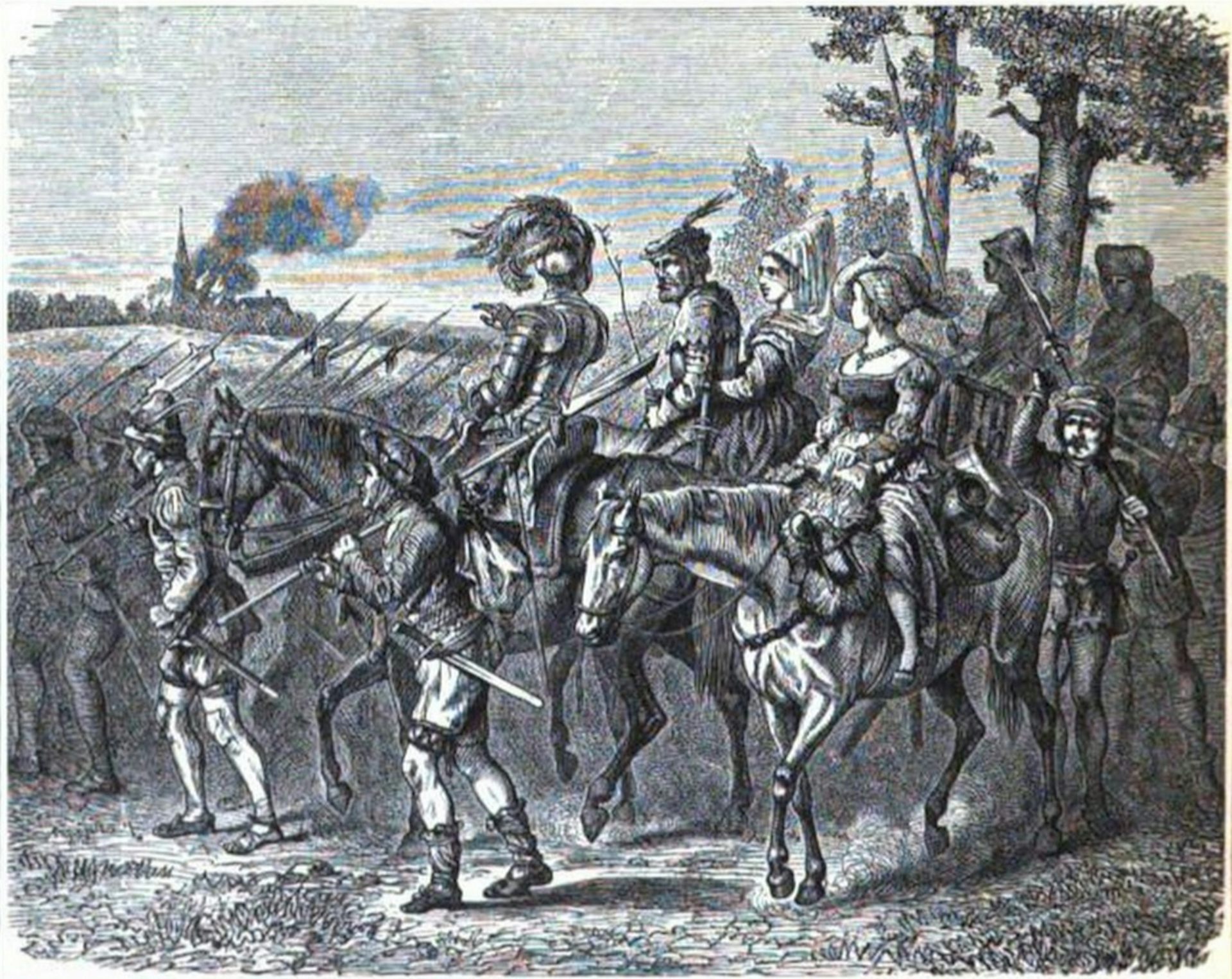
A sketch of groups of peasants wandering around the countryside during the German Peasants' War. (Warwick Press via Wikimedia Commons.)
Michael Bruening
February 26, 2025

(The Conversation) — Five hundred years ago, in the winter of 1524-1525, bands of peasants roamed the German countryside seeking recruits. It was the start of the German Peasants’ War, the largest uprising in Europe before the French Revolution. The peasants’ goal was to overturn serfdom and create a fairer society grounded on the Christian Bible.

For months, they seized their landlords’ monasteries and castles. By March 1525, the peasant armies had grown to encompass tens of thousands of peasants from Alsace to Austria and from Switzerland to Saxony.

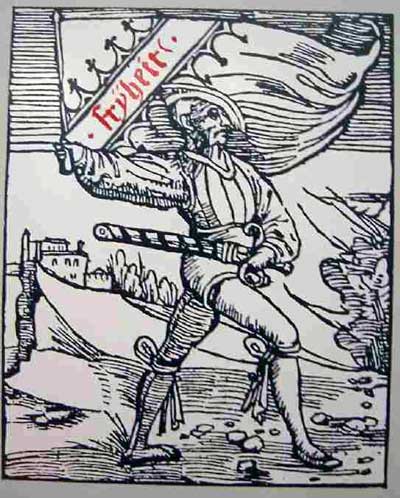
The peasants had economic grievances, to be sure, but they also drew inspiration from the message of freedom, or “Fryheit” in German, being preached by theologian Martin Luther, who had recently launched the Protestant Reformation

Luther’s rejection of the peasants’ cause, however, would help lead to their crushing defeat.

I am a scholar of the Reformation, and I included the peasants’ list of demands in my book on the debates of the era. The question of the legitimacy of the peasants’ uprising was one of the most consequential debates of the era.
Luther’s message of freedom

In 1517, eight years before the German Peasants’ War, Luther launched the Reformation with his 95 Theses. The theses reflected Luther’s belief that the pope and the Catholic Church were preying on the poor by selling them indulgences, taking their money for a false promise that their sins would be forgiven.

Luther taught instead that God freely forgives the sins of believers. In one of his most famous early treatises, “The Freedom of a Christian,” written in 1520, Luther argued that because they are saved or “justified” by faith alone, Christians are entirely free from the need to do works to merit salvation. This included fasting, going on pilgrimages and buying indulgences.

Luther’s attacks on the Catholic Church, clergy and monks quickly grew more vehement. He and his allies lambasted them for fleecing the peasants and the poor through usury, a practice of lending money at high rates of interest. Since the Bible provided no support for such practices, they argued, the poor should be free of them.
The Twelve Articles

In her 2025 book “Summer of Fire and Blood,” Reformation scholar Lyndal Roper argues that the religious element of the peasants’ war was central. The German peasants were among the first to try to unlock the revolutionary potential of Reformation teachings to fight social and economic injustice.

The peasants’ efforts to do so can be seen in the most important statement of their demands: The Twelve Articles. The articles are rooted in Reformation ideas and demanded, among other things, each village’s right to elect its own pastor and to be exempt from payments and duties not found in the Bible.


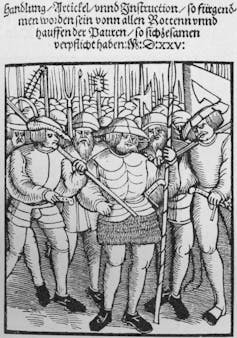
A pamphlet that peasants distributed with their Twelve Articles in 1525.
Otto Henne am Rhyn: Cultural History of the German People, via Wikimedia Commons

Most important was the message of freedom in the third article: “Considering that Christ has delivered and redeemed us all, without exception … it is consistent with Scripture that we should be free.” It was a cry for equality based on Christ’s redemption of all, rich and poor alike.

The Twelve Articles were hugely successful, going through 25 printings in just two months. Since the vast majority of peasants were illiterate, this was an astounding number.

For the lower classes, the Reformation promised to break up not just the spiritual monopoly held by the Catholic Church but the entrenched feudal system that kept them oppressed. Their desire for freedom was at the same time a denunciation of serfdom.

The peasants were willing to take up arms to secure their freedom. In winter 1524-1525, the peasants were able to capture castles and monasteries without much bloodshed. But starting in the spring of 1525, the uprising became increasingly violent. On Easter Sunday, the peasants shockingly slaughtered two dozen knights in the city of Weinsberg, Germany. A torrent of bloodshed would follow.
Luther’s rejection of the peasants

Although Luther may have provided the initial inspiration for the peasants, he denounced their revolt in the harshest terms. In his treatise “Admonition to Peace,” Luther complained that the peasants had made “Christian liberty an utterly carnal thing,” which “would make all men equal … and that is impossible.”

Responding to the revolt, Luther produced a tract entitled “Against the Murdering and Robbing Hordes of Peasants.” “Let everyone who can,” he infamously wrote, “smite, slay, and stab” the rebellious peasants. The rulers did just that.

The nobility had been slow to react to the peasants’ initial incursions, but when they finally organized their own armies, the peasants didn’t stand a chance. On the battlefield, the nobles’ cavalry and superior artillery brutally cut down the rebels. Many who escaped the battlefield were hunted down and executed.

The exact number of those killed are not known, but estimates place the number at around 100,000. As Roper notes, “this was slaughter on a vast scale.”

Consequences for the Reformation

English historian A. G. Dickens famously described the Reformation as an “urban event”, meaning that the movement’s important developments took place in cities. The German Peasants’ War shows the idea to be wrong.

In its first years, the Reformation galvanized the hopes and dreams of Germans in both town and country. To peasants and townsfolk, it seemed to promise the chance for a complete reordering of an unjust society.


Luther’s rejection of the peasants had important long-term consequences. His decision to side with the princes transformed the Reformation from a grassroots movement into an act of state. Everywhere the Protestant reformers went, they sought to work with the proper authorities. The close cooperation of Christian leaders and secular authorities would last for centuries.

For their part, the European peasantry grew wary of the Christian leaders who seemed to have abandoned them. Social uprisings over the next centuries lost the religious character of the 1525 conflict and would climax in the decidedly secular French Revolution.

(Michael Bruening, Professor of History, Missouri University of Science and Technology. The views expressed in this commentary do not necessarily reflect those of Religion News Service.)


The Conversation religion coverage receives support through the AP’s collaboration with The Conversation US, with funding from Lilly Endowment Inc. The Conversation is solely responsible for this content.


LA REVUE GAUCHE - Left Comment: Search results for PEASANT WAR GERMANY


Marxists.org
https://www.marxists.org/archive/marx/works/1850/peasant-war-germany/index.htm

The Peasant War in Germany by Frederick Engels 1850

Jun 6, 2023 ... The Peasant War in Germany was the first history book to assert that the real motivating force behind the Reformation and 16th-century peasant ...


Libcom.org
https://libcom.org/article/third-revolution-popular-movements-revolutionary-era

The Third Revolution: Popular Movements in the Revolutionary...

Jun 15, 2020 ... pdf (17.78 MB). ThirdRevVol2Pt1.pdf (12.23 MB). ThirdRevVol2Pt2.pdf (28.3 MB) ... Audiobook of Murray Bookchin's Ecology and Revolutionary Thought.

Thursday, September 19, 2024

Sacred chapel destroyed during German Peasants’ War rediscovered

Image Credit : LDA

By:Mark Milligan
Date: September 18, 2024
Archaeology

Archaeologists from the State Office for Monument Preservation and Archaeology (LDA) of Saxony-Anhalt have rediscovered the Mallerbach Chapel at the site of the Kaltenborn monastery.

Between 1524 to 1525, a large number of peasants, urban lower classes, and lesser nobles living in the German-speaking areas in Central Europe rebelled against a combination of economic, social, and religious factors. These include:
- Advertisement -

Economic hardship and inequality: Peasants faced heavy burdens from taxes, dues, and rents imposed by landlords, the church, and secular rulers.


Feudal oppression: Many peasants grew increasingly resentful of the limitations placed on their freedoms by feudal lords, including restrictions on hunting, fishing, and access to communal lands.

Religious influence: The Reformation inspired many peasants who saw in it a call for social and economic reform against a corrupt church.


Legal grievances: Peasants sought greater control over local governance and justice. They were frustrated by the arbitrary decisions made by their lords and demanded more influence over the laws and rules that governed their daily lives.


-
Image Credit : LDA

Following the outbreak of the Peasants’ War, insurgents from the nearby villages of Riestedt and Emseloh plundered the Kaltenborn monastery near Allstedt in the German district of Mansfeld-Südharz, leading to the monastery’s decline and eventual dissolution in 1538.


According to a press statement by the LDA: “It’s destruction – an act of rebellion against the Cistercian convent of Naundorf, which was in charge of the Chapel of St. Mary and to which the Allstedt residents were subject to taxes – can be seen as the first flare-up and harbinger of the coming uprising of the ‘common man’ against the authorities.”

Recent excavations at the monastery site have located the 12th/13th century Mallerbach chapel, a sacred place of worship for pilgrims who came to witness a weeping image of the Virgin Mary.

Archaeologists have uncovered the original floor plan of the chapel, which measures around 17 metres in length with a rectangular choir and semicircular apse. Excavations have also found the altar foundations, as well as traces of burning from the time of the German Peasants’ War.

Header Image Credit : LDA

Sources : State Office for Monument Preservation and Archaeology (LDA)


Jun 6, 2023 ... The Peasant War in Germany was the first history book to assert that the real motivating force behind the Reformation and 16th-century peasant war was socio- ....

Saturday, August 15, 2020


A vast plague of field mice in Germany is devouring crops on a massive scale

Sophia Ankel AUGUST 15,2020
Wood mouse (Apodemus sylvaticus) head emerging from nest while leaving burrow. Arterra/Universal Images Group via Getty Images

Field mice have destroyed swathes of farmland in Germany in what is the worst rodent infestation in over thirty years, according to the country's national farming association.
An estimated 300,000 acres have been stripped bare by the small furry animals, which has resulted in significant crop loss for farmers.
Farmers have blamed the infestation on the weather as well as highlighting a reduction in pesticide use, which has helped the rodents flourish in recent years.
While there have been calls on the government to relax the rules on the use of pesticides, environmentalists say that other endangered species will be at risk of being killed off.

Plagues of field mice have destroyed thousands of acres of farmland in Germany, which has been described as the worst rodent infestation in over 30 years, according to the country's national farming association.

An estimated 300,000 acres (120,000 hectares) of fields across the country have been stripped bare by the ravenous rodents, leading to significant crop loss and calls for compensation.

The country's agricultural minister, Julia Klöckner, has called the decimation of land an agricultural emergency and is now asking for a reassessment of laws governing the use of pesticides.

"We've already seen huge damage, and more is to be expected," Klöckner said, according to the Guardian.

Farmers in the worst-affected states of Thuringia and Saxony-Anhalt have complained that the mice, which are around 5-inches (15 cm) long, are devastating their food crops.

In the worst-affected state of Thuringia, as much as a quarter of the crops are affected. The damage is estimated at around $530 for every acre of wheat, the Guardian reported.

"They are eating everything," said Matthias Krieg, who manages an agricultural firm near the town of Zeitz in Saxony-Anhalt told German news website Der Spiegel. "Not even the sugar beets are safe."

Some farmers blame a succession of dry summers and mild winters for the infestation — but a reduction in the use of pesticides has also helped the rodents flourish, they say.

Joachim Rukwied, the president of the German Farmers' Association, said: "The farmers must be given the possibility to protect their harvest with appropriate measures. Right now environmental restrictions are preventing an effective control of the mouse population," the Guardian reported.

But while there have been calls on the government to relax the rules on the use of pesticides, environmentalists say that endangered species, such as hamsters, hares, and migratory birds, will be at risk of being killed off.

Magnus Wessel, of the Association for the Protection of the Environment and Nature, told German media that poison was not a solution and that the "side effects would be enormous."

"Not only would it kill off the field mice, but also the highly endangered common hamster. Birds that ingest the poison would also die," Wessel added, according to Der Spiegel.


According to the Guardian, some campaigners are calling for a ban on fox hunting that kills 400,000 annually. A fox can eat up to 5,000 field mice a year, they say.

Over 80% of Germany's land is used for agriculture, with chief agricultural products including milk, pork, beef, potatoes, wheat, barley, cabbages, and sugar beets.

Apr 23, 2015
As the story goes, in 1284, townspeople hired a rat catcher to lure away the vermin that had overrun their village ...

The Pied Piper of Hamelin · I Hamelin Town's in Brunswick, By famous Hanover city; · II Rats! · III At last the people in a body · IV An hour they sat in council, · V " ...
by F Engels - ‎Cited by 105 - ‎Related articles
https://www.marxists.org/archive/marx/works/1850/peasant-war-germany/index.htm. The 1848 uprisings in Germany put Engels in mind of the last great peasant ... Miracles supposed to have been performed by the Piper were being related;.

Wednesday, January 24, 2024

 The ‘ravening wolf’ priest who led a doomed revolution

Daniel Brooks
Mon, January 22, 2024 

A 19th-century engraving of Thomas Müntzer’s marauding peasants - Alamy

The decisive battle of the German Peasants’ War was fought on May 15 1525, upon a hilltop outside Frankenhausen, a small town in the central state of Thuringia. An army of around 8,000 peasants, gathered under rainbow banners, were demanding the overthrow of the existing social order. Their leader, the radical preacher Thomas Müntzer, pointed to the sky – where a rainbow-like halo seemed to have formed around the Sun – and reassured his troops that they should “fight with their heart and be of courage”. Within hours, the artillery-equipped army of the Saxon and Thuringian nobles had crushed the rebels’ flimsy fortifications and killed some 5,000 of them.

Andrew Drummond’s history steals its outstanding title, The Dreadful History and Judgement of God on Thomas Müntzer, from a pamphlet printed, soon after Müntzer’s execution, by his rival Martin Luther. The men were both important figures in the Protestant reformations that swept Europe at the start of the 16th century but, while Luther remained an ally of the aristocracy, Müntzer was a true revolutionary who demanded nothing less than the dissolution of feudal and religious structures and the full emancipation of the peasantry. As Drummond puts it, the latter approach was “playing with fire in an age of theological arson”.

It’s easy to understand why some were drawn to such lofty ambitions. Drummond begins by outlining the miserable state of your average Holy Roman peasant, and the apocalypticism that had taken root in Germany at the end of the 15th century. Müntzer too believed the world was ending, and that only the spiritually pure “Elect” were equipped to change the tide of history. There was a feeling – it may be familiar to those who remember the turn of 2000 – that some great but unknown change was on the horizon, accelerated by the emergence of a new form of communication technology: in their case, the Gutenberg printing press.

The echoes of the present day are not accidental. While Drummond conjures a sense of historical place – with credit due for capturing the religious lives of his subjects while largely dodging the dense mire of theology – The Dreadful History and Judgement… is very much a book in the New Left tradition of materialist history. We get a tightly narrativised case study of local conditions from which we can draw easy parallels to modern social movements, but we sometimes lose sight of history’s specific power-centres. The figure of the “early capitalist”, for instance, receives more frequent mention than Charles V, Holy Roman Emperor.

Printing allowed for the spread of ideas by prominent intellectuals, but it also became a vehicle for some impressive mudslinging. In the various tracts that emerged, Müntzer was branded a “ravening wolf” and a “false prophet”, while a fellow firebrand, Heinrich Pfeiffer, was said to want “to introduce murder, riot, overthrowing of authority”. Müntzer’s ripostes laid into the “lavish mimicry of the Godless” and painted the nobility as a “dribbling sack”. Luther, he claimed, couldn’t have drawn crowds as big as his “if he were to burst”.


An 18th-cenutry engraving of Thomas Müntzer - Hulton Archive

When he wasn’t writing, Müntzer’s career took him from town to town, preaching and agitating. His first real controversy arose in Zwickau in 1520, where he, along with a weaver named Nicholas Storch, incited a series of riots against the local Catholic clergy. He was firmly told that he had to leave. In Prague in 1521, things continued in much the same way, and he fled under a hail of stones. He was run out of several other towns, climbing over the walls of Allstedt in August 1524 after a warning from local leaders, and slipping out of Mühlhausen a month later after the townsfolk voted to get rid of him. In both of the latter cases, Müntzer left his wife Ottilie and his young child behind.

And that’s the thing. Even accounting, as Drummond does, for the fact that the historical record was largely written by Müntzer’s enemies, Müntzer at no point comes across as a pleasant man, much less one who lives up to the ideals he ignites in the peasants whom he’ll eventually send to their deaths. The reformist Philipp Melanchthon, whose second-hand account no doubt reflects plenty of Lutheran bias, presented him as a charlatan who told the peasants that he would “catch all the bullets in his sleeves”.

After the massacre, Müntzer somehow escaped the hill and was captured at a nearby inn; he would be executed soon after, but not before sending a final letter to his remaining acolytes. Here he claimed, in the tone of all failed revolutionaries, that his enterprise collapsed because it didn’t go far enough – that those who had died “only considered their own profit and thus destroyed God’s truth”.

Drummond has written a blisteringly good book about personal enmity, and the difference between revolution and reform. Müntzer’s head ended up on a spike outside of the gates of Mühlhausen, but Luther changed Christendom forever. The Frankenhausen hilltop was flattened in the 1970s by the East German government. They built a museum there, with a panoramic mural dedicated to the more-than-100,000 peasants killed in the war. Under the rainbow, defiant to the last, stands Thomas Müntzer.

The Dreadful History and Judgement of God on Thomas Müntzer is published by Verso 

Marxists.org

https://www.marxists.org/archive/marx/works/1850/peasant-war-germany/index.htm

Jun 6, 2023 ... The Peasant War in Germany was the first history book to assert that the real motivating force behind the Reformation and 16th-century peasant ...


Libcom.org

https://libcom.org/article/third-revolution-popular-movements-revolutionary-era

Jun 15, 2020 ... pdf (17.78 MB). ThirdRevVol2Pt1.pdf (12.23 MB). ThirdRevVol2Pt2.pdf (28.3 MB) ... Audiobook of Murray Bookchin's Ecology and Revolutionary Thought.


The Snow Queen, by Edmund Dulac [1911] (Public Domain Image)

The Sorceress (La Sorcière)

by Jules Michelet

tr. by Afred Richard Allinson

[1939]

But the greatest revolution the Sorceress brought about, the chief movement of all in contradiction, in direct contradiction to the spirit of the Middle Ages, is what we might well call a rehabilitation of the belly and its digestive functions. They boldly proclaimed the doctrine that "nothing is impure and nothing unclean." From that moment the study of physical science was enfranchised, its shackles loosed, and true medicine became a possibility.--p. 86

This is a translation of Jules Michelet's La Sorcière, originally published in Paris in 1862. I have titled this text The Sorceress because that is a literal translation of the original French title. The original title of this translation was Satanism and Witchcraft, and it was later retitled Witchcraft, Sorcery and Superstition. However there is no need to sensationalize this book; the material is already sensational enough. And women are at the center of this book: peasant healers, aristocratic noblewomen, and nuns; we get an unparalleled look at the misery that medieval women faced, and some of the ways they rebelled.


Thursday, July 22, 2021


Parsing the Witch Hunt 

Doug Ingold's There Came a Contagion

click to enlargeDoug Ingold's There Came a Contagion.
  • Doug Ingold's There Came a Contagion.

Humboldt author Doug Ingold's new novel There Came a Contagion lays out a dystopic vision of a countryside gripped by drought and famine, where frightened people seek scapegoats. Religious and civic leaders rise to prominence by mastering the articulation and gradual augmenting of that fear, assigning blame to outsiders in ways that dovetail with extant biases. These leaders say "the contagion" has come from outside and that punishing or purging figures at the group's margins will put things back to rights, encouraging townspeople to overcome inhibitions that previously constrained the open expression of hate. Rhetoric functions as an accelerant, fanning long-standing bias and resentment into murderous intent.

A Contagion is a work of historical fiction set among peasants in a 16th century German village and, yes, it's about a witch hunt, but the hunt proper does not commence until the book's second half. The novel's early chapters methodically set the stage for this grotesque event, building a world from the sights, sounds and cognitive horizons of a medieval village, and situating young protagonist Elsebett in a multigenerational narrative therein.

Ingold's medieval tale is propelled in part by a desire to illustrate the range of human response to societal crisis, and no one who's been paying attention to U.S. headlines since the COVID-19 pandemic hit will be surprised by its inglorious nature. Readers who are moved to superimpose the story in mind's eye over the map of recent U.S. history, like a template will likely raise their eyebrows at the passages of overlap and exhale at the parts where the stories diverge.

Present day parallels aside, Ingold's chronicle follows two generations of a German-speaking farming family in a tiny Western European village. Bereaved father Basil Helgen indentures his 7-year-old daughter Elsebett to village midwife/healer Rachel Mueller after the child's mother dies in childbirth. His family's life is difficult, like any pre modern subsistence farmer's: hard outdoor labor, close family and community ties, narrow economic margins, intermittent hunger and vulnerability to external forces like unpredictable weather and extortionate feudal masters. These aspects of community life figure in the book's earlier chapters, told largely from Basil's point of view. By the book's midsection, when Elsebett begins her apprenticeship, the narrative shifts to adopt her perspective with lyrically imagined passages detailing Frau Mueller teaching her to forage for medicinal plants and compound medications, how to assist in childbirth and, controversially, how to read.

The author's previous novel Rosyland plotted points of contact between old San Francisco money, the theater world of Ashland, Oregon, and the cannabis culture of Southern Humboldt. In this plot, place is a constant, while characters' connections unfold in time. Ingold is competent at describing an intensely local existence where, especially for women, opportunities for exposure to the outside world are rare.

Ingold practiced law in Garberville for many years before retiring to write full time, which may have served him well when it comes to writing about rural village life. His plainspoken narrative is attentive to familial triangulations and conflicts across generations. It forays readily into the interior, noting how a dynamic between two people might be experienced as "a private physical sensation," and how a person ensconced in a close-knit family can feel creeping isolation "growing around him like a thick skin."

In the novel's second half, a sense of impending disaster takes hold. Theories blaming drought and famine on a particular marginalized group gain feverish adherents, as initially halting efforts to identify a scapegoat become a juggernaut. Elsebett and her mistress Rachel possess knowledge about the natural world — much less the intimate functions of the supposedly sinful female body — that has not been incorporated within the discipline of medicine. In the eyes of their friends and neighbors, these features become enough to certify the women as a threat.

There Came a Contagion deftly crafts a portrait of a world before science, where calendar time is reckoned in terms of saints' days and the church is sole arbiter of truth. "Contagions want to happen," Frau Mueller says to Elsebett at one point. "What a contagion calls for is a cause, someone or something to blame .... The contagion produces a sleight of hand to draw attention away from itself." Witch hunts, she says, are entertaining by design: They appeal because they are associated with "excitement, drama and suspense." Before they do anything else, it seems, they answer the craving for a cool story.

The book's final third surveys the motives that make it easy for the good folks of the village to accommodate evil. Fear and a sense of grievance motivate some characters' fascination, while for others it's malice mingled with an inchoate desire to stick it to authority.

At one point, Rachel predicts that someday in the future a young nun in a convent, leafing through chronicles, "will find our time noted there, and she will marvel that such madness could have happened." Such a quasi-modern confidence — in the power of the written word and society's trope toward reason — sets Rachel apart from her peers. Today's readers might mull this commentary, which the author has placed in the mouth of a 16th century peasant midwife, and be struck by the audacity of its optimism.

Gabrielle Gopinath (she/her) is an art writer, critic and curator based in Arcata. Follow her on Instagram at  @gabriellegopinath.

  1. The Peasant War in Germany by Frederick Engels 1850

    https://www.marxists.org/archive/marx/works/1850/peasant-war-germany/...

    1996-01-04 · The Peasant War in Germany was the first history book to assert that the real motivating force behind the Reformation and 16th-century peasant war was socio-economic (class conflict) rather than “merely” religious. Contents. Author’s Preface to the Second Edition (1870) Author’s Addendum to the Preface (1874)

Friday, November 13, 2020

Russia’s occupation of Ukraine: a historical and centuries-old process


Ukrainian artist Dariya Marchenko created a portrait of Russian President Vladimir Putin from 5,000 spent shell cases collected from location of battles in Russia's aggressive war in the Donbas. Photo: dashart.com.ua


2020/11/13 - 10:04 • HYBRID WAR


Article by: Oksana Syroyid


Editor’s NoteThis year’s Lviv Security Forum brought together security experts from different countries in order to model the resolution of the Russian-Ukrainian conflict so that the sovereignty of Ukraine on territories temporarily occupied by Russia would be restored and Ukraine would be protected against Russian aggression in the future. In the preface to the report of the modeling exercise, the Security Forum’s co-chair Oksana Syroyid laid out an essential introduction to Russia’s war against Ukraine — that is, the centuries-old struggle of Russia to access warm-water ports. It is through this prism that the current war against Ukraine — and Russia’s attempts to resurrect its former empire altogether — should be viewed.

The Russian-Ukrainian conflict reaches back to the times when Ukraine emerged on the world map. In fact, it had started long before Russia established itself as a state. The nature of this conflict, though, has remained unchanged.

Since the creation of the Tsardom of Muscovy, its eastern and northern territories have been protected by seas, and the southern territories have been protected by mountains.


Photo: lib.byu.edu

However, basic human resources, agricultural land, and infrastructure routes were located along the western border. In addition, while possessing vast natural resources, the Russian Empire didn’t have access to warm-water ports.

This determined the main strategy of its expansion westward – to secure access to the Baltic and Black Seas and increase the buffer zone around the lifeline containing vital infrastructure and resources.


The defeat of the Tsarist Russian Empire in World War I and the October Coup didn’t in any way change the imperialist policies of Bolshevik Russia.

In fact, immediately after its formation in 1917, Soviet Russia began the occupation of the newly established Ukrainian People’s Republic. The occupation began with the formation of the “Ukrainian People’s Republic of Soviets” – an enclave controlled by the Bolsheviks (similar to today’s ORDLO – Separate Districts of Donetsk and Luhansk Regions).

During the Paris Peace Conference in Versailles in 1919 – 20, the leaders of the three nations – the United States, United Kingdom, and France – conceded statehood to nations that emerged from the ruins of European empires. The leaders of the Ukrainian People’s Republic sought support to oppose the Bolsheviks and the recognition of their statehood. However, it was the offensive of Bolshevik Russia that prevented the recognition of the Ukrainian Republic.

Western powers were exhausted by World War I and didn’t have the resources and desire to resist the Bolsheviks, whose intentions were unclear to them. They chose to isolate and ignore the Bolsheviks instead.

The return of control over Ukraine and its resources opened up new opportunities for the Russian Bolshevik government. The most valuable of such resources was grain, which could be exported to raise funds necessary for the industrialization of the Soviet Union.
However, taking grain from peasant owners was not easy, and collectivization pressed for technical development.

Collectivization and “dekulakization” provoked thousands of peasant revolts throughout Ukraine. People demanded the return of land and local governance to their communities. In order to prevent any potential peasant revolts and to secure control over land and grain, which was the main currency back then, Stalin killed millions of Ukrainian peasants by starvation in 1932 – 33.

Nazi Germany was the closest ally for Stalin’s empire at that time. Hitler and Stalin relied on each other’s resources in preparation for their own wars.

Stalin intended to move west, establish control over the seas and increase the “sanitary zone” under the banner of the socialist revolution. Hitler needed Ukrainian lands as the source of a workforce and food for his future empire.

Ukraine, or rather its land, remained the main trophy in the war between the two dictators. That’s why people weren’t spared. Ukrainians accounted for almost 40% of all human losses of the Soviet Union in World War II.


World War II was started by both dictators, but only one of them was punished.

Stalin ended the war as a winner who spelled the terms of peace. As a result, as of 1945, the Soviet empire had advanced its borders to Berlin.

Stalin intended to move even further west. He first laid siege to West Berlin and established the German Democratic Republic (once again, similar to today’s ORDLO) in breach of the conditions of the occupation zones.

Later on, in 1952, he attempted to expand westward, proposing that German leader Konrad Adenauer unite the GDR and the Federal Republic of Germany under conditions of an amnesty to former members of the Nazi party, new elections, and the non-aligned status of a united Germany. To this Chancellor Adenauer replied,

“Refusal to integrate with the West will lead to the capture of Germany by the Bolsheviks and will be tantamount to “political suicide.”

Despite unsuccessful attempts at further expansion to the west, the Soviet empire achieved the cherished dream of all Russian tsars.


Control of the Baltic Sea was secured by the Kaliningrad enclave – the remnant of the Kingdom of Prussia with its capital Königsberg, as well as the occupation of Poland, Latvia, Lithuania, Estonia, and the GDR satellite.

The Black Sea was put under Russian control as a result of control of the Crimea and the Ukrainian coastline, which was further boosted by the occupation of Georgia and the turning Bulgaria and Romania into Soviet satellites. The “sanitary zone” was expanded enough to keep the empire’s lifeline safe.


After WWII, Russia expanded its influence far to its east via the Eastern Bloc. Image: Wikipedia


Without control over the Baltic and Black Seas, as well as without control over Ukrainian resources, “Greater Russia” is impossible.

Meanwhile, Europe needed to recover from the war of the past, protect itself from the Soviet military threat of the present, and prevent wars between European nations in the future.

To maintain geopolitical balance on the European continent, the North Atlantic Alliance was established, whose aim, according to its first Secretary General, Baron Ismay, was to “keep the Russians out, the Americans in, and the Germans down.”

The democratic world assessed the purpose and methods of the Soviet threat adequately. However, the West was unable to look into the roots of the problem: throughout the decades of the Cold War, it was communism as an ideology, not the imperial nature of Russia which was considered a threat.


That is why Russian aggression against Ukraine, unfortunately, was inevitable. It is no coincidence that Russian President Vladimir Putin referred to the collapse of the Soviet Union as “the greatest geopolitical disaster of the twentieth century.”

Without control over the Baltic and Black Seas, as well as without control over Ukrainian resources, “Greater Russia” is impossible.

Initially, Russia took advantage of Ukrainians’ lack of experience in state-building and management of their resources after independence, and during large-scale privatization, they freely bought up strategic enterprises and critical infrastructure.

Most of the figures now called “oligarchs” have monopolized Ukrainian regional gas companies, oblenergos, thermal power plants, shipyards, and access to key natural resources for Russian money and in Russia’s interest.


They have never held a Ukrainian identity or interest in the development of Ukraine, so they easily pumped out and continue to pump out money from Ukraine through offshore jurisdictions. At the same time, in order to maintain their monopolies and guarantee Ukraine’s movement in the Russian fairway, those actors established control over Ukrainian politics through dependent media and political projects.

After all, today these oligarchs no longer make a secret of their reliance on Russia, openly lobbying for a Russian “appeasement” scenario in both Ukraine and the United States.

However, even this control wasn’t enough for Russia’s plans. Generations of people were born and raised in Ukraine, for whom any pro-Russian sentiments were alien and who increasingly looked to the West, identifying with European civilization and not with the “single Slavic people.” Time played against Russia – the territory got out of control.

The Revolution of Dignity proved to be only a pretext for the Russian invasion. The main purpose of the annexation of Crimea was to gain control of the Black Sea and strengthen geopolitical leverage in the greater Mediterranean region.

Thus, the main reasons for the occupation of East Ukraine were the levers of Russian pressure on Ukraine in both domestic and foreign policies.

Is it possible to resolve the age-old Russian-Ukrainian conflict? Is Ukraine able to do it alone? Is the democratic world ready to recognize the dependence of its own security on Ukraine’s security, realizing, in historical perspective, the price it will have to pay in the event of Ukraine’s loss of its freedom and independence?

“Thus it would be hypocrisy to deny that an independent Ukraine is as essential to […] the tranquility of the world. Merely because it is inconvenient to consider it and highly so to attempt its solution, the problem has too long been ignored. But it is a problem which has deep and intricate roots in history and in its modern form has assumed extreme urgency. Voltaire noted admiringly the persistence with which Ukrainians aspired to freedom and remarked that being surrounded by hostile lands, they were doomed to search for a Protector.

Until they are assured of liberty they will be faithless to whichever State they are bound and will continue freely to shed their own blood and that of their conquerors. So long, too, as this situation continues other nations will be tempted to exploit it. What then is the use of pretending that there is peace when there is no peace? Nor will there be any until this Ukrainian question is satisfactorily disposed of.”

These are the words of Lancelot Lawton, a British soldier, historian, economist, Ukrainian scholar, public figure, and international journalist, which he spoke in 1935. Ignoring these words then cost Europeans tens of millions of lives. Perhaps, history provides us with a chance to correct this mistake, doesn’t it?


Editor’s Note

Read the entire report here. The text in this article has been slightly edited for clarity.[/editorial


Oksana Syroyid is co-chair of the Lviv Security Forum, leader of the Samopomich Union political party, Deputy Speaker of the Ukrainian parliament in 2014-2019.

Friday, December 25, 2020

CLASS & INEQUALITY
The World Henry Ford Made

A new history charts the global legacy of Fordist mass production, tracing its appeal to political formations on both the left and the right.


JUSTIN H. VASSALLO
Photo: Getty Images


Forging Global Fordism: Nazi Germany, Soviet Russia, and the Contest over the Industrial Order

Stefan J. Link
Princeton University Press, $39.95 (cloth)

The utopian ideal of globalization has imploded over the past decade. Rising demand in Western countries for greater state control over the economy reflects a range of grievances, from a chronic shortage of well-compensated work to a sense of national decline. In the United States, the dearth of domestic supply chains exposed by the COVID-19 pandemic has only heightened alarm over the acute infrastructural weaknesses decades of outsourced production have created. Post-industrial society, rather than an advanced stage of shared affluence, is not only more unequal but fundamentally insecure. Rich but increasingly oligarchic countries are experiencing what we might call, following scholars of democratization, a dramatic “de-consolidation” of development.

As the promises of globalization have imploded, political forces in many rich countries—on both left and right—are converging on the imperative to use industrial policy.

To reverse this decline, political forces on both the left and the right are converging on the imperative to use industrial policy—the strategic process by which governments, either through state support of industrialists or state-owned enterprises, build up and diversify domestic manufacturing. On the left, the Green New Deal represents a futuristic and ecologically sustainable industrial policy, one that undergirds a strong public sector, progressive distribution, a job guarantee, and efforts to correct historical injustices. On the right, policy ideas are more muddled due to the powerful grip of free market ideology, yet a vocal “communitarian” cohort across Europe and the United States is pivoting toward heterodox economics. “Globalism,” in the view of these populists, has eroded the economic sovereignty of nation-states, shrinking historically key sectors and unleashing new forms of anomie. Industrial policy thus looks to be an instrument for reaffirming national sovereignty and restoring the social bonds that producer-oriented economies ostensibly foster. While only the left addresses the climate crisis, both visions are concerned with the social value economic activity generates, in contrast to neoliberalism’s justification of unimpeded self-interest.

In their search for an alternative to neoliberal globalization, these competing visions reflect the enduring power of Fordism, the industrial system that launched mass production in the early twentieth century and shaped many of our expectations of modern life. Henry Ford would likely find his relevance to the current crisis of globalization a testament to his “producerist” philosophy. But as historian Stefan J. Link writes in his new book, Forging Global Fordism: Nazi Germany, Soviet Russia, and the Contest over the Industrial Order, Ford’s peculiar ideals “projected a political (and moral) economy that hardly anticipated the American consumer modernity that emerged after 1945.” Link gives a fresh analysis of an overlooked dimension of interwar history, tracing the singular influence of Ford’s innovations and ideas upon the final, cataclysmic stages of twentieth-century industrialization. Forging Global Fordism allows us to better explore the relationship between industrialism, political ideology, and global competition, while also shedding important light on our tumultuous present moment.

In their search for an alternative to neoliberal globalization, competing new visions reflect the enduring power of Fordism—the industrial system that launched mass production in the early twentieth century.

One of the key insights of Link’s book is that Fordism was as much a theory of social organization as a scientific system of productivity, and it was highly malleable within different political and economic contexts. To explore the varieties of Fordist experience, Link employs the framework of the developmental state—the stage of state history in which governments, seeking modernization, a more integrated domestic market, and faster economic growth, typically pursue capital formation and reinvestment in strategic industries that are shielded from global competition.

Situating the global spread of Fordism within Europe’s struggle to “catch up” to U.S. industrialization after World War I and prepare for the next conflict, Link shows how Fordist America, as well as Ford’s philosophy, animated what he terms European “postliberals” on the left and the right in their ambitions for autarky and dominion over “great spaces.” In doing so, Link explains how the “isolationist” 1930s set the course for modern globalization. “Rather than interrupt,” Link argues, “depression and war actually accelerated and intensified the global spread of Fordism,” due to the industrial policies of activist states such as Nazi Germany and the Soviet Union.

In their respective quests for machine tools, automotive material, and expert knowledge of mass production techniques—all of which informed the construction of “dual-use” factories—delegations from each country sought and obtained technology transfers from Ford’s famed River Rouge plant in Detroit throughout the 1930s. At the seeming apex of isolationism in the twentieth century, the Ford Motor Company provided critical blueprints and other forms of assistance that could be harnessed in equal measure for economic development and total war.


How did Ford become this seemingly improbable node in the industrial strategies of Nazi Germany and the Soviet Union? “To gain the forefront of industrial modernity,” Link writes, “all insurgents” against a faltering liberal international system “first had to turn for guidance to the most advanced nation. . . . Interim technological dependency on the United States—such was the wager of autarky—would be the price of long-term economic independence.”

Fordism was as much a theory of social organization as a scientific system of productivity. Link shows it was highly malleable in different political and economics contexts.

Detroit was the locus of America’s advancement, and thus “an antagonistic development competition” arose across the globe from the race to acquire its technology, engineering know-how, and organizational methods. Among the region’s firms, the Ford Motor Company was especially receptive to teams from both Nazi Germany and the Soviet Union; Ford’s own views may have aligned with the nationalist right, but business opportunities mixed with pride in the company’s reputation and state of the art facilities. Contracts with each country were complemented by a consultative, instructional approach, making Ford a target of reconnaissance beyond what the company might have intended. As Link details, several Ford workers—many of whom were European immigrants—migrated to Russia and Germany, and in some cases, particularly in the Nazi state, ascended to important positions within the war bureaucracy.

Ford’s pivotal role in the diffusion of technology stemmed from his distinction within U.S. industry. Ford was rightly regarded as a pioneer of mass production, which had generated unprecedented consumption in the U.S. economy while raising industry wages. Unlike Taylorist management, with its taxing fixation on individual employee performance, Fordism, Link explains, had “devised a system that turned lack of skill into a productive resource” that not only generated jobs but inculcated a collective sense of discipline within factory workers. Mass production, with its optimized flow methods that integrated repetitive, segmented tasks with scientific floor plans and automated machines, was not merely an achievement of Ford’s ingenuity. It manifested an economic philosophy that took on a special power for European postliberals seeking to emulate U.S. development precisely in order to undermine U.S. dominance.

At the center of Ford’s philosophy, according to Link, were particular, complementary notions of social progress and moral improvement with roots in Midwestern populism. Ford’s various press statements and publications during the 1910s and 1920s articulated a clear concept of social justice. Announcing the five-dollar day in 1914, his company stated that, “Social justice begins at home. We want those who have helped us to produce this great institution and are helping to maintain it, to share our prosperity.” Link notes that Ford tied this benefit to strict standards of personal conduct, and even for a time maintained an invasive “Sociological Department” to surveil workers. But this dynamic between rewards and responsibilities also reflected Ford’s view that the modern firm was a microcosm of society.

As an economic philosophy, Fordism took on a special power for European states seeking to emulate U.S. development precisely in order to undermine U.S. dominance.

The “emphasis on justice, economic cooperation, and the cultivation of virtues,” Link writes, strongly “reasserted labor-republican notions of the nineteenth century,” including “the moral economy of the Knights of Labor” which “sought not to overcome capitalism through class struggle but to harness corporate organization and financial accumulation for the benefit of the laboring producers.” Visionary leadership, in Ford’s mind, inspired a synergistic relationship with labor, as exemplified by the core technicians whose creativity enhanced the scale and tempo of production. While it was incumbent upon workers to internalize discipline, the firm was obligated to envelop them within a communitarian culture, one that would recognize individual progress through interesting, advanced work, but would, above all, define the firm’s value on the basis of collective achievement.


Ford’s ideals thus corresponded, Link explains, to the German right’s fixation on the supposedly organic “reciprocity” between volk and leadership that was required of industrial progress. As a model of leadership and social organization, Fordism resonated deeply with postliberals seeking to mold capitalism and the masses toward a unifying political economy. As formulated by German rightwing theorists of the Weimar period, Fordism embodied Dienst: “an ethos by which individuals cheerfully submitted to a larger purpose or directed their energies to the presumed benefit of the Volk.” Refracted through a lens that exalted racial-national struggle, Fordism augmented early Nazi claims that National Socialism represented a true “socialism of leadership” (in the words of the economist Friedrich von Gottl-Ottlilienfeld) and purposive “anti-capitalism,” as opposed to Marxism’s subversion of social order.

As a model of leadership and social organization, Fordism resonated deeply with a German right seeking to mold capitalism and the masses toward a unifying political economy.

Crucially, Ford’s conception of social justice also deepened the postliberal right’s moral distinction between “productive” enterprises that rooted communities and the corrupting influence of global finance. Ford contrasted his motives to reinvest in production with the shareholder capitalism that shaped other firms, including Ford’s chief rival General Motors. According to Link, Ford believed his accomplishments “demonstrated that industry, released from the yoke of financial capital, could channel productivity increases into lower prices and higher wages.” Producers that constantly refined economies of scale thus had a social function that served the masses that distinguished them from other forms of enterprise, and entanglement with financiers would only undermine their “wealth-generating efficiency.”

Fordism was thus especially appealing to National Socialists in search of a political economy that could extinguish Marxism and social democracy but arouse communitarian sentiments toward a project of national renewal linking industrial modernization with racial purification. It combined the “moral” and “economic” arguments used to further legitimate Nazi ideology. During the 1920s, Ford’s critique of finance capitalism in My Life and Work—his most popular book, discerningly ghostwritten by the journalist Samuel Crowther and published in 1922—“rationalized” the blatant anti-Semitism he expressed in other publications. Industrial progress, and the moral improvement ascribed to it, was juxtaposed with the rent-seeking of which he and European nationalists accused Jews. Postliberals of the Weimar right took notice, and their contempt for the war debts that were enervating domestic production fueled anti-Semitic discourses that seeded the German public’s growing association of Jews with economic insecurity and Germany’s post-Versailles “subjugation.” Alleging economic difficulties were the fault of a Jewish conspiracy, the Nazi party and its allies luridly differentiated a predatory, “foreign” capitalism from industrialism in proper service to the nation.

Ford’s own conception of social justice deepened the postliberal right’s moral distinction between “productive” enterprises that rooted communities and the corrupting influence of global finance.

Beyond its uses for propaganda, Fordism was critical to Nazi industrial policy once Hitler secured his dictatorship in spring 1933. In Germany the Depression manifested most acutely as a “Great Balance-of-Payments Crisis”—the burden of large U.S. loans and the absence of a resilient domestic market were amplifying Germany’s structural weaknesses. Link explains that for the early Nazi regime, the question of how to reinvigorate stagnant industry was the same that had beleaguered the Weimar Republic. Germany faced a declining share of export markets precisely because U.S. firms, particularly those of Detroit, were becoming globally dominant. The prospect of surrendering to U.S. dominance in automobiles was tantamount to permanent subordination in the global economy, threatening underdevelopment.

In a rich analysis of the regime’s various strategies to coerce industry, Link shows that by embedding Fordist mass production within a “steered market economy,” the Nazi state accelerated industrial growth, stimulated employment, and recovered badly needed foreign exchange. Hitler’s regime converted a “makeshift system of trade management and capital controls” into a strategy that “fortified export promotion,” “elbowed industry into developing import substitutes,” “systematically privilege[d] strategic sectors,” and diverted “resources from consumption to rearmament.” It also entailed a stealth manipulation of U.S.-owned multinationals that affixed them to the state’s burgeoning military-industrial complex. The state wielded tariffs against U.S. imports while imposing capital controls that forced Americans to reinvest in Germany and increasingly substitute German materials for U.S. exports. Oddly, Ford initially held out when it came to plant expansion, but by the start of World War II his company’s German division “was responsible for almost one-fifth of German truck production.”

By embedding Fordist mass production within a “steered market economy,” the Nazi state accelerated industrial growth, stimulated employment, and recovered badly needed foreign exchange.

Fordism thus underpinned Hitler’s grand strategy of acquiring Lebensraum. In Hitler’s vision, Link writes, “mass production had a precise double role: it was necessary to create and sustain the armaments complex that would allow the conquest and control of territory in which industry would supply a vast contiguous market with a standard of living to match America’s.” The obsession with control over a vast geopolitical space, inspired in part by America’s genocidal pursuit of continental dominion in the nineteenth century, reflected Hitler’s fervid security concerns. In the prospective postliberal world order, a Germanized Europe would be “self-sufficient” through a combination of advanced industry and the supply, through frontiersmen and slave labor, of essential raw materials and foodstuffs from Eurasia. Intellectuals aligned with National Socialism, such as the journalist Ferdinand Fried and the jurist Carl Schmitt, would elaborate upon this reconfiguration of world order, envisioning a future where landmass imperia would largely supplant the commerce of liberal internationalism and naval-based colonialism.


In the Soviet Union, meanwhile, the challenge of adapting a still largely agrarian society to Fordism was far more formidable than what Nazi Germany faced. The Great Depression had compounded the problems of industrialization: the price for grain exports—the Soviet Union’s main commodity—was falling at the same time that the state determined it was necessary to speed up the purchase of U.S. equipment As in Germany, the fascination with Fordist America had percolated Soviet thought during the 1920s. It was so influential, Link writes, that a “common trope in the NEP [New Economic Policy] ideological arsenal”—Vladimir Lenin’s economic proposal of 1921—“held that socialism equaled Soviet revolution plus American technology.” But the implementation of Fordism was not just a matter of acquiring the materials and techniques of mass production, pressing as that was. It also constantly entailed ideological pivots and smoothing. The imperative to convert largely unskilled masses, with little exposure to industrial machinery, into disciplined workers required expert management to accelerate development.

Soviet policy, for its part, attempted to distill Fordism to its scientific mechanisms, laying a foundation that would enable the country to obtain “economic independence” from the capitalist international system.

During the initial stages of this transformation, engineers who had trained during the late Tsarist period formed a substrata of tenuous factory leadership, subject both to threats and to penalties from party elites and antagonism from workers who rejected a hierarchy that cut against their notions of self-management. Soviet policymakers were determined to eradicate vestiges of craftsmanship and other forms of “backwardness” impeding the adoption of modern industrial organization, but they needed to maintain the loyalty of the workers. The overarching ideological premise of Soviet industrial policy, Link summarizes, was that “if capitalism was an anarchic system of jealous partitions, cross-purposes, and collective blindness, Soviet socialism would be a system of total and harmonic coordination,” and yet its implementation of Fordism fell far from that ideal.

Soviet policy, according to the party leadership, would distill Fordism to its scientific mechanisms, laying a foundation that would enable the country to obtain “economic independence” from the capitalist international system. This vision was consistent with Stalin’s pronouncement that socialism would be achieved first in one country. Beginning with the first Five-Year Plan in 1928, radical modernizers dominated Soviet industrial policy, leading to a punishing pursuit of Western technology transfers that resulted in horrific famine. Link insightfully argues that the decision to ramp up agricultural collectivization was not a tragic scheme born of ideological militancy and bureaucratic folly but instead a calculated risk to squeeze as much as grain export as possible out of the peasant population to pay for the machinery needed to build and bring online plants such as the Gorky Automobile Plant (GAZ). Like Hitler, Stalin understood the centrality of national auto works in a future war. National security, however it was framed, took precedence over the welfare of the Soviet—and especially Ukrainian—countryside.

Beginning with the first Five-Year Plan in 1928, radical modernizers dominated Soviet industrial policy, leading to a punishing pursuit of Western technology transfers.

For all the coercive strategies employed by Nazi Germany and the Soviet Union, Link meticulously notes that the assimilation of Fordism in both countries was incomplete through the beginning of World War II until the Nazi invasion of the Soviet Union in June 1941. The Soviet Union, in particular, had contended with a “hybrid industrial system” prone to frequent machine-based stoppages and enormous turnover. Continuing in the vein of the party-manipulated factory conflicts of the NEP era, the tendency of individual laborers to demonstrate “grassroots worker initiative” often further disrupted the mastery of flow methods. What ultimately ignited more rapid industrialization were the unprecedented demands of conducting total war.

Industrial policy in both countries thus took another radical turn. In Germany, Link writes, “high-profile production engineers, whose American credentials lent them authority vis-a-vis both the ministries and the firms, connected the state apparatus to the sphere of economic execution in the factories.” The rampant use of forced labor, which accounted for one third of the Nazi war economy, disposed of “reciprocity,” instead activating the most brutal and extreme authoritarian possibilities latent in Fordism. “Only where coercion and control was complete and the threat of violence was ever present could the assembly line achieve its disciplinary strength,” Link concludes.

By World War II, the simultaneous mobilization of the army to the battlefield and displaced peasants into the factories hastened the full implementation of a command economy in accord with Fordist methods.

The dramatic output of the Soviet Union after 1941, then, was all the more remarkable given the ferocity of Nazi military power. Despite the immense hardship and piecemeal progress of the 1930s, Link underscores that the Soviets had in fact laid the groundwork for the wartime conversion of facilities and production methods. “For the remainder of the war,” he writes, “the Soviet Union decisively outmatched Germany in the war of the factories in every weapons category except ships and submarines.” In a war of national survival, the simultaneous mobilization of the army to the battlefield and displaced peasants into the factories hastened the full implementation of a command economy in accord with Fordist methods. The range of armaments were restricted in favor of a relentless output of key weaponry that could wring maximum raw efficiency out of an unskilled, malnourished workforce. On this score, Link notes that although “the Soviet Union had less steel at its disposal than all the other belligerents, it built more tanks and aircraft per available unit of steel than all the other belligerents combined.” The book vividly captures how this rapid transformation of Soviet industry repelled Hitler’s exterminatory quest for Lebensraum.

While the world depicted in Forging Global Fordism seems at first blush far removed from our own, the book makes a convincing case that in all its various guises, it was Fordism—perhaps more than any other system of social organization—that shaped our present, and now deeply uncertain, world order. Reflecting on the postwar recovery in Western Europe, Link addresses a deeply unsettling legacy of National Socialist industrial policy: Volkswagen and other German automakers had been primed for mass production through the various forms of support and compulsion Hitler’s regime administered. Their energies no longer siphoned into a war economy, Fordist consumption in the American sense could finally take off in a democratic West Germany allied with the United States. Rather than consider the industrial strategies of the Nazi state in isolation—and therefore as merely reflecting the choices of a mercurial and fanatical chain of command—Link perceptively suggests that “historians might look to the many other authoritarian, activist, and development-oriented states of the twentieth century” for substantive comparison.

Taken together, these historical insights suggest that the resurgence of rightwing populism today may reflect a final, belated crisis of Fordism.

It is worth recalling that the rise of different activist states in the 1930s all had a common focus on public works and infrastructure. This structural feature fed back into the international race to grow economies of scale that centered on the innovations, supply chains, and value-added inputs of national auto industries. Once we step back from Link’s close reading of the factors that established Fordism in the central antagonists of World War II, we can more fully observe the developmental state in all its various incarnations, from liberal democratic to totalitarian. Its successes have depended not just on the implementation of Fordism, but on the particular ways the state oversees the Fordist relationship between industry and labor.

That contingency helps put the ascent and subsequent post-industrial underdevelopment of the United States in historical, comparative perspective. Among the activist states of the twentieth century the most successful was Roosevelt’s New Deal, and it benefited significantly from the fact that Fordism had already matured in the United States. Because America maintained its edge in technology and industrial capacity, the shift to a war economy enabled it to outgun Nazi Germany while sparing Americans the levels of sacrifice that the Nazi, Soviet, and other war economies inflicted on their populations. Fordist manufacturing, in turn, became inextricable from conceits about the American Century; for decades it defined U.S. growth and the postwar idea that growth would ensure shared prosperity. Although Ford himself was virulently anti-union, a more assertive regulatory state that supported union rights molded, rather than blotted out, his producer populism.

The paradox of the Fordist era for Western countries is that it symbolizes the historic conversion of oppressive factory work into an unequalled period of shared prosperity and economic democracy.

In retrospect, the historic labor-capital compromise of the postwar era transformed the “cooperation” that Ford extolled into technocratic, state-mediated industrial relations. When that system was abandoned, most abruptly in the United States, in pursuit of a flexible, high-tech “knowledge” economy, industrial policy was subject to the new political taboo against strong government. In turn, industrial policy became the domain of China—now the world’s largest car manufacturer—and a few other late twentieth-century developmental states, while the much heralded new American economy became concentrated in a handful of globalized U.S. cities, barely reaching de-industrialized regions.

The international and domestic political tensions this policy regime has produced give the lie to the midcentury promise of permanent, self-sustaining, and inclusive economic growth. In a tacit negation of Francis Fukuyama’s “end of history” thesis, Link concludes that “the type of development competition that spread Fordism . . . will continue to be with us, shaping a global economic order that is ever contested, never finished.” One might add that elites who ignore signs of underdevelopment in democratic societies overestimate the durability of institutions and norms in the absence of a collective stake in where the economic future lies.

Taken together, these historical insights suggest that the resurgence of rightwing populism today may reflect a final, belated crisis of Fordism. It thus poses a distinct philosophical and policy dilemma. The paradox of the Fordist era for Western countries is that it symbolizes the historic conversion of oppressive factory work into an unequalled period of shared prosperity and economic democracy. On the one hand, the manufacturing jobs of the past were hardly what we think of as good jobs today, and many disappeared through automation rather than trade deals. On the other hand, the zenith of manufacturing correlated with high rates of unionization, a stronger public sector, and levels of taxation that encouraged reinvestment.

An important inference to be drawn from Link’s book is that we must resist a too simple embrace of its industrial policy, for it can easily ramify in ideologically unfavorable directions.

In some quarters the left has developed a tendency toward nostalgia for this period of more broadly shared prosperity. An important inference to be drawn from Link’s book is that we must resist a too simple embrace of its industrial policy, for it can easily ramify in ideologically unfavorable directions. For the communitarian right—not so far removed ideologically from the postliberals of the interwar period—the Fordist era represents not social democracy but the cultural cohesion and natalist values that paternalistic corporations once encouraged. As much as most conservatives have assailed the welfare state, it is conceivable that some will embrace industrial policy—and thus some version of a steered economy—in response to the cumulative pressures of underdevelopment and a more unstable phase in global affairs.

History warns that this particular turn toward dirigisme can quickly cohere with illiberal and belligerent visions of national renewal. To militate against this outcome, progressives will have to redouble efforts to frame the Green New Deal as the surest way to create millions of new, decent jobs that revitalize the economy. By invoking U.S. mobilization during World War II, and the cooperation upon which victory depended, any left committed to an egalitarian future must ultimately reconcile the traces of Henry Ford’s world in the new one being born.