Showing posts sorted by relevance for query SCHRODINGERS CAT. Sort by date Show all posts

Wednesday, January 15, 2025

SCHRODINGERS CAT

This metaphorical cat is both dead and alive – and it will help quantum engineers detect computing errors


University of New South Wales
Cat on sofa 

image: 

This metaphorical cat has seven lives.

view more 

Credit: UNSW Sydney


UNSW engineers have demonstrated a well-known quantum thought experiment in the real world. Their findings deliver a new and more robust way to perform quantum computations – and they have important implications for error correction, one of the biggest obstacles standing between them and a working quantum computer.

Quantum mechanics has puzzled scientists and philosophers for more than a century. One of the most famous quantum thought experiments is that of the “Schrödinger’s cat” – a cat whose life or death depends on the decay of a radioactive atom.

According to quantum mechanics, unless the atom is directly observed, it must be considered to be in a superposition – that is, being in multiple states at the same time – of decayed and not decayed. This leads to the troubling conclusion that the cat is in a superposition of dead and alive.

“No one has ever seen an actual cat in a state of being both dead and alive at the same time, but people use the Schrödinger’s cat metaphor to describe a superposition of quantum states that differ by a large amount,” says UNSW Professor Andrea Morello, leader of the team that conducted the research, published recently in the journal Nature Physics.

Atomic cat

For this research paper, Prof. Morello’s team used an atom of antimony, which is much more complex than standard ‘qubits’, or quantum building blocks.

“In our work, the ‘cat’ is an atom of antimony,” says Xi Yu, lead author of the paper.

“Antimony is a heavy atom, which possesses a large nuclear spin, meaning a large magnetic dipole. The spin of antimony can take eight different directions, instead of just two. This may not seem much, but in fact it completely changes the behaviour of the system. A superposition of the antimony spin pointing in opposite directions is not just a superposition of ‘up’ and ‘down’, because there are multiple quantum states separating the two branches of the superposition.”

This has profound consequences for scientists working on building a quantum computer using the nuclear spin of an atom as the basic building block.

“Normally, people use a quantum bit, or ‘qubit’ – an object described by only two quantum states – as the basic unit of quantum information,” says co-author Benjamin Wilhelm.

“If the qubit is a spin, we can call ‘spin down’ the ‘0’ state, and ‘spin up’ the ‘1’ state. But if the direction of the spin suddenly changes, we have immediately a logical error: 0 turns to 1 or vice versa, in just one go. This is why quantum information is so fragile.”

But in the antimony atom that has eight different spin directions, if the ‘0’ is encoded as a ‘dead cat’, and the ‘1’ as an ‘alive cat’, a single error is not enough to scramble the quantum code.

“As the proverb goes, a cat has nine lives. One little scratch is not enough to kill it. Our metaphorical ‘cat’ has seven lives: it would take seven consecutive errors to turn the ‘0’ into a ‘1’! This is the sense in which the superposition of antimony spin states in opposite directions is ‘macroscopic’ – because it’s happening on a larger scale, and realises a Schrödinger cat,” explains Yu.

Scalable technology

The antimony cat is embedded inside a silicon quantum chip, similar to the ones we have in our computers and mobile phones, but adapted to give access to the quantum state of a single atom. The chip was fabricated by UNSW’s Dr Danielle Holmes, while the atom of antimony was inserted in the chip by colleagues at the University of Melbourne.

“By hosting the atomic ‘Schrödinger cat’ inside a silicon chip, we gain an exquisite control over its quantum state – or, if you wish, over its life and death,” says Dr Holmes.

“Moreover, hosting the ‘cat’ in silicon means that, in the long term, this technology can be scaled up using similar methods as those we already adopt to build the computer chips we have today.”

The significance of this breakthrough is that it opens the door to a new way to perform quantum computations. The information is still encoded in binary code, ‘0’ or ‘1’, but there is more ‘room for error’ between the logical codes.

“A single, or even a few errors, do not immediately scramble the information,” Prof. Morello says.

“If an error occurs, we detect it straight away, and we can correct it before further errors accumulate. To continue the ‘Schrödinger cat’ metaphor, it’s as if we saw our cat coming home with a big scratch on his face. He’s far from dead, but we know that he got into a fight; we can go and find who caused the fight, before it happens again and our cat gets further injuries.”

The demonstration of quantum error detection and correction – a ‘Holy Grail’ in quantum computing – is the next milestone that the team will address.

The work was the result of a vast international collaboration. Several authors from UNSW Sydney, plus colleagues at the University of Melbourne, fabricated and operated the quantum devices. Theory collaborators in the USA, at Sandia National Laboratories and NASA Ames, and Canada, at the University of Calgary, provided precious ideas on how to create the cat, and how to assess its complicated quantum state.

“This work is a wonderful example of open-borders collaboration between world-leading teams with complementary expertise,” says Prof. Morello.

ENDS

This explainer video is available for media to embed in their stories.

Left to right: UNSW researchers Benjamin Wilhelm, Xi Yu, Prof Andrea Morello, Dr Danielle Holmes

Credit

UNSW Sydney

Wednesday, July 30, 2025

 SCHRODINGERS CAT

Famous double-slit experiment holds up when stripped to its quantum essentials


MIT physicists confirm that, like Superman, light has two identities that are impossible to see at once


Massachusetts Institute of Technology

Atomic Double Slit 

image: 

Schematic of the MIT experiment: Two single atoms floating in a vacuum chamber are illuminated by a laser beam and act as the two slits. The interference of the scattered light is recorded with a highly sensitive camera depicted as a screen. Incoherent light appears as background and implies that the photon has acted as a particle passing only through one slit.

view more 

Credit: Courtesy of Wolfgang Ketterle, Vitaly Fedoseev, Hanzhen Lin, Yu-Kun Lu, Yoo Kyung Lee, and Jiahao Lyu


MIT physicists have performed an idealized version of one of the most famous experiments in quantum physics. Their findings demonstrate, with atomic-level precision, the dual yet evasive nature of light. They also happen to confirm that Albert Einstein was wrong about this particular quantum scenario. 

The experiment in question is the double-slit experiment, which was first performed in 1801 by the British scholar Thomas Young to show how light behaves as a wave. Today, with the formulation of quantum mechanics, the double-slit experiment is now known for its surprisingly simple demonstration of a head-scratching reality: that light exists as both a particle and a wave. Stranger still, this duality cannot be simultaneously observed. Seeing light in the form of particles instantly obscures its wave-like nature, and vice versa. 

The original experiment involved shining a beam of light through two parallel slits in a screen and observing the pattern that formed on a second, faraway screen. One might expect to see two overlapping spots of light, which would imply that light exists as particles, a.k.a. photons, like paintballs that follow a direct path. But instead, the light produces alternating bright and dark stripes on the screen, in an interference pattern similar to what happens when two ripples in a pond meet. This suggests light behaves as a wave. Even weirder, when one tries to measure which slit the light is traveling through, the light suddenly behaves as particles and the interference pattern disappears. 

The double-slit experiment is taught today in most high school physics classes as a simple way to illustrate the fundamental principle of quantum mechanics: that all physical objects, including light, are simultaneously particles and waves. 

Nearly a century ago, the experiment was at the center of a friendly debate between physicists Albert Einstein and Niels Bohr. In 1927, Einstein argued that a photon particle should pass through just one of the two slits and in the process generate a slight force on that slit, like a bird rustling a leaf as it flies by. He proposed that one could detect such a force while also observing an interference pattern, thereby catching light’s particle and wave nature at the same time. In response, Bohr applied the quantum mechanical uncertainty principle and showed that the detection of the photon’s path would wash out the interference pattern.

Scientists have since carried out multiple versions of the double-slit experiment, and they have all, to various degrees, confirmed the validity of the quantum theory formulated by Bohr. Now, MIT physicists have performed the most “idealized” version of the double-slit experiment to date. Their version strips down the experiment to its quantum essentials. They used individual atoms as slits, and used weak beams of light so that each atom scattered at most one photon. By preparing the atoms in different quantum states, they were able to modify what information the atoms obtained about the path of the photons. The researchers thus confirmed the predictions of quantum theory: The more information was obtained about the path (i.e. the particle nature) of light, the lower the visibility of the interference pattern was.   

They demonstrated what Einstein got wrong. Whenever an atom is “rustled” by a passing photon, the wave interference is diminished. 

“Einstein and Bohr would have never thought that this is possible, to perform such an experiment with single atoms and single photons,” says Wolfgang Ketterle, the John D. MacArthur Professor of Physics and leader of the MIT team. “What we have done is an idealized Gedanken experiment.” 

Their results appear in the journal Physical Review Letters. Ketterle’s MIT co-authors include first author Vitaly Fedoseev, Hanzhen Lin, Yu-Kun Lu, Yoo Kyung Lee, and Jiahao Lyu, who all are affiliated with MIT’s Department of Physics, the Research Laboratory of Electronics, and the MIT-Harvard Center for Ultracold Atoms.

Cold confinement

Ketterle’s group at MIT experiments with atoms and molecules that they super-cool to temperatures just above absolute zero and arrange in configurations that they confine with laser light. Within these ultracold, carefully tuned clouds, exotic phenomena that only occur at the quantum, single-atom scale can emerge. 

In a recent experiment, the team was investigating a seemingly unrelated question, studying how light scattering can reveal the properties of materials built from ultracold atoms.  

“We realized we can quantify the degree to which this scattering process is like a particle or a wave, and we quickly realized we can apply this new method to realize this famous experiment in a very idealized way,” Fedoseev says. 

In their new study, the team worked with more than 10,000 atoms, which they cooled to microkelvin temperatures. They used an array of laser beams to arrange the frozen atoms into an evenly spaced, crystal-like lattice configuration. In this arrangement, each atom is far enough away from any other atom that each can effectively be considered a single, isolated and identical atom. And 10,000 such atoms can produce a signal that is more easily detected, compared to a single atom or two. 

The group reasoned that with this arrangement, they might shine a weak beam of light through the atoms and observe how a single photon scatters off two adjacent atoms, as a wave or a particle. This would be similar to how, in the original double-slit experiment, light passes through two slits. 

“What we have done can be regarded as a new variant to the double-slit experiment,” Ketterle says. “These single atoms are like the smallest slits you could possibly build.”

Tuning fuzz

Working at the level of single photons required repeating the experiment many times and using an ultrasensitive detector to record the pattern of light scattered off the atoms. From the intensity of the detected light, the researchers could directly infer whether the light behaved as a particle or a wave.

They were particularly interested in the situation where half the photons they sent in behaved as waves, and half behaved as particles. They achieved this by using a method to tune the probability that a photon will appear as a wave versus a particle, by adjusting an atom’s “fuzziness,” or the certainty of its location. In their experiment, each of the 10,000 atoms is held in place by laser light that can be adjusted to tighten or loosen the light’s hold. The more loosely an atom is held, the fuzzier, or more “spatially extensive,” it appears. The fuzzier atom rustles more easily and records the path of the photon. Therefore, in tuning up an atom’s fuzziness, researchers can increase the probability that a photon will exhibit particle-like behavior. Their observations were in full agreement with the theoretical description.

Springs away

In their experiment, the group tested Einstein’s idea about how to detect the path of the photon. Conceptually, if each slit were cut into an extremely thin sheet of paper that was suspended in the air by a spring, a photon passing through one slit should shake the corresponding spring by a certain degree that would be a signal of the photon’s particle nature. In previous realizations of the double slit experiment, physicists have incorporated such a spring-like ingredient, and the spring played a major role in describing the photon’s dual nature. 

But Ketterle and his colleagues were able to perform the experiment without the proverbial springs. The team’s cloud of atoms is initially held in place by laser light, similar to Einstein’s conception of a slit suspended by a spring. The researchers reasoned that if they were to do away with their “spring,” and observe exactly the same phenomenon, then it would show that the spring has no effect on a photon’s wave/particle duality. 

This, too, was what they found. Over multiple runs, they turned off the spring-like laser holding the atoms in place and then quickly took a measurement in a millionth of a second,  before the atoms became more fuzzy and eventually fell down due to gravity. In this tiny amount of time, the atoms were effectively floating in free space. In this spring-free scenario, the team observed the same phenomenon: A photon’s wave and particle nature could not be observed simultaneously. 

“In many descriptions, the springs play a major role. But we show, no, the springs do not matter here; what matters is only the fuzziness of the atoms,” Fedoseev says. “Therefore,  one has to use a more profound description, which uses quantum correlations between photons and atoms.”

The researchers note that the year 2025 has been declared by the United Nations as the International Year of Quantum Science and Technology, celebrating the formulation of quantum mechanics 100 years ago. The discussion between Bohr and Einstein about the double-slit experiment took place only two years later. 

“It’s a wonderful coincidence that we could help clarify this historic controversy in the same year we celebrate quantum physics,” says co-author Lee.

This work was supported, in part, by the National Science Foundation, the U.S. Department of Defense, and the Gordon and Betty Moore Foundation.

###

Written by Jennifer Chu, MIT News

Paper: “Coherent and incoherent light scattering by single-atom wavepackets”

https://journals.aps.org/prl/abstract/10.1103/zwhd-1k2t

Saturday, September 28, 2024

SCHRODINGERS NASRALLAH


Reuters: Hezbollah leader Hassan Nasrallah alive after Israeli airstrikes

By Fidel Rahmati
- September 28, 2024


Following a heavy airstrike by Israeli warplanes on Hezbollah’s headquarters in the suburbs of Beirut, Reuters, citing a source close to Hezbollah, reported that Hassan Nasrallah, the group’s Secretary-General, is alive.

Israeli media reported that the target of the Israeli airstrike in southern Beirut was Hezbollah’s Secretary-General.

The Israeli army announced on Friday that it had attacked Hezbollah’s main headquarters in southern Lebanon.

Fox News, quoting Israeli sources, confirmed that the target of the Israeli airstrike on Hezbollah’s command center was Hassan Nasrallah.

Al-Arabiya reported that Israel bombed the Dahiyeh area in the southern suburbs of Beirut, with at least ten strikes carried out in the area within minutes.

A Hezbollah official stated that six buildings were completely destroyed in the Israeli airstrike.

Daniel Hagari, the Israeli army spokesperson, said in a televised statement that Hezbollah’s central command is located deep within civilian areas.

Security sources in Lebanon confirmed that the attack targeted an area usually occupied by senior Hezbollah officials.

Reuters reported that this was the heaviest attack in Beirut during the year-long conflict between Hezbollah and Israel.

Tasnim News Agency, affiliated with Iran’s Islamic Revolutionary Guard Corps, cited security sources reporting that “Hassan Nasrallah is in a safe location.”

This attack coincided with Israeli Prime Minister Benjamin Netanyahu’s speech at the United Nations General Assembly.

Netanyahu referred to Hezbollah as “the essence of global terrorist organizations” and added, “We will continue to weaken Hezbollah until we achieve our goal. We are committed to eliminating the curse of terrorism that affects the entire world.”


Israel attack on Lebanon: Hezbollah chief Hassan Nasrallah killed in Beirut strike

The IDF has confirmed that they have killed the Hezbollah chief in airstrikes


Published: September 28, 2024 
An image grab taken from Hezbollah's Al Manar TV shows the Lebanese militant group's chief Hassan Nasrallah.Image Credit: AFP


Dubai: The Israel Defense Forces (IDF) has reportedly confirmed they have killed Hezbollah leader Hassan Nasrallah in airstrikes that targeted Southern Suburbs of Beirut last night.

"Hassan Nasrallah is dead," military spokesman Lieutenant Colonel Nadav Shoshani announced on X. Military spokesman Captain David Avraham also confirmed to AFP that the Hezbollah chief had been "eliminated" following strikes Friday on the Lebanese capital.

Contact lost

A source close to Lebanon's Hezbollah group said Saturday contact had been lost since last evening with chief Hassan Nasrallah, after Israel said it had "eliminated" him in a strike on the group's southern Beirut bastion.

"Contact with Sayyed Hassan Nasrallah has been lost since Friday evening," said the source, requesting anonymity to discuss sensitive matters. He did not confirm whether Nasrallah had been killed.

Ali Karki also killed

The strikes, carried out late Friday night, also reportedly killed senior Hezbollah commander Ali Karki, alongside other key figures in the group.

The confirmation followed initial reports from Israeli media that Israel’s security services had conclusive proof of Nasrallah’s death during a major assassination operation.

How it happened

The airstrikes targeted Hezbollah’s central military headquarters, located in a heavily fortified underground facility beneath a residential building in the Dahieh district of Beirut, a stronghold of the militant group.

The IDF's statement noted that the attack was based on intelligence from Israel's Mossad and was launched while Hezbollah’s leadership was inside the headquarters coordinating operations.

Nasrallah, who led Hezbollah for 32 years, was the principal architect behind the group’s military and terrorist activities, which included attacks on Israeli civilians and soldiers, as well as operations abroad.

Nasrallah, a 64-year-old Shiite cleric, took control of Hezbollah in 1992 after his predecessor, Abbas Al Musawi, was assassinated by Israeli forces.

Under Nasrallah’s leadership, Hezbollah became not only a dominant political party in Lebanon but also an entity with a robust military presence, wielding significant influence across the region.

Nasrallah’s tenure included leading the fight against Israel’s occupation of southern Lebanon, ultimately forcing Israeli forces to withdraw in 2000 without a peace treaty.

The airstrikes and subsequent confirmation of Nasrallah’s death come amid heightened tensions between Israel and Hezbollah, as well as growing concerns about the potential for broader conflict in the region.

The IDF emphasized that Nasrallah, throughout his leadership, was directly responsible for orchestrating thousands of terrorist acts and the deaths of countless Israeli civilians and soldiers.


Strikes continue


The Israeli military said it struck dozens of Hezbollah targets on Saturday in eastern and southern Lebanon, as the Lebanese armed group fired rockets into northern Israel.

Saturday morning's wave of Israeli strikes followed intense overnight bombardment targeting Hezbollah's southern Beirut stronghold, the site of a massive Israeli attack on Friday that flattened several residential buildings.

"The IAF (air force) conducted extensive strikes on dozens of terror targets belonging to the Hezbollah terrorist organisation in the area of Beqaa (east) and in different areas of southern Lebanon," the military said in a statement.

Air raid sirens sounded across northern Israel early on Saturday, warning of a barrage of rockets being fired from across the border.


Israel takes on Iran by neutralising Hassan Nasrallah

By Shishir Gupta
Sep 28, 2024 03:40 PM IST

That the Israelis caught Nasrallah unawares in his Beirut bunker last night shows the level of precise actionable intelligence and deadly targeting


The targeted assassination of Hezbollah’s terrorist in-chief Hassan Nasrallah by Israeli Air Force after neutralising top Radwan force commanders, pager explosions and walkie-talkie explosions within the Iran-backed Shia groups shows deep penetration of Israeli agencies inside the Lebanon-based Islamist group.
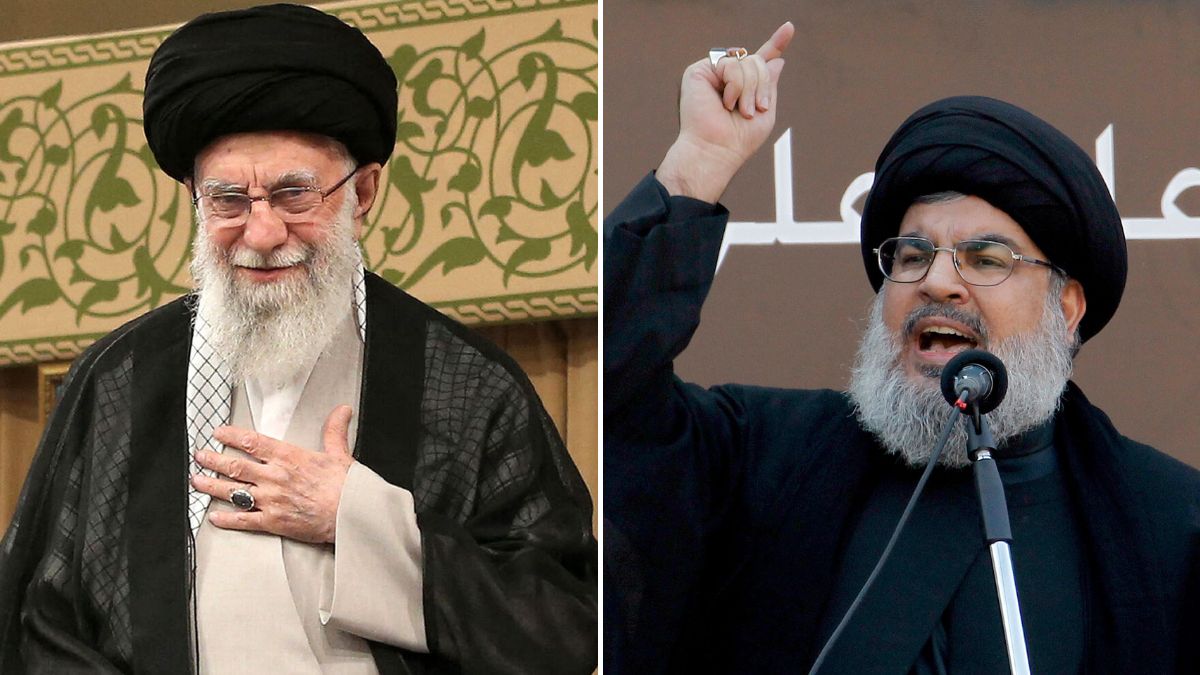
Iranian leader Al Khamenei with killed Hezbollah's Hassan Nasrallah and assassinated IRGC head Qassem Suleimani

Sixty-four-year-old Nasrallah was the principal cat’s paw of Ayatollahs of Iran as he ran the brutal Islamic group for the past three decades, taking on the powerful Israelis head-on during the occupation of southern Lebanon and then 2006 land war which ended in a stalemate.
That the Israelis caught Nasrallah unawares in his Beirut bunker last night shows the level of precise actionable intelligence and deadly targeting through laser-guided concrete penetrating bombs by the Israeli Air Force.

Presently, the majority of the population in north and central Israel are hiding in bomb shelters fearing Hezbollah and Iran retaliation post-killing of Nasrallah.
Hassan Nasrullah was favourite of Ayatollah Khamenei

Although Iran has been using Shia Houthis, Sunni Hamas, and Shia Kaitab Hezbollah in Iraq, Nasrallah, and his Lebanon-based group is the closest to the Iranian clergy and its strong arm—the QUDS force.

The killing of Nasrallah along with the deaths of senior commanders since the pagers exploded must be a serious setback for Tehran as the son of a vegetable seller was a favourite of Ayatollah Khomeini.

It was Khomeini’s 1979 Iranian revolution that radicalized the Hezbollah cadre and made them into fighters after taking training from Islamic Revolutionary Guard Corps of Iran. Hezbollah supported Syrian dictator Bashar al-Assad and virtually captured the once-Christian Lebanon.

Nasrallah ran afoul with Israel after Hezbollah launched rocket attacks into the north of Jew nation in support of Hamas post-October 7 massacre. In a span of two months, Israel has severely degraded Hezbollah’s fighting capabilities after killing top commanders like Fuad Shukr and Ibrahim Aqil in targeted strikes.

The losses of top and middle-level Hezbollah commanders will make it very difficult for Iran to appoint the successor of Nasrallah as even his deputy has been taken out by Tel Aviv.

Just like Hamas, Hezbollah is an ideology that cannot die despite its top leader being exterminated. The Israeli borders with Lebanon and Gaza will remain hot and so will be the skies with missiles being fired by Houthis in Yemen. The death of Nasrallah may trigger a strong retaliation from Iran but the missile capabilities of Tehran are limited in range and effectiveness.

After taking out Hamas’ Ismail Haniyeh in Tehran, Nasrallah in Lebanon, Israel has taken the fight to Iran. The ball is now in Ali Khamenei’s court as his credibility is at stake.


Iran Supreme Leader next? Tehran moves Ayatollah Khamenei to secure spot after IDF says Hezbollah chief killed

After declaring Hezbollah chief Hassan Nasrallah dead, Israeli army chief said, 'Anyone who threatens the citizens of Israel – we will know how to reach them'

Web Desk Updated: September 28, 2024 15:21 IST
Iran's Supreme Leader Ayatollah Ali Khamenei was moved to a secure location after Israel announced the death of Hezbollah chief Hassan Nasrallah | AFP

Iran Supreme Leader Ayatollah Ali Khamenei has been moved to safer place within the country and security has been beefed up after Israeli military said Tehran-backed Hezbollah chief Hassan Nasrallah was killed in the Beirut strike, said a report.

The sources quoted by Reuters said Iran was in constant touch with Hezbollah to decide on its next move.

ALSO READ: Hezbollah chief Hassan Nasrallah DEAD in Beirut strike, claims IDF


Iran's move comes after Israeli army chief said the IDF has not emptied its "toolbox" with Nasrallah's assassination. Chief of the General Staff Herzi Halevi said "the message is simple: Anyone who threatens the citizens of Israel – we will know how to reach them."

Hezbollah leadership was meeting at their undrground headquarters in south Beirut when the Israeli military launched its precision attack.

Hezbollah is yet confirm if Nasrallah has been killed. Earlier, a spokesperson of the group said the Hezbollah chief was fine and not in the targeted location.

Reports also said Nasrallah's daughter Zainab Nasrallah, Hezbollah missile unit commander Muhammad Ali Ismail and his deputy Hossein Ahmed Ismail were also killed in IDF strikes.

Israel had activated three batallions of reserve soldiers amid recent attacks in Lebanon.


ANALYSIS

Strikes on Beirut’s southern suburbs, the fate of Nasrallah: how to explain Hezbollah’s silence

The party's media continues its coverage of the war as if nothing has happened.


OLJ / By Salah HIJAZI, 28 September 2024


Protesters in Tehran hold up photos of Hezbollah leader Hassan Nasrallah following the Israeli strike on the southern suburbs on Friday, September 27, 2024. Photo credit: ATTA KENARE / AFP


The Israeli army announced on Saturday that it had succeeded in assassinating, in a lethal strike on the southern suburbs of Beirut the day before, the all-powerful secretary-general of Hezbollah, Hassan Nasrallah. An event whose shockwaves are likely to be felt across the region, as Nasrallah was a key figure in the pro-Iranian axis. He is sometimes even described as the number two in this camp, behind Supreme Leader Ali Khamenei.

During the night from Friday to Saturday, the southern suburb, a Hezbollah stronghold and densely populated area, was bombarded throughout the night. But on Hezbollah’s side, it’s radio silence. The party's media,such as its al-Manar channel or the al-Ahed website, do not mention Israeli allegations about this assassination or the uncertainty about Hassan Nasrallah's fate.

On the contrary, these two outlets continue their coverage of the war as if nothing had happened. Similarly, the party's official communication channels simply announce the various operations it is conducting against Israel. A resounding silence that raises many questions.

What we know


After the violent Israeli strike on Friday against the southern suburbs of Beirut, which, according to Tel Aviv, targeted the party's headquarters, sources close to Hezbollah told Reuters that the organization had lost contact with its leader. At the same time, other party insiders, such as journalist Faisal Abdel Sater, claimed that Hassan Nasrallah was still alive. The next day, the Israelis announced they had evidence of the "success" of their operation, which Hezbollah has not commented on.


The hypotheses

Hezbollah's silence regarding the fate of its secretary-general could simply be due to the fact that the party itself does not know if Hassan Nasrallah has survived the strike or not. This is reminiscent of the assassination by Israel of the chief of staff of the organization, Fouad Chukur, last August. It took a day for his body to be found and his death confirmed. In the meantime, contradictory information was constantly circulating.

Hezbollah has all the more reason to refrain from making statements on the subject since Nasrallah has developed, over his years at the head of the powerful Shiite organization, an almost divine image in the eyes of his most loyal supporters. Announcing uncertainty about his fate, or even his death, could cause panic and mobilization in the streets, especially in Shiite regions that have been continuously bombarded by the Israeli army since Friday evening.

Another hypothesis that circulates, particularly in circles close to the organization, is that Hassan Nasrallah is still alive, and his silence is therefore a tool of "psychological warfare" against Israel. These circles particularly recall the July 2006 war, during which Hassan Nasrallah broke a three-day silence with a speech. He announced, live, a missile strike on an Israeli warship deployed in Lebanese waters. "Watch it burn," he exclaimed, in a speech forever etched in history.

A third hypothesis can be put forward: that the party is completely overwhelmed by events. If the death of its leader is confirmed, the entire command would have been decapitated. Hezbollah is probably awaiting instructions from its Iranian patron before reacting. But on Tehran's side too, there is radio silence.


Nasrallah led Hezbollah through decades of conflict with Israel

Updated / Saturday, 28 Sep 2024 
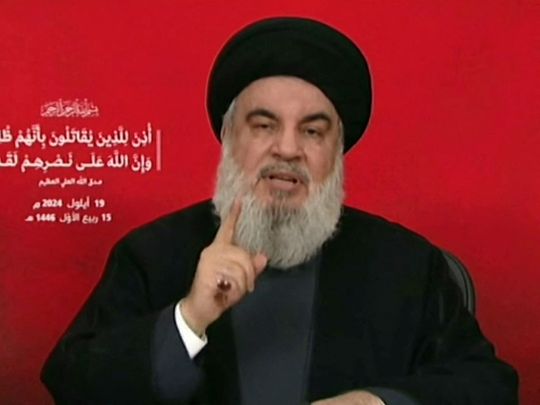
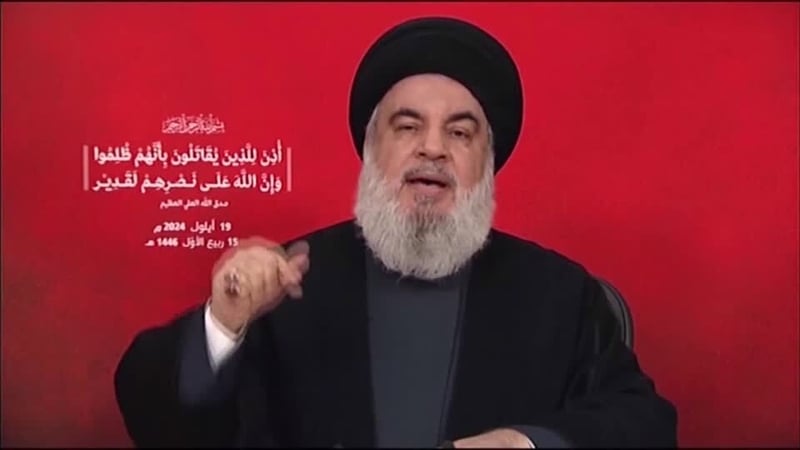
Hassan Nasrallah's most recent speech broadcast on 19 September

Lebanon's Sayyed Hassan Nasrallah, who Israel said it has killed, led Hezbollah through decades of conflict with Israel, overseeing its transformation into a military force with regional sway and becoming one of the most prominent Arab figures in generations - with Iranian backing.

The Iran-backed Hezbollah has yet to issue any statement on the status of Nasrallah, who led the group for 32 years.

The Israeli military said it had killed Nasrallah in an airstrike on the group's central headquarters in the southern suburbs of Beirut a day earlier.

The Israeli military "eliminated ... Hassan Nasrallah, leader of the Hezbollah terrorist organisation," Israeli army spokesperson Avichay Adraee wrote in a statement on X.

Among supporters, Nasrallah was lauded for standing up to Israel and defying the United States.

To enemies, he was head of a terrorist organisation and a proxy for Iran's Shi'ite Islamist theocracy in its tussle for influence in the Middle East.

His regional influence was on display over nearly a year of conflict ignited by the Gaza war, as Hezbollah entered the fray by firing on Israel from southern Lebanon in support of its Palestinian ally Hamas, and Yemeni and Iraqi groups followed suit, operating under the umbrella of "The Axis of Resistance".

"We are facing a great battle," Nasrallah said in an 1 August speech at the funeral of Hezbollah's top military commander, Fuad Shukr, who was killed in an Israeli strike on the Hezbollah-controlled southern suburbs of Beirut.

Yet when thousands of Hezbollah members were injured and dozens killed, when their communications devices exploded in an apparent Israeli attack last week, that battle began to turn against his group.

Responding to the attacks on Hezbollah's communications network in a 19 September speech, Nasrallah vowed to punish Israel.

"This is a reckoning that will come, its nature, its size, how and where? This is certainly what we will keep to ourselves and in the narrowest circle even within ourselves," he said.

He had not given a broadcast address since then.
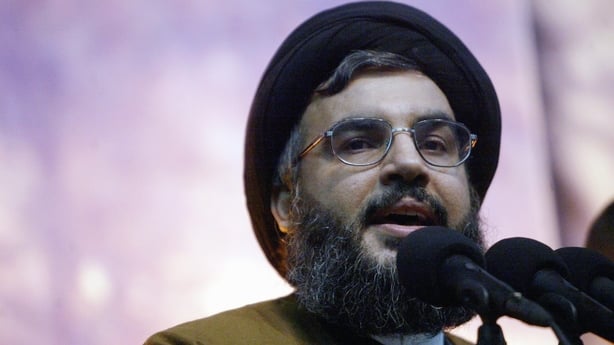
Hassan Nasrallah speaking in Beirut in 2004

Israel has meanwhile dramatically escalated its attacks, killing several senior Hezbollah commanders in targeted strikes and unleashing a massive bombardment in Hezbollah-controlled areas of Lebanon, which has killed hundreds of people.

Recognised even by his enemies as a skilled orator, Nasrallah's speeches were followed by friend and foe alike.

Wearing the black turban of a sayyed, or a descendent of the Prophet Mohammad, Nasrallah used his addresses to rally Hezbollah's base but also to deliver carefully calibrated threats, often wagging his finger as he does so.

He became secretary general of Hezbollah in 1992 aged just 35, the public face of a once shadowy group founded by Iran's Revolutionary Guards in 1982 to fight Israeli occupation forces.

Israel killed his predecessor, Sayyed Abbas al-Musawi, in a helicopter attack. Nasrallah led Hezbollah when its guerrillas finally drove Israeli forces from southern Lebanon in 2000, ending an 18-year occupation.

'Divine victory'

Conflict with Israel largely defined his leadership. He declared "Divine Victory" in 2006 after Hezbollah waged 34 days of war with Israel, winning the respect of many ordinary Arabs who had grown up watching Israel defeat their armies.

But he became an increasingly divisive figure in Lebanon and the wider Arab world as Hezbollah's area of operations widened to Syria and beyond, reflecting an intensifying conflict between Shi'ite Iran and US-allied Sunni Arab monarchies in the Gulf.

While Nasrallah painted Hezbollah's engagement in Syria - where it fought in support of President Bashar al-Assad during the civil war - as a campaign against jihadists, critics accused the group of becoming part of a regional sectarian conflict.

At home, Nasrallah's critics said Hezbollah's regional adventurism imposed an unbearable price on Lebanon, leading once friendly Gulf Arabs to shun the country - a factor that contributed to its 2019 financial collapse.

In the years following the 2006 war, Nasrallah walked a tightrope over a new conflict with Israel, hoarding Iranian rockets in a carefully measured contest of threat and counter threat.

The Gaza war, ignited by the 7 October Hamas attack on Israel, prompted Hezbollah's worst conflict with Israel since 2006, costing the group hundreds of its fighters including top commanders.

After years of entanglements elsewhere, the conflict put renewed focus on Hezbollah's historic struggle with Israel.

"We are here paying the price for our front of support for Gaza, and for the Palestinian people, and our adoption of the Palestinian cause," Nasrallah said in the 1 August speech.

Nasrallah grew up in Beirut's impoverished Karantina district. His family hail from Bazouriyeh, a village in the Lebanon's predominantly Shi'ite south which today forms Hezbollah's political heartland.

He was part of a generation of young Lebanese Shi'ites whose political outlook was shaped by Iran's 1979 Islamic Revolution.

Before leading the group, he used to spend nights with frontline guerrillas fighting Israel's occupying army. His teenage son, Hadi, died in battle in 1997, a loss that gave him legitimacy among his core Shi'ite constituency in Lebanon.

Hassan Nasrallah's son Hadi was killed in battle in 1997

Powerful enemies

He had a track record of threatening powerful enemies.

As regional tensions escalated after the eruption of the Gaza war, Nasrallah issued a thinly veiled warning to US warships in the Mediterranean, telling them: "We have prepared for the fleets with which you threaten us."

In 2020, Nasrallah vowed that US soldiers would leave the region in coffins after Iranian general Qassem Soleimani was killed in a US drone strike in Iraq.

He expressed fierce opposition to Saudi Arabia over its armed intervention in Yemen, where, with US and other allied support, Riyadh sought to roll back the Iran-aligned Houthis.

As regional tensions rose in 2019 following an attack on Saudi oil facilities, he said Saudi Arabia and the United Arab Emirates should halt the Yemen war to protect themselves.

"Don't bet on a war against Iran because they will destroy you," he said in a message directed at Riyadh.
On Nasrallah's watch, Hezbollah has also clashed with adversaries at home in Lebanon.

In 2008, he accused the Lebanese government - backed at the time by the West and Saudi Arabia - of declaring war by moving to ban his group's internal communication network. Nasrallah vowed to "cut off the hand" that tried to dismantle it.

It prompted four days of civil war pitting Hezbollah against Sunni and Druze fighters, and the Shi'ite group to take over half the capital Beirut.

He strongly denied any Hezbollah involvement in the 2005 assassination of former Prime Minister Rafik al-Hariri, after a UN-backed tribunal indicted four members of the group.

Nasrallah rejected the tribunal - which in 2020 eventually convicted three of them in absentia over the assassination - as a tool in the hands of Hezbollah's enemies.

Saturday, March 19, 2005

For a Ruthless Criticism of Everything Existing

Dialectical Magick

I have to thank the folks over at the Coffee Shop for the excellent article entitled Socratic Marx, which discusses this letter from Marx which was published in the Tucker Anthology The Marx and Engels Reader as: For a Ruthless Criticism of Everything Existing (1843).

This is one of my favorites short radical writings by Marx which expresses exactly what revolutionary thought is, philosophy in action. It is here we find the essence of Marx's revolutionary thought, and the phrase For a Ruthless Criticism of Everything Existing, was not lost on me when I first read this thirty-five years ago.

It is this letter which was to turn the entire socialist movement on its head, that communism is not just an extension of socialism it is something else, something different than existing socialism and social democracy. I have highlighted in bold those ideas which struck me as crucial so long ago, and remain embedded within my philosophical outlook.
And this essay has not just influence me, it has influenced other radical thinkers like Raya Dunayevskaya, it is in this essay we find mention of the idea of her Marxist Humanism [1].

Out of the broom closet

I had forgotten how important the ideas in this essay had been in building the foundation of of both my view of libertarian communism and what I would later call dialectical magick; a historical materialist interpretation that magick[2] has acted as a ‘ruthless criticism of religion’ and of science/scientism. It is the original Libertation Teleology.

"The whole socialist principle in its turn is only one aspect that concerns the reality of the true human being. But we have to pay just as much attention to the other aspect, to the theoretical existence of man, and therefore to make religion, science, etc., the object of our criticism."

As Marx says in his Introduction to A Contribution to the Critique of Hegel’s Philosophy of Right Karl Marx (published in the same journal; Deutsch-Französische Jahrbücher, in February, 1844) “the criticism of religion is the prerequisite of all criticism”. I have included an excerpt from this below his letter to Rouge.

Magick historically fulfills this prerequisite, it has functioned both as a practice[3], gift economy, and a social movement that acted as a "reform of consciousness not through dogmas, but by analyzing the mystical consciousness that is unintelligible to itself, whether it manifests itself in a religious or a political form. "

Marcel Mauss; shows this in his Outline of a General Theory of Magic, which is still relevant today, the centennial of its publication. While not as well known as his The Gift: The Form and Reason for Exchange in Archaic Societies, the General Theory of Magic postulates that magic is different from religion and not only pre-dates it but represents a social function that is essentially anti-authoritarian and based on an economy of self consciousness of production. Just as The Gift shows that this magickal economy is not one that produces exchange value but a communist exchange, those with surplus exchange it with those who do not have it by holding a potlatch.

Mauss further contends that magickal thinking is still with us, and modern physics shows this with its M-theory of String phenomena. Or as Feyerabend says in "Against Method", 1975, "Thus science is much closer to myth than a scientific philosophy is prepared to admit."

Magickal economy is consistent with what Marx called "actually existing communism" in his letter to Rouge. Marx, influenced by the early anthropological work of Lewis Morgan, saw the gift economy as essentially communist. It was an economy based on magick and mediated by the shaman, as in later periods communal society would be mediated by witches, cunning men, wise women, etc.

In the gift economy the shaman reflects social power of both the status quo and its other. They can be insiders, leaders in the community or outsiders, those exiled from the community. In either case they act to make acceptable to the community 'the other' such as homosexuality and gender bending (the bardache) which Edward Carpenter, the English socialist and gay advocate, documents.


THE SHAMAN IN THE CAVE

Les Trois Freres, France

“The Shaman/Trickster appears in the cave paintings of the Early European Tribes, about 18,000 about years ago. Warriors don't appear until about 9,000 years ago. Kings appeared even later. It appears historically that the Shaman/Trickster came a lot earlier, perhaps even before the cave painters appeared. The Shaman/Trickster is closely tied to hunting, and hunting and gathering were the origin of human society, maybe 50,000 years ago. The warrior and the king are possible only after the development of cities. THEORIES ON THE NORTH AMERICAN TRICKSTER

Magick in practice is mnemonic, it is a remembrance of mans development of tool making and technics, the subconscious memory that labour altered our consciousness. The tools of magick, the cup, the pentangle, the athame, the wand and the sword are mnemonic symbols of the development and transition of the human from the dominance of the world of nature, into nature’s transformer, the magi. The invocations and the evocations of magickal chants are the voice of humankind speaking of and to the names of the natural world as it are transformed by our labour. [4] As the world changes so do the deities, the reifications of the world made in the image of man. Or to put it another way "That which is mostly observed, is that which replicates the most."

“Man makes religion, religion does not make man. Religion is, indeed, the self-consciousness and self-esteem of man who has either not yet won through to himself, or has already lost himself again. But man is no abstract being squatting outside the world. Man is the world of man – state, society. This state and this society produce religion, which is an inverted consciousness of the world, because they are an inverted world,” as Marx says in his introduction to his Critique of Hegel below. And we could add that man also makes science, and that magick which originates science[5], as it does religion, it continues to be a different form of science, natural science as opposed to technic based science of capitalism.

And as Frazer says in the Golden Bough; "So far, therefore, as the public profession of magic has been one of the roads by which men have passed to supreme power, it has contributed to emancipate mankind from the thraldom of tradition and to elevate them into a larger, freer life, with a broader outlook on the world. This is no small service rendered to humanity. And when we remember further that in another direction magic has paved the way for science, we are forced to admit that if the black art has done much evil, it has also been the source of much good; that if it is the child of error, it has yet been the mother of freedom and truth."[6]

We can see within the modern Occult movements in the 19th and 20th centuries this dialectic of religion and politics, of liberation and oppression played out in the microcosm of secret societies and the macrocosm of mass movements for social change which includes the neo-pagan and witchcraft revivals that are occurring today. We can see it in the popular response to Harry Potter novels by millions of children, for whom magickal thinking has not been repressed. This is not mere mysticism, but as Freud called it the ‘return of the repressed[7]. Magick has influenced much of the modern revolutionary movements, from the time of Byron and Shelley (called satanic poets by their contemporaries) through to Surrealism, the beat poets such as libertarian communist Kenneth Rexroth and even Situationism, just as it has broadened our understanding of early human communities through the sciences of sociology and anthropology.

In the information age the return of magick in the 20th century , at the height of capitalisms ascendance its technological transformation of society, shows that the alienation of production and its reification into commodity and consumer, satisfies the individuals need to create meaning and power out of powerlessness. Magick functions not only for creating meaning and power for the individual, but to bring individuals back into contact with each other as creators of community; it answers the need for the village and commune in the midst of a mass consumer culture.

If we are to understand magick as part of the revolutionary movement, we must discard popular conspiracy theory notions of it and apply dialectical and historical materialist theory to it. This then is the challenge that dialectical libertarians face. The study of magick has long influenced revolutionary thinkers[8], as well as reactionaries[9]. The reactionary thinker sees the Occult as competing secret societies vying for power[10], the libertarian communist, sees magick as humanities gnosis of ourselves as self conscious creators of our world as Joseph Dietzgen[11] contends with his theory of Cosmic Dialectics.


Letters from the Deutsch-Französische Jahrbücher

M. to R.
Marx to Ruge

Kreuznach, September 1843

I am glad that you have made up your mind and, ceasing to look back at the past, are turning your thoughts ahead to a new enterprise.[22] And so — to Paris, to the old university of philosophy — absit omen! [May it not be an ill omen] — and the new capital of the new world! What is necessary comes to pass. I have no doubt, therefore, that it will be possible to overcome all obstacles, the gravity of which I do not fail to recognise.

But whether the enterprise comes into being or not, in any case I shall be in Paris by the end of this month,[23] since the atmosphere here makes one a serf, and in Germany I see no scope at all for free activity.

In Germany, everything is forcibly suppressed; a real anarchy of the mind, the reign of stupidity itself, prevails there, and Zurich obeys orders from Berlin. It therefore becomes increasingly obvious that a new rallying point must be sought for truly thinking and independent minds. I am convinced that our plan would answer a real need, and after all it must be possible for real needs to be fulfilled in reality. Hence I have no doubt about the enterprise, if it is undertaken seriously.

The internal difficulties seem to be almost greater than the external obstacles. For although no doubt exists on the question of “Whence,” all the greater confusion prevails on the question of “Whither.” Not only has a state of general anarchy set in among the reformers, but everyone will have to admit to himself that he has no exact idea what the future ought to be. On the other hand, it is precisely the advantage of the new trend that we do not dogmatically anticipate the world, but only want to find the new world through criticism of the old one. Hitherto philosophers have had the solution of all riddles lying in their writing-desks, and the stupid, exoteric world had only to open its mouth for the roast pigeons of absolute knowledge to fly into it. Now philosophy has become mundane, and the most striking proof of this is that philosophical consciousness itself has been drawn into the torment of the struggle, not only externally but also internally. But, if constructing the future and settling everything for all times are not our affair, it is all the more clear what we have to accomplish at present: I am referring to ruthless criticism of all that exists, ruthless both in the sense of not being afraid of the results it arrives at and in the sense of being just as little afraid of conflict with the powers that be.

Therefore I am not in favour of raising any dogmatic banner. On the contrary, we must try to help the dogmatists to clarify their propositions for themselves. Thus, communism, in particular, is a dogmatic abstraction; in which connection, however, I am not thinking of some imaginary and possible communism, but actually existing communism as taught by Cabet, Dézamy, Weitling, etc. This communism is itself only a special expression of the humanistic principle, an expression which is still infected by its antithesis — the private system. Hence the abolition of private property and communism are by no means identical, and it is not accidental but inevitable that communism has seen other socialist doctrines — such as those of Fourier, Proudhon, etc. — arising to confront it because it is itself only a special, one-sided realisation of the socialist principle.

And the whole socialist principle in its turn is only one aspect that concerns the reality of the true human being. But we have to pay just as much attention to the other aspect, to the theoretical existence of man, and therefore to make religion, science, etc., the object of our criticism. In addition, we want to influence our contemporaries, particularly our German contemporaries. The question arises: how are we to set about it? There are two kinds of facts which are undeniable. In the first place religion, and next to it, politics, are the subjects which form the main interest of Germany today. We must take these, in whatever form they exist, as our point of departure, and not confront them with some ready-made system such as, for example, the Voyage en Icarie. [Etienne Cabet, Voyage en Icarie. Roman philosophique et social.]

Reason has always existed, but not always in a reasonable form. The critic can therefore start out from any form of theoretical and practical consciousness and from the forms peculiar to existing reality develop the true reality as its obligation and its final goal. As far as real life is concerned, it is precisely the political state — in all its modern forms — which, even where it is not yet consciously imbued with socialist demands, contains the demands of reason. And the political state does not stop there. Everywhere it assumes that reason has been realised. But precisely because of that it everywhere becomes involved in the contradiction between its ideal function and its real prerequisites.

From this conflict of the political state with itself, therefore, it is possible everywhere to develop the social truth. just as religion is a register of the theoretical struggles of mankind, so the political state is a register of the practical struggles of mankind. Thus, the political state expresses, within the limits of its form sub specie rei publicae,[as a particular kind of state] all social struggles, needs and truths. Therefore, to take as the object of criticism a most specialised political question — such as the difference between a system based on social estate and one based on representation — is in no way below the hauteur des principes. [Level of principles] For this question only expresses in a political way the difference between rule by man and rule by private property. Therefore the critic not only can, but must deal with these political questions (which according to the extreme Socialists are altogether unworthy of attention). In analysing the superiority of the representative system over the social-estate system, the critic in a practical way wins the interest of a large party. By raising the representative system from its political form to the universal form and by bringing out the true significance underlying this system, the critic at the same time compels this party to go beyond its own confines, for its victory is at the same time its defeat.

Hence, nothing prevents us from making criticism of politics, participation in politics, and therefore real struggles, the starting point of our criticism, and from identifying our criticism with them. In that case we do not confront the world in a doctrinaire way with a new principle: Here is the truth, kneel down before it! We develop new principles for the world out of the world’s own principles. We do not say to the world: Cease your struggles, they are foolish; we will give you the true slogan of struggle. We merely show the world what it is really fighting for, and consciousness is something that it has to acquire, even if it does not want to.

The reform of consciousness consists only in making the world aware of its own consciousness, in awakening it out of its dream about itself, in explaining to it the meaning of its own actions. Our whole object can only be — as is also the case in Feuerbach’s criticism of religion — to give religious and philosophical questions the form corresponding to man who has become conscious of himself.

Hence, our motto must be: reform of consciousness not through dogmas, but by analysing the mystical consciousness that is unintelligible to itself, whether it manifests itself in a religious or a political form. It will then become evident that the world has long dreamed of possessing something of which it has only to be conscious in order to possess it in reality. It will become evident that it is not a question of drawing a great mental dividing line between past and future, but of realising the thoughts of the past. Lastly, it will become evident that mankind is not beginning a new work, but is consciously carrying into effect its old work.

In short, therefore, we can formulate the trend of our journal as being: self-clarification (critical philosophy) to be gained by the present time of its struggles and desires. This is a work for the world and for us. It can be only the work of united forces. It is a matter of a confession, and nothing more. In order to secure remission of its sins, mankind has only to declare them for what they actually are.

Introduction to A Contribution to the Critique of Hegel’s Philosophy of Right

Karl Marx in Deutsch-Französische Jahrbücher, February, 1844

For Germany, the criticism of religion has been essentially completed, and the criticism of religion is the prerequisite of all criticism.

The profane existence of error is compromised as soon as its heavenly oratio pro aris et focis [“speech for the altars and hearths”] has been refuted. Man, who has found only the reflection of himself in the fantastic reality of heaven, where he sought a superman, will no longer feel disposed to find the mere appearance of himself, the non-man [Unmensch], where he seeks and must seek his true reality.

The foundation of irreligious criticism is: Man makes religion, religion does not make man. Religion is, indeed, the self-consciousness and self-esteem of man who has either not yet won through to himself, or has already lost himself again. But man is no abstract being squatting outside the world. Man is the world of man – state, society. This state and this society produce religion, which is an inverted consciousness of the world, because they are an inverted world. Religion is the general theory of this world, its encyclopaedic compendium, its logic in popular form, its spiritual point d’honneur, its enthusiasm, its moral sanction, its solemn complement, and its universal basis of consolation and justification. It is the fantastic realization of the human essence since the human essence has not acquired any true reality. The struggle against religion is, therefore, indirectly the struggle against that world whose spiritual aroma is religion.

Religious suffering is, at one and the same time, the expression of real suffering and a protest against real suffering. Religion is the sigh of the oppressed creature, the heart of a heartless world, and the soul of soulless conditions. It is the opium of the people.

The abolition of religion as the illusory happiness of the people is the demand for their real happiness. To call on them to give up their illusions about their condition is to call on them to give up a condition that requires illusions. The criticism of religion is, therefore, in embryo, the criticism of that vale of tears of which religion is the halo.

Criticism has plucked the imaginary flowers on the chain not in order that man shall continue to bear that chain without fantasy or consolation, but so that he shall throw off the chain and pluck the living flower. The criticism of religion disillusions man, so that he will think, act, and fashion his reality like a man who has discarded his illusions and regained his senses, so that he will move around himself as his own true Sun. Religion is only the illusory Sun which revolves around man as long as he does not revolve around himself.

It is, therefore, the task of history, once the other-world of truth has vanished, to establish the truth of this world. It is the immediate task of philosophy, which is in the service of history, to unmask self-estrangement in its unholy forms once the holy form of human self-estrangement has been unmasked. Thus, the criticism of Heaven turns into the criticism of Earth, the criticism of religion into the criticism of law, and the criticism of theology into the criticism of politics.

For Donalda Cassel, Larry Gambone, Jane Leverick, Sam Wagar

FOOTNOTES


[1] communism is itself only a special expression of the humanistic principle

[2] The use of Magick with a 'k' comes from Giambattista della Porta (aka John Baptist della Porta) (1535-1615) Natural Magick , Published in 1558 in Italian and then in 1658 in English. ( In this wildly popular series, now expanded to 20 books, della Porta claims the natural world can be manipulated by the natural philosopher through theoretical and practical experiment. He describes ways of beautifying women, tempering steel, counterfeiting precious stones, identifying natural magnets, and forming new plants and animals.) Natural Magick predates Aleister Crowley’s use of Magick spelled with a K, though he is credited with popularizing this spelling.

[3] Magick is the Science and Art of causing Change to occur in conformity with Will.

In one sense Magick may be defined as the name given to Science by the vulgar.

[4] Mircea Eliade's The Forge and the Crucible (1956) asserts that the ancient art of alchemy begins in the bronze age with the forging of tools, and that western systems of initiation into secret knowledge originate in this era with the metal crafts guilds and secret societies of smithy’s.

[5] Astrology is the mother of Astronomy, and Alchemy is the mother of Chemistry as historians of science like to say, but Alchemy is also different from chemistry in that it postulates that the observer affects what is observed, which is the quantum theory of Schrodingers Cat, and that the observer is transformed in the process.

[6] Definition and Theorems of Magick , Magick in Theory and Practice, Aleister Crowley

[7] The Return of the Repressed The strange case of Masud Khan, Robert S. Boynton, The Boston Review

[8] William Godwin, the Lives of the Necromancers, 1834

[10] “the history of the world is the history of competing secret societies” Mumbo-Jumbo By Ishmael Reed which deals with Hoodoo and the spirit of Jazz Age which 'jez grew' in 1920's America to create a black autonomous culture. A very funny work on conspiracy theories in the vein of Robert Anton Wilson/Bob Shea’s Illuminatus series.