It’s possible that I shall make an ass of myself. But in that case one can always get out of it with a little dialectic. I have, of course, so worded my proposition as to be right either way (K.Marx, Letter to F.Engels on the Indian Mutiny)
Thursday, June 05, 2025
WhaleSETI:
Curious humpback whales approach humans and blow bubble “smoke” rings
Newly documented behavior in a recently published paper by SETI Institute and UC Davis team members may offer insights into nonhuman intelligence—and help shape the search for life beyond Earth
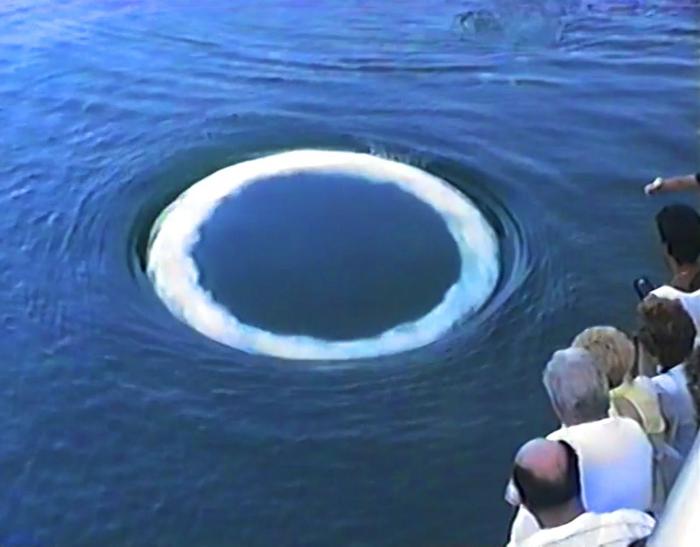
June 5, 2025, Mountain View, CA -- A team of scientists from the SETI Institute and the University of California at Davis documented, for the first time, humpback whales producing large bubble rings, like a human smoker blowing smoke rings, during friendly interactions with humans. This previously little studied behavior may represent play or communication. Humpback whales are already known for using bubbles to corral prey and creating bubble trails and bursts when competing to escort a female whale. These new observations show humpback whales producing bubble rings during friendly encounters with humans. This finding contributes to the WhaleSETI team’s broader goal of studying non-human intelligence to aid in the search for extraterrestrial intelligence.
“Because of current limitations on technology, an important assumption of the search for extraterrestrial intelligence is that extraterrestrial intelligence and life will be interested in making contact and so target human receivers,” said Dr. Laurance Doyle, SETI Institute scientist and co-author on the paper. “This important assumption is certainly supported by the independent evolution of curious behavior in humpback whales.”
“Humpback whales live in complex societies, are acoustically diverse, use bubble tools and assist other species being harassed by predators,” said co-lead author Dr. Fred Sharpe, UC Davis Affiliate. “Now, akin to a candidate signal, we show they are blowing bubble rings in our direction in an apparent attempt to playfully interact, observe our response, and/or engage in some form of communication.”
“Humpback whales often exhibit inquisitive, friendly behavior towards boats and human swimmers,” said co-lead author Jodi Frediani, marine wildlife photographer and U.C. Davis Affiliate. “We’ve now located a dozen whales from populations around the world, the majority of which have voluntarily approached boats and swimmers blowing bubble rings during these episodes of curious behavior.”
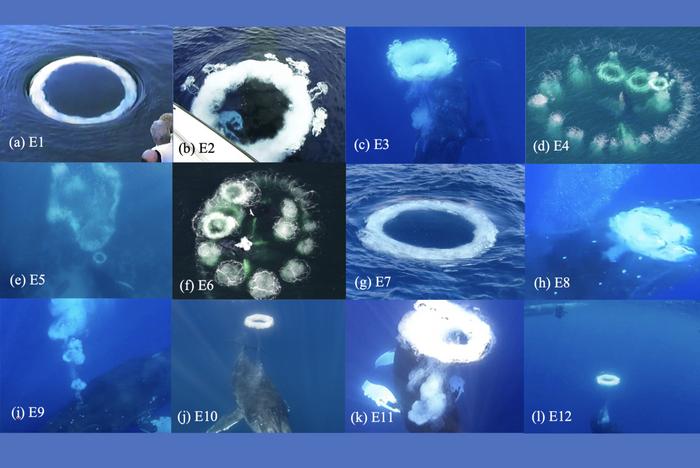
The team’s findings were recently published in Marine Mammal Science in a paper titled “Humpback Whales Blow Poloidal Vortex Bubble Rings.” The study analyzes 12 bubble ring–production episodes involving 39 rings made by 11 individual whales.
Similar to studying Antarctica or other terrestrial analogs as a proxy for Mars, the Whale-SETI team is studying intelligent, non-terrestrial (aquatic), nonhuman communication systems to develop filters that aid in parsing cosmic signals for signs of extraterrestrial life. As noted by Karen Pryor, “patterns of bubble production in cetaceans constitute a mode of communication not available to terrestrial mammals” (Pryor 1990).
Other team members and coauthors of the paper are Dr. Josephine Hubbard (Postdoc, U.C. Davis), Doug Perrine (Doug Perrine Photography), Simon Hilbourne (Marine Research Facility, Jeddah, Saudi Arabia), Dr. Joy Reidenberg (Icahn School of Medicine at Mount Sinai, NY) and Dr. Brenda McCowan, ( U.C. Davis, Veterinary Medicine), with specialties in animal intelligences, photography and behavior of humpback whales, whale anatomy, and the use of AI in parsing animal communication, respectively. An earlier paper by the team was published in the journal, PeerJ, entitled, “Interactive Bioacoustic Playback as a Tool for Detecting and Exploring Nonhuman Intelligence: “Conversing” with an Alaskan Humpback Whale.” The authors would like to acknowledge the Templeton Foundation Diverse Intelligences Program for financial support of this work.
About the SETI Institute Founded in 1984, the SETI Institute is a non-profit, multi-disciplinary research and education organization whose mission is to lead humanity’s quest to understand the origins and prevalence of life and intelligence in the universe and share that knowledge with the world. Our research encompasses the physical and biological sciences and leverages data analytics, machine learning, and advanced signal detection technologies. The SETI Institute is a distinguished research partner for industry, academia, and government agencies, including NASA and the National Science Foundation.
Composite image of at least one bubble ring from each episode.
Credit
Photo attributions: (a) D. Knaub, (b) F. Nicklen, (c) D. Perrine, (d) W. Davis, (e) G. Flipse, (f) A. Henry, (g) M. Gaughan, (h) H. Romanchik, (i) D. Patton, (j) D. Perrine, (k) S. Istrup, (l) S. Hilbourne
A team of international scientists, including from the Woods Hole Oceanographic Institution, have tracked over 100 marine megafauna species, identifying the most critical locations in our global oceans for better marine conservation efforts, and the establishment of effective Marine Protected Areas (MPAs)
Woods Hole, Mass. (June 5, 2025) -- A team of international scientists, including from the Woods Hole Oceanographic Institution, have tracked over 100 marine megafauna species, identifying the most critical locations in our global oceans for better marine conservation efforts, and the establishment of effective Marine Protected Areas (MPAs), according to new research published in Science.
The global UN-endorsed research project, MegaMove, involves almost 400 scientists from over 50 countries, showing where protection could be implemented specifically for the conservation of marine megafauna. Current Marine Protection Areas include only 8 per cent of the world’s total oceans, which the UN High Seas Treaty seeks to expand to 30 per cent.
The research found that the targets of the current Treaty which have been signed by 115 countries but still to be ratified, are a step in the right direction. These will be key to assisting conservation but insufficient to cover all critical areas used by threatened marine megafauna, suggesting that additional threat mitigation measures are also needed.
Some of the ocean’s best-known creatures – known as marine megafauna – include sharks, whales, turtles, and seals. They are typically top predators with critical roles in marine food webs, but face growing threats from humans’ environmental impact.
“The impacts of a changing ocean on marine megafauna are already evident,” said Camrin Braun, assistant scientist and ocean ecologist at WHOI, and a co-author of the study. “Our recent work tracking marine predators, including an earlier WHOI-led study, indicates changes in the ocean are expected to fundamentally alter the status quo for where these species are and how they live.”
Simon Thorrold is a senior scientist in biology at WHOI, and a co-author on the study. “Conservation and management efforts need to plan for ongoing changes in ocean ecosystems. Bringing together data from hundreds of scientists is a really effective way to collectively address the international protections needed for these important species.”
The Australian National University (ANU) marine ecologist and research lead author, Associate Professor Ana Sequeira, said the study’s goal is to identify areas used by marine megafauna for important behaviors like foraging and corridors used for migration, and these areas can only be identified by tracking animal movements.
“We found that the areas used by these animals overlap significantly with threats like fishing, shipping, warming temperatures, and plastic pollution,” she said. “The 30 per cent protection goal is seen as helpful but insufficient to protect all important areas, meaning that additional mitigation strategies are needed to alleviate pressures beyond areas that will be protected.”
The research also links to UN Sustainable Development Goals, Goal 14 on water, and specifically, to Goal A of the Kunming-Montreal Global Biodiversity Framework to halt human-induced extinction of threatened species.
Sequeira is the research director and founder of MegaMove, a global scientific project she launched in 2020. “MegaMove brings together an international network of researchers to provide innovative research to advance the global conservation of marine megafauna.”
“Our research shows that, in addition to protected areas, implementing mitigation strategies like changing fishing gear, using different lights in nets, and traffic schemes for ships will be key to alleviating current human pressure on these species,” she added.
Study co-lead author Dr Jorge Rodríguez, from Instituto de Física Interdisciplinar y Sistemas Complejos, added: “We’ve outlined the top areas for 30 per cent protection, ranking them based on their use by marine megafauna species. Our analysis identifies which areas in the global ocean these species are using as residencies or migratory corridors. We specifically focused on ranking higher those areas used for these important behaviors by the largest number of species.
“But the bottom line is, even if the whole 30 per cent protection were selected in key areas used by marine megafauna, it would still not be enough to conserve them,” Associate Professor Sequeira added.
“Adaptive management approaches, and stronger mitigation strategies are critical components of the coordinated international approach necessary to conserve these species into the future,” added Braun. “We need all the tools we can if we are going to successfully balance conservation goals with human uses in a changing ocean.”
About Woods Hole Oceanographic Institution
The Woods Hole Oceanographic Institution is a private, non-profit organization on Cape Cod, Massachusetts, dedicated to marine research, engineering, and higher education. Established in 1930, its primary mission is to understand the ocean and its interaction with the Earth as a whole, and to communicate an understanding of the ocean’s role in the changing global environment. Top scientists, engineers, and students collaborate on more than 800 concurrent projects worldwide—both above and below the waves—pushing the boundaries of knowledge and possibility.
As a member of the Marine Predators Group, WHOI assistant scientist Camrin Braun attaches satellite tags to sharks to track the movements and behavior of sharks. Braun has tracked sharks traveling as far as 10,000 miles and diving more than 3,000 feet.
Global tracking of marine megafauna space use reveals how to achieve conservation targets
Article Publication Date
5-Jun-2025
Groundbreaking study maps the movements of marine megafauna
Virginia Tech joined a global research team that tracked more than 100 species and identified ocean hotspots critical for protecting threatened marine megafauna that fall beyond current conservation zones
Global efforts like MegaMove can also help inspire the next generation of researchers and showcase how Virginia Tech connects local talent to worldwide impact.
A sweeping new study is helping pinpoint where whales, sharks, turtles, and other ocean giants need the most protection and where current efforts fall short.
Led by Ana Sequeira of Australian National University and supported by the United Nations, the research synthesized data from 12,000 satellite-tracked animals across more than 100 species. It reveals how marine megafauna move globally and where their migratory, feeding, and breeding behaviors intersect with human threats such as fishing, shipping, and pollution.
Virginia Tech contributed to the effort, called MegaMove, a massive collaboration of nearly 400 scientists across more than 50 countries. The project used biologging data collected using satellite tags to inform a new blueprint for ocean conservation.
“This is one of the largest marine tracking data sets ever assembled,” said Francesco Ferretti, a marine ecologist at Virginia Tech who contributed to the study. “It’s not just about drawing lines on a map. We need to understand animal behavior and overlap that with human activity to find the best solutions.”
The research was published today in the journal Science.
From the open ocean to Virginia waters
Though global in scope, the findings hold direct relevance for Virginia and the East Coast.
“Virginia’s coastline is part of a major migratory corridor for marine species,” Ferretti said. “Sharks, for example, play a critical role in maintaining healthy marine ecosystems, which in turn support fisheries and recreation. What happens to apex predators can ripple across the food web and impact local economies.”
Past collapses of shellfish fisheries in North Carolina and impacts on seagrasses meadows, important for fisheries, carbon sequestration, and to prevent coastal erosion, have shown how predator loss can shift entire ecosystems.
Ferretti said understanding these dynamics is critical to protecting both wildlife and the communities that rely on them.
A global conservation puzzle
MegaMove aimed to inform the United Nations' 30x30 target: a global goal to protect 30 percent of the world’s oceans by 2030. The team used optimization algorithms to propose which areas should be prioritized for protection based on how marine species use the space.
But the findings show that even if all 30 percent of protected areas were perfectly placed, it wouldn’t be enough.
“Sixty percent of the tracked animals’ critical habitats would be still outside these zones,” Ferretti said. “In addition to protected areas, we need targeted mitigation, changing fishing practices, rerouting shipping lanes, and reducing pollution.”
Building global science at Virginia Tech
Virginia Tech’s participation to initiatives such as the MegaMove project reflects a broader push to contribute to international, data-driven science.
“This project shows where the field is heading,” Ferretti said. “We’re seeing a revolution in big data approaches in marine science. Students need to be trained not only in fieldwork but in data science to meet future challenges.”
He said global efforts like MegaMove can also help inspire the next generation of researchers and showcase how Virginia Tech connects local talent to worldwide impact.

No comments:
Post a Comment