Against previous assumptions: Shark and ray diversity is declining, not increasing
Surprising long-term decline reveals urgent conservation priorities: preserving and restoring diverse coastal habitats
image:
Fig. 1: A young whitetip reef shark (Triaenodon obesus) rests under a table coral off the coast of Indonesia.
view moreCredit: Manuel A. Staggl
A team of international researchers led by the University of Vienna investigated the development of shark and ray biodiversity over the past 100 million years. Their surprising results show a continuous decline in diversity since the Eocene, 45 million years ago, which contradicts previous assumptions that biodiversity was either stable or increasing. This study, recently published in the renowned journal Scientific Reports, provides crucial insights for modern marine conservation.
What can fossil sharks and rays tell us about today's biodiversity crisis? This was the question posed by Manuel A. Staggl and his team at the Institute of Palaeontology at the University of Vienna. "Cartilaginous fish, which include today's sharks and rays, have existed on our planet for over 400 million years. They have survived several mass extinction events during this time, yet today, over a third of neoselachians (i.e. modern sharks and rays) are at risk of extinction," explains Manuel Staggl. "To develop effective conservation measures, we must understand which environmental factors have influenced their diversity in the past."
Past insights reveal current threats
The researchers analysed extensive fossil data and compared it with historical environmental conditions, such as temperature, carbon dioxide (CO₂) levels, and habitat availability. The surprising results shed a completely new light on the evolutionary history of these successful marine Predators.
Dinosaur extinction was less drastic for sharks and rays than previously thought
Sharks and rays have proven to be particularly resilient in the face of past catastrophes. Perhaps the most astonishing finding is that the famous mass extinction that followed the asteroid impact 66 million years ago, which wiped out large dinosaurs and many other species, had only a minor impact on sharks and rays. "These animals proved to be amazingly resilient and recovered quickly from the catastrophe," explains early career scientist Staggl. The biodiversity of sharks and rays peaked later in the Eocene, around 45 million years ago, at a time when the climate was significantly warmer than it is today. Since then, their biodiversity has declined, and the study identifies several causes of this decline.
Shallow coastal areas are biodiversity hotspots
Habitat availability has proven to be a decisive factor in the evolution of new species of shark and ray over the past 66 million years. Shallow, species-rich coastal habitats have been particularly important in this regard. "The more diverse the shallow marine habitats, the more species emerged," explains Jürgen Kriwet, head of the Evolutionary Morphology Research Group at the Institute of Palaeontology. However, he adds that this is also a worrying trend, as these very habitats are now under severe threat from coastal development, global warming, pollution and unsustainable fishing.
The role of carbon dioxide (CO₂) proved to be more complex than previously assumed. Surprisingly, the analyses showed that moderate CO₂ levels in the atmosphere tended to have a positive effect on the biodiversity of sharks and rays: "In simple terms, CO₂ promotes photosynthesis in algae and seagrass meadows. This has a positive effect on the entire food chain and ultimately on sharks and rays," explains Kriwet. However, if CO₂ levels rose too high, marine ecosystems as a whole would be damaged, as Staggl and his team had already shown in a previous study. "In a nutshell: moderate CO₂ levels were beneficial for shark and ray biodiversity in the past, but excessive levels were harmful. This highlights the danger posed by current ocean acidification caused by human-induced climate change," says Staggl.
Present-day changes leave species with no time to adapt
The current biodiversity crisis, which is caused by a combination of overfishing, habitat destruction, and rapid climate change, differs fundamentally from all previous threats. "In the past, sharks and rays had time to adapt to changes or migrate to other areas. However, the current changes are happening far too quickly. In this respect, the situation today is unprecedented," says Staggl. Highly specialised species, such as deep-sea sharks which are adapted to stable cold environments, cannot keep pace with rapid changes and are therefore particularly vulnerable to warming according to the findings of Staggl and his team.
Overall, the findings provide important insights for effective conservation strategies: preserving and restoring diverse coastal habitats must be the top priority. At the same time, it is imperative to drastically reduce CO₂ emissions in order to limit ocean acidification. "Our study shows that marine conservation is not just about fishing quotas – we need to adopt a broader perspective that considers entire habitats and the climate system," concludes palaeobiologist Staggl.
Summary:
- An international research team led by the University of Vienna has investigated the development of shark and ray biodiversity over the past 100 million years.
- The surprising results show a continuous decline in diversity since the Eocene epoch 45 million years ago – contrary to the previous assumption of stable or even increasing biodiversity.
- One of the most astonishing findings: the famous mass extinction following the asteroid impact 66 million years ago, which wiped out the large dinosaurs and many other species, had only a minor impact on sharks and rays.
- The availability of habitats proved to be a decisive factor in the development of new shark and ray species over the past 66 million years. Flat, species-rich coastal habitats are particularly important in this regard – but these are precisely the habitats that are under threat today.
- Overall, the findings provide important pointers for effective conservation strategies: preserving and restoring diverse coastal habitats and drastically reducing CO₂ emissions.
About the University of Vienna:
For over 650 years the University of Vienna has stood for education, research and innovation. Today, it is ranked among the top 100 and thus the top four per cent of all universities worldwide and is globally connected.
With degree programmes covering over 180 disciplines, and more than 10,000 employees we are one of the largest academic institutions in Europe. Here, people from a broad spectrum of disciplines come together to carry out research at the highest level and develop solutions for current and future challenges. Its students and graduates develop reflected and sustainable solutions to complex challenges using innovative spirit and curiosity.
Fig. 2: The young spotted eagle ray (Aetobatus narinari) visits a "cleaning Station" in the sun-drenched coral reef in the north of the Red Sea, where it is cleaned of parasites by cleaner fish.
Credit
Manuel A. Staggl
Journal
Scientific Reports
Article Title
Global environmental drivers shape cenozoic neoselachian diversity and identify modern conservation priorities
Article Publication Date
20-Nov-2025
Oldest modern shark mega-predator swam off Australia during the age of dinosaurs
Swedish Museum of Natural History
image:
A gigantic 8 m long mega-predatory shark stalks an unwary long-necked plesiosaur in the seas off Australia 115 million years ago.
view moreCredit: Polyanna von Knorring, Swedish Museum of Natural History
Around 115 million years ago, the seas off northern Australia were home to a gigantic ancestor of Jaws. Fossils of this ancient mega-predator reveal that modern sharks experimented with enormous body sizes much earlier in their evolutionary history than previously suspected, and took the top place in oceanic food chains alongside massive marine reptiles during the Age of Dinosaurs. This study presents a new interdisciplinary analysis to reconstruct size evolution in ancient sharks.
Sharks are iconic predators in the oceans today, and can trace their ancestry back over 400 million years. However, the evolutionary history of modern shark lineages began during the Age of Dinosaurs, with the oldest known fossils dating from around 135 million years ago. Known as lamniforms, these early modern sharks were small, possibly only about 1 m long, but over time would give rise to giants, such as the famous ‘Megalodon’ that may have exceeded 17 m in length, and the living Great White shark, which is an apex-predator in today’s oceans and tops the scales at around 6 m.
Sharks have cartilaginous skeletons. Therefore, their fossil record is mostly represented by teeth, which sharks shed continuously as they feed. Shark teeth are subsequently very common in rocks that were laid down as sediment at the bottom of the sea, and occur alongside the teeth and bones of other animals, such as fishes and gigantic marine reptiles, which the dominant predators in most marine ecosystems during the Age of Dinosaurs.
The rocky coastline fringing the city of Darwin in far northern Australia was once mud from the floor of the ancient Tethys ocean, which stretched from the southern shores of Gondwana (now Australia) to the northern island archipelagos of Laurasia (now Europe). The remains of sea monsters, including plesiosaurs (long-necked marine reptile resembling the popular image of the Loch Ness monster), ichthyosaurs (‘fish-lizards’), and large bony fish have all been found. Yet most spectacularly, a handful of enormous vertebrae have turned up that reveal the presence of an unexpected predator — a gigantic lamniform shark.
The five recovered vertebrae were partially mineralised, which enabled their preservation, and are virtually identical to those of a modern Great White shark. However, whereas adult Great Whites have vertebrae that are around 8 cm in diameter, the vertebrae of the fossil lamniform from Darwin were over 12 cm across. They were also morphologically distinctive enough to identify them as belonging to a cardabiodontid — huge mega-predatory sharks that roamed the world’s oceans from about 100 million years ago. Significantly, however, the Darwin lamniform is some 15 million years older and had already clearly achieved the hallmark massive body-size of cardabiodontids.
To accurately estimate the size of this earliest modern shark mega-predator, and international team of interdisciplinary scientists was assembled, including palaeontologists and tomographic from the U.S.A. Sweden, and Australia, and ichthyologists from South Africa and the U.S.A.
The paper is published in the Nature portfolio journal Communications Biology. Ancient shark fossils from the Age of Dinosaurs are on public display at the Swedish Museum of Natural History.
Reference
Bazzi, M., Siversson, M., Wintner, S., Newbrey, M., Payne, J.L., Campione, N.E., Roberts, A.J., Natanson, L.J., Hall, S., Blake, T. & Kear, B.P., 2025. Early gigantic lamniform marks the onset of mega-body size in modern shark evolution. Communications Biology, 8(1):1499.
115 million year old sea floor deposits exposed near Darwin in northern Australia. These rocks produce fossils of an ancient marine ecosystem that included the earliest modern shark mega-predator.
CreditBenjamin Kear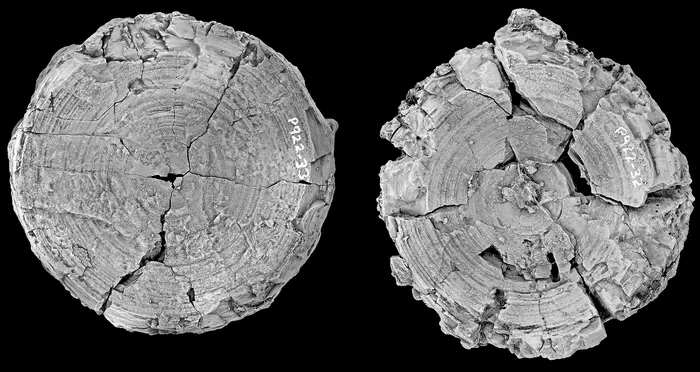
115 million year old gigantic shark vertebrae
Credit
Mikael Siversson
Mikael Siversson
Journal
Communications Biology
Method of Research
Data/statistical analysis
Subject of Research
Animals
Article Title
Early gigantic lamniform marks the onset of mega-body size in modern shark evolution

No comments:
Post a Comment