
Protecting Pedophile Predators: Jeffrey Epstein & the Elite’s Veil of Silence
Lawmakers on Capitol Hill are accusing the Justice Department of covering up the names of co-conspirators of the deceased sex offender Jeffrey Epstein as fallout from the Epstein files grows across the globe. Millions of pages remain unreleased. As many prominent U.S. figures evade accountability following mentions in the Epstein files, a number of European figures have resigned for their relationships with Epstein. “The most extraordinary and worrying thing of what is going on in the United States is the scale of normalization that is happening, in which the press is absolutely a structural part of this,” says Carole Cadwalladr, award-winning investigative journalist. “I have been shocked — deeply, deeply shocked — by the absence of headlines.”
Transcript
This is a rush transcript. Copy may not be in its final form.
AMY GOODMAN: Lawmakers on Capitol Hill are accusing the Justice Department of covering up the names of co-conspirators of the deceased sex offender Jeffrey Epstein, as fallout from the Epstein files grows across the globe. Last week, the Department of Justice just released over 3 million pages of files, but many contained major redactions. Millions of more pages remain unreleased.
On Monday, lawmakers were granted access to unredacted versions of the documents. Democratic Congressmember Jamie Raskin spoke out after seeing some of the files.
REP. JAMIE RASKIN: You know, I saw the names of lots of people who were redacted for mysterious or baffling or inscrutable reasons.
NERMEEN SHAIKH: The co-authors of the Epstein Files Transparency Act, Republican Thomas Massie and Democrat Ro Khanna, held a news conference after viewing some of the files.
REP. RO KHANNA: Our bigger concern is that there’s still a lot that’s redacted. Even in what we’re seeing, we’re seeing redacted versions. I thought we were supposed to see the unredacted versions. And that’s because the documents produced to Justice from the FBI, from other — from the grand jury, was redacted when they got it. So, we kept doing the searches for the unredacted information. It’s the identical redactions that they have. Now, I don’t think that’s nefarious on the career attorneys that were reviewing it, but they obviously haven’t gotten the production, because our law says that the FBI and the original grand jury needs to be unredacted.
REP. THOMAS MASSIE: I mean, what we’re after is the men who Jeffrey Epstein trafficked women to. We want those names published. We’re not out to embarrass people. And the problem is, we went in there hoping to see that in 302 forms. What we found out is those 302 forms were redacted before they got to the DOJ.
AMY GOODMAN: In related news, Epstein’s co-conspirator Ghislaine Maxwell, who’s serving a 20-year sentence, refused to answer lawmakers’ questions in a closed-door virtual deposition before the House Oversight Committee Monday.
JACK EMMER: Have you ever facilitated the sexual abuse of any minor or adult woman by Mr. Epstein?
GHISLAINE MAXWELL: I invoke my Fifth Amendment right to silence.
JACK EMMER: Have you ever participated in the sexual abuse of any minor or adult woman?
GHISLAINE MAXWELL: I invoke my Fifth Amendment right to silence.
NERMEEN SHAIKH: During the hearing, Maxwell’s attorney, David Markus, said Maxwell would speak fully and honestly if granted clemency by President Trump.
DAVID MARKUS: If this committee and the American public truly want to hear the unfiltered truth about what happened, there is a straightforward path. Miss Maxwell is prepared to speak fully and honestly if granted clemency by President Trump. Only she can provide a complete account, and some may not like what they want — what they hear, but the truth matters. For example, both President Trump and President Clinton are innocent of any wrongdoing. Miss Maxwell alone can explain why, and the public is entitled to hear that explanation.
AMY GOODMAN: This all comes as the release of the Epstein files threatens to bring down the British Prime Minister Keir Starmer over his decision to appoint Lord Peter Mandelson as U.S. ambassador despite Mandelson’s close ties to Epstein.
We go now to Britain, where we’re joined by Carole Cadwalladr. She is award-winning investigative journalist whose Substack is How to Survive the Broligarchy. She gained international recognition for her exposé on the Facebook-Cambridge Analytica data scandal in 2018. Her most recent piece is headlined “We all live in Jeffrey Epstein’s world.” She’s also the co-founder of an independent news outlet called The Nerve, launched with five former Guardian journalists.
Carole, welcome back to Democracy Now! I want to first get your response to Ghislaine Maxwell, the co-conspirator of Epstein, who you call in your piece a “monstrosity,” invoking the Fifth Amendment so she wouldn’t incriminate herself, but saying if Trump granted her clemency, in exchange, she would exonerate him. Can you respond to all of this latest news?
CAROLE CADWALLADR: Thanks, Amy. It’s so good to be back with you.
I mean, I guess what we see with Ghislaine, which is naked transactionalism, the offer of a quid pro quo arrangement with Trump, which is what this was, that is a pattern of behavior which we see all through the email correspondence of Ghislaine, of Jeffrey Epstein, of what’s been laid out there. So I don’t think that should come as any surprise or shock to people. You know, we know that there is a global trade in favors between a billionaire class, between people who are officials of hostile nations, between politicians, between people in Silicon Valley, in Washington, in Westminster, in Israel, across the Middle East. I mean, that’s what these documents have laid bare, is this exchange of favors. So that doesn’t come as any shock.
You know, it’s really good to hear that there are these efforts being made in Washington to unredact the documents. It’s really shocking. I mean, it’s in — one of the most sort of disgusting features, I think, of this data dump is that we can see that these young women have had their names exposed, and yet these men who are clearly involved are being shielded. Obviously, there’s a big question about why.
And I suppose my final point of what these headlines show is that it is absolutely extraordinary that we are seeing this heat and pressure on the British prime minister, who was not an accomplice of Jeffrey Epstein, who is not in the files, and yet there is this, you know, movement for his resignation. And I think if we get to a situation in which the British prime minister is forced out of office, and there is, across the Atlantic, zero pressure, zero consequences for Donald Trump, who, you know, thousands of mentions in the files and a close associate of Jeffrey Epstein for years, I find that just — I mean, it’s just sort of moral obscenity, I would say.
NERMEEN SHAIKH: Yeah, so, Carole, there was an Associated Press report over the weekend which was headlined “Epstein revelations have toppled top figures in Europe while US fallout is more muted.” They point out that “A prince, an ambassador, senior diplomats, top politicians. All brought down by the Jeffrey Epstein files. And all in Europe, rather than the United States.” I mean, if you could talk about why you think that’s the case? You’ve also expressed concerns about the fact that your sense is that this story, the Epstein story, has not been sufficiently covered in the U.S. media.
CAROLE CADWALLADR: You know, I’ve been really puzzling over this now for a week, and I’ve been talking to people and trying to sense-check what on Earth is going on. And the only conclusion I can come to is that — and this is extraordinary, because the British press, we have so many structural issues with it; however, I think what we’re seeing in this moment is that we in Europe are still living in some sort of functioning democracy. We are actually still living in societies where we have some norms. And actually what we’re — what we are understanding here is that this is a disgrace beyond disgrace, that pedophilia actually is too far, and that we are having some sort of semblance of accountability in public life.
And I think the most extraordinary and worrying thing of what is going on in the United States is the scale of normalization that is happening, in which the press is absolutely a structural part of this. I have been shocked — deeply, deeply shocked — by the absence of headlines, by the absence of sense-making across the U.S. media that contextualizes what is in these documents, that helps people to process them and to understand them. And I think, you know, there is a sort of self-surrendering, self-censorship which is going on in the United States right now. And that, I find really deeply worrying.
AMY GOODMAN: You know, I don’t think people realize, just to amplify what Nermeen just said about who has gone down around Europe, you have Mona Juul, if that’s how you pronounce her name, J-U-U-L, the Norwegian ambassador to Jordan, who just resigned after reports surfaced Epstein had left $10 million in his will to her — to her children and her husband. Brad Karp, here in the U.S., chair of the prestigious law firm Paul, Weiss, Rifkind, Wharton & Garrison, after emails revealed close personal business communications with Epstein, including helping with a job request and socializing. Peter Mandelson not only had to step down from the House of Lords, the British politician resigned from the Labour Party, following the release of the file showing he received $75,000 from Epstein. Of course, this is what could bring down the Prime Minister Keir Starmer, because of his close relationship to Mandelson. The former Slovak foreign minister and national security adviser to the Slovakian prime minister just signed after emails showed him discussing meeting with young women with Epstein in 2018. Joanna Rubinstein, president of Swedish UNHCR, just resigned after it was revealed she visited Epstein’s private island. David Ross, former department chair at School of Visual Arts in New York, just resigned after emails revealed a longtime, supportive friendship with him. Larry Summers, of course, forced out of Harvard, the former U.S. Treasury secretary, announced he’s stepping back from his public commitments, including leaving the OpenAI board. And Morgan McSweeney, chief of staff to the U.K. Prime Minister Keir Starmer, and Tim Allan, director of communications for the British Prime Minister Keir Starmer, just to name a few. And as you said, Carole, in the United States, we don’t see anything like this, except for the promise of exoneration if Trump grants clemency to Ghislaine Maxwell, who refused to testify.
So, if you could also talk about the whole issue you have raised of the connection between child pornography, the whole issue of, you know, what’s going on on the internet — you’re so famous for exposing Cambridge Analytica — and the pedophilia network, the sex trafficking network that Epstein was at the core of, that has enmeshed so many, though brought almost no one down in the United States?
CAROLE CADWALLADR: Yeah, so, there’s so much going on. There is so much going on in this story. And this is why, you know, I wrote this piece, because I had such problems trying to process what this story is about, because I come at this with really specific journalistic interests and specialisms. You know, I’ve spent a decade now looking at Silicon Valley companies, looking at the men who lead them, looking around their relationship with power, looking at how they have been utterly — they’ve had total impunity in terms of regulation and accountability. I’ve also looked really closely at Russia’s influence across the West, its deliberate strategies to interfere in our politics and elections. I also — Israeli defense and intelligence firms have also been part of this beat, as has Steve Bannon and the far right across Europe. But this has all been part of the stories that I’ve been reporting on for the last decade.
And what the files show, in absolute clarity, in black and white, is that those worlds are all connected. And the thing which blew my mind is that they’re connected through Jeffrey Epstein. He is a through line. It’s not to say there aren’t others. But this is what was the sort of stunning thing for me. And in some ways, you can look at him, and he’s almost like a one-man sort of intelligence service, I would say. So, that is all revealed, and it’s revealed there in detail and complexity. And as a journalist, I just wanted to get to laying down that evidence. It was like there was sort of scoop after scoop in the emails which are in those files.
But at the same time, I think I found I had, like I think a lot of people, particularly a lot of women, a sort of emotional reaction, I think, to what is also in these files, because what it reveals is that there is a billionaire class across the world who are in close communication, who have connections to this criminal network, who also have connections through to these hostile state governments. And there is literally this sort of playground, almost, in which there is this hidden communication, which has now been made visible.
And I think the sense of impunity, that’s sort of the thing for me which really came out of it, and that mirrors what we are seeing in the world right now in these rising authoritarian times, in which strong men rule, and there is this collapse of the rules-based order. And that is what I think that this sort of Jeffrey Epstein almost personifies. We see that through him, and that there is going to be no accountability even for exposed pedophiles and his network. And I think that is a line in the sand.
And what we are seeing is that these women are not getting justice. They’re getting the opposite of justice. Their predators, the offenders, the men who are complicit in this, are being aided and abetted in keeping their identities revealed. And I think that sense that they’re not going to get justice, as the victims of Israel are not going to get justice, as the victims of Russian aggression are not getting justice, and I think that realization that this is the world that we are living in now, that was one of the sort of profound things which affected me from my week of dealing with this material.
And I think the other thing which it really made me think about is, actually, how so much of our society, there is a pediaphiliac — sorry, there is a pediaphiliac — I’m so sorry, I can’t pronounce it. There is this pedophiliac element which crosses hidden, it’s submerged, but it is part of our society. And that is some of these people who are in the files, these Silicon Valley tech bros. It’s their companies which are facilitating that in so many ways. A quarter of the traffic across the internet, you know, a quarter of all searches are for porn. The most popular, numerous search terms are for teens, for barely legal content. We don’t see that. It’s not on the open web that we see. But it is, of course, absolutely there. And I think we have this understandable reluctance and resistance to recognize this current in our culture. And for me, Epstein should be the reckoning, where we are looking at this, where we are forced to look at this. And instead, we see this veil of silence. And yeah, I think that’s really profoundly disturbing. And I think that the U.S. press is not stepping up to the moment. It’s not serving its readers and its viewers. And I think that has huge consequences.
NERMEEN SHAIKH: I mean, Carole, that’s an extraordinary and perhaps not very well-known statistic that you just cited, namely that, as you write in your piece, most tech platforms derive a huge percentage of their profits from sexual interest in children. Porn represents 25% of all internet searches, and, according to Pornhub, “teen” is the most searched-for term. So, if you can talk about that? How is it that tech platforms make a profit from the searches of sexual interest in children, and whether you think this Epstein scandal will do anything to change the public discourse about the sexual abuse of teens, including what regulations may be put in place on these tech platforms that enable this?
CAROLE CADWALLADR: I mean, I think sexual interest in teens and access to that material has grown exponentially because of the internet. There is — you know, we know that. The amount of sexual content increases every single day. But it’s more than that, because what we know is that recommender algorithms and systems connect people to this, to this material. So, what might have been a fleeting interest becomes up, you know, next up in people’s feeds. We know that AI’s large language models are being fed on this content across the internet. That is being baked into the future. We know, because it has been reported from internal documents in Instagram, from Instagram, that its recommender system actually connects pedophiles to teenagers.
So, there is a — but, as I say, we sort of draw this veil of respectability over it. We sort of — we don’t like to think about it. It’s not there in the Google searches, that is kind of — you know, it’s not coming up necessarily. I mean, what I found, one of the most helpful things about Twitter under Elon Musk is that he has made this stuff visible. There is sort of disgusting content out there. And that’s why people, you know, left that platform. But that’s — again, it’s not an engagement.
And to go to the, like, “Is there going to be a reckoning?” there is not going to be a reckoning in a culture and a society, which is now America, in which there is a cowardice — I think you have to say that — about the way that this is — this story is being treated in America. There is just not this seriousness being brought to it. And that, I think, is both in the geopolitical consequences of what these documents show. We can see these very, very clear connections between, for example, Russian state officials and Silicon Valley. Like, that is there now, and Epstein is a conduit in that. So, we’re not seeing the geopolitical consequences.
But also, you know, I’ve just been — you know, I’ve been really thinking about it. There has been some excellent journalism, as ever, by journalists and journalistic teams, and I’m sure that they will be doing more. There will be deep dives. And I’m really glad and pleased for that. But I look at the front page of The New York Times today, I look at the front page of The Washington Post today, and there is nothing that spells this story out and its importance. And I feel that is a sort of — there’s this — it’s a lack of an understanding, it feels to me, of what journalism and news media should be about in an element of moral leadership in very, very troubled times.
And, you know, in the middle of this story last week, we saw this absolutely devastating and disgusting, frankly, sacking of 300 journalists at The Washington Post. And as much as that — you know, it’s another devastating blow against the press in the U.S. And for that to happen, I felt, in the middle of this particular news cycle is — you know, it’s devastating in itself; it’s also a symbol of what is happening.
And, you know, I say this as a foreigner sitting in London, and I know it’s very different for people, for U.S. citizens inside the country, but what is happening to your country is so alarming, but yet it is being normalized by its treatment in the — across the media. And I think that, you know, it’s why independent outlets like yourself and, you know, as we can see across the ecosystem, these new insurgent outlets, of which the thing that I’ve set up in the U.K., The Nerve, is part of, are increasingly important, because we’re not massive corporate entities with massive corporate interests who can, I think, be sat on or intimidated by power in the same way. And so, yeah, I find it extraordinary that the press is so cowed in this moment.
NERMEEN SHAIKH: Thank you so much, Carole, Carole Cadwalladr, award-winning investigative journalist whose Substack is How to Survive the Broligarchy. She gained international recognition for her exposé on the Facebook-Cambridge Analytica data scandal in 2018. Her most recent piece is headlined “We all live in Jeffrey Epstein’s world.” She’s also the co-founder of an independent news outlet called The Nerve, launched with five other former Guardian journalists.
Coming up, we’ll speak to Democratic Congressmember Joaquin Castro and a ProPublica reporter who managed to get inside a detention center in Dilley, Texas, to talk with children being held there. We’ll be back in a minute. Stay with us.
[break]
AMY GOODMAN: “Body Electric” by Alynda Segarra of Hurray for the Riff Raff, performing in our Democracy Now! studio. On Monday, February 23rd, Hurray for the Riff Raff will be performing as part of Democracy Now!’s 30th anniversary celebration at the historic Riverside Church in New York. Other guests will include Angela Davis, Naomi Klein, the Nobel Prize-winning journalist Maria Ressa, Michael Stipe, the jazz legend Wynton Marsalis and more. See democracynow.org for information and tickets. The tickets are going fast.
French Foreign Minister Jean-Noël Barrot has demanded an investigation into diplomat Fabrice Aidan following the revelation that the foreign affairs secretary shared a long email correspondence with late sex offender and financier Jeffrey Epstein. French media reported that Aidan had resigned from his position at the United Nations in 2013 after having been caught visiting child sex abuse material websites.
Issued on: 11/02/2026
By: FRANCE 24
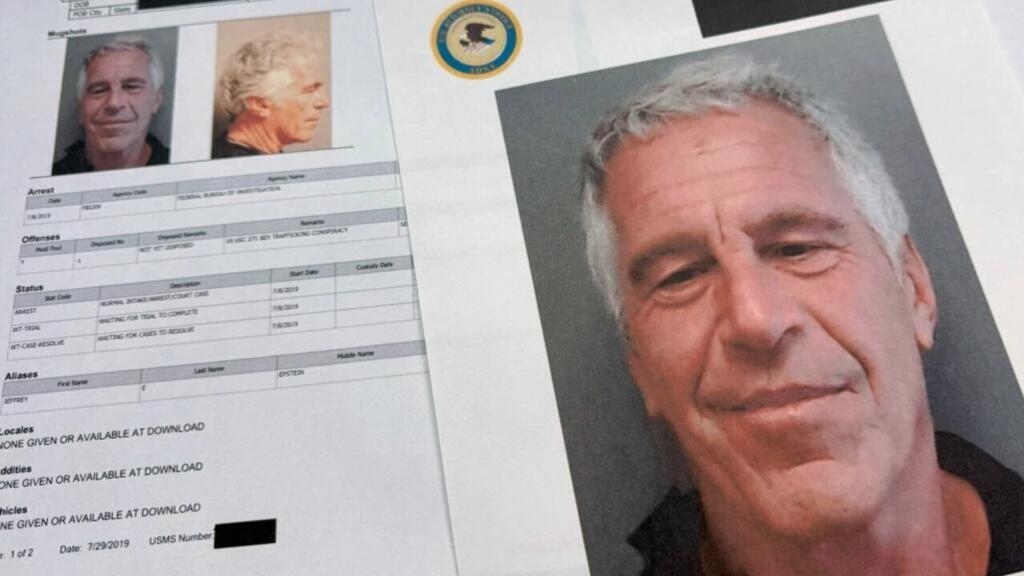
France's Foreign Minister Jean-Noël Barrot has requested a probe after the name of a French diplomat on leave appeared in numerous emails to convicted sex offender Jeffrey Epstein.
"I was appalled," Barrot said on Wednesday.
In an X post late on Tuesday, he said he was referring allegations against Fabrice Aidan to the public prosecutor, and launching an internal inquiry.
The ministry described Aidan as a "principal foreign affairs secretary on leave for personal reasons and holding positions in the private sector".
But French media, after unearthing his name in the files, reported he had shared email correspondence with Epstein from 2010 to 2017.
Investigative website Mediapart late Tuesday reported that the FBI had flagged Aidan as having consulted child sexual abuse websites while he was working at the New York-based United Nations from 2006 and 2013, leading to an internal probe and his resignation.
Aidan was during that time adviser to Norway's Terje Rod-Larsen, an adviser to the UN secretary general. Norwegian police said on Monday they were investigating Rod-Larsen over his ties to Epstein.
Mediapart also reported that Aidan sent UN documents and reports to Epstein.
Epstein files special: Revelations, Redactions & Ramifications
47:54
Aidan could not be immediately contacted for comment. He appeared to have deleted his Linkedin professional networking profile as of Wednesday morning.
After the UN headquarters in New York, Aidan then went on to work for the UN cultural agency UNESCO.
Energy group Engie, for whom he had been working more recently, told AFP it had let him go.
"In light of the information brought to our attention and reported in certain media, which would concern a period prior to his joining the group, Engie has decided to relieve Fabrice Aidan from his duties," it said.
The fallout of the latest Epstein files released by the US Department of Justice has led to former minister Jack Lang resigning from his position as the head of a top cultural body called the Arab World Institute.
He has however denied any wrongdoing, saying he was "shocked" that his name appeared in the statutes of an offshore company that Epstein founded in 2016.
His daughter Caroline, who allegedly owned half the shares in the company, has resigned from two positions.
(FRANCE 24 with AFP)
US Commerce Secretary admits Epstein island lunch as pressure mounts to resign
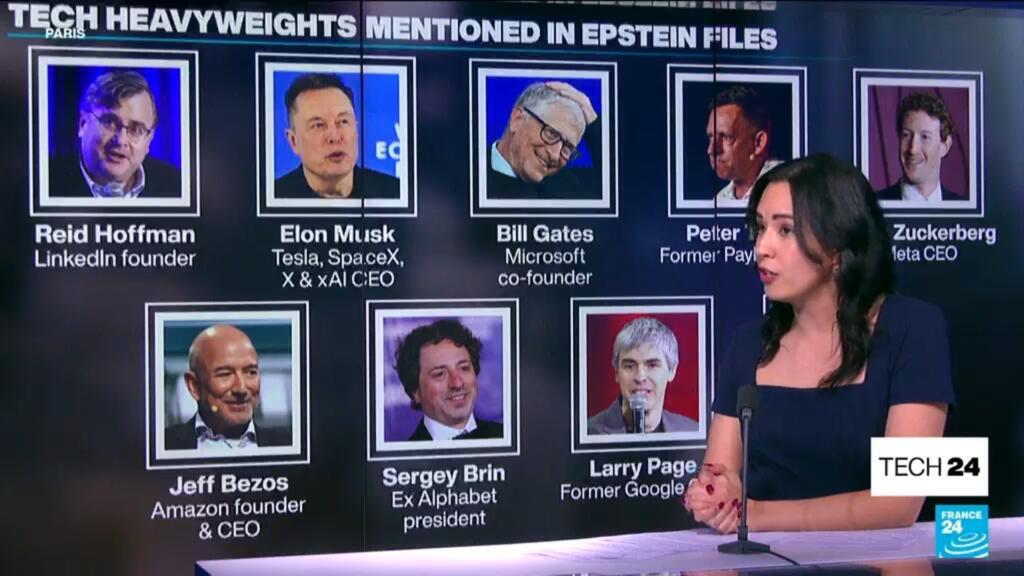
US Commerce Secretary Howard Lutnick on Tuesday acknowledged having lunch on Jeffrey Epstein’s private island in 2012, as newly released records intensified scrutiny of his past ties to the convicted sex offender and fuelled calls for his resignation.
Issued on: 11/02/2026 -
By: FRANCE 24
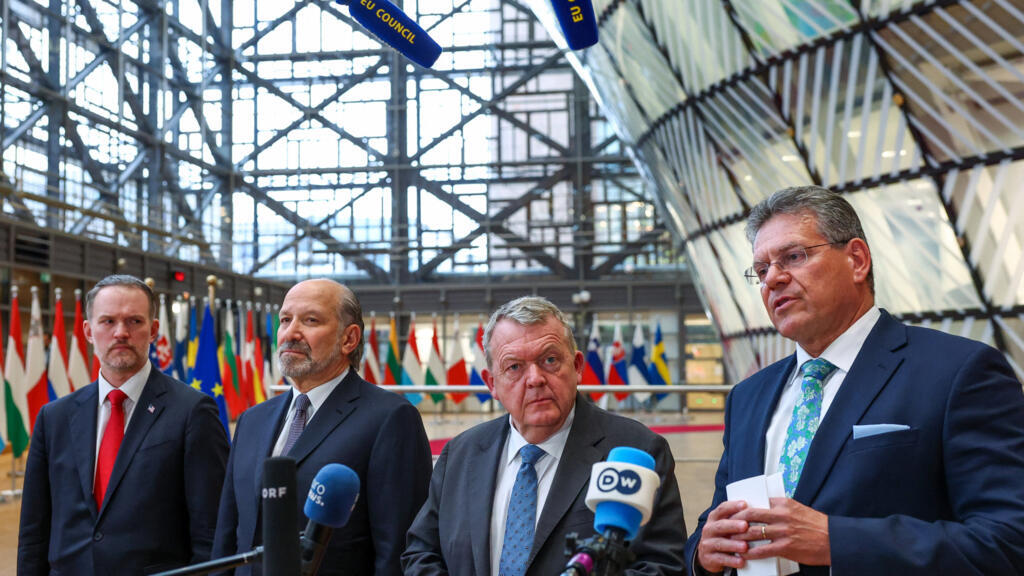
Facing growing calls for his resignation, US Commerce Secretary Howard Lutnick admitted Tuesday to having lunch on Jeffrey Epstein’s private island in 2012, but strenuously denied any closer relationship with the convicted sex offender.
Lutnick’s ties to Epstein have come under intense scrutiny after email exchanges included in newly released files undermined his earlier insistence that he had cut all links with the late financier back in 2005.
So far, President Donald Trump’s administration has stood by Lutnick, with White House Press Secretary Karoline Leavitt saying the president “fully supports” him.
She added that he “remains a very important member” of Trump’s team.
Epstein, a convicted sex offender who had ties to top business executives, politicians, celebrities and academics, was found dead in his New York jail cell in 2019 while awaiting trial for sex trafficking minor girls.
In a podcast last year, Lutnick recounted moving in next door to Epstein in 2005 and receiving a house tour that left him disturbed. He and his wife decided that he would “never be in the room with that disgusting person, ever again”.
01:52
“So I was never in the room with him socially, for business or even philanthropy,” he said.
But records have emerged showing Lutnick’s plans in 2012 to meet Epstein for lunch in Little Saint James, notoriously known as “Epstein Island”.
“We had lunch on the island, that is true, for an hour,” Lutnick told a Senate committee hearing.
But he stressed that he was with his wife, children and nannies.
“We were on family vacation,” he said.
Asked if he saw anything untoward, Lutnick maintained that besides his family and that of another couple who were present, he only saw staff who worked for Epstein on the island.
High-profile people have come under scrutiny for visits to Little Saint James, the private redoubt in the US Virgin Islands where prosecutors alleged Epstein trafficked underage girls for sex.
No ‘relationship’
Lutnick stressed to the Senate Appropriations Committee on Tuesday: “Over a 14-year period, I did not have any relationship with him. I barely had anything to do with that person.”
The billionaire was referring to the period starting in 2005 when he moved to a New York home where Epstein was his neighbour. He said that he met Epstein when they were both in New York.
He has come under fire from US lawmakers, however.
Democratic Senator Adam Schiff said Monday that “Lutnick has no business being our Commerce Secretary, and he should resign immediately”.
He added that Lutnick’s earlier denial of dealings with Epstein raises “serious concerns about his judgement and ethics”.
On Sunday, Republican lawmaker Thomas Massie also told CNN the commerce secretary “should just resign”, citing similar resignations in Great Britain.
And Robert Garcia, the top Democrat on the House oversight committee, charged in a social media post that Lutnick “has been lying about his relationship with Epstein”.
05:27
“He said he had no interactions with Epstein after 2005, yet we now know they were in business together,” Garcia said.
Released documents indicated the men had become investors in a firm some time after the island visit, although it is unclear if they personally engaged over the deal. They also appear to have communicated through assistants on other occasions.
Lutnick denied Tuesday that he had dinner in Epstein’s New York City home in 2011, although he acknowledged that the documents indicated a planned meeting with Epstein in May that year.
The commerce chief was also questioned about documents that suggested Epstein had an interest in meeting his nanny, but said this “had nothing to do with me”.
“I have nothing to hide, absolutely nothing,” Lutnick said.
Lutnick – a close ally of Trump’s – served as chief executive of financial services firm Cantor Fitzgerald before becoming US commerce secretary last year.
(FRANCE 24 with AFP)
Victims of convicted sex trafficker Jeffrey Epstein and Congressional Democrats introduced a new bill on Tuesday which would eliminate the statute of limitations for adult victims and would broaden victims' legal recourse.
Issued on: 10/02/2026
By: FRANCE 24
Video by:Monte FRANCIS
01:50
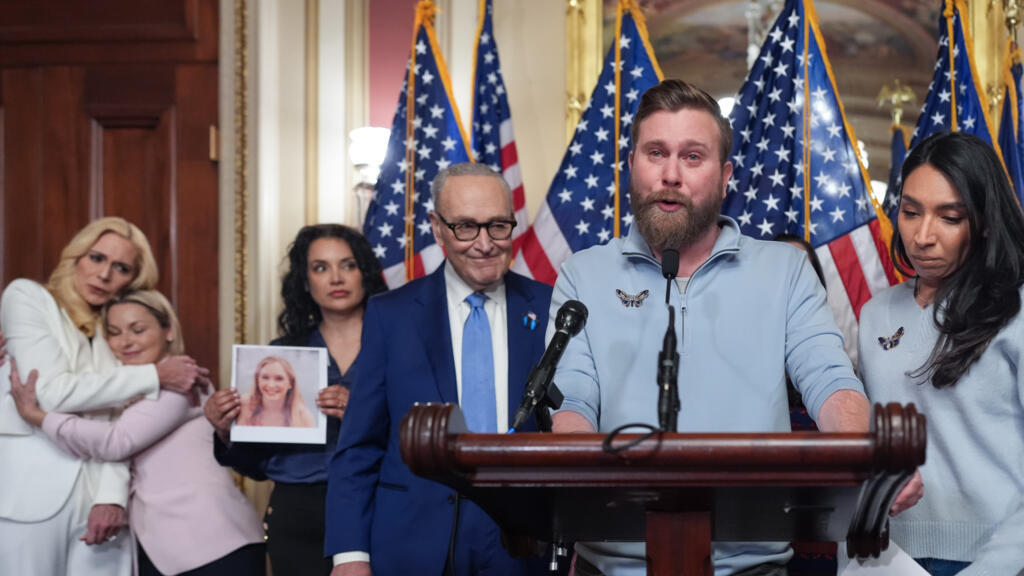
Congressional Democrats introduced legislation on Tuesday that they said would eliminate the statute of limitations that has shielded sex traffickers such as the late financier Jeffrey Epstein.
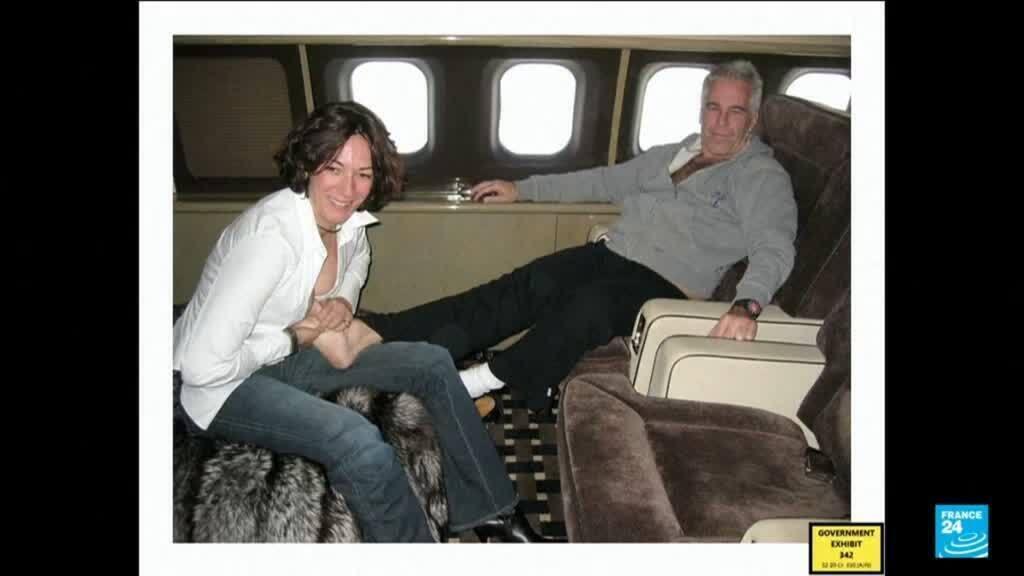
Senate Democratic Leader Chuck Schumer and Representative Teresa Leger Fernandez announced the proposal alongside Epstein victims and Virginia Giuffre's family. The proposal – Virginia's Law – is named after Giuffre, one of Epstein's most prominent accusers, who died by suicide last year.
The bill's fate in the Senate and House of Representatives, which are both controlled by Republicans, is unclear.
However, a bipartisan effort was successful last year to compel the Department of Justice to release all unclassified files in its Epstein investigation.
Epstein files: US Justice Dept has been 'destroyed from within', former prosecutor says
11:15
"Virginia's dream was to inspire and empower survivors to come forward in a world that too often turns away from abuse and pushes it into the shadows. She wanted to bring light," said Sky Roberts, Giuffre's brother.
A teary-eyed Roberts, speaking at a press conference in the US Capitol, was asked about a photograph that has been made public showing former UK prince Andrew Mountbatten-Windsor with his arm around Giuffre.
WATCH MORE‘Entitled’: UK monarchy and national security at risk over Andrew’s Epstein links
"I think he should show up in front of our Congress," Roberts responded, adding, "He has a lot of questions he needs to answer."
The Democrats' new bill would end the statute of limitations for adult victims or their survivors bringing civil suits, which would include many of Epstein's alleged victims. It broadens victims' legal recourse in additional ways, including covering applicable sex crimes occurring beyond US soil if a US court has jurisdiction.
Though Epstein died in 2019, transparency and accountability for victims of his abuse have led to oversight investigations and passage of the Epstein files law.
DOJ said it has released nearly 3.5 million pages of documents, though some files are heavily redacted. Members of Congress began reviewing unredacted files on Monday. Schumer has been calling for all the unreleased files, which he said number in the millions, to also be made public.
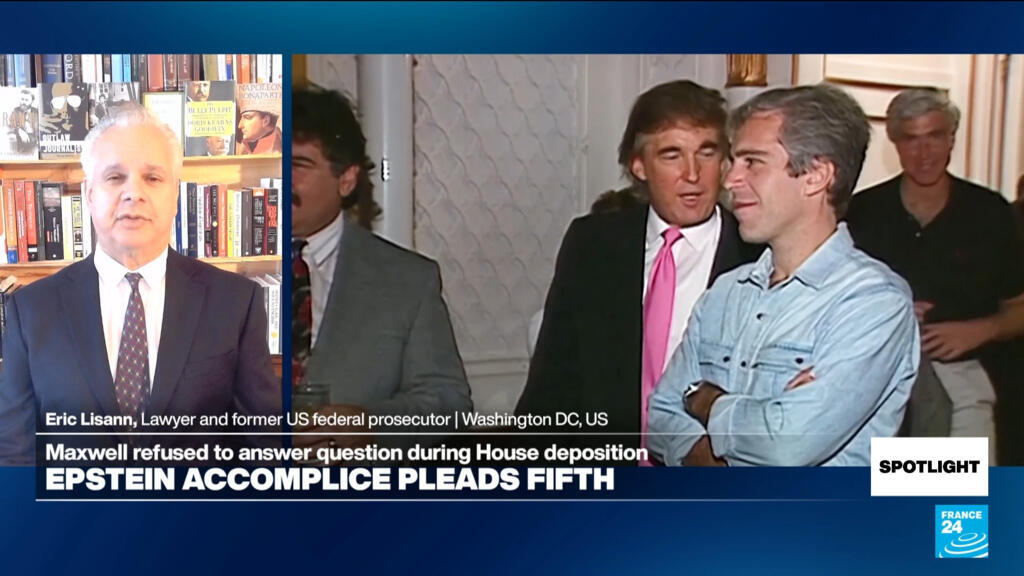
The House Oversight Committee interviewed Epstein associate Ghislaine Maxwell virtually on Monday in a private deposition.
Ghislaine Maxwell refuses to answer questions from congressional Epstein committee

02:02
Maxwell, who was found guilty in 2021 for her role in helping Epstein sexually abuse teenage girls, refused to answer questions. She is serving a 20-year prison sentence.
Former President Bill Clinton and former Secretary of State Hillary Clinton are set to testify separately behind closed doors in the committee's Epstein investigation later this month.
(FRANCE 24 with Reuters)
The Epstein/MAGA World as the Will to Power
The Spirit of Cruelty and the Soul of the World
Dream of the sadist, Otto Dix

The Epstein abominations, to state the obvious, are revealing, in lurid detail, hidden in plain sight, unnerving aspects of human nature; withal, what transpires during human sexuality is an analog, sublime and grotesque, redemptive and soul-decimating, of all things human. Epstein and his billionaire boys club exploitation of their victims are a microcosmic reflection of the capitalist macrocosm. According to the creed of the global economic elite, all things on planet earth and beyond into the cosmos (Elon’s maniacal fantasies involving his clown car rocketry) are fodder for exploitation.
Due to the fact that the economic elite believe they possess the entitlement to throw the planet’s human life sustaining climate into exponential runaway because they cannot run their life-defying existence without fossil fuel – how is it conceivable that they would regard teenage girls and women from lesser socio-economic backgrounds as anything less than fodder for exploitation? We, of the lower economic orders, are regarded as commodified, disposable consorts on everyday, capitalist Epstein’s Islands, albeit with a scenery comprised of stripmalls in decline and health-decimating, fast food outlets.
In short, we are not talking so much about sexuality but the violation of human beings, body and soul. Born into economic privilege, globe-trotting Ghislaine Maxwell scoured trailer parks in search of economically desperate teenage girls to service Jeffery Epstein’s hebephilic mania. Isn’t it obvious, from their insular perches of luxury, they view the entire planet as a trailer park?
Donald Trump, to protect his adult diaper-draped hind, has transferred Maxwell to a Club Fed facility where the warden complains he is pressured to act as her luxury hotel concierge.
The only way out of this dehumanizing setup is to break the cycle of exploitation — that is, molecule structure to insular, gated mansion, the capitalist order itself.
First, there is not an inherent right to be a billionaire. Look at the depravity engendered within the psyches of individuals whose vast wealth, in essence, allows them to defy the tenets of basic human decency.
They have lost their souls because they believe they own us and they have purchased us on the cheap; to retain our souls we must resist them. First step in recovery: Believe this: They do not possess any entitlement to own you – or our planet for that matter. My soul does not come with a sales tag, and, I suspect, neither does yours.
It appears Noam Chomsky contains a sales tag while Norman Finkelstein told Epstein to go piss up a golden rope line.
Be like Norm.
So many people are depressed…the realities of life as life plays out under the heel of a capitalist dictatorship of money/military empire presses down on the psyche — one’s sense of hopelessness turns earthly sadness into a paralyzing depression or into a compensatory mania to succeed (to what end?) and/or to consume (there can never be enough; hence, the consumer becomes consumed).
There are going to be portions of necessary and sublime sadness in life. Learning — thus enlarging one’s horizons — delivers feelings of expansion and grief. I know the world; therefore, as the poet posits, I am sad. To love is to experience heartache, and, in the end, endure loss. And what of the pursuit of happiness? What kind of damn fools instruct, to be gratified in life one is advised to fall in with a parade of phantoms, to walk in lockstep through a mirage-haunted landscape? Happiness arrives and departs; one might as well attempt to pursue a ghost into the afterlife.
Hence, we are confronted with an epidemic of the mental affliction known as normality. There exists a demon of the mind that induces one to conform to a degraded social reality, to silence the voice within that asks, “Are you fucking joking? You are attempting to convince me that normal entails submission to a system that is, in essence, a hierarchy of soul-sucking ghouls whose agenda is to exploit my fleeting hours as I dwell in this world of perishable forms?”
To believe that, I would have to be bughouse crazy.
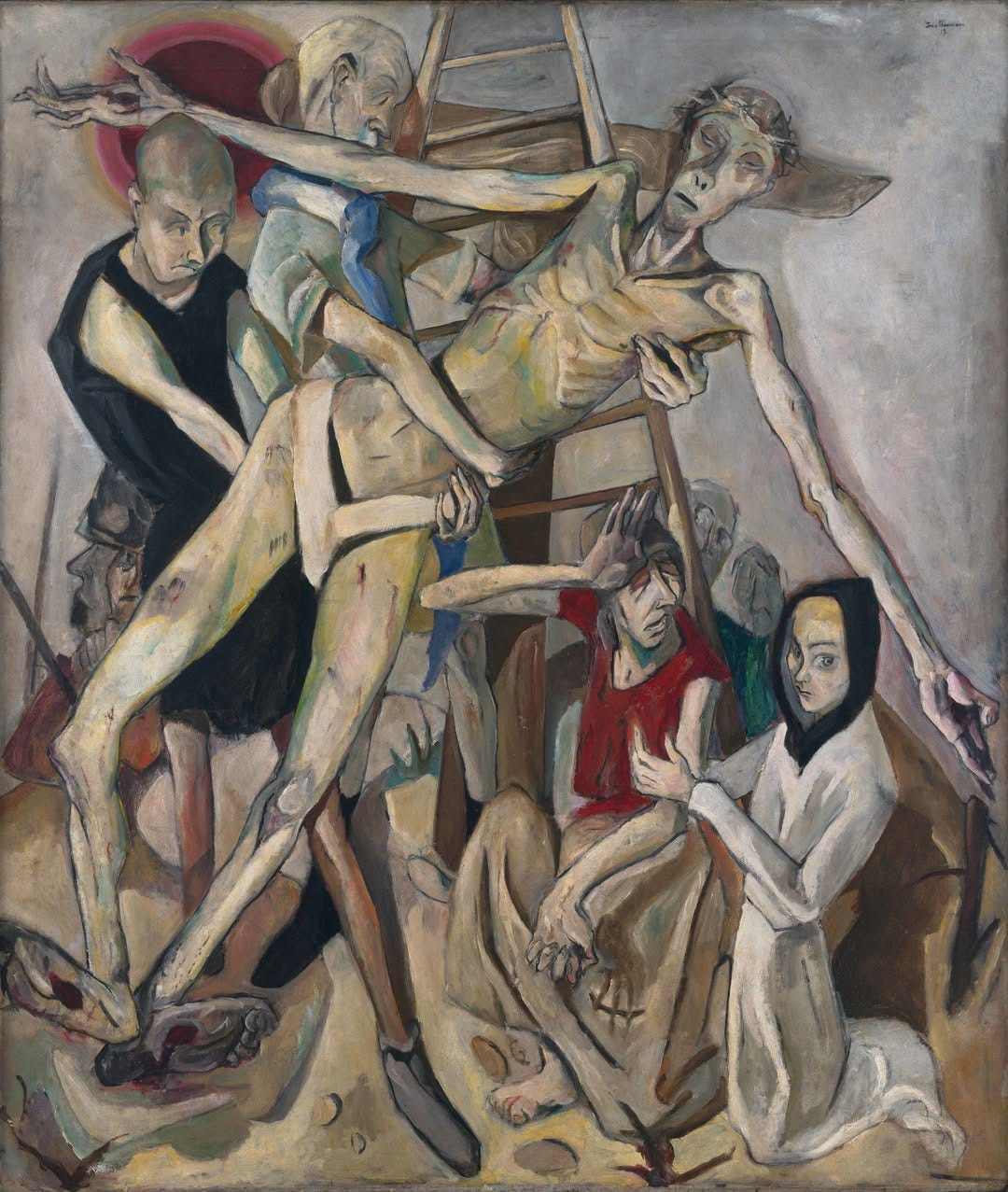 Max Beckmann, Descent from the Cross, 1917
Headline: Trump Says He Ordered 700 Agents to Leave Minnesota
Collectively, the people of Minnesota, or at least a viable portion of them, refuse to accept the inertia concomitant to feelings of aloneness and being powerless before mindless, brutal power and through actions, individual merged into collective action, have escorted ICE thugs to the exits of their state. In essence, our aloneness – our rage into the silence and at those who are mindlessly complicit — can resound and shake the very air — when a million voices become as one.
For way too long, we have been hypnotized into paralysis. We have internalized the lie-of-convenience that freedom is the dominion of the elite, that our inner lives were devoid of value, and our sense of worth was derived by how we could serve the masters of the capitalist/militarist order. All too many, pummeled by the noxious grift that the gods of the present moment — the gods that the economic and political elite bow down to on an exclusive basis — the God of Money and the God of Death — have surrendered to the present order’s daily rituals of exploitation and their cult of violent death.
What the fallen and forsaken neglect to notice: They only take your essential being if you grant them permission to do so. Vampires cannot enter your place of dwelling without your consent. They cannot rob you of your freedom to think creatively. To seek out affinities with other like minded souls who refuse to be consumed in the meaningless flames of a consumer-based inferno of empty desire, be self-incarnated in a prison of mundane thought, be dispatched to and rendered a corpse inside the charnel house appropriated for the casualties of perpetual war for perpetual profiteering.
ICE thuggery embodies the soul-defying, dream-shattering dominion of the capitalist/militarist deathscape. The very moment an individual accepts the sight of a so-called “illegal” person, brutalized, facedown, and cuffed on city streets and sidewalks — that is the moment that individual has forsaken his own life. He has internalized and made a tacit agreement that the state is at liberty to grind his being to shitdust under the boot of capricious authority. Here, we regard a person whose mind has been churned into fascist spittle. An individual who has become convinced that freedom is being granted the freedom to forsake freedom. The moment one gives the state/the corporate structure/a military order the power to strip the least among us of their rights and dignity — then and there one has signed away those life-vivifying qualities of their own.
This is the principle that is at stake in Minnesota, and wherever, at the moment, ICE is trampling the soul of humanity, one power-devoid individual at a time, and wherever the MAGA thugocracy will deem to deploy their Brownshirt bully boys next.
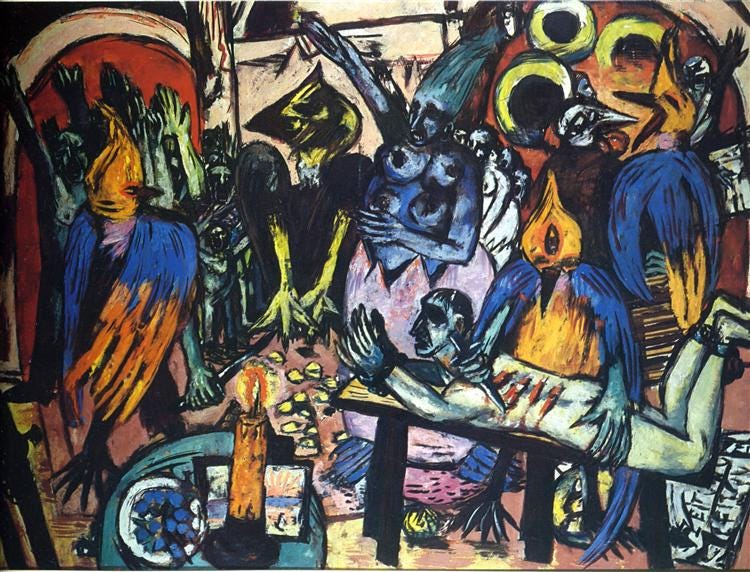 Birds’ Hell, 1937–1938, Max Beckmann
Men are conservatives when they are least vigorous, or when they are most luxurious. They are conservatives after dinner, or before taking their rest; when they are sick or aged. In the morning, or when their intellect or their conscience has been aroused, when they hear music, or when they read poetry, they are radicals.
— Ralph Waldo Emerson, “New England Reformers,” Essays: Second Series, 1844.
Therefore, we are given to ask what it is that conservatives are trying to conserve? The Trump Reich thugocracy, in regard to the type of people they are stopping in public places, arresting and detaining, makes it clear: The White supremacist order, and, on the international front, they are attempting to preserve the fantasy that US military imperium remains a viable enterprise.
Every empire, however, tells itself and the world that it is unlike all other empires, that its mission is not to plunder and control but to educate and liberate.
— Edward Said, Culture and Imperialism, 1983.
Yet the Trump Reich is not even attempting to fake it. They do not make the gesture to evince being educated and to fake that their agendas include the liberation of the oppressed of the earth. A cupidity to plunder is the feature of their rule.
They do not care whether their lies are transparent; the point is, the intoxication concomitant to the lie. In the social dynamic of the inner circle of MAGA, their sycophants and operatives — social status is gained by the audacity of the grift, the wealth gained by mendacity and plunder.
Their creed is: the false self is the best self possible. Mimicry of conviction – not heartfelt, mind-affirmed conviction – is appropriated for mercenary purposes, and for mercenary purposes alone. Sincerity is for suckers.
It is a mistake to appeal to the MAGA authoritarian’s humanity…their ballast of the soul was discarded as encumbering weight long ago. Yet, the mind of the Universe, has a relentless mercy, thus flights borne of the fuel of ego-intoxication will be lifted skyward on shoddy wings. Yet gravity is a loving force. The Spirit Of Cruelty can only outpace the Soul Of The World in short bursts of self-reinforcing mania. MAGA fascists will meet the kiss and embrace of the inexorable ground.
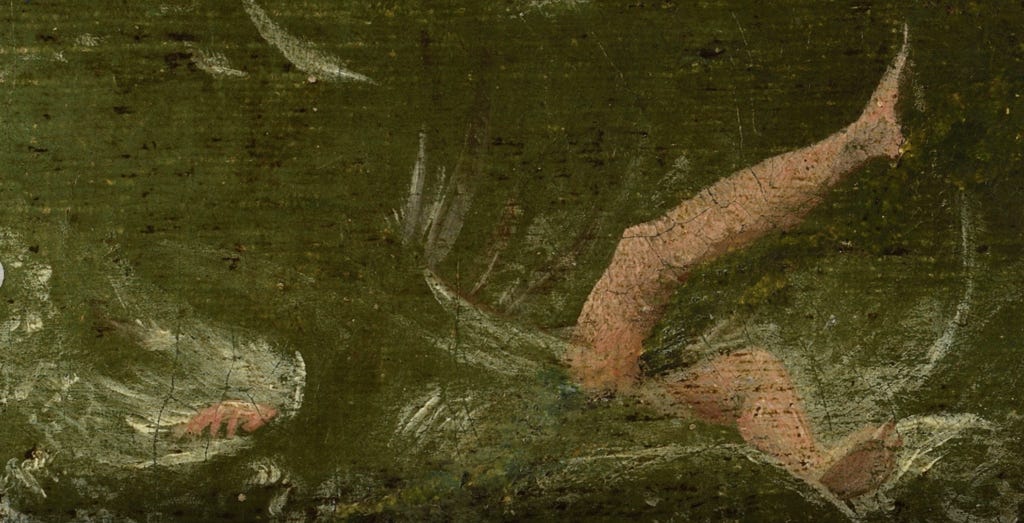
Landscape with the Fall of Icarus, Pieter Bruegel the Elder, detail
