ISLAMIST WAR ON KURDISTAN
Turkey has backed a Syrian army offensive against the Kurdish-led Syrian Democratic Forces (SDF) in Aleppo, Syria’s second-largest city, despite a fragile ceasefire backed by the United States.
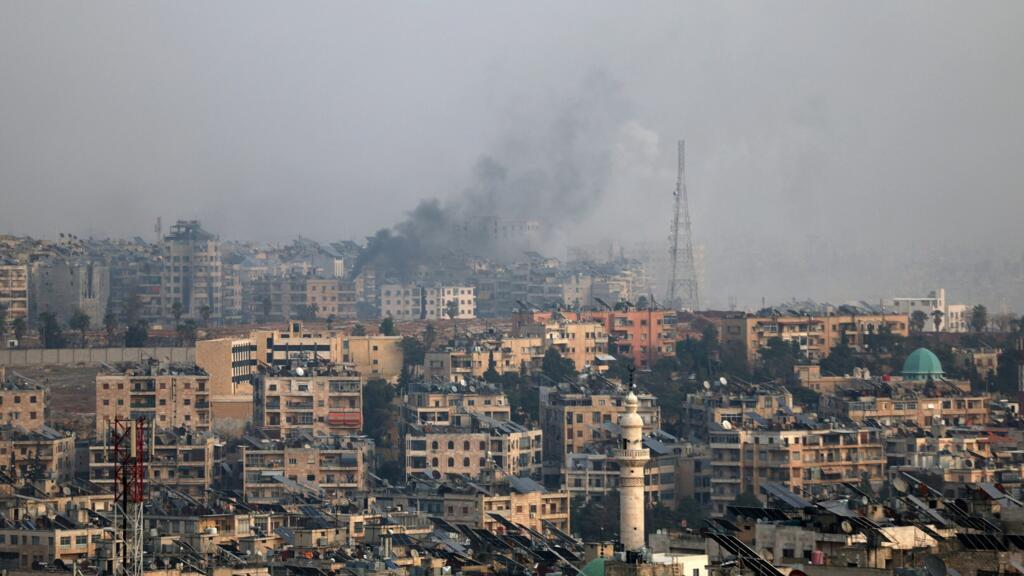
Columns of smoke rise over the Sheikh Maqsoud and Ashrafieh neighbourhoods of Aleppo on 8 January 2026 during clashes between Syrian government forces and the Kurdish-led Syrian Democratic Forces. Syria’s military had earlier warned civilians in the besieged areas to leave as it prepared new strikes, with thousands fleeing the fighting.
AFP - OMAR HAJ KADOUR
PODCAST

INTERNATIONAL REPORT
Issued on: 10/01/2026 -
Play - 06:06
Aleppo has seen its worst fighting in years, as the Syrian army moved to oust the SDF from two large, mainly Kurdish neighbourhoods in the north of the city. The clashes began in late December and continued into January, forcing many civilians to flee.
The SDF controls a large swathe of northern and eastern Syria. The offensive comes as efforts to integrate the SDF into the Syrian army stalled.
“This is a warning. It is a kind of pressure on the SDF to come to a conclusion quickly, rather than to kick the can down the road with Damascus,” Aydin Selcen, a former senior Turkish diplomat who served in the region, told RFI.
Turkey’s backing
Ankara, which has recently reopened channels with Damascus after years of strained relations, strongly backs the offensive and has signalled its readiness to provide military support against the SDF.
“Turkey has the military advantage there, and I believe the SDF should take these warnings seriously,” Selcen said. He is now an analyst for the Turkish news portal Medyascope.
Turkey accuses the SDF of links to the Kurdistan Workers’ Party, the PKK, which has fought an insurgency against the Turkish state for decades.
The PKK is designated a terrorist organisation by the United States and the European Union. Turkey is also pursuing a renewed peace initiative with the PKK and sees the integration of the SDF into the Syrian army as key to stabilising northern Syria.
Stalled integration
In March last year, the SDF signed an agreement in Damascus to integrate with the Syrian army. The deal set out broad principles but left key questions unresolved.
“There was a discrepancy from the beginning in what the parties understood integration to mean,” said Sezin Oney, of the Turkish Politikyol news portal.
“In Turkey’s case, they mean integration in such a way that it melts into the Syrian army. But the SDF understands it as integrating while protecting its inner core and identity. Remaining as the SDF, but operating under the umbrella of the Syrian army.
“Unless one of the parties backs down and makes concessions, we are likely to see a bigger military operation.”
International stakes
On Thursday, Syrian President Ahmed al-Sharaa held telephone talks with his French and Turkish counterparts on the security situation. The discussions focused on containing the fighting and preserving the ceasefire.
Despite its precarious position, the SDF retains influential supporters. Israel, an increasingly vocal critic of Turkey’s regional role, has expressed support for the group. Foreign Minister Gideon Sa’ar condemned Damascus’s operations in Aleppo.
The SDF remains a key partner of the United States Central Command in operations against the Islamic State group in Syria.
“The SDF lost a lot of troops, at least 10,000 fighters, in the fight against ISIS since 2014,” said Turkish international relations expert Soli Ozel.
“It’s a complicated picture. But from the American side, I do not yet see signs they would allow an attack on the SDF at this moment.”
According to Tom Barrack, the US ambassador to Turkey and Washington’s envoy on Syria, diplomatic efforts are under way to extend the Aleppo ceasefire and allow SDF fighters to withdraw from contested areas.
Pressure on Washington
The duration of US support for the SDF remains uncertain, especially after last year’s agreement between Washington and Damascus to step up cooperation against the Islamic State group.
The issue has taken on added significance following President Donald Trump’s meeting with Syrian President al-Sharaa in Washington.
Given President Recep Tayyip Erdogan’s strong relationship with Trump, time may not be on the SDF’s side, Oney said.
“They want to have the northern part of Syria, at least, but also Syria more broadly, as their backyard,” she added. “Turkey is the most influential country in Damascus. They want the SDF to melt away into the new Syrian state and its army.”
Turkey could face domestic political fallout for targeting the SDF. Protests have erupted in the country’s predominantly Kurdish southeast, which borders Syria, in response to the clashes in Aleppo.
Any further military action against the SDF could jeopardise the fragile peace process with the PKK.
By:Dorian Jones

Syrian army says swept Aleppo district after clashes with Kurdish fighters
Aleppo (Syria) (AFP) – Syria's army said it had completed a "security sweep" on Saturday of a neighbourhood in Aleppo where it clashed with Kurdish forces, though shelling could still be heard following calls for fighters to surrender themselves and their weapons.
Issued on: 10/01/2026 - RFI
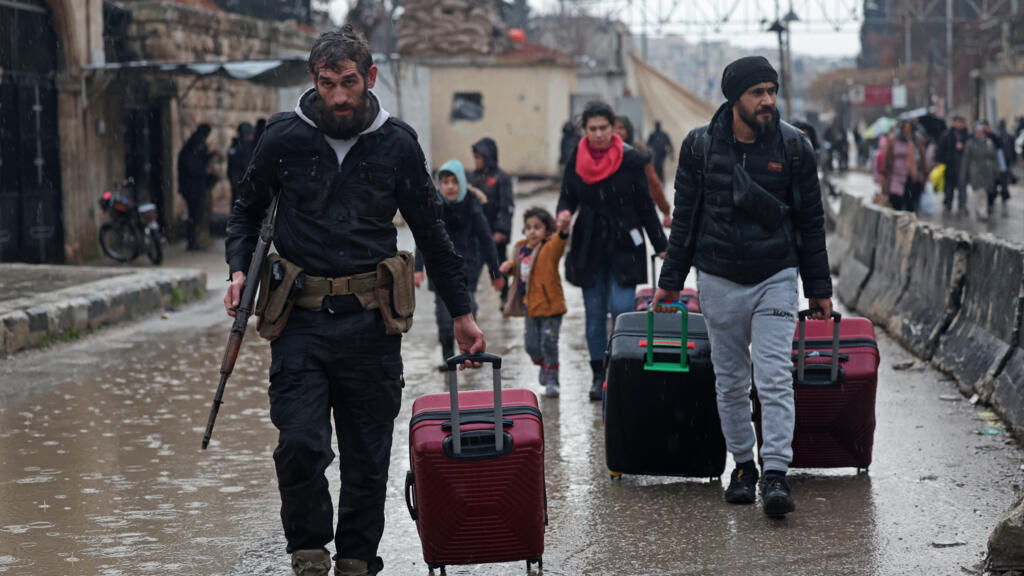
Residents of Aleppo's Sheikh Maqsoud area evacuate after warnings from the Syrian army © OMAR HAJ KADOUR / AFP
Government forces began striking the Sheikh Maqsud district overnight after the Kurdish fighters defied a deadline to withdraw during a temporary ceasefire.
In the morning, the army announced the "completion of a full security sweep of the Sheikh Maqsud neighbourhood", while urging residents to stay in their homes due to the continued presence of Kurdish forces.
AFP correspondents in Aleppo said shelling in the area continued even after the announcement.
A military source previously told the official SANA news agency that "a number of SDF members" -- a reference to the Kurdish-led Syrian Democratic Forces -- had been arrested during the operation
In a statement posted by the Ministry of Defence, Syria's army said "the only remaining option for the armed elements in the Sheikh Maqsud area of Aleppo is to surrender themselves and their weapons immediately".
The violence in Syria's second city erupted after efforts to integrate the Kurds' de facto autonomous administration and military into the country's new government stalled.
Since the start of the fighting on Tuesday, at least 21 civilians have been killed, according to figures from both sides, and tens of thousands have fled Aleppo.
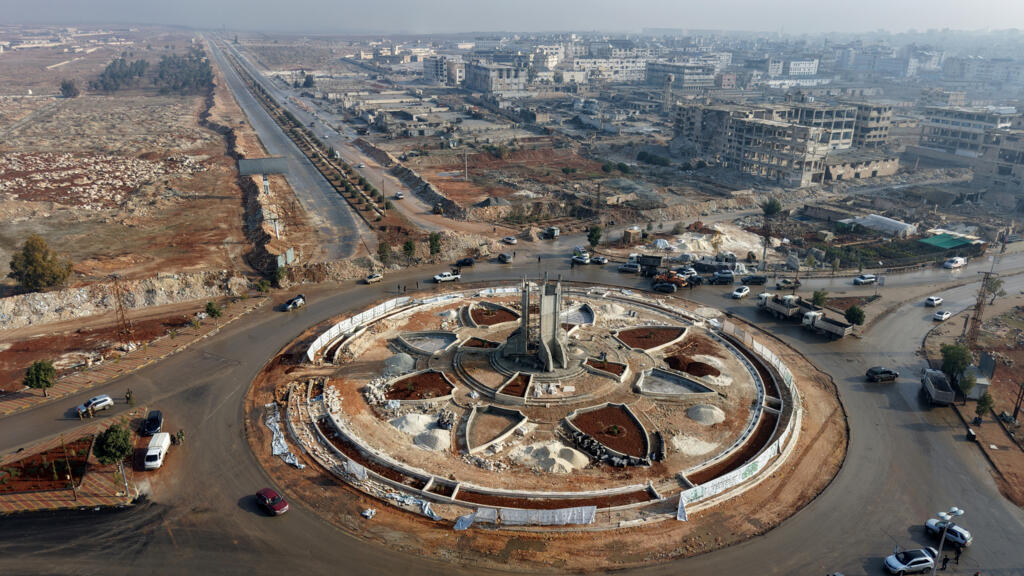
Aleppo has been rocked by clashes between the Syrian army and the Kurdish-led SDF after attempts to integrate the minority into the national military stalled © Bakr ALKASEM / AFP
The clashes, some of the most intense since Syria's new Islamist authorities took power, present yet another challenge as the country struggles to reunify after ousting longtime ruler Bashar al-Assad in December 2024.
Both sides blamed the other for starting the violence in Aleppo.
Early Friday, Syrian authorities announced a window for the Kurdish fighters to leave, but they refused to "surrender" and vowed to defend their districts.
In response, Syria's army warned it would renew strikes on military targets in Sheikh Maqsud and urged civilians to get out ahead of the district's takeover by security forces.
An AFP correspondent saw residents laden with belongings fleeing before the two-hour humanitarian corridor closed.
The clashes, some of the most intense since Syria's new Islamist authorities took power, present yet another challenge as the country struggles to reunify after ousting longtime ruler Bashar al-Assad in December 2024.
Both sides blamed the other for starting the violence in Aleppo.
Early Friday, Syrian authorities announced a window for the Kurdish fighters to leave, but they refused to "surrender" and vowed to defend their districts.
In response, Syria's army warned it would renew strikes on military targets in Sheikh Maqsud and urged civilians to get out ahead of the district's takeover by security forces.
An AFP correspondent saw residents laden with belongings fleeing before the two-hour humanitarian corridor closed.
'Fierce' resistance
Kurdish forces reported coming under artillery and drone attacks, and claimed in a post on social media to be mounting a "fierce and ongoing resistance".
The army said three soldiers had been killed by Kurdish fighters, while state television accused them of launching drones at residential areas of Aleppo.
Kurdish forces reported coming under artillery and drone attacks, and claimed in a post on social media to be mounting a "fierce and ongoing resistance".
The army said three soldiers had been killed by Kurdish fighters, while state television accused them of launching drones at residential areas of Aleppo.
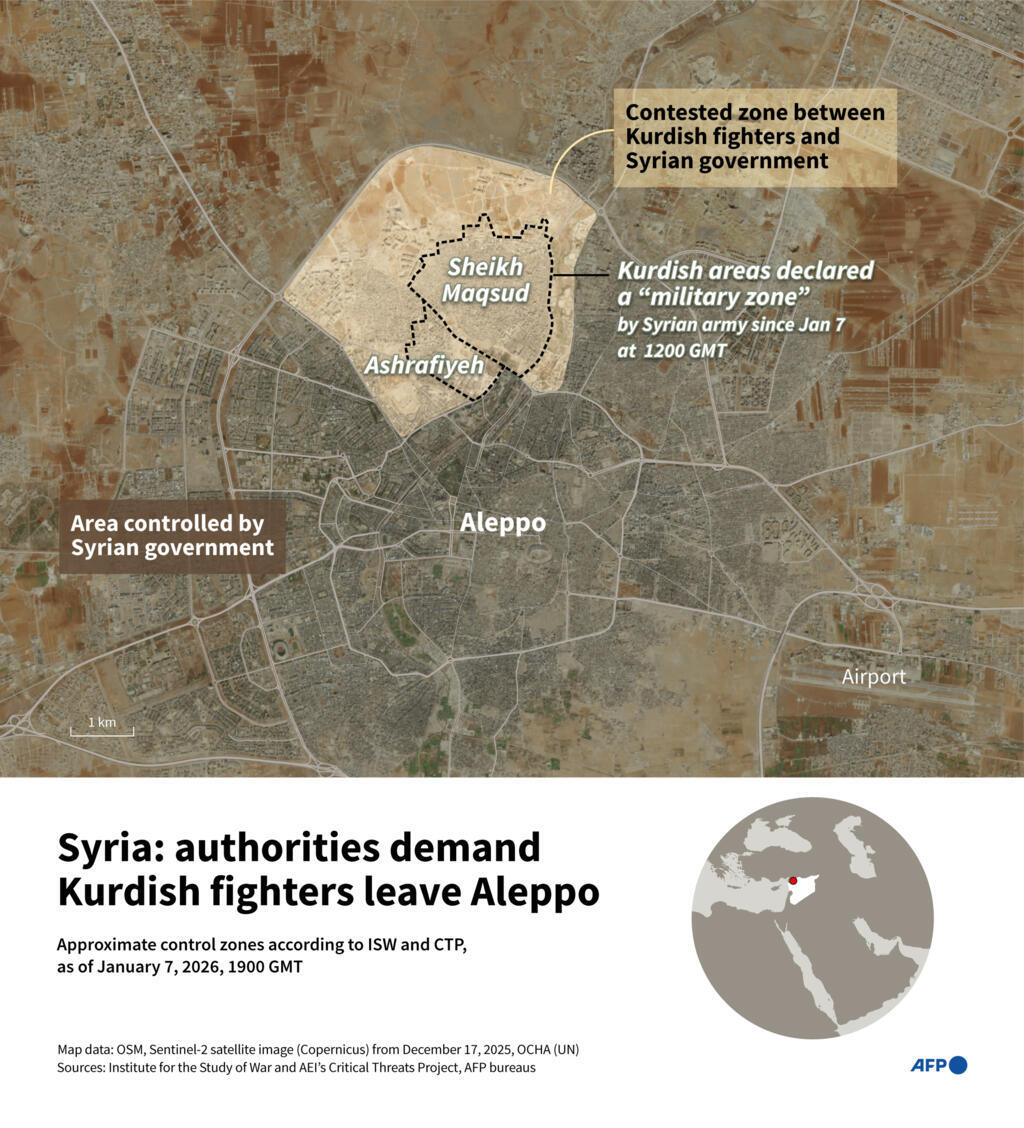
Syria: authorities demand departure of Kurdish fighters from Aleppo © Nalini LEPETIT-CHELLA, Valentina BRESCHI / AFP
A flight suspension at Aleppo airport was extended until late Saturday.
The SDF controls swathes of Syria's oil-rich north and northeast, and was key to the defeat of the Islamic State group in 2019.
But Turkey -- a close ally of Syria's new leaders -- views its main component as an extension of the Kurdistan Workers' Party (PKK), which agreed last year to end its four-decade armed struggle against Ankara.
Elham Ahmad, a senior official in the Kurdish administration in Syria's northeast, accused Syrian authorities of "choosing the path of war" by attacking Kurdish districts and of "seeking to put an end to the agreements that have been reached".
"We are committed to them and we are seeking to implement them," she told AFP.
US mediation
The March integration agreement was meant to be implemented last year, but differences, including Kurdish demands for decentralised rule, have stymied progress.
Ahmad said that "the United States is playing a mediating role... we hope they will apply pressure to reach an agreement".
A diplomatic source told AFP that US envoy Tom Barrack was headed to Damascus.
Barrack said in a statement Saturday morning that he had discussed the situation with Jordan's foreign minister, with both parties expressing a desire for "consolidating the ceasefire, ensuring the peaceful withdrawal of the Syrian Democratic Forces (SDF) from Aleppo, and guaranteeing" civilians' safety.
They also called for the implementation of the integration agreement.
Turkey, which shares a 900-kilometre (550-mile) border with Syria, has launched successive offensives to push Kurdish forces from the frontier.
UN spokesperson Stephane Dujarric expressed alarm over the impact of the fighting on civilians and called on all parties "to swiftly return to negotiations to ensure the full implementation of the 10 March agreement".
Nanar Hawach, senior Syria analyst at the International Crisis Group, said the renewed clashes cast doubt on the government's ability to gain the trust of minority factions and sew the country back together after 14 years of civil war.
"If the fighting escalates, international actors will wonder about Damascus's capacity to govern Syria's heterogeneous society," he added.
Syria's authorities have committed to protecting minorities, but sectarian bloodshed rocked the Alawite and Druze communities last year.
A flight suspension at Aleppo airport was extended until late Saturday.
The SDF controls swathes of Syria's oil-rich north and northeast, and was key to the defeat of the Islamic State group in 2019.
But Turkey -- a close ally of Syria's new leaders -- views its main component as an extension of the Kurdistan Workers' Party (PKK), which agreed last year to end its four-decade armed struggle against Ankara.
Elham Ahmad, a senior official in the Kurdish administration in Syria's northeast, accused Syrian authorities of "choosing the path of war" by attacking Kurdish districts and of "seeking to put an end to the agreements that have been reached".
"We are committed to them and we are seeking to implement them," she told AFP.
US mediation
The March integration agreement was meant to be implemented last year, but differences, including Kurdish demands for decentralised rule, have stymied progress.
Ahmad said that "the United States is playing a mediating role... we hope they will apply pressure to reach an agreement".
A diplomatic source told AFP that US envoy Tom Barrack was headed to Damascus.
Barrack said in a statement Saturday morning that he had discussed the situation with Jordan's foreign minister, with both parties expressing a desire for "consolidating the ceasefire, ensuring the peaceful withdrawal of the Syrian Democratic Forces (SDF) from Aleppo, and guaranteeing" civilians' safety.
They also called for the implementation of the integration agreement.
Turkey, which shares a 900-kilometre (550-mile) border with Syria, has launched successive offensives to push Kurdish forces from the frontier.
UN spokesperson Stephane Dujarric expressed alarm over the impact of the fighting on civilians and called on all parties "to swiftly return to negotiations to ensure the full implementation of the 10 March agreement".
Nanar Hawach, senior Syria analyst at the International Crisis Group, said the renewed clashes cast doubt on the government's ability to gain the trust of minority factions and sew the country back together after 14 years of civil war.
"If the fighting escalates, international actors will wonder about Damascus's capacity to govern Syria's heterogeneous society," he added.
Syria's authorities have committed to protecting minorities, but sectarian bloodshed rocked the Alawite and Druze communities last year.
Issued on: 10/01/2026 - FRANCE24
Syrian security forces began deploying Saturday in a neighborhood in the northern city of Aleppo after days of intense clashes with Kurdish fighters that killed and wounded dozens. Despite the army's claims that it has assumed control of Sheikh Maqsoud, "limited clashes" are still ongoing, FRANCE 24's Dana Alboz said, citing local sources.
Video by: Dana ALBOZ


No comments:
Post a Comment