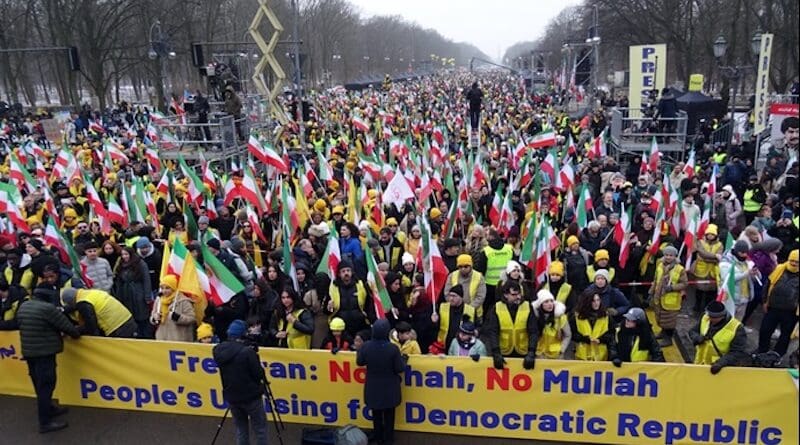
Iranian Resistance Berlin Rally February 7, 2026. Photo Credit: PMOI
February 9, 2026
By Matin Karim
Under the freezing skies of Berlin, with temperatures dropping well below zero, more than 100,000 Iranians and international supporters gathered at the historic Brandenburg Gate, according to the Express. Undeterred by the biting cold and logistical hurdles, including widespread flight and train cancellations, the massive crowd turned the heart of Germany into a resounding stage for the Iranian Resistance.
The rally, held to mark the anniversary of Iran’s 1979 anti-monarchical revolution, took on a distinct and urgent gravity this year. It convened in the immediate aftermath of a nationwide uprising that swept across Iran in late December 2025 and early January 2026. This recent explosion of public anger saw the clerical regime respond with unprecedented brutality, leaving thousands of protesters dead.
Prominent European and American dignitaries joined Mrs. Maryam Rajavi, President-elect of the National Council of Resistance of Iran (NCRI), to declare that the era of theocratic rule in Iran is drawing to a definitive close. The event underscored a shift in global perspective, moving away from appeasement and toward a recognition of the Iranian people’s right to self-defense and regime change.
Maryam Rajavi: The Countdown to Overthrow Has Begun
In her keynote address, Mrs. Maryam Rajavi set the tone for the event by drawing a direct line between the 1979 revolution against the Shah and the current uprising against the mullahs. She described the recent unrest as a turning point that has shattered the regime’s perceived stability.
“The January uprising turned crimson, but with the blood of a galaxy of martyrs and thousands of devoted souls and with the fury of a heroic nation, it shook Iran and the world,” Mrs. Rajavi declared. She emphasized that the sheer scale of the sacrifice has made the regime’s downfall an inevitability visible to the entire world. “For years and years, we said: overthrow, overthrow. And now, everyone sees it is approaching with their own eyes and hears its footsteps.”
Mrs. Rajavi outlined a specific path forward, rejecting both the current theocracy and any return to the monarchical dictatorship of the past. She presented a comprehensive six-point demand to world leaders, calling for the recognition of the Iranian people’s struggle, the prosecution of Supreme Leader Ali Khamenei for crimes against humanity, the closure of regime embassies, and immediate UN action to halt the execution of uprising detainees. Her speech culminated in a vow that the democratic revolution, fueled by the “Resistance Units,” would inevitably triumph where the 1979 revolution was hijacked.
The January Uprising: A Revolution in Blood and Fire
A central theme of the conference was the recognition of the recent December 2025 and January 2026 protests not merely as civil unrest, but as a full-scale revolution. Speakers provided harrowing details regarding the intensity of the conflict and the regime’s lethal response.
Former U.S. Secretary of State Mike Pompeo provided a stark assessment of the death toll, highlighting the severity of the regime’s crackdown. “The massacre of January 8th and January 9th killed at least 20,000, perhaps twice that many,” Pompeo stated, describing the events as a “murderous rampage” by a regime nearing its death. He noted that while protests have occurred before, the recent events represent a “hinge point” in history where the Iranian people have definitively signaled the end of the Islamic Republic.
This sentiment was echoed by Mrs. Rajavi, who lamented the loss of young lives, noting that “14- and 15-year-old girls continue to be gunned down in the streets.” She described the uprising as a “lightning assault” that showed the path to freedom, driven by a generation unwilling to submit to tyranny.
Peter Altmaier, former German Federal Minister for Economic Affairs, addressed the heroes of the uprising directly, acknowledging those who lost their lives or are currently languishing in prisons. He emphasized that the regime has “lost all legitimacy” by treating its citizens with a level of cruelty unmatched globally. “During the various uprisings, the mullahs’ regime shot tens of thousands; tens of thousands were executed, and tens of thousands are sitting in prisons,” Altmaier observed, reinforcing the scale of the humanitarian crisis.
Rejecting the “Hijackers”: No to Shah, No to Mullahs
A significant portion of the rally was dedicated to clarifying the political identity of the uprising. Speakers were unified in their rejection of the “two dictatorships”—the deposed Pahlavi monarchy and the current religious tyranny. This dual rejection was presented as the guiding principle of the current revolution.
Charles Michel, former President of the European Council, delivered a stinging critique of attempts by the remnants of the Shah’s regime to co-opt the current movement. He warned against those seeking to “steal your dreams and aspirations,” specifically pointing to the son of the Shah.
“Being the son of a dictator should inspire shame and humility,” Michel argued. He accused the remnants of the shah regime of using “industrial artificial intelligence bots” and massive financial resources to manufacture a fake image of support. “He seeks to create a fake image of support to manipulate and attempt to hijack the future of the Iranian people once again,” Michel said, drawing a sharp contrast between the “organized resistance” that seeks democracy and those who feel entitled to rule by lineage.
Mrs. Rajavi reinforced this narrative, categorizing the political landscape into three sides: the rebels sacrificing for freedom, the murderous clerics, and the “remnants of the Shah.” She described the slogan “Long Live the Shah” as “ultra-reactionary” and a tool that ultimately serves the current Supreme Leader by dividing the opposition and justifying suppression. “Anyone who imagines they can hijack Iran’s new democratic revolution… are gravely mistaken,” she affirmed.
Mike Pompeo also weighed in, stating that the Iranian people have made their preferences “abundantly clear” through repeated uprisings: “They do not want theocracy, they do not want autocracy, and they do not want a monarchy.”
The Organized Resistance and the “Third Option”
Countering the narrative that the alternative to the Iranian regime is chaos, the speakers highlighted the role of the NCRI and the PMOI/MEK as a viable, organized democratic alternative. They argued that the “Third Option”—neither foreign war nor appeasement—relies on empowering the Iranian people and their organized resistance.
Charles Michel articulated this explicitly: “There is an alternative! There is the mobilization of the people of Iran… The Ten-Point Plan is the right recipe to move from tyranny to democracy.” He praised the plan for its commitment to a secular system, gender equality, and the abolition of the death penalty. “The Ten-Point Plan is a solid bridge from oppression to liberty,” Michel concluded.
Mike Pompeo pointed to the “Resistance Units” inside Iran as the engine of the recent uprisings. “The uprisings that we have seen in these past days didn’t come out of nowhere… They are rooted in a Resistance now four decades in the making,” he said. He emphasized that the NCRI has built the capacity for popular support and laid out a systemic plan for a transition period, stressing that this movement does not ask for foreign soldiers but for recognition.
Mrs. Rajavi detailed the mechanics of the proposed transition, reiterating the NCRI’s commitment to a Constituent Assembly elected within six months of the regime’s overthrow to draft a new constitution. She highlighted the presence of the “National Liberation Army” and the “Resistance Units” as the forces capable of preventing disorder and instability in the post-regime vacuum.
Condemnation of Human Rights Abuses and the “Wall of Fear”
The rally took place in the shadow of the Brandenburg Gate, a location invoked by several speakers to symbolize the breaking of barriers. Charles Michel compared the Berlin Wall to the “wall of fear” in Iran—a divide between oppression and freedom. “It is a reminder that no wall is eternal and that freedom cannot be defeated forever,” he told the crowd.
Sabine Leutheusser-Schnarrenberger, former German Federal Minister of Justice, focused her address on the severe human rights violations occurring inside Iran’s prisons. She reminded the audience of the “torture chambers” and the reality that people are being “arrested, tortured, murdered, and executed” simply for demanding basic rights.
“What this mullahs’ regime is criminally and brutally inflicting on its own citizens in Iran cannot be accepted,” Leutheusser-Schnarrenberger stated. She highlighted the specific plight of women, noting their fight for the right to “go out on the streets without a headscarf—without having to fear disappearing into torture chambers for years.”
The speakers collectively painted a picture of a regime that has resorted to taking foreign hostages and massacring its own youth as a desperate survival tactic. As Michel noted, “Their cruelty is a desperate sign of weakness… This regime is more fragile and isolated than ever.”
Policy Demands: End Appeasement, Sanction the IRGC
A unified demand emerging from the Berlin rally was for Western governments to fundamentally alter their policy toward Tehran. The era of engagement and “appeasement” was declared dead, with speakers calling for tangible, punitive measures against the regime’s apparatus of suppression.
Peter Altmaier was emphatic in his message to Western capitals: “All hopes that this regime would modernize… were false.” He welcomed the EU’s designation of the Islamic Revolutionary Guard Corps (IRGC) as a terrorist organization but termed it “only a first step.” Altmaier called for tougher sanctions and urged the free press to increase its coverage of the atrocities in Iran.
Sabine Leutheusser-Schnarrenberger criticized ongoing diplomatic efforts, specifically mentioning negotiations via Oman regarding the nuclear deal. “What belongs in such talks, if they are already taking place?” she asked. She insisted that no talks should proceed without the primary demand being the release of uprising detainees. “One cannot continue with negotiations and then return to business as usual,” she argued, calling for a halt to financial flows that line the mullahs’ pockets.
Mike Pompeo, drawing on his experience implementing the “Maximum Pressure” campaign, reiterated that the regime is incapable of reform. “We need a policy that is grounded in strategic and moral clarity,” he said. He expressed confidence that the U.S. administration would continue to “cut off the lifelines” of the regime, noting recent sanctions on Iranian crude oil.
Maryam Rajavi provided a specific policy roadmap for the international community. Her demands included referring the regime’s leaders to the UN Security Council for prosecution, completely cutting off the regime’s financial resources, and providing the facilities necessary to ensure the Iranian people have access to a free and open internet to bypass state censorship.
The rally in Berlin concluded with a message of profound optimism despite the grim circumstances of the recent massacres. The speakers concurred that the sheer magnitude of the January 2026 uprising, combined with the organized nature of the resistance, signaled that the clerical regime has entered its final phase.
Mike Pompeo summarized the sentiment of the day: “Today, it is unequivocal and unmistakable that we are at a hinge point in Iran’s history… The Iranian people will prove fearless.”
“The decaying forces will be swept from the stage of history,” Mrs. Rajavi quoted the slain resistance leader Moussa Khiabani, assuring that the revolution would prevail.
Matin Karim
Matin Karim writes for the People's Mojahedin Organization of Iran (PMOI/MEK)
Exclusive: Iran, massacre under a blackout
Issued 08/02/2026
FRANCE24

In this exclusive documentary, FRANCE 24 retraces the chronology of events that took place in Iran from December 28, 2025, when merchants in Tehran's Grand Bazaar went on strike, to January 18, 2026, when the authorities restored internet access. Behind closed doors, from January 8 to 11, Iran's worst massacre took place since the 1979 establishment of the Islamic Republic. Warning: viewers may find the footage and descriptions in this report upsetting.
In early January, FRANCE 24 assembled a cross-media team of journalists, including senior producer Mariam Pirzadeh, online journalist Bahar Makooi and Ershad Alijani from the FRANCE 24 Observers. They collated and verified the many videos they received from Iran before, after and sometimes during the internet blackout. They also gathered the harrowing testimonies of several participants in, and victims of, the protest movement.
What emerged is a relentless, sometimes painful account of the extreme police brutality used by the Iranian regime from the early days of the protests, which escalated to the use of military methods and weapons from January 8 onwards. Then came the pressure put on victims' families, who were tracked down in hospitals and morgues as they went to collect their injured or dead loved ones, whom they had to pay for.
Our documentary ends on January 18, with undoubtedly tens of thousands of victims. It will be up to history to determine the final toll.
Warning: The report contains disturbing and violent images. Caution is advised for underage viewers.
Illustrations by Adel Gastel.
Iran: France 24 Reporters retrace chronology of deadly crackdown
22:45
Iranian Nobel laureate Narges Mohammadi sentenced to seven additional years in prison
Supporters of Narges Mohammadi, who was awarded the Nobel Peace Prize in 2023, said she had been on hunger strike since 2 February.
Iran has sentenced Nobel Peace Prize laureate Narges Mohammadi to more than seven additional years in prison after she began a hunger strike, supporters of hers said on Sunday.
Mohammadi’s supporters cited her lawyer, who spoke to Mohammadi. The lawyer, Mostafa Nili, confirmed the sentence on X, saying it had been handed down Saturday by a Revolutionary Court in the city of Mashhad.
The Nobel laureate had previously been sentenced to nearly 14-years in prison on other charges. Iranian authorities did not immediately acknowledge the more recent sentence.
“She has been sentenced to six years in prison for ‘gathering and collusion’ and one and a half years for propaganda and two-year travel ban,” Nili said. She received another two years of internal exile to the city of Khosf, some 740 kilometers (460 miles) southeast of Tehran, the capital, the lawyer added.
Supporters say Mohammadi has been on a hunger strike since 2 February. She had been arrested in December at a ceremony honoring Khosrow Alikordi, a 46-year-old Iranian lawyer and human rights advocate who had been based in Mashhad. Footage from the demonstration showed her shouting, demanding justice for Alikordi and others.
The new convictions against Mohammadi come as Iran tries to negotiate with the United States over its nuclear programme to avert a threatened military strike by President Donald Trump. Iran's top diplomat insisted Sunday that Tehran's strength came from its ability to “say no to the great powers," striking a maximalist position just after negotiations in Oman with the US.
Iran has sentenced Nobel Peace Prize laureate Narges Mohammadi to more than seven additional years in prison after she began a hunger strike, supporters of hers said on Sunday.
Mohammadi’s supporters cited her lawyer, who spoke to Mohammadi. The lawyer, Mostafa Nili, confirmed the sentence on X, saying it had been handed down Saturday by a Revolutionary Court in the city of Mashhad.
The Nobel laureate had previously been sentenced to nearly 14-years in prison on other charges. Iranian authorities did not immediately acknowledge the more recent sentence.
“She has been sentenced to six years in prison for ‘gathering and collusion’ and one and a half years for propaganda and two-year travel ban,” Nili said. She received another two years of internal exile to the city of Khosf, some 740 kilometers (460 miles) southeast of Tehran, the capital, the lawyer added.
Supporters say Mohammadi has been on a hunger strike since 2 February. She had been arrested in December at a ceremony honoring Khosrow Alikordi, a 46-year-old Iranian lawyer and human rights advocate who had been based in Mashhad. Footage from the demonstration showed her shouting, demanding justice for Alikordi and others.
The new convictions against Mohammadi come as Iran tries to negotiate with the United States over its nuclear programme to avert a threatened military strike by President Donald Trump. Iran's top diplomat insisted Sunday that Tehran's strength came from its ability to “say no to the great powers," striking a maximalist position just after negotiations in Oman with the US.
Concerns over Mohammadi's health
The Nobel laureate is now in "deteriorating health", her supporters say, after ending her nearly week-long hunger strike.
Mohammadi's supporters had warned for months before her arrest in December that she was at risk of being sent back to prison after having received a furlough in December 2024 over medical concerns.
While that was to be only three weeks, Mohammadi’s time out of prison lengthened, possibly as activists and Western powers pushed Iran to keep her free.
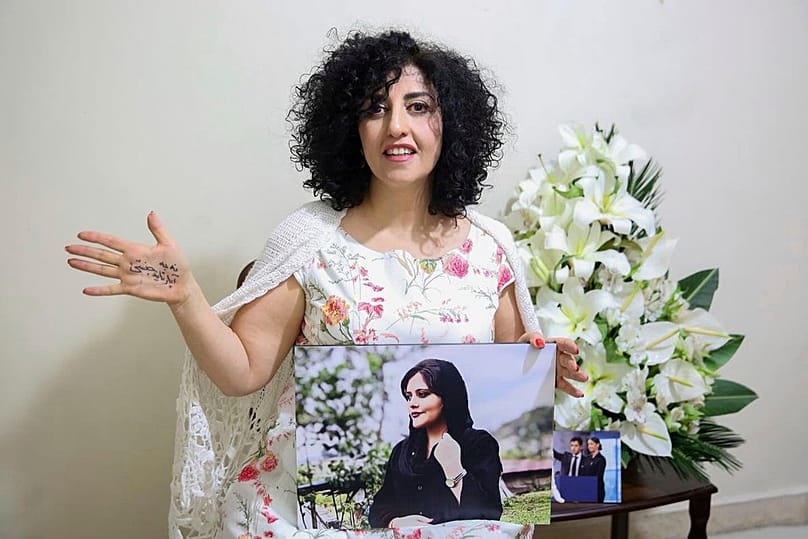 Nobel Peace Prize laureate Narges Mohammad after being released on a medical furlough in Tehran, Iran, 4 Dec, 2024. On her hand written in Farsi is "End gender apartheid." Narges Foundation Archive/AP
Mohammadi still kept up her activism with public protests and international media appearances, including even demonstrating at one point in front of Tehran’s notorious Evin prison, where she had been held.
She had been serving 13 years and nine months on charges of collusion against state security and propaganda against Iran’s government. She also had backed the nationwide protests sparked by the 2022 death of Mahsa Amini, which have seen women openly defy the government by not wearing the hijab.
Mohammadi suffered multiple heart attacks while imprisoned before undergoing emergency surgery in 2022, her supporters say. Her lawyer in late 2024 revealed doctors had found a bone lesion that they feared could be cancerous that later was removed.
The Nobel laureate is now in "deteriorating health", her supporters say, after ending her nearly week-long hunger strike.
Mohammadi's supporters had warned for months before her arrest in December that she was at risk of being sent back to prison after having received a furlough in December 2024 over medical concerns.
While that was to be only three weeks, Mohammadi’s time out of prison lengthened, possibly as activists and Western powers pushed Iran to keep her free.
Mohammadi still kept up her activism with public protests and international media appearances, including even demonstrating at one point in front of Tehran’s notorious Evin prison, where she had been held.
She had been serving 13 years and nine months on charges of collusion against state security and propaganda against Iran’s government. She also had backed the nationwide protests sparked by the 2022 death of Mahsa Amini, which have seen women openly defy the government by not wearing the hijab.
Mohammadi suffered multiple heart attacks while imprisoned before undergoing emergency surgery in 2022, her supporters say. Her lawyer in late 2024 revealed doctors had found a bone lesion that they feared could be cancerous that later was removed.
Iranian foreign minister strikes hard-line tone
Speaking to diplomats at a summit in Tehran, Foreign Minister Abbas Araghchi signalled that Iran would stick to its position that it must be able to enrich uranium - a major point of contention with US President Donald Trump.
“I believe the secret of the Islamic Republic of Iran’s power lies in its ability to stand against bullying, domination and pressures from others," Araghchi said. "They fear our atomic bomb, while we are not pursuing an atomic bomb. Our atomic bomb is the power to say no to the great powers. The secret of the Islamic Republic’s power is in the power to say no to the powers.”
Israeli Prime Minister Benjamin Netanyahu is expected to travel to Washington this week, with Iran expected to be the major subject of discussion.
The US has moved the aircraft carrier USS Abraham Lincoln, ships and warplanes to the Middle East to pressure Iran into an agreement and have the firepower necessary to strike the country, should Trump choose to do so.
Speaking to diplomats at a summit in Tehran, Foreign Minister Abbas Araghchi signalled that Iran would stick to its position that it must be able to enrich uranium - a major point of contention with US President Donald Trump.
“I believe the secret of the Islamic Republic of Iran’s power lies in its ability to stand against bullying, domination and pressures from others," Araghchi said. "They fear our atomic bomb, while we are not pursuing an atomic bomb. Our atomic bomb is the power to say no to the great powers. The secret of the Islamic Republic’s power is in the power to say no to the powers.”
Israeli Prime Minister Benjamin Netanyahu is expected to travel to Washington this week, with Iran expected to be the major subject of discussion.
The US has moved the aircraft carrier USS Abraham Lincoln, ships and warplanes to the Middle East to pressure Iran into an agreement and have the firepower necessary to strike the country, should Trump choose to do so.

No comments:
Post a Comment