“Until the president resigns...”
Friday 5 June 2026, by Javier Rojas
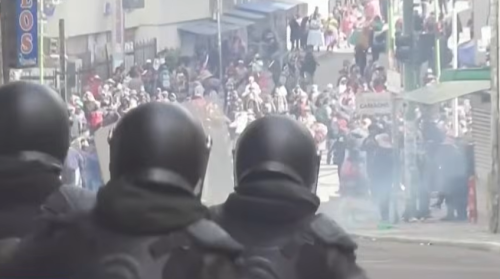
In Bolivia, mobilizations against austerity and an agrarian reform favourable to the concentration of land have weakened the government of Rodrigo Paz and his neoliberal policies.
The current mobilizations combine indefinite strikes, demonstrations, roadblocks and clashes with the forces of repression. They are an extension of the December 2025 movement against the neoliberal policies of the right-wing Paz government and an austerity plan that makes the popular classes pay for the crisis. Organized around the COB (Bolivian Workers’ Federation), the movement then made the government back down, with a central role for grassroots activists and the peasant and indigenous movement.
Peasants and indigenous peoples against the agrarian reform
2026 has opened a new chapter in the class struggle against the Paz government and its austerity policies. In April, legislation made it easier for small farms to be placed on the market. Peasant and indigenous communities denounced a regressive agrarian reform that favoured the concentration of land and the return of the latifundium to the benefit of the most economically powerful sectors. They also pointed out that they have not been the subject of any consultation, which implies a questioning of the community organisation guaranteed by the 2009 plurinational constitution.
From the north of La Paz, Beni and Pando, marches converged on La Paz to demand the repeal of the law. For 28 days, the mobilization won the support of peasant and indigenous organizations from other parts of the country. While the government ended up talking about repealing the law after the march arrived in La Paz on 1 May, it was mainly trying to buy time to achieve the same goals by other means. Faced with this manoeuvre, the peasant movement radicalised the mobilisation by launching road blockades.
Trade union strike against inflation and austerity
At the same time, inflation and the tightening of austerity policies — the end of fuel subsidies and privatizations — have aggravated the conflict between the COB and the government. On 1 May, the COB launched an indefinite strike that has lasted for more than 20 days and has resulted in 70 roadblocks, mainly around La Paz. The demands include the defence of collective agreements, investments in indigenous communities, currency control, an end to privatisation and the defence of health and education.
In addition, the shortage of fuel and a scandal around adulterated fuels have pushed hauliers, mainly those in La Paz and El Alto, to join the strike, as well as teachers in urban and rural areas and some health workers.
Repression and crisis of power
Rodrigo Paz has intensified the crackdown with the support of the region’s right-wing and far-right governments. Former president “Tuto” Quiroga called for a tougher repressive approach, accusing the demonstrators of committing “crimes against humanity”. Conversely, Evo Morales, who has taken refuge in the Chapare, supported the movement and denounced the sending of “anti-riot equipment” from Argentina.
The demand for the “immediate resignation of the president” has become the main slogan of the movement, without however achieving a consensus throughout society. In recent days, the country’s main organizations have mobilized in El Alto and La Paz despite the repression. Since the beginning of the conflict, it has left dozens of people injured and has been accompanied by a political persecution against several leaders, such as the secretary general of the COB, Mario Argollo, who was accused of incitement to terrorism and has now been forced underground. There have been five deaths.
Today, 56 roadblocks remain in place in 7 departments and the indefinite strike continues. It remains to be seen whether the rebellion will manage to spread nationwide and unify around common demands. President Rodrigo Paz appears increasingly weakened and, even without resigning, his government has ever less room for manoeuvre.
28 May 2026
Translated by International Viewpoint from l’Anticapitaliste.
P.S.
If you like this article or have found it useful, please consider donating towards the work of International Viewpoint. Simply follow this link: Donate then enter an amount of your choice. One-off donations are very welcome. But regular donations by standing order are also vital to our continuing functioning. See the last paragraph of this article for our bank account details and take out a standing order. Thanks.
Santa Cruz (Bolivia) (AFP) – Police and anti-government protesters clashed Saturday in the Santa Cruz area of eastern Bolivia, as authorities attempted to clear a road blocked by rural workers demanding President Rodrigo Paz's resignation.
Issued on: 06/06/2026 - RFI

A month of demonstrations calling for the center-right Paz to step down have paralyzed the Andean nation, with some 100 protest blockades around the country causing severe food and medicine shortages in major cities.
On Saturday, dozens of anti-riot police backed by military vehicles fired tear gas as they attempted to clear a road in the town of San Julian.
The town is in the Santa Cruz region -- an agricultural breadbasket for Bolivia, supplying food to the country's western areas.
Protesters threw stones and burned tires to try to halt the police's advance, according to an AFP reporter at the scene and local television footage.
Santa Cruz police chief Colonel David Gomez said two officers were wounded by gunfire during the clashes, prompting security forces to pull back. Both were being treated in hospital.
 Two offi
The incident came one day after police and soldiers cleared a key road linking La Paz to farming communities.
The US-backed, pro-business Paz took office in November promising to resolve the country's worst economic crisis in decades, but his unpopular economic reforms and failure to respond to social demands have roused public ire.
He has repeatedly called for dialogue with protesters but on Wednesday announced a bill to declare a state of emergency, which would authorize military deployment to crack down and clear the blockades.
Congress is debating the measure.
Supplies are running low in La Paz, El Alto, as well as the cities of Cochabamba, Oruro and Potosi.

The government accuses former socialist president Evo Morales -- in hiding from charges related to his relationship with a teen with whom he allegedly fathered a child -- of fomenting the unrest.
On Friday, US President Donald Trump's new Shield of the Americas alliance -- an anti-cartel coalition that includes pro-US administrations in Argentina, Bolivia and Chile among other countries -- gave Paz its unequivocal backing.
© 2026 AFP

No comments:
Post a Comment