Europe wants to be a strong partner of the US in the Moon race, ESA astronaut says
Italian astronaut Luca Parmitano will pilot the Artemis III mission, NASA's next step towards its first Moon landing in decades. He tells Euronews how he is preparing, his thoughts on the space race and what European aspects he’ll bring into orbit.
“We as Europeans, we as Italians, we want to be strong partners of the United States in this race,” astronaut Luca Parmitano told Euronews, talking about the current frontier in space exploration: returning to the Moon.
Parmitano, an Italian astronaut from the European Space Agency (ESA), was selected by NASA to take part in the Artemis III mission, designed to be a test mission for NASA’s Moon landing programme.
Set to launch in 2027, Artemis III will send three NASA astronauts and Parmitano to low-Earth orbit on the Orion spacecraft to dock with two lunar landers produced respectively by Elon Musk’s SpaceX company and Jeff Bezos’ Blue Origin.
NASA has presented the mission as one of the most complex human spaceflights in recent history. As Parmitano prepares for it, he joined Euronews interview programme 12 Minutes With to share how he is getting on, the challenges ahead, and the current state of the space race.
Bringing the European identity into orbit
“The mission was not at all on my horizon,” said Parmitano, “I was speechless, which is quite unusual for me, and I was really grateful."
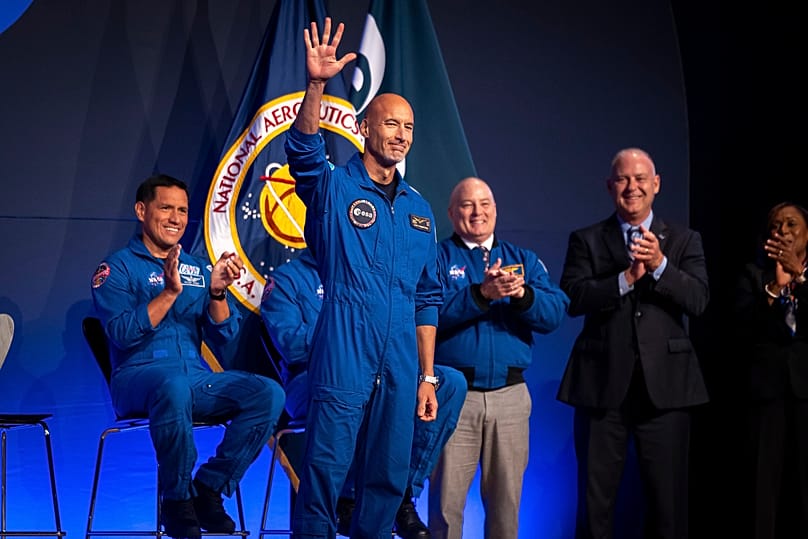
Parmitano was the first Italian commander on the International Space Station and spent over 366 days in space across two long-duration missions: Volare (2013) and Beyond (2019-2020). He was the first Italian to perform a space walk and now he will be the first European to go into orbit with the Artemis programme.
NASA publicly presented the crew for the Artemis III mission on June 9 at the Johnson Space Center in Houston, Texas. At the event, Parmitano gave an emotional speech, calling Italy his own “launch pad” and the ESA his “launch tower”.
Parmitano told Euronews he is grateful to the Italian public education system and aims to bring into orbit the spirit of determination — a characteristic of European identity for him.
“People of my age, we were not born Europeans. We became Europeans. This identity was desired, this identity has been a goal, something we wanted to achieve,” he said.
Artemis III: a complex mission toward the Moon
Despite the excitement, Parmitano is aware of the challenges posed by Artemis III. “We have three launches that have to happen in close proximity and from very different spacecrafts,” he explained.
Multiple factors will contribute to the success of the Artemis III mission, including the readiness and successful launches of the lunar landers and NASA’s Orion spacecraft as well as the critical orbital manoeuvers.
Astronauts will also have to live in the Orion spacecraft, with a habitable volume of just 8 to 9 cubic metres. It is built for deep space conditions, which are different to those at low-Earth orbit where the mission will be conducted.
To prepare for such a complex journey, Parmitano and his three NASA crew members, Randy Bresnik, Frank Rubio and Andre Douglas, are now following an intense training schedule.
The programme involves practicing crucial skills, conducting simulations, and preparing for potential malfunction scenarios. “Our training is very complex and wonderfully different and varied,” Parmitano stated.
The state of the space race
If lately on Earth, relations between the EU and the US have been tense, in space, Parmitano claims, this is not the case. “We don't look at what's happening at the political level; we are operators.”
Parmitano said the Artemis III mission is part of the space race to return to the Moon and underlined that the EU-US relationship in orbit remains strong. “We all feel a common goal, which is that of the betterment of humankind on Earth, our life, and this is the next step."
The ESA has been playing an important role in the Artemis mission architecture. For example, it built the European Service Module to provide electricity, thermal control, oxygen, nitrogen, and water to the Orion spacecraft.
However, ESA's contribution to the programme was altered following NASA's decision earlier this year to pause work on the Lunar Gateway, a Moon-orbiting space station for which Europe had been building some key modules.
On the 2027 deadline, presented by many experts as far too ambitious, Parmitano argued that “to achieve complex objectives, you have to be ambitious and push hard”.
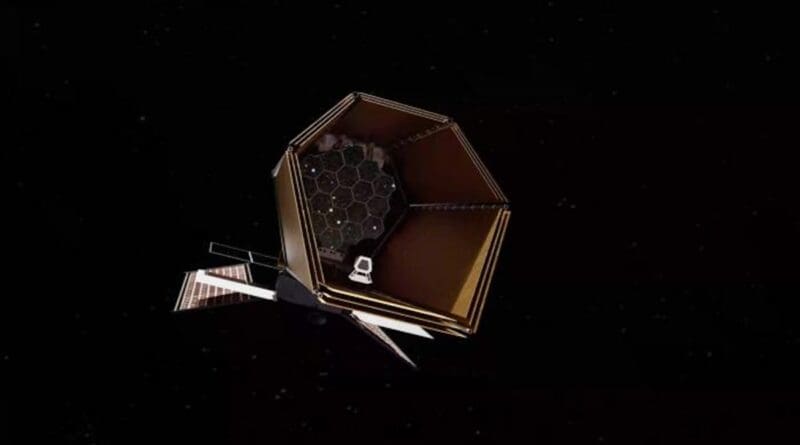
A conceptual design of the Habitable Worlds Observatory. CREDIT: NASA
By Eurasia Review
Key Takeaways:
Mission Goal: Search for Habitable Worlds and Signs of Life: The Habitable Worlds Observatory will focus on nearby stars (within ~30 light-years) to directly image Earth-like exoplanets and analyze their atmospheres for potential biosignatures, while also serving as a general-purpose space telescope.
Need for Sustained Investment to Maintain Leadership: While the funding strengthens the UK’s role (building on prior contributions to Hubble and JWST), experts warn that proposed cuts to research institutes and groups could undermine the expertise required to deliver the instruments and fully exploit the science when the observatory begins operations.
UK astronomers are a step closer to playing a leading role in NASA’s search for alien life in the coming decades, after receiving £3million to continue developing one of the core instruments of the Habitable Worlds Observatory (HWO).
The “exciting” mission – the US space agency’s next flagship space telescope after the Nancy Grace Roman Space Telescope – is expected to launch in the 2040s.
The UK-led plans follow a series of instrument studies funded by the UK Space Agency (UKSA), which have been shared with NASA and are helping to shape the mission as it moves into its next phase of development.
“The Habitable Worlds Observatory is one of the most exciting space science missions now under development,” said Professor Martin Barstow, of the University of Leicester, who is playing a leading role in the UK’s involvement and gave an update on the mission at the Royal Astronomical Society’s National Astronomy Meeting in Birmingham.
“It will tackle one of the biggest questions in science: are we alone in the universe? By searching for Earth-like planets and studying their atmospheres, the HWO will look for evidence of life beyond our Solar System.”
Seen from a distance, a planet like Earth would be a faint dot right next to a blinding sun, 10 billion times brighter. To image this moth next to a flamethrower, HWO’s 8 metre mirror must be held stable to within the width of an atom, and the light from the sun blocked out.
Professor Barstow added: “The UK has a long history of making major contributions to NASA’s flagship observatories, from Hubble to the James Webb Space Telescope, and we are now in a strong position to lead the development of one of HWO’s core scientific instruments.”
Vincent Van Eylen, Associate Professor in Exoplanets at UCL’s Mullard Space Science Laboratory, called HWO “one of the most exciting missions of my lifetime”.
He added: “It will be the first telescope designed to search for evidence of life on distant planets. Imagine for a moment it finds evidence of life out there. What an achievement that would be!
“It’s fantastic that the UK Space Agency is ensuring that UK scientists and engineers will have a leading role in this exciting project.”
The UK is leading on the development of HWO’s High Resolution Imager (HRI) and Multi-Object Spectrograph (MOS), which are expected to be core instruments on the telescope.
Researchers have just been awarded a new £3million funding boost from the UKSA to ramp up their efforts and develop the necessary technologies to make the instrument a reality. This latest development builds on the previous studies, but significantly expands the scale.
Dr Caroline Harper, Head of Space Science at the UK Space Agency, said: “This UK Space Agency funding is a significant step forward in securing the UK’s place at the heart of one of the most ambitious space science missions ever conceived.
“Habitable Worlds Observatory is being designed to answer whether we are alone in the universe and will require technological advances as well as scientific breakthroughs. That’s why we’re backing UK scientists and engineers to lead one of its core instruments.”
The UK team includes scientists from Durham University, The Open University, the University of Leicester, RAL Space, the University of Portsmouth, the University of Oxford, the UK’s Astronomy Technology Centre (ATC) and UCL’s Mullard Space Science Laboratory.
However, with the mission not expected to launch for another two decades, it is the existing generation of younger researchers – currently facing huge uncertainty against the backdrop of widespread funding cuts – who will be the UK’s science leaders when it’s ready.
“The UK Space Agency is supporting instrument development for HWO but that would be a waste if there is not a community of scientists ready to exploit it in the 2040s,” Professor Barstow cautioned.
“The decisions we make over the next few years will determine whether UK scientists are at the forefront of those discoveries for decades to come.”
He said sustained investment would be needed to maintain the scientific expertise and technical capability required to deliver the UK’s planned contribution.
“The proposed cuts affecting key institutes and research groups involved in the mission could weaken Britain’s ability to lead one of the world-leading observatory’s core instruments and fully exploit the science when HWO begins operations in two decades’ time,” Professor Barstow added.
The HWO’s headline scientific goal is to search for Earth-like planets around nearby stars and examine their atmospheres for signs of life.
But rather than surveying the entire galaxy, it will focus on nearby stars within our cosmic neighbourhood. At distances of around 30 light-years, astronomers expect the observatory to be capable of directly studying Earth-like planets and searching their atmospheres for possible signs of life.
Like the Hubble Space Telescope and James Webb Space Telescope (JWST) before it, though, HWO will also serve as a general-purpose observatory, allowing astronomers to study everything from planets and stars to galaxies and the evolution of the universe.
NASA is leading the mission, but international partners will provide major elements of the observatory. The UK aims to design and build one of the cameras that will sit at the telescope’s focal plane and collect the light needed to carry out its observations, while also contributing to other systems.
Over the past three years, the UK astronomy community has held a series of national workshops, supported by the Science and Technology Facilities Council (STFC), to develop scientific priorities and bring together universities, research laboratories and industry.
UK researchers previously played important roles with the Hubble mission and led the European consortium that developed the Mid-Infrared Instrument (MIRI) on JWST.
The next phase of UK instrument studies is expected to begin next month as NASA continues developing HWO in collaboration with researchers across the world.
HWO will be the first in NASA’s next generation of flagship “Great Observatories”, building on the legacy of Hubble and Webb while seeking to answer one of humanity’s oldest questions: whether life exists elsewhere in the universe.
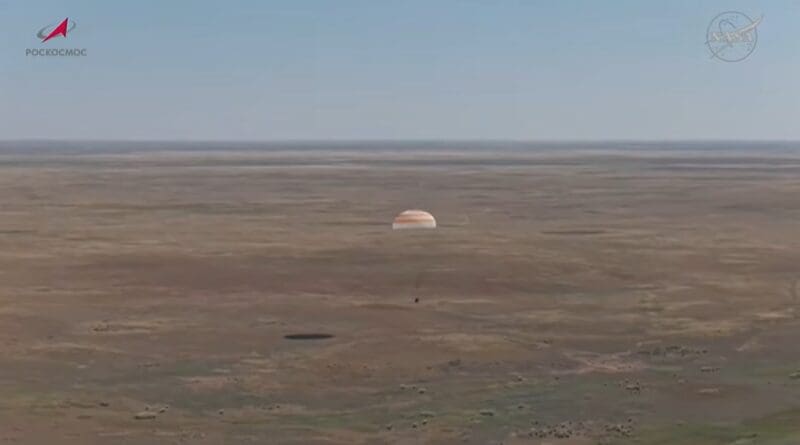
The Soyuz MS-28 spacecraft is seen as it lands in a remote area near the town of Zhezkazgan, Kazakhstan with NASA astronaut Chris Williams and Roscosmos cosmonauts Sergey Kud Sverchkov and Sergei Mikaev. Credit: NASA
July 26, 2026
By Eurasia Review
Concluding an eight-month science mission aboard the International Space Station, NASA astronaut Chris Williams returned to Earth on Sunday alongside Roscosmos cosmonauts Sergey Kud-Sverchkov and Sergei Mikaev.
The crew made its safe, parachute-assisted landing at 5:27 a.m. CDT (3:27 p.m., Kazakhstan time), southeast of Dzhezkazgan, after departing the space station at 2:03 a.m., aboard the Soyuz MS-28 spacecraft.
The crew was in space for 241 days, orbiting the Earth 3,856 times and traveling more than 102 million miles. They launched to the International Space Station on Nov. 27, 2025. The mission was the first for Williams and Mikaev and the second for Kud-Sverchkov.
While aboard the orbiting laboratory, Williams supported a wide range of scientific investigations and technology demonstrations. He helped advance research for new cancer treatments and improved in-space manufacturing of materials used in high-performance computers and electronics. Williams also completed two spacewalks to prep for space station power system upgrades and to replace a faulty joint on the Canadarm2 robotic arm. The crew’s work aboard the space station helps improve life on Earth and prepare for future human missions to the Moon and Mars.
Following post-landing medical checks, the crew members will fly by helicopter to Karaganda, Kazakhstan, where recovery teams are based. Williams then will board a NASA aircraft bound for the agency’s Johnson Space Center in Houston.
For more than 25 years, people have lived and worked continuously aboard the International Space Station, advancing scientific knowledge and making research breakthroughs not possible on Earth. The space station helps NASA understand and overcome the challenges of human spaceflight, expand commercial opportunities in low Earth orbit, and build on the foundation for long-duration missions to the Moon, as part of the Artemis program, and to Mars.

No comments:
Post a Comment