“Instead of building a modern, clean energy source to power its increased AI-driven electricity demand, Amazon chose to invest in a massive natural gas power plant to fuel its giant Texas data center.”
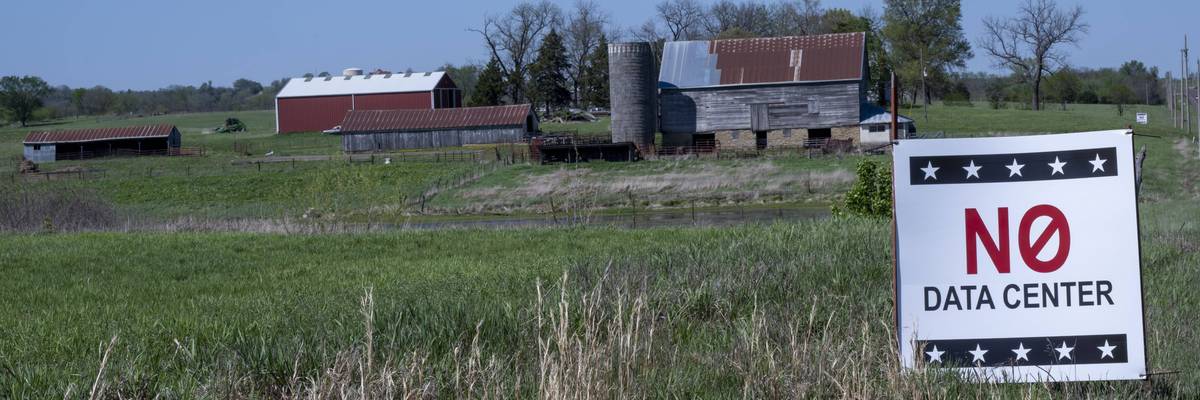
Small town residents raise concerns about a hyperscale data center proposed in Tonganoxie, Kansas on April 16, 2026. Amazon is planning a data center in Texas that could be the largest creator of pollution in the country.
(Photo by Michael Siluk/UCG/Universal Images Group via Getty Images
Julia Conley
Aug 10, 2026
COMMON DREAMS
Amazon is boasting that the new data center it plans to build in Pecos County, Texas will be self-sustaining in its use of electricity, as the company has acquired permits to build a 7.65 gigawatt gas plant to power the massive facility, ensuring it won’t raise electricity prices for households in the area.
But the savings on utility bills will likely come at a cost for the US at large and the planet, as well as locals in West Texas.
According to reporting from Cleanview Newsletter on Friday, the site acquired by Amazon, GW Ranch, has a permit from the state allowing the construction of a gas power plant that could emit 33 million tons of carbon pollution, which would make it by far the largest single source of pollution in the US.
The James H. Miller Jr. Power Plant, which burns coal in Quinton, Alabama, is currently the biggest emitter of carbon dioxide, sending about 16 million tons of pollution into the atmosphere each year.
Power plants generally emit less than the maximum amount of carbon permitted, but the unprecedented limit for the new plant, which is being developed for Amazon by Pacifico Energy and will have 35 natural gas turbines, means it is likely that the company’s project will far exceed the pollution caused by the plant in Alabama.
The permits viewed by Cleanview, which tracks data centers and sustainable energy development, show that the power plant would be disconnected from the state’s electricity grid, at least at first, and an Amazon spokesperson said the company “believes in paying the full costs of powering our operations” and would not “raise electricity costs for Texas families.”
The on-site power generation will be “designed to transition to grid-connected service as interconnection timelines allow,” the spokesperson added—suggesting the data center could ultimately raise household electricity costs as well as supercharging carbon pollution in the area.
The company further tried to allay fears of the impact of the new data center and its dedicated power plant by saying it plans to use brackish water that isn’t safe for irrigation or consumption at GW Ranch; along with data centers’ impact on utility costs, communities have protested against the facilities across the country due to their massive water consumption.
But the advocacy group Climate Action Campaign said Sunday that in its rush to join the nationwide artificial intelligence data center buildout as President Donald Trump has demanded, Amazon “chose dirty power over clean.”
“Instead of building a modern, clean energy source to power its increased AI-driven electricity demand, Amazon chose to invest in a massive natural gas power plant to fuel its giant Texas data center,” said Margie Alt, the group’s director. “During this excessively hot and dry summer, riddled with forest fires and unbearable air pollution, a move like this is truly unacceptable.”
With Amazon pledging to eliminate its pollution-causing emissions by 2040, the company’s decision to join Meta, Microsoft, and Google in investing in its own power plant to build a data center was an example of “yet another major corporation dodging accountability,” said Alt.
“This isn’t innovation,” she said. “Despite its massive resources, Amazon is shirking its own responsibility and the industry’s promises of computing progress without the economic or health burdens to local communities. The result of that broken promise is that communities will pay the consequences with their health and their wallets.”
According to Cleanview, Pacifico Energy has plans to eventually build up to 750 megawatts of solar generation and 1.8 gigawatts for battery storage capacity at GW Ranch.
As it potentially doubles the amount of planet-heating carbon emissions that are currently sent into the atmosphere by the James H. Miller Jr. Power Plant, the plant at the GW Ranch site could heighten the risk of developing heart disease, asthma, chronic respiratory illnesses, and other health problems for people living and working in the area.
“Progress shouldn’t come at the expense of the rest of us just to power billionaires’ ambitions,” said Alt. “Shame on you, Amazon!”
The project, Kathryn Guerra, a campaign director at the watchdog group Public Citizen, told The New York Times, will “absolutely have a huge impact on the environment, and on public health.”
The project was made public weeks after Trump insisted that “smart” communities want data centers to be built in their vicinity—but numerous polls have shown the facilities, which offer few long-term jobs as they raise costs for families, are sparking outcry from across the political spectrum.
About 70% of respondents to a Gallup poll in March said they would oppose the construction of a data center in their area. About half of those who expressed opposition said they were mostly concerned with the environmental impact associated with data centers, or the potential for resources to be gobbled up by the facilities.
Tech giants TSMC and Sony to invest billions in advanced chip sensor plant
Sony Corp. and Taiwan Semiconductor Manufacturing Co. (TSMC) are planning to invest around $6.3 billion (€5.4bn) in a joint venture to produce advanced image sensors in Japan, according to Nikkei.
The joint venture is expected to be owned 60% by Sony and 40% by TSMC, with mass production potentially beginning as early as 2029, the paper also reported.
The companies are expected to finalise the investment agreement in the coming months.
It would see the two tech giants develop and produce together high-performance camera sensors at Sony Semiconductor Solutions’ existing plant in Kumamoto.
Sony is the world's largest maker of image sensors, which are widely used in smartphones and automobiles, while TSMC is the world's largest contract chipmaker.
Meanwhile, TSMC reported net revenue of approximately NT$467.58 billion (€12.6bn) for July 2026, an increase of 5.6% from June 2026 and 44.7% from July 2025.
Revenue for January through July 2026 totalled NT$2,872.06 billion (€77.6bn), up 37.0% compared with the same period in 2025.

No comments:
Post a Comment