EAST GERMANY; FROM STALINISM TO FASCISM
Could an AfD victory put Germany’s economic recovery at risk?
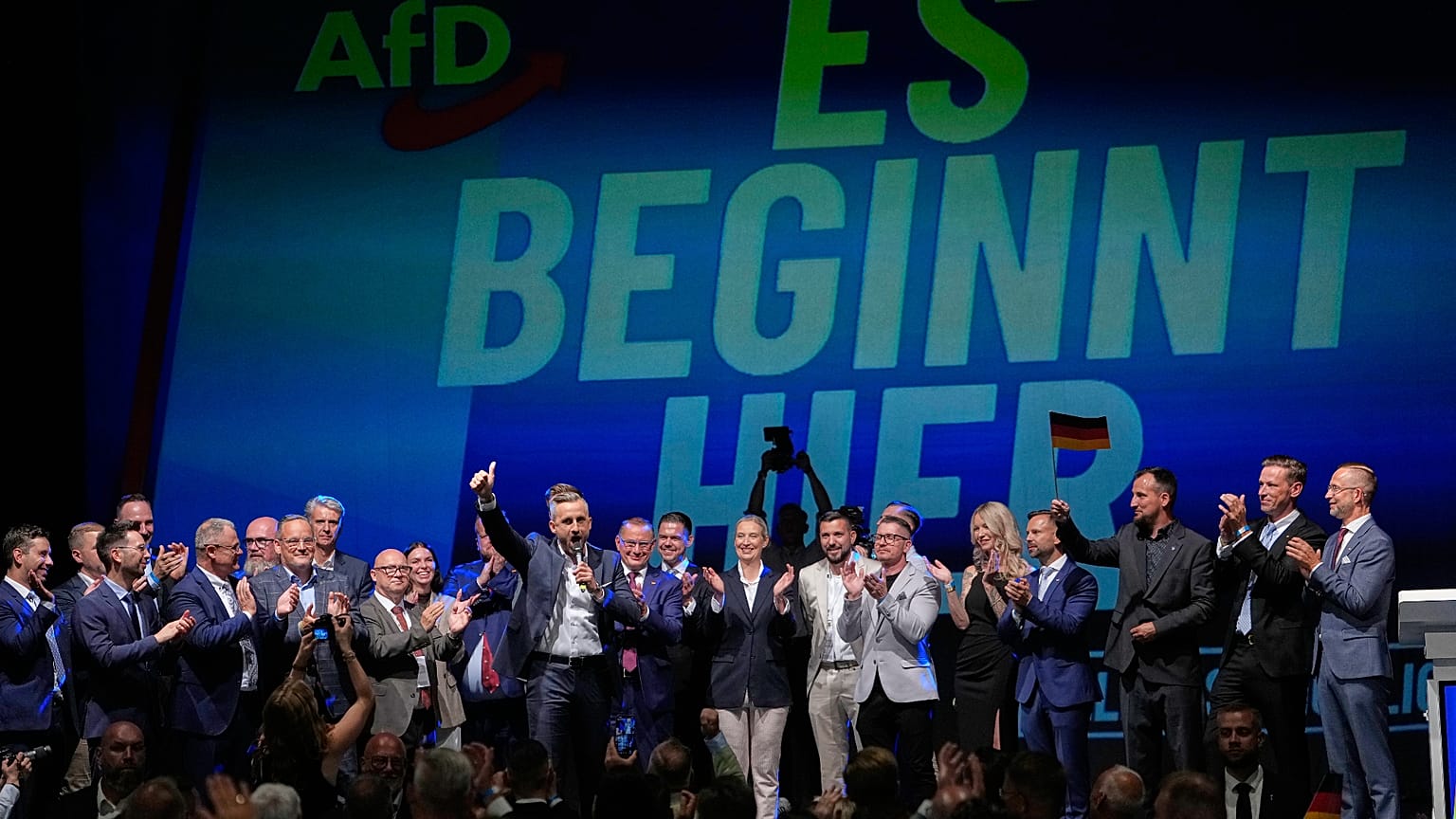
AfD’s historic Saxony-Anhalt victory adds a potential new political risk to Germany’s fragile recovery, raising fears that fragmentation in Berlin could delay reforms needed to sustain growth.
Germany crossed a line on Sunday that had held since the Federal Republic was founded in 1949.
The Alternative for Germany (AfD) took 43.8% of the vote in Saxony-Anhalt, the first outright win for a far-right party in a German state since the war.
It secured 39 of the 83 seats in the Magdeburg parliament, three short of a majority.
The result was equally striking for what happened to Chancellor Friedrich Merz’s Christian Democratic Union (CDU). Its vote share collapsed to 17.2% from 37.1% in 2021.
The Social Democrats, Greens and Left Party each secured eight seats.
The immediate economic consequences should be small. Saxony-Anhalt accounts for less than 2% of German output.
The bigger risk lies in what happens next in Berlin.
The real political risk is in Berlin
The AfD more than doubled its 2021 vote and became the first far-right party to win a German state election since the Second World War.
At the national level, the result reinforces an already dramatic erosion of support for Merz.
Only 13% of Germans are satisfied with the chancellor’s performance, matching the lowest reading for any incumbent chancellor in the history of the ARD-DeutschlandTrend survey.
The AfD leads nationally on 27%, six points ahead of the CDU/CSU at 21%, according to the latest polling average compiled by DAWUM.
That matters because Germany’s economic strategy increasingly depends on a federal government capable of implementing politically difficult reforms.
“We see an increasing risk of a political stalemate at the national level that would derail necessary reforms and could prompt us to revise Germany’s potential growth downwards,” Oxford Economics economist Alexander Valentin said.
The direct economic impact of the eastern state elections should remain limited.
Oxford Economics estimate that Saxony-Anhalt, Berlin and Mecklenburg-Western Pomerania, the three states voting this autumn, account for only around 8% of German GDP.
Together, they hold just 11 of the 69 votes in the Bundesrat, Germany’s upper house.
Valentin said none of the likely election outcomes would alter the national balance of power, assuming the federal coalition survives.
The risk is therefore less about an immediate economic shock and more about political contagion.
Heavy losses for mainstream parties could intensify internal pressure on the CDU and Social Democrats.
That could make compromises over pensions, labour markets and energy policy harder.
Corporate Germany now needs reform, not just spending
Germany’s industrial difficulties were never simply caused by insufficient government spending.
Slow permitting, high energy costs, labour shortages, ageing infrastructure and weakening competitiveness have all complicated long-term investment decisions.
Intel’s abandoned semiconductor project in Saxony-Anhalt became a symbol of that problem.
The US chipmaker was going to spend €30 billion on a chip complex, backed by roughly €10 billion of federal subsidy and promising 3,000 direct jobs. Intel cancelled the project in July 2025.
The challenge is even clearer in Germany’s most important industrial sector.
Volkswagen AG is implementing the biggest restructuring in its 89-year history.
On 3 September the supervisory board approved Future Plan 2030, adding 50,000 job cuts to the 50,000 already under way.
That is close to 100,000 positions by the end of the decade, around 15% of the group's workforce.
Four German plants, at Emden, Zwickau, Hanover and Neckarsulm, have no secured car production beyond 2031.
Shares of Volkswagen AG have fallen by 78% since their 2020 highs.
The broader German car industry tells a similar story.
Germany produced 2.65 million passenger cars during the first eight months of 2026, 4% fewer than a year earlier and 16% below 2019 levels.
Political fragmentation make fixing these problems harder.
Markets are cautious, not panicking yet
The market reaction to Sunday’s regional election was relatively muted.
The DAX index traded 0.3% lower.
The 10-year Bund yield rose by just 1 basis point to around 3.35% on Monday, close to levels not seen in 15 years.
The rise from June’s 2.8% Bund yield has been driven mainly by higher energy prices, renewed inflation concerns and expectations of tighter European Central Bank policy, rather than by Germany’s political turmoil itself.
Still, persistently higher borrowing costs increase the price of policy mistakes.
There is light, and there is a deadline
The irony is that Germany’s underlying economic data are beginning to strengthen.
The S&P Global manufacturing PMI jumped from 52.2 in July to 54.3 in August, its highest in 51 months.
New orders increased at the fastest pace since February 2022, helped by defence spending, data-centre construction and stockpiling.
“The recovery in the German manufacturing sector kicked up a gear in August,” S&P Global Market Intelligence economics associate director Phil Smith said.
That leaves Germany at an economic crossroads.
Sunday’s election does not kill the recovery. Defence spending, infrastructure investment and improving factory orders could keep growth moving higher.
Germany no longer lacks fiscal firepower.
What Sunday put in doubt is whether it still has the political cohesion to spend it well, and the two years in which that question gets answered have already begun.

No comments:
Post a Comment