The Alternative for Germany party’s victory in the Saxony-Anhalt state election is an ominous coup for the far right.
By C.J. Polychroniou ,
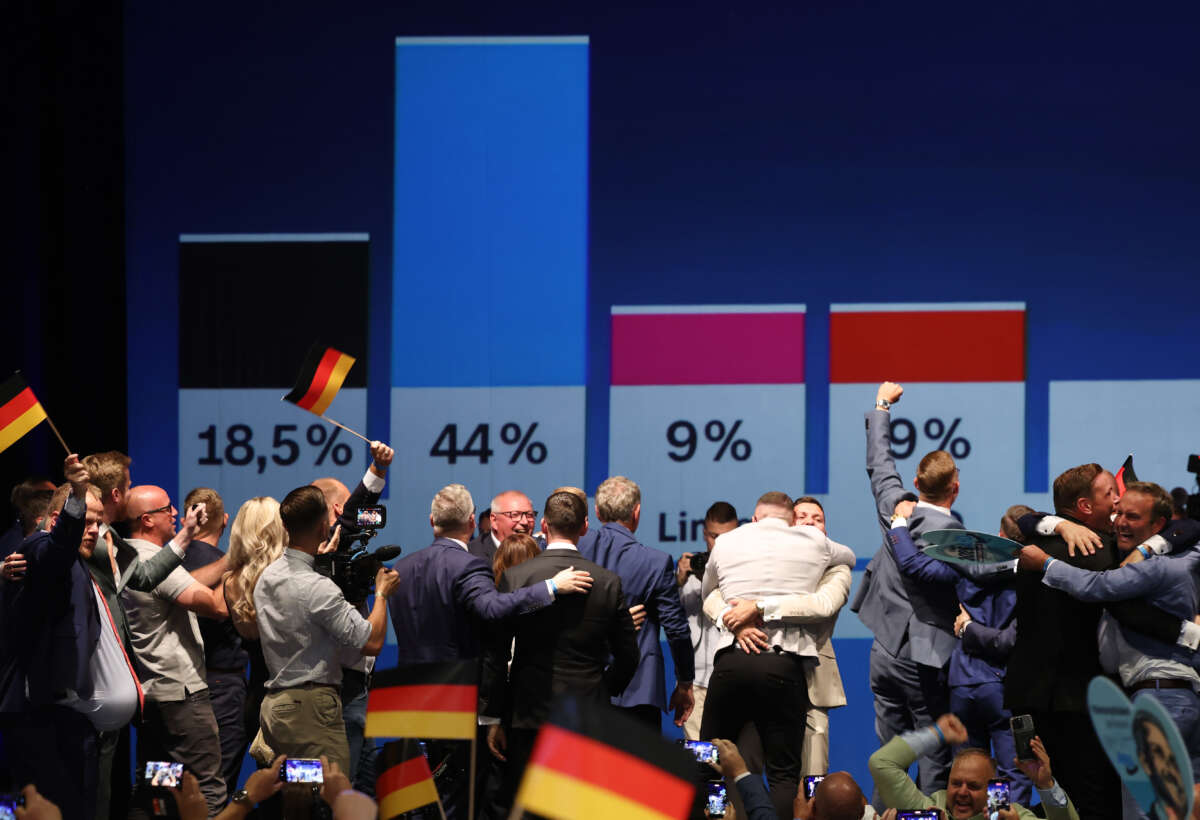
The far right Alternative for Germany (AfD) party scored a landslide victory this past Sunday in Germany’s Saxony-Anhalt state election, although it fell short of a majority in its bid to form the first far right state government in the country’s postwar history. It won 43.8 percent of the vote, more than doubling its share of the vote five years ago in the region, while Chancellor Friedrich Merz’s conservative Christian Democratic Union slumped to a historic low of 17.2 percent, down from 37.1 percent in 2021.
This shocking result has been a long time in the making. Neofascist ideology has been creeping into Germany’s mainstream political arena for the past few decades even though the country’s domestic intelligence agency has classified the AfD as an “extremist party” because its leaders have espoused far right rhetoric. Indeed, the party, which has grown rapidly since it was formed in 2013, is not hiding its racism and authoritarianism and has been quite blunt in its rejection of a liberal, pluralistic society.
Neofascist ideology has been creeping into Germany’s mainstream political arena for the past few decades.
Unsurprisingly, AfD leaders are exuberant over their party’s election success in Saxony-Anhalt and seem to think that the tide has finally turned to the point that winning in the next national election with at least 40 percent of the vote is now within reach. Meanwhile, the leaders of Spain and Portugal’s largest far right parties rushed to congratulate the AfD for its victory in Saxony-Ahhalt, as well as Hungary’s former prime minister Viktor Orbán. So did Elon Musk, posting a resounding “Well done!” on his social media platform X in response to a post from AfD’s co-leader Alice Weidel.
How realistic is the prospect that Germany may have a far right federal government by 2029? A recent poll indicates that if national elections were held today, the AfD would indeed emerge victorious with 28 percent of the vote. The reasons for this unsettling development are complex and may go beyond pure economics, although the state of the economy figures prominently into the equation, especially in east Germany, where Saxon-Anhalt is located, and where the AfD is particularly strong.
More than three decades after Germany’s 1990 reunification, there is still a wide gap between east and west. As numerous studies have pointed out, “East Germany is still 20% to 25% poorer than West Germany.” People living in East Germany have realized that convergence under neoliberalism has proved to be a mirage. Under the massive privatization scheme that was launched after 1990 by the government agency Treuhandanstalt, East Germany’s entire state-owned economy was privatized while its industrial base was decimated as thousands of publicly owned enterprises were closed or sold, leading to massive unemployment and triggering a demographic crisis as young and educated people moved westward in search of jobs and better living conditions.
Treuhand’s essential role was to organize the looting of East German industry and public wealth. As Hanna Behrend, a leading academic in the former German Democratic Republic wrote in her edited volume German Unification: The Destruction of an Economy,“Within less than three years, Treuhand destroyed or handed over to West German big business for next to nothing national property to the value of at least several hundred billion Deutschmarks … By 1994 … Treuhand had privatized 13,800 industrial enterprises; a further 3,354 had been closed down.”
This experience with “shock therapy,” which essentially converted East Germany into Berlin’s colony, remains firmly embedded in the collective memory of most East Germans. As Federal Commissioner for East Germany Elizabeth Kaiser has pointed out, many young people in what used to be East Germany see West German culture and lifestyles as deeply foreign to them. People living in small towns and rural regions not only earn “below-average incomes,” they also see their infrastructure continue to collapse while public transportation and medical facilities are “no longer comprehensively guaranteed.” Indeed, as Kim Leonie Kellermann at Ruhr University in Bochum has shown, the mass layoffs that resulted in East Germany because of the Treuhand privatization policies had profound effects on political alienation and mistrust of mainstream parties, “even up to 30 years after unification.”
It is within that context, and with the full realization on the part of many of its citizens that the parties of the establishment offer no hope for the future, that East Germany has become a stronghold of the AfD. Accordingly, the AfD has taken full advantage of the situation by promising a return to a “golden age.” The problem is that the AfD has, instead, a dystopian vision for the future, advancing an agenda that can best be described as “neoliberal fascism.”
The party, which has grown rapidly since it was formed in 2013, is not hiding its racism and authoritarianism.
Ahead of the regional election, the AfD put out a government program for the Saxony-Anhalt region. In the Preamble, the draft government program acknowledges real economic problems facing the region, such as collapsing infrastructure, hospitals and schools closing, the rising cost of living, and dwindling pension benefits, but assigns equal weight to the alleged threat posed by immigration and promises “deportation from minute one!” In addition, it wants to exclude children and adults without a permanent residency from attending schools. It also calls for radical changes in asylum rules, while its solution to the chronic shortage of skilled workers facing the country is to encourage Germans who live abroad to come back.
As the icing on the cake, the AfD calls for a thorough identification with German culture and commitment to the so-called traditional way of life, which includes “the marriage of a man to a woman, from which children are born.” The only thing missing in this section is “Heil Hitler.”
The economic doctrine of the AfD diverges from that of other far right parties on the continent in that it is almost exclusively anti-statist. While the economy as such did not play a major role in the evolution of the party until 2022, it has since taken a more central function. But the policies advocated are highly incoherent and quite contradictory. For instance, the AfD rejects regulation of the economy and advocates huge tax cuts, but at the same time defends the debt break and voted against amending the Basic Law to establish a special fund for infrastructure and climate neutrality in 2025.
Like other far right parties globally, the AfD is staunchly against a green transition, as its position is that climate change is a hoax and an ideological component of “globalism.” With regard to energy, the AfD’s stance is to return to reliance on Russian gas and nuclear power plants.
On the question of war and peace, the AfD is against the war in Ukraine but is by no means an anti-military party. In fact, it has argued in favor of massive increases in the military budget and calls for the return of compulsory military service, which ended in 2011 under former chancellor Angela Merkel.
AfD’s social sensitivities are confined to pensioners, and the party has proposed raising pensions by 70 percent of the last net income. But the idea that this proposal could somehow be financially viable alongside the fiscal impacts of the massive tax cuts, increases in defense spending, and fiscal discipline the party also proposes would simply make most economists throw their hands up in frustration.
The threat of German fascism is back.
After all this, the question is why so many voters across different age groups and economic backgrounds have been drawn to the extremist and impractical policy proposals of the AfD. The state of the economy in East Germany can only partly explain AfD’s support, especially since the party has also made noticeable gains with voters in several western states. The failure of the old political parties, especially of the Social Democrats, who have overwhelmingly lost the trust of the working class, in offering a viable vision for the future could form part of the explanation. In addition, it is quite possible that observers have overestimated the extent to which denazification reached ordinary society. It appears that attachment to ultranationalism remains a strong current among a rather sizable segment of the German population.
On the positive side, nearly half of Germans oppose the far right forming a government in Saxony-Anhalt and protests against the AfD erupted across Germany immediately after the election.
Be that as it may, the victory of the far right in a regional election is a turning point for German politics. The AfD has called for collaboration with other parties and may in fact strike a deal with the Bündnis Sahra Wagenknecht (BSW), a party of authoritarian tendencies that combines left-leaning economic policies with socially conservative views, particularly on immigration. Its founder and leader, Sahra Wagenknecht, appears eager to talk to the AfD about government options in Saxony-Anhalt.
The threat of German fascism is back.
This article is licensed under Creative Commons (CC BY-NC-ND 4.0), and you are free to share and republish under the terms of the license.
C.J. Polychroniou
C.J. Polychroniou is a political scientist/political economist, author and journalist who has taught and worked in numerous universities and research centers in Europe and the United States. Currently, his main research interests are in U.S. politics and the political economy of the United States, European economic integration, globalization, climate change and environmental economics, and the deconstruction of neoliberalism’s politico-economic project. He is a columnist for Global Policy Journal and a regular contributor to Truthout. He has published scores of books, including Marxist Perspectives on Imperialism: A Theoretical Analysis; Perspectives and Issues in International Political Economy (ed.); and Socialism: Crisis and Renewal (ed.), and over 1,000 articles which have appeared in a variety of journals, magazines, newspapers and popular news websites. Many of his publications have been translated into a multitude of languages, including Arabic, Chinese, Croatian, Dutch, French, German, Greek, Italian, Japanese, Portuguese, Russian, Spanish and Turkish. His latest books are Climate Crisis and the Global Green New Deal: The Political Economy of Saving the Planet (with Noam Chomsky and Robert Pollin as primary authors, 2020); The Precipice: Neoliberalism, the Pandemic, and the Urgent Need for Radical Change (an anthology of interviews with Noam Chomsky, 2021); Economics and the Left: Interviews with Progressive Economists (2021); Illegitimate Authority: Facing the Challenges of Our Time (an anthology of interviews with Noam Chomsky, 2023); and A Livable Future Is Possible: Confronting the Threats to Our Survival (an anthology of interviews with Noam Chomsky, 2024).
The AfD just short of an absolute majority
Thursday 10 September 2026, by Helmut Born
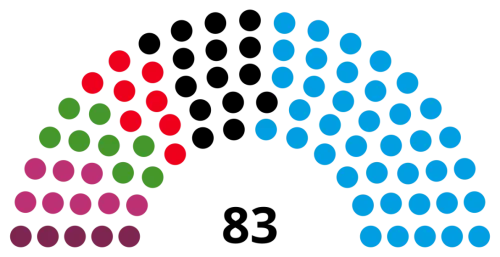
On 6 September a new Landtag was elected in Saxony-Anhalt. Saxony-Anhalt is the smallest of the territorial Länder by population, with 2.1 million people. It was clear in advance that there would be considerable changes. At the last Landtag election in 2021 the AfD, which the Saxony-Anhalt domestic intelligence service has classified as confirmed right-wing extremist, took over 20 per cent. In the run-up to this election the standing of the federal government of CDU and SPD reached a low point, as the opinion polls had made foreseeable. Accordingly the task for all the other parties was at least to prevent an absolute majority for the AfD, in percentages as well as in seats. [Image: Composition of the Saxony-Anhalt Landtag following the elections (from left to right): BSW: 5 MPs – Die Linke: 8 MPs – Die Grünen: 8 MPs – SPD: 8 MPs – CDU: 15 MPs – AfD: 39 MPs]
When the first projection was published on the evening of 6 September, showing the AfD on 44.2 per cent, the election-night parties of the other parties fell completely silent. The shock the result produced was too great. It looked altogether different at the AfD, which many people call a Nazi party. The party’s leading figures around the [national] co-chairs Alice Weidel and Tino Chrupalla crowded around the lead candidate Ulrich Siegmund to celebrate together what they called their historic election victory.
The CDU, the large bourgeois party, was punished terribly above all. It lost more than half of its votes and of its deputies. The liberal FDP did not make it into the Landtag at all and goes on wasting away. For the party Die Linke, too, the evening was not a happy one: three weeks before the election it had still been recorded at 13 per cent, and it has now ended up on only 8.4 per cent. The SPD and the Greens, by contrast, were able to improve slightly on their result at the last Landtag election, reaching 9.1 and 8.9 per cent respectively, a little more than Die Linke.
The decisive factor was a massive campaign by influential civil-society organisations which had called for tactical voting, so as to ensure that the SPD and the Greens got back into the Landtag at all. That had been in the balance for a long time. It was certainly a surprise that the Bündnis Sahra Wagenknecht (BSW) also entered the Landtag, which it managed with 5.3 per cent.
In the new Landtag, made up of deputies from six parties, forming a new Land government will not be easy. Since the AfD with 39 of 83 seats did not obtain an absolute majority of the seats, it depends on coalition partners or on support from others. All the other parties have refused to form a government with the AfD. The BSW too rejects a coalition with the AfD. Instead, according to the BSW, an independent minister-president should be elected, who would put a government together and would have to win a majority every time. This model existed in the Netherlands as well, at the election before last, when the party of the racist Geert Wilders narrowly missed an absolute majority and nobody wanted him as prime minister. It remains to be seen whether the AfD will agree to it. The SPD and the Greens have already declared themselves in favour.
For Die Linke this election result was a disappointment. It lost 2.4 per cent against the last Landtag election. The party certainly did not have an easy campaign, since it has a good anchoring only in the cities and its results in the countryside are traditionally poor. That showed again at this election. In the two large cities of Halle and Magdeburg it was able to win three direct mandates. All 38 other constituencies went to the AfD.
The party Die Linke has to become clearer and more radical. Many people simply assign it to a red-green camp together with the SPD and the Greens, which the "vote tactically" campaign also showed. It has to become clear that Die Linke stands for clear opposition to existing conditions, that its representatives are not "politicians" like all the others, that it wants to overcome capitalist class society, and that this will not be achieved in parliament alone. However good its parliamentary demands may be, and however much such measures would noticeably improve people’s lives if they could be realised, there will be no majorities for them in the parliaments. What is needed is a party that is both represented in parliament and that is able to change the social balance of forces through pressure on the street, through anchoring in workplaces and neighbourhoods, and through fostering the self-confidence and self-organisation of those below.
9 September 2026
Translated by International Viewpoint from SoZ.
Helmut Born
Helmut Born is an active member of the ISO (section of the Fourth International in Germany), of the party Die Linke and of ver.di, the trade union which organises in public and private services.
.png)
.png)

No comments:
Post a Comment