Intensified by Fossil Fuel-Driven Climate Crisis, ‘Godzilla-Level’ El Niño Smashing Records Ahead of Peak
“As long as we continue to burn fossil fuels,” said one scientist, El Niño “occurs on an increasingly hotter baseline, making it much more difficult for communities to deal with the consequences.”
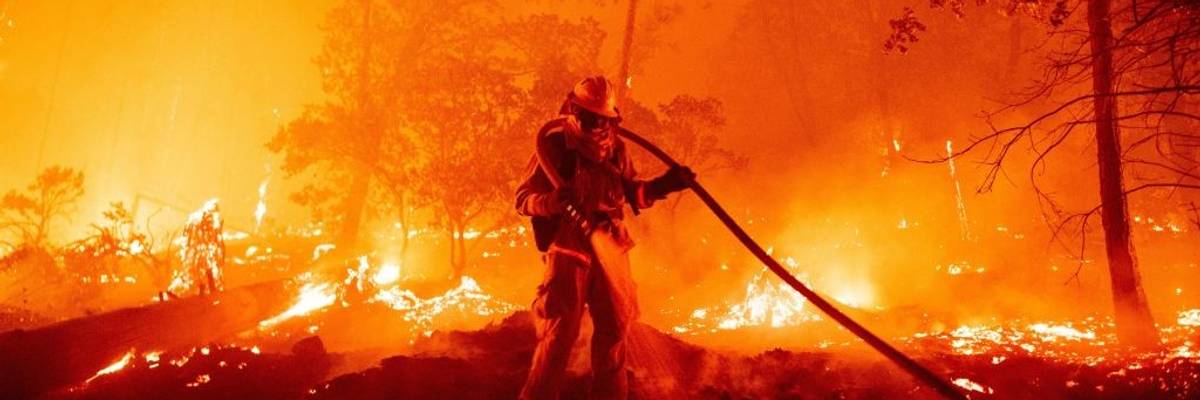
A firefighter douses flames as they push toward homes during the Creek Fire in the Cascadel Woods area of unincorporated Madera County, California on September 7, 2020. The El Niño event of 2026 is expected to cause a variety of extreme weather, including dry conditions in some regions and extreme rainfall in others, in 2027.
(Photo by Josh Edelson/AFP/Getty Images)
Julia Conley
Sep 22, 2026
COMMON DREAMS
Although “El Niño comes and goes,” as one climate scientist said of the naturally occurring warm-weather phenomenon on Monday, experts are in agreement that this year is different—with meteorologists already recording a temperature rise of 3.07°C in the Pacific Ocean, putting it at a statistical tie with November 2015, when El Niño caused the ocean to warm by 3.08°C.
The temperature rise is not expected to peak until November and December, when an average of 14 models examined by Zeke Hausfather of Carbon Brief and Berkeley Earth found that a temperature rise of 4.1°C is forecast.
The event has been underway since June, Hausfather wrote, and has been gathering strength “faster than any previous event on record.”
Scientists typically track the strength of El Niño—which leads to heavy rainfall, higher global temperatures, and other extreme weather as warmer Pacific waters are pushed to the south—using the Niño 3.4 anomaly, or ONI, which determines how much hotter the central Pacific is compared with a 30-year rolling average.
A temperature rise above 2.0°C is considered a “very strong” El Niño, and scientists and policymakers are already calling this year’s event a “super El Niño,” with some experts using the terms “Godzilla-level” and “jaw-dropping” to describe the weather conditions that can be expected in the coming months due to the warmer climate.
As Common Dreams reported late last month, planetary heating driven by fossil fuel emissions is intensifying El Niño, while the naturally occurring phenomenon can in turn worsen the impacts of the climate emergency.
In the last 40 years scientists have recorded a 16% increase in the strength of El Niño events, according to a study published in Science last month. They’ve also gotten 36% stronger than they were before industrialization began.
The “double whammy,” as The Guardian called it, could make 2027 the hottest year ever recorded, blowing through heat records that have just been set this year—and that have been linked to the deaths of people around the world from extreme heat and flooding.
“This event is a huge redistribution of energy in the climate system and is dangerous because it is unfolding on top of a much warmer, human-influenced climate system,” climate scientist Friederike Otto of Imperial College London told The Guardian. “So, in many places around the world we will see never-before-experienced heat extremes, with all their consequences on health, food security, and water stress.”
Despite the fact that El Niño predates the human-caused climate emergency, Otto said, “as long as we continue to burn fossil fuels, it occurs on an increasingly hotter baseline, making it much more difficult for communities to deal with the consequences.”
This year’s event is likely to be the most intense El Niño in 1,000 years, reported to The Guardian, with hotter and drier conditions already linked to deadly wildfires in Indonesia and crop losses in Central America and the Caribbean region due to drought conditions. Rice production this season is expected to fail in Indonesia, according to the Salata Institute for Climate and Sustainability at Harvard University.
As the Southern Hemisphere’s summer months approach, southern Africa and Australia are at heightened risk of wildfires and droughts as well. Meanwhile, cocoa production could be damaged by extreme rainfall in parts of South America.
“All strong El Niño events on record have continued to strengthen well into the winter—and the models are in near-unanimous agreement that this one will, too,” wrote Hausfather at Carbon Brief. “If the forecast holds, the current event will peak between November and January at a level far beyond any event previously observed in the instrumental record.”
In California on Monday, Democratic Gov. Gavin Newsom declared a state of emergency in an effort to prepare communities for El Niño’s impacts in the coming months, which could include coastal flooding and heavy snow in mountain regions.
Hausfather noted that strong El Niño events like those that occurred in 1997 and 2015 were also “associated with hundreds of billions of dollars in damages globally.”
“This event,” he told The Guardian, “is leaving those past ones in the dust.”
“As long as we continue to burn fossil fuels,” said one scientist, El Niño “occurs on an increasingly hotter baseline, making it much more difficult for communities to deal with the consequences.”
A firefighter douses flames as they push toward homes during the Creek Fire in the Cascadel Woods area of unincorporated Madera County, California on September 7, 2020. The El Niño event of 2026 is expected to cause a variety of extreme weather, including dry conditions in some regions and extreme rainfall in others, in 2027.
(Photo by Josh Edelson/AFP/Getty Images)
Julia Conley
Sep 22, 2026
COMMON DREAMS
Although “El Niño comes and goes,” as one climate scientist said of the naturally occurring warm-weather phenomenon on Monday, experts are in agreement that this year is different—with meteorologists already recording a temperature rise of 3.07°C in the Pacific Ocean, putting it at a statistical tie with November 2015, when El Niño caused the ocean to warm by 3.08°C.
The temperature rise is not expected to peak until November and December, when an average of 14 models examined by Zeke Hausfather of Carbon Brief and Berkeley Earth found that a temperature rise of 4.1°C is forecast.
The event has been underway since June, Hausfather wrote, and has been gathering strength “faster than any previous event on record.”
Scientists typically track the strength of El Niño—which leads to heavy rainfall, higher global temperatures, and other extreme weather as warmer Pacific waters are pushed to the south—using the Niño 3.4 anomaly, or ONI, which determines how much hotter the central Pacific is compared with a 30-year rolling average.
A temperature rise above 2.0°C is considered a “very strong” El Niño, and scientists and policymakers are already calling this year’s event a “super El Niño,” with some experts using the terms “Godzilla-level” and “jaw-dropping” to describe the weather conditions that can be expected in the coming months due to the warmer climate.
As Common Dreams reported late last month, planetary heating driven by fossil fuel emissions is intensifying El Niño, while the naturally occurring phenomenon can in turn worsen the impacts of the climate emergency.
In the last 40 years scientists have recorded a 16% increase in the strength of El Niño events, according to a study published in Science last month. They’ve also gotten 36% stronger than they were before industrialization began.
The “double whammy,” as The Guardian called it, could make 2027 the hottest year ever recorded, blowing through heat records that have just been set this year—and that have been linked to the deaths of people around the world from extreme heat and flooding.
“This event is a huge redistribution of energy in the climate system and is dangerous because it is unfolding on top of a much warmer, human-influenced climate system,” climate scientist Friederike Otto of Imperial College London told The Guardian. “So, in many places around the world we will see never-before-experienced heat extremes, with all their consequences on health, food security, and water stress.”
Despite the fact that El Niño predates the human-caused climate emergency, Otto said, “as long as we continue to burn fossil fuels, it occurs on an increasingly hotter baseline, making it much more difficult for communities to deal with the consequences.”
This year’s event is likely to be the most intense El Niño in 1,000 years, reported to The Guardian, with hotter and drier conditions already linked to deadly wildfires in Indonesia and crop losses in Central America and the Caribbean region due to drought conditions. Rice production this season is expected to fail in Indonesia, according to the Salata Institute for Climate and Sustainability at Harvard University.
As the Southern Hemisphere’s summer months approach, southern Africa and Australia are at heightened risk of wildfires and droughts as well. Meanwhile, cocoa production could be damaged by extreme rainfall in parts of South America.
“All strong El Niño events on record have continued to strengthen well into the winter—and the models are in near-unanimous agreement that this one will, too,” wrote Hausfather at Carbon Brief. “If the forecast holds, the current event will peak between November and January at a level far beyond any event previously observed in the instrumental record.”
In California on Monday, Democratic Gov. Gavin Newsom declared a state of emergency in an effort to prepare communities for El Niño’s impacts in the coming months, which could include coastal flooding and heavy snow in mountain regions.
Hausfather noted that strong El Niño events like those that occurred in 1997 and 2015 were also “associated with hundreds of billions of dollars in damages globally.”
“This event,” he told The Guardian, “is leaving those past ones in the dust.”
‘The Diagnosis Is Unambiguous’: 2026 Planetary Health Report Finds Pressure Mounting on Earth Systems
“Seven of nine planetary boundaries are transgressed, and pressure on all seven is at its highest recorded level,” said one scientist.
“Seven of nine planetary boundaries are transgressed, and pressure on all seven is at its highest recorded level,” said one scientist.

A protester is seen in Los Angeles during a climate change demonstration holding a placard that says, “There is no Planet B.”
(Photo by Ronen Tivony/SOPA Images/LightRocket via Getty Images)
Julia Conley
Sep 21, 2026
COMMON DREAMS
Like other recent warnings from climate scientists, the message sent by the latest Planetary Health Check report on Monday was clear: “We need to move fast,” as the director of the Potsdam Institute for Climate Impact Research, the group behind the report, said.
“Seven of nine planetary boundaries are transgressed, and pressure on all seven is at its highest recorded level,” said Johan Rockström, director of the Potsdam Institute (PIK).
The report finds that seven measures of the Earth’s health are no longer within the “safe operating space”: ocean acidification, freshwater change, land system change, climate change, modification of biogeochemical flows, introduction of novel entities, and change in biosphere integrity.
Just two markers, stratospheric ozone depletion and the increase in atmospheric aerosol loading, have shown improvement over the last decade, said the Planetary Boundaries Science Lab at PIK.
“The diagnosis is unambiguous,” said Boris Sakschewski, the lead author of the report. “Pressure is rising across every planetary boundary already outside the safe operating space. It means that the risk of large-scale, persistent, and potentially irreversible change is increasing, while our margin for error in tackling these problems is shrinking.”
The scientists behind the report emphasized that with recent news regarding the state of the planet’s crucial coral reefs, forests, and extreme weather events like heatwaves and flooding, it should come as no surprise that the Earth’s boundaries have been transgressed, as continued fossil fuel emissions have caused runaway planetary heating.
Earlier this month, United Nations scientists said the planet can no longer avoid at least a temporary temperature rise above 1.5°C over preindustrial levels.
Oceans have also become so warm that stressed coral reefs have less and less time to recover from climate damage, as Common Dreams reported last month, and a UN report last year found that the world’s governments are not moving fast enough to end the destruction of forests.
Last month and the summer of 2026 both set heat records, with extreme heat killing more than 1,000 people across Europe, and wildfires spreading across the continent and Canada. Record-breaking heat was also recorded in parts of Asia and the Middle East.
In June, the UN Children’s Fund found that nearly every child on Earth is now exposed to at least one climate hazard driven by fossil fuel emissions, including flooding, heatwaves, and drought.
“Pakistan’s 2025 monsoon floods affected more than 6.9 million people,” said PIK. “Global ocean heat content reached a new record in 2025, with Hurricane Melissa rapidly ramping up to a Category 5 hurricane and striking Jamaica after passing over exceptionally warm seas. From January 2023 to September 2025, bleaching-level heat stress impacted about 84.4% of the world’s coral reef area, making it the largest global coral-bleaching event observed to date.”
Hindou Oumarou Ibrahim, chair of Planetary Guardians, implored readers of the Planetary Health Check report to “read that list again: Pakistan, the Caribbean, Europe, the reefs beneath our oceans. These are not separate emergencies; the planet is telling us, in every region at once, that it is out of balance.”
“As chair of Planetary Guardians, I hear this same story wherever I go, whether from a pastoralist watching the rains fail season after season or a coastal community watching the sea rise,” said Ibrahim. “The 2026 Planetary Health Check puts data behind what communities on the frontlines already know from living it. We do not have the luxury of treating these as separate crises any longer.”
Rockström emphasized that while “we do not have the luxury of time... we do have the knowledge, capacity, and solutions to change course.”
“Accelerating action to return to the safe operating space across all planetary boundaries is essential to protect lives and livelihoods,” said Rockström, “and to deliver on the promise of shared future prosperity.”

No comments:
Post a Comment