I covered religion after the 9/11 attacks. I never imagined the hate would outlast the war.
(RNS) — Since 9/11, violence in America has come from within. Hate crimes against Muslims, Sikhs, Jews, Latinos, Black Americans and LGBTQ+ Americans are soaring. RNS CEO/Publisher Deborah Caldwell looks back on how we got here.

Tribute in Light, two vertical columns of light representing the fallen towers of the World Trade Center, shine against the lower Manhattan skyline. (Photo by David Z/Pixabay/Creative Commons)
Deborah Caldwell
September 8, 2026
(RNS) — I had just dropped my two little boys, ages 6 and 3, at school when news came over the car radio: First one plane, then a second, had hit the World Trade Center. I drove to a lookout on a mountain above my New Jersey town, where I could see the burning towers 14 miles east, one degree above the horizon: the width of my fingernail at arm’s length.
Within hours, fighter jets scrambled over my house, and bridges and tunnels into the city closed. For the rest of that week, I worked on a 56K home dial-up I didn’t disconnect for 150 hours. My sons were unfazed, their little worlds still knee hockey in the basement and stories at bedtime. That Friday, instead of their usual after-dinner treat, I drove them up the mountain.
At the lookout, candles burned on a giant stone semi-circle that looked like an altar, letters and posters taped to the rocks: grief (“Why?”), rage (“This will never happen again!”) and hope (“Let there be peace on earth”). The boys asked: “Why are the candles burning? What happened in New York, Mommy?”
I told them “bad guys” had knocked down the buildings and that we were safe. I wasn’t sure the second part was true.
I remember these details because I published an account of that vigil and my sons’ reactions only weeks after Sept. 11. Re-reading it now, at the 25th anniversary, I can see I spent the years after that night trying to answer their questions — and bearing witness to what came after. What I didn’t realize then was how many Americans would be treated as enemies in the years that followed.
In 2001, I was an editor at Beliefnet, a Web 1.0 website about religion, politics and spirituality. In the weeks after the attacks, we published everything we could to provide context and a wider perspective on Islam: “Forgive the Terrorists” by Archbishop Desmond Tutu, “What I Would Say to Osama bin Laden” by Buddhist monk Thích Nhất Hạnh, and official Muslim condemnations of the attacks. For his part, President George W. Bush stood in a Washington mosque and declared “Islam is peace.”
None of it quelled the anti-Muslim bigotry.

Attendees react during a vigil, the day after a shooting, outside of the Islamic Center of San Diego, Tuesday, May 19, 2026, in San Diego. (AP Photo/Jae C. Hong)
A former president of the Southern Baptist Convention described the Prophet Muhammad as a “demon-possessed pedophile.” The convention’s leadership continued to support what he said. Just after 9/11, commentator Ann Coulter proposed invading Muslim countries and converting them to Christianity. Nine months later on the “Today” show she suggested Muslims take up a hobby other than slaughtering infidels. Evangelist Franklin Graham described Islam as “a very evil and wicked religion.”
The nation’s leaders accounted for what caused the attacks. Congress created an independent commission and studied our preparedness and the immediate response. Today, there is a national memorial and museum, and every September, somber national observances.
Over the next two decades, though, violent attacks from within grew more frequent and widespread. The targets began with American Muslims, but eventually grew to include Sikhs, Jews, Latinos, LGBTQ+ people and, as always, Black Americans.

A makeshift memorial stands outside the Tree of Life Synagogue in the aftermath of a deadly shooting in Pittsburgh, Oct. 29, 2018. (AP Photo/Matt Rourke, File)
In 2012 a self-described white supremacist in Oak Creek, Wisconsin, killed six worshippers at a Sikh gurdwara, whose adherents are often mistaken for Muslims. In 2015 another self-described white supremacist sat through Bible study at Mother Emanuel AME Church in Charleston, South Carolina, and then shot and killed nine people. Three years later, a gunman killed 11 at the Tree of Life Synagogue in Pittsburgh, the deadliest antisemitic attack in American history. He had posted that a Jewish refugee agency was bringing Central American invaders into the country. As recently as late August, a teenager was charged with murder for coordinating with two other teenagers who in May shot a security guard and two other people outside a San Diego mosque, then killed themselves. Their manifesto included hatred for Muslims, Jews, Black people and the LGBTQ+ community.
There have been prosecutions, and hearings. Around the country, churches, mosques, temples and synagogues hired guards. The communities that were targeted built memorials, mostly with their own money. In Oak Creek, the congregation preserved a bullet hole on the prayer hall door frame and placed an inscription below that reads “We Are One, 8–5–12.” In Charleston, the $25 million Emanuel Nine Memorial, paid for largely by private donors, is expected to open in October. In Pittsburgh, Tree of Life has raised more than $50 million from donations, state and federal grants, and foundations but had to scale it back by 40% partly because of cost.
The country reckoned with the 9/11 attacks. It built the memorial and the museum and set aside a day to mourn. But America has not yet treated the hate crimes that followed as one continuous story that requires a national response.
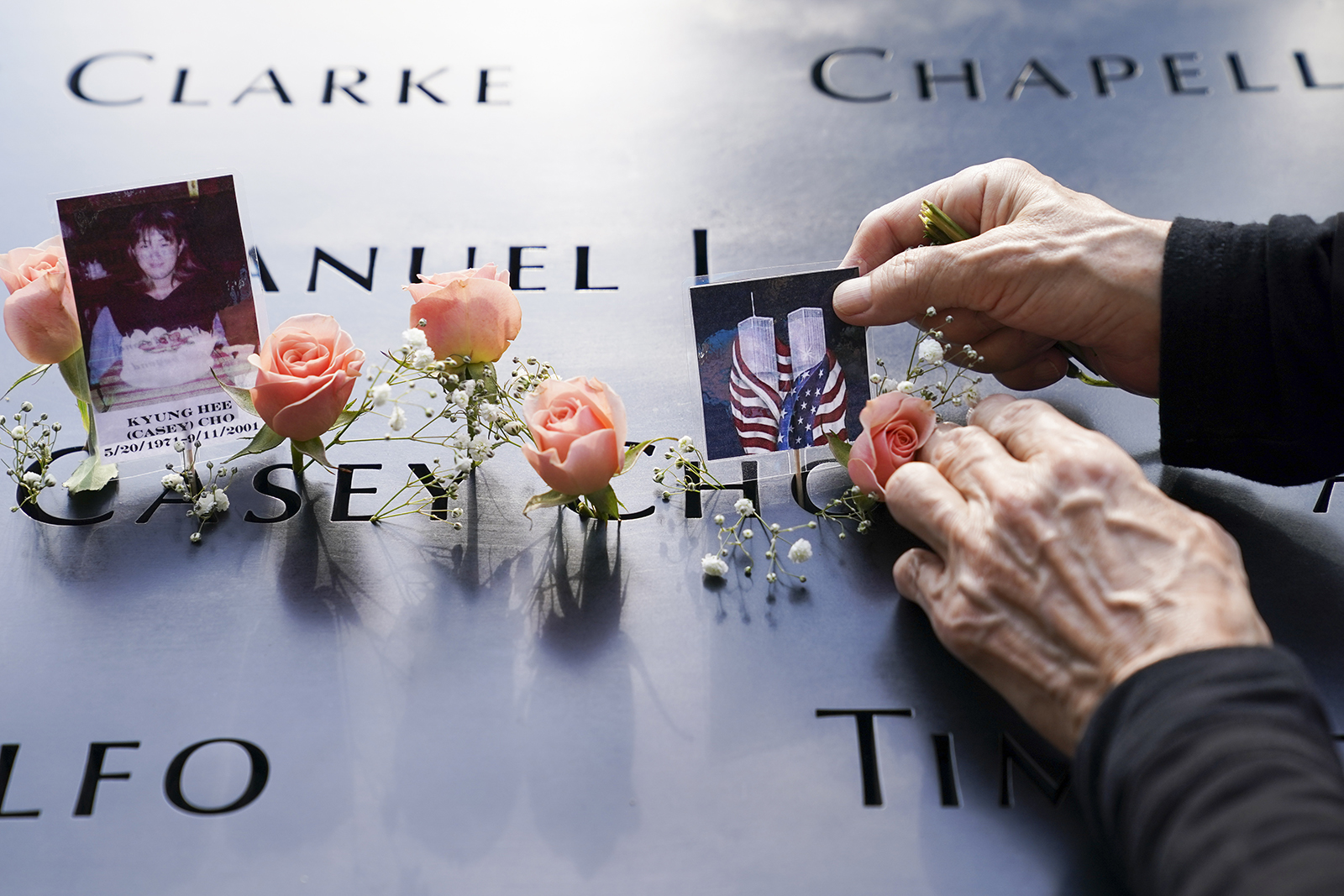
Mourners place flowers and pictures in the name cut-out of Kyung Hee (Casey) Cho at the National September 11 Memorial and Museum, Sept. 11, 2020, in New York. (AP Photo/John Minchillo)
Chronicling these incidents is journalism’s job, and journalists do it, story after story. RNS and many others have reported on the fact that in 2025, the Council on American-Islamic Relations (CAIR) logged 8,683 anti-Muslim complaints, the most in the 30 years of recordkeeping.
And the Anti-Defamation League counted 6,274 antisemitic incidents in 2025, the third-worst year since tracking began in 1979. In New York City, anti-Jewish crimes account for more than half of all confirmed hate crimes through August of 2026.
And hate crimes against Black Americans have been the most common for as long as the FBI has kept count. In 2024, anti-Black incidents made up more than half of all racial and ethnic hate crimes.
Preliminary FBI data put anti-Latino hate crimes at 1,014 in 2025, a record that moved them into the top three most-targeted groups for the first time in 34 years of tracking. ICE agents have arrested people in church parking lots, at preschool pickup and, once, while a pastor preached. In Latino and Haitian immigrant parishes, people stopped coming.
Twenty-five years after 9/11, the country is still holding vigils. For Muslims and Sikhs. For Black churchgoers, for Jews and for Latino and Haitian immigrants. Americans know how to grieve together. We proved that for 9/11. We valorized the victims of the 9/11 attacks — but we have not yet done the same for these victims of decades of hate crimes.
What I gave my boys 25 years ago was a candlelit night on the mountain and a promise that they were safe. It turned out to be true for them. They weren’t seen as the “enemy.” The hatred came for other people’s children.
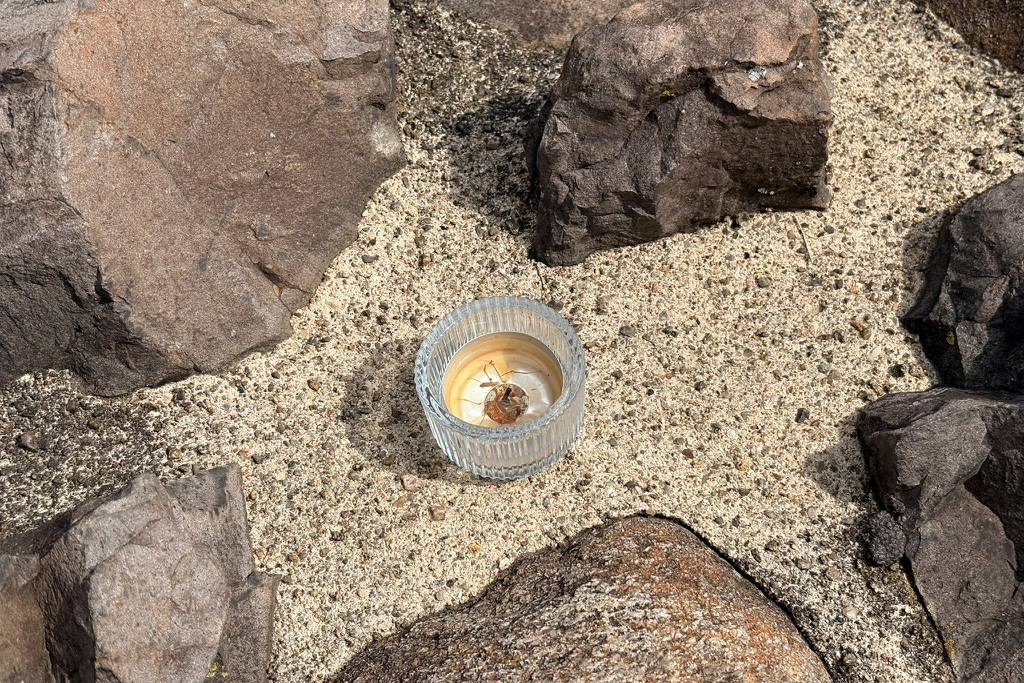
A single, extinguished votive candle atop a New Jersey lookout near New York City. (RNS photo/Deborah Caldwell)
Last month, I visited the lookout where I watched the towers burn that morning. The small plaque that commemorated 9/11 for several years is no longer there. The view of lower Manhattan is now blocked by trees that, like my sons, have grown taller. I walked the entire stone semi-circle, and at the spot where I’d stood the morning of Sept. 11, 2001, there was a single votive candle, extinguished.
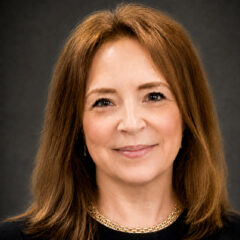
Deborah Caldwell. (Courtesy photo)
Deborah Caldwell is the Publisher and CEO of Religion News Service.
(RNS) — New mosques often stir up local resistance and anti-Muslim sentiment. Even when they get built, the blowback can be intense.
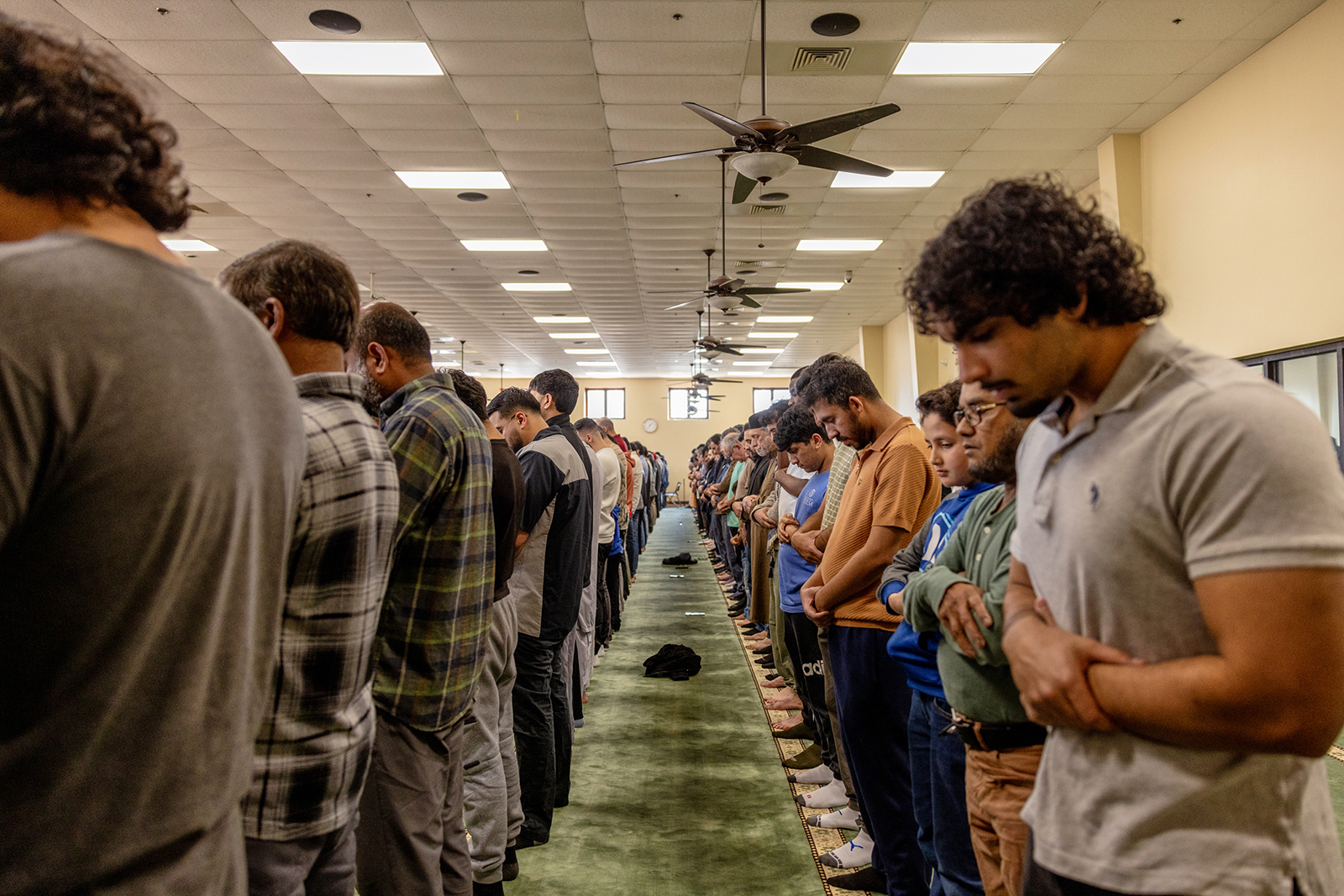
People pray at the Islamic Society of Tulsa, Friday, Feb. 13, 2026, in Tulsa, Okla. (AP Photo/Brittany Bendabout)
Ulaa Kuziez and Bob Smietana
September 9, 2026
(RNS) — In late 2009, Daisy Khan and her then-husband hoped to build a place of healing for a city still grieving over the hateful acts of the 9/11 terrorists.
They called their planned mosque and community center, modeled after Jewish community centers and YMCAs across the country, Cordoba House — a reference to a Spanish city where Muslims, Jews and Christians once coexisted peacefully.
The project was meant to counter extremism and be a powerful testament to the American promise of religious freedom and the resiliency of New Yorkers.
“We are faithful people. We are very good Americans,” Khan, a Muslim nonprofit leader, told Fox News in late 2009, when plans for the center first started to become public, according to The New York Times. “And we need to project a different message of Islam, one of tolerance, love.”
Instead, the community center, which would have been built about a five-minute walk from the former site of the World Trade Center, became a national flashpoint after critics labeled it the “Ground Zero Mosque” and launched a national movement to stop the project. That led to marches in the streets, with protesters holding up “No Sharia” signs; claims that Muslims did not deserve the same religious freedoms as other Americans; and organized efforts to stop not just the Cordoba House but any proposed mosque around the country.
“We tell Muslims that they have to integrate, and then when their institutions begin to grow, and they want to be part of the American fabric, we tell them you’re growing too much,” Khan told RNS in a recent interview.
The Cordoba House building project eventually failed in 2014. And 25 years after the 9/11 attacks, Muslim communities across the country say they are still facing opposition to mosque projects. Often, resistance is framed around similar warnings of “Sharia law” and misinformation around the faith.
“In fact, by some measures, public attitudes toward Islam have become more negative than they were immediately after the Sept. 11 attacks,” according to Pew researchers, with 42% of Americans saying Muslims have a negative impact on the country in a recent study.
Yet, most mosque projects in the U.S. are successful. The number of mosques in the U.S. has more than doubled since 9/11, going from about 1,200 in 2000 to about 2,800 in 2024, according to the Faith Communities Today Project overseen by the Hartford Institute for Religion Research, which studies congregational life in the United States.
But there is often stiff resistance.
According to RNS’s reporting, as well as other news reports, at least eight mosque expansion projects have faced anti-Muslim opposition over the past year, including large-scale resistance at public hearings and litigation.
Those projects include three mosques in Texas, and one each in New Mexico, North Carolina, New Jersey, Pennsylvania and Oklahoma.
“We still get linked to 9/11. We still get linked to terrorism, and it continues on,” Khan said. “That’s my regret: Twenty-five years after 9/11, we still haven’t learned anything.”
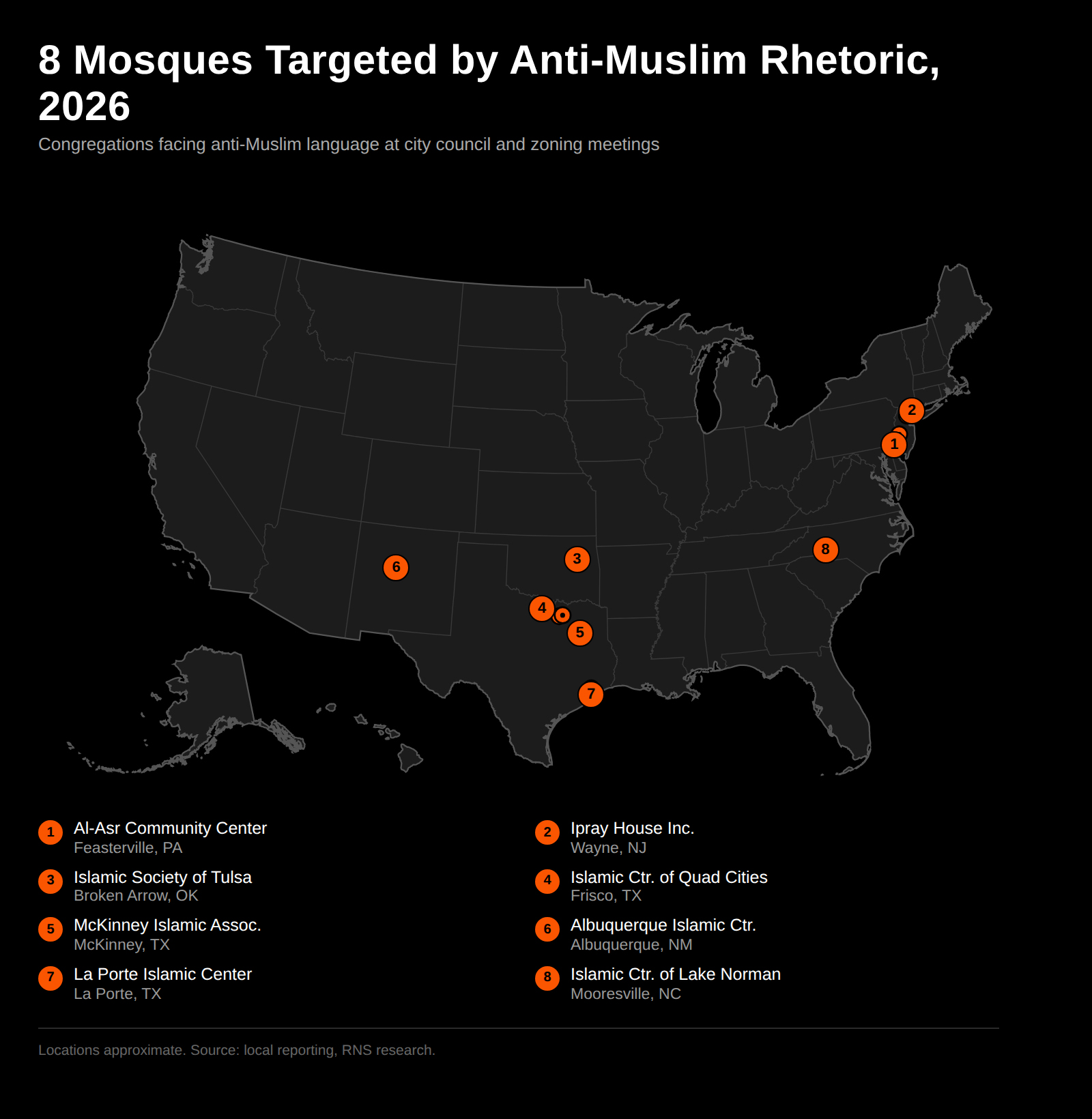
“8 Mosques Targeted by Anti-Muslim Rhetoric, 2026” (RNS graphic/Pam Kruger)
In Broken Arrow, Oklahoma, just outside of Tulsa, leaders of a proposed mosque filed suit after a request for a zoning change to allow a mosque was denied. City officials and the local zoning board had recommended approving the project, but the City Council voted it down. In some emails, mosque opponents made claims, which the city’s mayor agreed with, that the mosque was a threat, according to the complaint filed by mosque organizers.
“It’s the same Islamophobia cycle that comes every once in a while,” Imad Enchassi, an Oklahoma City University religion professor and senior imam at the Islamic Society of Greater Oklahoma City, told RNS earlier this year. “I see a pattern in which people are being fed lies and misconceptions.”
RELATED: Broken Arrow mosque leaders sue over alleged discrimination
Two years ago, a small Muslim congregation in McKinney, Texas, proposed building a new mosque on 5.5 acres in the north Dallas suburb. The nearly 700 worshippers had outgrown their current space. City planners rejected the rezoning request over land-use concerns.
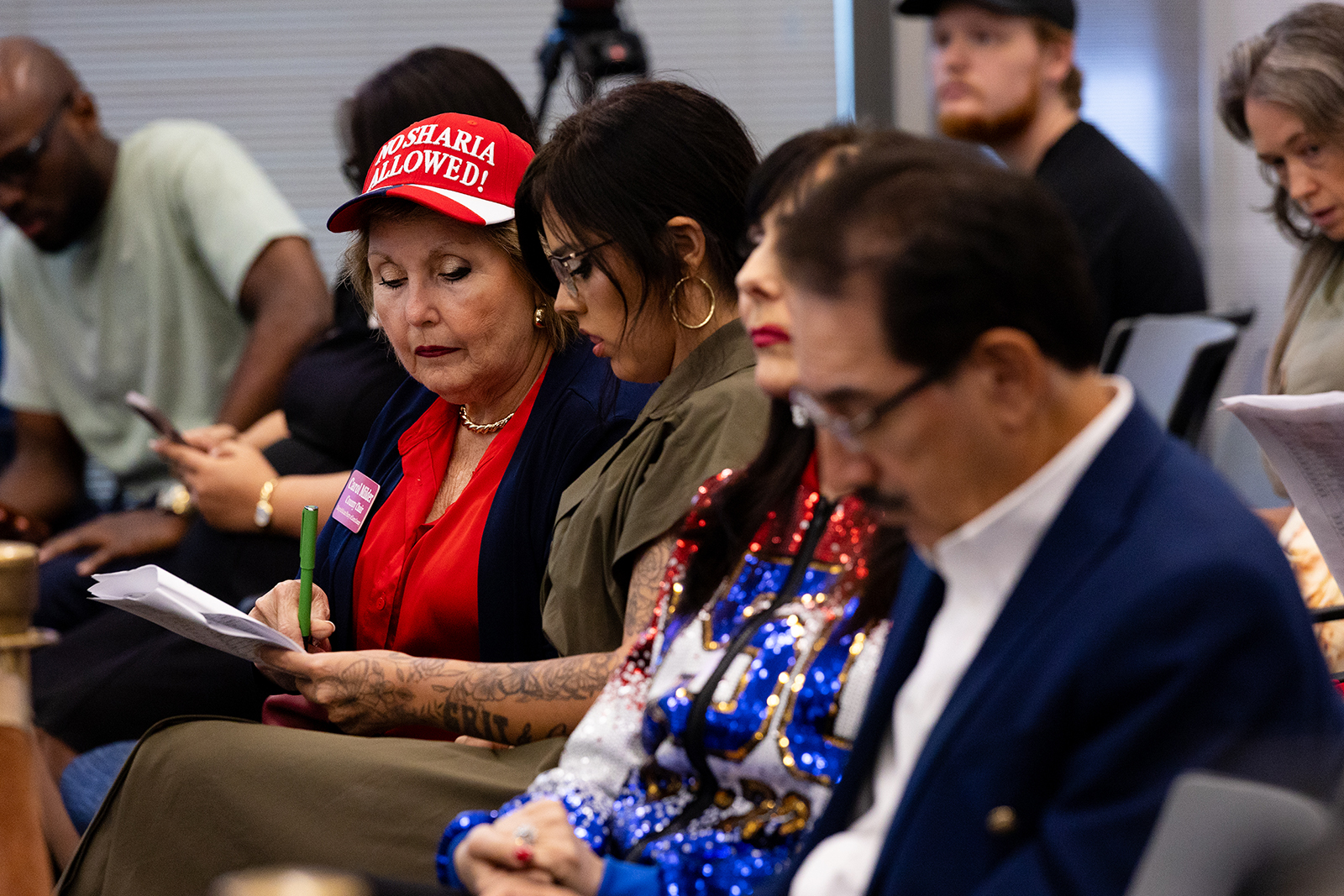
Carol Milder, chair of the Leon County Republican Party, wears a hat reading “No Sharia Allowed!” while attending a Texas State Board of Education hearing at the Barbara Jordan State Office Building in Austin, TX on Monday, June 22, 2026. (RNS photo/Angela Wang)
Most neighbors at the time raised what mosque President Yasser Wardany called “genuine concerns” about noise, traffic and parking. Only a few opposed the project using anti-Muslim rhetoric.
Hoping to be “good neighbors,” Wardany said the Islamic Association of McKinney spent the next two years reworking its plans with engineers and city staff to mitigate concerns before reapplying.
When mosque leaders returned to the city council this year, things had changed.
Dozens of critics spoke against the project at city council meetings, with some explicitly saying Muslims don’t belong in McKinney or Texas. Online, anti-Muslim activists brought large followings to rally opposition.
At a contentious city council meeting on Aug. 4, Republican Texas Rep. Keith Self, one of the founders of the Sharia Free Caucus in the U.S. Congress, spoke against the mosque, warning about “political Islam” and the alleged spread of Sharia in Texas.

Muslims pray in the gym of the new Unity Center, a former elementary school, in Lubbock, Texas. (Photo by Shaheer Ali)
The McKinney City Council ultimately voted to approve the mosque. And despite loud opposition, Wardany said he was pleased to receive support from local faith communities and neighbors. Many showed up days later to thank council members for upholding the law.
“We’re very happy that the city of McKinney Council members stood by the rule of law,” he said to RNS, “because if they don’t, then this is going to affect us in other cities, and it will be a bad precedent for them.”
It’s not a surprise that there was fierce backlash to the mosque project in McKinney, said Asma Uddin, an assistant professor of law at Michigan State University and an expert on religious liberty.
The clear underlying sentiment is: We just don't want this mosque in our neighborhood.Ihsan Bagby, a scholar who researches American mosques
She said that religious minorities in the United States have often faced opposition as their communities grow. The number of Muslims in Dallas-Fort Worth has grown, with about 50 new mosques being added in the past few years.
“It happened with Catholics and Jews in earlier waves of immigration,” she said. “It’s happening with Muslims in North Texas now, and growth this fast, concentrated in a state with an activist political culture, gives opponents a constant supply of fresh, visible mosque projects to organize around.”
Opposition to the construction and expansion of mosques dates back to the 1980s. Resistance back then was small and mostly contained to immediate neighbors, says Ihsan Bagby, emeritus associate professor of Arabic and Islamic studies at the University of Kentucky.
After 9/11, anti-mosque activity surged across the country and became “very political,” Bagby explains.
“The clear underlying sentiment is: We just don’t want this mosque in our neighborhood,” he said. “And it’s gotten worse in the last decade. Clearly, clearly.”
The most recent data shows that 35% of mosques faced significant resistance from their neighborhood or city when they tried to expand or build between 2010-2019, according to the American Mosque Survey. By comparison, from 1980-2009, the average percentage of mosques that met opposition was 25%, the 2020 survey showed.
Mosque opposition campaigns often coincide with midterms or national flashpoints. But they also consistently occur outside of election cycles and under all administrations, said Saher Selod, director of research at the Institute for Social Policy and Understanding.
“And I think that’s what this constant opposition to mosques, unfortunately, is showing is that anti-Muslim sentiments are still very prominent,” Selod said.
Mosques remain relatively uncommon in the United States, making up less than 1% of the nation’s more than 350,000 houses of worship. But in more recent years, when municipalities opposed mosque projects, federal courts have often overruled them, drawing on the Religious Land Use and Institutionalized Persons Act, a law passed by Congress in 2000. The law protects the rights of Americans seeking to build houses of worship and forbids local governments from imposing stricter zoning and other rules on houses of worship.
But even when they win their battles in court, it comes with a cost. For example, it took two years and 39 federal court hearings for members of the Islamic Society of Basking Ridge in Bernards Township to get their mosque approved. That meant two years of meeting in rented space for prayers and paying legal fees instead of construction costs.
“Winning the lawsuit at the end doesn’t give those years back,” Uddin said. “And it doesn’t cover what the process cost people beyond money and time.”
That kind of struggle also sends a message that Muslims are not wanted.
“It dampens the ambition to try in the first place, and it slows down how Muslim communities can grow and put down roots the way any other congregation would,” she said.
And when a mosque goes up, that’s more political fodder for opponents, who paint a mosque not as a house of prayer but as a threat.
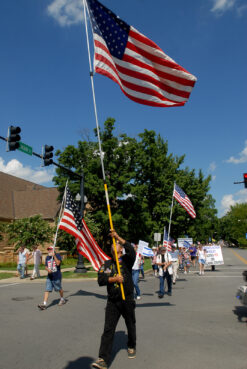
Protesters march during demonstration against a planned mosque and Islamic community center on Wednesday, July 14, 2010 in Murfreesboro, Tenn. Those opposing the mosque circulated a petition asking the county commission to rescind approval of the facility. (AP Photo/Christopher Berkey)
Last month leaders of the Islamic Center of Murfreesboro found themselves scrambling to find extra security and notify local police after an activist parked a truck emblazoned with “Deport All Muslims” outside of a mosque in nearby Nashville. The far-right activist, Jake Lang, also streamed himself handing out pulled pork sandwiches and denouncing Muslims, according to WKRN, a television station in Nashville.
“It just puts you on edge,” said Saleh Sbenaty, an engineering professor at Middle Tennessee State University and a longtime member of the Murfreesboro mosque.
In the early 2010s, Sbenaty was part of the group of Muslims in the Murfreesboro suburb of Nashville working to build a new mosque to replace a crowded and out-of-date building.
Most opponents, some of whom were also vocally opposed to the 9/11 mosque, organized marches in the streets and sued to block the mosque. Construction equipment at the building was set on fire. The federal government intervened in the lawsuit, arguing in court filings that Islam is a religion and that Muslims have the same religious liberty as other Americans. After a four-year court battle, the Supreme Court refused to hear an appeal by mosque critics, bringing the case to an end.
Yet anti-Muslim sentiment has been recently revived in Nashville. Lang’s publicity stunt was the latest in a series of anti-Muslim incidents in Nashville in recent years. Earlier this year, U.S. Representative Andy Ogles, a Republican who represents Nashville, made national headlines for claiming that “Muslims don’t belong in American society.”
Monty Fritts, a state legislator and failed candidate for Tennessee governor, claimed he would ban Muslims and other non-Christians if elected to office.
Sbenaty said that in the past, anti-Muslim activists had protested the mosque and sued to block the mosque from being built. Now elected leaders have joined in. Fringe ideas and conspiracy theories have become mainstream. And President Donald Trump has not helped.
“When the president of the United States says something, it adds fuel to the fire,” said Sbenaty.
I could never imagine being in this kind of situation here in the United States. But here we are.Saleh Sbenaty, a longtime member of a Tennessee mosque
Add to that the tensions over the war in Iran, which has led to some resentment of Muslims, said Sbenaty, and the environment has become more hostile. “I could never imagine being in this kind of situation here in the United States,” he said. “But here we are.”
He said that the protests at mosques and anti-Muslim rhetoric from politicians are distractions from the bigger issues the country faces, like a struggling economy. But that rhetoric takes a toll.
“It’s just added pressure,” he said. “I think that is what they are hoping to do. Add more and more pressure.”
Still, Sbenaty said all the effort and struggle that went into building the mosque was worth it. He said that he came to the U.S. from Syria because he wanted to be free. And he is not giving up that freedom, especially the freedom of religion.
“Even though it caused a lot of stress and anxiety and caused a lot of hardship, we would not have given up an inch,” he said. “This is the First Amendment, and it’s so embedded in our Constitution and in our thinking, that we cannot give up. No matter what the cost.”
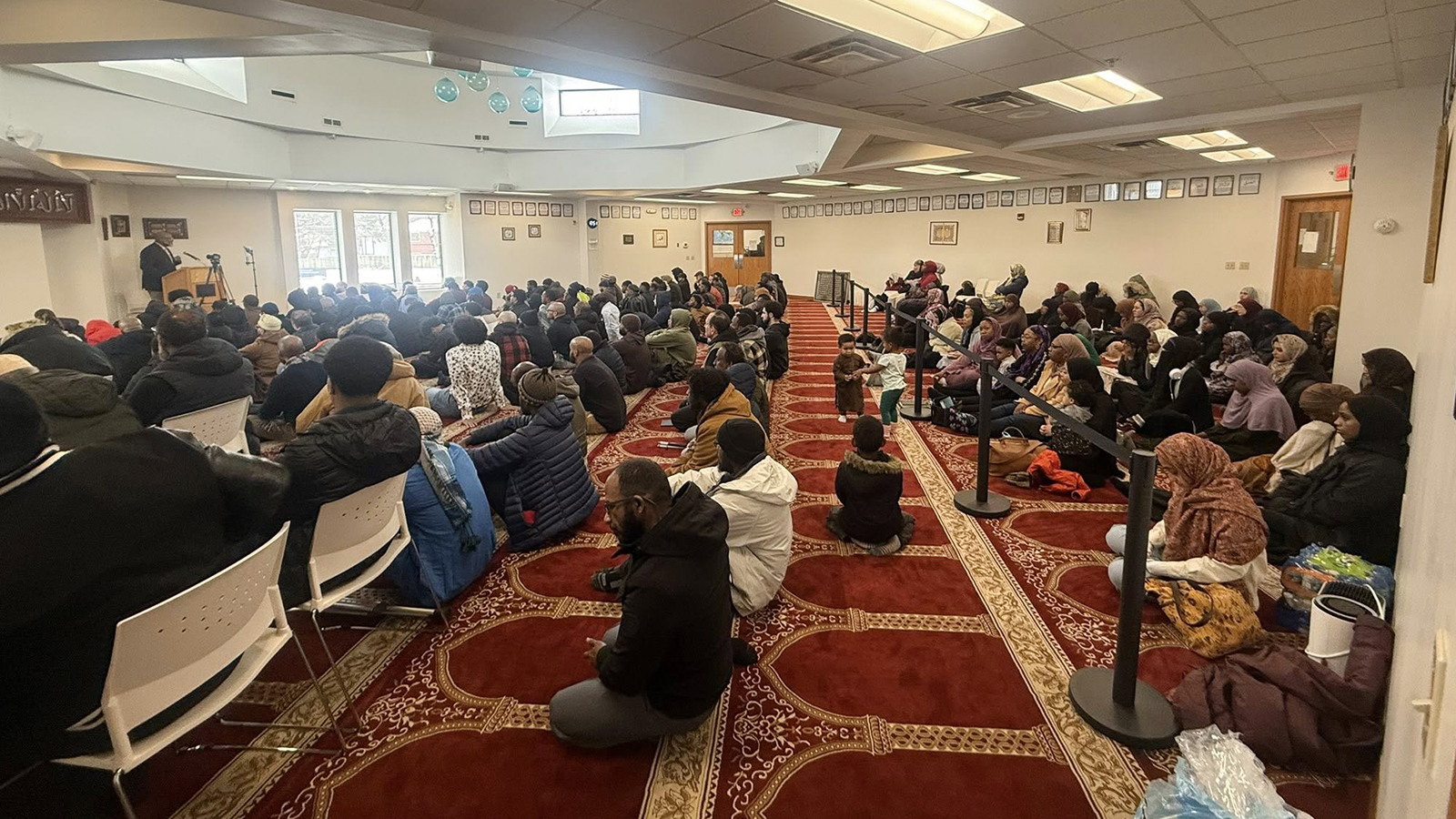
People attend Masjid An-Nur on the first Friday of Ramadan, Feb. 20, 2026, in Minneapolis. (Photo courtesy of Masjid An-Nur/Facebook)
For Uddin’s part, she sees the opposition to mosques, along with anti-Muslim activism, as part of a bigger movement that claims America is a nation for Christians.
“It’s about who gets to be visibly present in public space and who doesn’t,” she said. “The idea is simple: Public space should reflect and reinforce Christian identity, and any other faith’s visible presence in that space is an intrusion.”
RELATED: San Diego mosque shooting victims remembered as ‘men of courage, sacrifice and faith’
That kind of message can lead to people from non-Christian faiths feeling excluded. It can also lead to violence, in extreme cases. That’s something Uddin said her family has experienced.
In 2009, two teenagers were arrested for vandalizing a mosque in Miami, breaking windows and slashing tires in the parking lot. Her father had helped design and build that mosque.
“It’s an old story that keeps repeating itself,” she said.
Opinion
25 years of reporting on the state of American Muslims
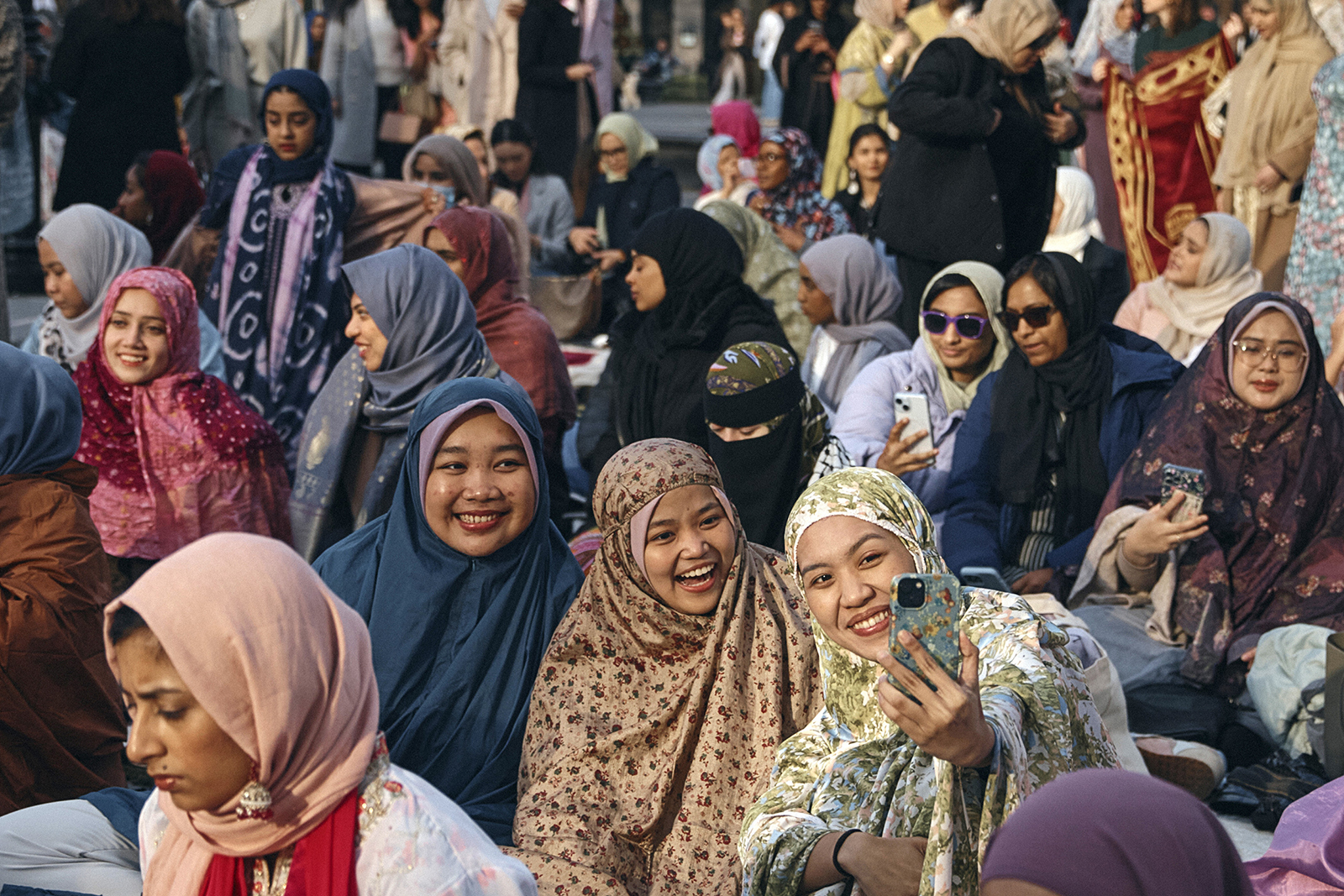
(RNS) — About a week after the terrorist attacks on the World Trade Center on Sept. 11, 2001 — four days of which I stayed in our Midtown Manhattan apartment being too scared to go outside, unable to leave the island to go to my parents’ place in Maryland because the bridges and tunnels in and out of the borough were shut down — I got on the subway and headed downtown as close as I could safely get to Ground Zero to begin reporting.
One of the first stories I reported was how Muslim students at New York University were dealing with the aftermath. Six dorms housing about 2,000 students in a 20-block radius of Ground Zero had been evacuated. Students were scared, with one young Muslim woman sharing her fears she would be pushed onto subway tracks.
I’ve thought about those students at times throughout my career — they were barely a few years younger than me. Some of the students I interviewed that day have gone on to become prominent imams, authors, commentators and other public-facing “career Muslims.”
I can’t think of a more defining way to start one’s career. I was a few years out of journalism school and hired (one month before 9/11) as an arts and culture reporter for a Muslim-focused digital media site. The intersection of 9/11 and the lives of American Muslims became my de facto beat, one that I am still covering in some way, shape or form 25 years later.
And while my commitment to reporting on and coordinating coverage of Muslim communities has remained consistent, the state of Muslim communities in America has fluctuated enormously in terms of power, authority and belonging. Muslim communities entered into a charged post-9/11 landscape and discourse and grappled with proving their Americanness, engaging in apologetics tours for things that needed no sweeping apologies, dealing with the surveillance of their spaces and chasing what often turned out to be performative allies.
“When you look at it from the 9/11 perspective, (Muslim American communities have) made some gains. We have more leaders who are Muslim; we have more Muslims in pop culture, although not completely representative,” said Zainab Chaudary, executive vice president of New Heights Communication. Chaudary spent a large part of the past 10 years working in rapid response, crisis communications and strategic messaging with coalitions at the intersection of national security and civil liberties.
While there has been some shift in discourse around Muslims, Chaudary said, “the underlying belief of Islamophobia in this country can be reignited at any moment,” which is evident since President Donald J. Trump took office in his second term.
Conditional acceptance of Muslims as Americans in the immediate years after 9/11 often hinged on their ability to provide something good or be a model minority. As former President Bill Clinton said at the 2016 Democratic National Convention, “If you’re a Muslim and you love America and freedom and you hate terror, stay here and help us win and make a future together.”
Meant to serve as a contrast to then-Republican presidential candidate Trump’s anti-Muslim rhetoric and threat of a travel ban, Clinton’s comment drew criticism from various civil rights groups that pointed out a conditional acceptance of American Muslims: Help us fight terrorism to be considered a good Muslim. Hillary Clinton, the 2016 Democratic presidential candidate further amplified this by stating several times on the campaign trail and in her nomination acceptance speech that American Muslims served “as a vital frontline defense against homegrown radicalization.”
This problematic framing of American Muslims grew from many things: years of inter-community and intra-Muslim battles around countering violent extremism programs (CVE) spearheaded during President Barack Obama’s administration; surveillance programs targeting Muslims (particularly the New York Police Department investigations of Muslims, which according to the Brennan Center for Justice, broke 95 percent of court-imposed rules regarding government surveillance programs around political activity); and internal pressures to issue large-scale apologies whenever any acts of terror occurred around the world.
A lot of my reporting and stories I edited in the first 15 years after 9/11 explored these questions: Should Muslims seek a seat at the proverbial table, and what strings came attached with that seat? And if not, do Muslim communities have the political and societal strength to influence policy and execute their own strategies and solutions? How can this strength be gained? Did they have authentic allies in place to build toward intersectional goals, or were these relationships more performative and transactional?
Chaudary said that one of the main problems Muslim communities continue to face since 9/11 was the failure to understand that communications is a long-term strategy rather than just advancing the kind of messaging to hopefully solidify Muslim Americans as unconditional threads of the American fabric. Who does that messaging serve?
“We’re trying to do persuasion instead of doing psychology,” she said. “And more and more because of the way algorithms serve us certain things, people’s perceptions are being shaped (in non-political spaces) before we even enter the room.”
Trump’s campaign and presidency in 2016 were a true test for Muslim American communities as fundamental breakdowns began to occur. While Muslim communities have since had successes in building political power and institutional strengths, understanding people’s psychologies around how they are influenced continues to be a challenge.
“People showed up at the airport in 2017 (when the so-called Muslim ban was enacted), but narrative wasn’t taken seriously as a strategy. We had an advocacy strategy, we had a legal strategy, but we did not do the work of having public opinion on our side,” Chaudary said. “We had the ability to make a lot of connections and build solidarity between a lot of groups. But what I’ve seen since then is a breakdown of that solidarity. It’s very easy to pick people off the margins in various demographics.”
A movement between Trump’s first and second terms grew from Muslim and other minority communities coalescing around grassroots initiatives to run for office (or stump for candidates who purported to support their concerns) and stand together in opposition to various Trump initiatives. But between the COVID-19 pandemic, the killing of approximately 1,200 Israelis on Oct. 7, 2023, the ensuing bombing campaign in Gaza (with the death toll surpassing 75,000 and its declaration as a genocide by the United Nations Independent International Commission of Inquiry) and most recently the Trump administration’s mass deportation campaign, a significant shift occurred within and around Muslim American communities.
As the politics and fear of division strengthened its grip on the country during Trump’s second term, what has also emerged is a doggedly stronger and more unapologetic and authentic ownership of what it means to be Muslim American during what are arguably harder times.
Muslim communities are dealing with the resurgence of numerous Republican leaders who push scare tactics around Shariah law taking over the country or vilify Islam as a political entity and not a religion. Various members of political office — at local, state and national levels — are hurling vicious anti-Muslim directives. One can look to Texas as the case study for the intense ramping up of Islamophobia and anti-Muslim measures.
Pushing back against all this continues to be a grind. “Do you want to know why I get mad? We are in the same struggle now that we were after 9/11,” Chaudary said. “We haven’t changed deeper psychology, and that … is not to make people more comfortable in our presence. That’s not our job.”
What has deepened is the continuous perpetuation of the idea that “somehow Muslims are violent, as well as deep-seated misconceptions about how Islam is somehow an evil religion,” she said. “Just listen to how (Vice President) JD Vance talks about (Michigan Democratic Senatorial candidate Abdul) El-Sayed — hinting at evil ideology. I think people have forgotten that this is not an “us versus them” story, that Muslim Americans are not outside of the story. We’ve had to deal with 9/11 and how it impacted our lives, too.”
And while the current climate in the United States for Muslims is perhaps worse now than the immediate years post 9/11, what also is different is steady growth in political strength and advocacy work, a stronger sense of self and a greater understanding of who truly is willing to build with Muslim American communities. One can consider the impact of student protesters in 2024, Rep. Ilhan Omar (D-Minn.) and Rep. Rashida Tlaib’s (D-Mich.) congressional battles, Zohran Mamdani’s mayoral success in New York or Abdul El-Sayed’s campaign in Michigan.
A few months ago I interviewed Haris Tarin, vice president of policy and programming for the Muslim Public Affairs Council, who said that Muslim American communities are more rooted now than post 9/11. From what I can see in my years on this beat, he’s right. “That is why Islamophobia is (now) more intense, because they know that American Muslims now have a little more influence,” he said. “They are able to push back, whether it’s at the ballot box or (through) litigation or in advocacy, or in the purchasing and buying power of American Muslims.” And above all, they hold onto hope.
Twenty-five years after 9/11, hope is a valuable commodity in current times. If there is one thing reporting on Muslim American communities for the past 25 years has taught me, it’s that looking at what the next generation is doing, rejecting, burning to the ground and building afresh is one of the best indicators of what may be to come.
(Dilshad D. Ali is a freelance journalist. The views expressed in this commentary do not necessarily reflect those of Religion News Service.)
The name Zainab Chaudary was misspelled in the original article. We regret the error.
More universities added Muslim chaplains post 9/11. Then came 10/7.
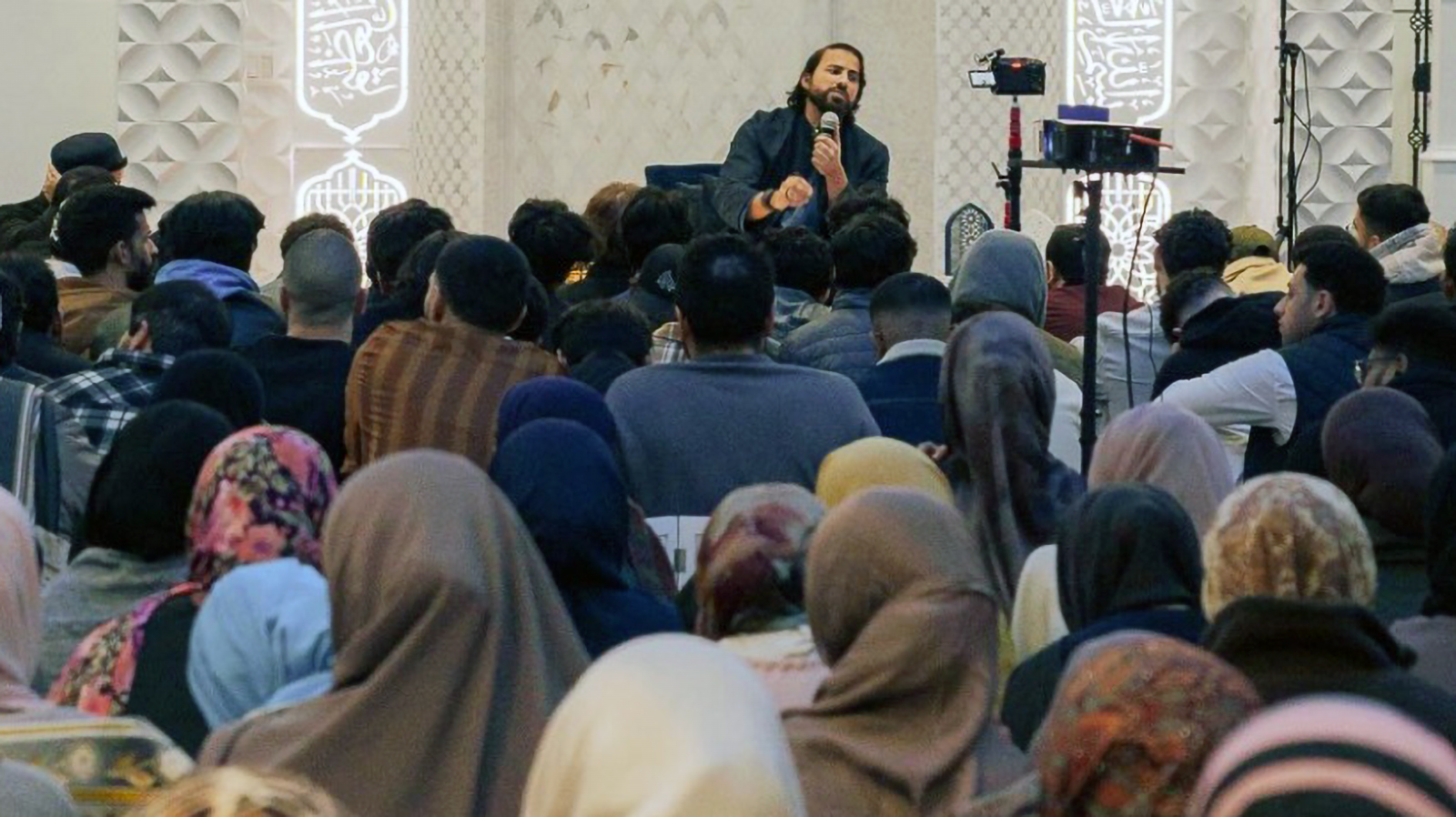
(RNS) — Saarah Abdul-Maajid chose to study at Rutgers University, in large part because she knew it had a Muslim chaplain and a Muslim center on campus where she would feel supported and valued.
A junior majoring in political science, she said she now spends at least part of each school day at the Center for Islamic Life at Rutgers University, located in the heart of the New Brunswick, New Jersey, campus. She takes a noncredit class on Islamic teachings with the chaplain there and usually finds a quiet nook to study. Many of her friends hang out there, and recently she has volunteered to be the center’s marketing intern.
“As Muslims, we’re very proud of our identities,” said Abdul-Maajid, 20. “Almost every other culture and religion seems to have their own spaces, and I can say we definitely have now, too.”
Shortly after the Sept. 11, 2001, attacks, universities across the country began to reckon with Muslim students in their midst, and within a decade, dozens, including Rutgers and all eight Ivy League Schools, added full-time Muslim chaplains to care for Muslim students. There are now 80 full time Muslim chaplains on college campuses across the country, and some have designated spaces for Muslim prayers and programs, according to the Association of Muslim Chaplains. It’s a big change from 25 years ago when only a few colleges had Muslim chaplains, and nearly all of them were volunteer part-time posts, the association said.
But that growth has collided with a more hostile moment for American Muslim students amid an increase in anti-Muslim political rhetoric, and in the wake of Israel’s war on Gaza, which has become a lightning rod in American politics and on college campuses.
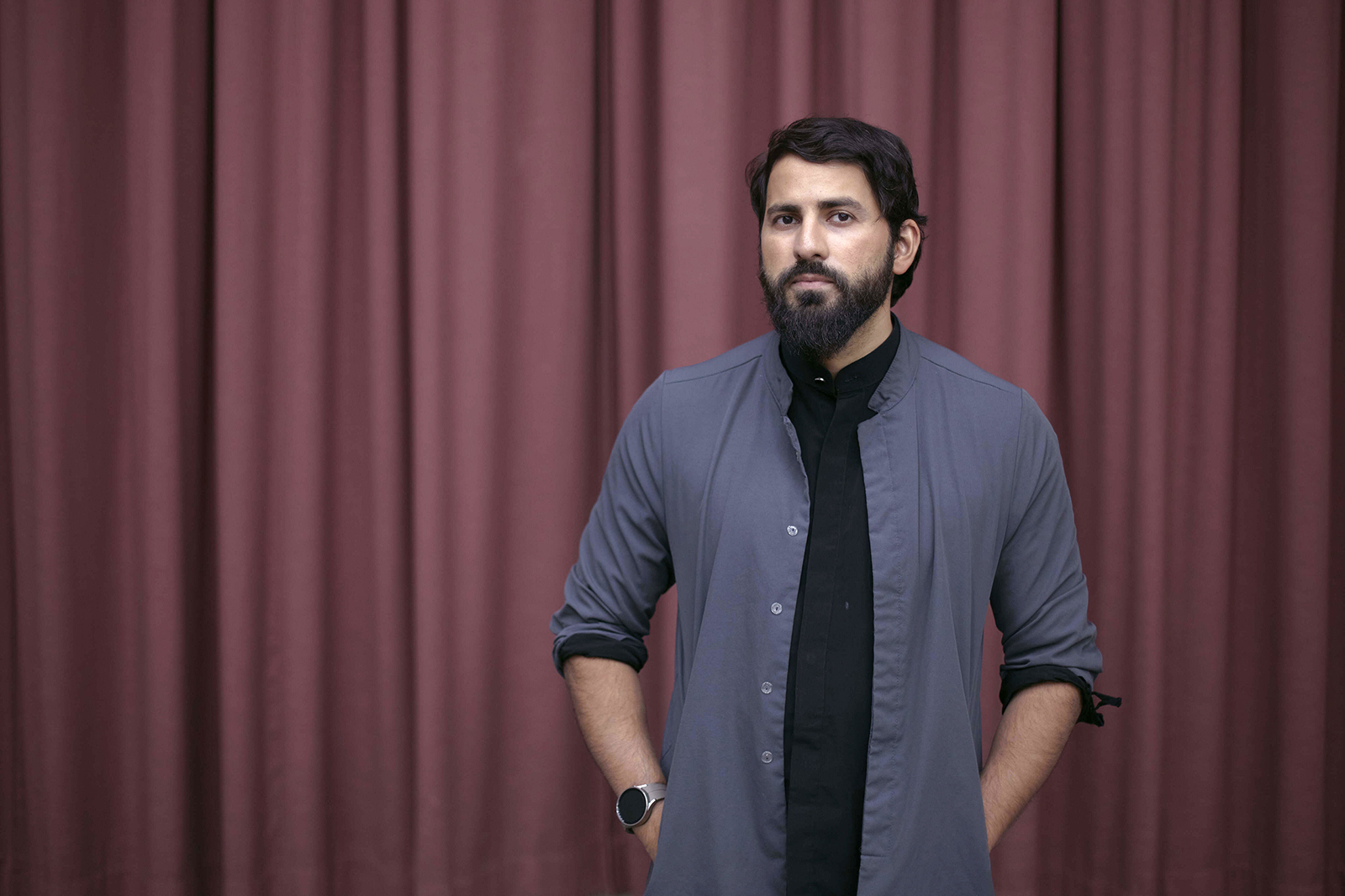
Muslim Chaplain Kaiser Aslam poses for a photograph at Rutgers University on Friday, Oct. 27, 2023, in New Brunswick, N.J. (AP Photo/Andres Kudacki)
“Muslim students have to constantly tell people what they’re not,” said Kaiser Aslam, the chaplain at Rutger’s Center for Islamic Life. “It’s good to have a space in which they can understand what they actually are. So that’s probably the first big bucket of what I do — provide emotional and spiritual support to individual students on campus.”
Rutgers was one of the first public universities to privately fund a full-time Muslim chaplain, beginning 15 years after 9/11. Unlike private universities, public universities funded by state and federal tax dollars cannot directly pay for faith-specific chaplains. They had to find a different way.
In 2010, students, alumni and New Jersey-based community leaders formed the Center for Islamic Life at Rutgers University (known as CILRU) and by 2015 had raised enough money to hire a full-time chaplain independently of the university, but with its blessing.
The center hired Aslam, who had just graduated from Hartford International University for Religion and Peace, then called Hartford Seminary. The Connecticut-based school began offering a Masters in Chaplaincy with a specialization in Islamic chaplaincy in 2001 that is an equivalent to a Master of Divinity. (Today two more schools offer similar degrees: Bayan Islamic Graduate School, in Southern California and the American Islamic College in Chicago.)
A handful of other state universities — in Illinois, Michigan, New York, Texas and California — have copied Rutgers’ model with independently funded Muslim chaplains serving Muslim students, and in some cases, a dedicated center for Muslim students where Friday prayers, classes and social events can be held.
Of Rutgers’ 47,000 students, about 6,000 are Muslim. That makes it among the largest, if not the largest, Muslim student population on any U.S. campus. (Universities don’t ask students to identify their faith, so exact numbers are hard to come by.) The University of Michigan at Ann Arbor has about as many. It too has an independently paid Muslim chaplain.
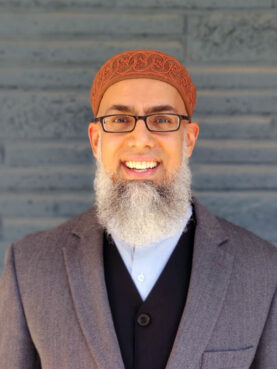
Omer Bajwa. (Photo courtesy of Yale University)
Still, the number of Muslim chaplains among the U.S.’s 6,000 colleges and universities is small overall, and even smaller at state schools. And the challenges of attending to the emotional and spiritual lives of Muslim students is even harder in the current political environment, which has seen a significant uptick in anti-Muslim rhetoric and campaigns against “Sharia law,” in states like Texas.
“President Trump has unleashed and emboldened horrible forces of racism, of Islamophobia, of antisemitism, of xenophobia, of homophobia,” said Omer Bajwa, the Muslim chaplain at Yale. “It’s a poisonous atmosphere that is antithetical to what I see chaplaincy and pastoral caregiving and community caregiving to be about.”
Add to that the Gaza war protests of 2024 and the widespread wave of student-led encampments and demonstrations against U.S. military funding of Israel’s war, begun in response to the Hamas attack on Israel.
Chaplains say the three years since then have been even more defining than 9/11, both for themselves and for the students under their care.
“There are moments in which a spotlight is shined on your Muslim identity, and right now, for many of our students, that was the aftermath of Oct. 7, 2023, when suddenly there’s that minting moment we could call it, where they become acutely aware that — ‘Wow, my identity leads people reacting to me or what I believe is important, very differently than others,’” Aslam said.
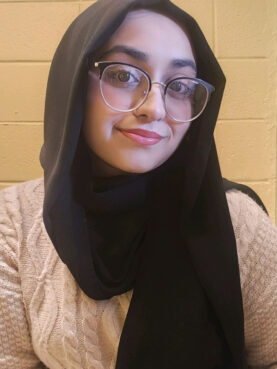
Saarah Abdul-Maajid, a junior at Rutgers University majoring in political science, visits the Center for Islamic Life at Rutgers University every day she’s on campus. (Photo courtesy of Saarah Abdul-Maajid)
As hard as it has been for students, it has also been a challenge for the chaplains themselves, caught between university administrators, students and parents with conflicting demands about Israel and Palestine. Chaplains have received threats and experienced doxxing, harassment and vandalism, often with support from the institutions employing them, said Jaye Starr, a hospital chaplain and secretary of the Association of Muslim Chaplains.
“It’s just a lot to always be seen as a threat,” said Joshua Salaam, the chaplain at Duke University and the president of the Association of Muslim Chaplains. “It does something to the Muslim psyche, like ‘Oh, this is how you think of us,’ and the university won’t allow a conversation or the mention of the word Palestine. It’s a hard world to live in, and it’s hard to communicate that to someone else who doesn’t have that lived experience.”
Still, for students like Abdul-Maajid, who began her studies at Rutgers in 2024 during the height of the student demonstrations, the past year has also brought some hope, especially in the election of New York’s first Muslim mayor — Zohran Mamdani and others who may be elected in the November midterms. (New Jersey’s 12th congressional district, for example, is likely to elect Adam Hamawy, an Egyptian-born physician and a former U.S. Army combat surgeon who is Muslim.)
“We’re in a time where I think a lot of people my age are getting more politically active and we’re making our stances known,” she said.
Her confidence in herself and in her faith, she said, has grown in large part because of the support she has received at the Center for Islamic Life at Rutgers University.
“We’re very keen on knowing what our rights are, standing up for ourselves and supporting Muslims running,” said Abdul-Maajid, who is considering law school after she graduates. “We’ve seen what we can actually do.”
The post-9/11 infrastructure of Islamophobia
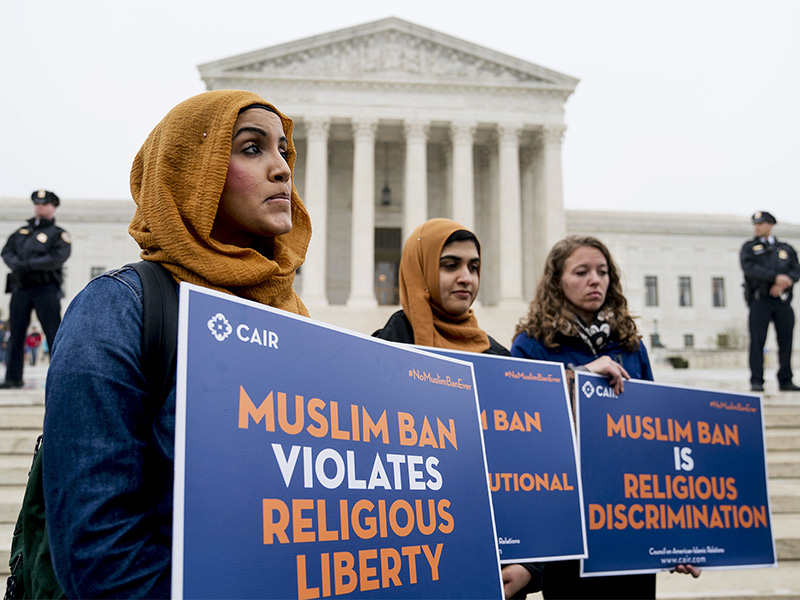
(RNS) — This week, Republicans are gathering for a midterm convention in Dallas, in my own backyard, immediately before the 25th anniversary of Sept. 11.
But angry demonstrators outside our mosques are not something that arrived with the convention. On Fridays, even without a national political gathering nearby, members of our community regularly encounter protesters when they come to pray.
As an American Muslim imam, I consider this setting as we approach this anniversary. Alongside the somber commemorations and historical retrospectives are the ordinary concerns of people wondering whether they can enter their mosque without being harassed.
For us, the legacy of Sept. 11 is not confined to a terrible morning. It includes the institutions, organizations and assumptions that took shape afterward.
Six days after the attacks, President George W. Bush visited the Islamic Center of Washington, D.C., and declared: “Islam is peace.” He spoke about Muslim Americans as neighbors and warned against intimidating women wearing headscarves.
Sadly, that reassurance was not the whole record. The wars in Afghanistan and Iraq he launched in the aftermath brought about extensive civilian suffering to Muslims and others abroad.
And at home, Muslim charities, imams and community leaders were viciously targeted. Bush used 9/11 not just in every speech, but seemingly to justify every unconstitutional attack on the Muslim community. And the tenuous relationship between Muslim communities and counterterrorism policy sadly was only further incentivized in the Countering Violent Extremism programs of the Obama administration.
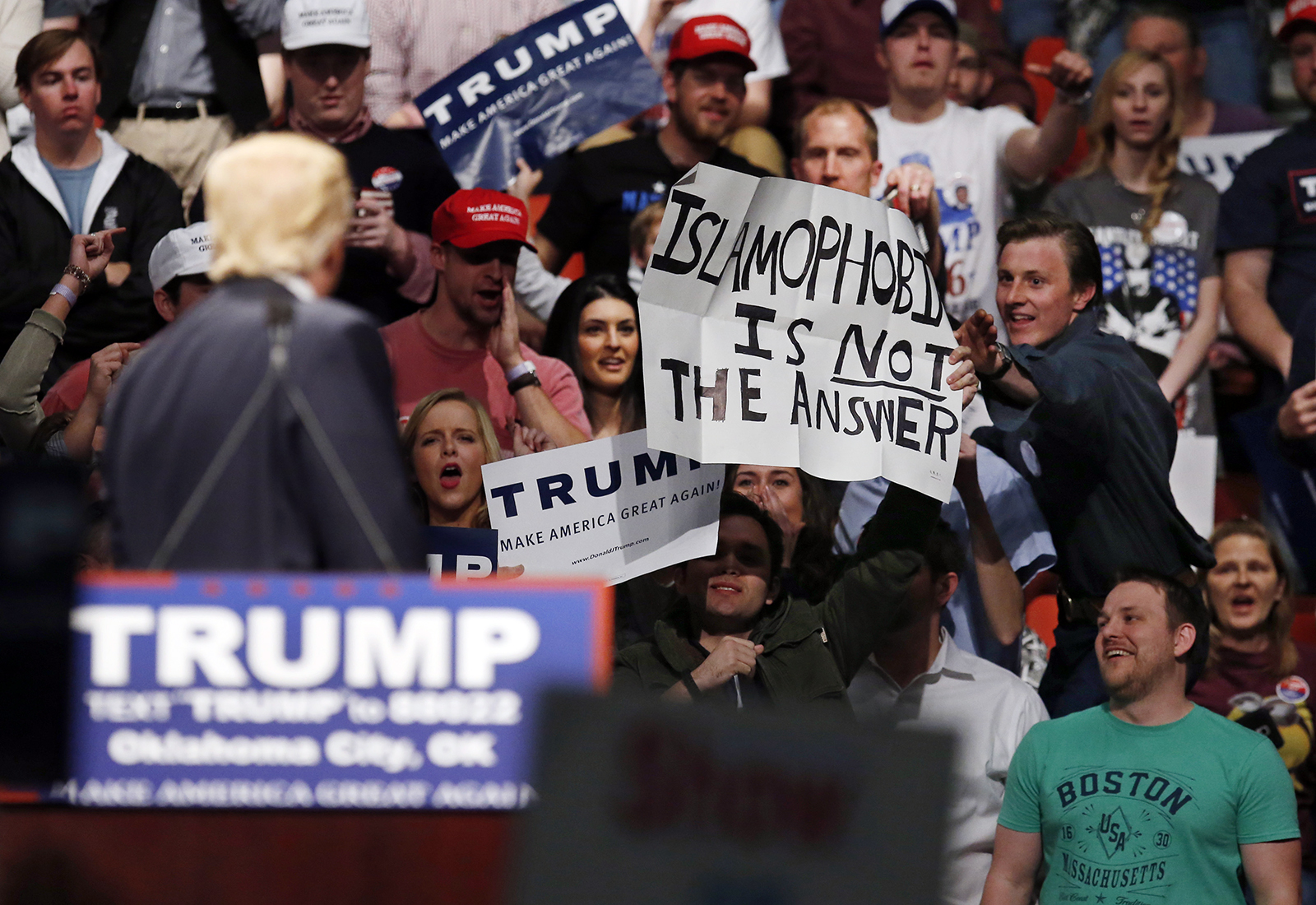
In this Feb. 26, 2016 file photo, then-Republican presidential candidate Donald Trump, left, looks on as a Trump supporter reaches for a sign that reads “Islamophobia is not the answer” at a rally in Oklahoma City. (AP Photo/Sue Ogrocki)
Then in 2016, presidential candidate Donald Trump openly told CNN: “I think Islam hates us.” To me, it felt like the policies had already been speaking that way for some time, but the bigotry was now just out in the open. The industry got what it wanted: a full-blown Islamophobe as president.
The public-opinion record offers another comparison. In March 2002, six months after the attacks, 25% of Americans told Pew Research Center that Islam was more likely than other religions to encourage violence. This January, 51% said so. That is not a historical peak, as the figure reached 52% in 2016, but it is substantially higher than in the immediate aftermath of Sept. 11.
And this spring, 43% surveyed described Muslims as less patriotic than other Americans, while 42% said Muslim Americans have a negative impact on the country, according to Pew.
A quarter-century of living alongside Muslim neighbors has not apparently resolved those suspicions.
To understand this history, we have to look beyond individual prejudice. We have to examine its organization.
In its 2011 report “Fear, Inc.,” the Center for American Progress identified what it called an “Islamophobia network” connecting donors, policy organizations, media figures and activists who promote misrepresentations of Islam. Its investigation traced $42.6 million given from seven foundations and charitable groups to organizations in that network between 2001 and 2009. The report describes how misleading claims circulated among researchers, commentators and political organizers, including through model legislation concerning Islamic law.
Older institutions were joined by new organizations and projects: Campus Watch in 2002, Jihad Watch in 2003 and ACT for America in 2007. The network included websites, advocacy organizations and grassroots campaigns.
A 2016 Council on American-Islamic Relations and University of California, Berkeley report identified 74 organizations it associated with Islamophobia, with 33 categorized as its core.
This is the organizational dimension of the story: It’s not simply what someone believes about Muslims, but how messages are funded, reproduced and distributed.
There is also a separate indispensable institutional history: the government’s reorganization after Sept. 11.
Consider the Immigration and Customs Enforcement agency that haunts so many today. ICE is now so familiar that it can sound like a historical American institution. But neither ICE nor its overseer, the Department of Homeland Security, existed when Bush delivered his reassurance at that Washington mosque. Bush signed the Homeland Security Act in November 2002.
The reorganization brought together 22 federal agencies and components; ICE was established in 2003, inheriting investigative and enforcement functions from predecessor agencies. Immigration enforcement was much older; its consolidation inside this new homeland-security structure was not. The connection to Muslim communities was embedded from the start.

A woman exits the closed international arrivals hall during anti-Donald Trump travel ban protests outside Philadelphia International Airport in Philadelphia, Penn., on Jan. 29, 2017. (Photo by Charles Mostoller/Reuters)
Long before Trump’s famous Muslim ban of 2017, the government introduced the National Security Entry-Exit Registration System in 2002. Its domestic registration requirements applied to certain male noncitizens ages 16 and older from 25 designated countries — overwhelmingly Muslim-majority nations, although religious identification was not a formal factor. Those who fit that description were required to report to the federal government for fingerprinting, photographs and questioning. Administration of the program transferred to DHS in 2003.
The institutions created during that period subsequently acquired additional resources and responsibilities. A law enacted last year provided ICE with an additional $45 billion for detention capacity and nearly $30 billion for purposes including personnel, transportation, technology and enforcement operations. (These are multiyear appropriations available through September 2029, not a single year’s operating budget.)
Those appropriations are not obvious donations to an anti-Muslim advocacy network. Nor does the agency’s founding date make every ICE pickup Islamophobic. But the historical point is more precise: Sept. 11 helped reshape the institutions through which the government administers immigration and security, with consequences extending far beyond Muslim communities.
The private advocacy network and the public security bureaucracy may be distinct histories, but both belong in an account of what the post-9/11 years produced.
Meanwhile, the debate about Muslims’ place in public life continues. Texas Reps. Keith Self and Chip Roy organized a congressional “Sharia Free America Caucus” earlier this year. Its members cite security concerns and the role of Islamic law in American life.
Muslim political visibility has also increased, giving fodder to their fear-mongering. Zohran Mamdani became New York City’s first Muslim mayor, and Abdul El-Sayed won Michigan’s Democratic U.S. Senate nomination.
In August, U.S. Rep. Nancy Mace, R-South Carolina, wrote: “Every single Muslim holding public office in America is a trojan horse, and a threat to both national security and our republic.”
After El-Sayed contrasted social isolation in America with the sense of community among his relatives in Egypt, Sen. Tommy Tuberville, R-Alabama, responded: “If you hate America so much, go live in Egypt.”
Mamdani is being told by some he’s not welcome to the 25-year anniversary ceremonies, as if to suggest he’s somehow complicit for being Muslim himself.
And it’s not just Muslim politicians who are openly being told they’re not welcome here in the public space.
On Aug. 30, Mosab Hassan Yousef, the ex-Muslim supposed son of a Hamas cofounder, appeared at the Jewish American Summit in Los Angeles shouting “I don’t want Muslims in America. Get the f— out of the United States.” Sadly, the audience loudly applauded.
Mosab is a validator like so many strange ex-Muslims, unknown to our communities, who hit our screens after 9/11 to suggest that Muslims are indeed the problem, and Islam is incompatible with modern civilization. That same rhetoric of erasure then becomes real life.
After the Christchurch, New Zealand, mosque attacks, I helped wash the bodies of Muslims who had been murdered in cold blood. That experience remains with me whenever the safety of our communities becomes a subject of public debate. Washing the dead is an act of tenderness that no terrorist or terror supporter seems to grasp.
But whatever abstractions surround a tragedy, there is nothing abstract about that responsibility. The terrorist cited Trump in his manifesto for a reason.
And in May of this year, three people were murdered in the same way at the Islamic Center of San Diego. The attackers’ writings cited the Christchurch murderer as an inspiration. The connection between these perpetrators was documented; it was not simply a resemblance between two tragedies.
Beyond the most devastating attacks are experiences that rarely become national news. It’s not always murder, but the conditions that have a whole industry to foment fear behind them working in overdrive.
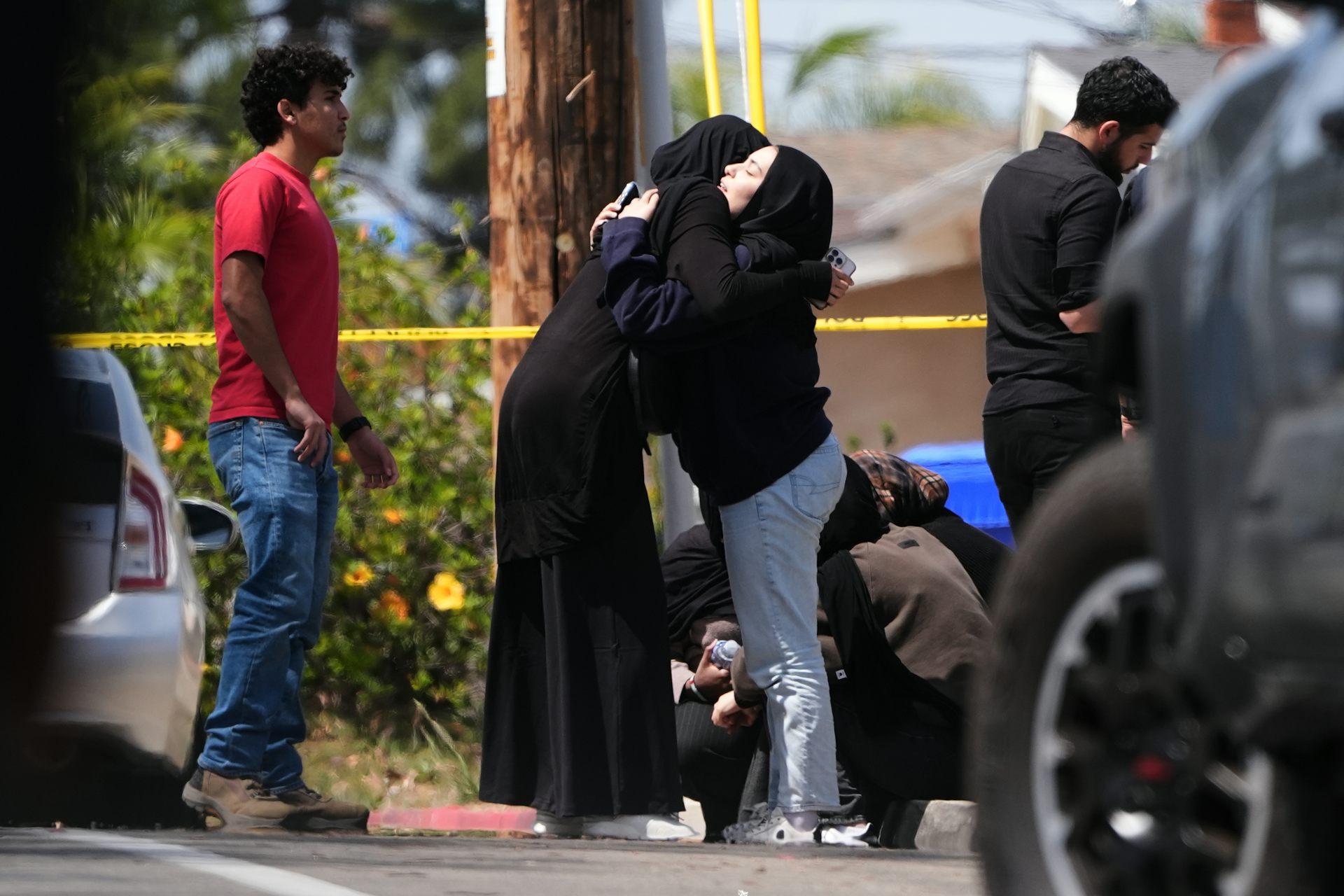
People comfort one another near the scene of a shooting outside the Islamic Center of San Diego on May 18, 2026, in San Diego. (AP Photo/Gregory Bull)
CAIR recorded 8,683 civil rights complaints in 2025, its highest annual total on record. Those are complaints received by an advocacy organization, not a national count of verified hate crimes. They nevertheless document the volume of concerns being brought to one of the institutions Muslim Americans turn to for help.
No single statistic captures this anniversary. Some measures have worsened. Others have remained troublingly persistent. The institutional history, meanwhile, cannot be reduced to a temporary surge of fear that simply passed.
That is what I am trying to convey when I speak about the industrialization of Islamophobia: the need to examine not only hostile encounters, but the organizations, funding networks and repeated claims surrounding them, and to place those developments alongside the government’s documented post-9/11 record.
On 9/11, we will mourn the people murdered that morning and remember the families whose lives were permanently changed. That grief does not compete with my grief for Christchurch or San Diego, or the hundreds of thousands of lives lost in Afghanistan, Iraq or Yemen in the “war on terror” that followed.
And 25 years later, when a family walks into a mosque on Friday, they’re just asking to be left alone to pray. And part of what they pray for is a more peaceful and justice-filled world where the atrocities of 9/11 and what followed don’t happen anymore.
We should use these times to mourn the dead. We should not have to fear for the living.

No comments:
Post a Comment