9/11: Remembering The CIA’s Failure To Protect America – OpEd
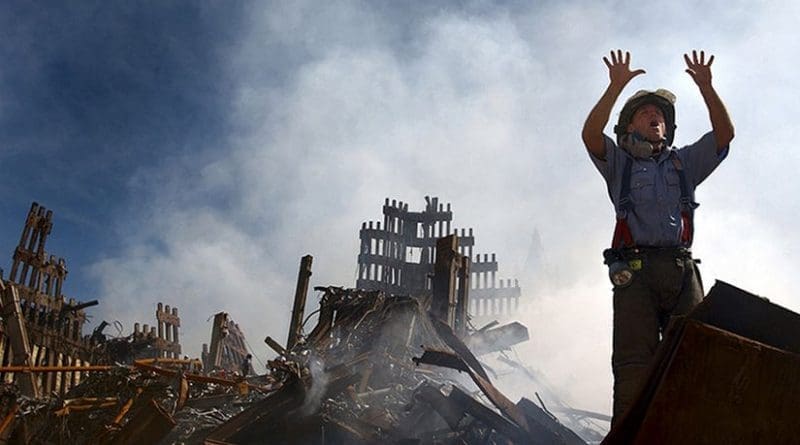
A New York City fireman calls for 10 more rescue workers to make their way into the rubble of the World Trade Center site of the 9/11 attacks. U.S. Navy Photo by Journalist 1st Class Preston Keres, Wikipedia Commons.
September 10, 2026
By K. Lloyd Billingsley
Key Takeaways:
The author marks the 25th anniversary of 9/11 by arguing the CIA—and the FBI—failed to stop the attacks that killed nearly 3,000 people, including 24 Canadians.
John Brennan’s memoir is cited as evasive (Pentagon “attacked,” Pennsylvania plane “crashed,” little on the World Trade Center). After the failure, the piece notes bigger CIA budgets and no clear account of bosses being fired; Tenet and Mueller kept their jobs.
Homeland Security and later CIA years are tied to later U.S. attacks. The author backs Angelo Codevilla’s call to abolish FISA, reform the FBI, and break up the CIA—presented as overdue congressional work, not a finding of new 9/11 facts.
On Sep. 11, 2001, al Qaeda terrorists flew hijacked airliners into the World Trade Center and the Pentagon, killing nearly 3,000 people from many nations, including 24 Canadians. On the 25th anniversary, the people might recall the U.S. agency that failed to stop the worst attack on the United States since Pearl Harbor in 1941.
“At the CIA, our mission is to preempt threats and further U.S. national security objectives,” claims the secretive agency, whose budget is classified. Consider this account of the 9/11 events from John Brennan, a CIA officer since 1980 and CIA director from 2013 to 2017.
“We learned that the Pentagon had been attacked and that a plane had crashed in Shanksville, Pennsylvania,” wrote Brennan. “George [CIA director George Tenet] called his senior staff back into the room to coordinate actions that the CIA would need to take as the attack against our homeland was unfolding,” starting with the evacuation of the CIA building.
That is from Brennan’s Undaunted: My Fight Against America’s Enemies, at Home and Abroad, published in 2020. The author, Tenet’s chief of staff on 9/11, doesn’t explain how, exactly, the Pentagon was “attacked.” The former CIA boss also fails to mention the hijackers’ primary target, the World Trade Center, where most of the nearly 3,000 victims perished.
In a similar evasive style, the Pennsylvania plane had only “crashed,” with no mention of the heroic passengers who took down the airliner in a field before it could reach its target in New York or Washington. After this colossal failure, Brennan writes, the CIA “demonstrated its agility by “deploying officers to Afghanistan,” where the terrorists were hiding in caves.
The former CIA director is “absolutely certain” that al Qaeda “would have succeeded in carrying out devastating attacks against the United States after 9/11, including in the homeland, had it not been for the outstanding work of CIA officers around the world.” The people have cause to wonder if those are the same “outstanding” officers who failed to see 9/11 coming in the first place.
After 9/11, Brennan notes, the CIA budget was “significantly increased,” which implies that the problem was not enough money. So in the best bureaucratic tradition, the failure to prevent 9/11 earned a financial reward, but there was more to it.
George Tenet remained CIA director until 2004, and Brennan does not say if any CIA bosses were disciplined, demoted, or dismissed after 9/11. To be fair, the Federal Bureau of Investigation also failed to prevent 9/11, and director Robert Mueller held the top post until 2013, the longest span since J. Edgar Hoover. On the watch of Mueller and Tenet, other bureaucratic failures were in the works.
George W. Bush, president on 9/11, oversaw the creation of the Department of Homeland Security. In the style of the CIA and FBI, the DHS failed to prevent terrorist attacks at Fort Hood (2009), the Boston Marathon (2013), San Bernardino (2015), and Orlando in 2016, when John Brennan was still running the CIA and targeting enemies “at home.”
If friends and loved ones of the 9/11 victims thought the CIA was a failure at its duly appointed tasks, it would be hard to blame them. Those in search of a solution should consider the late Angelo Codevilla, author of Informing Statecraft: Intelligence for a New Century.
As a staffer on the Senate Intelligence Committee, Codevilla was one of the few to see everything on the CIA’s wish list. In 2020, the same year as Brennan’s Undaunted, Codevilla made a strong case to abolish FISA, reform the FBI, and “break up” the CIA. On the 25th anniversary of 9/11, Congress should get started on those long-overdue reforms.
This article was also published in The American Spectator
About K. Lloyd Billingsley
K. Lloyd Billingsley is a Policy Fellow at the Independent Institute and a columnist at The Daily Caller.
View all posts by K. Lloyd Billingsley →

No comments:
Post a Comment