United Russia is heading for a bigger State Duma majority than it won in 2021, on a count running some 20 points above the Kremlin's own final polling.
With 90.43% of ballots processed, the ruling party had 57.86% of the federal party-list vote and led in 208 of the 225 single-member constituencies, TASS reported on September 21. That points to roughly 331 seats in the 450-seat chamber, well past the 301 a party needs to amend the constitution on its own.
The Communist Party had 13.84%, and the systemic opposition parties of the Liberal Democratic Party of Russia (LDPR) 8.9% and liberal-leaning New People 7.94%. Duma veterans A Just Russia, which is on the verge of being a non-systemic opposition party, was on 4.95% and falling - it stood at 5.23% when a third of precincts had reported and has lost ground with every tranche since, Meduza reported. If it finishes below the 5% barrier the Duma drops from five parties to four.
The long standing liberal non-systemic opposition party Yabloko, which has nevertheless been tolerated by the Kremlin as it has been a feature of Russian politics since the 1990s, was struck off the party-list ballot by the Supreme Court on August 10. Still, more than 100 of its candidates stood in single-member seats and the party urged supporters to spoil their party-list papers rather than back the four systemic opposition parties left on it.
Yabloko was the only party to campaign on an anti-war platform, but when it threatened to turn the general election into a referendum on the war, the Supreme Court barred its candidates from standing.
“Support” for United Russia has surged in the week of the poll. Both of the Kremlin's own pollsters had it in the 30s a week before polling opened - VTsIOM on 37.4% and FOM on 33%. The count is also eight points above the 49.8% United Russia was awarded in 2021, a result independent analysts said had been padded with 13mn-16mn fraudulent votes. On the commission's numbers, support for the ruling party has risen by eight points over a war that both pollsters had been recording as a drag on it.
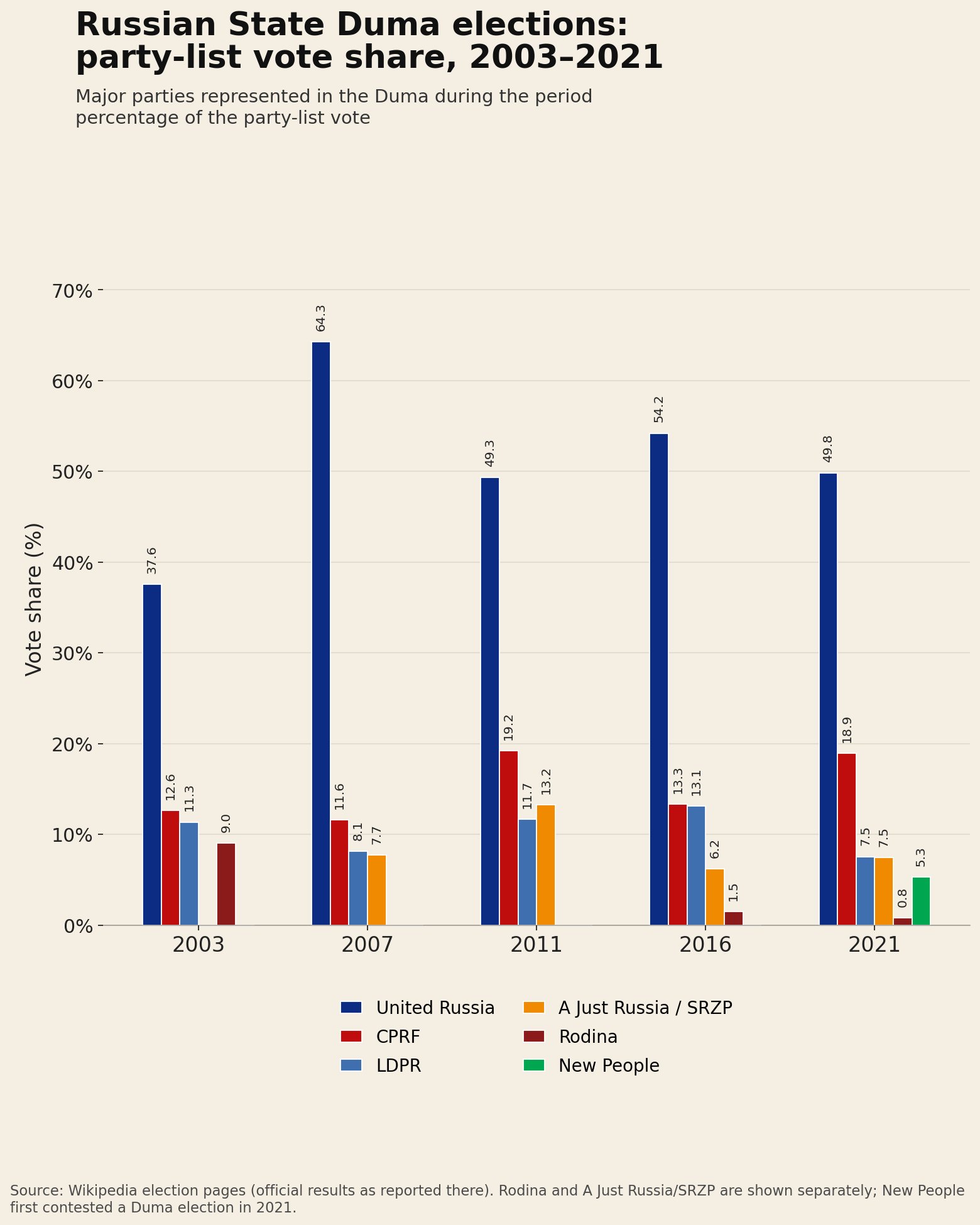
United Russia's party-list share has swung between 37.6% and 64.3% since 2003. A final 57.9% would be its second-best result in two decades.
The count outran the exit polls as well. VTsIOM put United Russia on 49.4% as voting closed and INSOMAR on 52.8%, both well below the figure the commission began publishing hours later.
This was the first time it was possible for the bulk of the population to vote electronically, after the 2021 elections introduced e-votes in only 17 regions. The change over is widely seen as ending any pretence of democracy and free voting as the 2021 elections highlighted the control the Kremlin has over the vote when the Communist Party (KPRF) win in Moscow was overturned overnight after the electronic votes were added to the tallies.
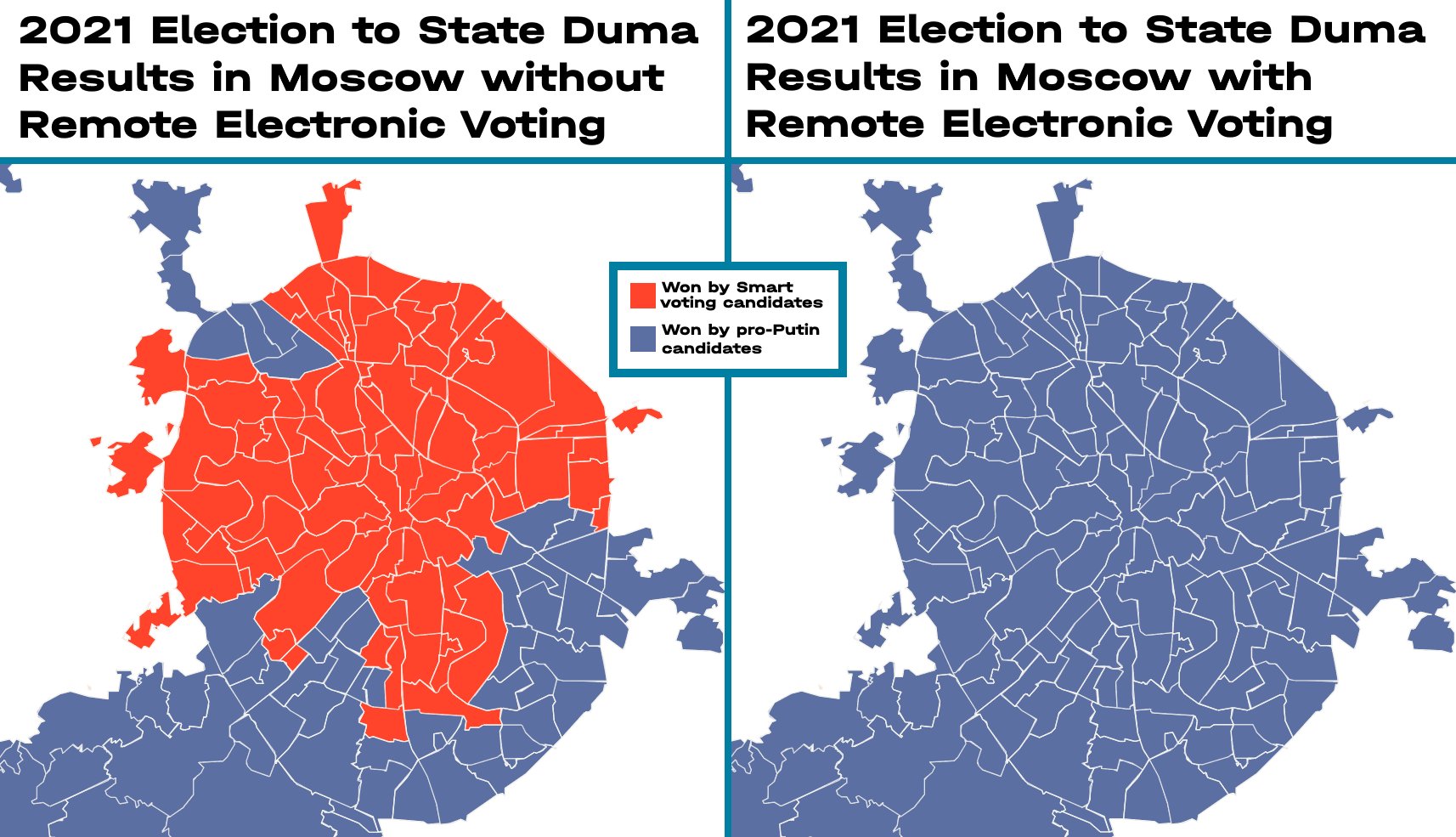
Moscow in 2021, with and without remote electronic voting: the online tranche reversed every constituency won on paper by Smart Voting candidates.
The Kremlin had spent the summer managing expectations downwards. United Russia's nationwide target was cut from 55% to 50% in June and the target for mid-loyalty regions from 50% to 45% in July, before the Presidential Administration raised them again in the closing weeks - to 47% in average regions and 52-53% where officials saw a higher degree of mobilisation, with a nationwide expectation of more than 50%, Meduza reported on September 8. Even the raised target is more than seven points below what has now been announced.
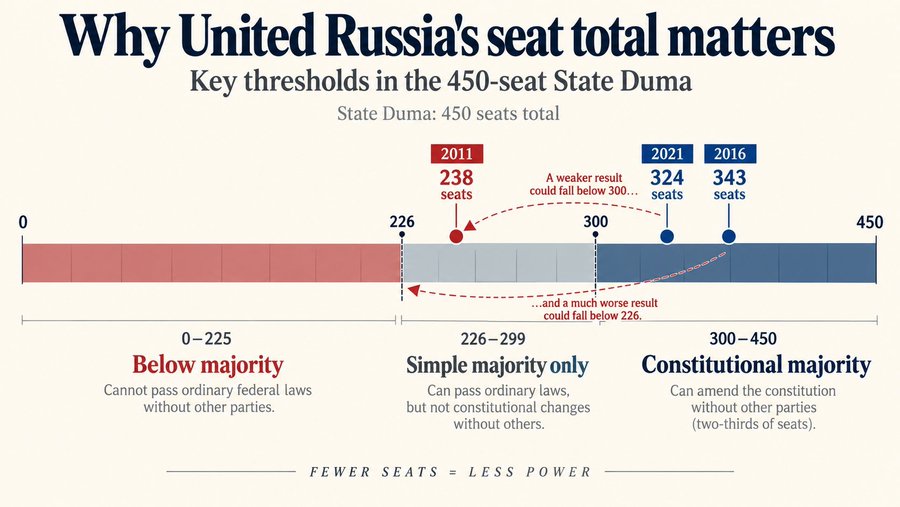
Why the seat total matters: 301 of 450 seats lets a single party amend the constitution without anyone else's votes.
Turnout was 56.66% by 20:00 on September 20, against 51.72% in 2021.
Having been robbed of nearly a quarter of the Duma seats in 2021, Communist leader Gennady Zyuganov rejected this year’s count as well as the KPRF has once again seen a lot of its votes stolen by Uniter Russia. He warned of a return to the “wild 90s” when the Duma was largely gridlocked by fractional fighting, saying his party would set its own copies of polling-station protocols against the official tally.
“The tables that have been shown on the screens here over the past three hours do not reflect any real trend or the true picture,” Zyuganov said, alleging that in Voronezh “all our observers were removed, completely illegally”. The Communists' 13.84% is five points down on the 18.9% they took in 2021.
However, as part of the systemic opposition, this is the KPRF’s job: to allow voters to blow off some steam at the obvious rigged nature of the system, without actually doing anything about it. Zyuganov failed to call for mass demonstrations following the obvious manipulation of the 2021 Moscow result and he is very unlikely to call for any drastic actions this time round either.
Just how deep the fix runs was demonstrated by two photographed polling-station protocols from the Babushkinsky constituency in Moscow that were literally next to each other in the same school on Glebovskaya Street that produced impossibly opposite results. At station 857, where observers were present, United Russia's Vladislav Gusev took 90 votes and finished third behind the Communist candidate Georgy Fedorov on 125 and the Greens' Yulia Kuznetsova on 102. At station 871, where the observer was refused entry according to the journalist who posted the protocols, Gusev took 675 against Fedorov's 24 and Kuznetsova's eight.
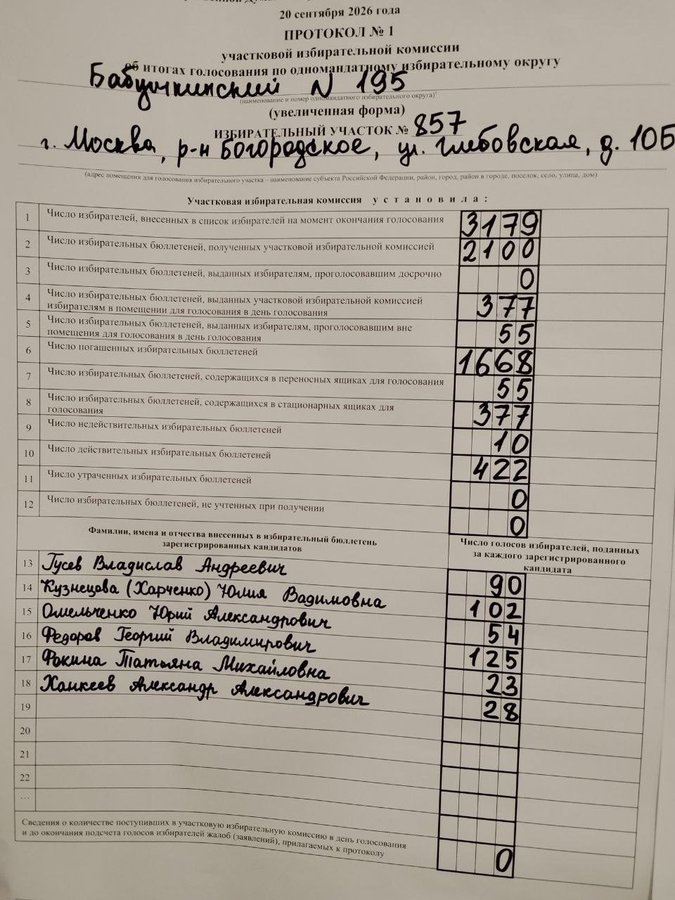
Station 857, Glebovskaya Street, Moscow: observers present, United Russia's candidate third.
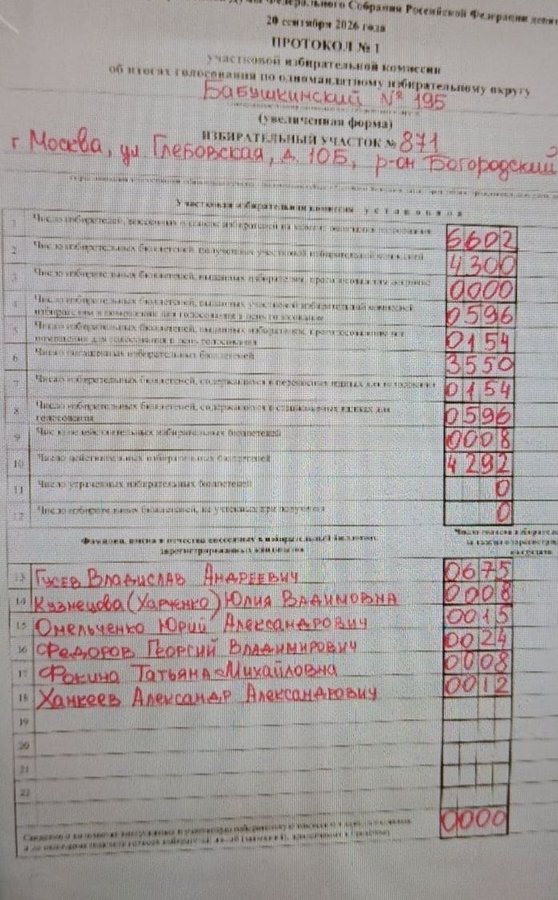
Station 871, the same address: the observer was not admitted and United Russia's candidate took 675 of about 742 votes cast.
The monitoring platform Vybory 2026 - nablyudaem vmeste! logged more than 900 complaints by 20:00 on September 20, about a third of them concerning observers being barred, removed or detained. The Prosecutor General's Office said it had recorded no serious violations of the law during the voting.
Remote electronic voting ran in 32 regions plus Moscow, covering 48.4mn eligible voters from a total of 111mn. Central Election Commission chairwoman Ella Pamfilova said the platform came under a “massive and intense” cyberattack from Ukraine from late on September 19 into the following morning but that voting was not interrupted, the Kyiv Post reported. Moscow's city election commission reported the same, and the digital development ministry claimed an attempted diversion on communications lines in the Far East. Putin complained that Kyiv was trying to interfere with the vote, but none of the claims was independently verified, and no evidence was offered linking any of them to Ukraine.
Wartime elections
The Kremlin is keen to carry out the vote to show that elections can be held in war time and have been playing up the theme as part of their rhetorical efforts to show that Zelenskiy’s government is illegitimate as he has repeatedly refused to hold elections and his presidential term officially expired last May. Ukraine’s constitution precludes holding elections while martial law is in effect.
The war lingered in the background as many Russians fear as soon as the poll is concluded Putin will launch a second mobilisation to flood the Donbas with fresh recruits and bring a swift end to the war. And those fears look real. Men who voted online began receiving notices on the Gosuslugi state services portal telling them they had been added to the military register, Agentstvo reported, citing a Moscow voter who was registered within hours of casting an electronic ballot. Yabloko said two observers working for a member of its federal political committee were handed summonses to report to enlistment offices.
Voting was held in occupied parts of Donetsk, Luhansk, Zaporizhzhia and Kherson, and Russia opened polling stations in Transnistria over Moldovan objections, after Chisinau summoned Russia's ambassador in early September.
Russia has never run the near-unanimous votes staged in North Korea, or the 70-90% results normal in Central Asia, and its federalism is part of the reason: closed republics deliver very large majorities while the big cities do not, so the federal total is assembled from very unequal local counts. The political scientist Julian Waller, writing on X on September 18, put it this way: “the general rule of thumb is that at the federal level, you can tack on roughly 15-20% of that as fraud.”
A Just Russia has sat in every Duma since 2007. It may not be in the next one. Yabloko first entered the State Duma in the December 1993 election, the first parliamentary election of the post-Soviet Russian Federation. The Yavlinsky–Boldyrev–Lukin bloc, which became Yabloko, won 33 seats. It remained a significant parliamentary faction for the Yeltsin-era. Yabloko failed to clear the 5% party-list threshold in 2023 at the start of the Putin-era, but four Yabloko candidates won single-member constituencies, which is the only representation it had until its total exclusion now.
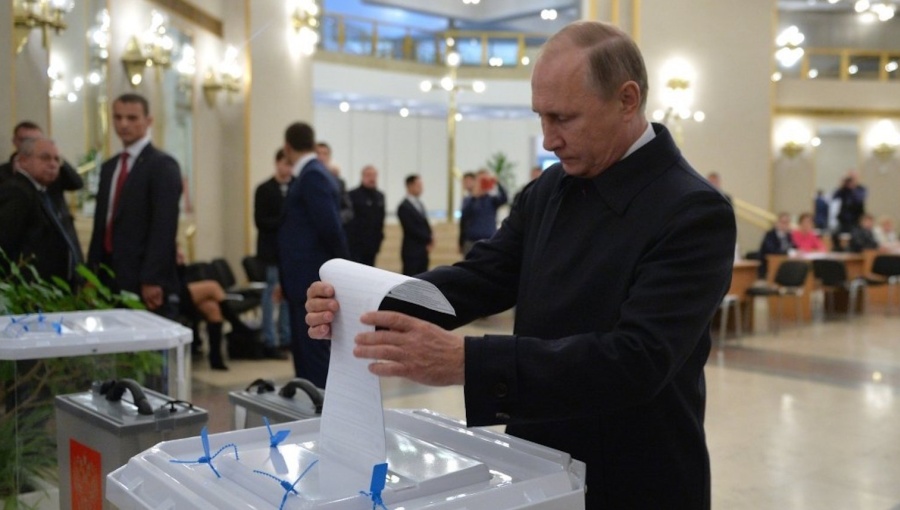
Russia's ninth State Duma is being elected on a website. Seven in ten voters signed up to the federal platform had voted by the end of day one of three days given over to the vote. This is the first time a Russian general election can be done entirely online and it clear the way for the Kremlin to make up any result it wants.
In the last Duma elections in 2021, famous Russian physicist and election statistician Sergei Shpilkin showed that about half the votes were fake. That election should have seen the Communist Party (KPRF) win a significant number of new seats and it took almost all of the Moscow districts by storm – until the electronic votes were counted, and overturned the KPRF’s wins in nearly all of them due to a statistics “comet effect” and the “Moscow blob” that are clear indicators of vote fixing.
The last general election was a wet trial for the new electronic voting system and only used in 17 of Russia’s 89 regions. Now the system has been perfected seats for the whole country are only a mouse click away and the pace of the voting was extraordinary. A quarter of all votes were cast in the first few hours of the first day.
Online voting
Russia's Digital Ministry said more than 2.8mn people had voted through the federal remote electronic voting system by 21:45 Moscow time on September 18, or 70% of everyone registered for it, Interfax reported. The running count had been 1mn at 09:00 and 2mn by 12:15. Smolensk and Novgorod regions were at 80%, Mari El at 79%, Kostroma at 75% and Chuvashia at 73%.
Moscow, which runs its own system alongside the federal one, was further ahead still. Around 1.4mn Muscovites had voted electronically in the first four hours, RBC reported. By 15:00 the figure was more than 1.8mn against roughly 100,000 paper ballots, Vedomosti said, and Kommersant put it at 2mn by 19:35.
In the surrounding Moscow region, polling-station physical turnout was 7.16% while remote turnout had reached 58.3%. National turnout, which folds in early voting, reached 24.89% by 20:10 Moscow time on the first day.
All 450 Duma seats are being filled over three days to September 20, alongside more than 2,200 other contests for about 20,700 mandates: regional legislatures in 39 regions, governors in 11 and councils in ten regional capitals. Some 111mn voters are on the register at home and 1.8mn abroad, where 333 polling stations are open in 152 countries.
The last 2021 election was arguably the last time Russians had a real chance to change the government’s make up. And they nearly did by giving the KPRF enough votes to break the incumbent United Russia’s supermajority that forced the Kremlin into an ugly and transparent fix. Under the new system there are no embarrassing physical votes that can be recounted, as the count all happens behind the Central Election Committee (CEC) screens.
The comet and the blob
Tinkering with physical election ballot counts leaves statistical fingerprints that trained statistician can spot. The principal behinds it is that voting should leave a perfectly random distribution of numbers and changing the numbers destroys that randomness.
Shpilkin has been a fixture of Russian elections and has each time highlighted how the results were fixed using statistical techniques. But sometimes having a PhD in mathematics is necessary: one year early on the official CEC election results showed very clearly little spikes on numbers ending in zeros or fives; when fixing vote counts on ballot sheets, there is a very human tendency to round up to whole or half whole values, Shpilkin explained.
His study of the 2021 Duma vote concluded that roughly 14mn votes were fabricated, about half the total, and that United Russia's real share was somewhere between 31% and 33% rather than the 49.8% it was officially awarded. Analysts working on the same data put the inflation at 13mn-16mn votes. Most of the difference had been picked up by KPRF which would have dramatically changed the balance of power in the Duma and increased the power of what has been dubbed the “systemic opposition” – MPs from parties other than United Russia which the Kremlin tolerates to give a veneer of democracy, but who never seriously oppose the Kremlin’s wishes. The Liberal Democratic Party of Russia (LDPR) play a similar role. Members of Yabloko, the only party to campaign on an anti-war platform were too close to being “non-systemic opposition" and so were barred from running at the last minute.
Two charts from that election became the shorthand for how the fix looks from the outside: a comet effect, in which United Russia's share climbs as a district's turnout climbs towards 100%, and a Moscow blob parked up near the 100% mark in the city that votes more liberally than anywhere else in the country. The same technique had already picked up anomalies in online registration for the 2020 constitutional referendum.
Moscow is where what moving to an electronic count shows what it can do. Part of the KPRF’s success in 2021 was due to the “smart voting” tactic introduced by the late opposition figure and anti-corruption activist Alexei Navalny, who died in a Russian prison under questionable circumstances in February 2024.
The idea is given there are no real opposition parties standing in the elections, then voters vote for whoever is standing that is not from United Russia and is the most likely to beat the incumbent irrespective of their party or platform – and that was often a communist – to break United Russia’s hold on power.
A smart-voting-backed candidates led in 11 of the capital's 15 single-member seats on the paper count, on Navalny's team's figures, while the Communists said six of their own should have won. But the day after the polls closed, those leads were reversed once the online votes were added. The Communist Party demanded the system be scrapped; police raided its Moscow headquarters minutes before its lawyers could file a lawsuit.
What made that exercise possible was that there was still a paper election to hold the electronic one against. Now the electronic system will swap the physical ballot paper vote.
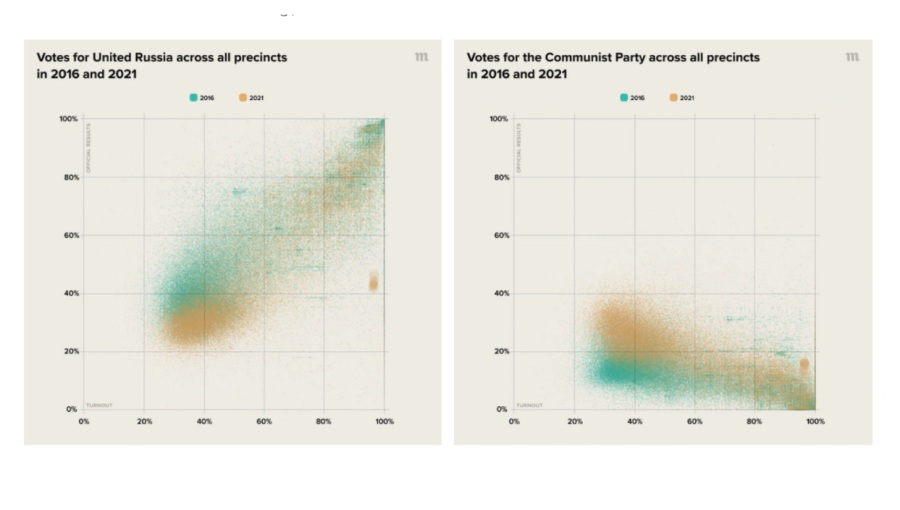
A statistical study of voting patterns in Russia's 2021 Duma elections shows a "comet effect" and a "Moscow blob" (right) that testify to large scale vote-rigging. / wiki
Putin's own campaign
The 2021 elections became exciting with the surge in support for the KPRF and the abrupted overturn of its successes. This time round the Kremlin has tried to make these elections as boring as possible.
The Kremlin's political bloc, run by first deputy chief of staff and former Prime Minister, Sergei Kiriyenko, wanted a campaign dull enough that independent voters stayed at home and the result was delivered by people who depend on the state for their living, Andrey Pertsev argued in a Carnegie Politika commentary published the day before voting opened. The ballot was purged of opposition as far as it could be, manifestos were kept vague, and the parties raised and spent little. Electronic voting also comes with a fresh tool: voting choices are now easily stored on a computer database.
"People are scared that the authorities can see whom they have voted for via this system, so may vote for the ruling party just to be on the safe side," Pertsev wrote.
United Russia needs 300 of the 450 seats to hold the constitutional majority that lets it legislate alone. The large majority also allows it to dominate all the key Duma committees that actually make the law and so it alone can steer the country and make policy and law.
On Pertsev's arithmetic it takes more than 200 of the 225 single-member districts, against 198 in 2021, helped by a cut in the number of districts effectively ceded to the in-system opposition to 16. That leaves about 40% of the party-list vote to find.
The complication is Putin himself. Where the political bloc wanted quiet, the president spent the summer on a tour of Siberia and the Far East that looked like a campaign, talking about the war, wearing military uniform on the Kuril Islands, and describing the fuel crisis shortages that have produced fights at filling stations as "certain inconveniences" and new business levies as "voluntary contributions". In August he told a United Russia congress that the election amounted to a referendum on the country's course.
The two pollsters the Kremlin relies on went into the vote telling contradictory stories. VTsIOM had United Russia on 37.4%; FOM had it stuck on 33% after a four-point slide in its first survey once the liberal Yabloko party was struck off the federal ballot, with the share of respondents saying they would not vote at all rising from 10% to 16%. Both are far below the 49.8% of 2021. The party went into the campaign with Putin's own approval at its lowest since the invasion.
Voting under drones
This is an election in wartime and Putin accused Ukraine of trying to interfere with the polls on September 19. Sochi suspended voting at all 244 of its polling stations shortly after 10:00 on the first morning after a drone warning, moving commission members, observers and voters into shelters. Flight restrictions went on at the city's airport at 09:22 and the stations reopened a little after 11:00, Interfax reported. Mayor Andrei Proshunin said voting would resume “once the threat had passed.”
Elsewhere the war came closer to the ballot box. CEC chairwoman Ella Pamfilova said a drone had circled 150 metres from the territorial election commission in Belokurakino in the Luhansk region, keeping the staff inside. A polling station in Krasnodar Krai was moved after a strike, and 14 stations in the Luhansk region were running on backup power. Elena Astanina, who chaired precinct commission No.394 in the Zaporizhzhia region, was killed in a drone attack on her home in the village of Oktyabrskoye; acting deputy governor Serhiy Obertas said the strike was deliberate.
Russia is running the vote in the occupied parts of Donetsk, Luhansk, Zaporizhzhia and Kherson, where early voting opened on August 28, as it did in Crimea, Sevastopol, Krasnodar Krai and the Belgorod, Bryansk, Voronezh, Kursk and Rostov regions in the south. Pamfilova put early voting across the 12 regions under martial law or a heightened alert regime at 4.22mn ballots.
Kommersant said first-day activity was running at record pace, past the whole of the first day of 2021 by lunchtime, but that early voting in the new and border regions made a large contribution to the headline number. The comparison with 2021 is not like for like.
Observers, errors and a village called Paris
More than 1,000 Communist observers in ten regions were refused access to polling stations, Kommersant said, and the Public Chamber's monitoring centre had logged 80 complaints about breaches of its observation standards by mid-afternoon, 20 of which it dismissed. In St Petersburg, Yabloko, the Communists and liberal systemic opposition party A Just Russia all reported observers being turned away or blocked from filing documents; the city commission said more than 6,000 observers were working in the city, over 2,000 of them sent by the Public Chamber.
In Kirov, the election in legislative constituency No.25 was cancelled and put back to 2027 after officials found that the Communist candidate, Eduard Plastin, had been left off the ballot paper, Vedomosti reported. The ballots were declared invalid.
But the nature of how the elections are being run was clearest in Paris – a village in the oil-rich region of Bashkortostan in the middle of Russia, a settlement named after the Napoleonic campaign of 1814, which reported 100% turnout on day one.
Unbelievably high results for the ruling party is a fixed feature of Russian elections. In an earlier election during Putin’s first two turns in office, Chechnya reports a "victory" for the ruling party which had registered 107% of vote for its candidate. In the March 4, 2012 presidential election a Grozny precinct with 1,389 registered voters returned 1,482 votes for Putin and one for Zyuganov.
But the digital half of the election brought its own failures. Internet company Kaspersky said fraudulent websites impersonating the online voting system were harvesting passport and pension-insurance numbers, one of them built on an artificial-intelligence-generated template, and that some victims were then told their state-services account had been hacked and moved on to a telephone scam, Interfax reported. Pamfilova dismissed reports that the GAS Vybory state election system had been breached as nonsense, while the chairwoman of the Moscow city commission, Olga Kirillova, said attacks on the capital's electronic system were more serious than at previous elections.
What is left to protest with
Striking Yabloko off the federal list removed the only party campaigning openly against the war from the ballot paper, though 127 of its candidates in single-member districts were not disqualified, and the options left to a voter who wants to object are thin.
A boycott changes nothing, because the minimum turnout requirement for Duma elections was abolished in 2007 and there is no way to tell a protest abstention from a wet afternoon. A spoiled ballot is at least counted separately, and spoiled party-list papers ran at 1.57% in 2011, 1.87% in 2016 and 2.08% in 2021. Taking the ballot home is legal and can expose stuffing, because a commission that later reports nothing missing has some explaining to do. The one choice that can change who takes a seat is backing the strongest challenger to United Russia in a single-member district, where there is no runoff, Meduza's Denis Dmitriev set out.
Every one of those depends on the count being honest in the first place. Yulia Galyamina, a Moscow opposition politician, told the journalists' cooperative Bereg that the mood in Russia was exhaustion, and that the Smart Voting project built by Navalny's team had mostly failed to deliver.
"You're choosing one cannibal over another," she said. "With electronic voting, there may be no limit to fraud at all."
Duma speaker Vyacheslav Volodin said European Commission foreign policy chief Kaja Kallas had circulated a note to EU capitals declaring the elections unrecognised, Vedomosti reported.
Voting runs to September 20, and the number worth waiting for is not United Russia's national share. It is the gap between what the paper boxes say and what the servers say. The smaller the paper pile gets, the less the official results matter.

No comments:
Post a Comment