Issued on: 18/09/2026 -
Turkey has jailed dozens of people pending trial as a sweeping crackdown on LGBTQI+ groups widens, prompting international condemnation and protests outside Turkish embassies on Friday.

By Thursday, courts in several provinces had jailed at least 82 people following raids on LGBTQI+ organisations, clubs, cafes and homes.
The cases include LGBTQI+ activists and members of rights groups as well as people accused of prostitution, drug offences and other crimes. Not everyone jailed is accused of gay rights advocacy.
The United Nations human rights office has called on Turkey to uphold human rights without discrimination on the basis of sexual orientation or gender identity and to immediately release anyone arbitrarily detained.
Protests were held outside Turkish embassies in cities including Paris, Brussels, London, Oslo and Washington on Friday.
The crackdown began on Saturday, when police carried out coordinated raids targeting nine LGBTQI+ organisations. Justice Minister Akin Gurlek said legal action was being taken against 162 people, nine associations and 13 businesses in 15 provinces.
Mass detentions
The raids prompted protests across Turkey, including outside Istanbul’s main courthouse on Tuesday. Police broke up the demonstration and detained more than 100 people, including journalists. They were later released.
“I am here because I want to say that LGBTQ+ friends are not alone in this country,” said Ayse, a protester who asked to be identified only by her first name.
“I want to support them and to stay in solidarity with them, which is not easy these days in Turkey, but they are not alone, and we are not alone, and we will be here until the end.”
Opposition DEM Party parliamentarian Ozgul Saki remained at the protest, protected from arrest by parliamentary immunity.
“This oppression against LGBTQ+ people is an attempt to compress society into a single type; to build an Islamist, Turkish, racist society,” Saki said. “Those who are here say, 'No! Society will live equally, freely and honourably with all its diversity,' and that's why they were all detained.”
The operations have been defended by Gurlek, from President Recep Tayyip Erdogan’s conservative Justice and Development Party (AKP).
“No criminal organisation, abuse network or illegal activity which targets children, youths or families will be tolerated,” Gurlek posted on social media.
Among the organisations affected was Istanbul-based SPoD, which provides psychological support to LGBTQI+ people.
“As a community, we were expecting that such an operation would come one day. But we didn't imagine it as that violent, that much unlawful,” said a SPoD representative who asked to remain anonymous.
“They raided our office; I think four or five have been detained, and they are still in custody. What will happen to the LGBTQ+ community after this day? Like they can implement a kind of informal criminalisation upon our community, so my personal feeling is an immense feeling of uncertainty.”
Obscenity allegations
Homosexuality has been legal since the foundation of the Turkish republic in 1923, but authorities are using an obscenity law as part of the crackdown.
“All of our board members are detained due to the allegations of obscenity,” said Yildiz Tar of Ankara-based KAOS GL, Turkey’s leading LGBTQI+ news portal.
“They look into our social media account, and our news articles are seen as obscene because, for example, there is one picture of two women kissing, and they see that it's obscene. So that is why they have been detained.”
The measures resemble actions taken against LGBTQI+ communities in Russia and Egypt, Tar said.
“It's very similar to Russia and Egypt, like the things they want to do is very similar to anti-gay propaganda laws, and there were huge operations, and people got detained,” Tar said.
“So it's very similar to both countries. And actually, like the Turkish government is very fond of Putin's way of dealing things.”
The crackdown has also drawn condemnation from the European Union and international human rights groups.
“It's an attempt to show LGBTQ+ people as immoral and against the family. But in fact, none of this does anything to protect the family at all,” said Emma Sinclair-Webb, who leads Human Rights Watch’s Turkey office.
“It's all about discrediting and stigmatizing people for their sexual orientation or gender identity.”
Wider crackdown
The arrests form part of a broader crackdown on people regarded as opposing the government, Sinclair-Webb said.
“This operation should be set in the context of a very wide crackdown on anybody who is regarded as oppositional to the government, whether in terms of being politically or in terms of their lifestyle or their outlook… there is a general attempt by the government to impose as well as, you know, ideological conformity on people, lifestyle,” Sinclair-Webb said.
President Erdogan routinely refers to LGBTQI+ people as perverts and has stepped up his rhetoric ahead of much-rumoured early elections. Gurlek has called on prosecutors to increase investigations into the LGBTQI+ community, fuelling fears of further arrests.
The crackdown has also prompted condemnation across Turkish civil society, with trade unions, doctors’ associations and opposition parties voicing their opposition.
For Tar, that support offers some hope amid fears over what could follow for Turkey’s LGBTQI+ community.
“If this attack won't be stopped, it would mean a lot of maltreatment and torture; it can also cause hate crimes; it incites hatred inside the country too,” Tar said. “And it will mean that you cannot be openly queer; if they succeed in their operation, that is a really, really hellish scenario.”
Tuesday 15 September 2026, by Uraz Aydin
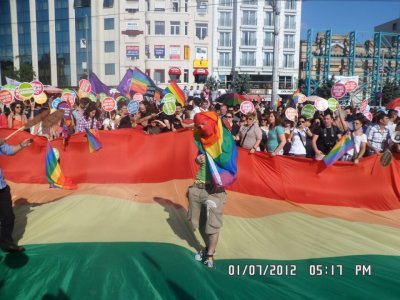
A new milestone was reached in the Erdoğan regime’s homophobic crackdown on Sunday 13 September. Police forces launched a large-scale operation against LGBTI+ organisations and activists, as well as organisations campaigning against HIV/AIDS. Raids were carried out in Istanbul, Ankara and Izmir, amongst other places. The Ministry of Justice states that the operation, dubbed “My family is safe”, involves a total of 162 people, nine organisations and thirteen premises across fifteen provinces. [1]
Dozens of websites and social media accounts have also been blocked. The wave of censorship is gradually spreading to news websites and human rights organisations. In his statement, Justice Minister Akın Gürlek explicitly equates certain organisations with groups “promoting LGBT and immorality” and asserts that the state will not tolerate any organisation that “targets our children, our young people and our families”.
Criminalising the existence and organisation of LGBTI+ people
The fact that various organisations have received funding from the European Union is also highlighted in the investigations and portrayed in the regime-controlled press as a criminal act. Yıldız Tar, editor-in-chief of Kaos GL, denounces this as an attempt to criminalise the very existence of LGBTI+ people. [2] Tar points out that “all LGBTI+ organisations in this country are registered, operate legally and are inspected several times a year by the Ministry of the Interior. Among the main recipients of funding from the European Union and the United Nations are also public institutions, ministries and foundations close to the government, such as TÜGVA. In that case, are we the ones who become the criminals? ”
Tar emphasises that LGBTI+ people organise themselves first and foremost to protect themselves from violence and discrimination: “LGBTI+ people organise themselves simply so they aren’t killed. They organise themselves simply so they can be treated like human beings. And then you claim that this constitutes a crime.”
Until 2025, repression against LGBTI+ people in Turkey mainly took the form of bans on Pride marches and police raids on gatherings and community spaces, periodically accompanied by humiliating statements from the highest levels of government. [3]
However, a qualitative shift took place with the declaration of 2025 as the ‘Year of the Family’. LGBTI+ people are no longer merely portrayed as contrary to conservative values, but as an organised threat to the family, young people, demographics and society itself. Recep Tayyip Erdoğan speaks of ‘LGBT perversion’ and ‘deviant trends’ that ‘poison’ the younger generations, and claims that the family is under ‘new-generation attacks’. He has also stated that these trends are ‘undermining the institution of the family’.
This rhetoric has been accompanied by an attempt to enshrine it in criminal law. A draft reform leaked in 2025 provided for up to three years’ imprisonment for behaviour deemed ‘contrary to biological sex at birth and public morality’, as well as for ‘encouraging, praising or promoting’ such behaviour. Attending a same-sex engagement or wedding ceremony could have been punishable by four years’ imprisonment. The draft bill also significantly tightened the conditions for gender transition and provided for sentences of up to seven years’ imprisonment for healthcare professionals who failed to comply with the new restrictions, and up to three years for transgender people themselves.
This draft bill, leaked in the autumn of 2025, was ultimately never tabled in Parliament following strong reactions from civil society organisations in Turkey and abroad. However, very similar provisions resurfaced in June 2026 in the preparatory work for the 12th ‘judicial package’. Following renewed mobilisation by feminist and LGBTI+ organisations, as well as numerous human rights organisations, these articles were once again withdrawn from the package before it was tabled in Parliament. They were therefore not adopted, but their repeated reappearance shows that the government has by no means abandoned this approach.
An offensive set to continue
Since 2026, this offensive has become part of a long-term policy. The government has declared the period 2026–2035 the ‘Decade of the Family and Population’. The official presidential statement specifically condemns the trends towards ‘degenderisation’ which, under the guise of human rights and individual freedoms, are said to threaten the family, future generations and ‘national and spiritual values’. The operation on 13 September, directly presented by the Minister of Justice as an implementation of this ten-year strategy, shows that this approach is already leading to an intensification of repression.
In the face of this offensive – which is certainly not limited to Erdoğan’s Islamo-nationalist regime but reflects the patriarchal and homophobic ideological orientation of virtually the entire international neo-fascist spectrum – the defence of LGBTI+ people cannot remain isolated. It demands the unity of Turkey’s progressive, democratic, feminist, trade union and revolutionary forces against this criminalisation. International solidarity also remains essential: democratic organisations, social movements and left-wing forces abroad must clearly denounce the arrests, bans, the closure of associations and any attempt to criminalise the existence and organisation of LGBTI+ people.
So that we can all shout together, and even louder, just as we do at Pride marches:
‘Get used to it! We are here!’
14 September 2026, Istanbul
Footnotes
[1] Photo Istanbul Pride 2012.
[2] Interview with Nalin Öztekin by Yıldız Tar, ‘Standing up for LGBTI+ people is standing up for our humanity and our conscience’, bianet, 14 September 2026: https://bianet.org/haber/yildiz-tar-lgbti-lara-sahip-cikmak-insanligimiza-vicdanimiza-sahip-cikmaktir-323449
[3] [Istanbul hosted the first gay pride march held in a Muslim majority country in 2003, and annual marches in Istanbul, Ankara and other cities drew growing crowds through the 2010s, with the 2013 and 2014 Istanbul marches each attracting more than 100,000 participants. Since 2015 however, authorities have banned Pride events in Istanbul and other cities in most years. However despite the bans, they were still able to take place until recent years, but in the past 4–5 years repression has increased significantly


No comments:
Post a Comment