Cornell University Journalists Kept Rape Case in Spotlight
“We have the right to demand safety from our university administrators,” said one student journalist.
By Shireen Akram-Boshar ,
“We have the right to demand safety from our university administrators,” said one student journalist.
By Shireen Akram-Boshar ,
Truthout
Published
October 1, 2026
 A student walks on the campus of Cornell University on September 29, 2026, in Ithaca, New York. The New York state attorney general has announced a review of the university’s initial response to allegations by a former Cornell student that she was raped at a campus fraternity in 2024.Spencer Platt / Getty Images
Truthout is a vital news source and a living history of political struggle. If you think our work is valuable, support us with a donation of any size.
Student journalists at Cornell University who have relentlessly pursued the story about the alleged gang rape by seven fraternity members on campus are demanding accountability from their institution.
“The Sun is really asking for something that everyone deserves, which is a level of transparency and accountability,” Sophia Dasser, editor-in-chief of Cornell’s student paper, told CNN’s Erin Burnett on Tuesday. “We are students, we have the right to demand safety from our university administrators, and we have the right to demand things like anonymized data reports of outcomes and sanctions and punishments from [sexual assault] cases that were reported.”
On September 16, Jane Doe filed a civil lawsuit accusing seven members of a campus fraternity of drugging and raping her in October 2024. The lawsuit also names the university and university leaders — as well as a local bar, the fraternity, and her sorority — for failing to protect her.
In November 2024, a month after the assault, the Tompkins County District Attorney had declined to file charges against the fraternity members accused of rape. But Jane Doe’s civil suit released new details — including messages in the fraternity’s group chat in which the alleged perpetrators encouraged other men to join — that sparked widespread outrage, pushing the DA’s office to reopen the case.
Central to this push was Cornell’s independent student newspaper, The Cornell Daily Sun, which published an editorial shortly after Jane Doe’s September lawsuit — “Cornell Won’t, We Will.” The piece began by naming the seven men accused of rape and sexual assault, and went on to condemn the university for its treatment of the case.
“We ask the questions the University has left unanswered,” the editorial team wrote. “If Cornell follows the law, then we should have access to a public deposition issued from the school, the Title IX investigation opened in January 2025 and how it concluded. Why were these men allowed to ‘pursue their education in a secure and nourishing environment’ and [Jane Doe] was not? Why was she not informed of the outcome of her own Title IX investigation? Who benefited from the 23 months of elapsed time when the public knew nothing? “
“Cornell has failed to protect its students,” the editorial concluded, and “failed to address the growing issue of sexual assault on campus with its pathetic task force.”
The student newspaper — one of the oldest student newspapers in the country – has reported on the case since 2024.
“I really wanted to look at what was happening,” student journalist Cereese Qusba, who has reported on the story for The Sun, told CNN on Tuesday. “I wanted to find out where the defendants were, what happened to the Title IX proceedings, what happened to a criminal investigation. So I started to look into this and I was able to get in contact with Jane Doe, and communicate with her and with her lawyers.”
But The Sun did not stop at coverage of the case. It has also demanded that the university revise its approach to handling sexual assault on campus.
“To The Sun, it was extraordinarily concerning that the last we had heard on any solution from the case was a sexual assault task force that had approached sexual misconduct as an educational problem, one that could be solved with workshops and lectures and website links,” said Dasser. “The individuals who would probably be committing the sexual misconduct are not the ones who would be showing up to these workshops. So we fundamentally believe that this was a poor approach to this issue.”
In a September 29 letter from the editor — “Cornell Won’t Listen, We Will” — Dasser fended off the university’s statements that have put blame on reporting of the case, writing: “We know reporting on a case does not make survivors less safe; silence does.”
The newspaper has also pointed out the university’s double standard in punishing Palestine solidarity activists more harshly than alleged perpetrators of sexual violence. On September 27, The Sun published an anonymous guest submission — “Cornell’s Dereliction of Duty” — pointing out that the university had arrested students for engaging in a sit-in that called for divestment from Israel in early 2024.
In the fall of that year, punishments for student activism in solidarity with Palestine became even harsher, the article states, “entail[ing] not only arrests but also months-long disciplinary proceedings and partial campus access bans.” At the same time, five of the seven men accused of rape were allowed to remain on campus following the Title IX proceedings, and their punishment largely focused on writing essays, the article notes.
The Sun has announced that on Thursday afternoon, Cornell’s Student Assembly will hold an open forum on sexual violence, where students can voice complaints regarding the university’s process. National groups like the Women’s March have now linked their October day of action to the Cornell case, suggesting that coverage of the case could spark wider mobilization against sexual violence across the country.
A student walks on the campus of Cornell University on September 29, 2026, in Ithaca, New York. The New York state attorney general has announced a review of the university’s initial response to allegations by a former Cornell student that she was raped at a campus fraternity in 2024.Spencer Platt / Getty ImagesTruthout is a vital news source and a living history of political struggle. If you think our work is valuable, support us with a donation of any size.
Student journalists at Cornell University who have relentlessly pursued the story about the alleged gang rape by seven fraternity members on campus are demanding accountability from their institution.
“The Sun is really asking for something that everyone deserves, which is a level of transparency and accountability,” Sophia Dasser, editor-in-chief of Cornell’s student paper, told CNN’s Erin Burnett on Tuesday. “We are students, we have the right to demand safety from our university administrators, and we have the right to demand things like anonymized data reports of outcomes and sanctions and punishments from [sexual assault] cases that were reported.”
On September 16, Jane Doe filed a civil lawsuit accusing seven members of a campus fraternity of drugging and raping her in October 2024. The lawsuit also names the university and university leaders — as well as a local bar, the fraternity, and her sorority — for failing to protect her.
In November 2024, a month after the assault, the Tompkins County District Attorney had declined to file charges against the fraternity members accused of rape. But Jane Doe’s civil suit released new details — including messages in the fraternity’s group chat in which the alleged perpetrators encouraged other men to join — that sparked widespread outrage, pushing the DA’s office to reopen the case.
Central to this push was Cornell’s independent student newspaper, The Cornell Daily Sun, which published an editorial shortly after Jane Doe’s September lawsuit — “Cornell Won’t, We Will.” The piece began by naming the seven men accused of rape and sexual assault, and went on to condemn the university for its treatment of the case.
“We ask the questions the University has left unanswered,” the editorial team wrote. “If Cornell follows the law, then we should have access to a public deposition issued from the school, the Title IX investigation opened in January 2025 and how it concluded. Why were these men allowed to ‘pursue their education in a secure and nourishing environment’ and [Jane Doe] was not? Why was she not informed of the outcome of her own Title IX investigation? Who benefited from the 23 months of elapsed time when the public knew nothing? “
“Cornell has failed to protect its students,” the editorial concluded, and “failed to address the growing issue of sexual assault on campus with its pathetic task force.”
The student newspaper — one of the oldest student newspapers in the country – has reported on the case since 2024.
“I really wanted to look at what was happening,” student journalist Cereese Qusba, who has reported on the story for The Sun, told CNN on Tuesday. “I wanted to find out where the defendants were, what happened to the Title IX proceedings, what happened to a criminal investigation. So I started to look into this and I was able to get in contact with Jane Doe, and communicate with her and with her lawyers.”
But The Sun did not stop at coverage of the case. It has also demanded that the university revise its approach to handling sexual assault on campus.
“To The Sun, it was extraordinarily concerning that the last we had heard on any solution from the case was a sexual assault task force that had approached sexual misconduct as an educational problem, one that could be solved with workshops and lectures and website links,” said Dasser. “The individuals who would probably be committing the sexual misconduct are not the ones who would be showing up to these workshops. So we fundamentally believe that this was a poor approach to this issue.”
In a September 29 letter from the editor — “Cornell Won’t Listen, We Will” — Dasser fended off the university’s statements that have put blame on reporting of the case, writing: “We know reporting on a case does not make survivors less safe; silence does.”
The newspaper has also pointed out the university’s double standard in punishing Palestine solidarity activists more harshly than alleged perpetrators of sexual violence. On September 27, The Sun published an anonymous guest submission — “Cornell’s Dereliction of Duty” — pointing out that the university had arrested students for engaging in a sit-in that called for divestment from Israel in early 2024.
In the fall of that year, punishments for student activism in solidarity with Palestine became even harsher, the article states, “entail[ing] not only arrests but also months-long disciplinary proceedings and partial campus access bans.” At the same time, five of the seven men accused of rape were allowed to remain on campus following the Title IX proceedings, and their punishment largely focused on writing essays, the article notes.
The Sun has announced that on Thursday afternoon, Cornell’s Student Assembly will hold an open forum on sexual violence, where students can voice complaints regarding the university’s process. National groups like the Women’s March have now linked their October day of action to the Cornell case, suggesting that coverage of the case could spark wider mobilization against sexual violence across the country.
The congresswoman spoke in Ithaca, New York and other cities ahead of a possible 2028 US Senate run.
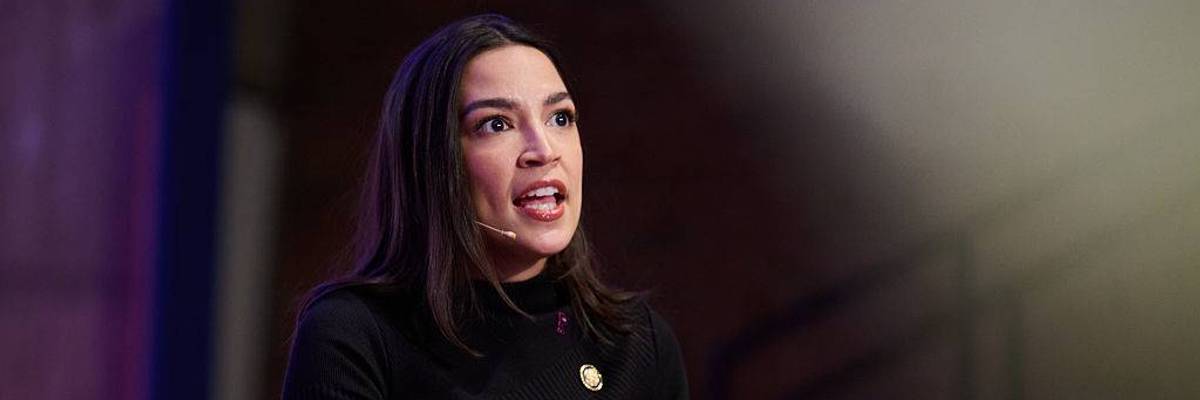
Rep. Alexandria Ocasio-Cortez (D-NY) speaks at TU Berlin on March 15, 2025.
(Photo by Annette Riedl/picture alliance via Getty Images)
Julia Conley
Sep 28, 2026
COMMON DREAMS
As national outrage grew over an alleged rape of a former Cornell University student by seven members of a fraternity in 2024, US Rep. Alexandria Ocasio-Cortez on Sunday condemned a culture in which students accused of sexual assault are “protected” while survivors like the woman in the Cornell case, identified as Jane Doe, are often forced out of their campus communities.
The progressive New York Democrat spoke at a town hall in Ithaca, which has been rocked in recent weeks by the news that Doe filed a lawsuit against the school and several campus organizations and individuals over the alleged crime.
Ocasio-Cortez is visiting several cities across New York State this week, kicking off a voter outreach effort and meeting local officials ahead of a possible 2028 US Senate run. She has also been named as a potential presidential candidate. The event she spoke at Sunday was hosted by More Perfect University and titled “Students vs. Billionaires,” but Ocasio-Cortez began by speaking about the case, which prosecutors on Monday said they were reopening after learning of new evidence.
“The fact that Jane Doe, that survivor, lost her education—because you can’t stay in school when something like that happens to you... the fact that she had to lose her education and those men were protected by an institution and granted an Ivy League degree as a reward—never again,” said Ocasio-Cortez. “Never again.”
The Cornell case centers around an incident that allegedly took place in October 2024 at the Chi Phi fraternity house in Ithaca, according to the plaintiff’s lawsuit.
The student was visiting a friend at the house and was intoxicated when two male students coerced her into snorting a substance that they said was ketamine, the lawsuit says. She was then sexually assaulted, and one of the men subsequently sent a message in the fraternity’s group chat on Snapchat inviting other members to assault the victim.
Doe’s attorney, Thomas Giuffra, has said that two of the seven men named in the lawsuit were expelled from the school, while others were temporarily suspended or required to attend workshops or write essays.
Giuffra has also said that the Cornell Police Department did not follow up with Doe after her initial report, and that she was never contacted by a “specially trained detective or district attorney” regarding her allegations.
“In my experience, speaking with an abuse survivor requires delicacy, understanding, and specialized training,” Giuffra told ABC News. “An average university police officer would not have these skills.”
Matthew Van Houten, the district attorney for Tompkins County, New York, told ABC News Monday that his office was reopening an investigation into the case and considering whether to bring criminal charges. He told the outlet that the details of the assault in the lawsuit were “dramatically different” from the plaintiff’s statement to police in 2024, when his office relied on the Cornell Police Department’s investigation.
Two of the men accused in the lawsuit denied to ABC that they had committed sexual assault.
In 2024, Van Houten said, the victim did not allege that she was drugged or that she didn’t consent to sexual activities. He also said his office had not been not provided with a screenshot of the Snapchat messages.
Giuffra suggested the university authorities had not passed the evidence along to the DA’s office for its review of the investigation.
“My client went to the Cornell University Police because a crime was committed,” Giuffra told ABC News. “It was the obligation of the police to investigate the complaints. They were given the group chat inviting the members of the fraternity to rape my client. This was a critical piece of evidence supporting that a crime had occurred. Despite this there was no follow-up with Ms. Doe either by the Cornell Police or the Tompkins County district attorney.”
Ocasio-Cortez said Sunday that the fact that the students “posted in a group chat... means it was normal to them. That means it was acceptable to them. This is a culture, this is norms, these are practices. And what we must do is understand that we cannot protect those spaces anymore. We cannot.”
After the lawsuit was filed on September 14, student journalists at the Cornell Daily Sun expressed outrage at the university’s failure to publicly release information from a Title IX investigation Cornell officials opened regarding the alleged rape, which resulted in the expulsions and lesser punishments of the men accused of the attack.
“Safety is not adjacent to the educational mission—safety is, in fact, its precondition,” wrote the editors of the student-run newspaper. “Cornell has said as much, in the document that governs the student conduct, which announces that it is ‘intended to preserve a higher education community and residential campus where ‘any person’ in the community can pursue their education in a secure and nourishing environment.’”
“So we ask the questions the university has left unanswered,” continued the editors. “If Cornell follows the law, then we should have access to a public deposition issued from the school, the Title IX investigation opened in January 2025, and how it concluded. Why were these men allowed to ‘pursue their education in a secure and nourishing environment’ and she was not? Why was she not informed of the outcome of her own Title IX investigation? Who benefited from the 23 months of elapsed time when the public knew nothing?”
The editorial named the seven men accused in the plaintiff’s lawsuit, writing, “We know who you are and we refuse to let you benefit from this university’s concealment.”
Cornell on Monday released a statement saying it supported the Tompkins County DA’s decision to reopen an investigation into the case, and rejecting claims that officials had not properly sanctioned the men named in the lawsuit.
In Ithaca, Ocasio-Cortez said that “a lot of work” needs to be done at the federal level to protect college students from assaults on campuses.
“The culture of rape,” said the congresswoman, “is protected in elite institutions across the United States, including Cornell University... This entire country is sick and tired of not just financially corrupt, but morally corrupt leadership.”


No comments:
Post a Comment