Poten: Sky-High Tanker Rates are Driving Refiners' Oil Buying Decisions
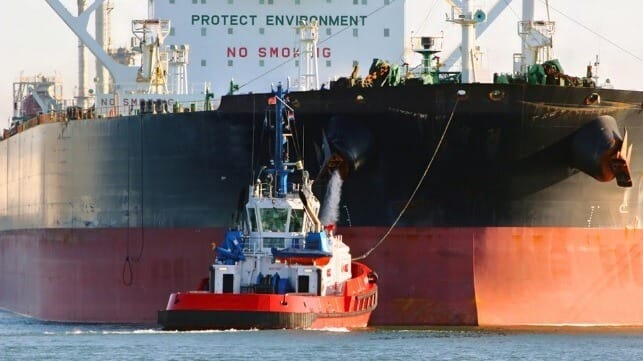
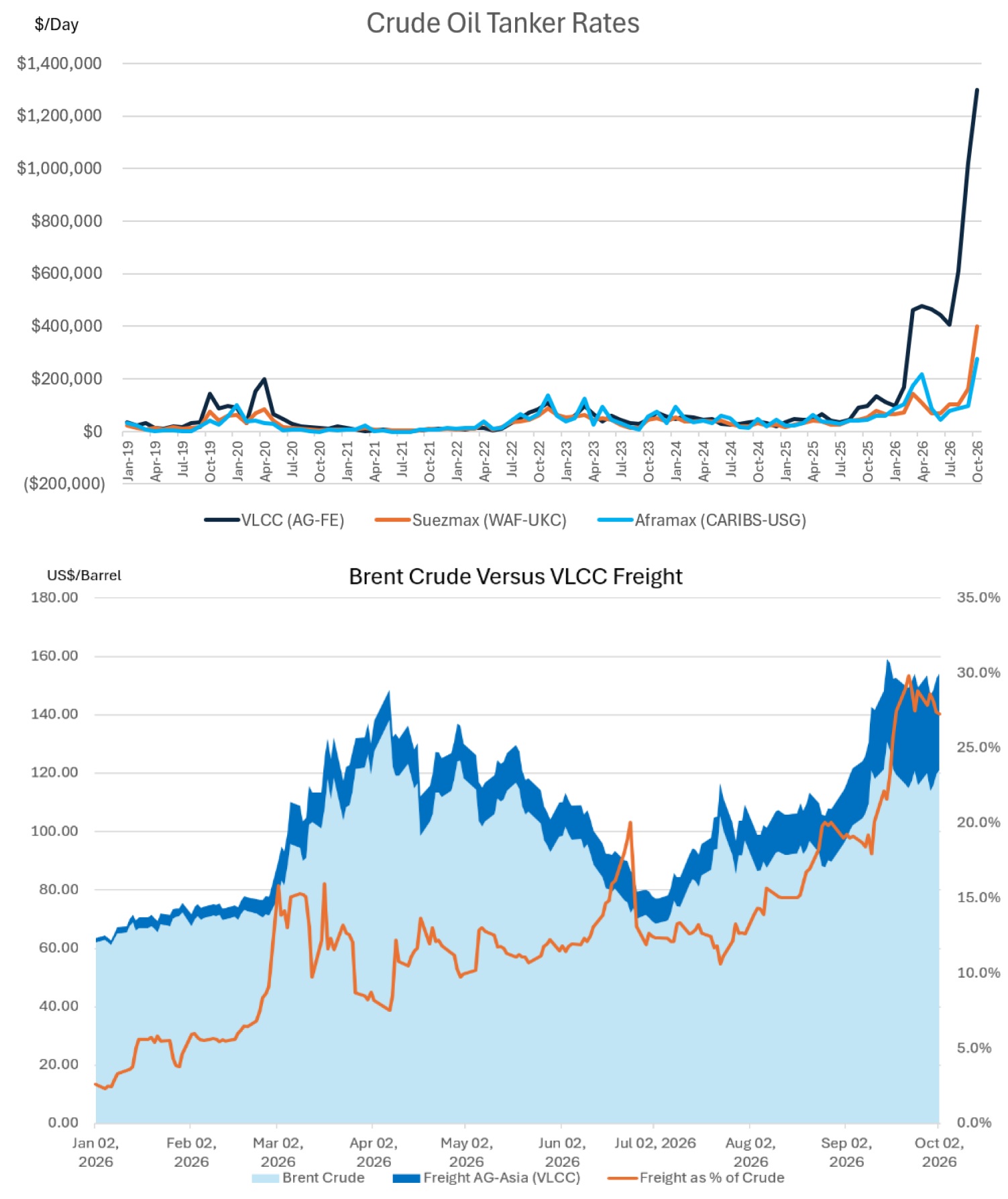
A review of Poten's Daily Market Report, which monitors spot freight rates on many of the key tanker trade routes, shows eyewatering numbers. Across the board, tanker rates have reached levels never seen before (see Chart 1, below). The reasons for the sky-high tanker rates are well documented. The wars in Europe and the Middle East have created significant inefficiencies in the market. On top of that, there is the threat of attacks in areas like the Strait of Hormuz, the Bab el-Mandeb Strait and the Black Sea, which have spiked insurance rates and risk premiums. Widespread sanctions have also limited the availability of mainstream vessels that have the flexibility to trade worldwide. Last, but not least, ownership of the large tanker fleet (in particular VLCCs) is more concentrated than in the past, which, in combination with the other factors, has shifted some of the negotiating power from the charterers to the owners.
The big question is: How high can it go and how long will it last? It is safe to say that it has already gone higher and lasted longer than most people expected. The follow up question could be: is there a level at which freight rates start to restrict oil demand?
In the oil markets, when prices spike (like in the early weeks of the war against Iran), people start talking about which price levels will lead to demand destruction. Obviously, there are no hard and fast numbers, it very much depends on the circumstances and which countries/regions they are talking about.
However, oil analysts typically focus on quoted oil prices for Brent, WTI, etc. when discussing this topic. In the current market, that is a mistake. Freight needs to be taken into account. Historically, freight was such a small component of the delivered cost of a barrel of oil that it could be easily ignored.
As recently as January of this year, this was still the case. While Brent crude was priced at around $62 per barrel. VLCC rates for the benchmark AG-Far East route in the early days of 2026 were around $30,000/day, equivalent to $1.73 per barrel, adding 3% to the delivered cost of crude oil (on the Middle East to Asia route). Today's physical market price for Brent crude is estimated to be around $120 per barrel. In contrast, VLCC rates have reached unprecedented levels and are now at $1.3 million per day (43 times the January number). This is equivalent to almost $33/barrel, or 27% of the delivered cost of the crude. Chart 2 (below) shows the dramatic increase of tanker freight as a percentage of Brent crude prices.
These exceptional freight levels do have an impact on trade flows. Refiners will buy the oil that gives them the best refining margin. In the past, this would primarily be driven by the crude grade and its yield. However, if the margin for the ideal crude grade becomes too small or disappears because of high freight cost, refiners will consider other crude grades from sources closer to home as long as the savings in transportation cost compensate for the lower yield.
If this is not possible, refiners may need to consider cutting runs. Unfortunately for refiners, the global oil market remains really tight, and refiners do not have many options. For the moment that means that most charterers will pay up to get access to the crude they need.
Even in a crazy market, shipowners tend to make rational decisions. A VLCC owner that discharged in Asia faces a choice: Ballast all the way to the U.S. Gulf to pick up a long-haul cargo to Asia, currently yielding around $400,000/day or take a (shorter) ballast voyage to West Africa or Brazil for a cargo to Asia, generating TCE's of around $650,000/day. Or, he can brave the AG market and potentially earn more than $1.0 Million/day.
This earnings discrepancy has kept VLCCs closer to the Asian market, leaving it to Suezmaxes and Aframaxes to do the heavy lifting out of the U.S. Gulf, turbo-charging their earnings. Our expectation is that as long as there is more crude oil demand than supply, tanker rates will remain strong. However, as soon as the crude oil market loosens, tanker rates will come off the boil quickly.
This article appears courtesy of Poten & Partners.
The opinions expressed herein are the author's and not necessarily those of The Maritime Executive.
Difficult Times for Iran's Sanctions-Evading Oil Brokers
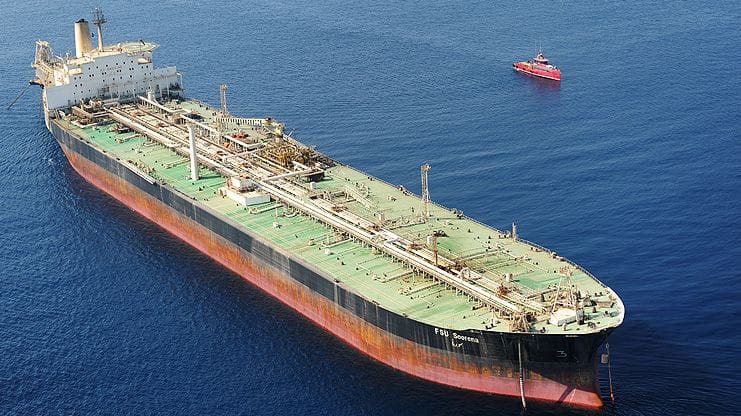
With the naval blockade preventing any Iranian tankers leaving the Gulf, for the last 10 weeks Iran has been selling oil from the stocks it had built up for just such a contingency which are being held afloat primarily off Malaysia and China.
Historically, Iran has sold 90% of its exports of crude to China. Chinese purchasers are still wary of being subject to US sanctions because these sanctions have global effect. To be sanctioned may entail being excluded from global dollar transactions, and thus impinge on wider business activity. So the Iranian brokers collude with the Chinese purchasers to disguise the origin of the oil being sold, and to hide the nature of the transactions which are used to pay for the oil. Chinese purchasers, normally from the independent teapot refineries of Shandong, have been happy to collude, because in exchange for taking on the risk of being sanctioned they receive a discount on the purchase price of the oil.
But between the Iranian state entities owning the oil at source, and the final Chinese end-user and his refinery, is a network of middlemen and brokers, organizing the physical shipment of oil and the ship-to-ship transfers which are used to disguise its origin. Often the same middlemen and brokers are then involved in channeling payments for the oil, masking the origin and destination of the payment, structuring and layering transactions through a series of front companies so that it can integrated back into the legitimate financial system without trace of its antecedents, with the nature of what has been paid for disguised. The system for years has depended on a blind eye being turned to these transactions as they pass through the financial system, with certain governments either tolerant or complicit in jurisdictions where those profiting are closely connected to officials or ministers.
But for those middlemen and brokers who for years have skimmed profits from this sanctions evasion, times recently have become very hard. Because the product which is being bought and sold – sanctioned Iranian oil – is drying up fast, as stocks afloat are sold and run down.
These middlemen and brokers are known in Iran as trustees because they are entrusted with the State’s oil and then are expected to pay for it. They are also trusted because they are closely connected to families in the highest level of the ruling clerical elite, and being privileged can travel and transact with the regime’s protection in a way most other Iranians cannot. Besides not having product to sell, these trustees are now under major attack from two quarters.
Firstly, notwithstanding their connections within the regime, the trustees face severe criticism even from Paydari hardline insiders, in a chorus which every Iranian joins, whatever their political views. Indeed criticism of the trustees is one of the most unifying themes prevalent in Iran today, probably even more so than any animosity towards Israel or the United States. The criticism comes from the skimming of the State’s oil and money as it passes through the trustees’ hands, or which they simply steal. Many of the trustees, such as Babak Zanjani and Mohammed Hossein Shamkani on whom the Maritime Executive has previously reported, have become fabulously and ostentatiously wealthy. Added recently to the list of prominent trustees under fire is Mostafa Ahadi from the IRGC’s Unit 600, believed to be the organizer of the Shayan network within the Ministry of Intelligence oil sales department, a network which has purloined huge sums from the State.
Fundamentalist Iranian MP Hussein Samsani makes a public attack on a trustee for misappropriating 56 million barrels of oil (Video posted on @mhmiranusa)
Secondly, Operation Economic Outcast is now sinking its claws into the network of front companies and financial institutions which the trustees and middlemen have used to conduct their business. Many of these front companies were registered in the United Arab Emirates and used banking facilities in the UAE. But the realization that these companies were generating funds for the IRGC, who in turn were attacking the UAE, encouraged the Emirati authorities to embark upon a clamp-down, in tandem with US Treasury sanctions action against banks such as the UAE branch of Banque Misr.
Last week the US Treasury deepened this attack by sanctioning an extensive virtual network of financial sub-agents, all built and controlled centrally as part of the A7 network, which in effect is an underworld alternative banking system. Although Russian-controlled, the majority of these front entities are registered in Hong Kong. Besides being used to manage Iranian dark fleet operations, the A7 network was used by ransomware gangs, North Korean hacking gangs and the IRGC Quds Force to fund overseas operations.
The A7 network has developed its own ruble-backed token and custom-built VPN network. The US Treasury believes the sub-agents of the A7 network processed transactions worth $17 billion between January 2025 and June 2026, was processing on average 2,000 transactions per day, and in total handles 13% of Russia’s foreign trade transactions.
To make matters worse for the trustees, they are no longer able to hop on a plane and travel to meet contacts outside Iran. As much of the money-laundering seeks to avoid using communications which can be intercepted by law enforcement, transactions agreed in face-to-face meetings have still been an important element of the sanctions-busting process, and are now much harder to set up due to U.S. sanctions on Iranian air travel.

No comments:
Post a Comment